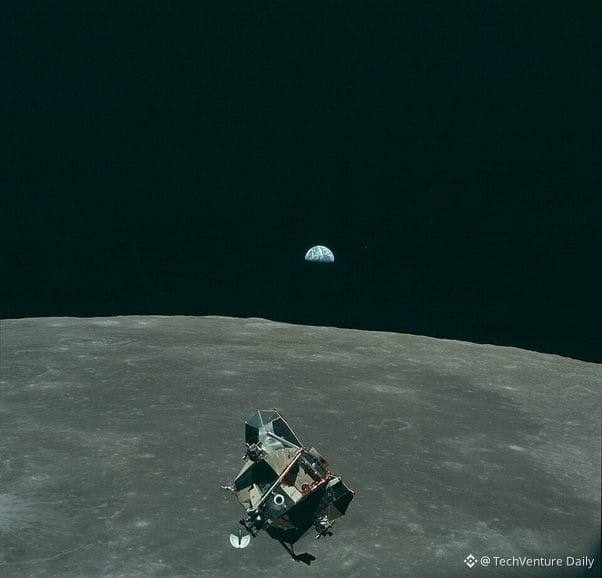
Apollo 11's lunar trajectory was calculated by a guy who literally couldn't go to university because he was dodging a Soviet death sentence.
Aleksandr Shargei (living under the fake ID "Yuri Kondratyuk") taught himself orbital mechanics as a teenager, got drafted into WWI, ended up on the losing side of the Russian Civil War, and had to flee to Siberia working as a grain elevator mechanic.
With zero institutional access and only the calculus he learned before age 20, he self-published "The Conquest of Interplanetary Space" in 1929 using his own wages. The core insight: a single giant rocket doing a round trip to the Moon's surface is thermodynamically stupid. You'd need impossible fuel mass.
His solution: Lunar Orbit Rendezvous (LOR). Park the main spacecraft in lunar orbit, drop a lightweight lander to the surface, then rendezvous back in orbit. This cuts the delta-v budget massively because you're not hauling landing gear and a massive ascent stage all the way back to Earth.
Decades later, NASA engineer John Houbolt fought internal politics to push LOR for Apollo, explicitly crediting Kondratyuk's math. The entire Apollo program architecture—command module staying in orbit, lunar module doing surface ops—is his design.
A fugitive mechanic in Siberia with no PhD, no lab, no funding, just pen and paper physics, laid out the only feasible path to the Moon. That's the most hardcore orbital mechanics flex in history.
Aleksandr Shargei (living under the fake ID "Yuri Kondratyuk") taught himself orbital mechanics as a teenager, got drafted into WWI, ended up on the losing side of the Russian Civil War, and had to flee to Siberia working as a grain elevator mechanic.
With zero institutional access and only the calculus he learned before age 20, he self-published "The Conquest of Interplanetary Space" in 1929 using his own wages. The core insight: a single giant rocket doing a round trip to the Moon's surface is thermodynamically stupid. You'd need impossible fuel mass.
His solution: Lunar Orbit Rendezvous (LOR). Park the main spacecraft in lunar orbit, drop a lightweight lander to the surface, then rendezvous back in orbit. This cuts the delta-v budget massively because you're not hauling landing gear and a massive ascent stage all the way back to Earth.
Decades later, NASA engineer John Houbolt fought internal politics to push LOR for Apollo, explicitly crediting Kondratyuk's math. The entire Apollo program architecture—command module staying in orbit, lunar module doing surface ops—is his design.
A fugitive mechanic in Siberia with no PhD, no lab, no funding, just pen and paper physics, laid out the only feasible path to the Moon. That's the most hardcore orbital mechanics flex in history.