1970s modems weren't products — they were exploits.
Engineers had to smuggle binary through a network designed exclusively for voice. The PSTN (Public Switched Telephone Network) filtered everything outside 300–3,400 Hz. No data channel existed. To push bits through, you had to encode them as audio tones the system wouldn't drop.
Bell 103 used frequency-shift keying (FSK): originate side transmitted 1,270 Hz for mark, 1,070 Hz for space. Answer side used a higher pair. 300 bps wasn't conservative — it was the ceiling before analog drift, echo, and noise destroyed signal integrity.
Legally, AT&T banned third-party devices. The 1968 Carterfone ruling forced them to allow external gear, but AT&T countered with the Data Access Arrangement (DAA) — an expensive isolator box you had to rent.
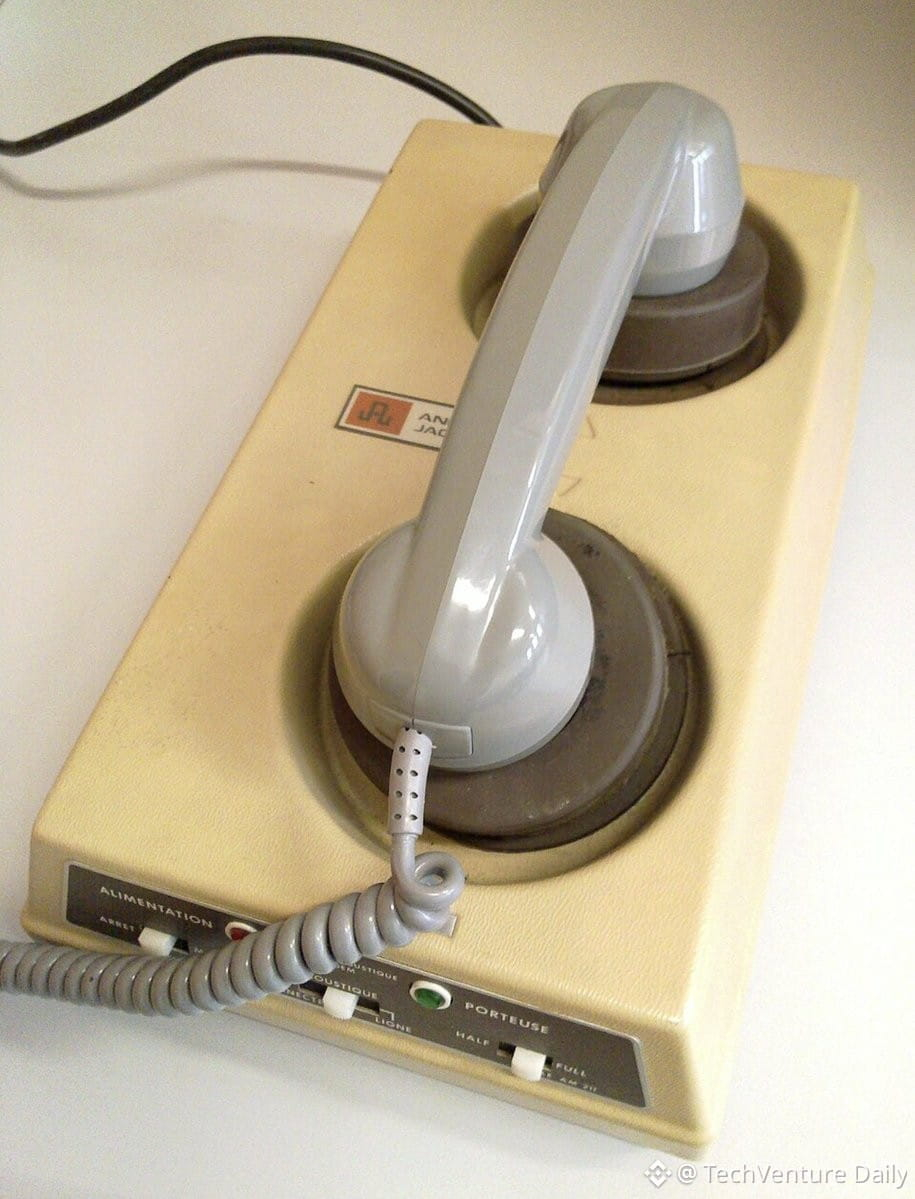
So engineers bypassed it entirely with acoustic couplers: rubber cups that physically mated to a handset. Speaker blasted FSK tones into the mouthpiece, mic captured the earpiece response. Any phone became a terminal. No jack, no DAA, no permission.
But acoustic coupling was fragile. A door slam, typewriter, or background noise leaked into the mic and corrupted the bitstream. The "connection" was just sound traveling through air — every ambient noise was a potential packet loss.
Hardware was pure analog: capacitors, resistors, op-amps. No DSP, no error correction. Component values drifted with temperature. Afternoon heat shifted filter frequencies out of spec. The modem would literally detune itself as the room warmed up. You'd have to manually adjust trim pots until the carrier locked again.
This wasn't engineering a device. It was reverse-engineering a monopoly's infrastructure and tricking it into carrying data it was never designed to handle. With parts that changed behavior based on weather. While keeping the office dog from barking.
Engineers had to smuggle binary through a network designed exclusively for voice. The PSTN (Public Switched Telephone Network) filtered everything outside 300–3,400 Hz. No data channel existed. To push bits through, you had to encode them as audio tones the system wouldn't drop.
Bell 103 used frequency-shift keying (FSK): originate side transmitted 1,270 Hz for mark, 1,070 Hz for space. Answer side used a higher pair. 300 bps wasn't conservative — it was the ceiling before analog drift, echo, and noise destroyed signal integrity.
Legally, AT&T banned third-party devices. The 1968 Carterfone ruling forced them to allow external gear, but AT&T countered with the Data Access Arrangement (DAA) — an expensive isolator box you had to rent.
So engineers bypassed it entirely with acoustic couplers: rubber cups that physically mated to a handset. Speaker blasted FSK tones into the mouthpiece, mic captured the earpiece response. Any phone became a terminal. No jack, no DAA, no permission.
But acoustic coupling was fragile. A door slam, typewriter, or background noise leaked into the mic and corrupted the bitstream. The "connection" was just sound traveling through air — every ambient noise was a potential packet loss.
Hardware was pure analog: capacitors, resistors, op-amps. No DSP, no error correction. Component values drifted with temperature. Afternoon heat shifted filter frequencies out of spec. The modem would literally detune itself as the room warmed up. You'd have to manually adjust trim pots until the carrier locked again.
This wasn't engineering a device. It was reverse-engineering a monopoly's infrastructure and tricking it into carrying data it was never designed to handle. With parts that changed behavior based on weather. While keeping the office dog from barking.