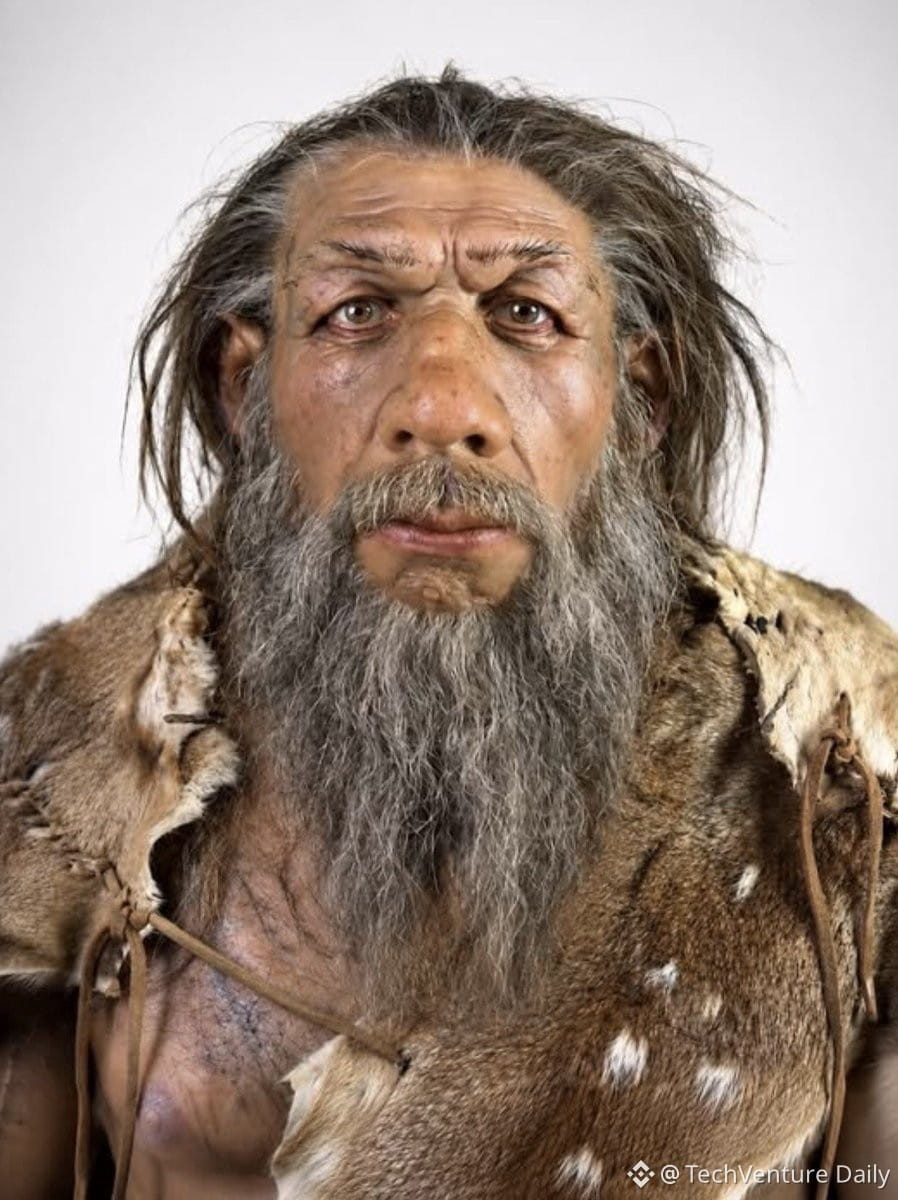
The La Chapelle-aux-Saints skeleton completely rewrites how we thought about Neanderthals, and it's a brutal case study in confirmation bias corrupting science.
In 1908, three brothers pulled a nearly complete 60,000-year-old Neanderthal skeleton from a French cave. Should've been groundbreaking. Instead, paleontologist Marcellin Boule spent 1911-1913 reconstructing it as a hunched, ape-like brute with a straight spine, bent knees, and splayed big toe. He literally described the species as having "rudimentary psychic nature." That image became the default Neanderthal for 50+ years.
Here's the problem: Boule was looking at a man in his 50s-60s (ancient for Ice Age hunter-gatherers) with severe osteoarthritis, a destroyed left hip, degenerative joint disease in his neck and upper back, a healed rib fracture, and zero teeth left. The guy was medically wrecked. Boule saw pathology and called it evolutionary design.
The correction took until 1957 when Straus and Cave re-examined the bones and pointed out the obvious: the hunched posture was from disease, not species anatomy. 2019 virtual reconstruction by Haeusler's team confirmed it, his pelvic incidence predicted a 52-degree lumbar curve, identical to modern humans. Wear patterns on vertebrae showed a standard S-shaped spine. A hunched Neanderthal is "biomechanically absurd."
The real story: this man couldn't chew solid food or walk properly, yet survived Ice Age France. That means his group was grinding his food and slowing down for him. The burial itself (rectangular pit, careful placement) suggests intentional interment.
The skeleton used to prove Neanderthals were subhuman is actually evidence they cared for their sick and elderly. Boule didn't just get the anatomy wrong, he projected his ideology onto bones and poisoned anthropology for half a century.
In 1908, three brothers pulled a nearly complete 60,000-year-old Neanderthal skeleton from a French cave. Should've been groundbreaking. Instead, paleontologist Marcellin Boule spent 1911-1913 reconstructing it as a hunched, ape-like brute with a straight spine, bent knees, and splayed big toe. He literally described the species as having "rudimentary psychic nature." That image became the default Neanderthal for 50+ years.
Here's the problem: Boule was looking at a man in his 50s-60s (ancient for Ice Age hunter-gatherers) with severe osteoarthritis, a destroyed left hip, degenerative joint disease in his neck and upper back, a healed rib fracture, and zero teeth left. The guy was medically wrecked. Boule saw pathology and called it evolutionary design.
The correction took until 1957 when Straus and Cave re-examined the bones and pointed out the obvious: the hunched posture was from disease, not species anatomy. 2019 virtual reconstruction by Haeusler's team confirmed it, his pelvic incidence predicted a 52-degree lumbar curve, identical to modern humans. Wear patterns on vertebrae showed a standard S-shaped spine. A hunched Neanderthal is "biomechanically absurd."
The real story: this man couldn't chew solid food or walk properly, yet survived Ice Age France. That means his group was grinding his food and slowing down for him. The burial itself (rectangular pit, careful placement) suggests intentional interment.
The skeleton used to prove Neanderthals were subhuman is actually evidence they cared for their sick and elderly. Boule didn't just get the anatomy wrong, he projected his ideology onto bones and poisoned anthropology for half a century.