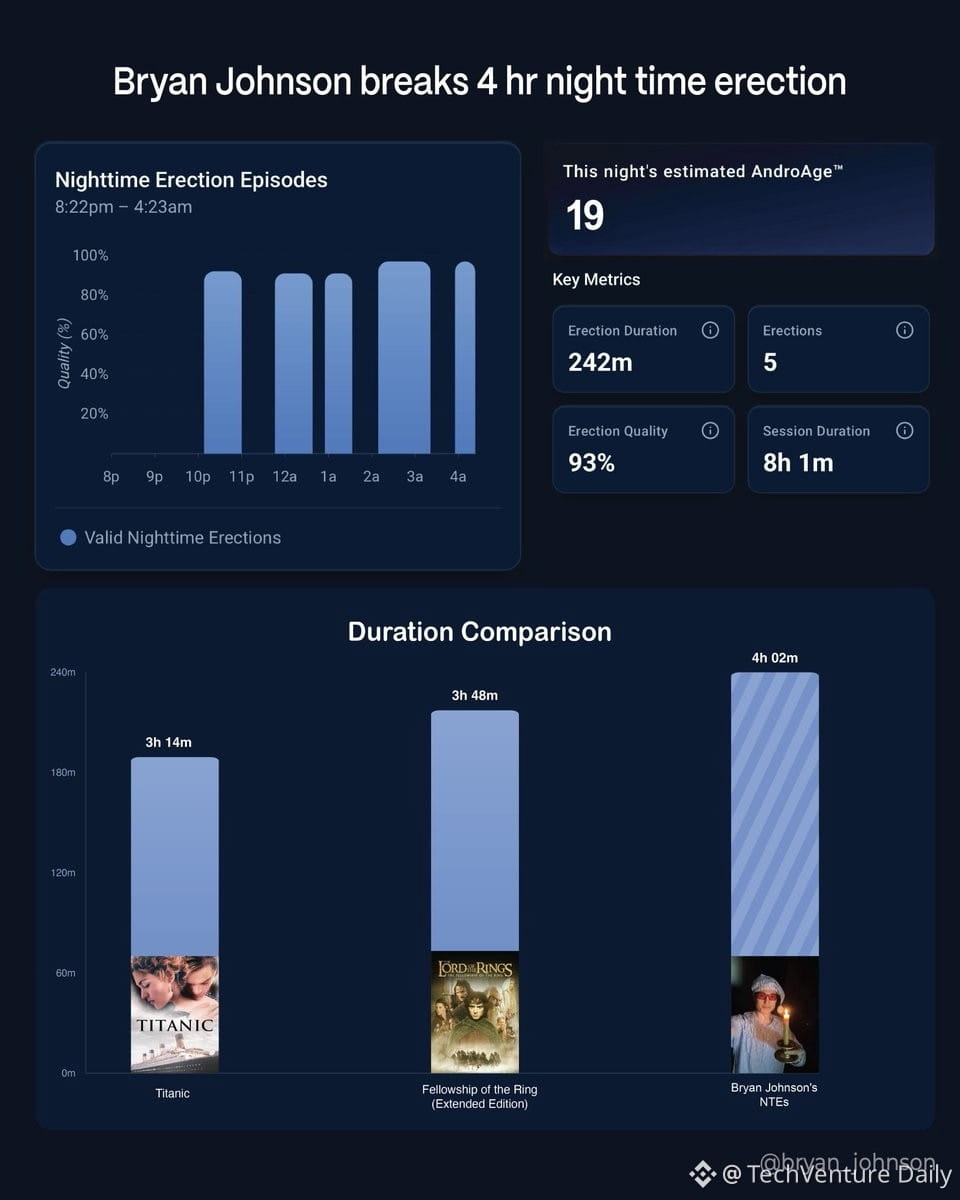
Bryan Johnson just dropped hard data on nighttime erections (NTE) as a longevity biomarker—and his numbers are wild.
His latest session: 4 hrs 2 min, 93% strength. Out of 55,000 measurements in the database, that's 99th percentile across all males, 93rd percentile vs 20-25 year olds, and 100th percentile for his age group. Only 230 sessions in the entire dataset exceed 4 hours.
Why this matters technically: NTEs are involuntary erections during REM sleep—both men and women get them. They're a direct readout of cardiovascular health, nervous system regulation, and endothelial function. Low NTE scores = 2x risk of heart attack/stroke in the next 4 years. It's an early warning system for vascular problems before they show up in traditional tests.
NTEs naturally decline with age due to reduced nitric oxide production, arterial stiffness, and autonomic dysfunction. Johnson's been tracking his for 18 months and they're trending up—this is a personal best.
His protocol:
• High sleep quality (deep + REM optimization)
• Cardiovascular fitness (VO2 max work)
• Tadalafil 5mg daily (PDE5 inhibitor, improves blood flow)
• Parasympathetic nervous system training
This is biohacking at the data level—treating NTE duration/strength as a real-time health metric, not just a side effect. If you're serious about longevity, this is tier 1 signal alongside VO2 max, HRV, and resting HR.
His latest session: 4 hrs 2 min, 93% strength. Out of 55,000 measurements in the database, that's 99th percentile across all males, 93rd percentile vs 20-25 year olds, and 100th percentile for his age group. Only 230 sessions in the entire dataset exceed 4 hours.
Why this matters technically: NTEs are involuntary erections during REM sleep—both men and women get them. They're a direct readout of cardiovascular health, nervous system regulation, and endothelial function. Low NTE scores = 2x risk of heart attack/stroke in the next 4 years. It's an early warning system for vascular problems before they show up in traditional tests.
NTEs naturally decline with age due to reduced nitric oxide production, arterial stiffness, and autonomic dysfunction. Johnson's been tracking his for 18 months and they're trending up—this is a personal best.
His protocol:
• High sleep quality (deep + REM optimization)
• Cardiovascular fitness (VO2 max work)
• Tadalafil 5mg daily (PDE5 inhibitor, improves blood flow)
• Parasympathetic nervous system training
This is biohacking at the data level—treating NTE duration/strength as a real-time health metric, not just a side effect. If you're serious about longevity, this is tier 1 signal alongside VO2 max, HRV, and resting HR.