


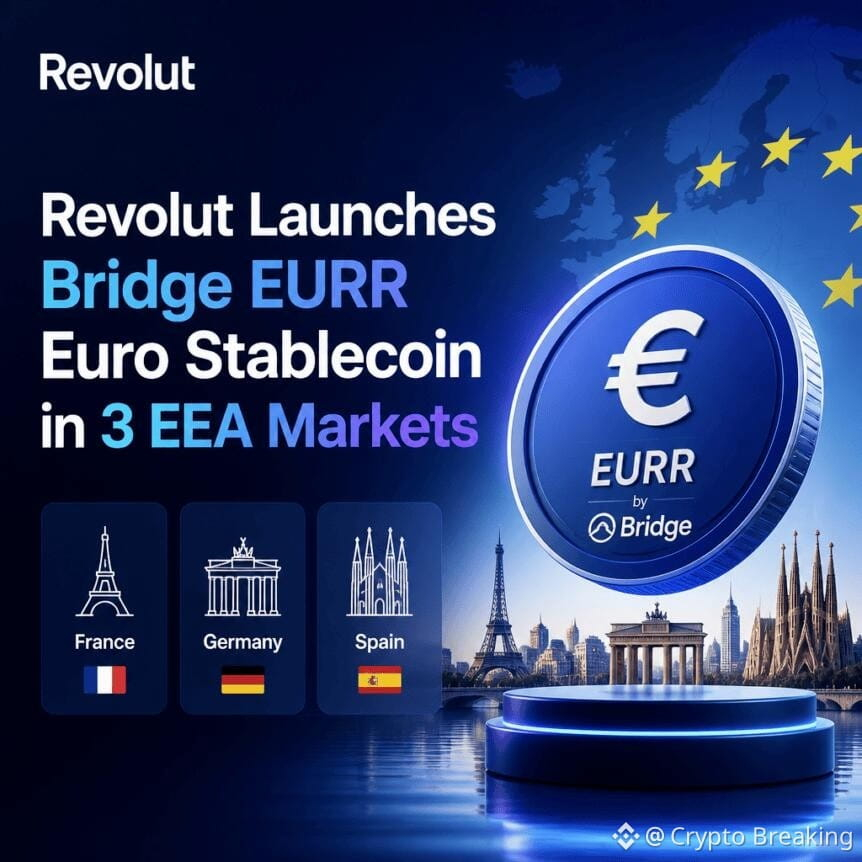
Revolut has started rolling out its first stablecoin, EURR, a euro-pegged token, to a limited set of customers in Denmark, Poland and Portugal. The rollout is expected to broaden to additional European Economic Area (EEA) markets later this year, depending on product, operational and regulatory readiness.
The company said EURR is issued by Bridge Building S.A., the Luxembourg-based entity behind Bridge’s stablecoin infrastructure. Revolut will integrate the token into its retail app and plans to support transfers across multiple blockchain networks, including sending funds to external wallets.
Key takeaways
Revolut is launching EURR first in Denmark, Poland and Portugal, with expansion to other EEA markets later in 2026.
EURR is issued by Bridge Building S.A. and is designed to target parity with one euro under EU MiCA-compliant reserves.
Ethereum is the initial network, with external wallet transfers available immediately for select customers as liquidity builds.
The move aligns with Revolut withdrawing Tether’s USDt from the EEA and Switzerland, with remaining USDT balances slated for conversion after Aug. 31.
Revolut says EURR is an initial step toward a wider stablecoin strategy, including tokens in other currencies via separate regulatory pathways.
A targeted European rollout
In a Wednesday announcement shared with Cointelegraph, Revolut described EURR’s launch as phased. The first phase focuses on Denmark, Poland and Portugal—choices the firm tied to market size and customer reach.
According to a Revolut spokesperson, about 2 million customers will be involved in the initial rollout, and additional EEA markets will be added later in the year subject to readiness across product development, operations, and regulatory requirements. The phased approach suggests Revolut wants to validate user demand and operational flow before scaling across more jurisdictions with potentially different implementation details.
What EURR is and how it will work in the app
EURR is intended to maintain a value of one euro and is backed by reserves held and managed by Bridge in line with the EU’s MiCA stablecoin rules. Revolut Digital Assets Europe is offering the token.
Inside the app, Revolut said it will support EURR integration from launch and intends to enable users to transfer the token to external wallets. For the initial phase, the stablecoin will launch on Ethereum.
Revolut also outlined timing for external transfers: wallet transfers will be available immediately for select customers, with broader access to follow “as liquidity builds.” The company indicated that Revolut’s standard crypto trading and remittance limits will apply to activity involving the token. At the same time, it said fiat transactions related to stablecoin usage will carry no fees or spreads.
For users and traders, those parameters matter because they affect how easily customers can move between euro-denominated value in stablecoins and traditional fiat rails, especially if external wallet support is intended for broader on-chain usage rather than only in-app balances.
MiCA compliance and the shift away from USDt
The EURR launch arrives as Revolut changes its stablecoin lineup in Europe. Cointelegraph previously reported that Revolut is withdrawing Tether’s USDt from the EEA and Switzerland, following regulatory concerns. Revolut said remaining USDT balances would be converted into customers’ base currencies after Aug. 31.
By introducing a MiCA-compliant alternative, Revolut is effectively replacing USDt with an internally supported, EU-regulated path for euro-denominated stablecoin exposure. That could reduce friction for customers who want stable value tied to the euro, especially in markets where stablecoins are increasingly being shaped by local compliance expectations.
From an investor and builder perspective, the change also underscores how European stablecoin offerings are fragmenting. Instead of a single global stablecoin filling every role, platforms are moving toward region-specific, regulation-aligned tokens that can be supported within their products without requiring users to navigate more complex compliance or conversion mechanics.
Beyond EURR: other currencies in the works
Revolut framed EURR as the first step in a broader stablecoin strategy. The company said it is developing stablecoins denominated in other currencies, but through separate regulatory pathways. Revolut did not specify which currencies it is pursuing.
That gap in details leaves room for interpretation. It signals that while the product direction is clear—multiple currency stablecoins—the regulatory route may differ depending on the target currency, reserve structure, and applicable frameworks. For users, this matters because each additional stablecoin may come with its own integration timeline, network support, and transfer or limit rules.
Revolut’s approach also highlights a broader tension in the stablecoin market: stablecoins are not just technical instruments, but also regulatory products. As MiCA continues to shape which tokens can be marketed and distributed across the EU/EEA, issuers and wallet platforms are likely to expand only once operational readiness and legal acceptance are aligned.
What to watch next
As Revolut expands EURR beyond Denmark, Poland and Portugal, the key variables to monitor will be how quickly access broadens across additional EEA markets, whether liquidity improves in tandem with wallet transfer availability, and what specific currencies—if any—Revolut’s next stablecoin steps will target under its stated separate regulatory pathways.
This article was originally published as Revolut Launches Bridge EURR Euro Stablecoin in 3 EEA Markets on Crypto Breaking News – your trusted source for crypto news, Bitcoin news, and blockchain updates.