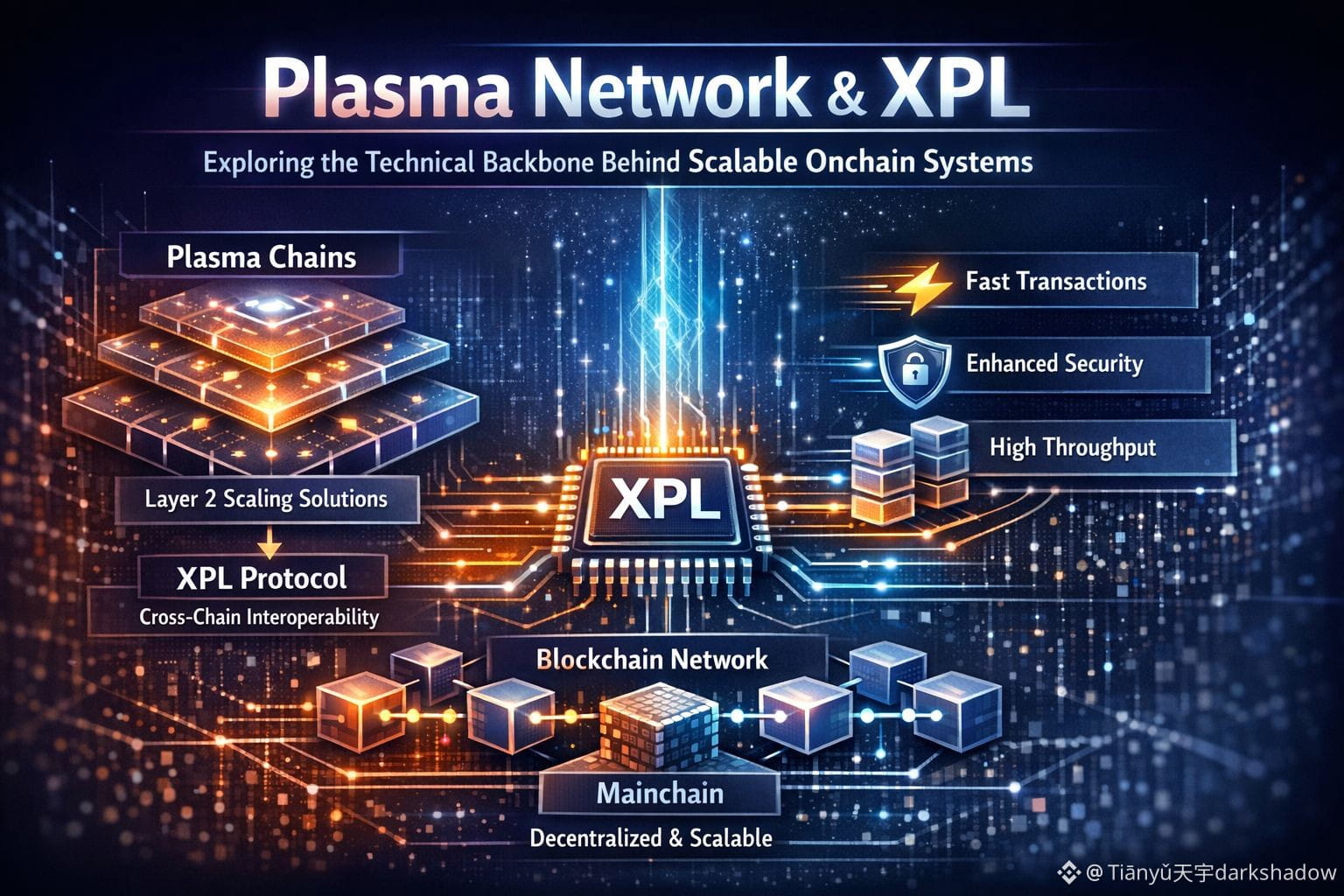
Plasma is steadily positioning itself as a serious infrastructure layer for scalable blockchain execution, and the growing interest around $XPL reflects that direction. At its core, the Plasma network focuses on improving transaction throughput while preserving security and decentralization, which remains a central challenge across the broader crypto ecosystem. By optimizing data availability and execution efficiency, Plasma introduces a framework that reduces congestion without compromising verifiability.
One of the notable technical strengths of Plasma lies in its modular design. Instead of forcing all computation and storage onto a single layer, Plasma separates responsibilities across specialized components. This approach allows developers to deploy applications that benefit from faster finality and lower costs while still anchoring security to a robust base layer. As activity scales, this architecture helps maintain predictable performance even during periods of high demand.
The $XPL token plays a functional role within this ecosystem. It is designed to support network operations, incentivize validators, and align participants around long term protocol health. Economic design is a critical element in any decentralized system, and Plasma appears to emphasize sustainable incentives rather than short term speculation. This makes the token model more resilient as real usage increases.
Developer tooling is another area where Plasma is gaining attention. Compatibility with existing smart contract standards reduces friction for teams migrating from other environments. This lowers the barrier to entry and encourages experimentation, which is often the catalyst for meaningful innovation. With continued progress and transparent development, @Plasma is building toward an ecosystem where scalability is not a tradeoff but a baseline expectation.