

Strong Results, Unhappy Investors
Apple delivered record revenue, stronger iPhone sales and another quarter of impressive profits. Normally, those results would be enough to lift the stock. This time, investors looked past the headline numbers.
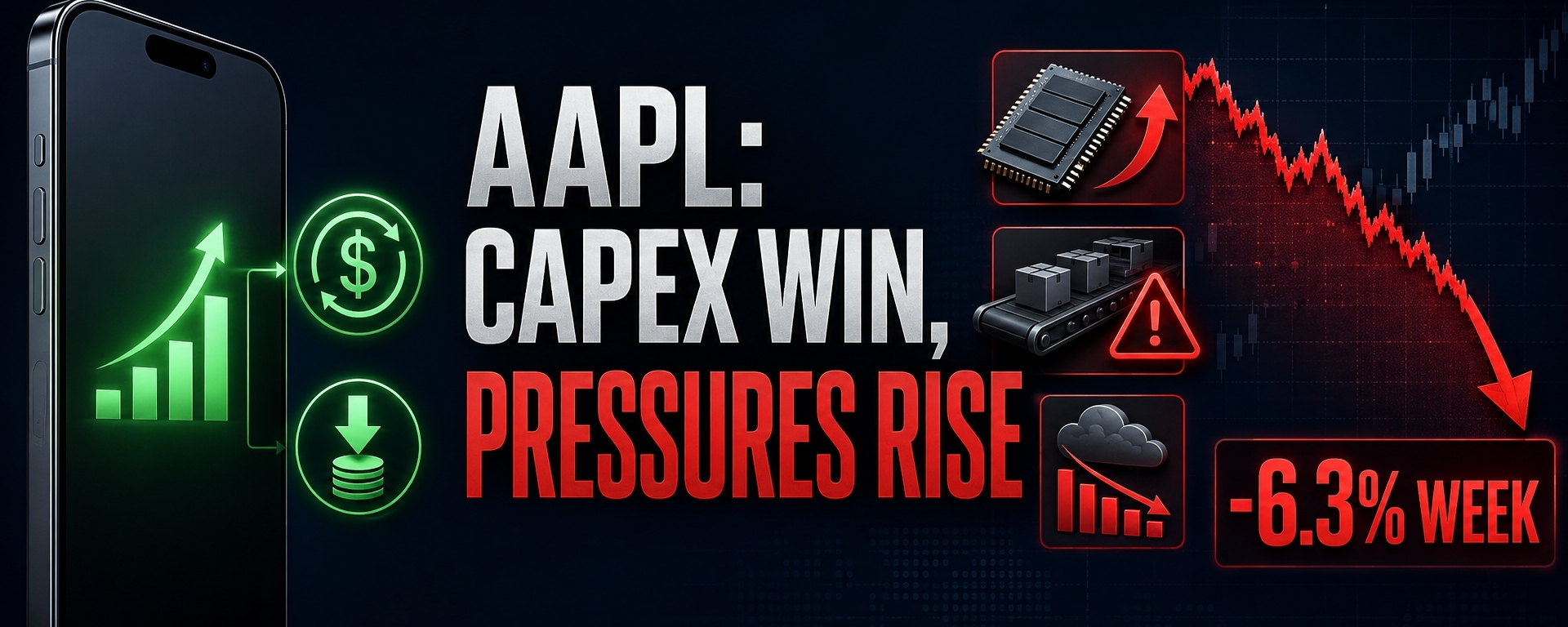
AAPL fell 7.4% on July 31 and ended the following week down about 6.3%. At roughly $312 per share on August 7, 2026, Apple was still worth around $4.6 trillion. The selloff was not a rejection of Apple as a business. It reflected concern that the company’s strong quarter may be harder to repeat than the numbers initially suggest.
Apple’s restrained capital spending is working. It is generating enormous cash flow without joining the costly AI infrastructure race being led by Alphabet, Microsoft, Amazon and Meta. At the same time, rising memory prices, semiconductor shortages, slower Services growth and an upcoming leadership change are creating new pressure.
The result is a mixed picture: Apple remains financially powerful, but its premium valuation leaves little room for disappointment.
Apple Delivered a Record June Quarter
Apple generated $109.42 billion in fiscal third-quarter revenue, up 16.4% from $94.04 billion a year earlier. Net income climbed 27.1% to $29.79 billion, while diluted earnings per share increased from $1.57 to $2.02.
Operating income rose even faster, advancing 26.6% to $35.70 billion. This shows that Apple was not simply selling more products—it was also turning a larger share of its revenue into operating profit.
The iPhone remained the main growth engine. Revenue from the product increased 21.7% to $54.25 billion, setting a new June-quarter record. Mac revenue jumped 28.7% to $10.35 billion, supported by demand for the MacBook Neo and MacBook Pro.
Wearables, Home and Accessories revenue rose 6.5% to $7.88 billion. iPad was the weakest hardware category, with revenue falling 5.9% to $6.19 billion.
Services revenue reached a record $30.74 billion and grew 12.1%. Even so, it came in below the approximately $31.22 billion analysts had expected.
Apple also reported growth across all of its geographic segments. Greater China revenue rose 22.4% to $18.82 billion, although it remained below some Wall Street forecasts. The installed base of active Apple devices reached another record, giving the company more opportunities to sell subscriptions, cloud storage, applications and future upgrades.
The detailed figures can be found in Apple’s fiscal Q3 financial statements.
Apple Is Spending Less While Generating More Cash
The most impressive part of the report may have been Apple’s capital efficiency.
During the first nine months of fiscal 2026, Apple spent $6.80 billion on property, equipment and other physical assets. That was down more than 28% from $9.47 billion during the same period last year.
Capital expenditure represented less than 2% of revenue, compared with roughly 3% a year earlier. This is unusually low for a technology company of Apple’s size, especially during a period when artificial intelligence is reshaping the industry.
At the same time, Apple generated $117 billion in operating cash flow, an increase of more than 43%. After subtracting property and equipment purchases, approximate free cash flow reached $110.2 billion. That was more than 52% higher than the comparable figure from the previous year.
Apple is proving that it does not need to build a massive AI data-center network to continue growing. It already controls the devices, operating systems, distribution channels and customer relationships that matter most to its business.
Other technology giants are taking a different approach. Alphabet, Microsoft, Amazon and Meta are collectively spending hundreds of billions of dollars on data centers, processors, networking equipment and energy infrastructure. Those investments could produce large returns, but they also carry serious financial risk.
Apple is choosing flexibility. Instead of owning the entire AI infrastructure stack, it can use outside providers when needed.
The Google Partnership Explains Apple’s AI Strategy
Apple’s agreement with Google is a clear example of its capital-light approach.
In January 2026, the two companies announced a multi-year partnership under which future Apple Foundation Models would use Google’s Gemini technology and cloud infrastructure. The partnership is expected to support new Apple Intelligence features, including a more personalized version of Siri.
The arrangement allows Apple to benefit from Google’s AI investment without matching Google’s infrastructure spending. Apple can focus on integrating AI into the iPhone, Mac, iPad and its wider ecosystem.
The strategy makes financial sense. AI models are improving quickly, and the cost of running them may continue to decline. Building enormous amounts of infrastructure today could leave companies holding expensive assets that become less valuable over time.
Apple avoids part of that risk by using a combination of its own technology and third-party resources. The companies explained the collaboration in their official joint statement.
There is a downside, however. Google is not just a supplier; it is also one of Apple’s biggest competitors. If Gemini becomes essential to Siri, Apple may become more dependent on technology it does not fully control.
Lower Capex Does Not Mean Lower Investment
Apple has reduced spending on physical assets, but it has not stopped investing.
Research and development spending reached $11.73 billion during the quarter, up 32.3% from $8.87 billion a year earlier. For the first nine months of fiscal 2026, R&D spending rose from $25.68 billion to $34.04 billion.
Apple is putting more money into engineers, software development, chip design, AI research and future products. Those costs appear as operating expenses rather than capital expenditure.
This distinction matters because Apple’s low capex can make its strategy appear cheaper than it really is. The company is still spending heavily. It is simply investing in people, software and partnerships instead of building a huge network of company-owned data centers.
That model will be successful if it produces useful products and new revenue. Saving money is valuable, but customers will ultimately judge Apple Intelligence by how well it works.
A Tariff Refund Made Profit Margins Look Better
Apple reported a gross margin of 50.1%, but the figure included a significant temporary benefit.
U.S. tariff refunds added roughly two percentage points to the margin and approximately $0.11 to earnings per share. Without that benefit, gross margin would have been closer to 48.1%, while EPS would have been around $1.91.
The adjusted result was still solid. It also remained slightly above the market’s earnings expectation. However, the refund made the quarter look more profitable than Apple’s recurring operations alone would suggest.
This matters because Apple expects September-quarter gross margin to fall between 47% and 48%. The midpoint would be about 2.6 percentage points below the reported June-quarter margin.
Apple disclosed the effect of the refund in its official earnings announcement.
Investors are now asking what Apple’s margins will look like when the refund is no longer helping and more expensive components begin reaching newly manufactured products.
Rising Memory Prices Are Becoming a Serious Problem
The biggest immediate threat comes from memory costs.
AI data centers require enormous quantities of advanced memory. Chipmakers can often earn more by supplying AI and cloud companies than by serving consumer-electronics manufacturers. That has tightened the supply of memory used in smartphones, tablets and computers.
Apple is one of the world’s largest component buyers, and its scale normally gives it strong negotiating power. This shortage is different because memory production is concentrated among a small group of major suppliers.
Apple said it paid substantially more for memory during the June quarter and expects prices to rise again. Management is exploring additional suppliers, but Apple cannot switch instantly. New components must meet strict performance, quality and production standards.
The company has tried to protect itself by building inventory. Inventory reached $11.09 billion at the end of June, almost double the $5.72 billion reported at the end of fiscal 2025.
That inventory provided temporary protection from higher prices. Once Apple uses the older supply, however, it will have to replace it at current market rates.
The company is also dealing with limited availability of the advanced manufacturing capacity needed to produce Apple silicon. Tim Cook said unexpectedly strong demand combined with limited supply-chain flexibility had affected the company’s ability to deliver products.
Apple expects September-quarter revenue to grow between 9% and 11%. That would still be respectable, but it is below the roughly 12% Wall Street expected. Reuters reported the company’s guidance and supply-chain concerns.
Apple May Have Pulled Some Demand Forward
The sharp increase in iPhone and Mac sales looks encouraging, but some customers may have purchased devices earlier than planned.
Consumers are aware that memory shortages are pushing electronics prices higher. Apple has already increased prices on several Mac and iPad products. Buyers who expected further increases may have decided not to wait.
This could mean that part of the June quarter’s growth came from future demand. Apple made the sales, but some of those purchases may otherwise have occurred during the September or December quarters.
The next iPhone launch will offer an important test. Apple can raise prices to protect margins, but larger increases could encourage customers to keep their existing phones longer or purchase cheaper models.
Apple’s brand gives it more pricing power than most consumer-electronics companies. That power still has limits, particularly when households are already dealing with higher prices across several areas of spending.
Services Growth Is Becoming More Important
Apple’s Services business generated $30.74 billion during the quarter and grew 12.1%. On its own, that would be a strong result for most companies.
For Apple, expectations were higher.
Services has an estimated gross margin of about 75.6%, compared with roughly 40.1% for Apple’s products. A dollar of Services revenue therefore contributes much more profit than a dollar of hardware revenue.
That is why the Services miss worried investors. The segment is supposed to make Apple’s earnings more predictable and reduce its dependence on device-upgrade cycles.
Regulation is also changing the App Store’s business model. In the United States, Apple’s legal battle with Epic Games has made it easier for developers to direct customers toward external payment systems. In Europe, the Digital Markets Act requires Apple to allow alternative app marketplaces, distribution methods and payment options.
Apple has introduced revised terms and fee structures in response. Its European developer guidance explains the new choices available to app developers.
The Services business is not collapsing. Apple still benefits from a huge installed base, loyal customers and recurring subscription revenue. The concern is that future growth may be slower and less profitable than investors previously assumed.
Apple Still Has to Prove Its AI Value
Apple’s AI strategy may be financially efficient, but its commercial impact remains uncertain.
The company has not yet shown that Apple Intelligence can create a major upgrade cycle or generate significant subscription revenue. Its rising R&D expenses are easy to see. The revenue produced directly by AI is not.
A more capable Siri could strengthen the Apple ecosystem. Management has also discussed the possibility of offering advanced features through higher iCloud+ subscription tiers.
That could eventually become an important source of recurring revenue. For now, investors have little information about adoption, engagement or customer willingness to pay.
Apple does not necessarily need to build the most powerful AI model. Its real opportunity is to integrate AI into everyday tasks across its devices. The experience must be reliable, private and noticeably useful.
Until customers begin using those features at scale, the financial success of Apple’s AI strategy remains unproven.
A New CEO Will Inherit These Challenges
Apple is preparing for a major leadership change.
John Ternus is scheduled to become CEO on September 1, 2026. Tim Cook will remain involved as executive chairman. Apple said the transition was part of a long-term succession plan approved unanimously by its board.
The company announced the change in an April 2026 statement.
Cook became known for turning Apple’s supply chain into a major competitive advantage. His successor will take control just as memory shortages, semiconductor constraints and geopolitical tensions are making that supply chain more difficult to manage.
Ternus must also improve confidence in Apple’s AI direction, protect the Services business and decide how aggressively the company should pursue new product categories.
Cook’s continued presence should make the transition smoother. Even so, investors will need time to understand the new CEO’s priorities.
Apple’s Financial Strength Remains Difficult to Ignore
Despite the risks, Apple remains one of the strongest cash-generating businesses in the world.
During the first nine months of fiscal 2026, it spent $62.09 billion repurchasing shares and approximately $11.78 billion on dividends and dividend equivalents. Apple also has a new $100 billion share-buyback authorization.
The company ended June with $39.54 billion in cash and cash equivalents, along with almost $107 billion in marketable securities. That gives management plenty of flexibility to invest, acquire technology, secure supplies and continue returning capital to shareholders.
However, financial strength does not automatically make a stock inexpensive. At around $312, AAPL was trading near 36 times trailing earnings. Even after the decline, investors were still paying a premium for Apple’s future growth.
Why Wall Street Sold the Stock
The market’s reaction was mostly about expectations.
Apple shares had already risen more than 22% during 2026 before the earnings announcement. Investors were expecting strong results, stable margins and an encouraging outlook.
Instead, Apple provided weaker-than-expected guidance, revealed greater supply pressure and reported a Services result below forecasts. Its margin was also lifted by a temporary refund.
The 7.4% decline on July 31 erased approximately $359 billion from Apple’s market value, according to Dow Jones Market Data. It became one of the largest single-day value losses recorded by a U.S. company. Barron’s covered the size of the decline.
Investors were not saying that Apple had reported a bad quarter. They were questioning whether its future results would be strong enough to justify such a high valuation.
What Investors Should Watch Next
Gross margin will be one of the most important numbers in Apple’s next report. The most useful comparison will be with the underlying 48.1% June-quarter margin, not the refund-supported 50.1%.
Services growth will matter just as much. A return to stronger growth could restore confidence in Apple’s ecosystem. A drop below 10% would make the slowdown more difficult to dismiss.
Investors should also watch memory costs, inventory levels and product availability. Any significant iPhone price increase will test Apple’s ability to pass higher costs to customers.
Finally, Apple must begin showing how its AI investments create value. A successful Siri rollout, stronger iCloud+ subscriptions or an AI-driven upgrade cycle would make the company’s strategy easier to defend.
Final Outlook
Apple’s capex strategy is working. The company generated approximately $110 billion in free cash flow during the first nine months of fiscal 2026 while avoiding the enormous infrastructure commitments being made by its competitors.
That is a meaningful advantage, but it does not remove Apple’s other problems.
Memory costs are rising, chip supplies are tight, Services growth has slowed, App Store economics are under pressure and AI revenue remains difficult to identify. The company must manage all of this during a major leadership transition.
After the 6.3% weekly decline, Apple shares are more attractive than they were before earnings. They are not obviously cheap. The valuation still assumes that Apple will protect its margins, defend its ecosystem and turn AI into a real source of growth.
Apple has shown that it can compete in the AI era without spending as aggressively as its rivals. Now it must prove that spending less can still lead to better products, stronger growth and lasting value for shareholders.