
S T E P H E N
19k Posts

S T E P H E N
 Square Verified+
📊 Crypto enthusiast focused on trends and discoveries
Open Trade

BTC Holder
High-Frequency Trader
1.5 Years
8 Following
35.9K+ Followers
29.6K+ Liked
Posts
Portfolio
All
Quotes
Live
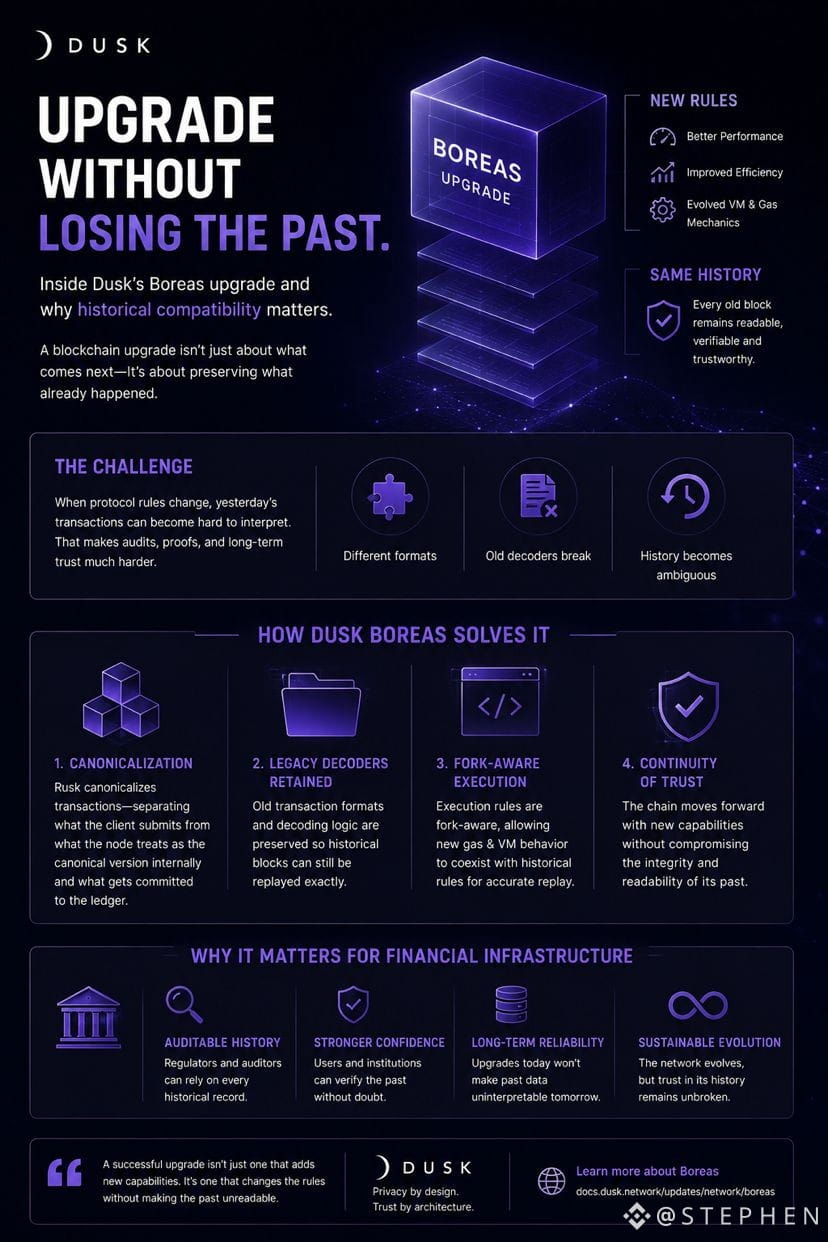
#dusk $DUSK @Dusk I used to think a blockchain upgrade was mostly about adding something new.
The more I looked at Dusk’s recent protocol work, the more I realized that the harder part might be making sure the old chain still makes sense after the rules change.
That’s what caught my attention about Boreas.
Dusk didn’t simply introduce new transaction rules and move on. The Rusk implementation now separates what a client submits, what the node treats as the canonical transaction internally, and what ultimately gets committed to the ledger. At the same time, it keeps the historical decoding logic needed to replay older blocks.
That sounds like engineering housekeeping.
I don’t think it is.
A financial blockchain can’t afford to have yesterday’s records become ambiguous just because today’s protocol is different.
Imagine an archive that can process the latest transaction format perfectly, but struggles to reproduce how an older block was interpreted. The network might still be moving forward, but confidence in the history underneath it starts becoming harder to maintain.
Boreas also made execution rules fork-aware, so newer gas and VM behavior can coexist with the historical rules needed for replay.
That made me rethink what “upgrading a blockchain” actually means.
Maybe a successful upgrade isn’t just one that gives the network new capabilities.
Maybe it’s one that changes the rules without making the past unreadable.
And for financial infrastructure, that might matter more than another headline feature.
The more I looked at Dusk’s recent protocol work, the more I realized that the harder part might be making sure the old chain still makes sense after the rules change.
That’s what caught my attention about Boreas.
Dusk didn’t simply introduce new transaction rules and move on. The Rusk implementation now separates what a client submits, what the node treats as the canonical transaction internally, and what ultimately gets committed to the ledger. At the same time, it keeps the historical decoding logic needed to replay older blocks.
That sounds like engineering housekeeping.
I don’t think it is.
A financial blockchain can’t afford to have yesterday’s records become ambiguous just because today’s protocol is different.
Imagine an archive that can process the latest transaction format perfectly, but struggles to reproduce how an older block was interpreted. The network might still be moving forward, but confidence in the history underneath it starts becoming harder to maintain.
Boreas also made execution rules fork-aware, so newer gas and VM behavior can coexist with the historical rules needed for replay.
That made me rethink what “upgrading a blockchain” actually means.
Maybe a successful upgrade isn’t just one that gives the network new capabilities.
Maybe it’s one that changes the rules without making the past unreadable.
And for financial infrastructure, that might matter more than another headline feature.
Verified
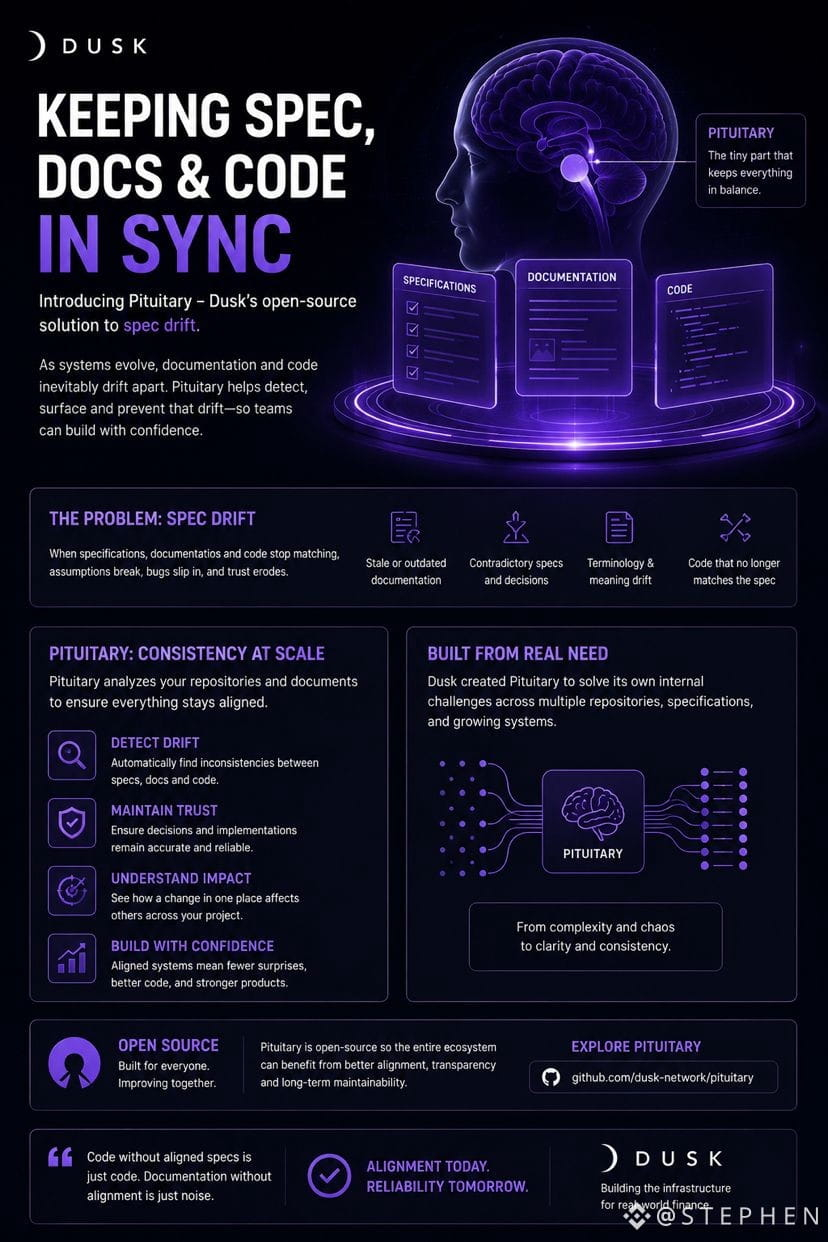
#dusk $DUSK @Dusk I used to think documentation problems were mostly a developer inconvenience.
Then I started thinking about what happens when the documentation describes one system, while the code quietly becomes another.
That gap can be much more serious than a typo.
Dusk’s Pituitary caught my attention for exactly this reason.
It was built to detect what Dusk calls spec drift situations where specifications, decision records and documentation stop matching the code they are supposed to describe. It can flag stale docs, overlapping decisions, terminology changes and code that contradicts an accepted specification.
I find that surprisingly relevant to blockchain infrastructure.
A protocol isn’t just its deployed code. There are assumptions around that code: what a transaction should do, how a component is supposed to behave, what a security decision means.
If those assumptions quietly diverge from implementation, the problem can remain invisible until someone relies on the wrong version of reality.
What I like about Pituitary is that it approaches this as a consistency problem, not simply a documentation problem.
And Dusk actually built it because the team ran into the issue themselves across a growing collection of specs and repositories.
Maybe mature infrastructure isn’t only about writing better code.
Maybe it’s also about making sure the things we say the code does remain true as the system evolves.
That sounds less exciting than a new protocol feature.
But honestly, it might be just as important.
Then I started thinking about what happens when the documentation describes one system, while the code quietly becomes another.
That gap can be much more serious than a typo.
Dusk’s Pituitary caught my attention for exactly this reason.
It was built to detect what Dusk calls spec drift situations where specifications, decision records and documentation stop matching the code they are supposed to describe. It can flag stale docs, overlapping decisions, terminology changes and code that contradicts an accepted specification.
I find that surprisingly relevant to blockchain infrastructure.
A protocol isn’t just its deployed code. There are assumptions around that code: what a transaction should do, how a component is supposed to behave, what a security decision means.
If those assumptions quietly diverge from implementation, the problem can remain invisible until someone relies on the wrong version of reality.
What I like about Pituitary is that it approaches this as a consistency problem, not simply a documentation problem.
And Dusk actually built it because the team ran into the issue themselves across a growing collection of specs and repositories.
Maybe mature infrastructure isn’t only about writing better code.
Maybe it’s also about making sure the things we say the code does remain true as the system evolves.
That sounds less exciting than a new protocol feature.
But honestly, it might be just as important.
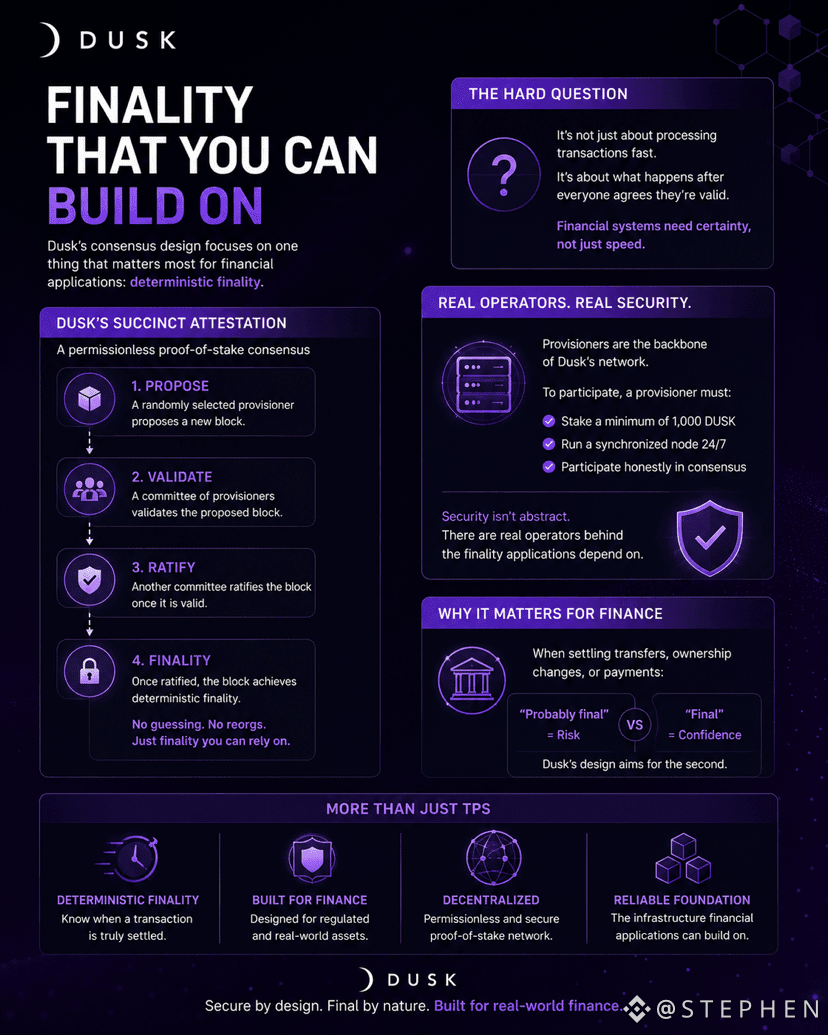
#dusk $DUSK @Dusk I used to think fast blockchains were mostly about how quickly a transaction gets processed.
The more I look at financial infrastructure, the more I think the harder question is what happens after everyone agrees that the transaction is valid.
That’s what made Dusk’s consensus design interesting to me.
Dusk uses Succinct Attestation, where provisioners are selected to propose blocks, committees validate them, and another committee ratifies the result. Once a block is ratified, the network is designed to provide deterministic finality rather than leaving users wondering whether the transaction might later be reorganized.
That sounds like a technical detail until you think about financial assets.
If a market is settling a transfer, ownership change, or payment, “probably final” and “final” are very different experiences.
What I find more interesting is that becoming part of this process isn’t just about holding DUSK. A provisioner needs to operate a synchronized node, stay online, and participate correctly in consensus. The current minimum direct stake is 1,000 DUSK.
So the security model isn’t completely abstract.
There are actual operators behind the finality that applications depend on.
Maybe blockchain performance shouldn’t be measured only by transactions per second.
Maybe for financial infrastructure, certainty about when something is truly settled is the more important metric.
The more I look at financial infrastructure, the more I think the harder question is what happens after everyone agrees that the transaction is valid.
That’s what made Dusk’s consensus design interesting to me.
Dusk uses Succinct Attestation, where provisioners are selected to propose blocks, committees validate them, and another committee ratifies the result. Once a block is ratified, the network is designed to provide deterministic finality rather than leaving users wondering whether the transaction might later be reorganized.
That sounds like a technical detail until you think about financial assets.
If a market is settling a transfer, ownership change, or payment, “probably final” and “final” are very different experiences.
What I find more interesting is that becoming part of this process isn’t just about holding DUSK. A provisioner needs to operate a synchronized node, stay online, and participate correctly in consensus. The current minimum direct stake is 1,000 DUSK.
So the security model isn’t completely abstract.
There are actual operators behind the finality that applications depend on.
Maybe blockchain performance shouldn’t be measured only by transactions per second.
Maybe for financial infrastructure, certainty about when something is truly settled is the more important metric.
Verified
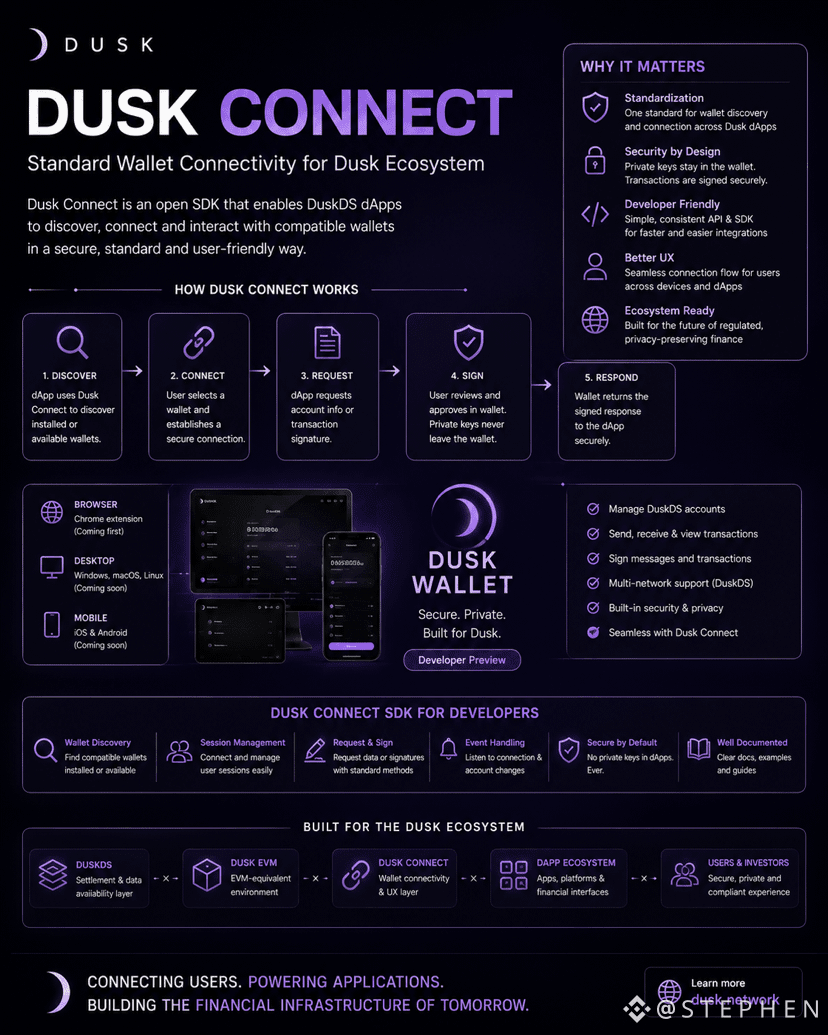
#dusk $DUSK @Dusk I used to think the wallet was just the last step between a user and a blockchain.
Looking at @Dusk ’s recent work on Dusk Connect made me reconsider that.
For financial applications, wallet infrastructure isn’t just about holding tokens and pressing “confirm.”
A regulated application needs to know which wallet is connecting, what it is allowed to do, and how transactions are authorized without turning the user experience into a collection of custom integrations.
That’s why Dusk Connect is interesting to me.
It gives DuskDS dApps a standard way to discover compatible wallets, connect accounts and request transaction signatures, while keeping key material local.
The new Dusk Wallet then provides a first-party wallet experience across browser, desktop and mobile.
It sounds like a developer-experience improvement, but I think it’s more important than that.
If regulated assets are going to move on-chain, the infrastructure around signing, permissions and wallet connectivity has to be reliable too.
The blockchain can have excellent privacy and settlement.
But if interacting with it is awkward, fragmented or insecure, adoption still has a problem.
Sometimes the less visible infrastructure is what makes the whole system usable.
Looking at @Dusk ’s recent work on Dusk Connect made me reconsider that.
For financial applications, wallet infrastructure isn’t just about holding tokens and pressing “confirm.”
A regulated application needs to know which wallet is connecting, what it is allowed to do, and how transactions are authorized without turning the user experience into a collection of custom integrations.
That’s why Dusk Connect is interesting to me.
It gives DuskDS dApps a standard way to discover compatible wallets, connect accounts and request transaction signatures, while keeping key material local.
The new Dusk Wallet then provides a first-party wallet experience across browser, desktop and mobile.
It sounds like a developer-experience improvement, but I think it’s more important than that.
If regulated assets are going to move on-chain, the infrastructure around signing, permissions and wallet connectivity has to be reliable too.
The blockchain can have excellent privacy and settlement.
But if interacting with it is awkward, fragmented or insecure, adoption still has a problem.
Sometimes the less visible infrastructure is what makes the whole system usable.
Verified
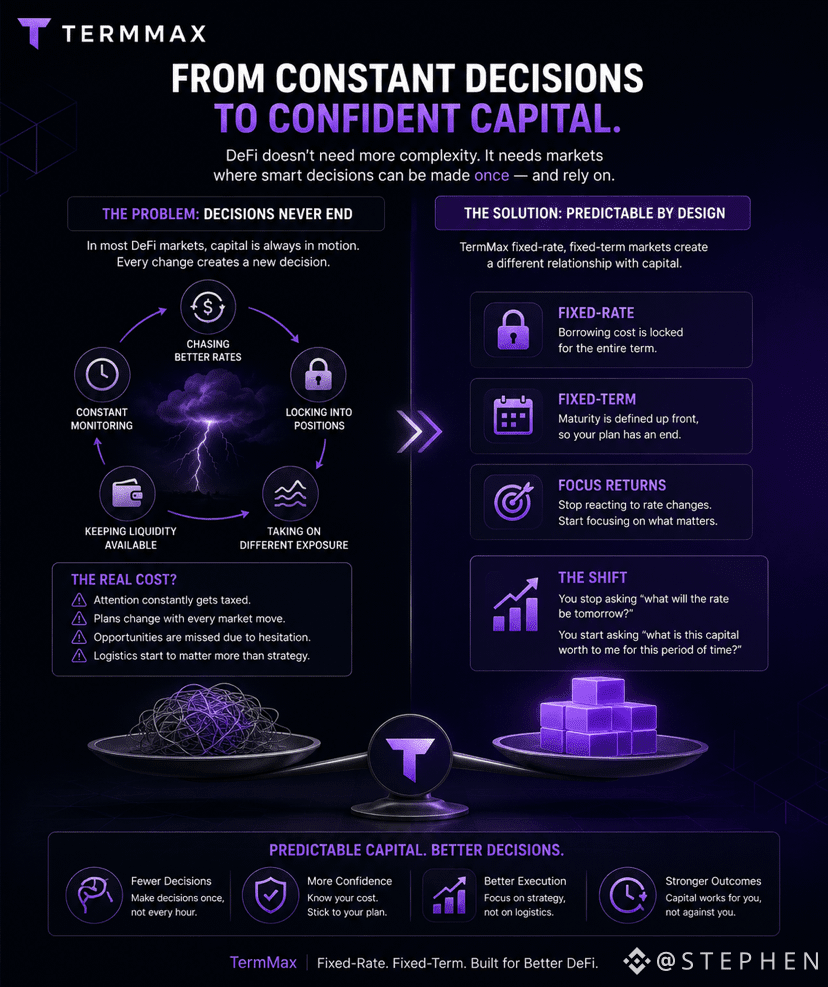
I’ve started wondering if one of DeFi’s biggest problems is something we’ve learned to accept as normal.
Capital rarely gets to just sit there and wait for the right opportunity.
You’re constantly choosing between keeping liquidity available, locking it into a position, chasing a better rate, or taking on a different kind of exposure. None of those decisions are necessarily difficult on their own. It’s the constant switching between them that starts becoming expensive in attention.
That’s what makes TermMax interesting to me.
Its fixed-rate, fixed-term markets create a different relationship with capital. Instead of letting the borrowing cost keep changing underneath a position, the rate and maturity are defined for the term. That sounds like a small change, but it can change how someone plans around the position.
You’re not constantly asking what the borrowing rate might become tomorrow.
You can start asking a more useful question: what is this capital actually worth to me for this period of time?
I think that distinction gets overlooked when DeFi is judged mainly by flexibility.
More flexibility isn’t automatically better if it also means more decisions, more monitoring, and more uncertainty.
Maybe mature DeFi won’t be about giving users another thing to optimize every few hours.
Maybe it’s about designing markets where some decisions can finally be made once — and then left alone.
If predictable capital has value of its own, are we still measuring DeFi efficiency the right way?
#termmax @TermMax
Capital rarely gets to just sit there and wait for the right opportunity.
You’re constantly choosing between keeping liquidity available, locking it into a position, chasing a better rate, or taking on a different kind of exposure. None of those decisions are necessarily difficult on their own. It’s the constant switching between them that starts becoming expensive in attention.
That’s what makes TermMax interesting to me.
Its fixed-rate, fixed-term markets create a different relationship with capital. Instead of letting the borrowing cost keep changing underneath a position, the rate and maturity are defined for the term. That sounds like a small change, but it can change how someone plans around the position.
You’re not constantly asking what the borrowing rate might become tomorrow.
You can start asking a more useful question: what is this capital actually worth to me for this period of time?
I think that distinction gets overlooked when DeFi is judged mainly by flexibility.
More flexibility isn’t automatically better if it also means more decisions, more monitoring, and more uncertainty.
Maybe mature DeFi won’t be about giving users another thing to optimize every few hours.
Maybe it’s about designing markets where some decisions can finally be made once — and then left alone.
If predictable capital has value of its own, are we still measuring DeFi efficiency the right way?
#termmax @TermMax
Verified
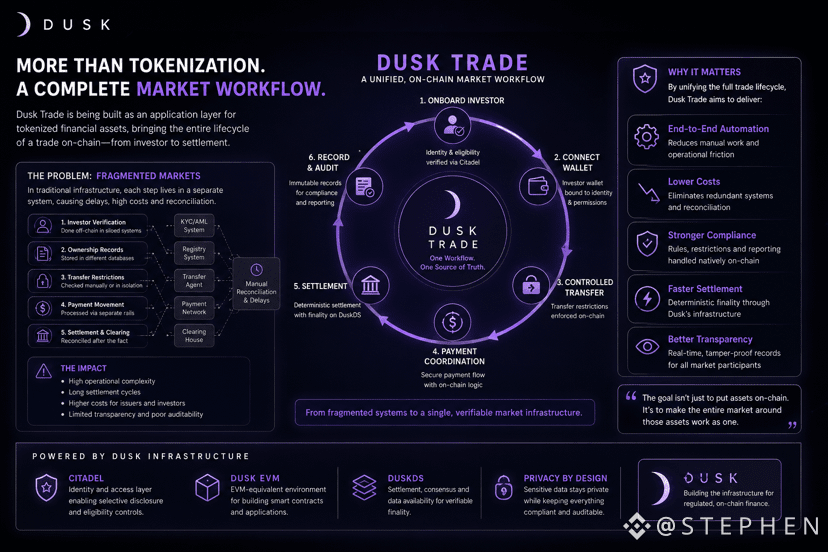
I’ve been thinking about something that doesn’t get enough attention when people talk about bringing financial markets on-chain.
The difficult part isn’t necessarily creating a token.
It’s everything that has to happen around that token.
An investor may need to be verified. Their wallet may need to be connected to an eligible identity. A transfer might have restrictions. Payment has to move correctly. Ownership needs to update. Then the whole transaction still needs a reliable settlement record.
In traditional markets, these steps can involve different systems and intermediaries. That creates a lot of coordination and reconciliation.
This is where @Dusk ’s approach becomes interesting to me.
Dusk Trade is being built around bringing important parts of that market workflow together, rather than treating tokenization as the finish line.
I think that distinction matters.
Putting a financial asset on a blockchain is only the beginning.
The bigger opportunity is making the infrastructure around that asset work as one coordinated process.
If onboarding, eligibility, transfers, payments and settlement can interact natively, tokenization starts looking less like a new representation of an old asset and more like a redesign of the market infrastructure itself.
That’s the Dusk direction I’m watching.
#dusk $DUSK @Dusk
$BOME
$AVAAI
The difficult part isn’t necessarily creating a token.
It’s everything that has to happen around that token.
An investor may need to be verified. Their wallet may need to be connected to an eligible identity. A transfer might have restrictions. Payment has to move correctly. Ownership needs to update. Then the whole transaction still needs a reliable settlement record.
In traditional markets, these steps can involve different systems and intermediaries. That creates a lot of coordination and reconciliation.
This is where @Dusk ’s approach becomes interesting to me.
Dusk Trade is being built around bringing important parts of that market workflow together, rather than treating tokenization as the finish line.
I think that distinction matters.
Putting a financial asset on a blockchain is only the beginning.
The bigger opportunity is making the infrastructure around that asset work as one coordinated process.
If onboarding, eligibility, transfers, payments and settlement can interact natively, tokenization starts looking less like a new representation of an old asset and more like a redesign of the market infrastructure itself.
That’s the Dusk direction I’m watching.
#dusk $DUSK @Dusk
$BOME
$AVAAI
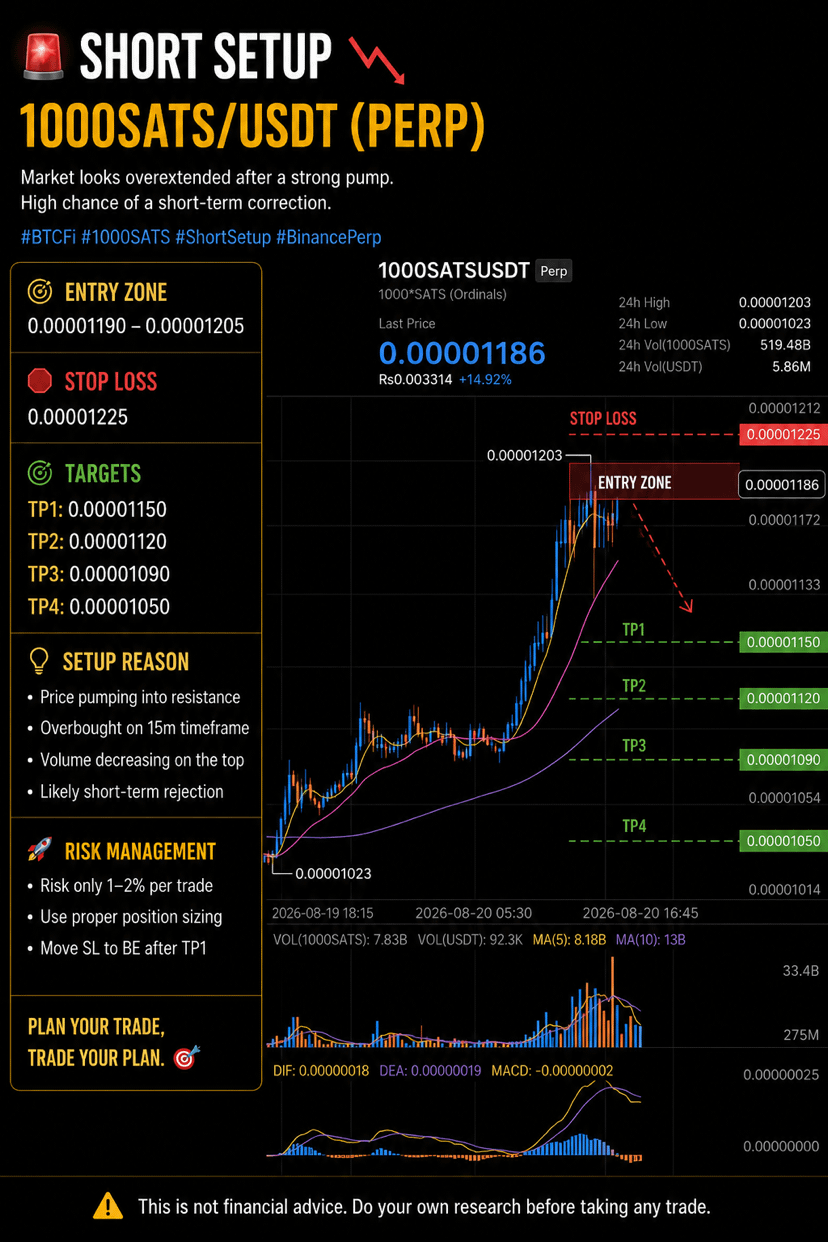
$1000SATS Short Setup
$1000SATS is showing rejection near the 0.00001203 resistance after a strong pump.
📌 Short idea:
Entry: 0.00001185–0.00001200
🎯 TP1: 0.00001172
🎯 TP2: 0.00001158
🎯 TP3: 0.00001133
🛑 Invalidation: above 0.00001210–0.00001215
MACD is starting to cool off while price is consolidating near resistance.
⚠️ Educational setup only — wait for confirmation/rejection before considering any trade.
#CryptoRally #AdnocPlansToTrimAsiaCrudeShipments
$1000SATS is showing rejection near the 0.00001203 resistance after a strong pump.
📌 Short idea:
Entry: 0.00001185–0.00001200
🎯 TP1: 0.00001172
🎯 TP2: 0.00001158
🎯 TP3: 0.00001133
🛑 Invalidation: above 0.00001210–0.00001215
MACD is starting to cool off while price is consolidating near resistance.
⚠️ Educational setup only — wait for confirmation/rejection before considering any trade.
#CryptoRally #AdnocPlansToTrimAsiaCrudeShipments
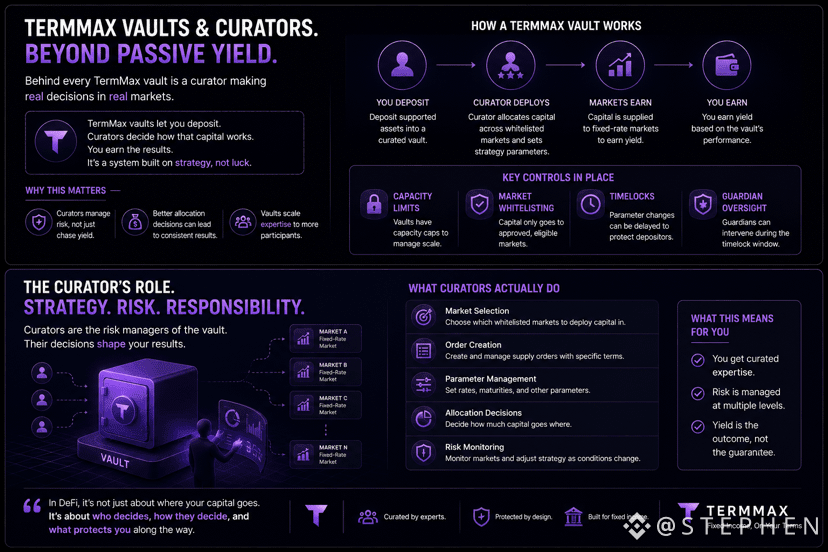
One thing I didn’t expect to focus on when looking at TermMax was the person sitting between a vault and its markets.
At first, a curated vault sounds simple: deposit assets, let the strategy handle the rest, collect the results.
But the interesting part is what “curated” actually means.
On TermMax, a curator decides how vault capital is deployed across eligible markets, including which orders to create, how much supply to allocate, and how pricing parameters are configured. That makes the curator part of the risk-management layer, not just someone choosing a few settings.
And there are constraints around that power.
Vaults have capacity limits. Markets need to be whitelisted. Important parameter changes can be subject to timelocks, while a guardian can intervene during the waiting period.
That made me rethink the word “passive.”
For the depositor, the experience can be passive.
The underlying strategy definitely isn’t.
Someone still has to decide where liquidity goes, how much risk is acceptable, and when a market no longer deserves capital.
That creates a different question for DeFi yield products:
Is the real product the yield itself, or the risk-management process that decides where that yield comes from?
For me, that’s a much more interesting way to evaluate a vault.
#termmax @TermMax
At first, a curated vault sounds simple: deposit assets, let the strategy handle the rest, collect the results.
But the interesting part is what “curated” actually means.
On TermMax, a curator decides how vault capital is deployed across eligible markets, including which orders to create, how much supply to allocate, and how pricing parameters are configured. That makes the curator part of the risk-management layer, not just someone choosing a few settings.
And there are constraints around that power.
Vaults have capacity limits. Markets need to be whitelisted. Important parameter changes can be subject to timelocks, while a guardian can intervene during the waiting period.
That made me rethink the word “passive.”
For the depositor, the experience can be passive.
The underlying strategy definitely isn’t.
Someone still has to decide where liquidity goes, how much risk is acceptable, and when a market no longer deserves capital.
That creates a different question for DeFi yield products:
Is the real product the yield itself, or the risk-management process that decides where that yield comes from?
For me, that’s a much more interesting way to evaluate a vault.
#termmax @TermMax
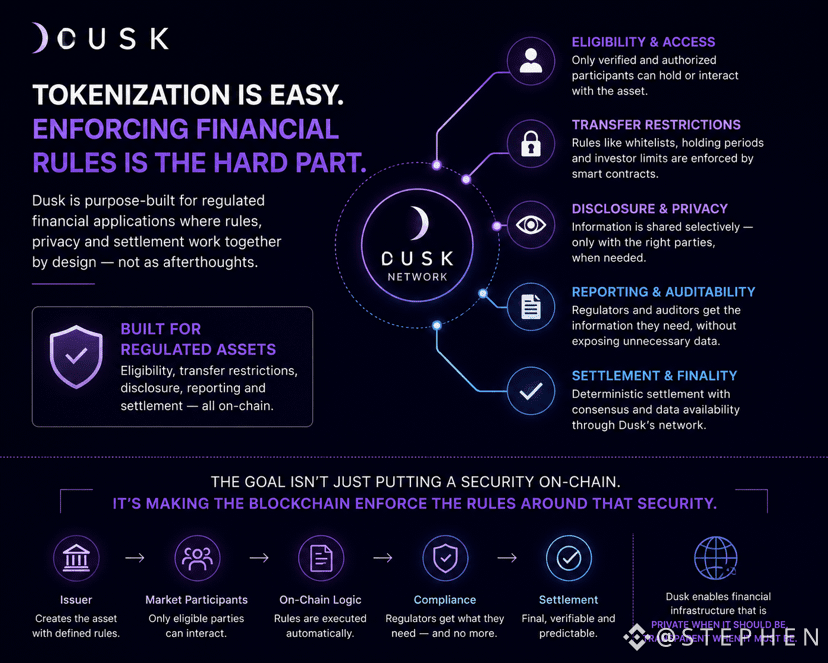
#dusk $DUSK @Dusk Tokenizing an asset is starting to look easy.
The harder question is what happens after the token exists.
Who is allowed to hold it?
Can it be transferred to anyone?
What happens when a payment has to settle with the asset?
Who gets access to the information?
And can those rules actually be enforced by the infrastructure?
That’s the part of @DuskNetwork I find more interesting.
Dusk is building around financial workflows where eligibility, transfer restrictions, privacy, disclosure and settlement aren’t separate afterthoughts. They can become part of how the asset actually operates on-chain.
That changes how I think about tokenization.
The goal isn’t just putting a security on a blockchain.
It’s making the blockchain understand the rules around that security.
$RICE
$BTW
The harder question is what happens after the token exists.
Who is allowed to hold it?
Can it be transferred to anyone?
What happens when a payment has to settle with the asset?
Who gets access to the information?
And can those rules actually be enforced by the infrastructure?
That’s the part of @DuskNetwork I find more interesting.
Dusk is building around financial workflows where eligibility, transfer restrictions, privacy, disclosure and settlement aren’t separate afterthoughts. They can become part of how the asset actually operates on-chain.
That changes how I think about tokenization.
The goal isn’t just putting a security on a blockchain.
It’s making the blockchain understand the rules around that security.
$RICE
$BTW
What caught my attention about TermMax isn’t the phrase “fixed-rate lending.”
It’s the structure underneath it.
A fixed-rate loan sounds simple from the outside: borrow something today, agree on a rate, repay later.
But turning that idea into an on-chain market is a different problem.
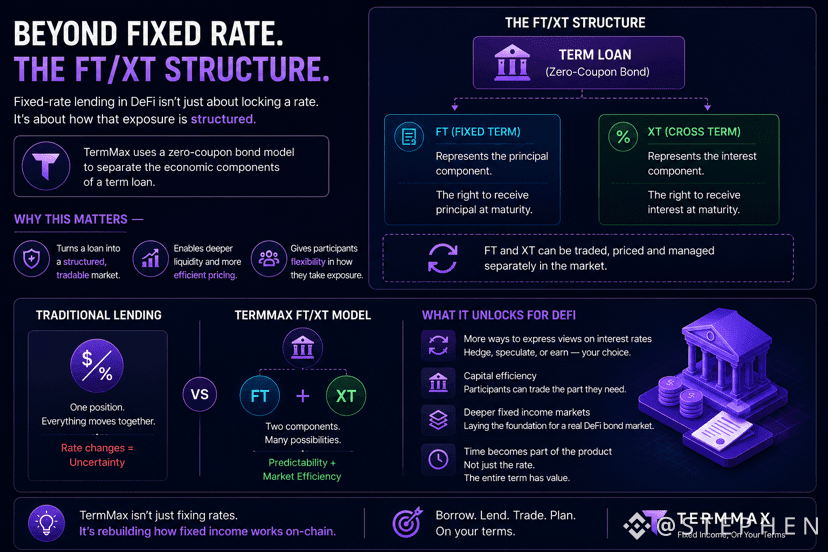
TermMax approaches it through a zero-coupon bond model, where the economic components of a term loan can be separated rather than treating the position as one indivisible asset. The protocol’s FT/XT structure is designed around that separation, allowing the principal and interest components of a fixed-term position to have distinct market roles.
I find that more interesting than the headline itself.
Because once you separate the pieces, fixed income starts looking less like a simple lending pool and more like something that can actually become a tradable market structure.
That matters for DeFi.
Variable-rate lending has made borrowing incredibly flexible, but flexibility isn’t always the same thing as predictability. Fixed-term markets introduce another way to organize capital: define the maturity, establish the economics, and let participants decide what that specific exposure is worth.
There’s still risk, obviously. Liquidity, collateral quality and maturity all matter.
But the design question is fascinating:
What happens when DeFi stops treating interest rates as something that constantly floats—and starts treating time itself as part of the financial product?
#termmax @TermMax
It’s the structure underneath it.
A fixed-rate loan sounds simple from the outside: borrow something today, agree on a rate, repay later.
But turning that idea into an on-chain market is a different problem.
TermMax approaches it through a zero-coupon bond model, where the economic components of a term loan can be separated rather than treating the position as one indivisible asset. The protocol’s FT/XT structure is designed around that separation, allowing the principal and interest components of a fixed-term position to have distinct market roles.
I find that more interesting than the headline itself.
Because once you separate the pieces, fixed income starts looking less like a simple lending pool and more like something that can actually become a tradable market structure.
That matters for DeFi.
Variable-rate lending has made borrowing incredibly flexible, but flexibility isn’t always the same thing as predictability. Fixed-term markets introduce another way to organize capital: define the maturity, establish the economics, and let participants decide what that specific exposure is worth.
There’s still risk, obviously. Liquidity, collateral quality and maturity all matter.
But the design question is fascinating:
What happens when DeFi stops treating interest rates as something that constantly floats—and starts treating time itself as part of the financial product?
#termmax @TermMax
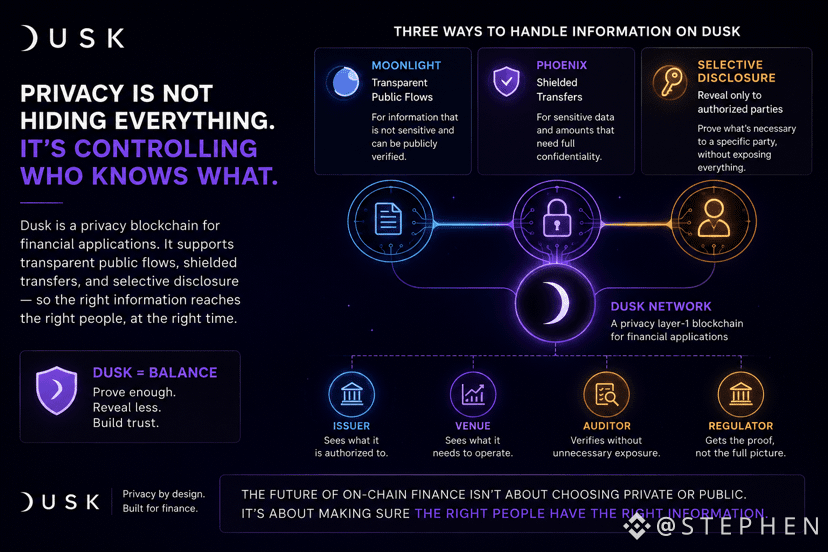
One thing I find interesting about @DuskNetwork is that its value isn’t limited to making transactions private.
The bigger idea is what happens when financial logic itself needs confidentiality.
That’s where the Confidential Security Contract (XSC) standard caught my attention. Instead of treating smart contracts as if every input and output should automatically be public, Dusk is building around the reality that financial applications can have sensitive rules, data, and participants.
I think that’s an important distinction.
Putting financial assets on-chain is one challenge. Making the underlying financial workflows work on-chain without exposing information that was never meant to be public is another.
That’s the part of Dusk I’m watching more closely.
@Dusk $DUSK #Dusk
The bigger idea is what happens when financial logic itself needs confidentiality.
That’s where the Confidential Security Contract (XSC) standard caught my attention. Instead of treating smart contracts as if every input and output should automatically be public, Dusk is building around the reality that financial applications can have sensitive rules, data, and participants.
I think that’s an important distinction.
Putting financial assets on-chain is one challenge. Making the underlying financial workflows work on-chain without exposing information that was never meant to be public is another.
That’s the part of Dusk I’m watching more closely.
@Dusk $DUSK #Dusk
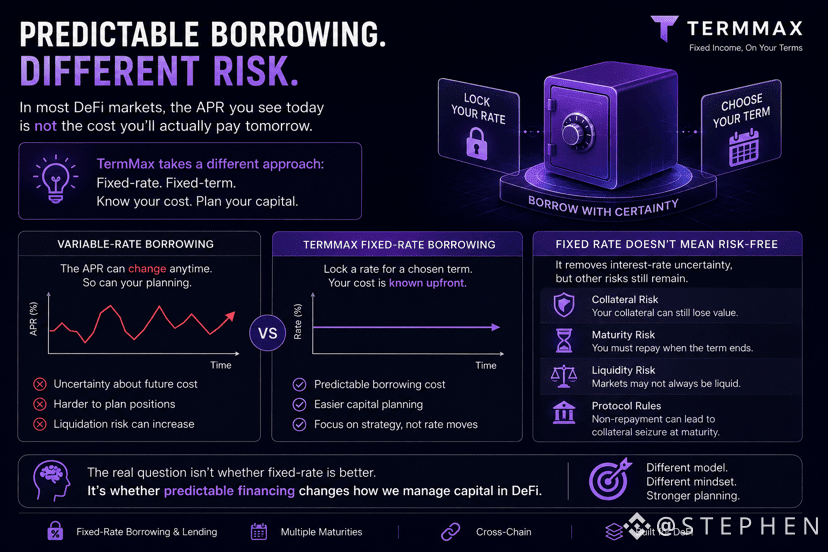
I keep seeing DeFi borrowing discussed through one number: the APR.
That makes sense until the rate starts moving.
A borrower might enter a position because the cost looks attractive today, only to discover that the economics can look completely different later. For anyone trying to plan capital rather than simply speculate, that uncertainty is a cost.
That’s the part of TermMax I find interesting.
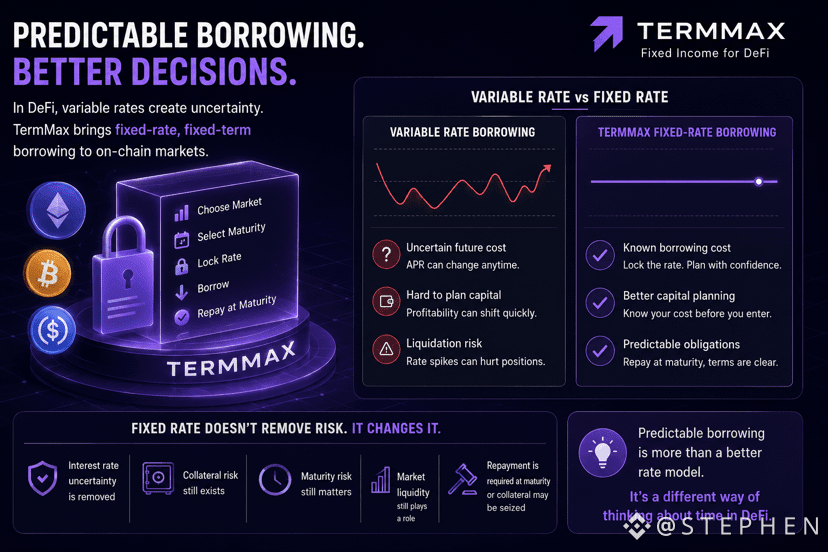
Its borrowing markets use a fixed-rate, fixed-term structure. You choose a market and maturity, lock the rate, receive the borrowed asset, and know the agreed borrowing cost for that term instead of being exposed to rate changes.
But I don’t think “fixed rate” automatically means “lower risk.”
It changes the type of risk you’re taking.
You remove uncertainty around the interest rate, but you still have collateral risk, maturity risk, liquidity considerations, and the responsibility to repay when the term ends. If a borrower doesn’t repay at maturity, the protocol has mechanisms for collateral seizure rather than keeping the position open indefinitely.
That distinction matters.
To me, the interesting question isn’t whether fixed-rate borrowing sounds better than variable borrowing.
It’s whether knowing your financing cost changes how people manage capital on-chain.
Maybe predictable borrowing is more than a better rate model.
Maybe it’s a different way of thinking about time in DeFi.
#termmax @TermMax
That makes sense until the rate starts moving.
A borrower might enter a position because the cost looks attractive today, only to discover that the economics can look completely different later. For anyone trying to plan capital rather than simply speculate, that uncertainty is a cost.
That’s the part of TermMax I find interesting.
Its borrowing markets use a fixed-rate, fixed-term structure. You choose a market and maturity, lock the rate, receive the borrowed asset, and know the agreed borrowing cost for that term instead of being exposed to rate changes.
But I don’t think “fixed rate” automatically means “lower risk.”
It changes the type of risk you’re taking.
You remove uncertainty around the interest rate, but you still have collateral risk, maturity risk, liquidity considerations, and the responsibility to repay when the term ends. If a borrower doesn’t repay at maturity, the protocol has mechanisms for collateral seizure rather than keeping the position open indefinitely.
That distinction matters.
To me, the interesting question isn’t whether fixed-rate borrowing sounds better than variable borrowing.
It’s whether knowing your financing cost changes how people manage capital on-chain.
Maybe predictable borrowing is more than a better rate model.
Maybe it’s a different way of thinking about time in DeFi.
#termmax @TermMax
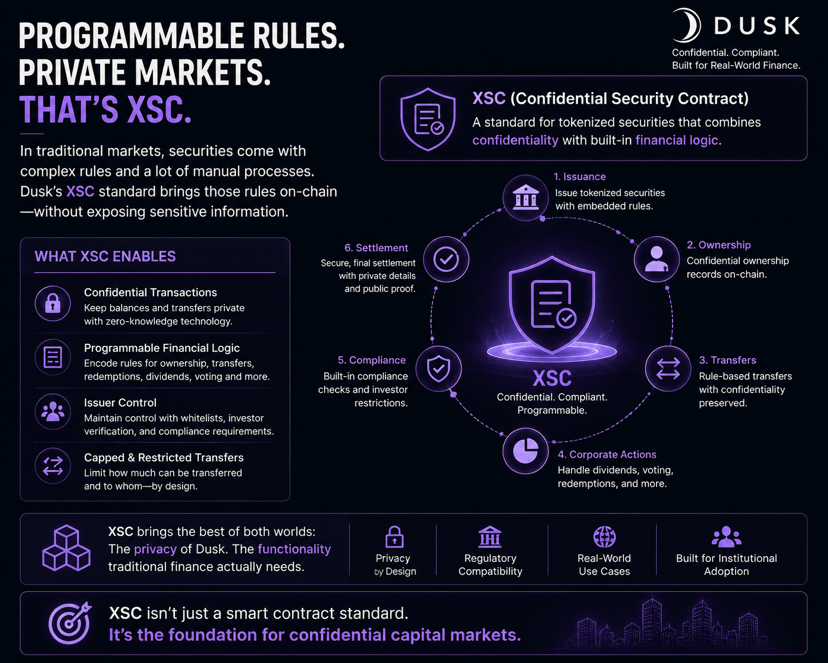
The more I look at Dusk, the more I think the interesting part isn’t simply making financial transactions private.
It’s making financial rules programmable without making the whole market transparent.
That’s where Dusk’s XSC standard caught my attention.
A security token isn’t just something that needs to move from one wallet to another. Real securities have rules around ownership, transfers, redemptions, dividends, voting and sometimes limits on how much one participant can hold.
Dusk designed XSC around that reality.
What I find interesting is that these rules can live alongside confidential transactions instead of forcing the asset into a completely transparent model. The protocol can enforce things like capped transfers and ownership restrictions while keeping transaction details private where appropriate.
That changes the way I look at “smart contracts” in financial markets.
The valuable part isn’t only automating what an asset can do.
It’s being able to encode who can do it, under which conditions, and what information actually needs to be exposed.
Maybe that’s the difference between putting securities on a blockchain and actually building financial infrastructure around them.
@Dusk $DUSK #Dusk
It’s making financial rules programmable without making the whole market transparent.
That’s where Dusk’s XSC standard caught my attention.
A security token isn’t just something that needs to move from one wallet to another. Real securities have rules around ownership, transfers, redemptions, dividends, voting and sometimes limits on how much one participant can hold.
Dusk designed XSC around that reality.
What I find interesting is that these rules can live alongside confidential transactions instead of forcing the asset into a completely transparent model. The protocol can enforce things like capped transfers and ownership restrictions while keeping transaction details private where appropriate.
That changes the way I look at “smart contracts” in financial markets.
The valuable part isn’t only automating what an asset can do.
It’s being able to encode who can do it, under which conditions, and what information actually needs to be exposed.
Maybe that’s the difference between putting securities on a blockchain and actually building financial infrastructure around them.
@Dusk $DUSK #Dusk
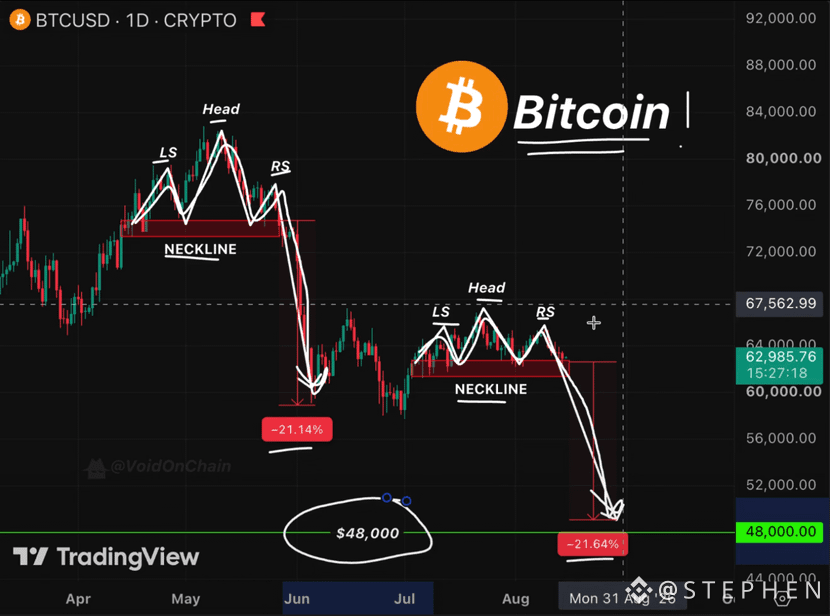
🚨 $BTC COULD STILL HAVE MORE DOWNSIDE
Bitcoin is already moving in the direction I’ve been tracking.
And this setup looks very familiar.
The previous time we saw a similar structure, BTC dropped over 24% within just a few days.
Here’s the path I’m watching:
$62K → $55K → $48K
What stands out most is how calm the market still feels.
Most traders are positioning for another bounce.
I’m preparing for a deeper flush.
I called the $17K bottom in 2022 and the $126K peak in 2025.
Both sounded unrealistic before the market proved otherwise.
If this setup unfolds as expected, I’ll share the next signal before the move becomes obvious to everyone.
You don’t want to find this call after the move is already over.
Turn notifications on.
#btc
Bitcoin is already moving in the direction I’ve been tracking.
And this setup looks very familiar.
The previous time we saw a similar structure, BTC dropped over 24% within just a few days.
Here’s the path I’m watching:
$62K → $55K → $48K
What stands out most is how calm the market still feels.
Most traders are positioning for another bounce.
I’m preparing for a deeper flush.
I called the $17K bottom in 2022 and the $126K peak in 2025.
Both sounded unrealistic before the market proved otherwise.
If this setup unfolds as expected, I’ll share the next signal before the move becomes obvious to everyone.
You don’t want to find this call after the move is already over.
Turn notifications on.
#btc
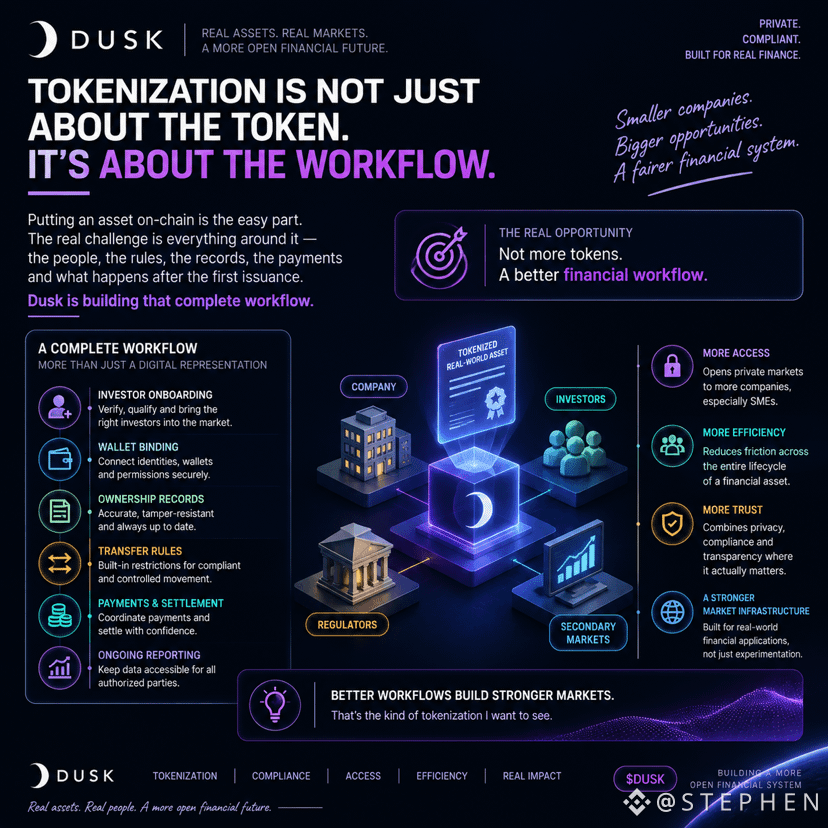
I keep seeing tokenization described as if the difficult part is putting an asset on a blockchain.
I’m starting to think that’s the easy part.
The more interesting question is what happens around the asset once it’s there.
A private company doesn’t just need a digital version of its shares. It still needs investor onboarding, ownership records, transfer rules, payments, reporting and a way to handle what happens after the initial issuance.
That’s where Dusk caught my attention.
Its approach to tokenized financial assets is built around the workflow around the asset, not just the token itself. Dusk Trade, for example, is designed around things like investor onboarding, wallet binding, trading actions, payment coordination and settlement.
That changes how I think about the tokenization narrative.
If all we do is move an existing certificate onto a blockchain, we haven’t really changed the market infrastructure.
But if issuance, ownership, transfers and settlement can start working as connected parts of the same system, the token becomes more than a digital receipt.
Maybe the real opportunity in tokenization isn’t creating more tokens.
Maybe it’s rebuilding the financial workflow around them.
@Dusk $DUSK #Dusk
I’m starting to think that’s the easy part.
The more interesting question is what happens around the asset once it’s there.
A private company doesn’t just need a digital version of its shares. It still needs investor onboarding, ownership records, transfer rules, payments, reporting and a way to handle what happens after the initial issuance.
That’s where Dusk caught my attention.
Its approach to tokenized financial assets is built around the workflow around the asset, not just the token itself. Dusk Trade, for example, is designed around things like investor onboarding, wallet binding, trading actions, payment coordination and settlement.
That changes how I think about the tokenization narrative.
If all we do is move an existing certificate onto a blockchain, we haven’t really changed the market infrastructure.
But if issuance, ownership, transfers and settlement can start working as connected parts of the same system, the token becomes more than a digital receipt.
Maybe the real opportunity in tokenization isn’t creating more tokens.
Maybe it’s rebuilding the financial workflow around them.
@Dusk $DUSK #Dusk
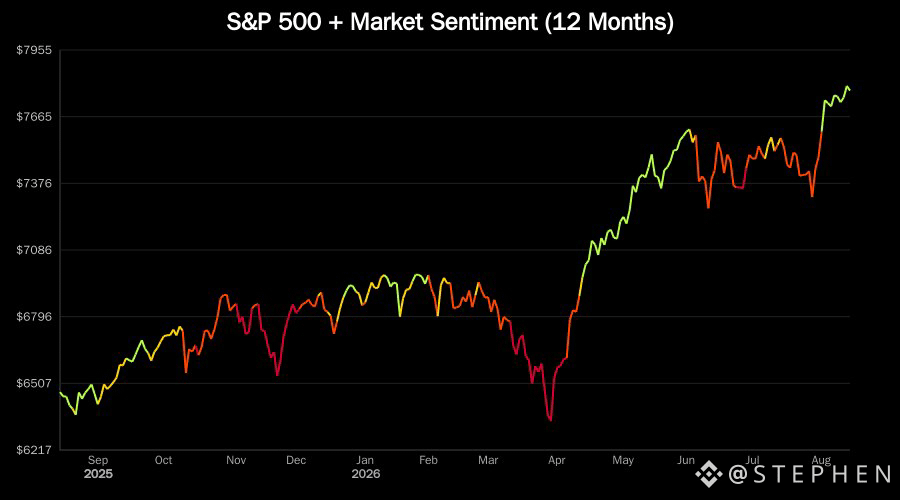
📊 CNN Fear & Greed Index vs. S&P 500
The market’s emotions can often tell a story that price alone doesn’t reveal. The CNN Fear & Greed Index tracks investor sentiment across several factors and helps show whether the market is leaning toward Fear or Greed.
When the S&P 500 is rising while sentiment moves deeper into Greed, it can reflect strong confidence and risk appetite. But when extreme Greed appears after a prolonged rally, it may also be a warning that investors are becoming overly optimistic.
On the other hand, periods of extreme Fear often come with heavy selling pressure and increased uncertainty. While fear can signal weakness in the short term, historically it can also create opportunities when valuations become more attractive.
That’s why comparing the Fear & Greed Index with the S&P 500 can provide useful context about market psychology. 📈🧠
The key is not to trade based on sentiment alone. Price action, momentum, volume, support and resistance, and overall market conditions still matter.
Fear can create opportunities. Greed can create risk.
Always manage your risk and avoid making decisions based on emotions. ⚠️📊
The market’s emotions can often tell a story that price alone doesn’t reveal. The CNN Fear & Greed Index tracks investor sentiment across several factors and helps show whether the market is leaning toward Fear or Greed.
When the S&P 500 is rising while sentiment moves deeper into Greed, it can reflect strong confidence and risk appetite. But when extreme Greed appears after a prolonged rally, it may also be a warning that investors are becoming overly optimistic.
On the other hand, periods of extreme Fear often come with heavy selling pressure and increased uncertainty. While fear can signal weakness in the short term, historically it can also create opportunities when valuations become more attractive.
That’s why comparing the Fear & Greed Index with the S&P 500 can provide useful context about market psychology. 📈🧠
The key is not to trade based on sentiment alone. Price action, momentum, volume, support and resistance, and overall market conditions still matter.
Fear can create opportunities. Greed can create risk.
Always manage your risk and avoid making decisions based on emotions. ⚠️📊
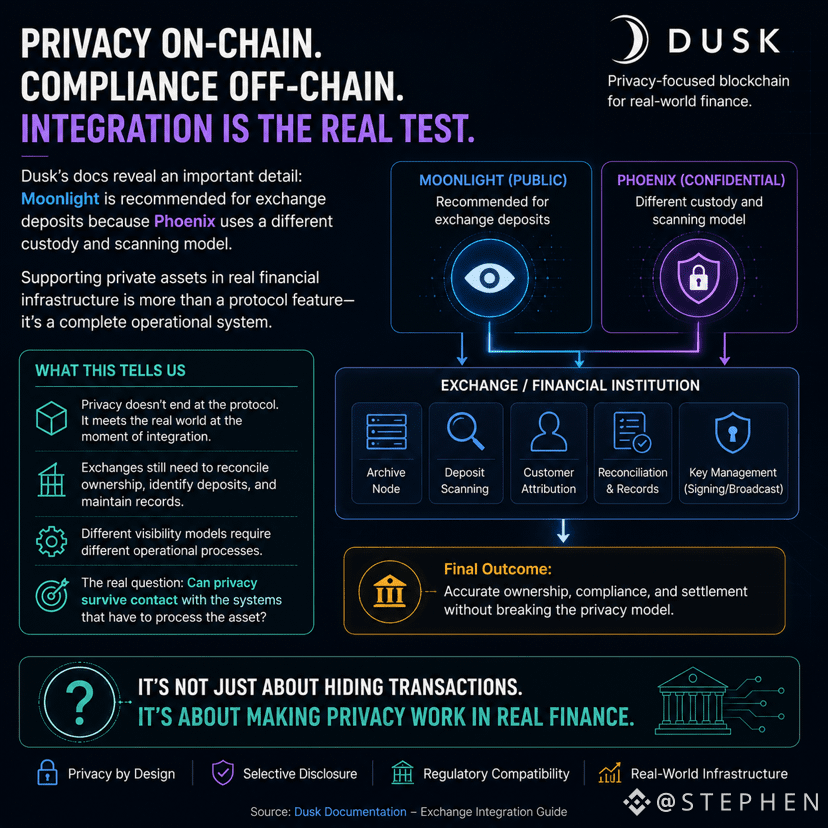
I found a small detail in Dusk’s exchange-integration docs that made me look at the network a little differently.
The obvious assumption is that if a blockchain supports private transactions, an exchange should simply be able to support those transactions too.
Apparently, it isn’t that simple.
Dusk recommends Moonlight for exchange deposits because Phoenix uses a different custody and scanning model. The production setup also involves finalized history, deposit scanning, customer attribution, reconciliation, and key-management infrastructure.
That caught my attention because it exposes a part of blockchain privacy that usually gets ignored.
Privacy doesn’t end at the protocol.
The moment an asset enters an exchange, custodian, or other financial system, someone still has to reconcile ownership, identify deposits, maintain records, and know what can actually be credited.
So the difficult question isn’t simply whether Dusk can hide transaction details.
It’s whether financial infrastructure can handle different visibility models without turning the whole operational process into a mess.
I think that’s a much more practical test for privacy-focused blockchains.
Not “Can the transaction be private?”
But “Can privacy survive contact with the systems that actually have to process the asset?”
@Dusk $DUSK #Dusk
The obvious assumption is that if a blockchain supports private transactions, an exchange should simply be able to support those transactions too.
Apparently, it isn’t that simple.
Dusk recommends Moonlight for exchange deposits because Phoenix uses a different custody and scanning model. The production setup also involves finalized history, deposit scanning, customer attribution, reconciliation, and key-management infrastructure.
That caught my attention because it exposes a part of blockchain privacy that usually gets ignored.
Privacy doesn’t end at the protocol.
The moment an asset enters an exchange, custodian, or other financial system, someone still has to reconcile ownership, identify deposits, maintain records, and know what can actually be credited.
So the difficult question isn’t simply whether Dusk can hide transaction details.
It’s whether financial infrastructure can handle different visibility models without turning the whole operational process into a mess.
I think that’s a much more practical test for privacy-focused blockchains.
Not “Can the transaction be private?”
But “Can privacy survive contact with the systems that actually have to process the asset?”
@Dusk $DUSK #Dusk
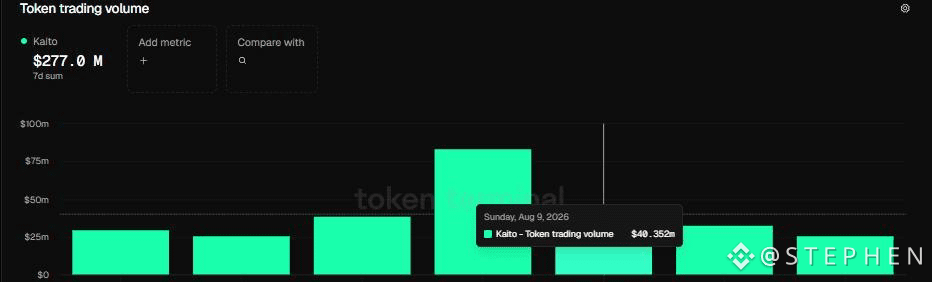
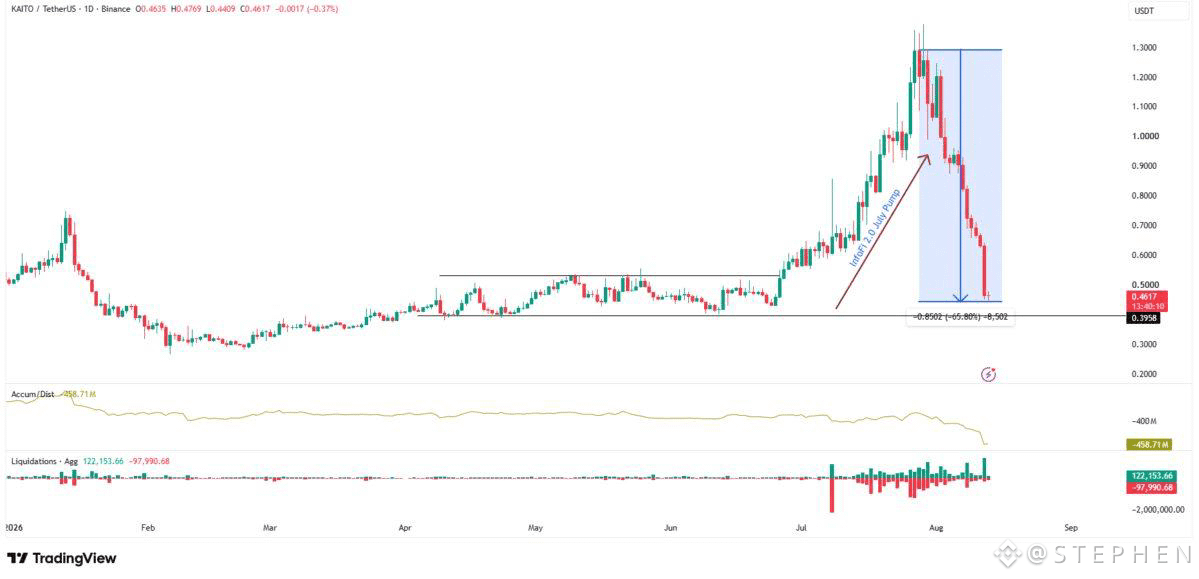
$KAITO Erases Its July Rally in 15 Days
$KAITO fell more than 19% in 24 hours and 68% over two weeks, returning to the $0.40 area after reaching $1.37 in late July.
📊 Where Capital Disappeared
• Daily trading volume dropped from $84 million to $25 million within four days.
• Weekly volume declined from $541 million to $277 million.
• Total Value Locked contracted from $21.9 million to approximately $8 million.
• More than $3 million left the ecosystem on August 13, extending a pattern of outflows that began early in the month.
The data indicates that the decline is being driven by shrinking liquidity and sustained capital withdrawal rather than price action alone.
Leverage Accelerated the Fall
OI-weighted funding remained negative for four consecutive days and reached -0.4359%, showing aggressive short positioning.
• Long liquidations totaled $1.25 million.
• Short liquidations reached only $198,000.
• The imbalance intensified downside momentum as bullish positions were forced out.
The Remaining Defense
The $0.40 level marks the base of the previous rally and is now the critical support. Stabilization requires distribution to slow, volume to recover and funding pressure to normalize.
If $0.40 fails, the next major downside reference is the 2026 low near $0.266.
Insight: KAITO’s July advance has fully reversed because capital, liquidity and leveraged positioning moved against the token simultaneously. Holding $0.40 may create a recovery opportunity, but current market structure still favors sellers.
$KAITO
#AnthropicIPOMeetingsSkipFinancialsValuation #KalshiOrderedToSuspendWashingtonOperations #GlobalStocksNearRecordHighs
$KAITO fell more than 19% in 24 hours and 68% over two weeks, returning to the $0.40 area after reaching $1.37 in late July.
📊 Where Capital Disappeared
• Daily trading volume dropped from $84 million to $25 million within four days.
• Weekly volume declined from $541 million to $277 million.
• Total Value Locked contracted from $21.9 million to approximately $8 million.
• More than $3 million left the ecosystem on August 13, extending a pattern of outflows that began early in the month.
The data indicates that the decline is being driven by shrinking liquidity and sustained capital withdrawal rather than price action alone.
Leverage Accelerated the Fall
OI-weighted funding remained negative for four consecutive days and reached -0.4359%, showing aggressive short positioning.
• Long liquidations totaled $1.25 million.
• Short liquidations reached only $198,000.
• The imbalance intensified downside momentum as bullish positions were forced out.
The Remaining Defense
The $0.40 level marks the base of the previous rally and is now the critical support. Stabilization requires distribution to slow, volume to recover and funding pressure to normalize.
If $0.40 fails, the next major downside reference is the 2026 low near $0.266.
Insight: KAITO’s July advance has fully reversed because capital, liquidity and leveraged positioning moved against the token simultaneously. Holding $0.40 may create a recovery opportunity, but current market structure still favors sellers.
$KAITO
#AnthropicIPOMeetingsSkipFinancialsValuation #KalshiOrderedToSuspendWashingtonOperations #GlobalStocksNearRecordHighs
I think one of the more interesting things about Dusk isn’t actually its privacy features.
It’s how much of the existing developer experience it tries to preserve.
That’s easy to overlook when most conversations about Dusk focus on financial applications, confidential transactions, or compliance.
But from a builder’s perspective, the transition matters just as much as the technology.
DuskEVM gives developers an EVM-compatible environment for deploying smart contracts, while DuskDS handles settlement and data availability underneath the execution layer.
That creates an interesting separation.
Developers don’t necessarily have to rethink the entire way they build just because the underlying infrastructure is designed for a different type of financial application.
To me, that’s an underrated adoption factor.
Every new development environment creates friction before an application even reaches its users. If familiar workflows can connect with infrastructure designed for regulated financial use cases, the barrier to experimentation becomes much smaller.
Maybe blockchain adoption isn’t always about convincing developers to learn something completely new.
Sometimes it’s about giving them a reason to use what they already know — while changing what the infrastructure underneath can actually do.
@Dusk $DUSK #Dusk
It’s how much of the existing developer experience it tries to preserve.
That’s easy to overlook when most conversations about Dusk focus on financial applications, confidential transactions, or compliance.
But from a builder’s perspective, the transition matters just as much as the technology.
DuskEVM gives developers an EVM-compatible environment for deploying smart contracts, while DuskDS handles settlement and data availability underneath the execution layer.
That creates an interesting separation.
Developers don’t necessarily have to rethink the entire way they build just because the underlying infrastructure is designed for a different type of financial application.
To me, that’s an underrated adoption factor.
Every new development environment creates friction before an application even reaches its users. If familiar workflows can connect with infrastructure designed for regulated financial use cases, the barrier to experimentation becomes much smaller.
Maybe blockchain adoption isn’t always about convincing developers to learn something completely new.
Sometimes it’s about giving them a reason to use what they already know — while changing what the infrastructure underneath can actually do.
@Dusk $DUSK #Dusk
Log in to explore more content