
CryptoQuant Quicktake
8.6k Posts

CryptoQuant Quicktake
 Square Verified+
Report
Block User
CryptoQuant.com - Leading On-chain Data/Analytics Provider
0 Following
22.8K+ Followers
27.0K+ Liked
Posts
Article
BTC’s Rebound Is Bringing Retail-Linked Supply Back to BinanceRetail-linked coins are moving back to Binance, but the most relevant signal is not simply the size of the latest print, but the persistence of the move.
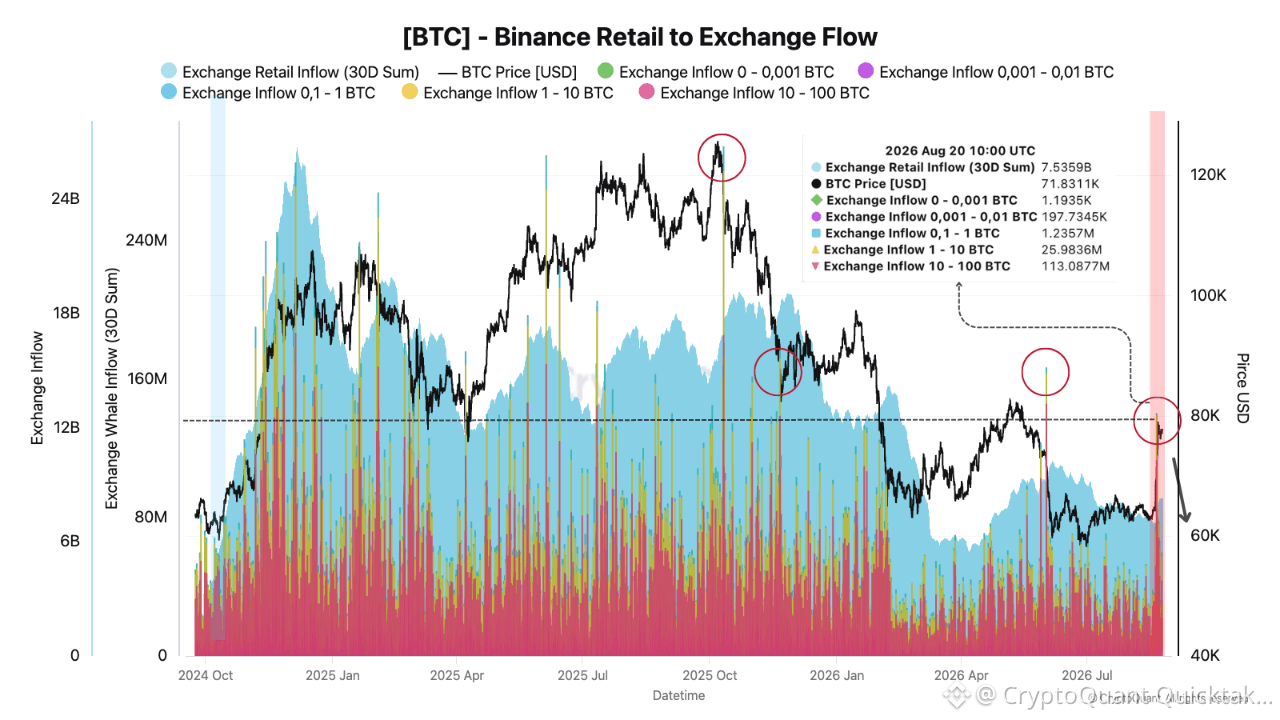
As of August 20, Binance Retail Inflow reached $7.54B on a 30-day rolling basis.
At the latest observation, component flows totalled roughly $140.5M. Of that amount, $113.1M (80.5%) came from the 10–100 BTC band and another $26.0M (18.5%) from the 1–10 BTC band. Together, these two cohorts represented 99.0% of the observed flow, while transfers below 1 BTC contributed only about $1.4M.
This is not primarily a “small-wallet panic” signal. It points instead to the upper end of the retail-labelled cohort moving meaningful inventory toward Binance.
The timing adds another layer. Inflows accelerated after BTC’s recent rally toward $80K, suggesting that renewed price strength may have encouraged holders to move coins that are potentially in profit. Rather than capitulating into weakness, some investors may be using the rebound to secure gains, or positioning inventory on Binance in preparation to do so.
Exchange inflows alone cannot confirm this because the metric does not reveal each coin’s acquisition price. Exchange Inflow SOPR, realised price by cohort and coin-age data would be needed to establish whether profits are actually being realised. Still, rising prices combined with persistent exchange-bound flows make profit-taking a credible explanation.
Unlike the June 1 sell-off, when inflows appeared as a sharp, isolated spike, the latest move has extended across several consecutive sessions. That persistence is more consistent with an ongoing shift in holder behaviour than with a single reactive event.
What to watch:
If these flows persist while BTC struggles around $80K, profit-taking could cap rebounds and reinforce short-term downside pressure. If inflows fade and price absorbs the available supply, the bearish interpretation would weaken.
Written by MorenoDV_
BTC’s Rebound Is Bringing Retail-Linked Supply Back to Binance
Retail-linked coins are moving back to Binance, but the most relevant signal is not simply the size of the latest print, but the persistence of the move.
As of August 20, Binance Retail Inflow reached $7.54B on a 30-day rolling basis.
At the latest observation, component flows totalled roughly $140.5M. Of that amount, $113.1M (80.5%) came from the 10–100 BTC band and another $26.0M (18.5%) from the 1–10 BTC band. Together, these two cohorts represented 99.0% of the observed flow, while transfers below 1 BTC contributed only about $1.4M.
This is not primarily a “small-wallet panic” signal. It points instead to the upper end of the retail-labelled cohort moving meaningful inventory toward Binance.
The timing adds another layer. Inflows accelerated after BTC’s recent rally toward $80K, suggesting that renewed price strength may have encouraged holders to move coins that are potentially in profit. Rather than capitulating into weakness, some investors may be using the rebound to secure gains, or positioning inventory on Binance in preparation to do so.
Exchange inflows alone cannot confirm this because the metric does not reveal each coin’s acquisition price. Exchange Inflow SOPR, realised price by cohort and coin-age data would be needed to establish whether profits are actually being realised. Still, rising prices combined with persistent exchange-bound flows make profit-taking a credible explanation.
Unlike the June 1 sell-off, when inflows appeared as a sharp, isolated spike, the latest move has extended across several consecutive sessions. That persistence is more consistent with an ongoing shift in holder behaviour than with a single reactive event.
What to watch:
If these flows persist while BTC struggles around $80K, profit-taking could cap rebounds and reinforce short-term downside pressure. If inflows fade and price absorbs the available supply, the bearish interpretation would weaken.
Written by MorenoDV_
As of August 20, Binance Retail Inflow reached $7.54B on a 30-day rolling basis.
At the latest observation, component flows totalled roughly $140.5M. Of that amount, $113.1M (80.5%) came from the 10–100 BTC band and another $26.0M (18.5%) from the 1–10 BTC band. Together, these two cohorts represented 99.0% of the observed flow, while transfers below 1 BTC contributed only about $1.4M.
This is not primarily a “small-wallet panic” signal. It points instead to the upper end of the retail-labelled cohort moving meaningful inventory toward Binance.
The timing adds another layer. Inflows accelerated after BTC’s recent rally toward $80K, suggesting that renewed price strength may have encouraged holders to move coins that are potentially in profit. Rather than capitulating into weakness, some investors may be using the rebound to secure gains, or positioning inventory on Binance in preparation to do so.
Exchange inflows alone cannot confirm this because the metric does not reveal each coin’s acquisition price. Exchange Inflow SOPR, realised price by cohort and coin-age data would be needed to establish whether profits are actually being realised. Still, rising prices combined with persistent exchange-bound flows make profit-taking a credible explanation.
Unlike the June 1 sell-off, when inflows appeared as a sharp, isolated spike, the latest move has extended across several consecutive sessions. That persistence is more consistent with an ongoing shift in holder behaviour than with a single reactive event.
What to watch:
If these flows persist while BTC struggles around $80K, profit-taking could cap rebounds and reinforce short-term downside pressure. If inflows fade and price absorbs the available supply, the bearish interpretation would weaken.
Written by MorenoDV_
1
1
587
Article
Binance BTC, ETH and XRP Volume Tops $64B, Highest Since June As Perpetuals Capture 91%Combined trading volume across Binance’s BTC, ETH and XRP USDT spot and perpetual markets reached approximately $64.21 billion on August 21, the highest daily reading since June 5.
Perpetual contracts accounted for $58.4 billion, or roughly 91% of the total, exceeding the combined spot volume of $5.81 billion by about 10 times.
Compared with June 5, perpetual volume increased 9%, while spot activity rose just 1.2%, indicating that the return to higher turnover was concentrated primarily in derivatives.
XRP recorded the strongest acceleration among the three assets.
Its combined spot and perpetual volume climbed to $2.41 billion from $1.11 billion on June 5—an increase of approximately 118%.
XRP perpetual volume rose 127% to $1.8 billion, while spot volume increased nearly 95% to $611 million.
Bitcoin’s combined volume also advanced 15.9% to $38 billion. Ethereum moved in the opposite direction, declining 6.5% to $23.8 billion despite the 8.2% increase in aggregate activity across the three assets.
The data shows a clear return of high trading turnover on Binance, led by perpetual markets .
Written by Amr Taha
Binance BTC, ETH and XRP Volume Tops $64B, Highest Since June As Perpetuals Capture 91%
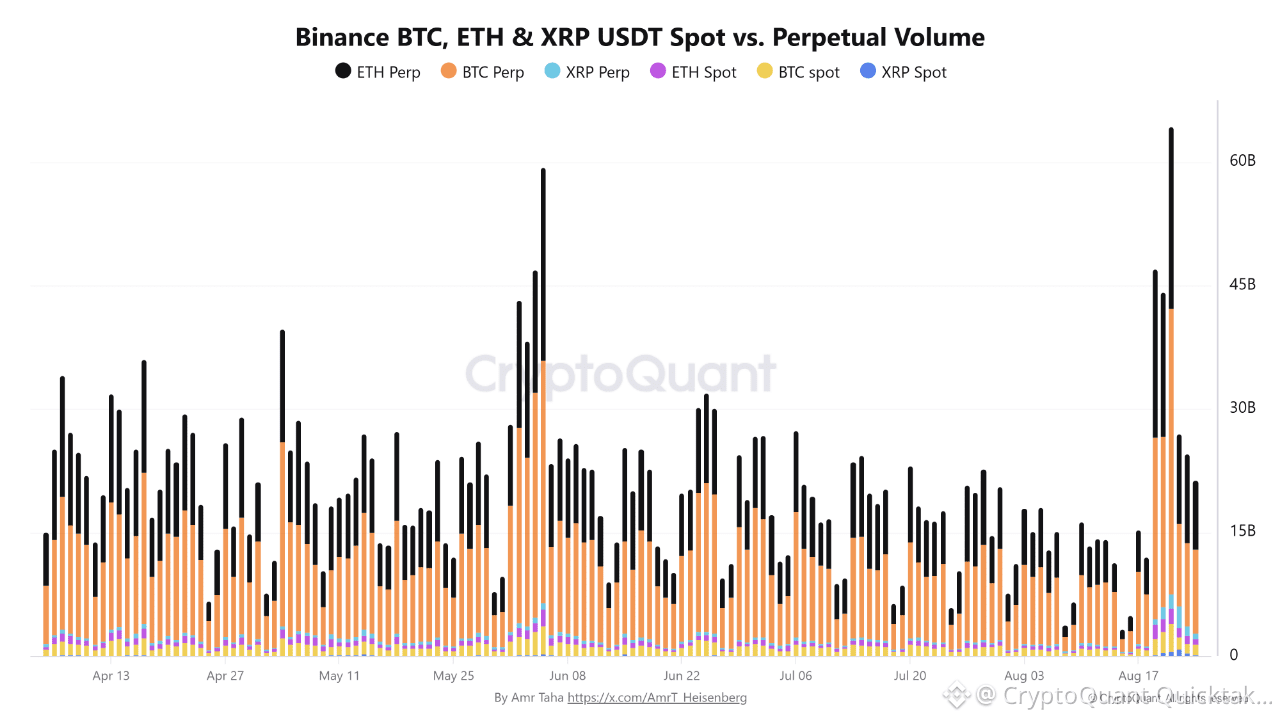
Combined trading volume across Binance’s BTC, ETH and XRP USDT spot and perpetual markets reached approximately $64.21 billion on August 21, the highest daily reading since June 5.
Perpetual contracts accounted for $58.4 billion, or roughly 91% of the total, exceeding the combined spot volume of $5.81 billion by about 10 times.
Compared with June 5, perpetual volume increased 9%, while spot activity rose just 1.2%, indicating that the return to higher turnover was concentrated primarily in derivatives.
XRP recorded the strongest acceleration among the three assets.
Its combined spot and perpetual volume climbed to $2.41 billion from $1.11 billion on June 5—an increase of approximately 118%.
XRP perpetual volume rose 127% to $1.8 billion, while spot volume increased nearly 95% to $611 million.
Bitcoin’s combined volume also advanced 15.9% to $38 billion. Ethereum moved in the opposite direction, declining 6.5% to $23.8 billion despite the 8.2% increase in aggregate activity across the three assets.
The data shows a clear return of high trading turnover on Binance, led by perpetual markets .
Written by Amr Taha
Perpetual contracts accounted for $58.4 billion, or roughly 91% of the total, exceeding the combined spot volume of $5.81 billion by about 10 times.
Compared with June 5, perpetual volume increased 9%, while spot activity rose just 1.2%, indicating that the return to higher turnover was concentrated primarily in derivatives.
XRP recorded the strongest acceleration among the three assets.
Its combined spot and perpetual volume climbed to $2.41 billion from $1.11 billion on June 5—an increase of approximately 118%.
XRP perpetual volume rose 127% to $1.8 billion, while spot volume increased nearly 95% to $611 million.
Bitcoin’s combined volume also advanced 15.9% to $38 billion. Ethereum moved in the opposite direction, declining 6.5% to $23.8 billion despite the 8.2% increase in aggregate activity across the three assets.
The data shows a clear return of high trading turnover on Binance, led by perpetual markets .
Written by Amr Taha
326
Article
Futures Sentiment on Binance Flips Bullish After Months of Short DominanceFor the first time this year, funding rates on Binance have shifted toward a predominance of long positions.
This hasn't happened since the October 2025 top, when funding rates remained consistently below the 0.01% threshold, signaling a dominance of short positions and reflecting the pessimism among traders.
With $BTC delivering a 27% performance over the past 7 days, funding rates have finally turned positive again (>0.01%).
Contrary to popular belief, a funding rate at 0% doesn't indicate a neutral market, it actually reflects short dominance.
On Binance and on other platforms, the calculation formula factors in a base interest rate of 0.01%, which represents the true neutrality threshold. Below that level, shorts dominate, above it, longs take over.
This shift is particularly notable as it follows several episodes of extreme short dominance, marked by negative funding rates. It confirms that sentiment on the futures market is turning bullish again.
This dynamic comes at a pivotal moment: positive demand on futures is now adding to the recent improvement in spot market demand. And it's precisely when these two signals sync up that a durable bullish trend has the best chance of taking hold,which is exactly what we're seeing today.
But be cautious, when an extreme positive level is reached, it can signal the early stages of a trend reversal.
Written by Darkfost
Futures Sentiment on Binance Flips Bullish After Months of Short Dominance
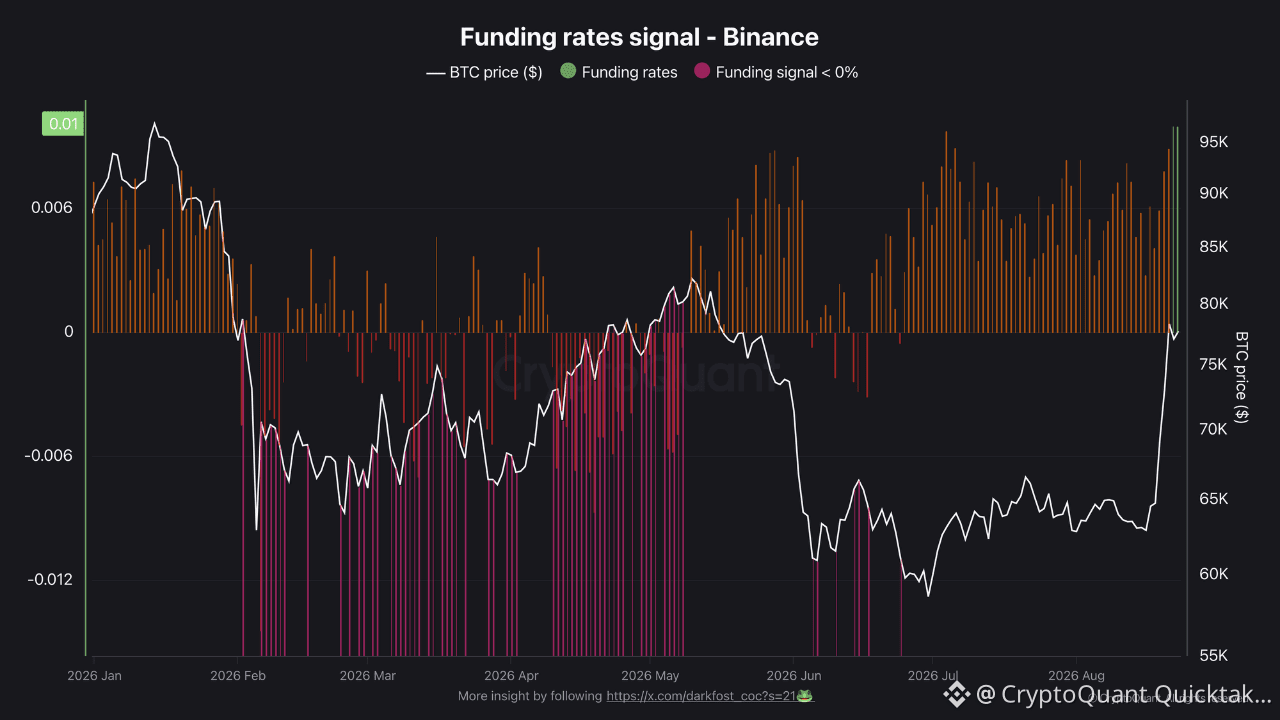
For the first time this year, funding rates on Binance have shifted toward a predominance of long positions.
This hasn't happened since the October 2025 top, when funding rates remained consistently below the 0.01% threshold, signaling a dominance of short positions and reflecting the pessimism among traders.
With $BTC delivering a 27% performance over the past 7 days, funding rates have finally turned positive again (>0.01%).
Contrary to popular belief, a funding rate at 0% doesn't indicate a neutral market, it actually reflects short dominance.
On Binance and on other platforms, the calculation formula factors in a base interest rate of 0.01%, which represents the true neutrality threshold. Below that level, shorts dominate, above it, longs take over.
This shift is particularly notable as it follows several episodes of extreme short dominance, marked by negative funding rates. It confirms that sentiment on the futures market is turning bullish again.
This dynamic comes at a pivotal moment: positive demand on futures is now adding to the recent improvement in spot market demand. And it's precisely when these two signals sync up that a durable bullish trend has the best chance of taking hold,which is exactly what we're seeing today.
But be cautious, when an extreme positive level is reached, it can signal the early stages of a trend reversal.
Written by Darkfost
This hasn't happened since the October 2025 top, when funding rates remained consistently below the 0.01% threshold, signaling a dominance of short positions and reflecting the pessimism among traders.
With $BTC delivering a 27% performance over the past 7 days, funding rates have finally turned positive again (>0.01%).
Contrary to popular belief, a funding rate at 0% doesn't indicate a neutral market, it actually reflects short dominance.
On Binance and on other platforms, the calculation formula factors in a base interest rate of 0.01%, which represents the true neutrality threshold. Below that level, shorts dominate, above it, longs take over.
This shift is particularly notable as it follows several episodes of extreme short dominance, marked by negative funding rates. It confirms that sentiment on the futures market is turning bullish again.
This dynamic comes at a pivotal moment: positive demand on futures is now adding to the recent improvement in spot market demand. And it's precisely when these two signals sync up that a durable bullish trend has the best chance of taking hold,which is exactly what we're seeing today.
But be cautious, when an extreme positive level is reached, it can signal the early stages of a trend reversal.
Written by Darkfost
250
Article
The State of the Ethereum Market ↓• Overall, despite similar price weakness, several of Ethereum's underlying fundamentals are stronger during the June 2026 decline than they were in April 2025 during the tariff war, which is why this recovery is taking place in a more solid context for ETH.
Written by Facundo Fama
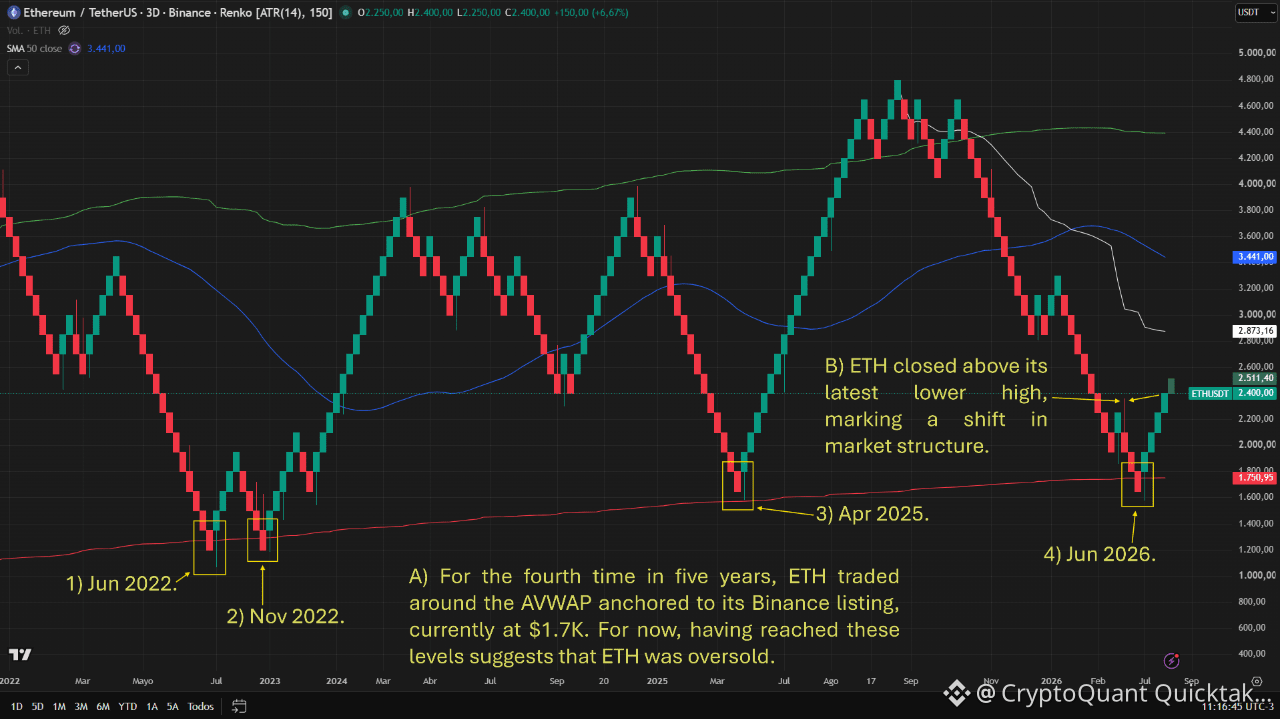
The State of the Ethereum Market ↓
• Overall, despite similar price weakness, several of Ethereum's underlying fundamentals are stronger during the June 2026 decline than they were in April 2025 during the tariff war, which is why this recovery is taking place in a more solid context for ETH.
Written by Facundo Fama
Written by Facundo Fama
176
Article
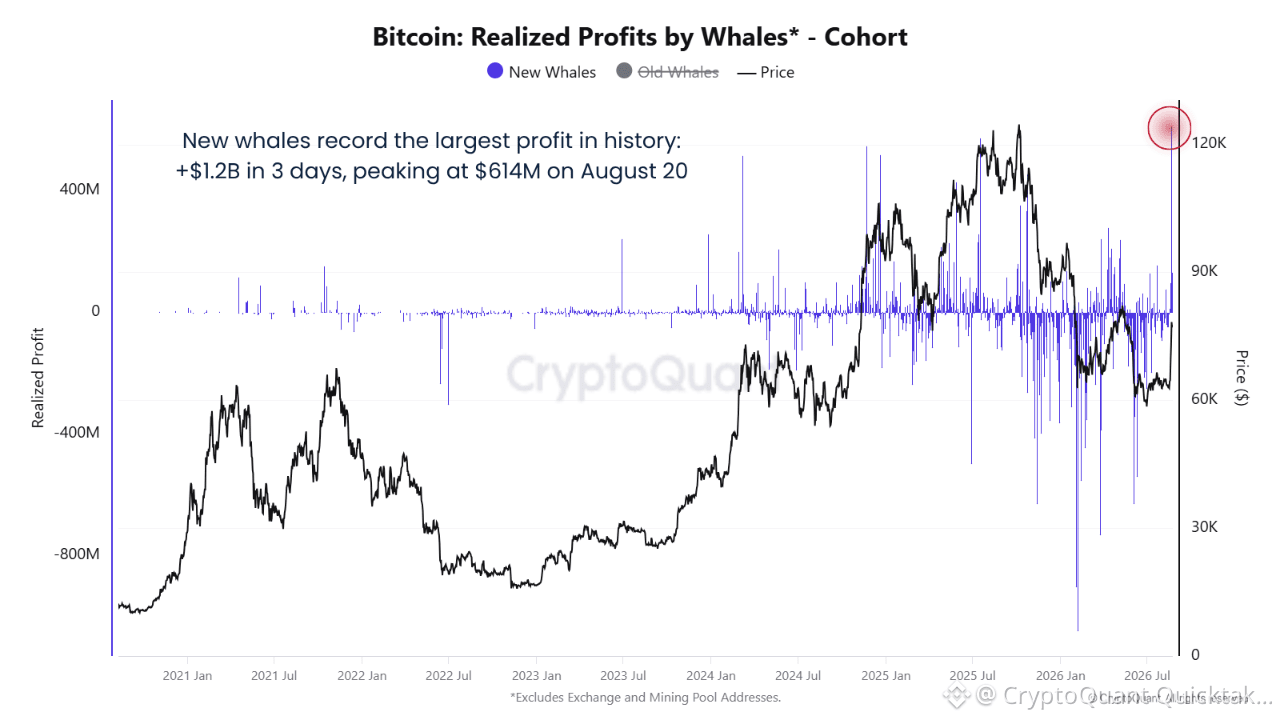
New Whales Just Realized a Record $1.2B As Bitcoin Reclaimed Their Cost BasisNew Whales have now realized more than $1.2B in profits in just three days, the largest profit-realization event recorded for this cohort. The sequence peaked on August 20 at roughly $614M, also marking the highest single-day reading in the metric’s history.
The timing matters.
Bitcoin has simultaneously moved back above the Short-Term Whale Realized Price, currently around $68.9K. By August 23, BTC was trading near $77.7K, placing price roughly 12.8% above this aggregate cost basis.
For months, recently accumulated large holders were operating around or below their acquisition price as BTC traded beneath this level. The latest rebound has radically changed their incentive structure: capital that had been trapped in unrealized losses suddenly received an opportunity to exit at breakeven, or secure a meaningful profit.
This makes the current move an important demand test.
What to Watch
If BTC can remain above the ~$70K whale cost basis while realized profits normalize, it would suggest that new demand is successfully absorbing distribution.
If profit realization remains elevated and price falls back below that level, however, the rebound could increasingly resemble a breakeven exit rally, with recently trapped holders becoming overhead supply once again.
The rally has restored profitability.
Now the market needs to prove it can absorb what that profitability unlocks.
Written by MorenoDV_
New Whales Just Realized a Record $1.2B As Bitcoin Reclaimed Their Cost Basis
New Whales have now realized more than $1.2B in profits in just three days, the largest profit-realization event recorded for this cohort. The sequence peaked on August 20 at roughly $614M, also marking the highest single-day reading in the metric’s history.
The timing matters.
Bitcoin has simultaneously moved back above the Short-Term Whale Realized Price, currently around $68.9K. By August 23, BTC was trading near $77.7K, placing price roughly 12.8% above this aggregate cost basis.
For months, recently accumulated large holders were operating around or below their acquisition price as BTC traded beneath this level. The latest rebound has radically changed their incentive structure: capital that had been trapped in unrealized losses suddenly received an opportunity to exit at breakeven, or secure a meaningful profit.
This makes the current move an important demand test.
What to Watch
If BTC can remain above the ~$70K whale cost basis while realized profits normalize, it would suggest that new demand is successfully absorbing distribution.
If profit realization remains elevated and price falls back below that level, however, the rebound could increasingly resemble a breakeven exit rally, with recently trapped holders becoming overhead supply once again.
The rally has restored profitability.
Now the market needs to prove it can absorb what that profitability unlocks.
Written by MorenoDV_
The timing matters.
Bitcoin has simultaneously moved back above the Short-Term Whale Realized Price, currently around $68.9K. By August 23, BTC was trading near $77.7K, placing price roughly 12.8% above this aggregate cost basis.
For months, recently accumulated large holders were operating around or below their acquisition price as BTC traded beneath this level. The latest rebound has radically changed their incentive structure: capital that had been trapped in unrealized losses suddenly received an opportunity to exit at breakeven, or secure a meaningful profit.
This makes the current move an important demand test.
What to Watch
If BTC can remain above the ~$70K whale cost basis while realized profits normalize, it would suggest that new demand is successfully absorbing distribution.
If profit realization remains elevated and price falls back below that level, however, the rebound could increasingly resemble a breakeven exit rally, with recently trapped holders becoming overhead supply once again.
The rally has restored profitability.
Now the market needs to prove it can absorb what that profitability unlocks.
Written by MorenoDV_
147
Article
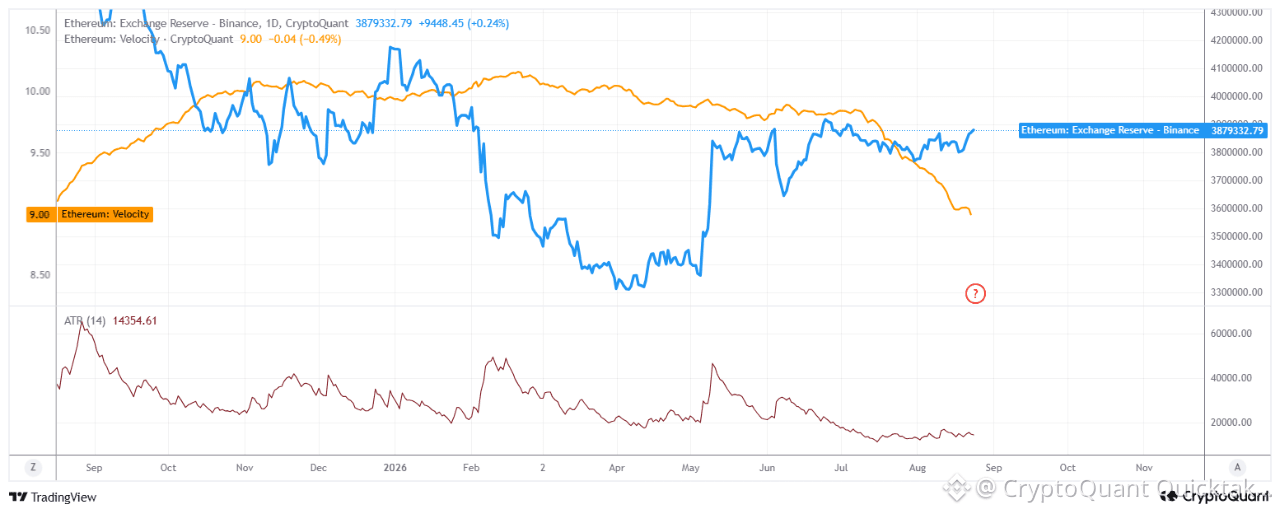
Has Ethereum’s Uptrend Started?As we can see from the chart, the fact that the Binance ETH reserve is rising alongside the ETH price increase indicates that risk is accumulating on the supply side of the rally. The Binance ETH reserve has increased from approximately 3.5 million ETH to 3.87 million ETH. In other words, while ETH has been recovering, the amount of ETH held on Binance has also increased.
This is a development that should be closely monitored from a price perspective. ETH held on exchanges represents an increasing amount of ETH that is readily available for trading and potentially selling. Therefore, even if the price continues to rise, the associated risk is also increasing at the same time. During bullish periods, investors generally withdraw their ETH from exchanges and move it to personal wallets for long term holding. However, in this case, investors may not fully trust the rally, as they are sending their ETH to Binance even while the price is rising.
Of course, we cannot say that these ETH deposits are definitely intended for selling. ETH can be sent to exchanges for trading, use as collateral, or other operational purposes. Therefore, it would not be correct to interpret the increase in exchange reserves alone as a direct sell signal. However, such increases are often followed by increased selling pressure.
The decline in Velocity while the reserve is rising is also noteworthy. ETH Velocity has fallen from approximately 10.1 to 9.0, indicating a significant slowdown in the movement of ETH. This suggests that transaction activity is not strengthening at the same pace as the price.
ATR also indicates that the strength of the upward move is weakening. A falling ATR indicates that ETH’s price movements and volatility are contracting. In other words, although the price has risen, the volatility supporting the move has gradually decreased.
Therefore, rather than a strong and established uptrend, the current structure makes me consider the possibility of a short squeeze.
Written by PelinayPA
Has Ethereum’s Uptrend Started?
As we can see from the chart, the fact that the Binance ETH reserve is rising alongside the ETH price increase indicates that risk is accumulating on the supply side of the rally. The Binance ETH reserve has increased from approximately 3.5 million ETH to 3.87 million ETH. In other words, while ETH has been recovering, the amount of ETH held on Binance has also increased.
This is a development that should be closely monitored from a price perspective. ETH held on exchanges represents an increasing amount of ETH that is readily available for trading and potentially selling. Therefore, even if the price continues to rise, the associated risk is also increasing at the same time. During bullish periods, investors generally withdraw their ETH from exchanges and move it to personal wallets for long term holding. However, in this case, investors may not fully trust the rally, as they are sending their ETH to Binance even while the price is rising.
Of course, we cannot say that these ETH deposits are definitely intended for selling. ETH can be sent to exchanges for trading, use as collateral, or other operational purposes. Therefore, it would not be correct to interpret the increase in exchange reserves alone as a direct sell signal. However, such increases are often followed by increased selling pressure.
The decline in Velocity while the reserve is rising is also noteworthy. ETH Velocity has fallen from approximately 10.1 to 9.0, indicating a significant slowdown in the movement of ETH. This suggests that transaction activity is not strengthening at the same pace as the price.
ATR also indicates that the strength of the upward move is weakening. A falling ATR indicates that ETH’s price movements and volatility are contracting. In other words, although the price has risen, the volatility supporting the move has gradually decreased.
Therefore, rather than a strong and established uptrend, the current structure makes me consider the possibility of a short squeeze.
Written by PelinayPA
This is a development that should be closely monitored from a price perspective. ETH held on exchanges represents an increasing amount of ETH that is readily available for trading and potentially selling. Therefore, even if the price continues to rise, the associated risk is also increasing at the same time. During bullish periods, investors generally withdraw their ETH from exchanges and move it to personal wallets for long term holding. However, in this case, investors may not fully trust the rally, as they are sending their ETH to Binance even while the price is rising.
Of course, we cannot say that these ETH deposits are definitely intended for selling. ETH can be sent to exchanges for trading, use as collateral, or other operational purposes. Therefore, it would not be correct to interpret the increase in exchange reserves alone as a direct sell signal. However, such increases are often followed by increased selling pressure.
The decline in Velocity while the reserve is rising is also noteworthy. ETH Velocity has fallen from approximately 10.1 to 9.0, indicating a significant slowdown in the movement of ETH. This suggests that transaction activity is not strengthening at the same pace as the price.
ATR also indicates that the strength of the upward move is weakening. A falling ATR indicates that ETH’s price movements and volatility are contracting. In other words, although the price has risen, the volatility supporting the move has gradually decreased.
Therefore, rather than a strong and established uptrend, the current structure makes me consider the possibility of a short squeeze.
Written by PelinayPA
196
Article
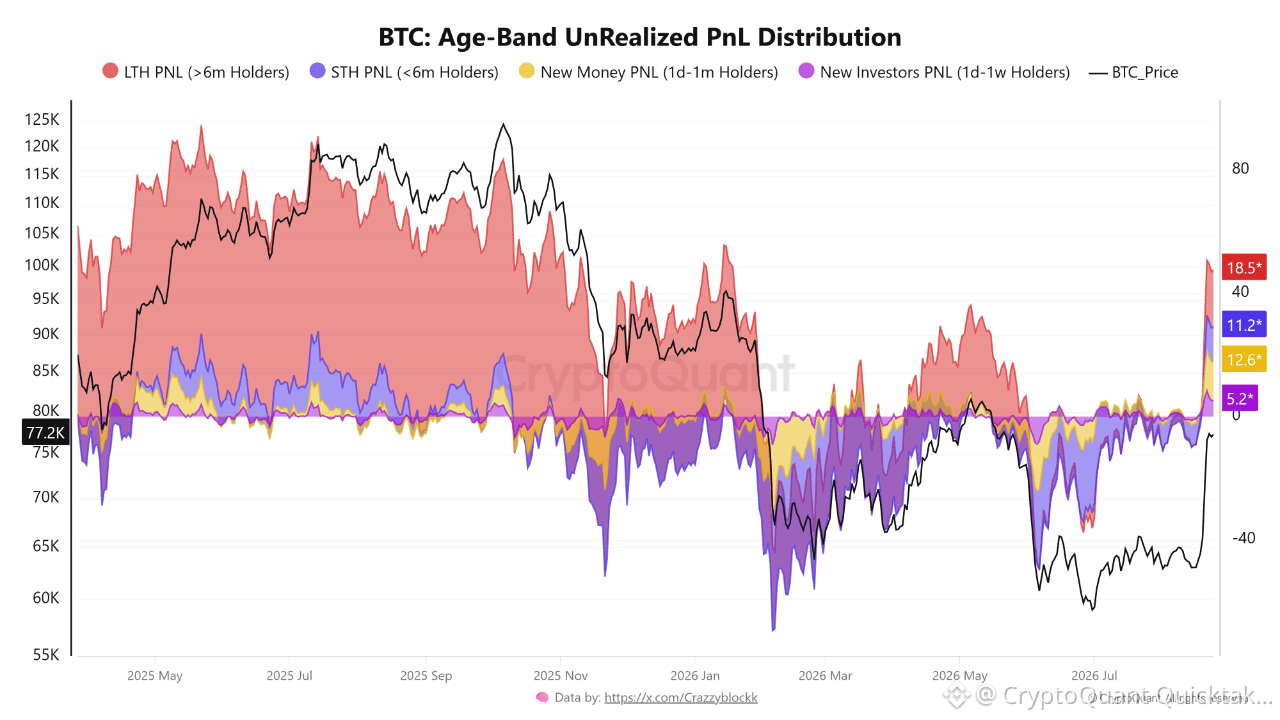
Bitcoin’s $77K Rally Is Repairing the Most Fragile Part of the MarketBitcoin’s move toward $77K has triggered a broad profitability reset across the network, but the most important change is happening among Short-Term Holders.
On August 16, BTC was trading near $63K while the Short-Term Holder Realized Price stood around $67.3K. STH profitability was roughly -6.8%, meaning the average recent buyer was still underwater.
By August 24, BTC had climbed to about $77.3K, while the STH Realized Price increased to roughly $68.6K. STH profitability improved to +11.3%.
At the same time, Long-Term Holder profitability moved from approximately breakeven to +18.5%, while New Money profitability rose from -1.4% to +12.7%.
This recovery is also visible across the broader UTXO structure. The share of UTXOs in loss fell from 51.8% to 23.8% between August 16 and August 24. Aggregate unrealized losses declined by about 45%, while unrealized profits increased nearly 40%.
This is a classic cost-basis reclamation process.
During late-stage bear markets, a large amount of supply changes hands at depressed prices. When price later breaks through these dense cost-basis zones, recent buyers move rapidly from loss to profit and the amount of underwater supply contracts sharply.
The current structure is now much healthier: BTC trades above both the LTH cost basis near $63K and the STH cost basis near $68.6K.
However, the newest investors have a much higher cost basis near $73K, leaving them with only a small profit cushion.
That makes the $68K–$73K region the key area to watch. Holding above it would suggest that the profitability reset is becoming structurally durable. Losing it would quickly push a large portion of recent buyers back into loss.
Written by Crazzyblockk
Bitcoin’s $77K Rally Is Repairing the Most Fragile Part of the Market
Bitcoin’s move toward $77K has triggered a broad profitability reset across the network, but the most important change is happening among Short-Term Holders.
On August 16, BTC was trading near $63K while the Short-Term Holder Realized Price stood around $67.3K. STH profitability was roughly -6.8%, meaning the average recent buyer was still underwater.
By August 24, BTC had climbed to about $77.3K, while the STH Realized Price increased to roughly $68.6K. STH profitability improved to +11.3%.
At the same time, Long-Term Holder profitability moved from approximately breakeven to +18.5%, while New Money profitability rose from -1.4% to +12.7%.
This recovery is also visible across the broader UTXO structure. The share of UTXOs in loss fell from 51.8% to 23.8% between August 16 and August 24. Aggregate unrealized losses declined by about 45%, while unrealized profits increased nearly 40%.
This is a classic cost-basis reclamation process.
During late-stage bear markets, a large amount of supply changes hands at depressed prices. When price later breaks through these dense cost-basis zones, recent buyers move rapidly from loss to profit and the amount of underwater supply contracts sharply.
The current structure is now much healthier: BTC trades above both the LTH cost basis near $63K and the STH cost basis near $68.6K.
However, the newest investors have a much higher cost basis near $73K, leaving them with only a small profit cushion.
That makes the $68K–$73K region the key area to watch. Holding above it would suggest that the profitability reset is becoming structurally durable. Losing it would quickly push a large portion of recent buyers back into loss.
Written by Crazzyblockk
On August 16, BTC was trading near $63K while the Short-Term Holder Realized Price stood around $67.3K. STH profitability was roughly -6.8%, meaning the average recent buyer was still underwater.
By August 24, BTC had climbed to about $77.3K, while the STH Realized Price increased to roughly $68.6K. STH profitability improved to +11.3%.
At the same time, Long-Term Holder profitability moved from approximately breakeven to +18.5%, while New Money profitability rose from -1.4% to +12.7%.
This recovery is also visible across the broader UTXO structure. The share of UTXOs in loss fell from 51.8% to 23.8% between August 16 and August 24. Aggregate unrealized losses declined by about 45%, while unrealized profits increased nearly 40%.
This is a classic cost-basis reclamation process.
During late-stage bear markets, a large amount of supply changes hands at depressed prices. When price later breaks through these dense cost-basis zones, recent buyers move rapidly from loss to profit and the amount of underwater supply contracts sharply.
The current structure is now much healthier: BTC trades above both the LTH cost basis near $63K and the STH cost basis near $68.6K.
However, the newest investors have a much higher cost basis near $73K, leaving them with only a small profit cushion.
That makes the $68K–$73K region the key area to watch. Holding above it would suggest that the profitability reset is becoming structurally durable. Losing it would quickly push a large portion of recent buyers back into loss.
Written by Crazzyblockk
85
Article
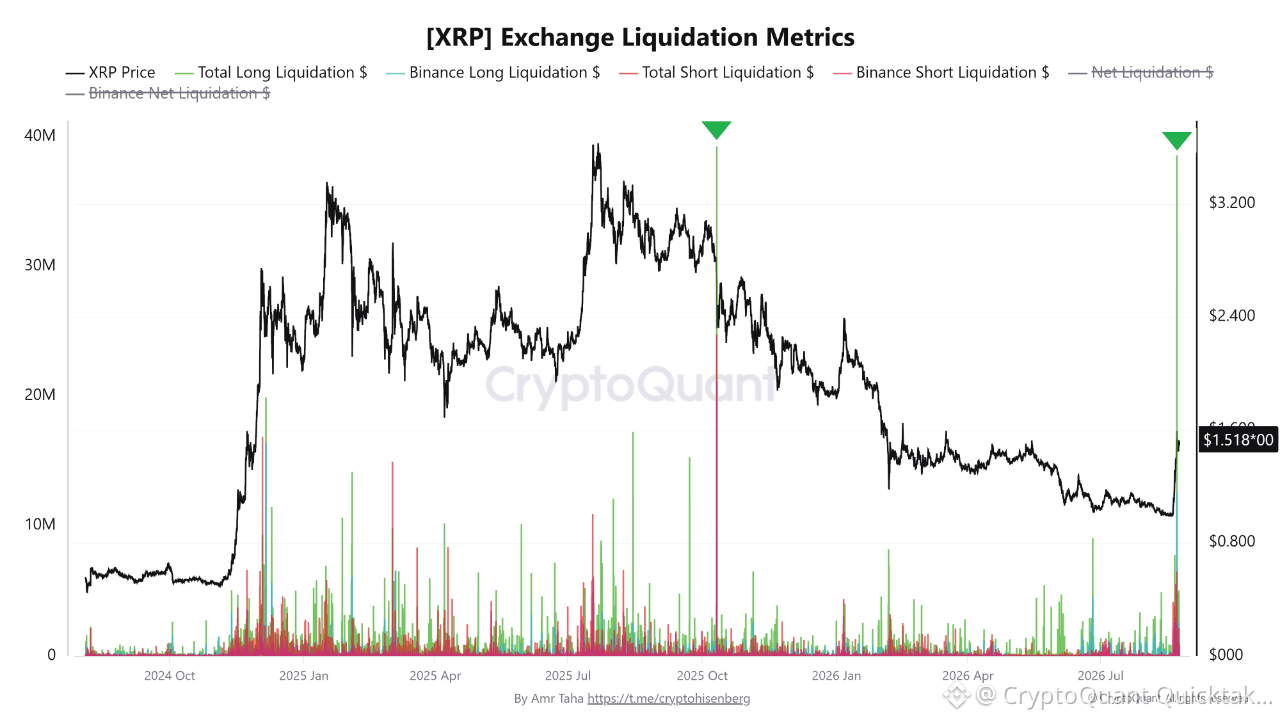
XRP Long Liquidations Hit $38.6M, Largest Since October As Binance Flips to 9-to-1 ImbalanceXRP long liquidations surged to $38.58 million on August 22, the highest reading since October 10, 2025.
The figure came within just $720,000—or 1.8%—of the $39.3 million recorded during the October liquidation event.
Short liquidations reached only $6.5 million, meaning long liquidations were nearly six times larger and accounted for 85.6% of the $45.08 million total.
This contrasts with October 10, when $39.3 million in longs and $24.8 million in shorts were liquidated.
Despite nearly matching October’s long-liquidation total, the latest event was almost 30% smaller overall because short liquidations were 74% lower.
The structural reversal was even clearer on Binance.
XRP long liquidations reached $12.63 million, compared with just $1.4 million in shorts—a nine-to-one imbalance, with longs representing 90% of the exchange’s total.
On October 10, Binance showed the opposite structure: short liquidations reached $21.1 million, more than twice the $9.82 million recorded for longs.
Compared with that event, Binance long liquidations increased 28.6%, while short liquidations fell 93.4%.
The pattern was not limited to Binance.
Ex-Binance long liquidations totaled approximately $25.95 million on August 22, versus $5.1 million in shorts, producing another five-to-one imbalance.
Written by Amr Taha
XRP Long Liquidations Hit $38.6M, Largest Since October As Binance Flips to 9-to-1 Imbalance
XRP long liquidations surged to $38.58 million on August 22, the highest reading since October 10, 2025.
The figure came within just $720,000—or 1.8%—of the $39.3 million recorded during the October liquidation event.
Short liquidations reached only $6.5 million, meaning long liquidations were nearly six times larger and accounted for 85.6% of the $45.08 million total.
This contrasts with October 10, when $39.3 million in longs and $24.8 million in shorts were liquidated.
Despite nearly matching October’s long-liquidation total, the latest event was almost 30% smaller overall because short liquidations were 74% lower.
The structural reversal was even clearer on Binance.
XRP long liquidations reached $12.63 million, compared with just $1.4 million in shorts—a nine-to-one imbalance, with longs representing 90% of the exchange’s total.
On October 10, Binance showed the opposite structure: short liquidations reached $21.1 million, more than twice the $9.82 million recorded for longs.
Compared with that event, Binance long liquidations increased 28.6%, while short liquidations fell 93.4%.
The pattern was not limited to Binance.
Ex-Binance long liquidations totaled approximately $25.95 million on August 22, versus $5.1 million in shorts, producing another five-to-one imbalance.
Written by Amr Taha
The figure came within just $720,000—or 1.8%—of the $39.3 million recorded during the October liquidation event.
Short liquidations reached only $6.5 million, meaning long liquidations were nearly six times larger and accounted for 85.6% of the $45.08 million total.
This contrasts with October 10, when $39.3 million in longs and $24.8 million in shorts were liquidated.
Despite nearly matching October’s long-liquidation total, the latest event was almost 30% smaller overall because short liquidations were 74% lower.
The structural reversal was even clearer on Binance.
XRP long liquidations reached $12.63 million, compared with just $1.4 million in shorts—a nine-to-one imbalance, with longs representing 90% of the exchange’s total.
On October 10, Binance showed the opposite structure: short liquidations reached $21.1 million, more than twice the $9.82 million recorded for longs.
Compared with that event, Binance long liquidations increased 28.6%, while short liquidations fell 93.4%.
The pattern was not limited to Binance.
Ex-Binance long liquidations totaled approximately $25.95 million on August 22, versus $5.1 million in shorts, producing another five-to-one imbalance.
Written by Amr Taha
2
388
Article
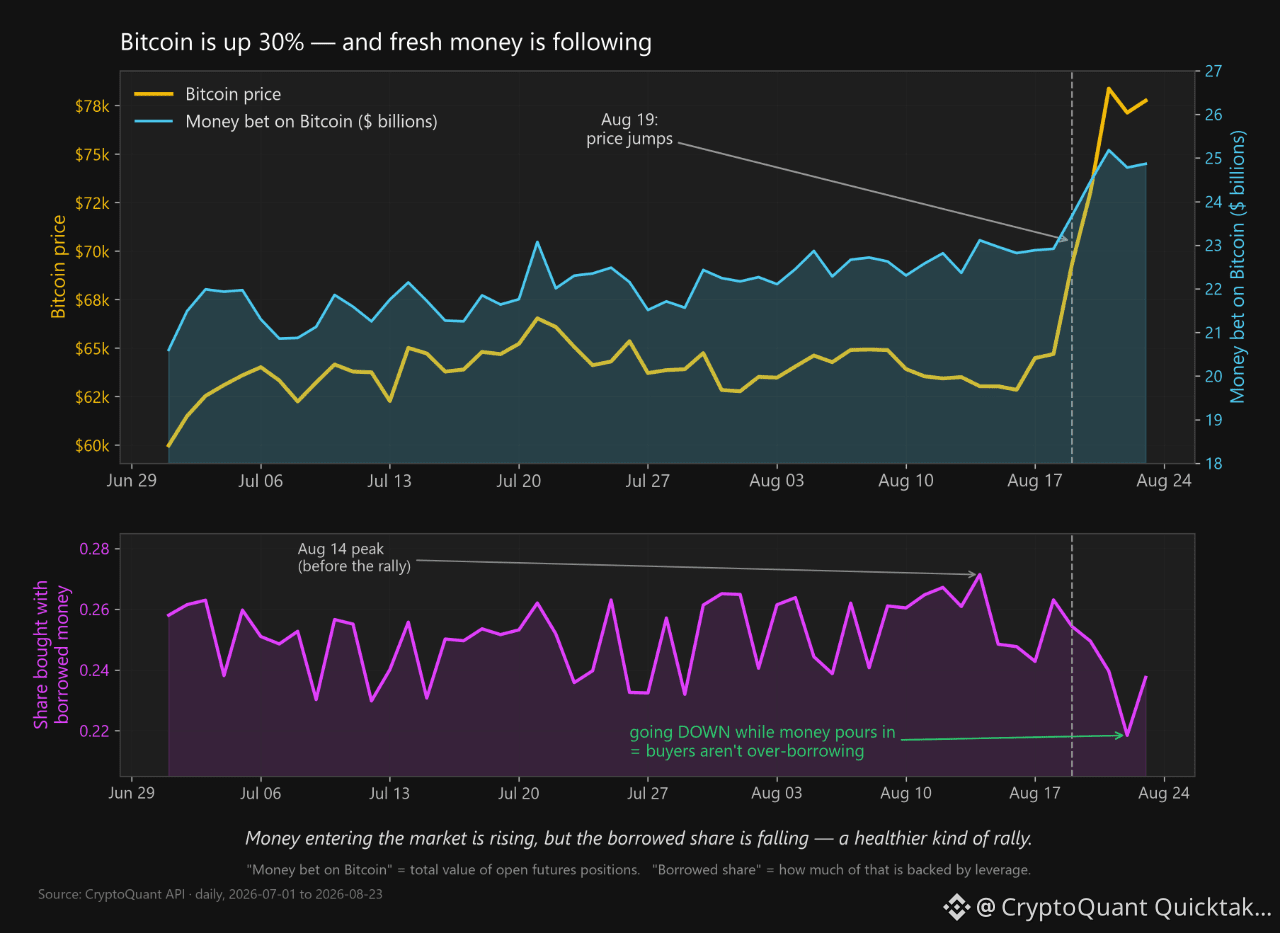
Bitcoin Is Up 30% — and Fresh Money Is FollowingSince early July, Bitcoin has climbed from $60k to $78k. Along the way, the total amount of money positioned in the market has grown from $20.6B to $24.9B — near the highest level of this window.
But here's the interesting part: the share of that money backed by borrowing has been falling, not rising. It peaked on August 14 — before the rally even started — and has been drifting down ever since, even as prices jumped after August 19.
That's unusual. Rallies driven by borrowed money tend to end violently, because lenders can force-sell positions when prices dip. A rally where fresh money arrives without growing leverage is built on firmer ground.
This doesn't guarantee the price keeps rising. But compared to mid-August — when borrowing was at its peak and price was going nowhere — today's structure looks a lot healthier.
If the borrowed-money share starts climbing back while prices stall, that's the warning sign to watch for. We're not there yet.
Written by 우민규 Woominkyu
Bitcoin Is Up 30% — and Fresh Money Is Following
Since early July, Bitcoin has climbed from $60k to $78k. Along the way, the total amount of money positioned in the market has grown from $20.6B to $24.9B — near the highest level of this window.
But here's the interesting part: the share of that money backed by borrowing has been falling, not rising. It peaked on August 14 — before the rally even started — and has been drifting down ever since, even as prices jumped after August 19.
That's unusual. Rallies driven by borrowed money tend to end violently, because lenders can force-sell positions when prices dip. A rally where fresh money arrives without growing leverage is built on firmer ground.
This doesn't guarantee the price keeps rising. But compared to mid-August — when borrowing was at its peak and price was going nowhere — today's structure looks a lot healthier.
If the borrowed-money share starts climbing back while prices stall, that's the warning sign to watch for. We're not there yet.
Written by 우민규 Woominkyu
But here's the interesting part: the share of that money backed by borrowing has been falling, not rising. It peaked on August 14 — before the rally even started — and has been drifting down ever since, even as prices jumped after August 19.
That's unusual. Rallies driven by borrowed money tend to end violently, because lenders can force-sell positions when prices dip. A rally where fresh money arrives without growing leverage is built on firmer ground.
This doesn't guarantee the price keeps rising. But compared to mid-August — when borrowing was at its peak and price was going nowhere — today's structure looks a lot healthier.
If the borrowed-money share starts climbing back while prices stall, that's the warning sign to watch for. We're not there yet.
Written by 우민규 Woominkyu
138
Article
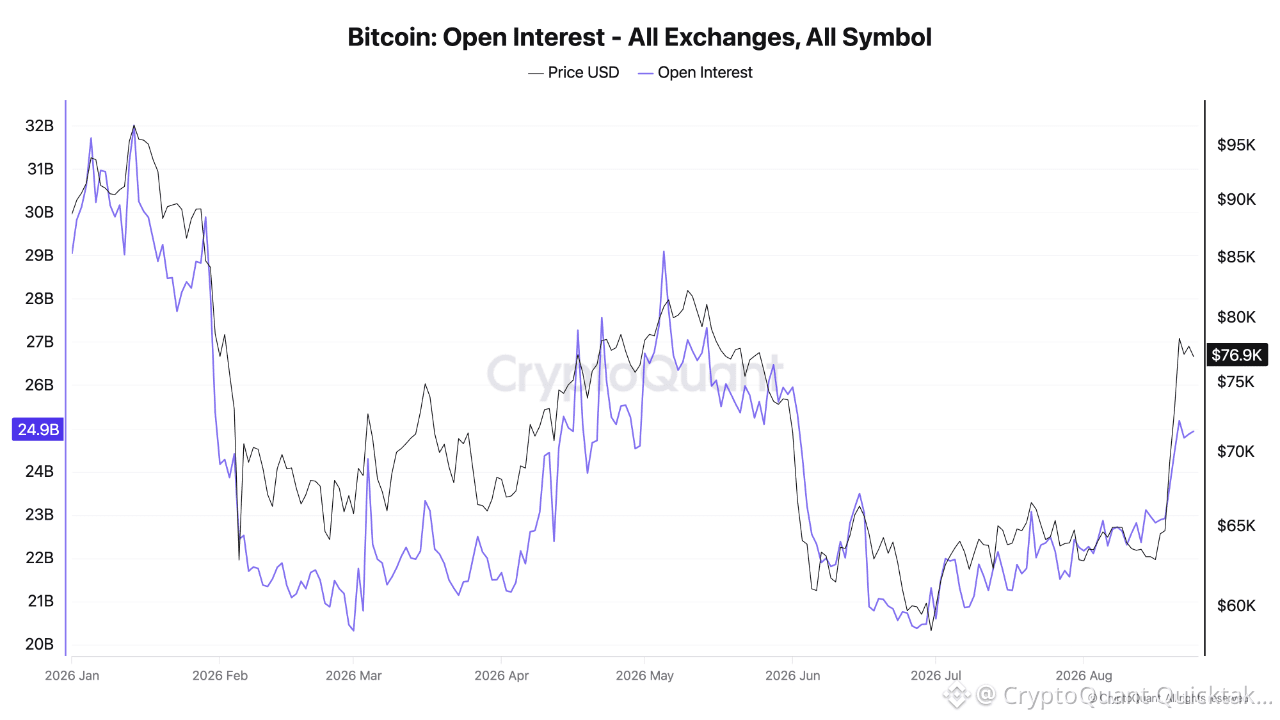
BTC Is Moving Faster Than Leverage.Earlier this week, BTC went from ~$64K to ~$77K, while open interest increased from roughly $22B to $24.9B.
Leverage is coming back as BTC breaks higher, but OI is still lagging behind the move in price.
BTC is up roughly 21% from the recent low, while OI is up around 13%.
The estimated leverage ratio is also around 0.23, still below some of the higher levels seen earlier this year.
So far, the rally doesn't look heavily driven by leverage. Traders are adding positions, but not at the same pace as the move in BTC.
If BTC keeps pushing higher, OI and ELR will be important to watch. If OI starts catching up quickly and ELR moves back toward its previous highs, that would change the picture.
For now, price is still moving faster than leverage.
Written by nocoffeenobrain
BTC Is Moving Faster Than Leverage.
Earlier this week, BTC went from ~$64K to ~$77K, while open interest increased from roughly $22B to $24.9B.
Leverage is coming back as BTC breaks higher, but OI is still lagging behind the move in price.
BTC is up roughly 21% from the recent low, while OI is up around 13%.
The estimated leverage ratio is also around 0.23, still below some of the higher levels seen earlier this year.
So far, the rally doesn't look heavily driven by leverage. Traders are adding positions, but not at the same pace as the move in BTC.
If BTC keeps pushing higher, OI and ELR will be important to watch. If OI starts catching up quickly and ELR moves back toward its previous highs, that would change the picture.
For now, price is still moving faster than leverage.
Written by nocoffeenobrain
Leverage is coming back as BTC breaks higher, but OI is still lagging behind the move in price.
BTC is up roughly 21% from the recent low, while OI is up around 13%.
The estimated leverage ratio is also around 0.23, still below some of the higher levels seen earlier this year.
So far, the rally doesn't look heavily driven by leverage. Traders are adding positions, but not at the same pace as the move in BTC.
If BTC keeps pushing higher, OI and ELR will be important to watch. If OI starts catching up quickly and ELR moves back toward its previous highs, that would change the picture.
For now, price is still moving faster than leverage.
Written by nocoffeenobrain
353
Article
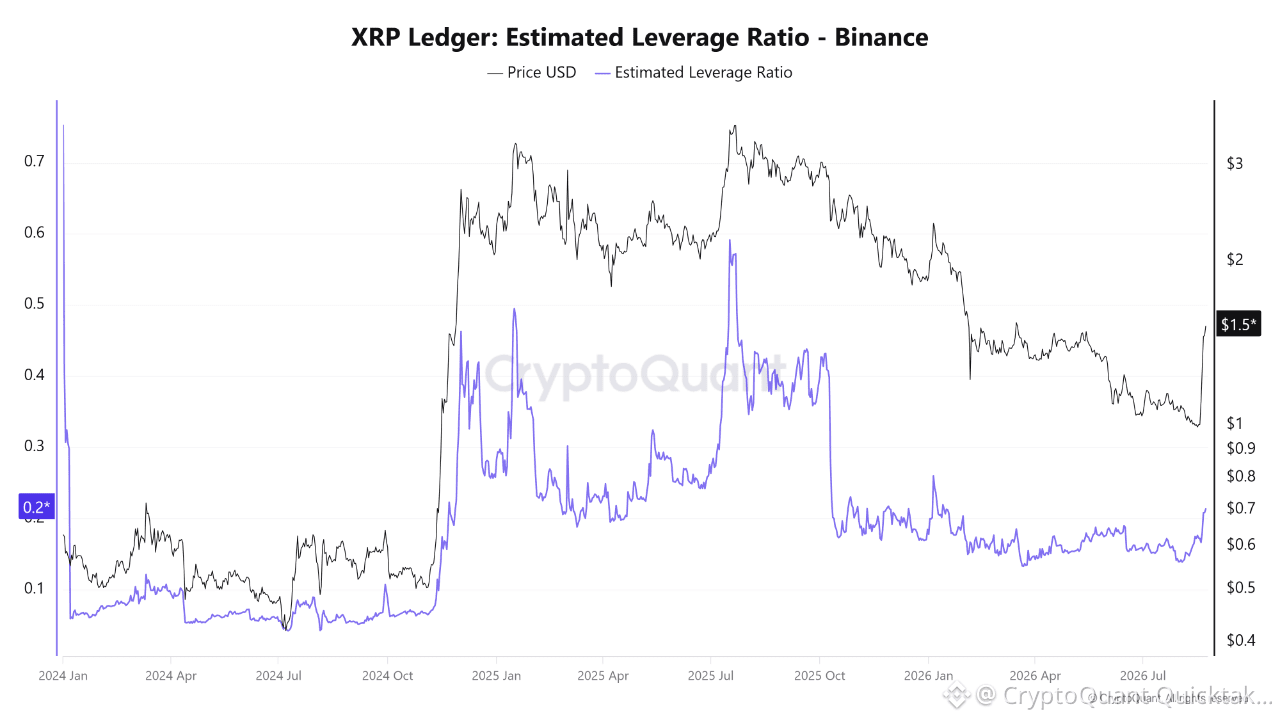
XRP Leverage Ratio Hits Highest Level in More Than 7 Months on BinanceData indicates that the estimated leverage ratio for XRP on Binance has risen to approximately 0.213, its highest level since last January. This increase reflects traders’ growing reliance on leverage, with positions in the XRP derivatives market This suggests that traders are becoming more willing to take risks and open larger positions, indicating increased activity and speculation in the derivatives market. In other words, a larger portion of market activity is now linked to leveraged positions, which could amplify XRP’s price movements in both directions.
This increase is particularly significant because it comes after a prolonged period during which the ratio remained at relatively low levels throughout 2026. Reaching its highest level since January suggests a gradual return of risk appetite to the XRP derivatives market, rather than merely a temporary surge in the indicator.
However, the rise in leverage has two sides. If it coincides with a price increase and rising open interest, it could reflect increased confidence and the opening of new positions, potentially supporting the continuation of the upward trend. If the ratio rises while the price begins to decline, this could indicate an accumulation of highly leveraged positions, increasing the likelihood of forced liquidations and potentially leading to more severe price movements.
Written by Arab Chain
XRP Leverage Ratio Hits Highest Level in More Than 7 Months on Binance
Data indicates that the estimated leverage ratio for XRP on Binance has risen to approximately 0.213, its highest level since last January. This increase reflects traders’ growing reliance on leverage, with positions in the XRP derivatives market This suggests that traders are becoming more willing to take risks and open larger positions, indicating increased activity and speculation in the derivatives market. In other words, a larger portion of market activity is now linked to leveraged positions, which could amplify XRP’s price movements in both directions.
This increase is particularly significant because it comes after a prolonged period during which the ratio remained at relatively low levels throughout 2026. Reaching its highest level since January suggests a gradual return of risk appetite to the XRP derivatives market, rather than merely a temporary surge in the indicator.
However, the rise in leverage has two sides. If it coincides with a price increase and rising open interest, it could reflect increased confidence and the opening of new positions, potentially supporting the continuation of the upward trend. If the ratio rises while the price begins to decline, this could indicate an accumulation of highly leveraged positions, increasing the likelihood of forced liquidations and potentially leading to more severe price movements.
Written by Arab Chain
This increase is particularly significant because it comes after a prolonged period during which the ratio remained at relatively low levels throughout 2026. Reaching its highest level since January suggests a gradual return of risk appetite to the XRP derivatives market, rather than merely a temporary surge in the indicator.
However, the rise in leverage has two sides. If it coincides with a price increase and rising open interest, it could reflect increased confidence and the opening of new positions, potentially supporting the continuation of the upward trend. If the ratio rises while the price begins to decline, this could indicate an accumulation of highly leveraged positions, increasing the likelihood of forced liquidations and potentially leading to more severe price movements.
Written by Arab Chain
1
506
Article
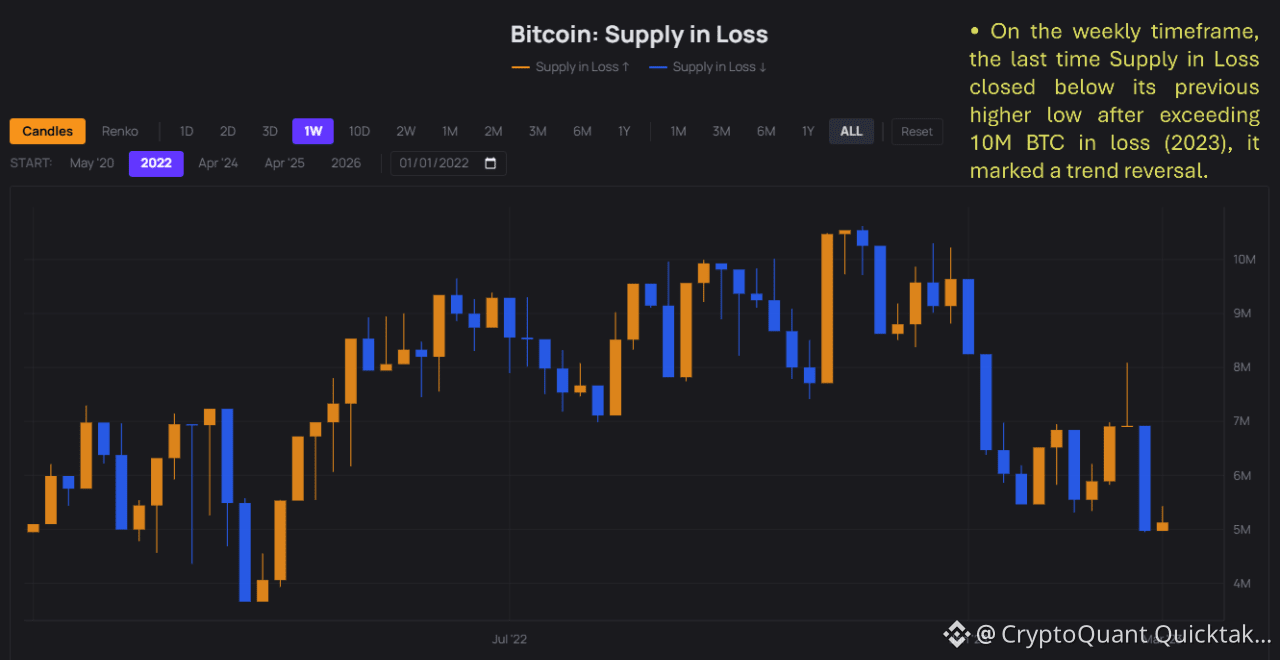
Bitcoin: Supply in Loss ↓• On the weekly timeframe, the last time Supply in Loss closed below its previous higher low after exceeding 10M BTC in loss (2023), it marked a trend reversal.
Written by Facundo Fama
Bitcoin: Supply in Loss ↓
• On the weekly timeframe, the last time Supply in Loss closed below its previous higher low after exceeding 10M BTC in loss (2023), it marked a trend reversal.
Written by Facundo Fama
Written by Facundo Fama
1
387
Article
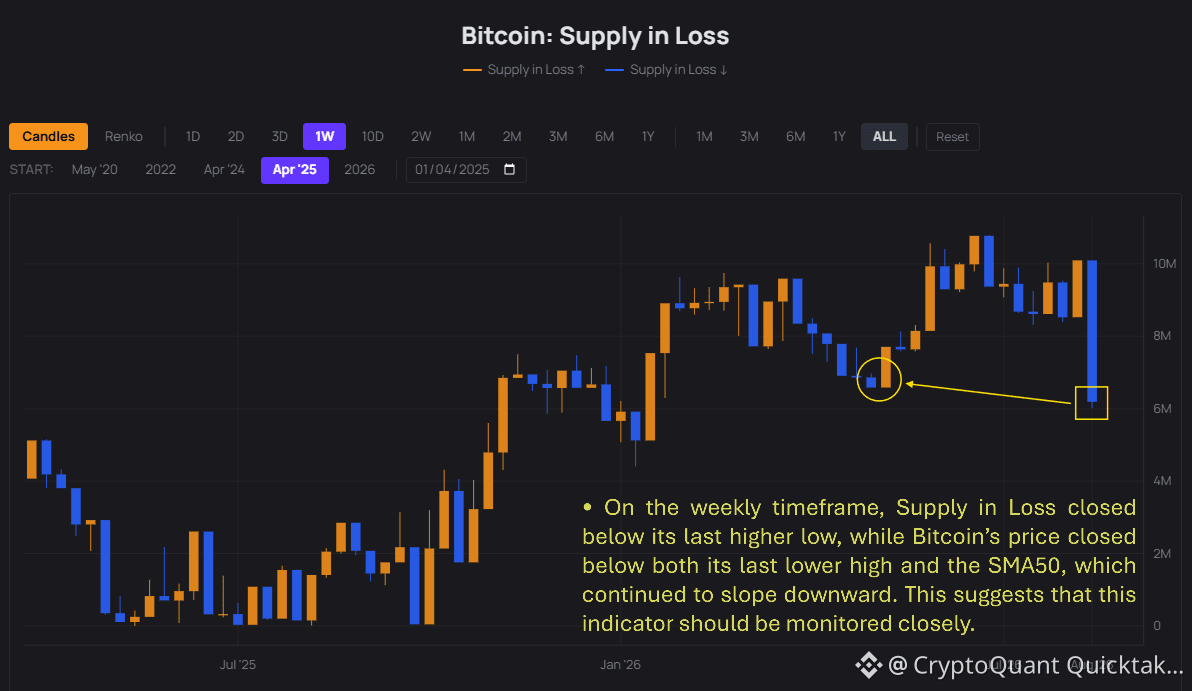
Bitcoin: Supply in Loss ↓• On the weekly timeframe, Supply in Loss closed below its last higher low, while Bitcoin’s price closed below both its last lower high and the SMA50, which continued to slope downward. This suggests that this indicator should be monitored closely.
Written by Facundo Fama
Bitcoin: Supply in Loss ↓
• On the weekly timeframe, Supply in Loss closed below its last higher low, while Bitcoin’s price closed below both its last lower high and the SMA50, which continued to slope downward. This suggests that this indicator should be monitored closely.
Written by Facundo Fama
Written by Facundo Fama
144
Article
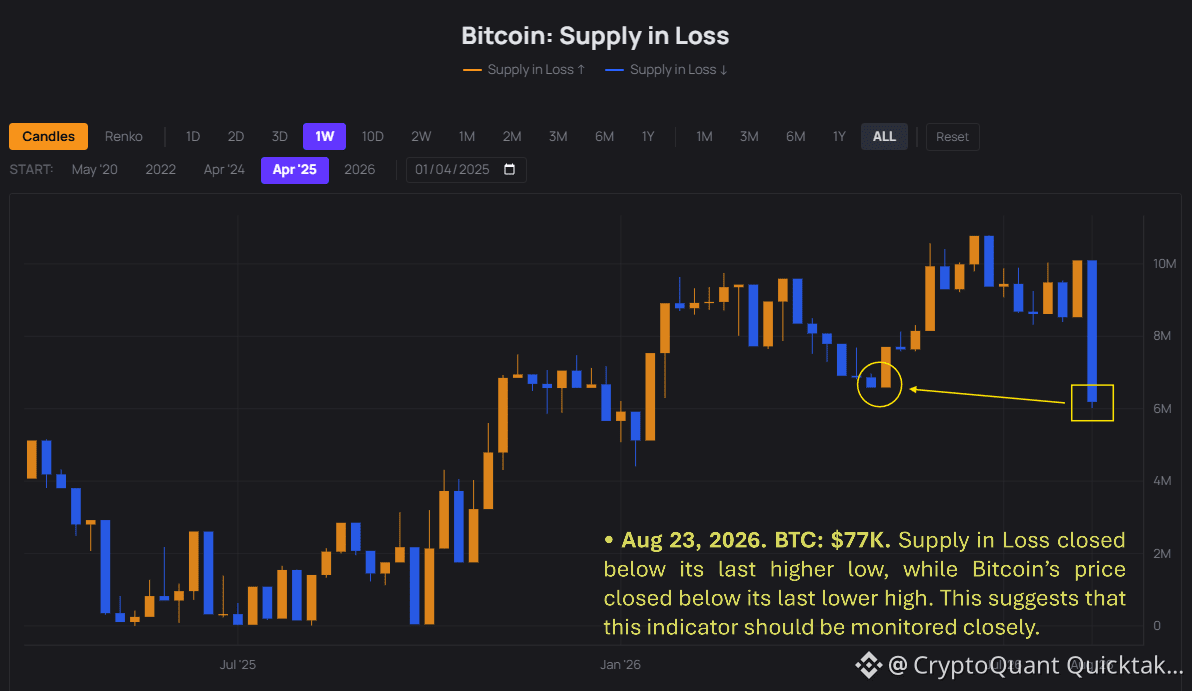
Bitcoin: Supply in Loss ↓• Aug 23, 2026. BTC: $77K. Supply in Loss closed below its last higher low, while Bitcoin’s price closed below its last lower high. This suggests that this indicator should be monitored closely.
Written by Facundo Fama
Bitcoin: Supply in Loss ↓
• Aug 23, 2026. BTC: $77K. Supply in Loss closed below its last higher low, while Bitcoin’s price closed below its last lower high. This suggests that this indicator should be monitored closely.
Written by Facundo Fama
Written by Facundo Fama
1
941
Article
U.S. Selling Pressure Is Fading — Coinbase Premium Signals Improving Bitcoin DemandBitcoin has rebounded sharply, climbing from the mid-$60K range to around $77.9K. One indicator worth watching behind this recovery is the Coinbase Premium Index.
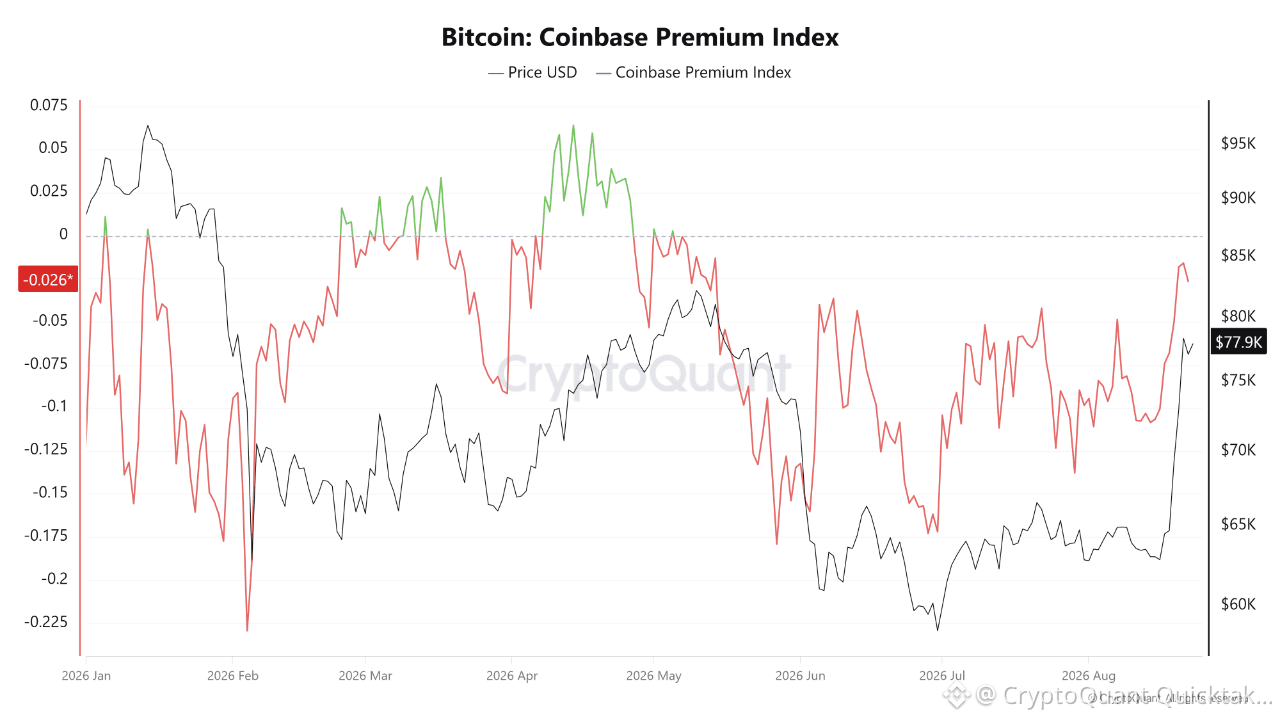
The index measures the price gap between Bitcoin on Coinbase and other major exchanges, providing insight into U.S. investor demand. Positive readings generally suggest stronger U.S. buying pressure, while negative readings indicate relatively stronger selling pressure.
Since late May, the index has remained deeply negative. During June and July, it briefly fell below -0.15 as Bitcoin declined, signaling persistent selling pressure from the U.S. market.
That trend is now changing.
In late August, the Coinbase Premium Index recovered rapidly from around -0.10 to -0.026. It is still negative, so this does not yet mean U.S. investors have become aggressive net buyers. However, it suggests that the heavy selling pressure seen over recent months is fading.
Importantly, this improvement has occurred alongside Bitcoin’s rebound toward $77.9K.
The next key signal will be whether the index can cross above zero and remain positive. If Bitcoin continues recovering while the Coinbase Premium turns positive, the market could shift from “selling pressure is easing” to a stronger phase of renewed U.S. spot demand.
The key question is no longer just where Bitcoin trades, but who is stopping their selling — and who starts buying next.
Written by XWIN Japan
U.S. Selling Pressure Is Fading — Coinbase Premium Signals Improving Bitcoin Demand
Bitcoin has rebounded sharply, climbing from the mid-$60K range to around $77.9K. One indicator worth watching behind this recovery is the Coinbase Premium Index.
The index measures the price gap between Bitcoin on Coinbase and other major exchanges, providing insight into U.S. investor demand. Positive readings generally suggest stronger U.S. buying pressure, while negative readings indicate relatively stronger selling pressure.
Since late May, the index has remained deeply negative. During June and July, it briefly fell below -0.15 as Bitcoin declined, signaling persistent selling pressure from the U.S. market.
That trend is now changing.
In late August, the Coinbase Premium Index recovered rapidly from around -0.10 to -0.026. It is still negative, so this does not yet mean U.S. investors have become aggressive net buyers. However, it suggests that the heavy selling pressure seen over recent months is fading.
Importantly, this improvement has occurred alongside Bitcoin’s rebound toward $77.9K.
The next key signal will be whether the index can cross above zero and remain positive. If Bitcoin continues recovering while the Coinbase Premium turns positive, the market could shift from “selling pressure is easing” to a stronger phase of renewed U.S. spot demand.
The key question is no longer just where Bitcoin trades, but who is stopping their selling — and who starts buying next.
Written by XWIN Japan
The index measures the price gap between Bitcoin on Coinbase and other major exchanges, providing insight into U.S. investor demand. Positive readings generally suggest stronger U.S. buying pressure, while negative readings indicate relatively stronger selling pressure.
Since late May, the index has remained deeply negative. During June and July, it briefly fell below -0.15 as Bitcoin declined, signaling persistent selling pressure from the U.S. market.
That trend is now changing.
In late August, the Coinbase Premium Index recovered rapidly from around -0.10 to -0.026. It is still negative, so this does not yet mean U.S. investors have become aggressive net buyers. However, it suggests that the heavy selling pressure seen over recent months is fading.
Importantly, this improvement has occurred alongside Bitcoin’s rebound toward $77.9K.
The next key signal will be whether the index can cross above zero and remain positive. If Bitcoin continues recovering while the Coinbase Premium turns positive, the market could shift from “selling pressure is easing” to a stronger phase of renewed U.S. spot demand.
The key question is no longer just where Bitcoin trades, but who is stopping their selling — and who starts buying next.
Written by XWIN Japan
179
Article
Did Trump Just Kick Off Altseason ?Between August 19 and 22, $215 billion was added to the altcoin market cap, a surge of more than 24% in just 3 days, pushing Total2 back above $1 trillion in market cap.
Mid and small caps in particular rose the fastest. Being the least capitalized, they remain structurally the most exposed to extreme volatility in both directions.
On Binance, which covers a wide range of altcoins, this blistering performance is especially visible.
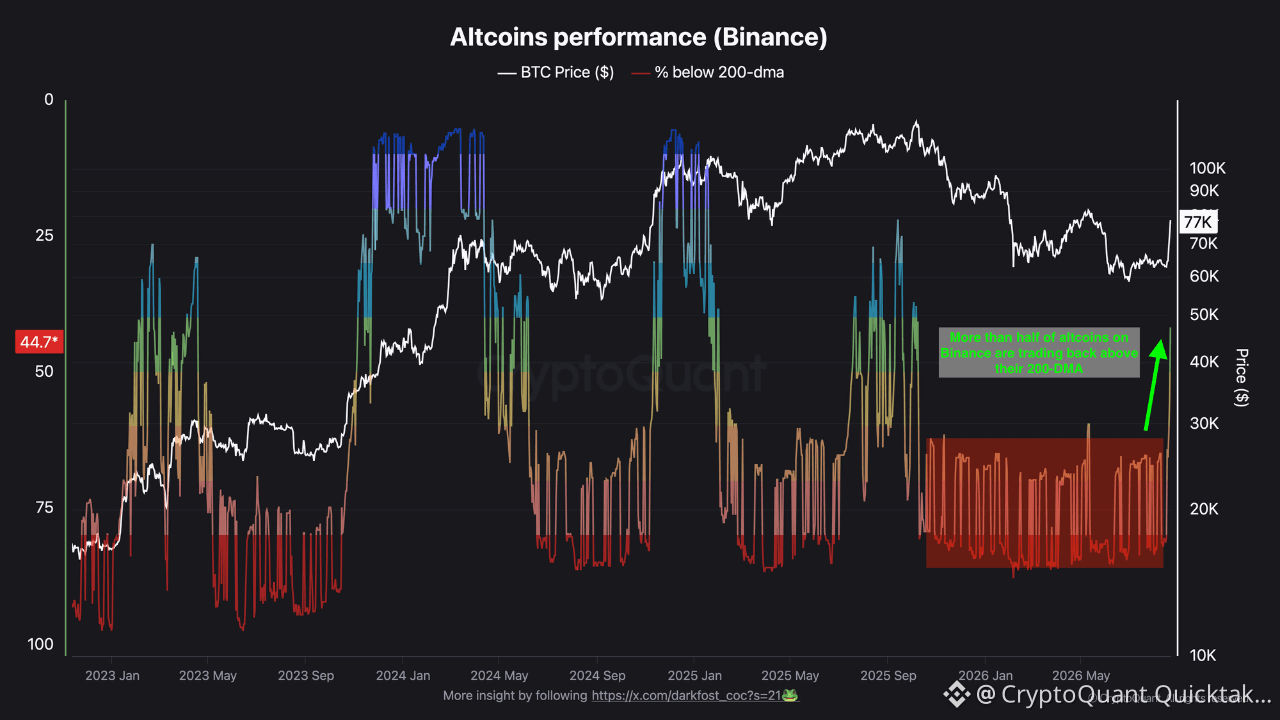
After a period of dormancy that began in November, during which roughly 80% to 85% of altcoins traded below their 200-day moving average, a key technical level, 56% of them have now moved back above that threshold.
Today, more than half of the altcoins available on Binance are trading above their 200-DMA, signaling a regime shift.
This turnaround followed several announcements from Trump on August 19, which came amid very thin volumes and seller exhaustion.
The president notably stated that the U.S. would purchase large amounts of BTC, while also urging Congress to pass the Clarity Act, claiming his administration had ended the war on crypto once and for all.
These announcements triggered a wave of liquidity into altcoins, driving a large share of them higher.
Historically, this level of gains marks an intermediate signal of an early-stage altseason.
That said, the market has entered overbought territory that calls for a short-term breather.
There's no need to rush, though, if the momentum for altcoins remains strongly positive, more opportunities should continue to present themselves.
Written by Darkfost
Did Trump Just Kick Off Altseason ?
Between August 19 and 22, $215 billion was added to the altcoin market cap, a surge of more than 24% in just 3 days, pushing Total2 back above $1 trillion in market cap.
Mid and small caps in particular rose the fastest. Being the least capitalized, they remain structurally the most exposed to extreme volatility in both directions.
On Binance, which covers a wide range of altcoins, this blistering performance is especially visible.
After a period of dormancy that began in November, during which roughly 80% to 85% of altcoins traded below their 200-day moving average, a key technical level, 56% of them have now moved back above that threshold.
Today, more than half of the altcoins available on Binance are trading above their 200-DMA, signaling a regime shift.
This turnaround followed several announcements from Trump on August 19, which came amid very thin volumes and seller exhaustion.
The president notably stated that the U.S. would purchase large amounts of BTC, while also urging Congress to pass the Clarity Act, claiming his administration had ended the war on crypto once and for all.
These announcements triggered a wave of liquidity into altcoins, driving a large share of them higher.
Historically, this level of gains marks an intermediate signal of an early-stage altseason.
That said, the market has entered overbought territory that calls for a short-term breather.
There's no need to rush, though, if the momentum for altcoins remains strongly positive, more opportunities should continue to present themselves.
Written by Darkfost
Mid and small caps in particular rose the fastest. Being the least capitalized, they remain structurally the most exposed to extreme volatility in both directions.
On Binance, which covers a wide range of altcoins, this blistering performance is especially visible.
After a period of dormancy that began in November, during which roughly 80% to 85% of altcoins traded below their 200-day moving average, a key technical level, 56% of them have now moved back above that threshold.
Today, more than half of the altcoins available on Binance are trading above their 200-DMA, signaling a regime shift.
This turnaround followed several announcements from Trump on August 19, which came amid very thin volumes and seller exhaustion.
The president notably stated that the U.S. would purchase large amounts of BTC, while also urging Congress to pass the Clarity Act, claiming his administration had ended the war on crypto once and for all.
These announcements triggered a wave of liquidity into altcoins, driving a large share of them higher.
Historically, this level of gains marks an intermediate signal of an early-stage altseason.
That said, the market has entered overbought territory that calls for a short-term breather.
There's no need to rush, though, if the momentum for altcoins remains strongly positive, more opportunities should continue to present themselves.
Written by Darkfost
1
474
Article
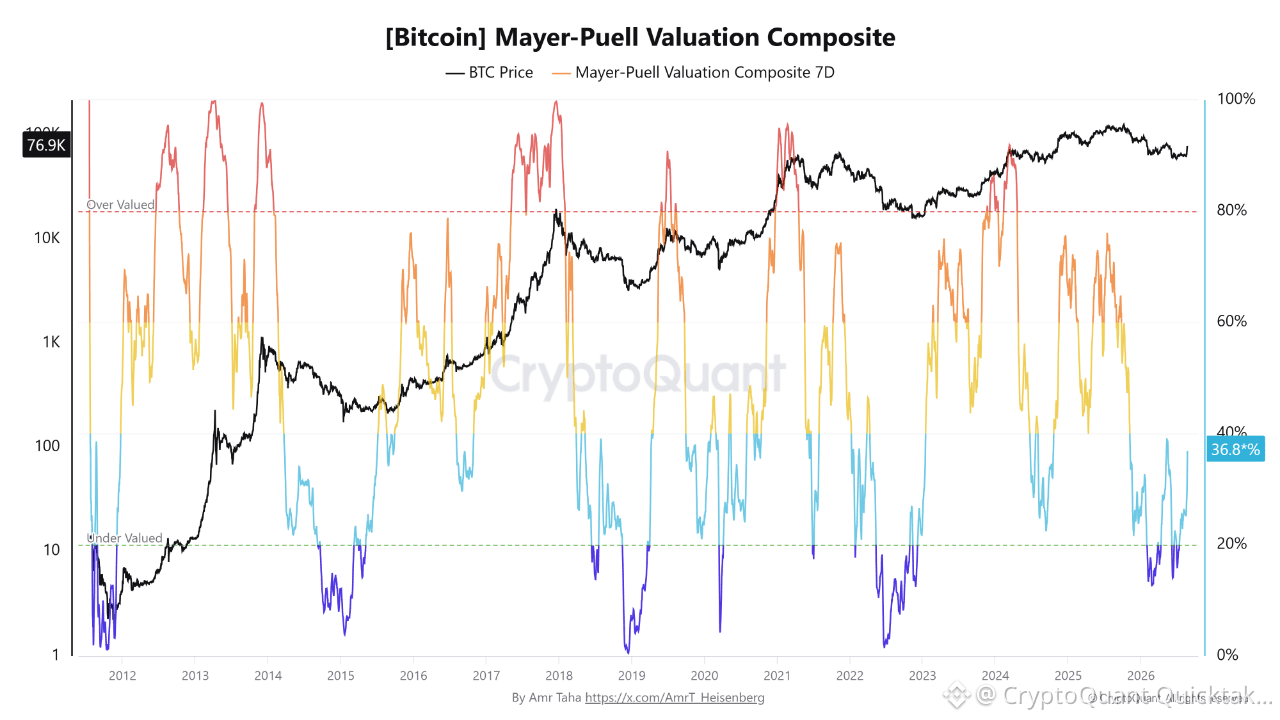
Bitcoin Exits Undervalued Zone As Sharpe Ratio Nears End of Fourth Low-Risk Since 2012Bitcoin’s Mayer-Puell Valuation Composite rose to 36.8 on August 23, marking its first exit from the undervalued zone since March after recording three major lows inside the region during 2026.
The first low appeared in February when Bitcoin traded near $64,000.
The indicator returned to the zone on June 11 at approximately $63,400 before registering its third and lowest-price test on July 2, when BTC traded near $61,400.
Bitcoin has since recovered to around $76,900, representing a gain of roughly 25% from the July 2 level.
Historically, moves into the Mayer-Puell undervalued zone have frequently coincided with major bottoming periods, although they do not identify an exact bottom or guarantee an immediate reversal.
A second historically rare signal is now approaching a potential transition.
Bitcoin’s Sharpe Ratio registered -12.8 on August 23, leaving it just 2.8 points below the -10 boundary used to define the chart’s deeply depressed “low-risk” region.
The current Sharpe Ratio began in February, with the indicator recording its two deepest readings on July 13 and August 14. According to the chart’s historical classification, this is only the fourth broad move into the low-risk region since 2012.
The previous comparable regime occurred in November 2022, coinciding with the collapse of FTX.
Earlier periods appeared around the 2015 and 2019 market lows, making the current reading historically uncommon rather than a routine fluctuation.
Together, the two indicators place Bitcoin at a rare transition point: the valuation composite has already moved out of its undervalued zone following three tests, while the Sharpe Ratio is approaching—but has not yet crossed—its -10 exit threshold.
Holding above the undervalued boundary alongside a sustained Sharpe Ratio recovery above -10 would provide stronger evidence that the improvement extends beyond a short-term price rebound.
Written by Amr Taha
Bitcoin Exits Undervalued Zone As Sharpe Ratio Nears End of Fourth Low-Risk Since 2012
Bitcoin’s Mayer-Puell Valuation Composite rose to 36.8 on August 23, marking its first exit from the undervalued zone since March after recording three major lows inside the region during 2026.
The first low appeared in February when Bitcoin traded near $64,000.
The indicator returned to the zone on June 11 at approximately $63,400 before registering its third and lowest-price test on July 2, when BTC traded near $61,400.
Bitcoin has since recovered to around $76,900, representing a gain of roughly 25% from the July 2 level.
Historically, moves into the Mayer-Puell undervalued zone have frequently coincided with major bottoming periods, although they do not identify an exact bottom or guarantee an immediate reversal.
A second historically rare signal is now approaching a potential transition.
Bitcoin’s Sharpe Ratio registered -12.8 on August 23, leaving it just 2.8 points below the -10 boundary used to define the chart’s deeply depressed “low-risk” region.
The current Sharpe Ratio began in February, with the indicator recording its two deepest readings on July 13 and August 14. According to the chart’s historical classification, this is only the fourth broad move into the low-risk region since 2012.
The previous comparable regime occurred in November 2022, coinciding with the collapse of FTX.
Earlier periods appeared around the 2015 and 2019 market lows, making the current reading historically uncommon rather than a routine fluctuation.
Together, the two indicators place Bitcoin at a rare transition point: the valuation composite has already moved out of its undervalued zone following three tests, while the Sharpe Ratio is approaching—but has not yet crossed—its -10 exit threshold.
Holding above the undervalued boundary alongside a sustained Sharpe Ratio recovery above -10 would provide stronger evidence that the improvement extends beyond a short-term price rebound.
Written by Amr Taha
The first low appeared in February when Bitcoin traded near $64,000.
The indicator returned to the zone on June 11 at approximately $63,400 before registering its third and lowest-price test on July 2, when BTC traded near $61,400.
Bitcoin has since recovered to around $76,900, representing a gain of roughly 25% from the July 2 level.
Historically, moves into the Mayer-Puell undervalued zone have frequently coincided with major bottoming periods, although they do not identify an exact bottom or guarantee an immediate reversal.
A second historically rare signal is now approaching a potential transition.
Bitcoin’s Sharpe Ratio registered -12.8 on August 23, leaving it just 2.8 points below the -10 boundary used to define the chart’s deeply depressed “low-risk” region.
The current Sharpe Ratio began in February, with the indicator recording its two deepest readings on July 13 and August 14. According to the chart’s historical classification, this is only the fourth broad move into the low-risk region since 2012.
The previous comparable regime occurred in November 2022, coinciding with the collapse of FTX.
Earlier periods appeared around the 2015 and 2019 market lows, making the current reading historically uncommon rather than a routine fluctuation.
Together, the two indicators place Bitcoin at a rare transition point: the valuation composite has already moved out of its undervalued zone following three tests, while the Sharpe Ratio is approaching—but has not yet crossed—its -10 exit threshold.
Holding above the undervalued boundary alongside a sustained Sharpe Ratio recovery above -10 would provide stronger evidence that the improvement extends beyond a short-term price rebound.
Written by Amr Taha
314
Article
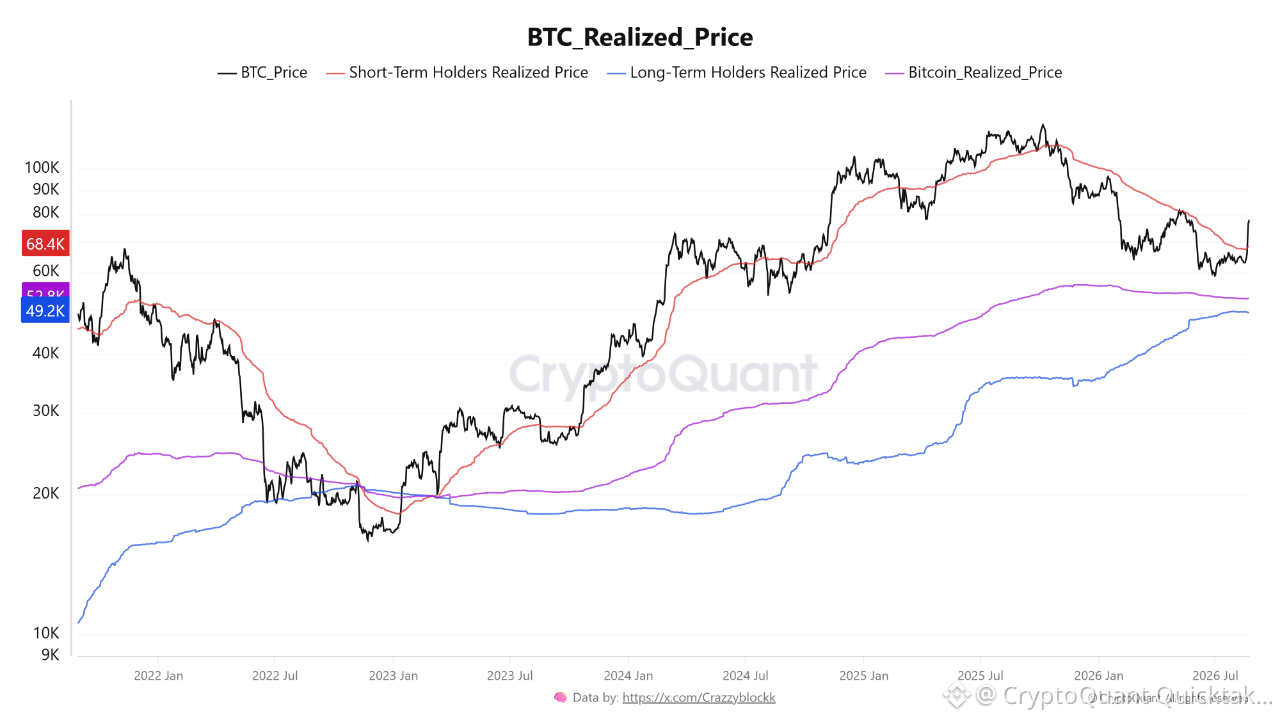
Bitcoin's Five-Day Reclaim: What the Cost-Basis Data Really SaysBitcoin's move from the low $60,000s to roughly $77,000 in five sessions is not just a headline number, it is a cost-basis reclaim. Through July price sat beneath the Short-Term Holder Realized Price near $67,000-$69,000, the apathy band where recent buyers stay underwater and spot conviction fades. The break above that level on August 19-20 changed the picture for the first time since May.
What stands out across the models I track is how little the Long-Term Holder Realized Price moved through the correction, holding near $49,200 even as price fell to June's low near $59,700 — a shallower LTH drawdown than prior cycles at equivalent stages, meaning no structural long-term distribution occurred.
Price now sits almost exactly on the True Market Mean Price near $76,500 and just under the Active Realized Price near $83,800, the zone that has capped or launched every major trend shift this cycle. On the short-term bands, spot has moved from below base STH-Realized Price into the plus-0.5 STD zone near $83,000, read as greed rather than euphoria; the plus-1 STD band near $98,000 stays untested.
This is the part that gets misread. Sharp reclaims after prolonged compression rarely resolve in a straight line, because the initial leg is driven by leverage unwind and short covering, not patient spot accumulation. That produces what we see now: outsized volatility, fast profit-taking from short-term buyers of the range, and sentiment swinging from disbelief toward euphoria within days.
None of this confirms a completed bear-to-bull transition alone. A durable shift needs the STH-Realized Price reclaim to hold as support on retest, and the one-year Holder Realized Price near $104,800 to eventually come back into range — both still open. Higher-probability read: Bitcoin has exited capitulation into a volatile transition phase, favoring continuation but not a smooth path.
Written by Crazzyblockk
Bitcoin's Five-Day Reclaim: What the Cost-Basis Data Really Says
Bitcoin's move from the low $60,000s to roughly $77,000 in five sessions is not just a headline number, it is a cost-basis reclaim. Through July price sat beneath the Short-Term Holder Realized Price near $67,000-$69,000, the apathy band where recent buyers stay underwater and spot conviction fades. The break above that level on August 19-20 changed the picture for the first time since May.
What stands out across the models I track is how little the Long-Term Holder Realized Price moved through the correction, holding near $49,200 even as price fell to June's low near $59,700 — a shallower LTH drawdown than prior cycles at equivalent stages, meaning no structural long-term distribution occurred.
Price now sits almost exactly on the True Market Mean Price near $76,500 and just under the Active Realized Price near $83,800, the zone that has capped or launched every major trend shift this cycle. On the short-term bands, spot has moved from below base STH-Realized Price into the plus-0.5 STD zone near $83,000, read as greed rather than euphoria; the plus-1 STD band near $98,000 stays untested.
This is the part that gets misread. Sharp reclaims after prolonged compression rarely resolve in a straight line, because the initial leg is driven by leverage unwind and short covering, not patient spot accumulation. That produces what we see now: outsized volatility, fast profit-taking from short-term buyers of the range, and sentiment swinging from disbelief toward euphoria within days.
None of this confirms a completed bear-to-bull transition alone. A durable shift needs the STH-Realized Price reclaim to hold as support on retest, and the one-year Holder Realized Price near $104,800 to eventually come back into range — both still open. Higher-probability read: Bitcoin has exited capitulation into a volatile transition phase, favoring continuation but not a smooth path.
Written by Crazzyblockk
What stands out across the models I track is how little the Long-Term Holder Realized Price moved through the correction, holding near $49,200 even as price fell to June's low near $59,700 — a shallower LTH drawdown than prior cycles at equivalent stages, meaning no structural long-term distribution occurred.
Price now sits almost exactly on the True Market Mean Price near $76,500 and just under the Active Realized Price near $83,800, the zone that has capped or launched every major trend shift this cycle. On the short-term bands, spot has moved from below base STH-Realized Price into the plus-0.5 STD zone near $83,000, read as greed rather than euphoria; the plus-1 STD band near $98,000 stays untested.
This is the part that gets misread. Sharp reclaims after prolonged compression rarely resolve in a straight line, because the initial leg is driven by leverage unwind and short covering, not patient spot accumulation. That produces what we see now: outsized volatility, fast profit-taking from short-term buyers of the range, and sentiment swinging from disbelief toward euphoria within days.
None of this confirms a completed bear-to-bull transition alone. A durable shift needs the STH-Realized Price reclaim to hold as support on retest, and the one-year Holder Realized Price near $104,800 to eventually come back into range — both still open. Higher-probability read: Bitcoin has exited capitulation into a volatile transition phase, favoring continuation but not a smooth path.
Written by Crazzyblockk
1
413
From Pilot to Real Adoption: Why Stablecoins Require Digital Capital Management and Talent Develo...Japan is entering a new phase of stablecoin adoption. The key question is no longer whether companies can run a proof of concept, but whether they can turn it into a sustainable business.
A successful PoC only proves that the technology works. Real adoption requires companies to answer harder questions: What problem does it solve? How does it connect with existing customers and operations? Who owns the project after the pilot? And how does it create long-term value?
XWIN Group has supported the introduction of JPYC at Matsuya Ginza. Through this experience, we have seen that stablecoins should not simply be viewed as another payment method. When connected with stores, customer networks, data, loyalty programs, inbound tourism and digital services, they can become part of a broader business infrastructure.
This is where “Digital Capital Management” becomes important. AI, data, blockchain and digital assets should increasingly be treated as corporate resources—not isolated technologies.
Four factors will determine whether stablecoin projects move beyond experimentation:
1. A clear real-world use case
2. Integration with existing customers, operations and systems
3. Management that understands digital assets as strategic capital
4. Internal talent capable of operating and expanding the initiative
Technology alone will not drive stablecoin adoption.
The companies that succeed will be those that develop both their business models and their people.
Japan’s next challenge is to move from “technical demonstration” to “management implementation.”
Written by XWIN Japan
From Pilot to Real Adoption: Why Stablecoins Require Digital Capital Management and Talent Develo...
Japan is entering a new phase of stablecoin adoption. The key question is no longer whether companies can run a proof of concept, but whether they can turn it into a sustainable business.
A successful PoC only proves that the technology works. Real adoption requires companies to answer harder questions: What problem does it solve? How does it connect with existing customers and operations? Who owns the project after the pilot? And how does it create long-term value?
XWIN Group has supported the introduction of JPYC at Matsuya Ginza. Through this experience, we have seen that stablecoins should not simply be viewed as another payment method. When connected with stores, customer networks, data, loyalty programs, inbound tourism and digital services, they can become part of a broader business infrastructure.
This is where “Digital Capital Management” becomes important. AI, data, blockchain and digital assets should increasingly be treated as corporate resources—not isolated technologies.
Four factors will determine whether stablecoin projects move beyond experimentation:
1. A clear real-world use case
2. Integration with existing customers, operations and systems
3. Management that understands digital assets as strategic capital
4. Internal talent capable of operating and expanding the initiative
Technology alone will not drive stablecoin adoption.
The companies that succeed will be those that develop both their business models and their people.
Japan’s next challenge is to move from “technical demonstration” to “management implementation.”
Written by XWIN Japan
A successful PoC only proves that the technology works. Real adoption requires companies to answer harder questions: What problem does it solve? How does it connect with existing customers and operations? Who owns the project after the pilot? And how does it create long-term value?
XWIN Group has supported the introduction of JPYC at Matsuya Ginza. Through this experience, we have seen that stablecoins should not simply be viewed as another payment method. When connected with stores, customer networks, data, loyalty programs, inbound tourism and digital services, they can become part of a broader business infrastructure.
This is where “Digital Capital Management” becomes important. AI, data, blockchain and digital assets should increasingly be treated as corporate resources—not isolated technologies.
Four factors will determine whether stablecoin projects move beyond experimentation:
1. A clear real-world use case
2. Integration with existing customers, operations and systems
3. Management that understands digital assets as strategic capital
4. Internal talent capable of operating and expanding the initiative
Technology alone will not drive stablecoin adoption.
The companies that succeed will be those that develop both their business models and their people.
Japan’s next challenge is to move from “technical demonstration” to “management implementation.”
Written by XWIN Japan
225
What Will It Take for On-Chain Finance to Go Mainstream in Japan?Japan may be approaching a major turning point in finance. One key theme is “on-chain finance.”
As Chair of the DeFi Committee at the Blockchain Collaborative Consortium (BCCC), I have advocated for the adoption of DeFi and on-chain finance, as well as a regulatory framework that enables responsible innovation.
On-chain finance means issuing, managing, transferring and settling financial assets—such as money, deposits, securities and bonds—on blockchain networks. Its real potential, however, is not simply tokenization. It is the ability to connect commerce and finance through programmable infrastructure.
For example, once delivery and inspection are confirmed, a smart contract could automatically trigger stablecoin payment and update accounting records. Commerce, payments and accounting could become one continuous digital process.
For this to scale in Japan, five conditions are critical:
1. Move from regulations that allow experiments to rules that enable commercialization.
2. Treat stablecoins as programmable money, not merely digital payment instruments.
3. Connect banks and DeFi rather than viewing them as competitors.
4. Make blockchain invisible to users through simple, familiar UX.
5. Measure success by commercialization, transaction volume and cost reduction—not the number of PoCs.
Japan already has financial institutions, major corporate markets, advanced payment infrastructure and an evolving regulatory foundation.
The next challenge is execution.
The future of finance is not simply digital. It is programmable. Japan’s opportunity is to connect finance, industry, data and AI on-chain—and turn experimentation into real economic infrastructure.
Written by XWIN Japan
What Will It Take for On-Chain Finance to Go Mainstream in Japan?
Japan may be approaching a major turning point in finance. One key theme is “on-chain finance.”
As Chair of the DeFi Committee at the Blockchain Collaborative Consortium (BCCC), I have advocated for the adoption of DeFi and on-chain finance, as well as a regulatory framework that enables responsible innovation.
On-chain finance means issuing, managing, transferring and settling financial assets—such as money, deposits, securities and bonds—on blockchain networks. Its real potential, however, is not simply tokenization. It is the ability to connect commerce and finance through programmable infrastructure.
For example, once delivery and inspection are confirmed, a smart contract could automatically trigger stablecoin payment and update accounting records. Commerce, payments and accounting could become one continuous digital process.
For this to scale in Japan, five conditions are critical:
1. Move from regulations that allow experiments to rules that enable commercialization.
2. Treat stablecoins as programmable money, not merely digital payment instruments.
3. Connect banks and DeFi rather than viewing them as competitors.
4. Make blockchain invisible to users through simple, familiar UX.
5. Measure success by commercialization, transaction volume and cost reduction—not the number of PoCs.
Japan already has financial institutions, major corporate markets, advanced payment infrastructure and an evolving regulatory foundation.
The next challenge is execution.
The future of finance is not simply digital. It is programmable. Japan’s opportunity is to connect finance, industry, data and AI on-chain—and turn experimentation into real economic infrastructure.
Written by XWIN Japan
As Chair of the DeFi Committee at the Blockchain Collaborative Consortium (BCCC), I have advocated for the adoption of DeFi and on-chain finance, as well as a regulatory framework that enables responsible innovation.
On-chain finance means issuing, managing, transferring and settling financial assets—such as money, deposits, securities and bonds—on blockchain networks. Its real potential, however, is not simply tokenization. It is the ability to connect commerce and finance through programmable infrastructure.
For example, once delivery and inspection are confirmed, a smart contract could automatically trigger stablecoin payment and update accounting records. Commerce, payments and accounting could become one continuous digital process.
For this to scale in Japan, five conditions are critical:
1. Move from regulations that allow experiments to rules that enable commercialization.
2. Treat stablecoins as programmable money, not merely digital payment instruments.
3. Connect banks and DeFi rather than viewing them as competitors.
4. Make blockchain invisible to users through simple, familiar UX.
5. Measure success by commercialization, transaction volume and cost reduction—not the number of PoCs.
Japan already has financial institutions, major corporate markets, advanced payment infrastructure and an evolving regulatory foundation.
The next challenge is execution.
The future of finance is not simply digital. It is programmable. Japan’s opportunity is to connect finance, industry, data and AI on-chain—and turn experimentation into real economic infrastructure.
Written by XWIN Japan
237
Log in to explore more content
Join global crypto users on Binance Square
⚡️ Get latest and useful information about crypto.
💬 Trusted by the world’s largest crypto exchange.
👍 Discover real insights from verified creators.
Email / Phone number
Trending Topics
BTCReaches$80000
362 views
78 Discussing
#BTCReaches$80000 BITCOIN HITS $80,000
from 63k last Monday to 80k in just 7 days
almost 30% straight up without a single real pullback
last time it took 30 days to climb 20% from 66k to 80k
will this momentum keep going or do we stall soon?$BTC $BMNRB $SOXSB
Isabella-I
·0 Likes
·87 views
BitcoinOpenInterestFallsToTwoMonthLow
11,563 views
675 Discussing
BitcoinRises23.6%Weekly
20,968 views
692 Discussing