
Bykaranteli
14.8k Publications

Bykaranteli
Signaler
Bloquer l’utilisateur
All Social Media @Bykaranteli
Trade régulièrement
5.7 an(s)
6 Suivis
10.2K+ Abonnés
31.6K+ J’aime
Publications
Tous
Citations
Vidéos
Direct
PINNED
·
--
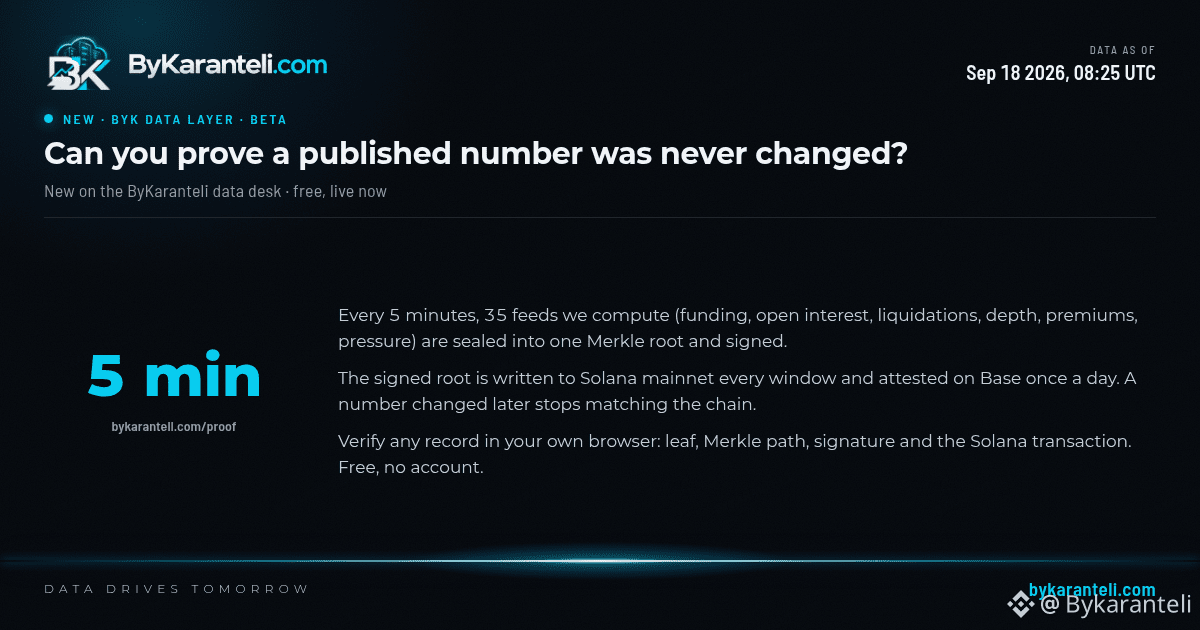
Nos données laissent désormais un reçu sur des blockchains publiques. Toutes les 5 minutes, 35 flux que nous calculons (financement, open interest, liquidations, profondeur du carnet d’ordres, primes et scores de pression pour $BTC, $ETH, $SOL et plus) sont scellés dans une seule racine Merkle, signés par une clé isolée et écrits sur le mainnet de Solana, avec une attestation quotidienne sur Base. Si quelqu’un, y compris nous, modifiait ensuite l’un de ces nombres, cela ne correspondrait plus à la chaîne. Vous n’avez pas à nous croire sur parole : le vérificateur sur notre page de preuve reconstruit un enregistrement, vérifie sa signature et lit l’ancrage directement depuis Solana dans votre propre navigateur. Beta, disponible sur le mainnet depuis le 18 septembre. Gratuit, aucun compte requis.
Nos données laissent désormais un reçu sur des blockchains publiques. Toutes les 5 minutes, 35 flux que nous calculons (financement, open interest, liquidations, profondeur du carnet d’ordres, primes et scores de pression pour $BTC , $ETH , $SOL et plus) sont scellés dans une seule racine Merkle, signés par une clé isolée et écrits sur le mainnet de Solana, avec une attestation quotidienne sur Base. Si quelqu’un, y compris nous, modifiait ensuite l’un de ces nombres, cela ne correspondrait plus à la chaîne. Vous n’avez pas à nous croire sur parole : le vérificateur sur notre page de preuve reconstruit un enregistrement, vérifie sa signature et lit l’ancrage directement depuis Solana dans votre propre navigateur. Beta, disponible sur le mainnet depuis le 18 septembre. Gratuit, aucun compte requis.
1
3
63
·
--
Voir la traduction
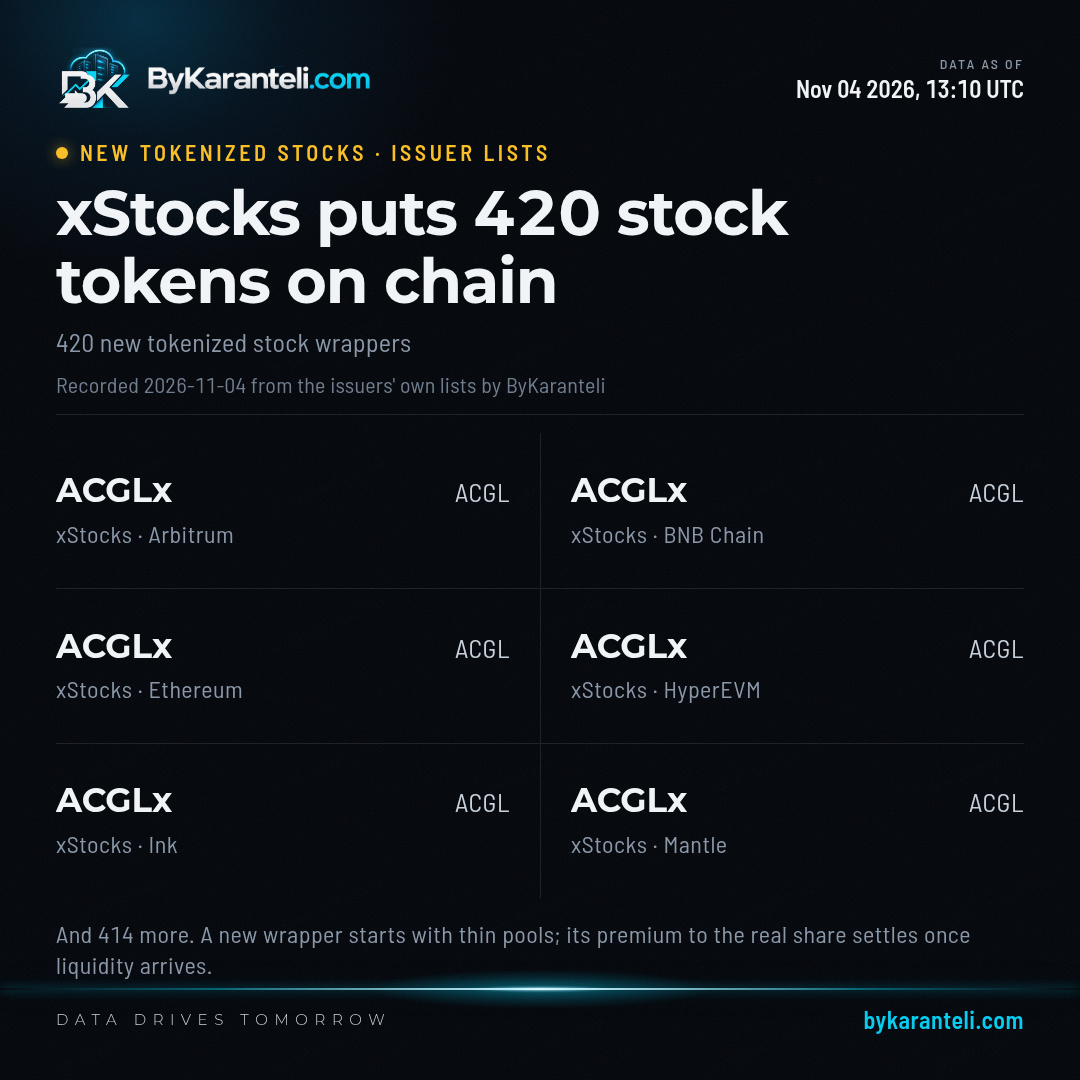
xStocks was the only issuer behind the 420 new tokenized stock wrappers we recorded on Nov 4. These are on chain tokens that track a listed share.
The batch landed in equal parts, 42 on each of Arbitrum, BNB Chain, Ethereum, HyperEVM, Ink, Mantle, Optimism, Solana, TON and X Layer.
$ACGL appears as ACGLx on Arbitrum, BNB Chain, Ethereum, HyperEVM, Ink and Mantle. Every wrapper here comes from the issuers' own lists, not from a name search.
The batch landed in equal parts, 42 on each of Arbitrum, BNB Chain, Ethereum, HyperEVM, Ink, Mantle, Optimism, Solana, TON and X Layer.
$ACGL appears as ACGLx on Arbitrum, BNB Chain, Ethereum, HyperEVM, Ink and Mantle. Every wrapper here comes from the issuers' own lists, not from a name search.
ACGLUS+1,09%
3
·
--
Voir la traduction
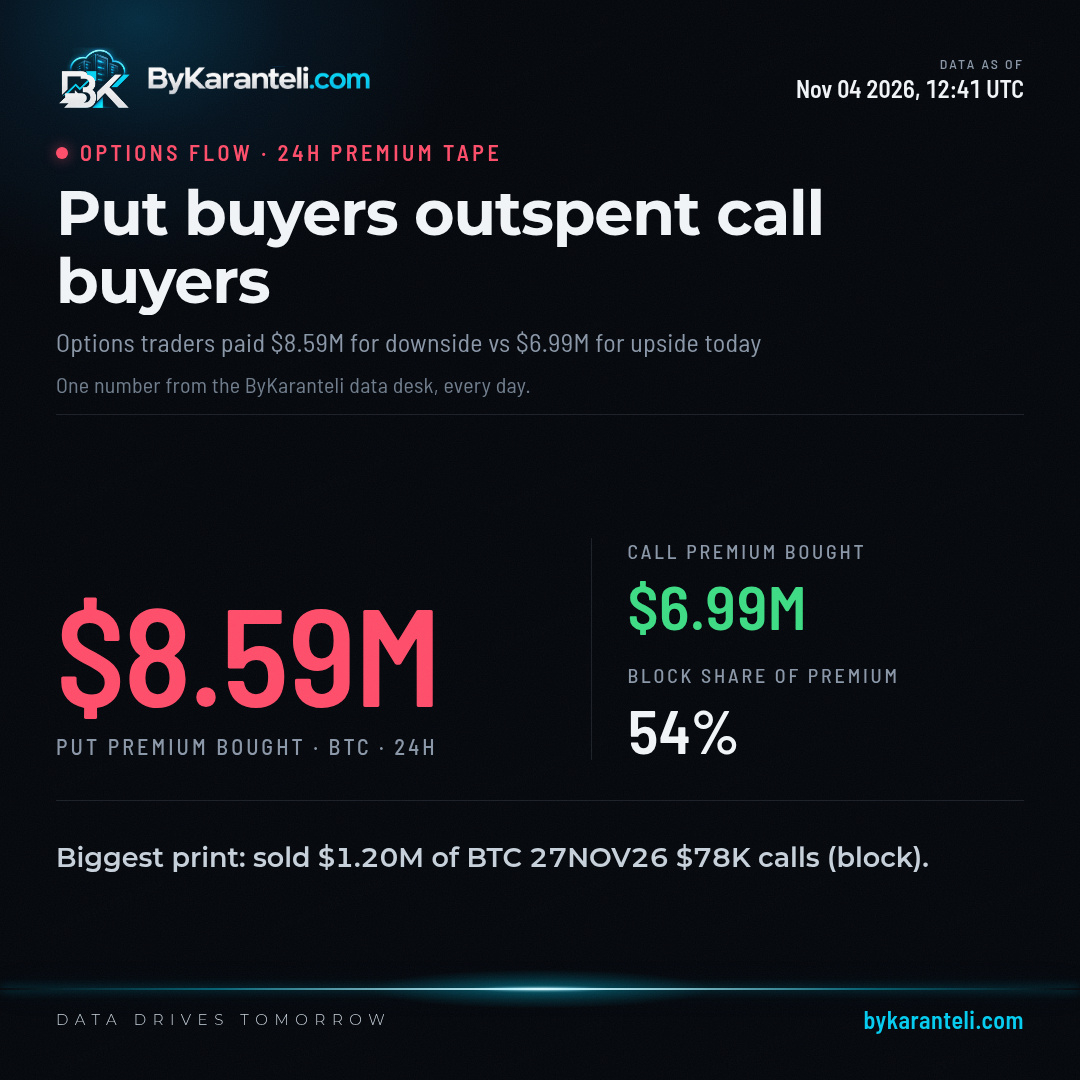
Put buyers outspent call buyers over the latest day of options flow, $8.59M against $6.99M. A put pays off if the price ends below its strike, a call if it ends above.
Block trades, large deals arranged away from the public order book, made up 54% of that flow.
The single largest trade went the other way. Someone sold a call for $1.20M in premium, struck at $78,000 and expiring Nov 27, done as a block. The seller keeps that premium and carries the loss if the price finishes above the strike.
4
·
--
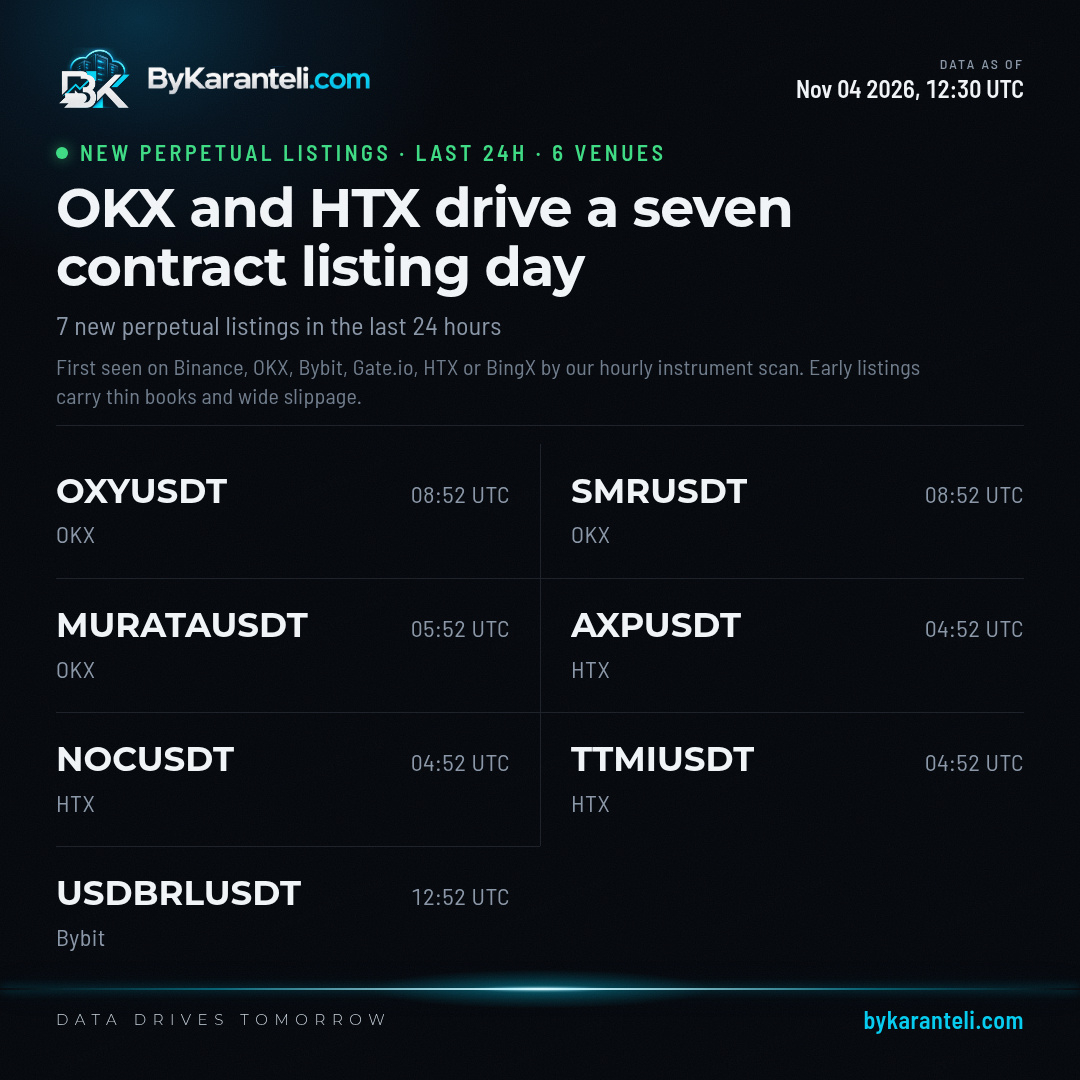
OKX et HTX ont porté le total des nouvelles cotations au 4 nov. Parmi les sept nouveaux contrats perpétuels apparus pour la première fois au cours de cette période de 24 heures, OKX et HTX en ont ajouté trois chacun, et Bybit a ajouté le dernier.
OXY et SMR sur OKX étaient les plus récents, tous deux apparus pour la première fois à 08:52 UTC, après MURATA à 05:52 UTC. HTX a coté AXP, NOC et TTMI simultanément, dans un seul lot, à 04:52 UTC.
USDBRL sur Bybit a ouvert la période, apparaissant pour la première fois à 12:52 UTC le 3 nov.
OXY et SMR sur OKX étaient les plus récents, tous deux apparus pour la première fois à 08:52 UTC, après MURATA à 05:52 UTC. HTX a coté AXP, NOC et TTMI simultanément, dans un seul lot, à 04:52 UTC.
USDBRL sur Bybit a ouvert la période, apparaissant pour la première fois à 12:52 UTC le 3 nov.
2
·
--
Voir la traduction
One call. 11 exchanges' liquidations, summed. Free API key, no card.
One call. 11 exchanges' liquidations, summed. Free API key, no card.
1
·
--
Voir la traduction
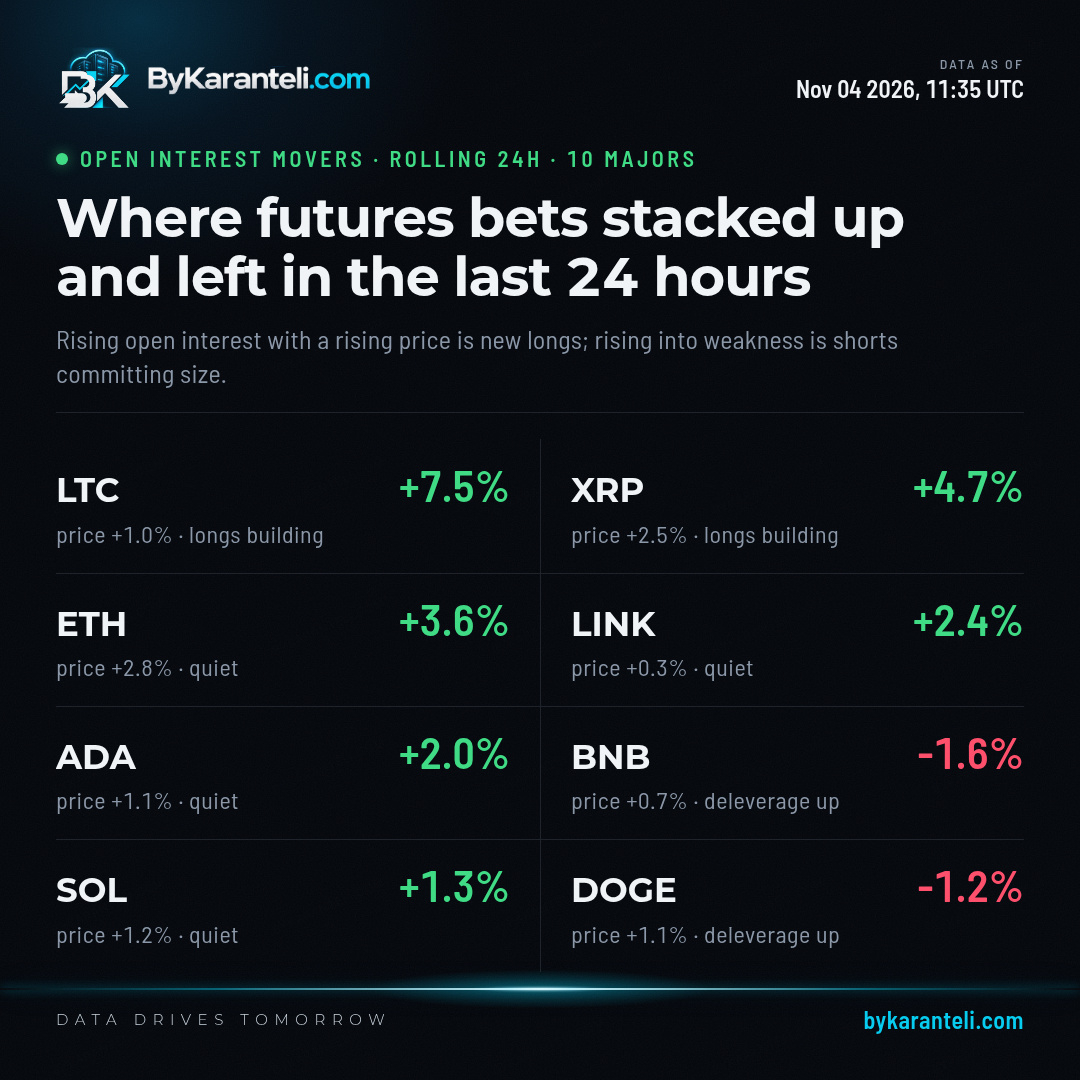
Litecoin led the futures build in the 24 hours to Nov 4, 11:35 UTC. Open interest on $LTC, the value of futures positions still open, grew 7.51% and the price rose 0.99%. Our tracker classes it as longs building, with new leverage well ahead of the move.
$XRP carried the same label, with open interest up 4.74% on a 2.48% gain. $ETH added 3.56% in open interest as price rose 2.77%, and that reading stays quiet.
BNB and Dogecoin went the other way. Open interest fell 1.61% and 1.17% as both prices rose, so traders closed bets into the gain.
Litecoin led the futures build in the 24 hours to Nov 4, 11:35 UTC. Open interest on $LTC , the value of futures positions still open, grew 7.51% and the price rose 0.99%. Our tracker classes it as longs building, with new leverage well ahead of the move.
$XRP carried the same label, with open interest up 4.74% on a 2.48% gain. $ETH added 3.56% in open interest as price rose 2.77%, and that reading stays quiet.
BNB and Dogecoin went the other way. Open interest fell 1.61% and 1.17% as both prices rose, so traders closed bets into the gain.
$XRP carried the same label, with open interest up 4.74% on a 2.48% gain. $ETH added 3.56% in open interest as price rose 2.77%, and that reading stays quiet.
BNB and Dogecoin went the other way. Open interest fell 1.61% and 1.17% as both prices rose, so traders closed bets into the gain.
8
·
--
Voir la traduction
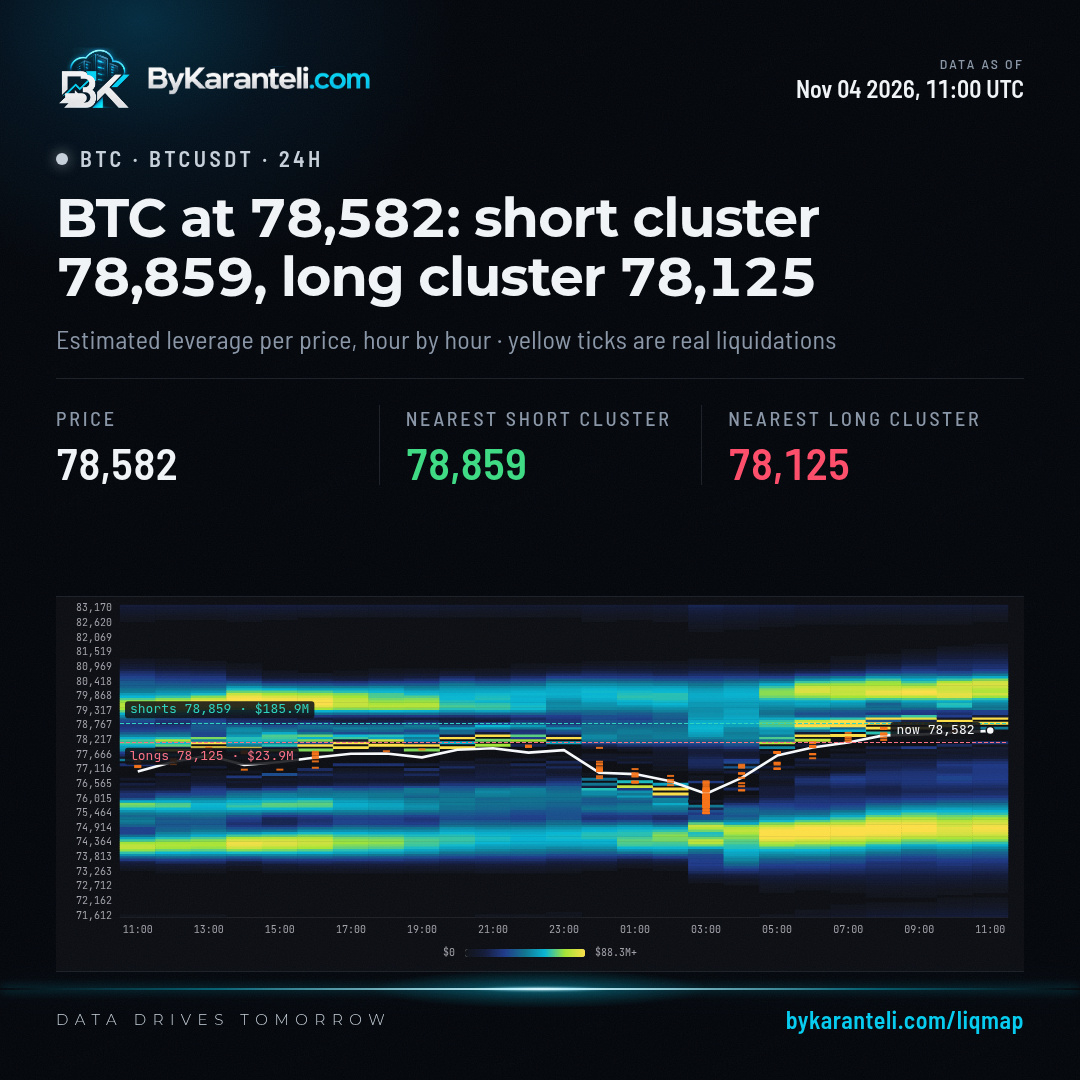
Bitcoin's estimated liquidation map at 11:00 UTC on Nov 4 leans against traders betting on a fall. With $BTC at $78,582, the heavier modeled exposure within 3% of price sits above the market, where short positions would be forced to buy back.
The nearest of those modeled short levels is $78,859, a small distance over the price.
Under the market, the closest estimated long liquidation level is $78,125. The larger modeled cluster for leveraged buyers sits further down at $74,914.
The nearest of those modeled short levels is $78,859, a small distance over the price.
Under the market, the closest estimated long liquidation level is $78,125. The larger modeled cluster for leveraged buyers sits further down at $74,914.
8
·
--
Voir la traduction
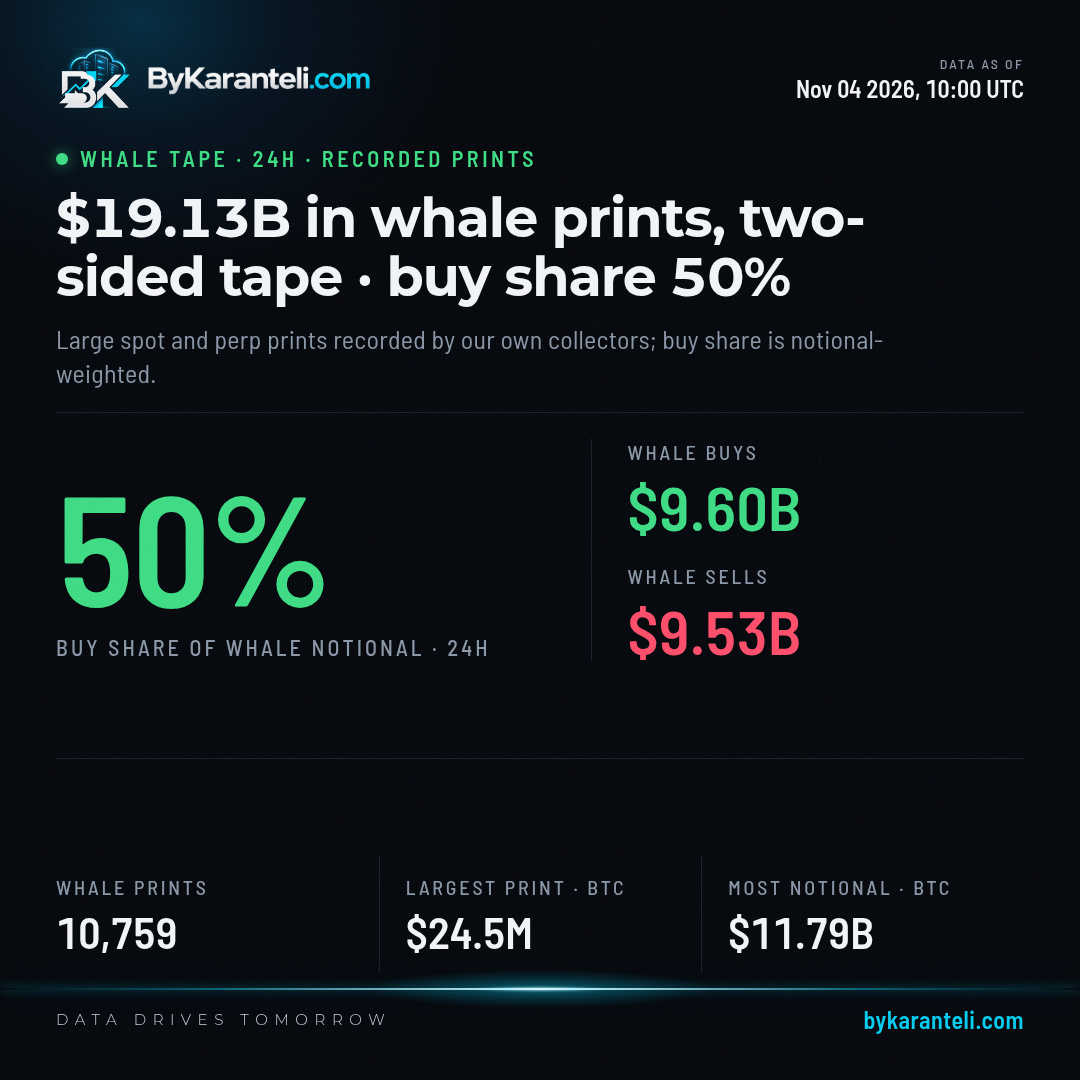
Neither side of the big money won the day. In the 24 hours to 10:00 UTC on Nov 4, whale sized buys came to $9.60B and sells to $9.53B across 10,759 large trades.
Buyers held 50.2% of that flow. That is close to an even split and well inside the 45% to 55% range we treat as two sided.
Bitcoin drew most of the action with 6,342 of those trades. It also carried the largest single order of the window, at $24.5M.
Buyers held 50.2% of that flow. That is close to an even split and well inside the 45% to 55% range we treat as two sided.
Bitcoin drew most of the action with 6,342 of those trades. It also carried the largest single order of the window, at $24.5M.
15
·
--
Voir la traduction
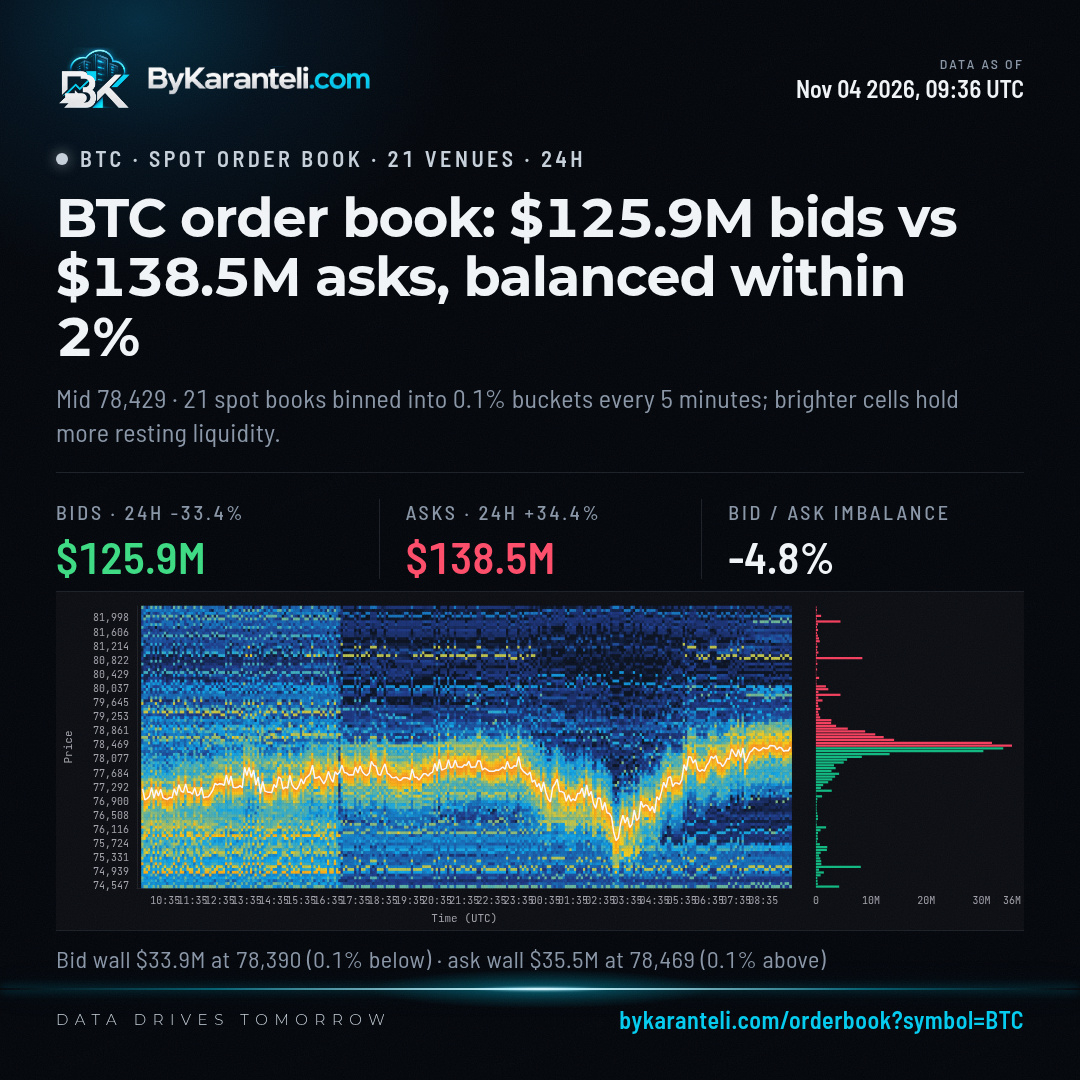
Resting bids in the $BTC spot book thinned out over the 24 hours to 09:36 UTC on Nov 4, down 33.4% within 2% of mid. Asks within the same range grew 34.4%. Price went the other way, with the mid up 1.5% to $78.4K from $77.3K a day earlier.
Across 21 spot venues, that leaves asks heavier, $138.5M against $125.9M in bids, a -4.8% imbalance.
The biggest walls sit right next to price. There is $33.9M of bids at $78.4K, 0.05% below mid, and $35.5M of asks at $78.5K, 0.05% above. Resting orders can be pulled at any moment, so this is a snapshot of the book, not a forecast.
6
·
--
Voir la traduction
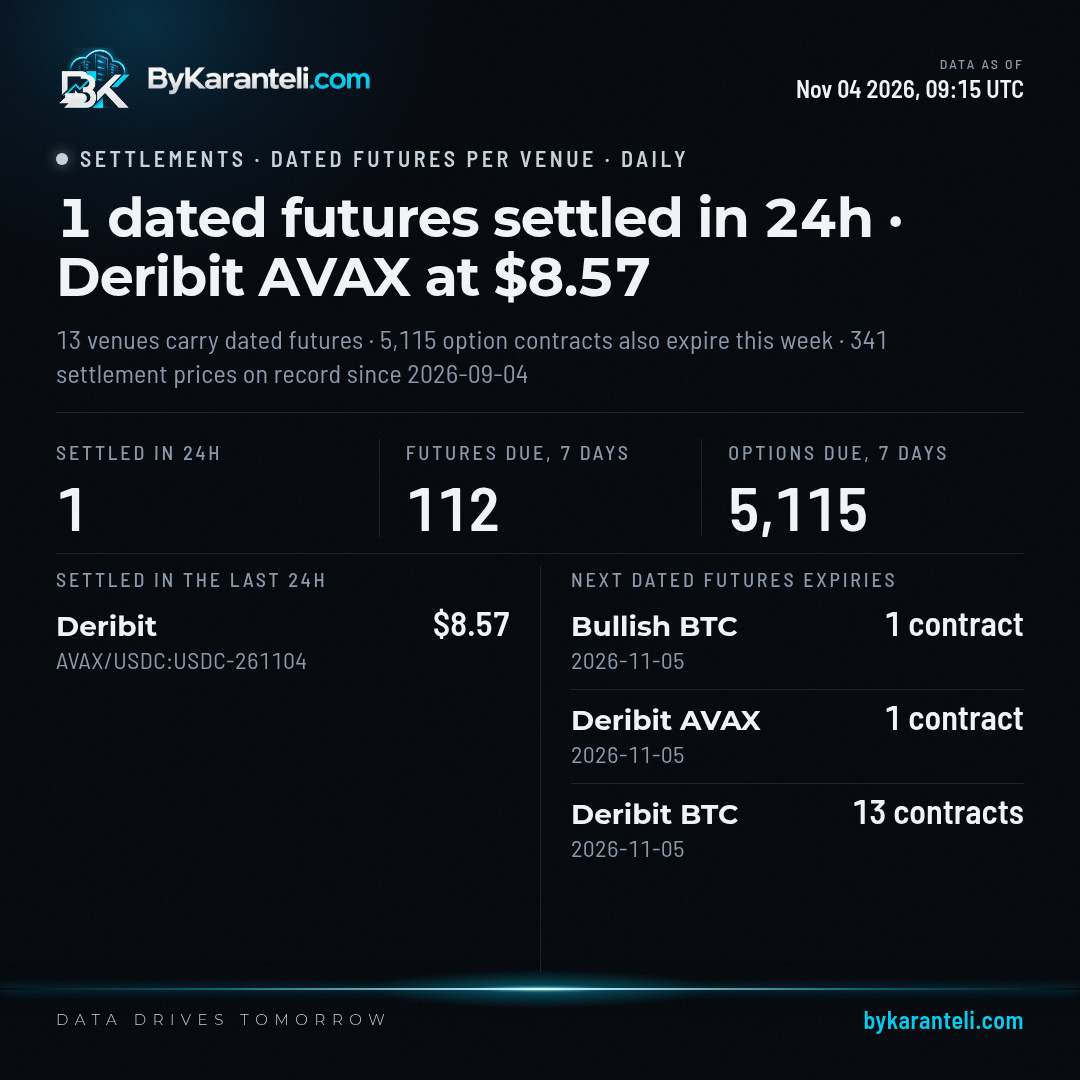
Recorded one dated futures settlement in the last 24 hours at Deribit: $AVAX/USDC:USDC-261104 at 8.573. Footnote: Deribit and Bullish; 5,115 option contracts across 15 venues.
Recorded one dated futures settlement in the last 24 hours at Deribit: $AVAX /USDC:USDC-261104 at 8.573. Footnote: Deribit and Bullish; 5,115 option contracts across 15 venues.
11
·
--
Voir la traduction
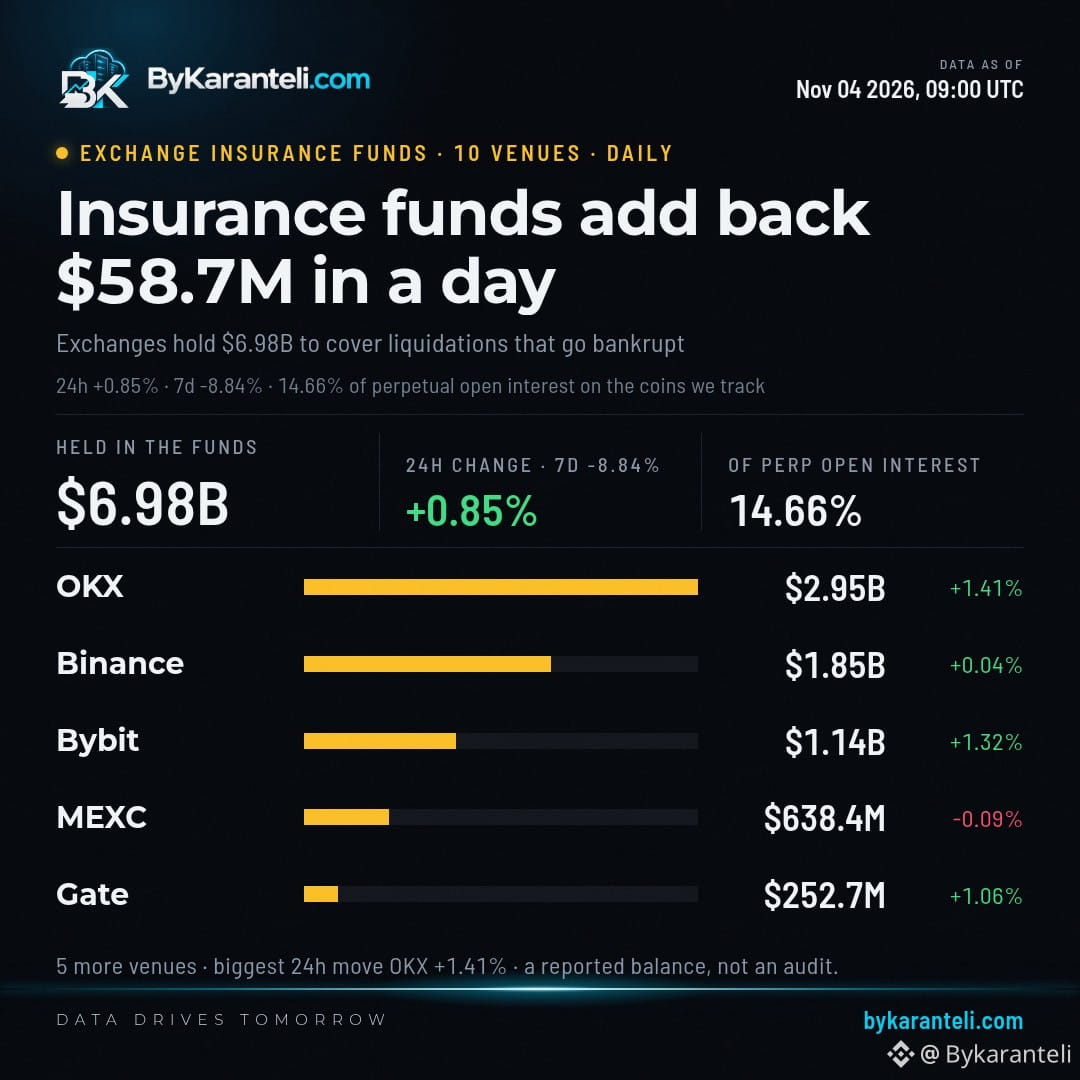
Exchange insurance funds put back +$58.7M in the 24 hours to Nov 4, a +0.85% day, yet the week still reads -8.84%. These are the reserves venues keep to pay for liquidations that close below the bankruptcy price.
The 10 venues we track held $6.98B. OKX, the largest at $2.95B, moved most at +1.41%, with Bybit at +1.32% and Gate at +1.06%. MEXC was the only big fund lower, at -0.09%.
Together they equal 14.66% of perpetual open interest on the coins we track, meaning the money sitting in open futures bets. Each fund is a balance the venue reports, not an audit.
5
·
--
Voir la traduction
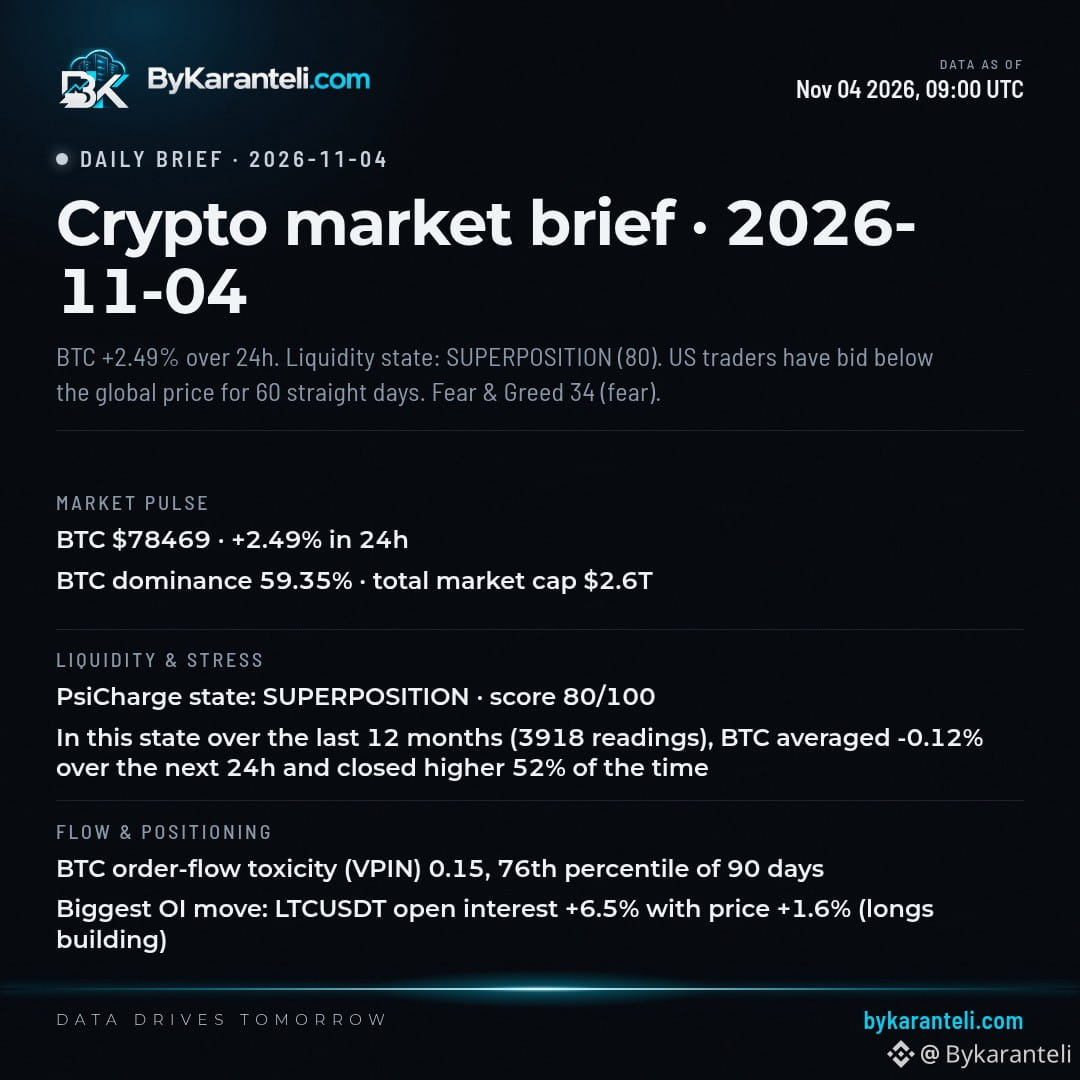
A 2.49% rise in Bitcoin over the 24 hours to Nov 4 did not change where Americans price it. US traders have now bid $BTC below the global price for 60 straight days, with Bitcoin at $78,469.
Bitcoin holds 59.35% of a $2.6T crypto market, and the Fear & Greed index reads 34, in fear.
Trading was more one sided than usual. VPIN, a gauge of how lopsided aggressive order flow is, read 0.15, the 76th percentile of the past 90 days. The biggest move in open futures bets came on $LTC, up 6.5% with price up 1.6%, as longs built positions.
A 2.49% rise in Bitcoin over the 24 hours to Nov 4 did not change where Americans price it. US traders have now bid $BTC below the global price for 60 straight days, with Bitcoin at $78,469.
Bitcoin holds 59.35% of a $2.6T crypto market, and the Fear & Greed index reads 34, in fear.
Trading was more one sided than usual. VPIN, a gauge of how lopsided aggressive order flow is, read 0.15, the 76th percentile of the past 90 days. The biggest move in open futures bets came on $LTC , up 6.5% with price up 1.6%, as longs built positions.
21
·
--
Voir la traduction
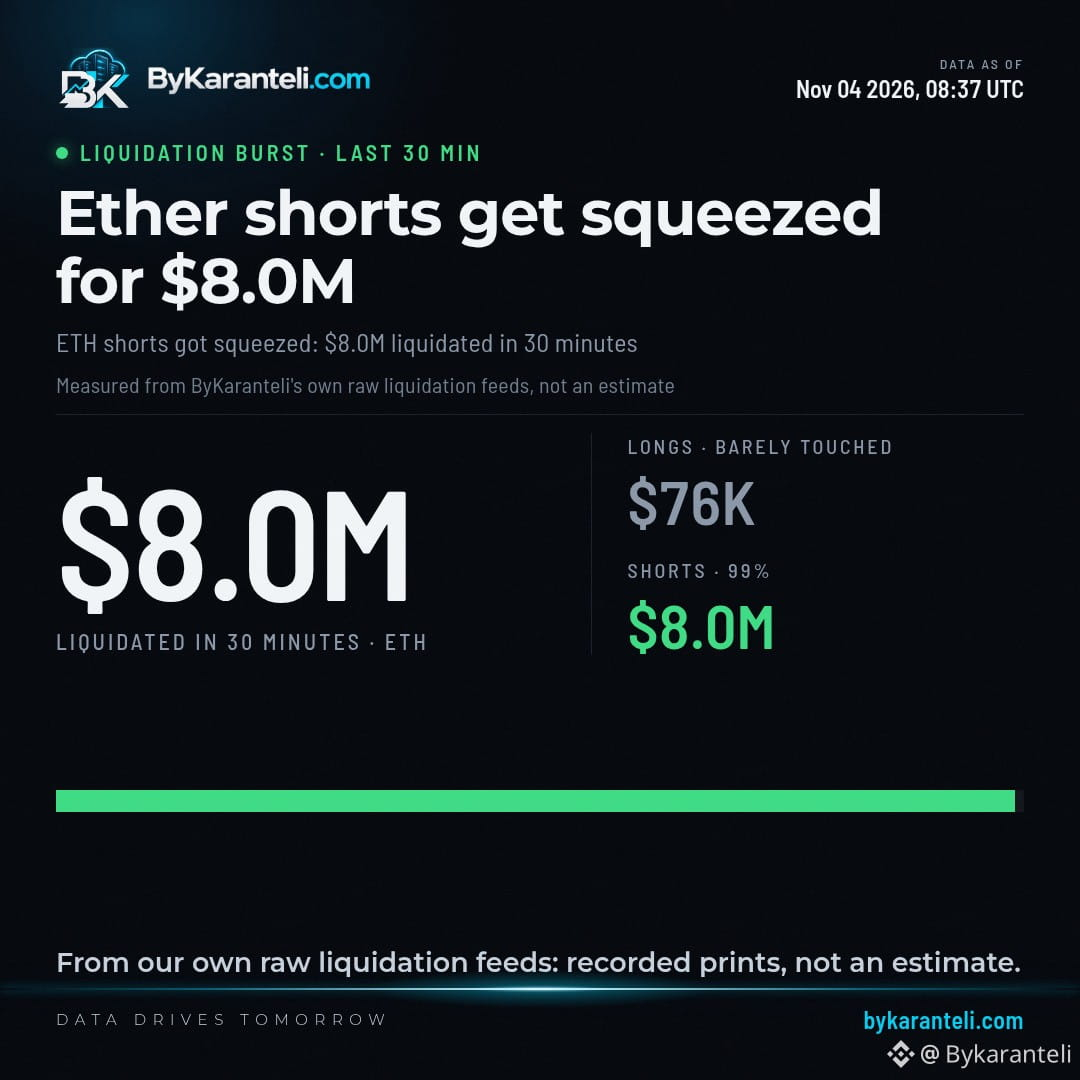
The latest Ether move landed almost entirely on one side. In the last 30 minutes, the major venues liquidated $8.0M of $ETH short positions, the bets on a lower price.
Long positions barely registered, with $75.8K closed by force over the same half hour.
These figures come from the raw liquidation streams of the major venues, so they cover those exchanges only.
Long positions barely registered, with $75.8K closed by force over the same half hour.
These figures come from the raw liquidation streams of the major venues, so they cover those exchanges only.
17
·
--
Voir la traduction
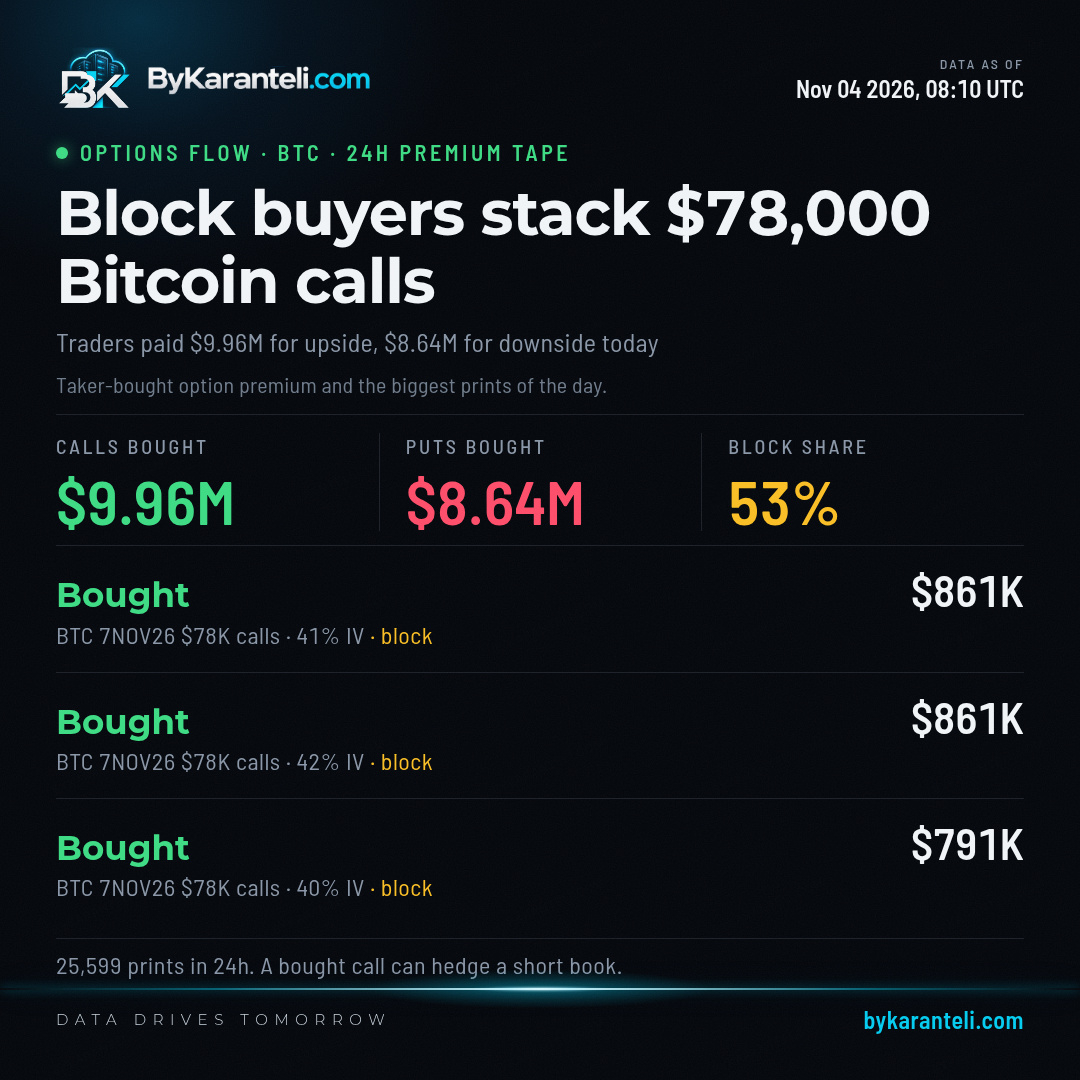
Three negotiated trades bought the same Bitcoin contract over the past two days: $78,000 calls expiring Nov 7, which pay if $BTC finishes above that price at expiry. They cost $861.3K, $860.7K and $791.0K, the three largest single trades we recorded in that window.
Block trades, arranged off the order book and then reported to the venue, carried 53% of all premium dollars in the 24 hours to Nov 4, across 25,599 recorded trades.
Buyers spent $10.0M on calls against $8.6M on puts, the contracts that pay on a fall, so bets on a higher price drew the larger amount.
Since 2021, days in this very low band saw a median -0.2% BTC move over the next 7d (n=404, base +0.1%, 5y of records). History, not a forecast.
21
·
--
Voir la traduction
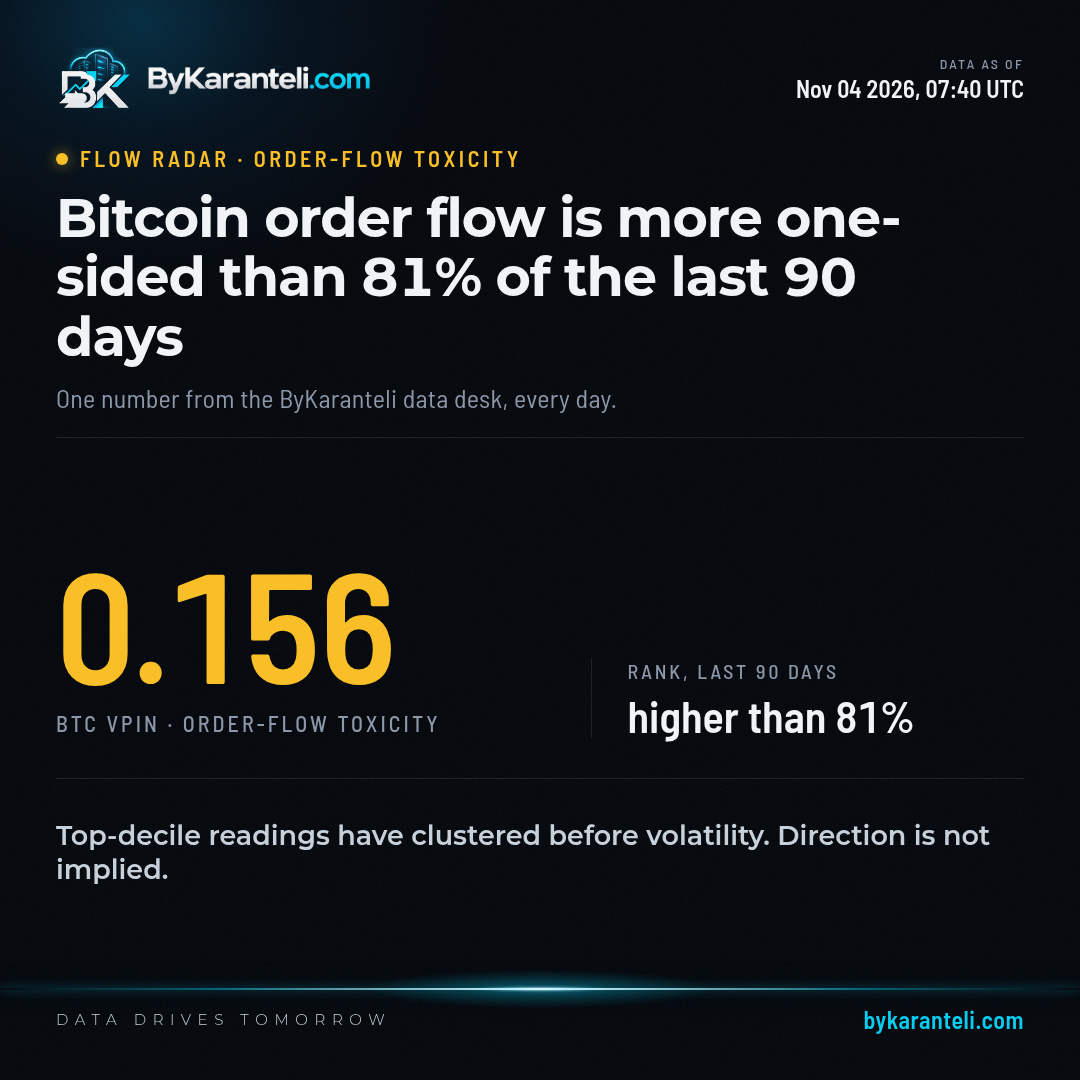
Trading has been more lopsided than usual, with the order flow imbalance reading at 0.1563. That is higher than 81% of the last 90 days.
The gauge here is VPIN, which estimates how much of the volume in each slice of trading came from one side, buyers or sellers, rather than a balanced back and forth. Higher readings mean more of the flow arrived in one direction at a time.
The measure does not say which side was doing the pushing, only that one side was. Read it as a measure of how one sided recent trading has been, not as a signal for where price goes.
7
·
--
Voir la traduction
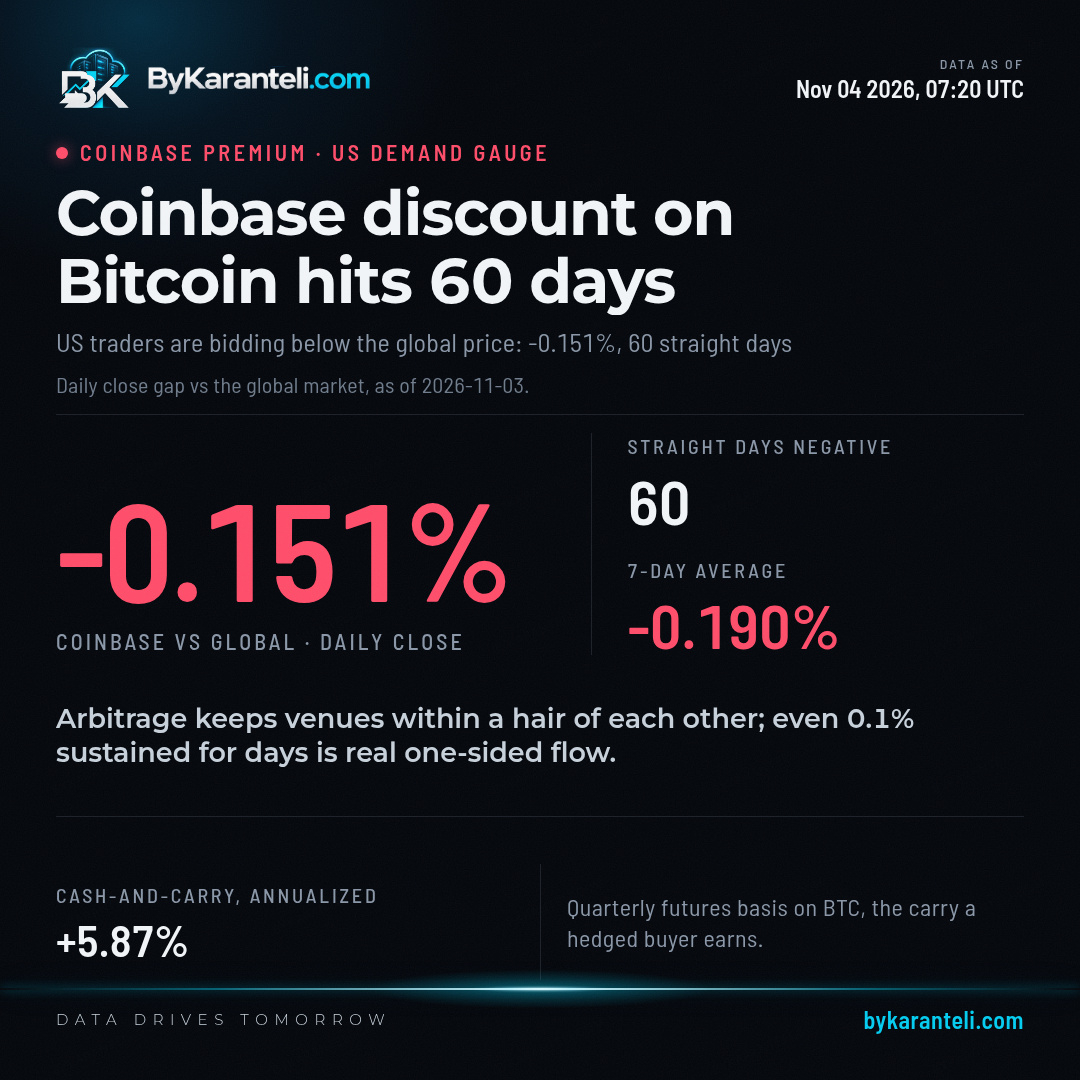
Sixty days. That is how long Bitcoin has traded cheaper on Coinbase than on global venues, with Nov 3 extending the run. American buyers paid -0.151% under the world price for $BTC that day.
The gap was a little shallower than its recent norm. The seven day average for the same discount came in at -0.190%.
Dated futures told a different story. Quarterly contracts were priced above spot at an annualized +5.87%, meaning traders buying exposure through the quarter accepted a yearly premium over the spot price to get it.
Since 2017, days in this very low band saw a median -0.2% BTC move over the next 7d (n=667, base +0.5%, 9y of records). History, not a forecast.
19
·
--
Voir la traduction
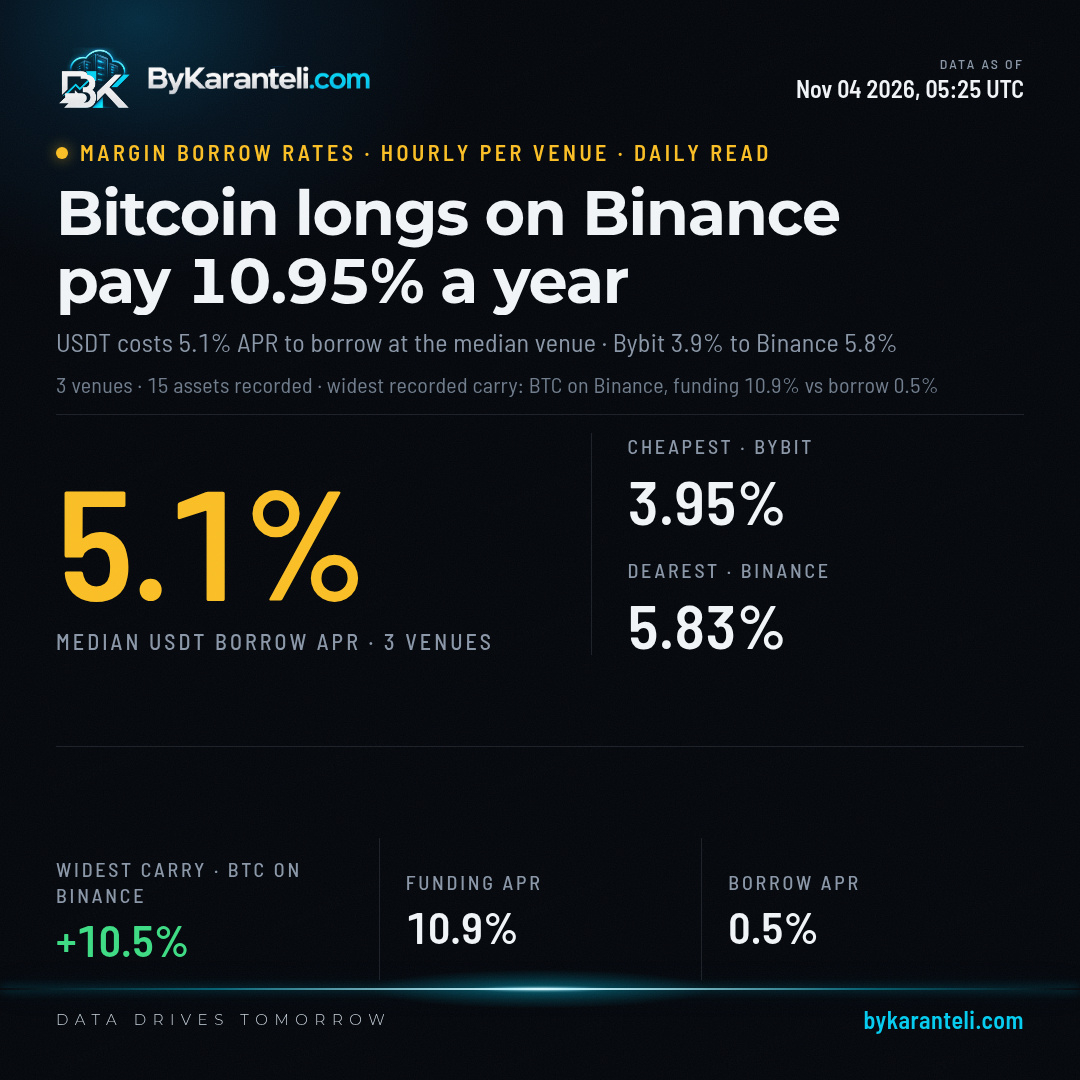
Leveraged Bitcoin longs on Binance were paying 10.95% a year in funding to keep their bets open in the Nov 4 read at 05:25 UTC. Borrowing $BTC itself on margin at the same exchange cost 0.5% a year.
That left a recorded gap of 10.45% between what longs pay and what the coin costs to borrow, the widest of the 15 assets we track across three venues.
Dollars were the pricier loan. The median USDT margin rate came to 5.1% a year, with Bybit the cheapest at 3.95% and Binance the most expensive at 5.83%.
3
·
--
Voir la traduction
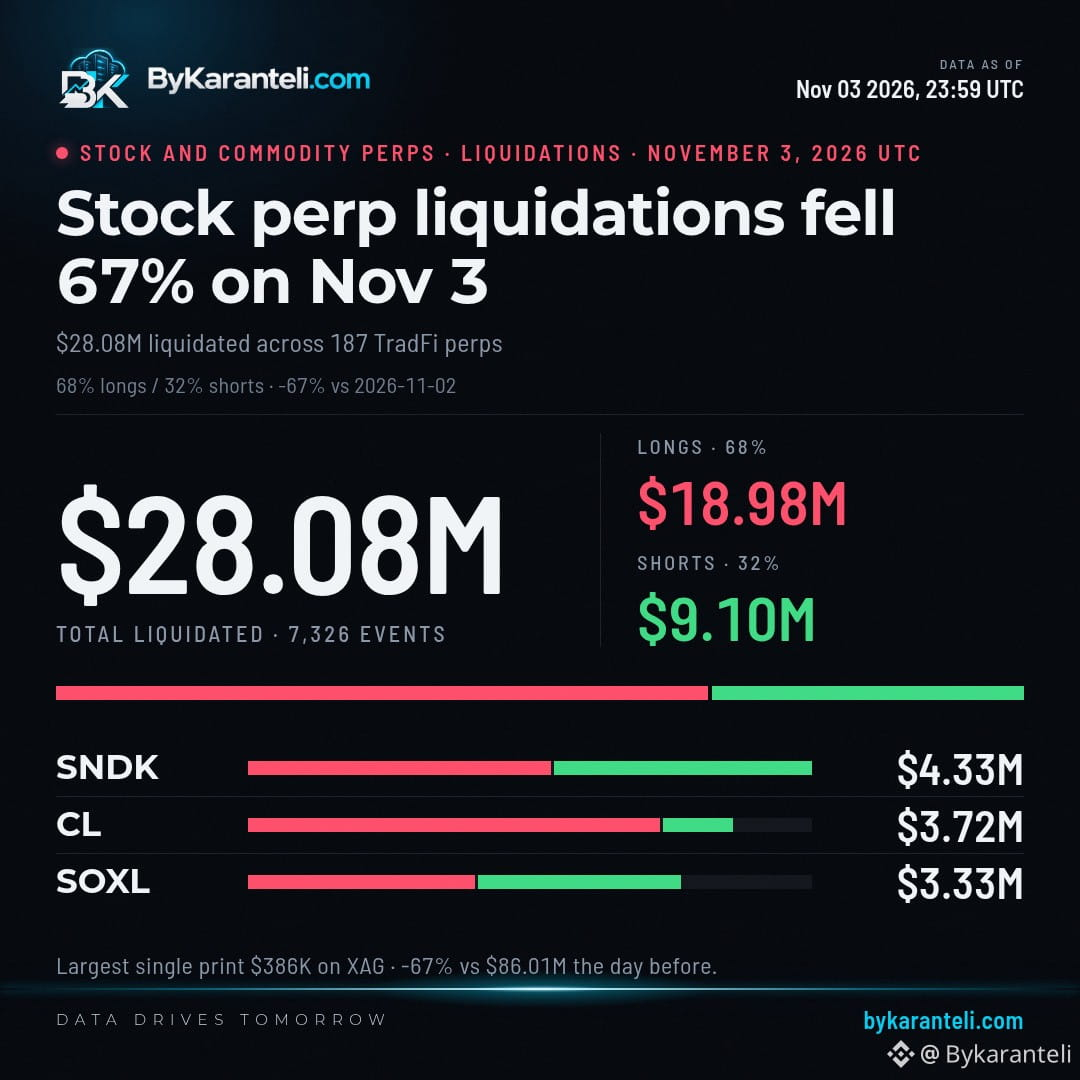
Forced closures on Binance's stock and commodity perpetuals fell 67% on Nov 3, to $28.08M from $86.01M the day before. Traders using leverage to bet on higher prices still took most of the hits, with the split at 68% longs / 32% shorts.
Longs lost $19.0M and shorts $9.1M, across 187 contracts and 7,326 liquidation events in our recorded stream. That is a floor, not the whole market.
SanDisk (SNDK) led with $4.33M, ahead of crude oil (CL) at $3.72M and SOXL at $3.33M. The largest single position closed by force was $386K in silver (XAG).
16
·
--
Voir la traduction
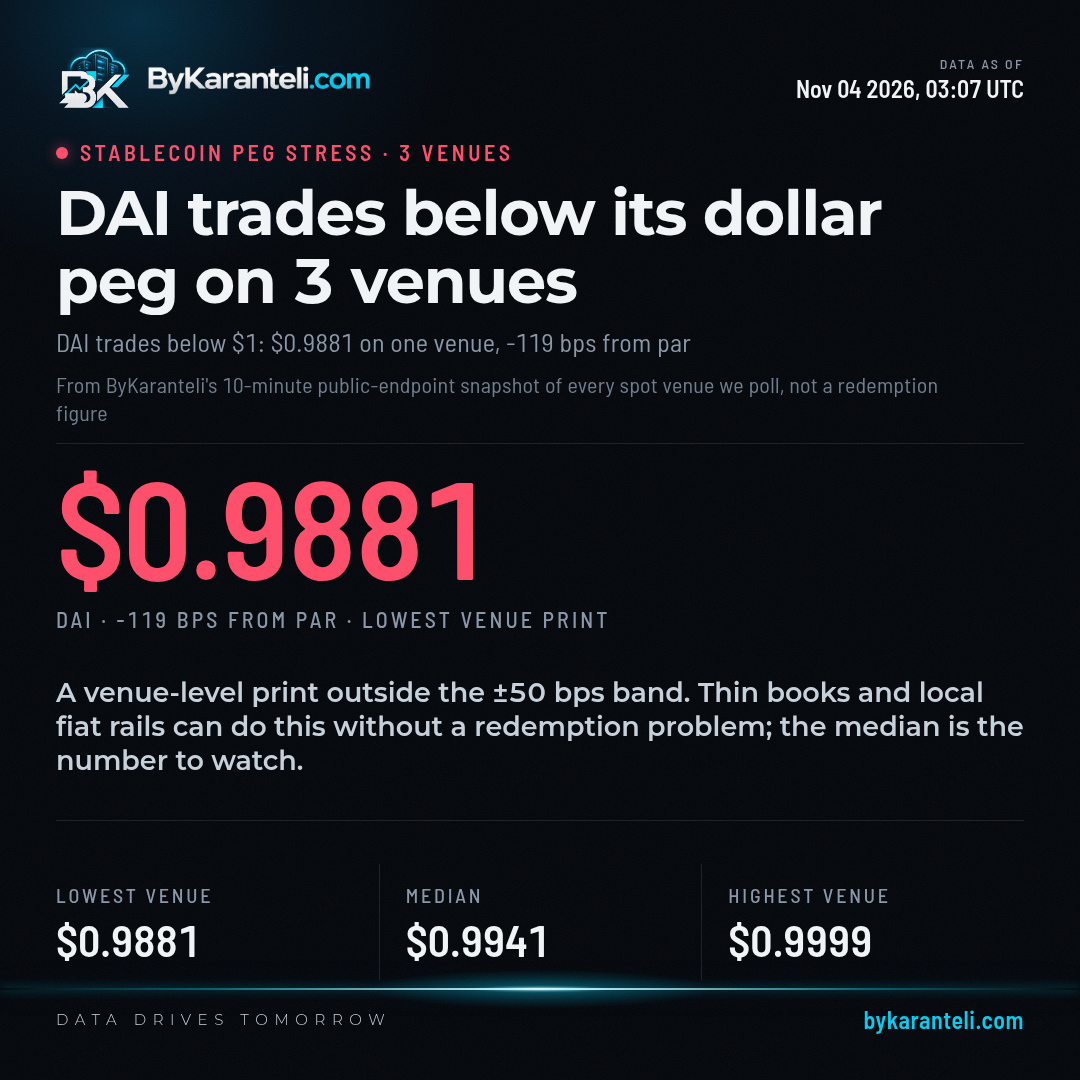
A dollar of $DAI fetched as little as $0.9881 on one venue in a 10 minute snapshot of three exchanges.
None of the three had it at par. The best quote was $0.9999 and the median $0.9941, so anyone selling on these venues received less than a dollar for each coin.
These are prices on individual venues, not a reading of redemptions. A venue level discount like this does not by itself mean the stablecoin's backing is in question.
7
·
--
Voir la traduction
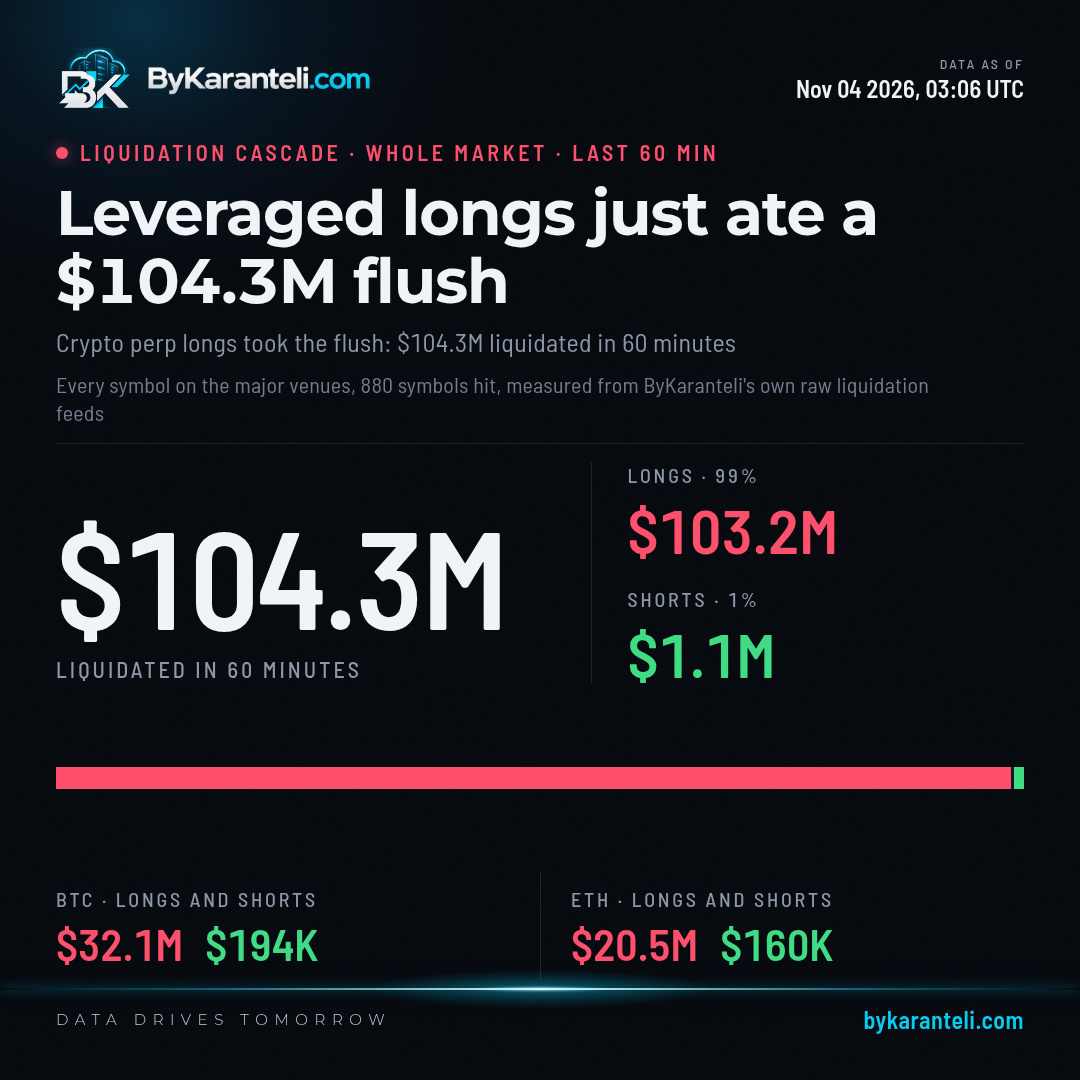
Crypto just saw $104.3M of leveraged positions closed by force in 60 minutes, across 880 coins on the major venues. Almost all of it, $103.2M, came from traders betting on a rise. Shorts lost only $1.1M. The hit came fast, with $97.7M of the total in the last 30 minutes.
Bitcoin longs lost $32.1M and $ETH longs lost $20.5M. The largest single closure was a $5.0M Ether long on Binance at $2,231 at 03:02 UTC, a minute after a $3.0M Bitcoin long went at $75,952 on the same exchange.
$BTC last traded at $75,827, down 1.15% over 24 hours, with a session low of $75,760.
Bitcoin longs lost $32.1M and $ETH longs lost $20.5M. The largest single closure was a $5.0M Ether long on Binance at $2,231 at 03:02 UTC, a minute after a $3.0M Bitcoin long went at $75,952 on the same exchange.
$BTC last traded at $75,827, down 1.15% over 24 hours, with a session low of $75,760.
36
Connectez-vous pour découvrir plus de contenu
Rejoignez la communauté mondiale des adeptes de cryptomonnaies sur Binance Square
⚡️ Suviez les dernières informations importantes sur les cryptomonnaies.
💬 Jugé digne de confiance par la plus grande plateforme d’échange de cryptomonnaies au monde.
👍 Découvrez les connaissances que partagent les créateurs vérifiés.
Adresse e-mail/Nº de téléphone
Sujets d’actualité
USMidterms-WhatAreMarketsExpecting?
146,814 vues
1,074 mentions
Le raz-de-marée démocrate au Congrès ébranle les paris liés à Trump sur les actions de l’IA et les cryptomonnaies
Binance News
·16 mentions J’aime
·6k vues
USOctoberNFP-AreRateCutsStillPossible
280,537 vues
2,155 mentions
CircleQ3Revenue865M
1,955 vues
100 mentions