

Everyone is obsessed with making AI agents smarter. Almost nobody is talking about the much harder problem: how do you let an autonomous agent spend real money without risking your entire wallet?
Right now, human payment rails break the moment machines enter the loop. Credit cards assume a human clicks "confirm," chargebacks don't work for $0.002 API calls, and traditional blockchains force agents to manage volatile gas tokens while competing for congested blockspace.
That infrastructure gap is exactly what Kite ($KITE) is engineered to solve—not as another generic AI narrative chain, but as a purpose-built EVM Layer-1 settlement and identity layer for autonomous commerce.
What actually sets Kite’s architecture apart:
Three-Tier Cryptographic Identity:
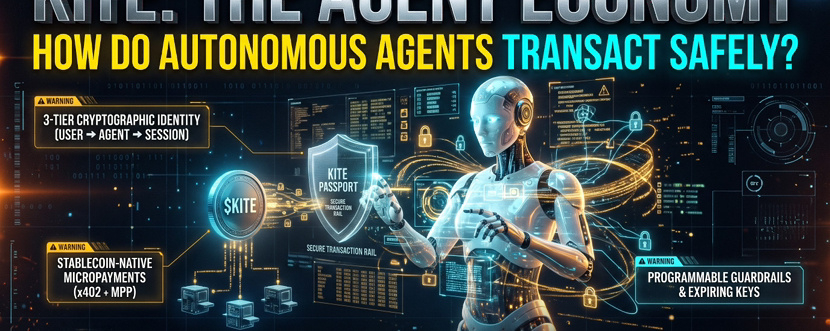
Instead of handing an AI bot your master private key, Kite splits authority into three distinct layers: the User (root authority), the Agent (delegated authority with its own deterministic BIP-32 address), and the Session (ephemeral, task-scoped keys that expire immediately after use). If a session key is ever compromised, the blast radius stays locked to a single bounded task.
Kite Passport & Programmable Guardrails:
Through Kite Passport, users enforce hard cryptographic limits before an agent ever transacts—per-transaction caps, total budgets, allowed assets, and time-to-live rules approved via passkey. An agent cannot overspend because the protocol itself refuses the transaction.
Machine-Speed Micropayments Without Gas Friction:
By combining stablecoin-native fees (like USDC and PYUSD), dedicated payment lanes, and state channels, agents can settle thousands of sub-cent API, data, and compute requests natively through HTTP 402 (x402) and Stripe’s Machine Payments Protocol (MPP)—while staying compatible with Google’s AP2 and Anthropic’s MCP.
The Hard Question Every Builder Should Ask:
Paying gas in stablecoins is a massive UX win for developers and enterprises—it removes volatile gas accounting overnight. But it also creates a critical economic test for the ecosystem: if everyday agent payments settle in stablecoins, long-term $KITE utility depends heavily on real Proof-of-Stake validator demand (1,000,000 $KITE per validator), module staking, and whether on-chain agent volume scales fast enough to anchor network security.
Building payment rails for machine-to-machine commerce is easy to pitch on a slide deck—proving that autonomous agents will actually transact at scale on-chain is the real test.
What’s your honest take? Will enterprises trust cryptographic passports like Kite’s to handle autonomous agent budgets, or will big tech keep agent payments locked inside closed Web2 walled gardens? 👇