🔗 BitTorrent's 590M Client Accounts: The Infrastructure Story Behind Distributed File Sharing.
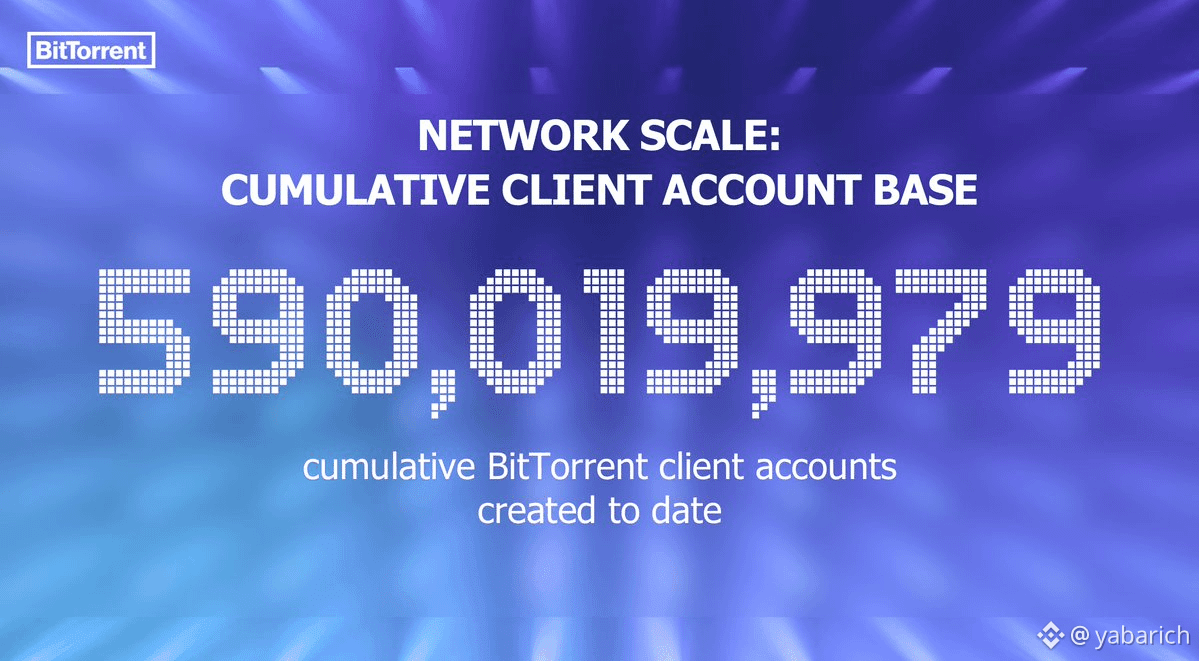
BitTorrent has reported 590,019,979 cumulative client accounts generated across its network.
Alongside this milestone, BitTorrent emphasizes the role of distributed network capacity in supporting users worldwide.
The underlying idea is important.
Traditional centralized file delivery depends heavily on infrastructure operated by service providers.
Peer-to-peer systems take a different approach.
Participating devices can exchange data directly, distributing transfer activity across multiple peers.
Why does this architecture matter?
1️⃣ Distributed Data Transfer
File delivery can draw on multiple participating peers rather than relying exclusively on a single source.
2️⃣ Resource Sharing
Available bandwidth and file copies can contribute to the wider distribution process.
3️⃣ Potential Resilience
Multiple available peers can reduce dependence on any one transfer source.
💡 My perspective:
The long-term strength of P2P infrastructure isn't determined solely by the number of accounts created.
It depends on whether the network can coordinate distributed resources effectively.
More participants can create opportunities for greater capacity, but actual performance depends on peer availability, connectivity, bandwidth, and file popularity.
BitTorrent's account milestone provides evidence of accumulated ecosystem reach.
It doesn't independently establish current network capacity or uptime.
For a deeper assessment, I'd look at active peers, data-transfer success rates, and real-world reliability.
The broader lesson:
Decentralization becomes valuable when distributed participation delivers measurable utility.
Not just when the network becomes large.
@BitTorrent_Official @Justin Sun孙宇晨
#TRONEcoStar #BitTorrent #P2P #DistributedInfrastructure