


Tribute Labs co-founder Aaron Wright on Aiden using AI agents for vetting startups (8:11)
A venture fund where the first pass on every deal comes from AI agents is no longer a futuristic experiment.
Aaron Wright, a lawyer turned crypto builder, is betting that AI will soon pick startups better than humans do. His new venture product, ADIN, puts artificial intelligence at the center of the investment process.
"People need to get comfortable with the fact that these agentic systems are probably gonna be able to generate a higher rate of return," Wright told TheStreet Roundtable in an episode of the video series, Against the Odds.
Related: This AI startup is betting it can end insurance claim denials
Behind America’s first DAO law
Wright co-founded Tribute Labs, along with Priyanka Desai. It began as the Ethereum legal-tech startup OpenLaw before rebranding in 2021 to focus on building decentralized autonomous organizations, or DAOs. He is also a former law professor at Cardozo School of Law in New York.
Wright has helped write Wyoming’s DAO law, which passed the state Senate in a 28-2 vote in 2021. The law let DAOs register as limited liability companies, and Wyoming approved America’s first legally recognized DAO that same year.
Tribute has since supported a network of about 20 DAOs that try to replace a fund’s general partner with democratic voting. Wright says they have collectively backed six of the top 12 DeFi projects. Aiden takes that idea a step further, replacing much of the crowd with AI.
A billion dollars on paper
The crowd-picking model also produced one of the most visible boom-and-bust trades in crypto.
In 2020, Wright co-founded Flamingo DAO, a members-only collective that pooled capital to buy NFTs. By early 2022, the group’s collection of CryptoPunks, Bored Apes and generative art was valued at about $1 billion, up from roughly $10 million in member contributions.
NFTs, or non-fungible tokens, are blockchain records that prove someone owns a digital item, usually an image. During the 2021 boom, collectors paid millions of dollars for cartoon apes and pixelated portraits.
Then the market collapsed.
NFT trading volume came to about $5.5 billion in 2025, well below 2024 levels and far from the peak. CryptoPunks, a centerpiece of Flamingo’s collection, saw their floor price fall roughly 78% from the 2021 high.
The projects that lasted mostly turned into something else. Pudgy Penguins, a 2021 collection of cartoon penguin NFTs, now sells plush toys in about 2,000 Walmart stores, TheStreet reported. Even that model has limits: in October, parent company Igloo shut down Abstract, the blockchain it launched in January 2025.
Asked what the collection is worth today and what the bust taught him, Wright did not give a number. He said Flamingo bought “before there was any boom” and that he expects the works to carry “cultural and also hopefully financial” value in the long run.
The episode is a useful test for ADIN.
A $1 billion mark in a thin, momentum-driven market is not the same as a realized return. If AI agents are built to spot what comes next, investors will want to know whether they can tell a trend from a bubble.
More on TheStreet Roundtable
Pudgy Penguins maker shuts down its next big bet within 18 months
Binance hackers turn to Elon Musk memecoins to hide $6.3 billion
GTA 6 may be the last blockbuster built without AI
A vote followed by an hour of diligence
Aiden starts by taking in whatever information exists on a startup, from pitch decks to public materials. It then runs an extensive diligence process that lasts about an hour.
At the end, a “synthetic investment committee” made up of multiple AI agents votes on the deal, giving it a thumbs up, a thumbs down or a maybe. The result is a composite score that Wright compares to an IMDb rating or a Rotten Tomatoes score.
For now, humans make the final call.
Wright’s team interviews the founders, feeds the answers back into Aiden and then decides whether to invest. Tribute has also paired Aiden with a network of about 1,300 scouts who source deals across the technology sector.
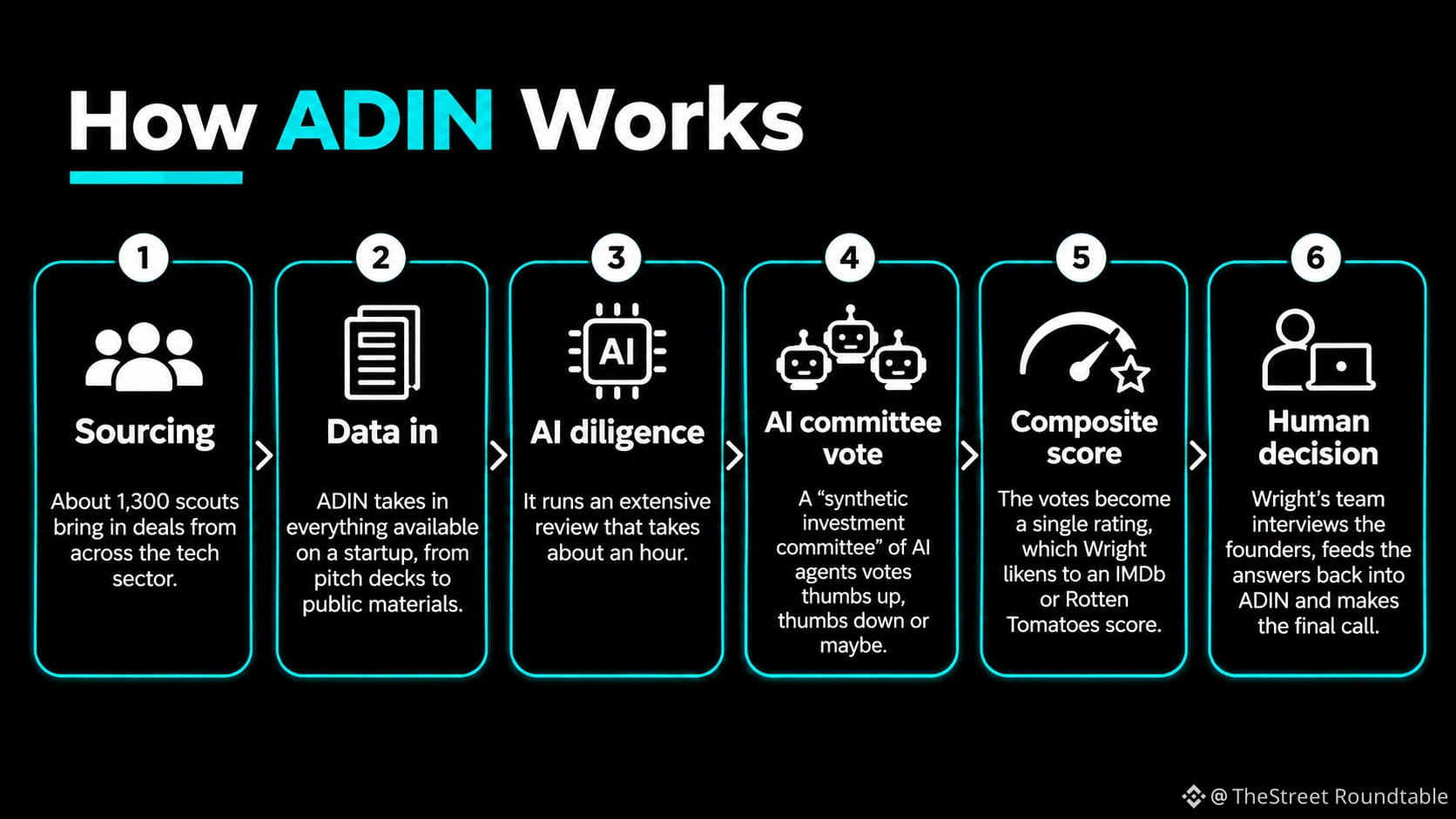 ADIN follows a pre-determined sequence to finally arrive at a final decision.
The legal ramifications
Because people make the final decisions, legal liability for Aiden’s picks rests with the firm. But Wright says U.S. law is already ready for something much stranger.
"Today in the U.S., with a little bit of legal work, you can have an AI that owns a legal entity and doesn't have any humans overseeing that enterprise," he said. "That may sound odd, but I think that's the future."
He expects AI agents to become regular players in finance. “They’ll be generating income and revenue, they’ll be making a profit for themselves and possibly even investors,” he said.
Taking on a 60% failure rate
Wright says roughly 60% to 70% of venture-backed projects never return any capital. Cutting that even slightly, he said, “just changes the entire game.”
He also sees a fairness angle. Founders often feel they must be in Silicon Valley, New York, Boston or Austin to raise money. An AI that can judge a startup from anywhere “should democratize access to capital,” Wright said.
Related: Mace Ai founders warn of AI double agents amid banks detecting unauthorized AI agents
From filter to decision-maker
Wright expects ADIN to take on more of the process over the next few years, possibly including writing the check itself.
He compares the shift to the rise of algorithmic hedge funds, when data science reshaped trading. AI systems, he said, will “first assist and then ultimately obliterate” the way venture funds work today.
“Agentic finance is coming,” he said.
The Roundtable 100
If you follow our market coverage, don’t miss the Roundtable 100. Updated every Friday, it’s a power ranking of the 100 most investable tech stocks, including digital assets. Check out the latest RTB 100 rankings at roundtable100.com.