

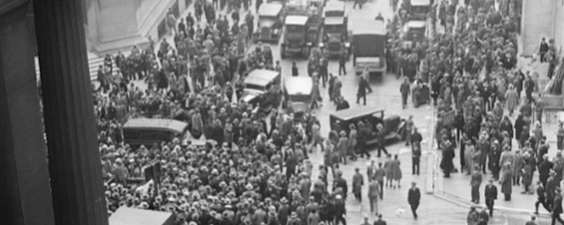

Imagine watching the value of your investments fall…
10%.
20%.
50%.
And then realizing the collapse isn't over.
That was the reality after the 1929 Wall Street Crash — one of the most devastating financial collapses in modern history.
But here's the part that matters:
The crash wasn't simply caused by people suddenly deciding to sell.
It was the result of a financial system that had become dangerously fragile.
🚨 How the Bubble Was Built
During the 1920s, stock prices exploded.
The Dow Jones Industrial Average rose from 63 in August 1921 to 381 by September 1929 — roughly a six-fold increase.
And ordinary investors increasingly entered the market using borrowed money.
Some buyers could purchase stocks with only around 10% of the purchase price upfront, borrowing the rest.
That created a powerful feedback loop:
📈 Prices rise
→ Investors become more confident
→ More people borrow to buy
→ Demand pushes prices even higher
→ Confidence becomes euphoria
→ Leverage increases
Until eventually...
Someone has to sell.
💥 Then the Machine Reversed
In October 1929, panic hit.
On Black Monday, October 28, the Dow fell almost 13%.
The following day, Black Tuesday, it dropped almost another 12%.
By mid-November, the Dow had lost nearly half its value.
And the damage continued.
By July 1932, the Dow had fallen about 89% from its 1929 peak.
But here's the crucial distinction:
The stock-market crash itself wasn't the entire Great Depression.
The financial collapse interacted with banking failures, deflation, falling demand, unemployment and policy mistakes.
From 1930 to 1933, the U.S. banking system suffered repeated waves of panic, while the money supply fell dramatically.
A market crash became an economic catastrophe.
🧠 So Why Could Something Like This Happen Again?
Because the underlying ingredients haven't disappeared.
Human psychology hasn't changed.
Financial markets still experience:
Leverage.
Crowded trades.
Speculation.
Liquidity shocks.
Overconfidence.
Fear.
And when leverage meets falling prices, things can move extremely quickly.
The IMF has repeatedly highlighted leverage, liquidity mismatches, high valuations and interconnected financial institutions as potential sources of financial instability.
Consider the pattern:
Easy money → rising asset prices → greater risk-taking → leverage → complacency → unexpected shock → forced selling → falling prices → more forced selling.
That's how a relatively small spark can become a much larger fire.
🔥 The Scariest Part?
The next major financial crisis doesn't have to look like 1929.
It could begin somewhere completely different.
A banking system.
A bond market.
A heavily leveraged investment fund.
A property market.
A sovereign-debt problem.
Or an asset class nobody currently considers dangerous.
The lesson isn't:
"A crash is definitely coming."
The lesson is much more important:
Financial stability can disappear faster than investors expect.
🧩 The Real Lesson From 1929
The biggest mistake isn't believing that markets can fall.
Everyone knows they can.
The dangerous belief is:
"It can't happen to me."
1929 demonstrated what happens when optimism, leverage and rising prices reinforce each other for long enough.
And history keeps reminding us of the same principle:
A financial system can look incredibly strong right before the weaknesses become visible.
The question isn't whether markets will ever crash again.
They will.
The real question is:
Where is the leverage hiding when the next shock arrives?
👇
What do you think could become the trigger for the next major financial crisis?