
The Bank of Japan just delivered another rate hike, but the yen moved in the opposite direction.
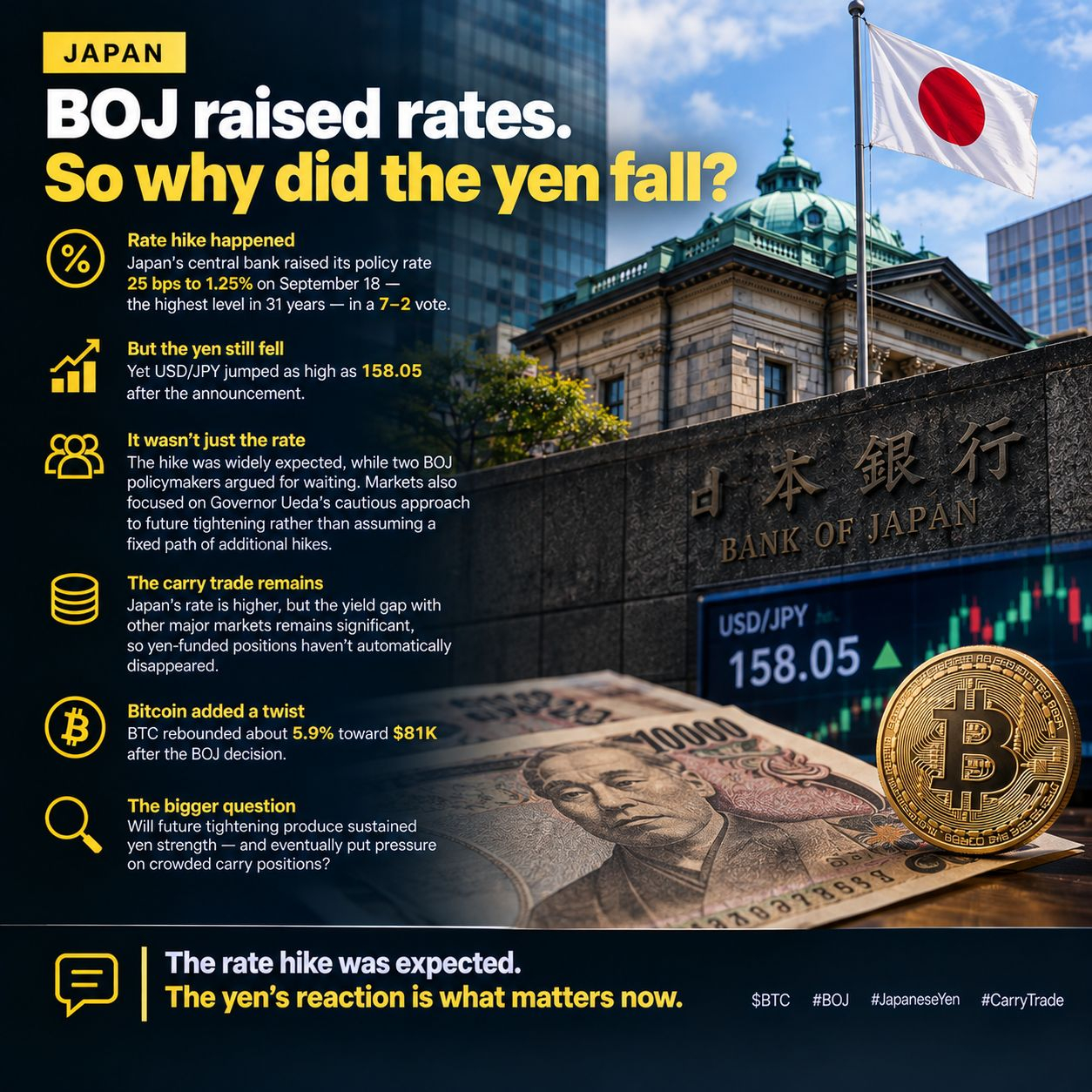
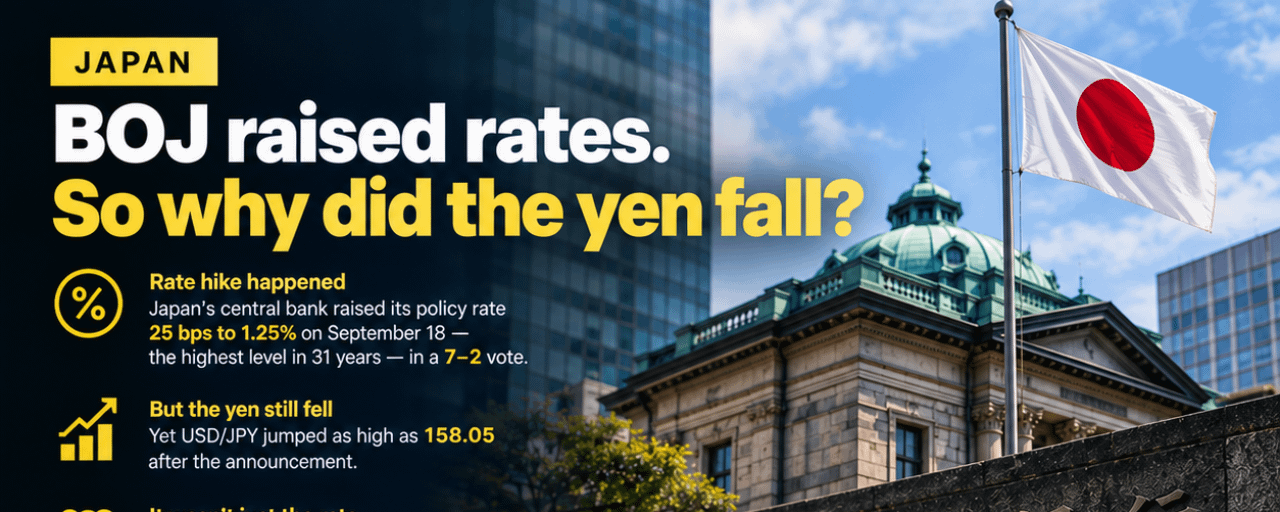
On September 18, the BOJ raised its policy rate by 25 basis points to 1.25%, the highest level in 31 years. The decision passed by a 7–2 vote, with two policymakers dissenting. The move itself was widely expected by markets.
So why did the yen weaken?
The answer lies in the difference between what happened and what markets expected to happen next.
The 25-basis-point increase wasn't a major surprise. What traders were looking for was stronger guidance about the BOJ's next moves.
Instead, Governor Kazuo Ueda avoided committing to a fixed pace of future tightening. He said the bank would assess conditions at each policy meeting and determine the appropriate policy response based on inflation, economic activity and financial conditions.
That created an important gap between the rate decision and expectations for the future.
The BOJ can raise rates today while still giving markets reasons to believe that future hikes won't necessarily come quickly.
The two dissenting votes also caught the market's attention. Two policymakers preferred to leave rates unchanged, adding uncertainty around how quickly the BOJ can continue tightening.
The result was striking: despite Japan's highest policy rate since 1995, the dollar rose as much as 1.2% against the yen to around ¥158.05.
This is why simply looking at the rate hike can miss the bigger market signal.
Japan has historically been a major funding market because borrowing costs were extremely low. The basic carry-trade structure is straightforward: borrow yen, convert into another currency, and invest in higher-yielding assets.
When Japanese rates rise and the yen strengthens, those positions can become less attractive. But a single rate hike doesn't automatically force the trade to unwind.
For that to become a larger market issue, investors would need to see a more sustained change in the relative attractiveness of yen funding and potentially stronger yen appreciation.
That is why USD/JPY remains an important macro indicator.
Bitcoin adds another layer.
Interestingly, Bitcoin moved higher after the BOJ decision. Reuters reported BTC rebounded roughly 6% toward $81,000 following the announcement.
That doesn't mean BOJ tightening is automatically bullish for Bitcoin.
It simply shows why the relationship isn't as simple as “BOJ hikes = BTC falls.”
Markets are constantly comparing the actual policy decision with what was already expected.
If the BOJ hikes but markets interpret the future path as relatively gradual, the immediate impact can look very different from what the headline rate decision suggests.
The bigger risk for global markets isn't necessarily the 25-basis-point hike itself. It's what happens if the yen eventually begins strengthening sharply.
A stronger yen could make existing carry positions less attractive. If positioning is crowded, a rapid currency move could create pressure to reduce those positions, potentially affecting other risk assets as capital is repositioned.
There is also a separate currency-policy issue. Japanese authorities conducted rate checks after the yen weakened, a step that markets often watch for potential intervention.
For traders, that makes USD/JPY more important than the BOJ headline alone.
The key questions are now: Does the BOJ continue tightening? Does the yen finally respond with sustained appreciation? Does the carry trade begin to unwind? And how do global risk assets, including Bitcoin, respond?
The September decision showed something important: markets don't trade the rate hike in isolation. They trade the gap between expectations and what policymakers actually deliver.
For now, Japan tightened policy, but the yen weakened.
That divergence is the part worth watching.