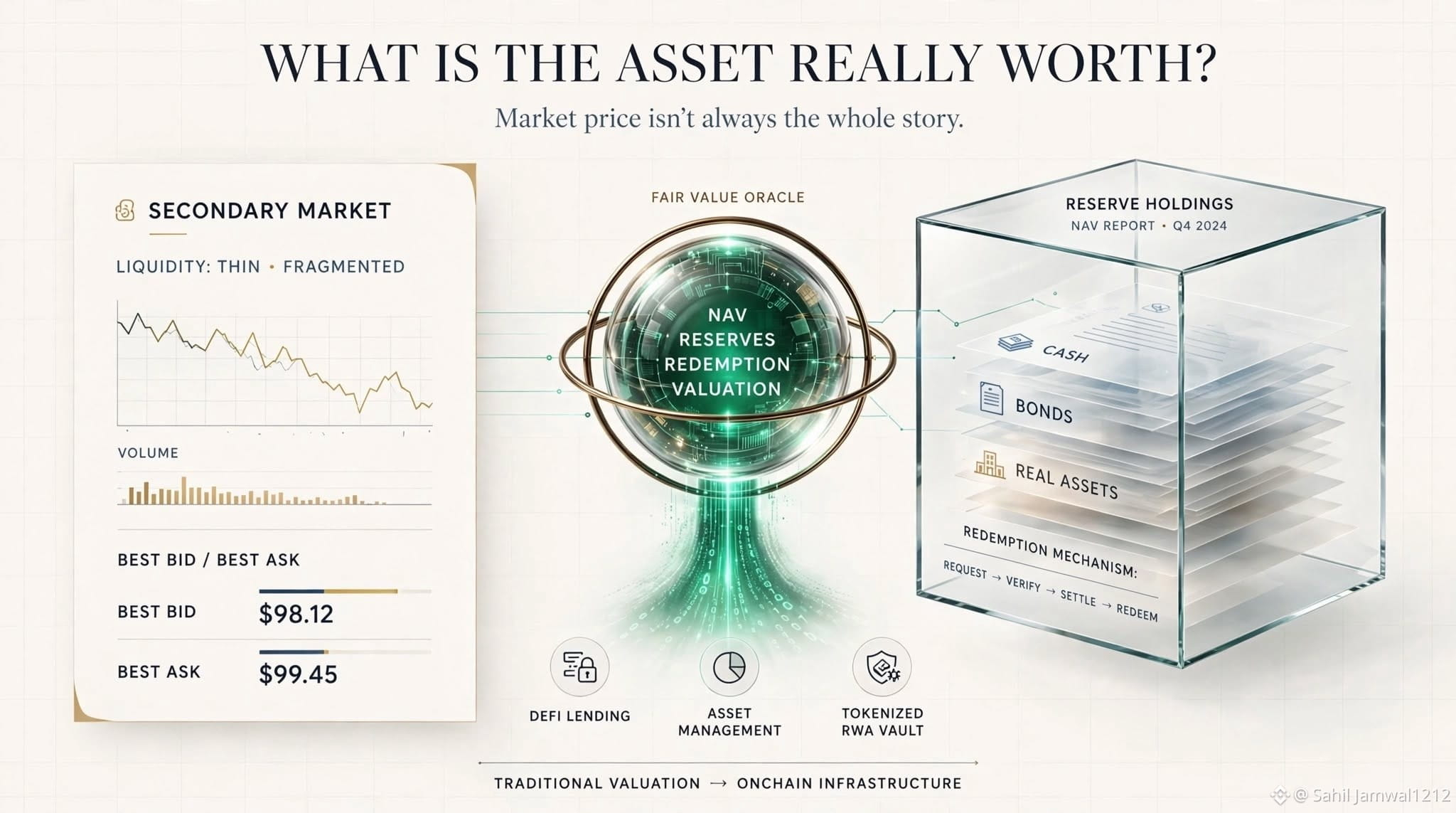
Here's a DIA angle I think gets overlooked: fair-value pricing.
Traditional finance has spent decades dealing with assets that don't have a clean, liquid market price.
IFRS 13 and ASC 820 provide frameworks for fair-value measurement, with observable market prices prioritized but valuation techniques also used when market inputs aren't sufficient.
That sounds surprisingly familiar when looking at DIA Value.
DIA can calculate fundamental value using things like:
→ NAV
→ Proof of Reserves
→ Redemption Value
→ Contract Exchange Rate
→ Reserve-Backing
For a tokenized fund, vault or reserve-backed asset, simply looking at the last trade may not always tell you what the asset is fundamentally worth.
$DIA Value is designed for exactly that kind of situation.
And this matters as more traditional assets move onchain.
Think tokenized funds, treasuries, private credit, yield-bearing assets and other instruments where valuation can depend on underlying assets, liabilities, reserves or redemption mechanisms.
One thing I wouldn't claim is that DIA Value itself makes an asset IFRS- or GAAP-compliant.
That's an accounting determination, not an oracle feature.
But the underlying idea is interesting:
Take established valuation concepts from traditional finance and make them programmable, transparent and available onchain.
For me, that's one of the more interesting bridges between TradFi and DeFi.
Traditional finance has spent decades dealing with assets that don't have a clean, liquid market price.
IFRS 13 and ASC 820 provide frameworks for fair-value measurement, with observable market prices prioritized but valuation techniques also used when market inputs aren't sufficient.
That sounds surprisingly familiar when looking at DIA Value.
DIA can calculate fundamental value using things like:
→ NAV
→ Proof of Reserves
→ Redemption Value
→ Contract Exchange Rate
→ Reserve-Backing
For a tokenized fund, vault or reserve-backed asset, simply looking at the last trade may not always tell you what the asset is fundamentally worth.
$DIA Value is designed for exactly that kind of situation.
And this matters as more traditional assets move onchain.
Think tokenized funds, treasuries, private credit, yield-bearing assets and other instruments where valuation can depend on underlying assets, liabilities, reserves or redemption mechanisms.
One thing I wouldn't claim is that DIA Value itself makes an asset IFRS- or GAAP-compliant.
That's an accounting determination, not an oracle feature.
But the underlying idea is interesting:
Take established valuation concepts from traditional finance and make them programmable, transparent and available onchain.
For me, that's one of the more interesting bridges between TradFi and DeFi.