
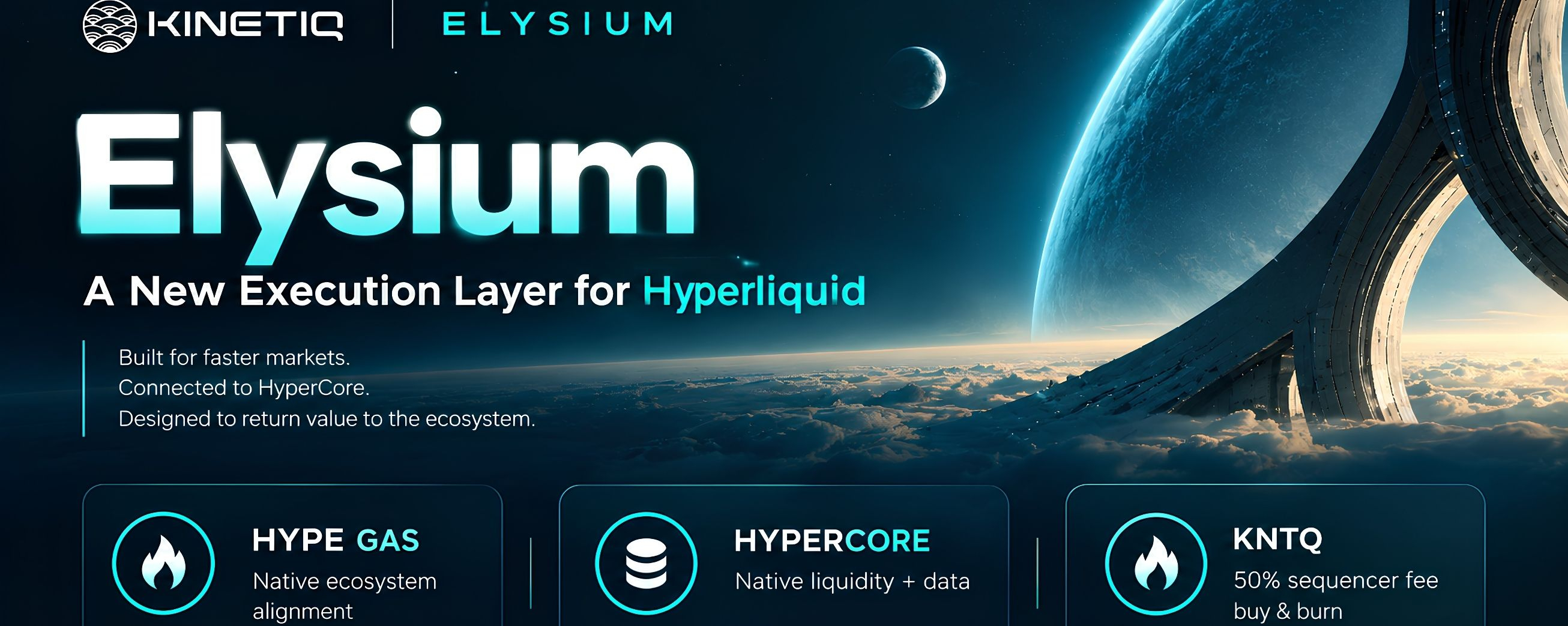

Hyperliquid already has a strong trading engine.
But the next phase of its growth may depend on something different:
better application infrastructure around that engine.
That is where Kinetiq's Elysium enters the picture.
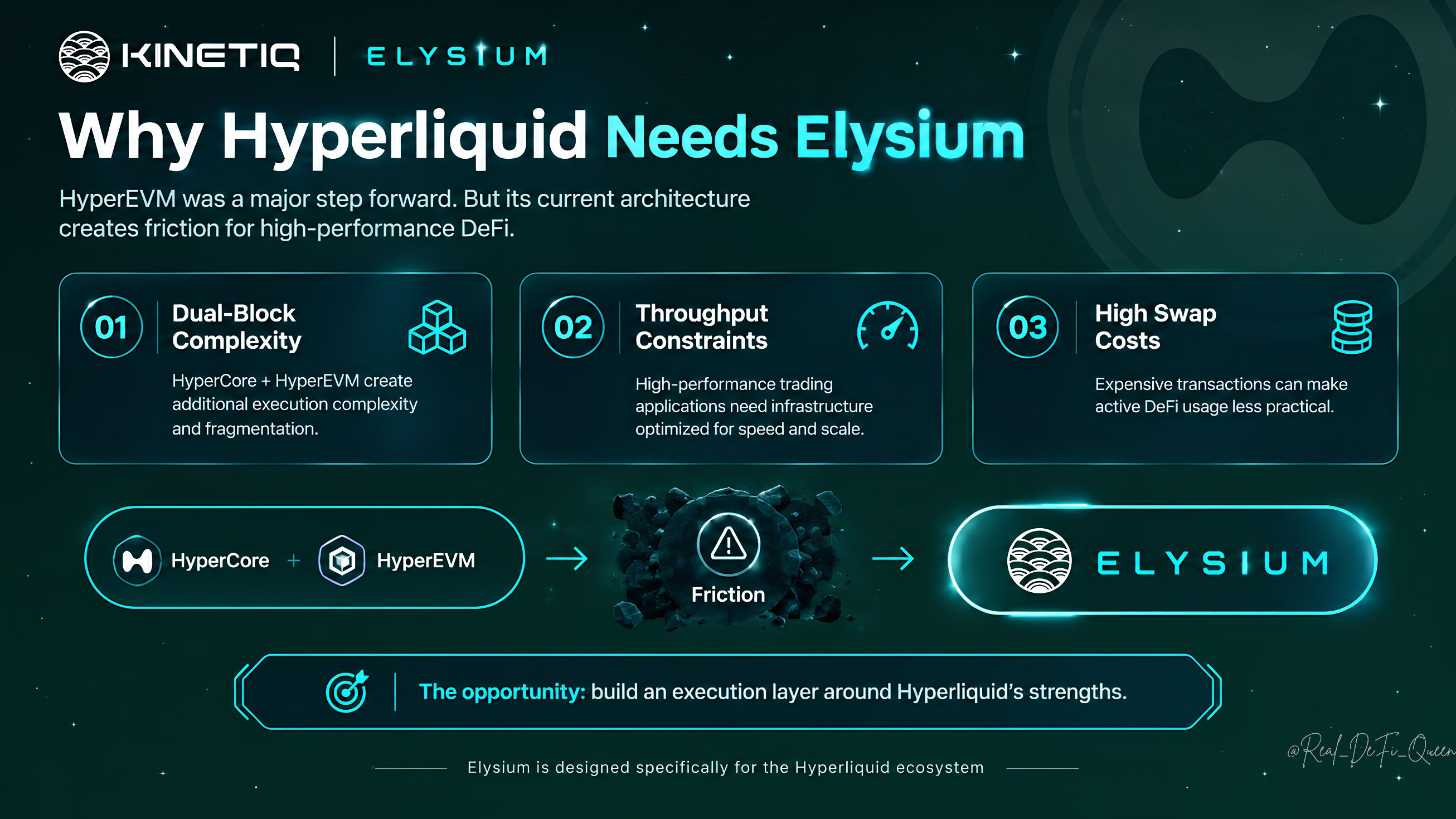
Elysium is being designed as a purpose-built Layer 2 for Hyperliquid, targeting several HyperEVM bottlenecks including dual-block complexity, throughput limitations and periods of expensive swaps.
The interesting part is that Elysium is not being positioned as an isolated chain trying to pull liquidity away from Hyperliquid.
The design is much more tightly connected.
HYPE becomes the gas
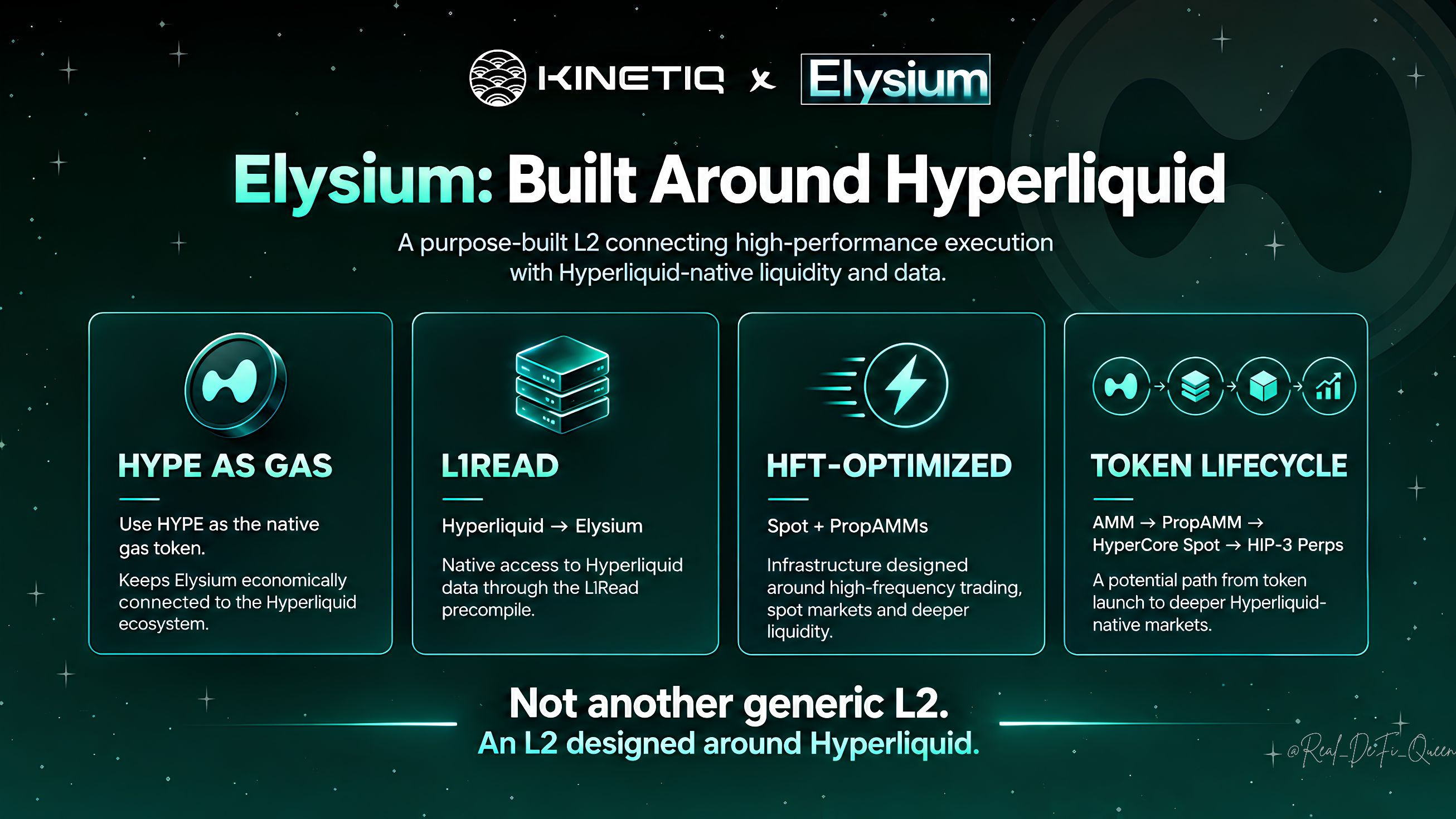
Elysium uses $HYPE as its native gas token.
That keeps the execution environment economically connected to the Hyperliquid ecosystem instead of introducing another gas asset.
The architecture is also designed around HyperCore, with a focus on high-frequency trading, spot markets and PropAMMs.
For traders and builders, that matters because infrastructure optimized for general applications does not always behave the same way as infrastructure designed around trading.
Elysium is explicitly targeting the latter.
Hyperliquid as a native data source
Another interesting component is the L1Read precompile.
The idea is to allow Elysium applications to read Hyperliquid data directly, effectively giving the L2 a native connection to the L1.
That can open up new possibilities for DeFi applications, PropAMMs and market infrastructure that need reliable Hyperliquid-native information.
A token can have a lifecycle
Elysium also proposes a broader token lifecycle:
AMM → PropAMM → HyperCore Spot → HIP-3 Perps
This is interesting because it treats token creation as a progression rather than a one-time launch.
An asset could potentially start with an AMM, develop deeper liquidity through a PropAMM, move into HyperCore spot markets and eventually reach perpetual markets.
If adoption develops, Elysium could become infrastructure for the journey of an asset across the Hyperliquid ecosystem.
The part I keep coming back to: sequencer fees
This is where Elysium's “value-accretive L2” thesis becomes particularly interesting.
The proposed sequencer fee distribution is:
25% → Builders
25% → Treasury
50% → KNTQ buyback and burn
That creates a simple feedback loop:
More Elysium activity → more sequencer fees → more $KNTQ purchased → more KNTQ burned.
That is a very different economic proposition from an L2 simply capturing activity for itself.
Builders receive an incentive.
The treasury receives revenue.
KNTQ receives a direct buy-and-burn mechanism.
And the network gets an economic reason to grow.
But there is a catch
I would not jump straight from “50% buy and burn” to “KNTQ is guaranteed to become hyper-deflationary.”
The percentage is only one part of the equation.
The bigger variable is usage.
If Elysium attracts serious builders, meaningful spot volume, PropAMM activity and sustained users, then the sequencer model could create substantial value capture.
If activity remains small, the mechanism remains mostly theoretical.
That is why the numbers I would watch after launch are not just token supply.
I would watch:
• Sequencer revenue
• Daily active users
• Spot volume
• PropAMM activity
• Builder adoption
• Token launches
• Liquidity moving into HyperCore
That will tell us much more than a tokenomics diagram.
My take
The most interesting thing about Elysium is not simply that it aims to be faster.
Crypto has plenty of fast chains.
The interesting question is whether an execution layer can grow with its underlying ecosystem instead of extracting value from it.
Elysium's architecture is clearly designed around that idea.
$HYPE provides the gas.
HyperCore provides the deeper trading connection.
L1Read provides native data access.
The token lifecycle connects launches with spot and perpetual markets.
And the sequencer fee model creates a direct path toward KNTQ buybacks and burns.
The thesis is compelling.
But the thesis still needs to meet reality.
Builders have to come.
Traders have to use it.
Liquidity has to follow.
And sequencer revenue has to become meaningful.
That is when we will know whether Elysium is simply another L2 narrative or something more important for the Hyperliquid economy.