
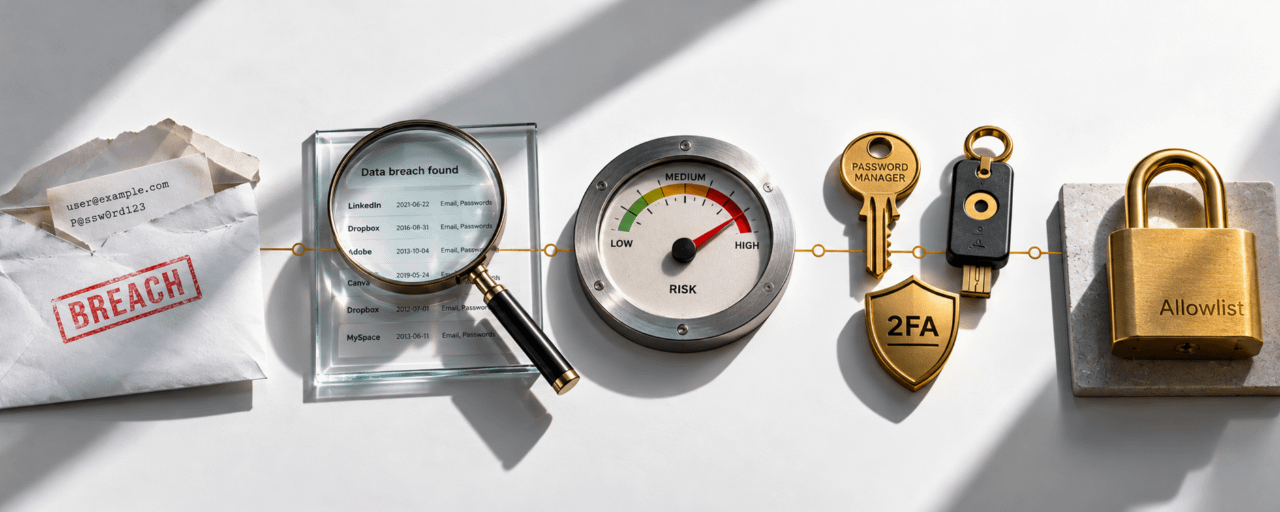

Your personal data has probably been leaked. Not maybe probably. Over 16 billion records were exposed in data breaches in 2024 alone. If you have ever created an online account, used an email address to sign up for a service, or shopped online, your data exists in databases that may have been breached, sold, or published on the dark web. The question is not "was my data leaked?" it is "which leaks, and what do I do about it?"
Here is a practical guide to checking if your data was exposed, understanding what was leaked, and taking the right steps to protect yourself.
🔍 Part 1: How to Check if Your Data Was Leaked
Method 1 :Have I Been Pwned (haveibeenpwned.com)**This is the gold standard for checking data breaches. Created by security researcher Troy Hunt, the free tool lets you enter your email address or phone number and instantly see every known data breach that includes your data.
How to use it:
Go to haveibeenpwned.com
Enter your email address
View the results every breach that contains your data is listed with:
The name of the breached service
The date of the breach
What data was exposed (email, password, name, phone, address, etc.)
A description of what happened
What the results tell you: If your email appears in 3-5 breaches, that is normal in 2026. Most people have been in multiple breaches without knowing. What matters is what data was exposed in each one and whether you reused the same password across services.
Method 2 : Firefox Monitor
Mozilla's Firefox Monitor is a free tool that checks your email against known data breaches. It is integrated into Firefox browser and also available as a standalone website at monitor.mozilla.org.
How to use it:
Go to monitor.mozilla.org
Enter your email address
View the results similar to Have I Been Pwned but with a cleaner interface and breach notifications
Method 3 : Google Password Checkup
If you use Google Chrome or Google Account, Google's built-in Password Checkup tool checks your saved passwords against known breaches.
How to use it:
Go to mypasswords.google.com
Review the "Password Checkup" section
Google shows you which saved passwords have been exposed in known breaches and which are weak or reused
Method 4 : Dark Web Monitoring Services
Several services actively monitor the dark web for your
Binance security alerts if you have a Binance account, enable security notifications to receive alerts if your email or credentials appear in breach databases
Identity protection services services like LifeLock, IdentityForce, or similar providers monitor the dark web for your personal information
Credit monitoring in some countries, credit bureaus offer monitoring that alerts you when your data is used to open new accounts
Method 5 : Check Your Email for Breach Notifications
If a service you use has been breached, they are legally required (in most jurisdictions) to notify you by email. Search your inbox for terms like "data breach," "security incident,""we are writing to inform you," or "unauthorized access."
The problem: These emails often look like phishing attempts, so users ignore them. If you receive a breach notification from a service you use, do not click links in the email go directly to the service's website by typing the URL manually and check your account security settings there.
📊 What Kind of Data Gets Leaked and Why It Matters
Not all data breaches are equal. The severity depends on what was exposed.
Low risk email address alone: Your email is in a breach but no password, no financial data, no personal details. Risk: increased spam, phishing attempts targeting your email.
Medium risk : email + hashed password: Your email and an encrypted version of your password were exposed. If the password was weak or the hash was unsalted, attackers can crack it. Risk: if you reused this password on other services, those accounts are also compromised.
High risk : email + plaintext password: Your email and your actual password (not encrypted) were exposed. Risk: immediate account takeover on any service where you used the same password.
Critical risk : email + password + personal Your email, password, full name, date of birth, phone number, and/or physical address were exposed. Risk: identity theft, social engineering attacks, SIM swapping, and targeted phishing.
Severe risk : financial Your credit card number, bank account details, or payment credentials were exposed. Risk: financial fraud, unauthorized transactions, identity theft.
🛡️ Part 2: What to Do After a Data Leak
Step 1: Change Your Passwords Immediately
This is the first and most important step. If your password was leaked, it is now public. Anyone with access to the breach database has it.
How to do it right:
Change the password on the breached service first
Change the password on every other service where you used the same password (this is why password reuse is dangerous)
Use a unique, randomly generated password for every account at least 16 characters with a mix of uppercase, lowercase, numbers, and symbols
Use a password manager (Bitwarden, 1Password, KeePass) to generate and store unique passwords so you never have to remember them
Step 2: Enable Two-Factor Authentication (2FA)
A stolen password is useless if the attacker cannot get past 2FA.
What to use:
Best: Passkeys (FIDO2/WebAuthn) resistant to phishing, SIM swaps, and credential theft
Good: Authenticator apps (Google Authenticator, Authy, Raivo) generate time-based codes
Acceptable: SMS-based 2FA better than nothing but vulnerable to SIM swapping
Not acceptable: Email-based 2FA if your email is compromised, this is useless
On Binance specifically: passkeys, Google Authenticator, and anti-phishing codes are all available and strongly recommended.
Step 3: Check if Your Email Account Is Compromised
Your email account is the master key to your digital life. If an attacker has your email password, they can reset passwords on every service that uses that email including your crypto exchange, your bank, and your social media.
Signs your email is compromised:
Emails in your sent folder you did not send
Password reset emails you did not request
Rules or filters you did not create (attackers set these to hide password reset emails from your inbox)
Login alerts from devices or locations you do not recognize
What to do:
Change your email password immediately
Check and delete any forwarding rules or filters you did not create
Review recent login activity
Enable 2FA on your email account
Check connected apps and revoke access for anything you do not recognize
Step 4: Freeze Your Credit (If Available)
If personal data like your full name, date of birth, address, and government ID number were leaked, you are at risk of identity theft someone opening accounts in your name.
How to freeze your credit:- US: Contact Equifax, Experian, and TransUnion to freeze your credit (free by federal law)
UK: Contact Cif as to add a protective registration to your credit file
EU: Contact your national credit bureau
Africa: Check with your local credit bureau or financial regulator in many African countries, credit freezing is less formalized, so monitor your bank accounts and financial statements closely for unauthorized activity
Step 5: Monitor Your Accounts
After a data leak, stay vigilant for weeks and months.
What to monitor:
Bank and card statements for unauthorized transactions
Email inbox for password reset emails you did not request
Crypto exchange accounts for unauthorized login attempts
Social media accounts for posts or messages you did not send
Phone for SIM swap indicators (sudden loss of signal, inability to make calls)
On Binance: Enable login notifications, check your login history regularly, and enable withdrawal allowlisting so funds can only go to pre-approved addresses even if an attacker gains access to your account, they cannot withdraw to their own wallet.
Step 6: Report Identity Theft (If It Happens)
If your leaked data is used to commit identity theft someone opens accounts in your name, files taxes using your identity, or makes unauthorized transactions take these steps:
Contact the financial institution where the fraud occurred and report it immediately
File a police report this creates a legal record of the identity theft
Contact your national identity protection authority (if one exists in your country)
In the US: file a report with the FTC at IdentityTheft.gov
In Africa: contact your bank, your telecom provider (for SIM swap fraud), and local law enforcement
🔐 Part 3: How to Prevent Future Damage
Habit 1: Use a Password Manager
Stop reusing passwords. Stop trying to remember them. Use a password manager that generates unique, random passwords for every account and stores them encrypted.
Recommended:
Bitwarden free, open-source, cross-platform
1Password paid, polished, family plans available
KeePass free, offline, maximum control, less user-friendly
Habit 2: Never Reuse Passwords
If you use the same password on five services and one of them is breached, all five are compromised. A password manager solves this every account gets a unique password.
Habit 3: Enable 2FA Everywhere
Not just on your crypto exchange. Enable 2FA on:
Your email account (most important it is the master key)
Your crypto exchange accounts
Your bank and financial apps
Your social media accounts
Any service that offers 2FA
Habit 4: Use Passkeys Where Available
Passkeys (FIDO2/WebAuthn) are the strongest authentication method available. They use cryptographic key pairs stored on your device your authentication never leaves your device and cannot be intercepted. Binance, Google, Apple, Microsoft, and many others now support passkeys.
Habit 5: Be Skeptical of Every Email and Message
After a data leak, attackers know your email address, your name, and possibly more. They will use this information to craft targeted phishing emails that look legitimate.
The rule: Never click a link in an email that asks you to log in, reset a password, or verify your identity. Always go to the website directly by typing the URL.
Habit 6: Set Up Breach Alerts
Subscribe to Have I Been Pwned notifications you will receive an email when your data appears in a new breach
Enable security alerts on your Binance account
Enable login alerts on your email and social accounts
Habit 7: Use a Hardware Security Key for High-Value Accounts
For accounts that matter most your crypto exchange, your email, your bank consider a hardware security key like YubiKey or Google Titan. These are physical devices that provide FIDO2 authentication and are immune to phishing, SIM swaps, and credential theft.
🌍 Why This MattersMore in Africa
In many African countries, the safety net for identity theft is thinner than in Western markets. There may not be a federal trade commission to file a complaint with. Credit freezing may not be available. Consumer protection laws may be weaker.
This means prevention is everything. When the safety net is thin, the parachute matters more.
For users in Congo and similar markets:
Your phone number is a critical asset SIM swap attacks can give an attacker access to your SMS-based 2FA. Use authenticator apps or passkeys instead of SMS 2FA wherever possible
Your email account is your digital identity protect it with 2FA and a unique password
Your crypto exchange account is your bank enable every security feature available: passkeys, 2FA, anti-phishing codes,and withdrawal allowlisting
Mobile money accounts (Orange Money, MTN, M-Pesa) should be secured with PINs and biometric authentication where available
❓ FAQs
Q: What should I do first if I find my data in a breach?
A: Change the password on the breached service immediately. Then change the password on every other service where you used the same password. Enable two-factor authentication on the breached service and on your email account. Check your email account for suspicious activity forwarding rules, login alerts, or password reset emails you did not request. If financial data was exposed, monitor your bank and card statements for unauthorized transactions.
Q: Is Have I Been Pwned safe to use?
A: Yes. Have I Been Pwned is a widely trusted, free tool created by security researcher Troy Hunt. It only stores email addresses and breach data it does not store passwords or personal information. When you search your email, the site does not reveal your full email to anyone else. It is used by security professionals, governments, and Fortune 500 companies. It is the industry standard for breach checking.
Q: What is the difference between a data breach and a data leak?
A: A data breach is a security incident where an attacker gains unauthorized access to a system and steals data for example, a hacker breaking into a company's database and exporting user records. A data leak is when data is exposed due to misconfiguration or human error for example, a company leaving a database open to the internet without a password. Both result in your data being exposed,and the steps you take to protect yourself are the same: change passwords, enable 2FA, and monitor for suspicious activity.
📌 Sources: Have I Been Pwned official site; Mozilla Firefox Monitor; Google Password Checkup; Binance security features official page; FTC Identity Theft guide (IdentityTheft.gov).
⚠️ Educational content only. This guide provides general cybersecurity best practices and does not guarantee protection against all threats. Always follow the specific security recommendations of the services you use.