CROSS CHAIN SWAP.
A cross-chain swap lets you move from an asset on one blockchain to a different asset on another blockchain in a single coordinated flow. You start with one token on its native chain and end with another token on a separate chain without needing multiple manual steps.
Blockchains do not natively share state. Each network maintains its own independent ledger and can not directly read or verify balances on another chain. This isolation means value can not simply transfer between them without some form of coordination layer.
Same-chain swaps are simpler. Both assets live on the same network, so a single smart contract can handle the exchange instantly. Cross-chain swaps require extra mechanisms because the two ledgers never talk to each other directly.
Two common approaches exist. Traditional bridges often lock assets on one side and mint a wrapped version on the other. Atomic swaps use cryptographic locks so both sides of the trade are either complete fully or reverse completely, reducing the need for a large shared pool of funds.
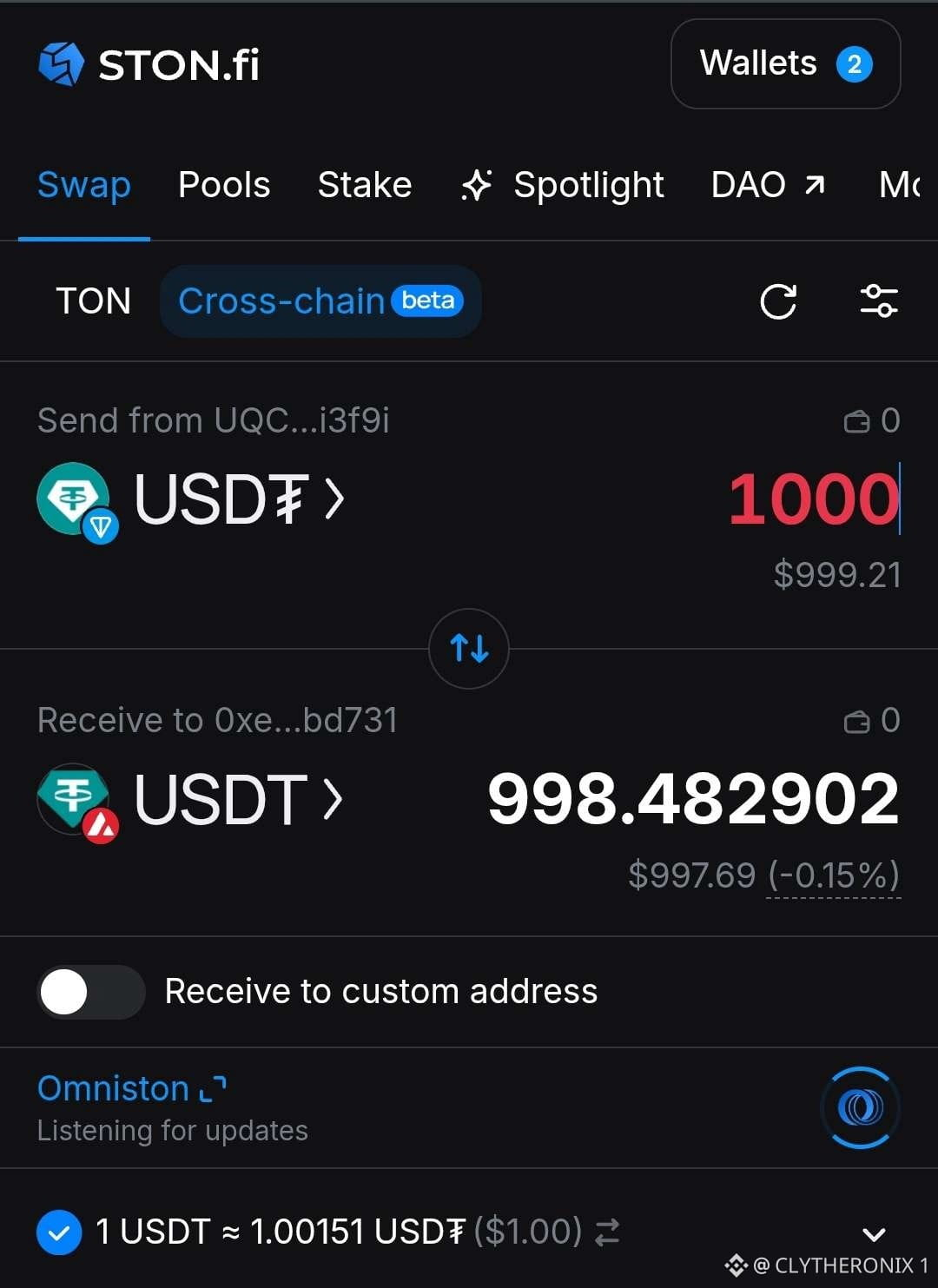
For example, swapping $USDT on $GRAM to $AAVA chain, respectively. Omniston [https://ston.fi/omniston] offers one practical architecture. It uses a resolver-based model with hashed timelock contracts. A resolver locks the destination asset while the user’s source asset is locked on its chain. Both contracts share the same cryptographic condition. When the condition is met, both sides settle at the quoted rate.
If anything fails within the time window, the locks expire, and every asset returns automatically. The result is an all-or-nothing outcome with no custodian holding funds in between.
This design keeps the process non-custodial and focused on exact quoted settlement across chains.
#Macro Insights#
A cross-chain swap lets you move from an asset on one blockchain to a different asset on another blockchain in a single coordinated flow. You start with one token on its native chain and end with another token on a separate chain without needing multiple manual steps.
Blockchains do not natively share state. Each network maintains its own independent ledger and can not directly read or verify balances on another chain. This isolation means value can not simply transfer between them without some form of coordination layer.
Same-chain swaps are simpler. Both assets live on the same network, so a single smart contract can handle the exchange instantly. Cross-chain swaps require extra mechanisms because the two ledgers never talk to each other directly.
Two common approaches exist. Traditional bridges often lock assets on one side and mint a wrapped version on the other. Atomic swaps use cryptographic locks so both sides of the trade are either complete fully or reverse completely, reducing the need for a large shared pool of funds.
For example, swapping $USDT on $GRAM to $AAVA chain, respectively. Omniston [https://ston.fi/omniston] offers one practical architecture. It uses a resolver-based model with hashed timelock contracts. A resolver locks the destination asset while the user’s source asset is locked on its chain. Both contracts share the same cryptographic condition. When the condition is met, both sides settle at the quoted rate.
If anything fails within the time window, the locks expire, and every asset returns automatically. The result is an all-or-nothing outcome with no custodian holding funds in between.
This design keeps the process non-custodial and focused on exact quoted settlement across chains.
#Macro Insights#