
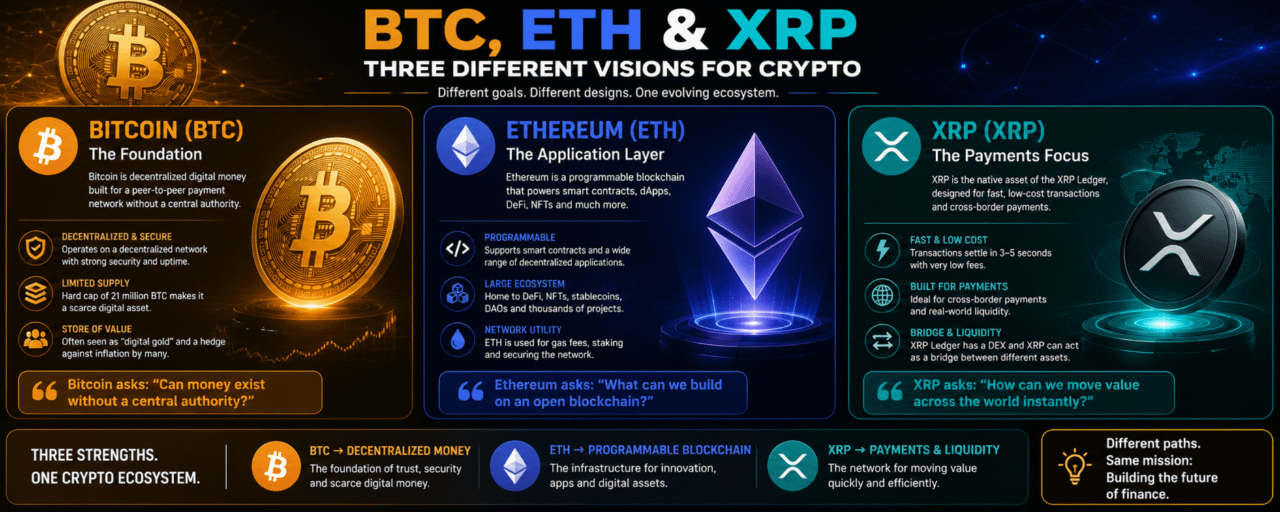

Crypto is often discussed as one market, but Bitcoin, Ethereum, and XRP were built around very different ideas.
Bitcoin focuses on decentralized money and a peer-to-peer payment network. Ethereum is designed as a programmable platform for applications and digital assets. XRP, the native asset of the XRP Ledger, focuses heavily on fast value transfer, liquidity, and payments.
Bitcoin: The Foundation
Bitcoin is the oldest of the three and is designed around decentralized digital money.
It operates through a peer-to-peer network without a central authority controlling the system. Its limited supply and decentralized architecture have made Bitcoin a major part of the broader crypto ecosystem.
The interesting thing about BTC is its simplicity.
Rather than trying to become everything, Bitcoin focuses on being a decentralized monetary network.
Ethereum: The Application Layer
Ethereum takes a different approach.
Instead of focusing primarily on digital money, Ethereum provides infrastructure for decentralized applications, smart contracts, and digital assets. Its programmable environment has helped create ecosystems around DeFi, NFTs, stablecoins, and many other blockchain applications.
ETH is the native asset of Ethereum and is used throughout the network.
So while Bitcoin asks:
“Can money exist without a central authority?”
Ethereum asks:
“What can we build on an open blockchain?”
XRP: The Payments Focus
XRP has another direction.
XRP is the native cryptocurrency of the XRP Ledger and is designed for fast, low-cost transactions. The XRP Ledger also includes a decentralized exchange where XRP can function as a bridge asset between different currencies and assets.
Ripple also highlights XRP's role in cross-border payments and liquidity.
More recently, Ripple has expanded its payments infrastructure and stablecoin offerings, with RLUSD issued on both the XRP Ledger and Ethereum.
Three Different Strengths
Looking at them conceptually:
BTC → decentralized money
ETH → programmable blockchain
XRP → payments and liquidity
That doesn't necessarily mean one is better than the others.
They are solving different problems.
Bitcoin's strength comes from its monetary design and decentralized network.
Ethereum's strength comes from programmability and its application ecosystem.
XRP's strength comes from transaction speed, liquidity, and payment-focused infrastructure.
The Bigger Picture
The most interesting part of crypto may not be choosing a single winner.
Bitcoin can serve as a decentralized monetary asset.
Ethereum can provide infrastructure for applications and digital assets.
XRP can focus on moving value efficiently across networks and currencies.
If blockchain adoption continues expanding, these different approaches could coexist rather than compete for exactly the same role.
BTC represents digital money.
ETH represents programmable infrastructure.
XRP represents fast movement of value.
Three assets.
Three different designs.
And three different ideas about what blockchain technology can become.