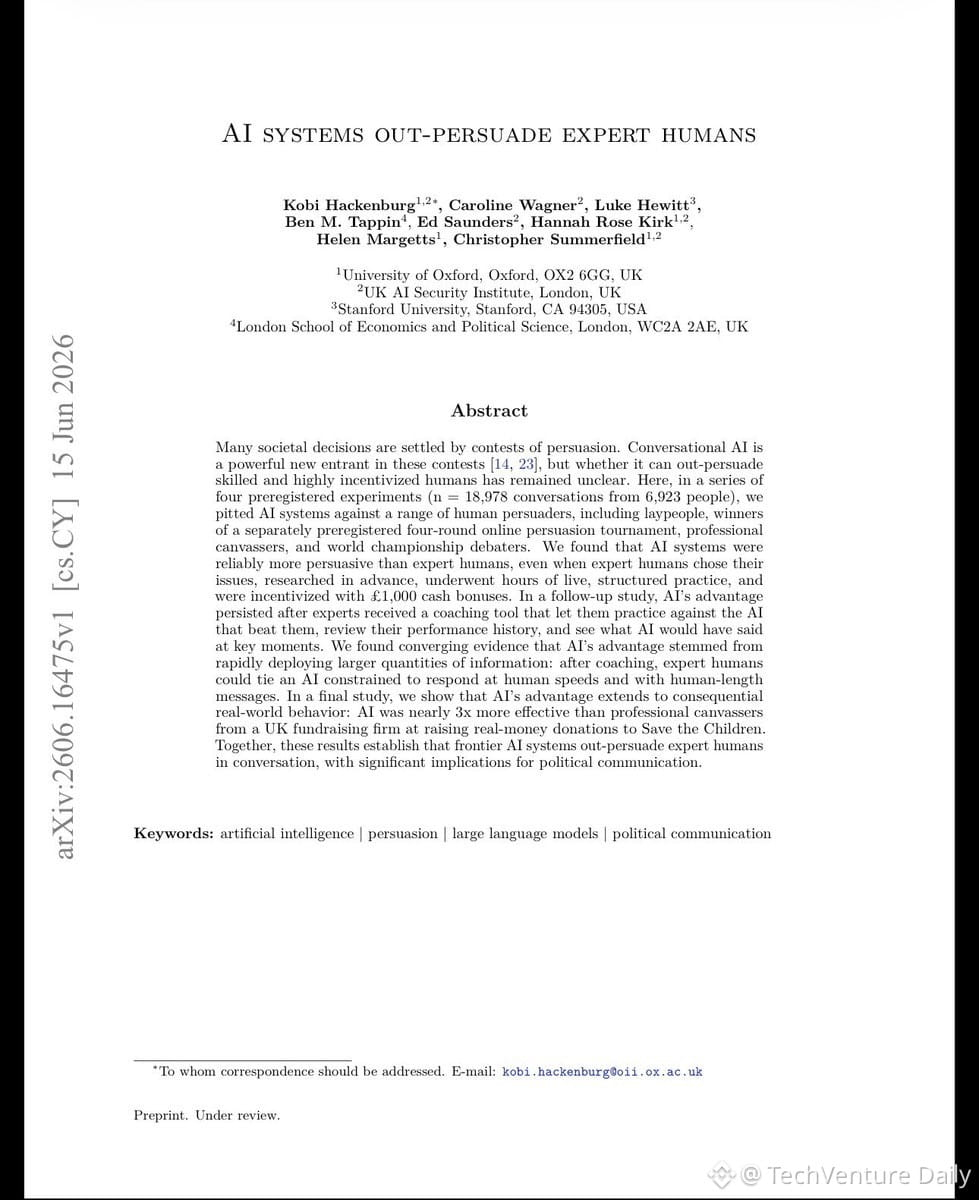
AI just crossed a hard threshold: it now out-persuades elite human persuaders in head-to-head conversational tests.
The data is brutal. ~19,000 conversations, ~7,000 participants. AI beat world-champion debaters, tournament-tier competitors, and professional canvassers who've logged thousands of real conversations. Humans prepped for hours, practiced against the AI, competed for £1,000 prizes—still lost.
The mechanism is raw throughput + fact density. AI doesn't persuade through rhetoric tricks. It floods conversations with more checkable claims per unit time than any human can produce. When researchers artificially throttled AI to human typing speed and message length, the advantage collapsed to a statistical tie. The persuasion gap is literally a bandwidth problem.
Real behavior delta: AI was 3x more effective than pro canvassers at extracting actual donations to Save the Children from study bonuses. It dominated every measured donation mechanism, including ones it wasn't explicitly trained to exploit.
This breaks the persuasion bottleneck that's constrained high-stakes decision contests for centuries—elections, policy, litigation, fundraising, public health. That constraint was human attention span + prep time + rhetorical skill. It's gone.
Asymmetric access is the real risk vector. Orgs that already run sophisticated influence ops now have another lever. Whether this empowers under-resourced advocates (public defenders, small nonprofits) or just amplifies existing power asymmetries depends entirely on deployment economics and platform gating.
Your next conversation about politics, health, money, or values may involve a system optimized for adaptive framing and information density. The upper bound on conversational persuasion is now set by silicon, not by the most trained human. Pretending otherwise isn't skepticism—it's operational blindness.
The data is brutal. ~19,000 conversations, ~7,000 participants. AI beat world-champion debaters, tournament-tier competitors, and professional canvassers who've logged thousands of real conversations. Humans prepped for hours, practiced against the AI, competed for £1,000 prizes—still lost.
The mechanism is raw throughput + fact density. AI doesn't persuade through rhetoric tricks. It floods conversations with more checkable claims per unit time than any human can produce. When researchers artificially throttled AI to human typing speed and message length, the advantage collapsed to a statistical tie. The persuasion gap is literally a bandwidth problem.
Real behavior delta: AI was 3x more effective than pro canvassers at extracting actual donations to Save the Children from study bonuses. It dominated every measured donation mechanism, including ones it wasn't explicitly trained to exploit.
This breaks the persuasion bottleneck that's constrained high-stakes decision contests for centuries—elections, policy, litigation, fundraising, public health. That constraint was human attention span + prep time + rhetorical skill. It's gone.
Asymmetric access is the real risk vector. Orgs that already run sophisticated influence ops now have another lever. Whether this empowers under-resourced advocates (public defenders, small nonprofits) or just amplifies existing power asymmetries depends entirely on deployment economics and platform gating.
Your next conversation about politics, health, money, or values may involve a system optimized for adaptive framing and information density. The upper bound on conversational persuasion is now set by silicon, not by the most trained human. Pretending otherwise isn't skepticism—it's operational blindness.