#termmax @TermMax
I’m used to thinking of a DeFi loan as a few numbers on a dashboard: collateral here, debt there, health factor somewhere else.
Then I noticed how @TermMax handles a Gearing Token.
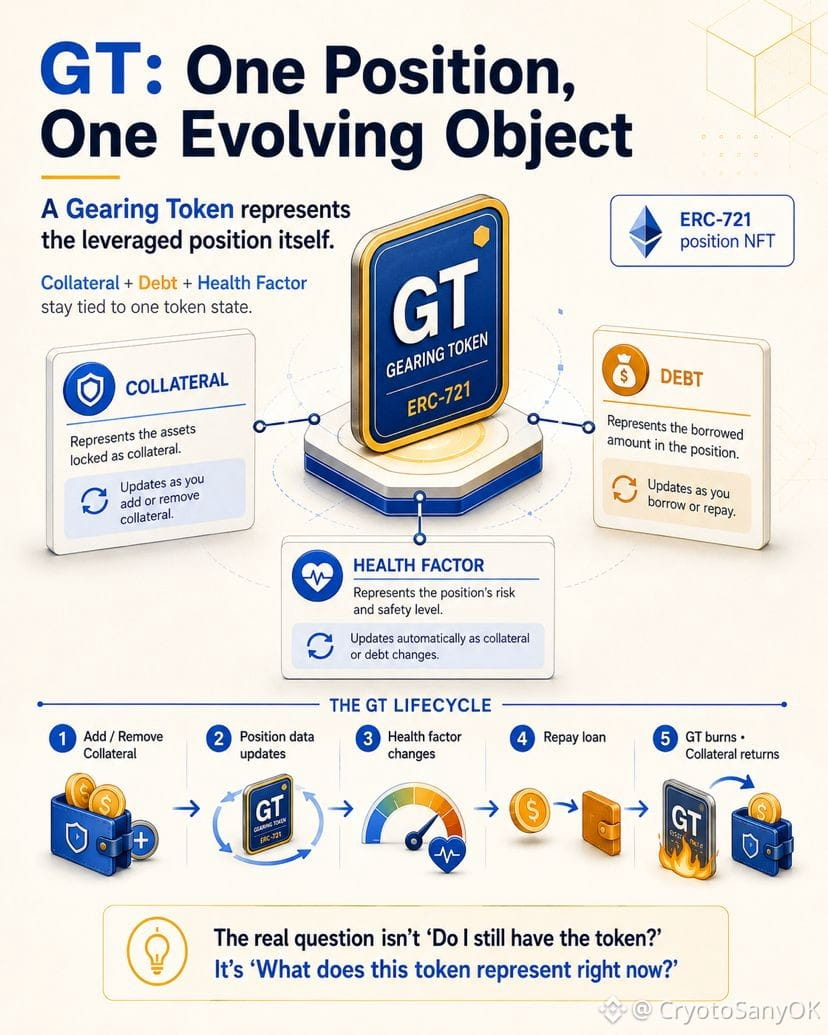
A GT is an ERC-721 NFT that represents the leveraged borrowing position itself. It carries the position’s collateral and debt information together.
What I found more interesting is what happens when the position changes.
Add or remove collateral, and the GT’s position data and health factor change with it. Repay the loan, and the GT is burned while the collateral is returned.
That sounds like a small implementation detail, but it changes the mental model for me.
Instead of managing several separate pieces and hoping the dashboard ties them together correctly, I can think of the leveraged position as one object whose state evolves over time.
The practical catch is that the NFT itself isn’t the thing I’d watch.
I’d still care about what sits behind it: collateral value, debt and health factor.
So if I held a GT, my question wouldn’t be “Do I still have the token?”
It would be:
“What does this token represent right now?”
That feels like a much better way to think about a leveraged position.
$TMX
I’m used to thinking of a DeFi loan as a few numbers on a dashboard: collateral here, debt there, health factor somewhere else.
Then I noticed how @TermMax handles a Gearing Token.
A GT is an ERC-721 NFT that represents the leveraged borrowing position itself. It carries the position’s collateral and debt information together.
What I found more interesting is what happens when the position changes.
Add or remove collateral, and the GT’s position data and health factor change with it. Repay the loan, and the GT is burned while the collateral is returned.
That sounds like a small implementation detail, but it changes the mental model for me.
Instead of managing several separate pieces and hoping the dashboard ties them together correctly, I can think of the leveraged position as one object whose state evolves over time.
The practical catch is that the NFT itself isn’t the thing I’d watch.
I’d still care about what sits behind it: collateral value, debt and health factor.
So if I held a GT, my question wouldn’t be “Do I still have the token?”
It would be:
“What does this token represent right now?”
That feels like a much better way to think about a leveraged position.
$TMX