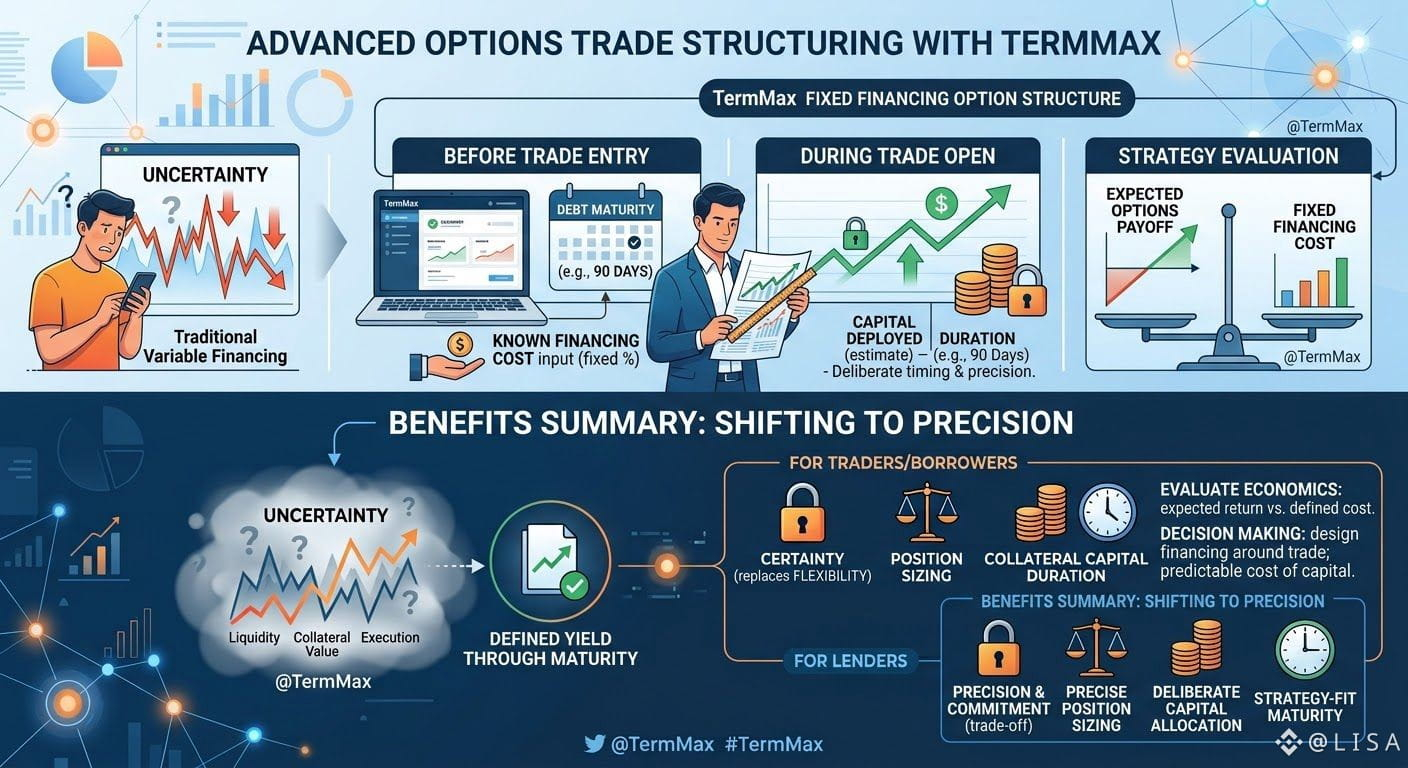
The part of TermMax I find most interesting is how fixed term financing changes the way I can structure an options trade. I usually think about an options position through entry, payoff, and risk, but financing can quietly alter the result while the trade is still open. With @TermMax , a fixed borrowing cost gives me a known financing input through maturity. That means I can estimate the cost of carry before entering instead of treating future interest expense as an unknown. #TermMax
The trade off is that precision comes with commitment. A fixed term means I need to choose a maturity that actually fits the strategy, rather than keeping capital completely flexible. But when the timing is deliberate, that constraint can be useful. I can compare the expected options payoff against a financing cost that stays defined, making the economics easier to evaluate before I commit capital. I see this as a subtle shift from simply borrowing to designing the financing around the trade itself. If options already require careful assumptions about timing and payoff, why should the cost of capital remain unpredictable?
The trade off is that precision comes with commitment. A fixed term means I need to choose a maturity that actually fits the strategy, rather than keeping capital completely flexible. But when the timing is deliberate, that constraint can be useful. I can compare the expected options payoff against a financing cost that stays defined, making the economics easier to evaluate before I commit capital. I see this as a subtle shift from simply borrowing to designing the financing around the trade itself. If options already require careful assumptions about timing and payoff, why should the cost of capital remain unpredictable?