#termmax TermMax and Pendle both split a yield-bearing position into two pieces, and I think a lot of people are quietly assuming they're doing the same thing with different branding. Sat down and actually compared the two mechanisms directly.
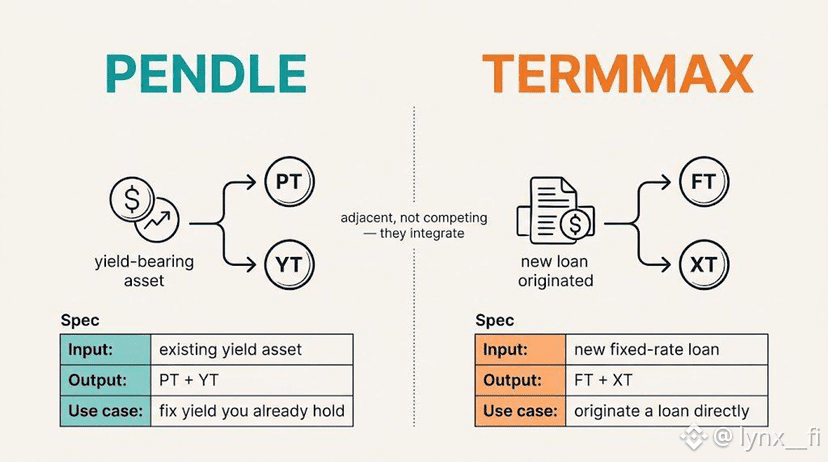
Pendle splits an existing yield-bearing asset into a Principal Token (PT, the underlying redeemable at maturity) and a Yield Token (YT, the future yield stream) — fundamentally a yield-stripping tool applied to assets already generating yield somewhere else. 🔧 TermMax's FT/XT split works on a loan itself, not a pre-existing yield-bearing asset — FT is the discounted claim on the loan's principal repayment, XT represents the interest obligation on that specific loan.
Side by side, stripped to the mechanics:
— Input: Pendle needs an asset already earning yield elsewhere. TermMax needs nothing pre-existing — the loan is originated on the spot.
— Output split: Pendle → PT (principal claim) + YT (yield stream). TermMax → FT+ XT (interest obligation).
— Rate exposure: Pendle YT holders are betting on a variable yield staying above or below the market-implied fixed rate. TermMax XT holders are exposed to a rate fixed at loan origination, not a floating benchmark. 📐
Practical distinction: you'd use Pendle to fix the yield on an asset you already hold that's earning variable rate somewhere else. You'd use TermMax to actually originate a new fixed-rate loan — borrowing or lending directly — with FT/XT as the byproduct of that origination, not as a wrapper around an existing position. 🧭
They're not competitors in the direct sense — they're adjacent tools solving related but distinct problems, which is probably exactly why they ended up integrating with each other rather than treating each other as replacements. 🌐
The "split yield into two tokens" framing makes them sound interchangeable when the actual problems they solve aren't. 🙋 Curious which one comes up more in your own portfolio — fixing yield on something you already hold, or originating a fresh fixed-rate loan.
@TermMax #TermMax
Pendle splits an existing yield-bearing asset into a Principal Token (PT, the underlying redeemable at maturity) and a Yield Token (YT, the future yield stream) — fundamentally a yield-stripping tool applied to assets already generating yield somewhere else. 🔧 TermMax's FT/XT split works on a loan itself, not a pre-existing yield-bearing asset — FT is the discounted claim on the loan's principal repayment, XT represents the interest obligation on that specific loan.
Side by side, stripped to the mechanics:
— Input: Pendle needs an asset already earning yield elsewhere. TermMax needs nothing pre-existing — the loan is originated on the spot.
— Output split: Pendle → PT (principal claim) + YT (yield stream). TermMax → FT+ XT (interest obligation).
— Rate exposure: Pendle YT holders are betting on a variable yield staying above or below the market-implied fixed rate. TermMax XT holders are exposed to a rate fixed at loan origination, not a floating benchmark. 📐
Practical distinction: you'd use Pendle to fix the yield on an asset you already hold that's earning variable rate somewhere else. You'd use TermMax to actually originate a new fixed-rate loan — borrowing or lending directly — with FT/XT as the byproduct of that origination, not as a wrapper around an existing position. 🧭
They're not competitors in the direct sense — they're adjacent tools solving related but distinct problems, which is probably exactly why they ended up integrating with each other rather than treating each other as replacements. 🌐
The "split yield into two tokens" framing makes them sound interchangeable when the actual problems they solve aren't. 🙋 Curious which one comes up more in your own portfolio — fixing yield on something you already hold, or originating a fresh fixed-rate loan.
@TermMax #TermMax