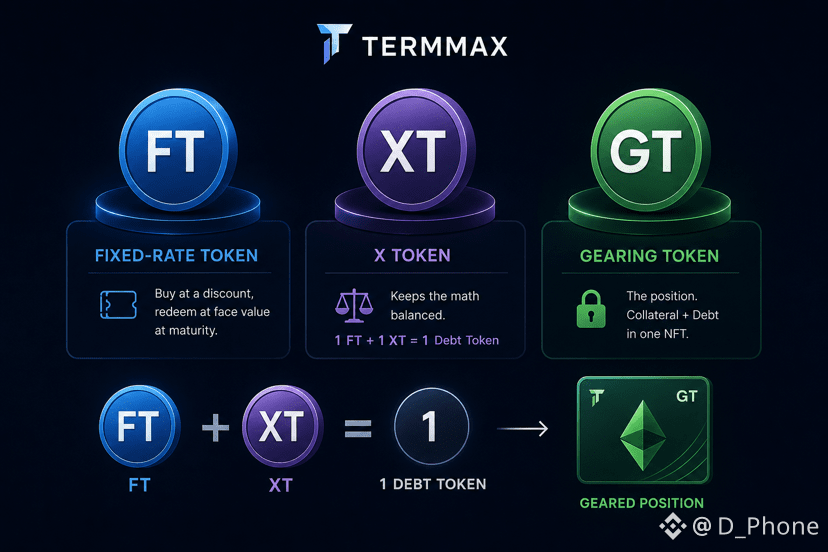
I keep coming back to one detail in TermMax's design that most first-time users skip past: a single fixed-rate loan gets split into three separate tokens instead of one. There's the Fixed-Rate Token, the X Token, and the Gearing Token, and each one carries a different job. FT behaves like a zero-coupon bond. You buy it at a discount, you redeem it at face value on the maturity date, and the gap between those two numbers is your yield, fixed the moment you buy in. XT exists purely to keep the math balanced: at any point before maturity, one FT plus one XT equals one full debt token, and once maturity hits, XT drops to zero while FT becomes redeemable. GT is the position itself, the collateral and the debt wrapped into a single tradable record.
Why not just use one lending token like most money markets do? Because bundling collateral, principal, and interest into one instrument makes each piece less liquid on its own. Separating them lets a lender sell just the yield exposure, lets a borrower trade the interest portion of their debt independently, and lets a leveraged position get transferred as one unit without unwinding the whole loan. I think this is the real reason TermMax can support one-click leverage: the GT already contains everything a looping strategy needs in a single wrapper.
There's a practical side too. Because a GT tracks both the collateral and the debt of one position, a borrower can add collateral, repay part of the debt, or adjust the loan without touching the FT market, and the position stays intact as a single record throughout.
What I haven't seen proven yet is whether three tokens instead of one actually improves capital efficiency for the average user, or whether it mostly benefits sophisticated actors who know how to trade FT and XT separately. For a first-time lender just parking USDC, the extra token layer is invisible. For a market maker running range orders across TermMax, it's the entire point
@TermMax #TermMax $VELVET $BTW $PORTAL
Why not just use one lending token like most money markets do? Because bundling collateral, principal, and interest into one instrument makes each piece less liquid on its own. Separating them lets a lender sell just the yield exposure, lets a borrower trade the interest portion of their debt independently, and lets a leveraged position get transferred as one unit without unwinding the whole loan. I think this is the real reason TermMax can support one-click leverage: the GT already contains everything a looping strategy needs in a single wrapper.
There's a practical side too. Because a GT tracks both the collateral and the debt of one position, a borrower can add collateral, repay part of the debt, or adjust the loan without touching the FT market, and the position stays intact as a single record throughout.
What I haven't seen proven yet is whether three tokens instead of one actually improves capital efficiency for the average user, or whether it mostly benefits sophisticated actors who know how to trade FT and XT separately. For a first-time lender just parking USDC, the extra token layer is invisible. For a market maker running range orders across TermMax, it's the entire point
@TermMax #TermMax $VELVET $BTW $PORTAL