Found DUSK again at 2am. Six cents, around $30M mcap, volume basically dead. That quiet is what pulled me back in.
It's not another privacy coin. Dusk brands itself as a privacy blockchain for financial applications - layer-1 that powers the Confidential Security Contract standard, XSC, plus confidential smart contracts.
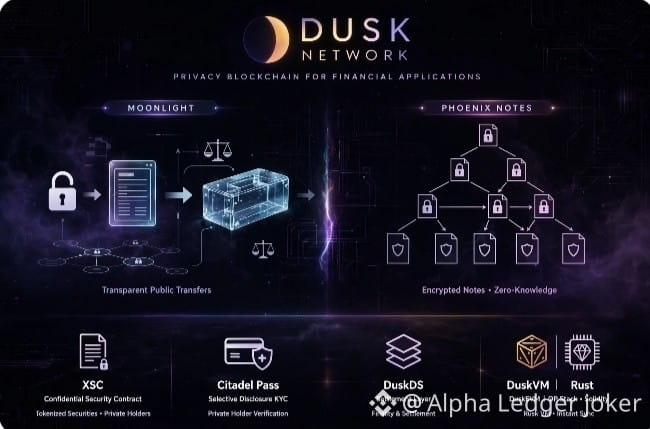
What most people skip is how different it works underneath. It has two transfer models. Moonlight is public, normal accounts. Phoenix is the private one - your money lives as encrypted notes, hashes of those notes sit in a Merkle tree. You spend by proving you own one with a ZKP without saying which one. You can even give someone a View Key to audit your notes without handing over control.
XSC only makes sense after that. On Ethereum a security token leaks everything - holders, amounts. XSC hides that but lets the issuer still do dividends, voting, caps, and accredited checks. Zedger does it on native DuskVM, Hedger does the same on DuskEVM which is OP Stack settling to DuskDS.
Citadel is the part I actually like. KYC once, get a pass like a keycard. Then you prove "accredited" or "not from that jurisdiction" without showing your passport again. Selective disclosure.
Rusk VM 2.0 has this small detail - new nodes only need the latest block to sync, not full history. Instant sync. That's long-term thinking.
Mainnet has been live since early 2025 but TVL and activity are still thin. The chain is ready for institutions to settle privately, but they can use it without holding much DUSK. Holders carry gas + staking and the slow halving emissions.
I like that it hides what should be hidden. Adoption won't be loud - it'll be a settlement that just couldn't happen elsewhere.
@Dusk #dusk $DUSK $LAB $EVAA
It's not another privacy coin. Dusk brands itself as a privacy blockchain for financial applications - layer-1 that powers the Confidential Security Contract standard, XSC, plus confidential smart contracts.
What most people skip is how different it works underneath. It has two transfer models. Moonlight is public, normal accounts. Phoenix is the private one - your money lives as encrypted notes, hashes of those notes sit in a Merkle tree. You spend by proving you own one with a ZKP without saying which one. You can even give someone a View Key to audit your notes without handing over control.
XSC only makes sense after that. On Ethereum a security token leaks everything - holders, amounts. XSC hides that but lets the issuer still do dividends, voting, caps, and accredited checks. Zedger does it on native DuskVM, Hedger does the same on DuskEVM which is OP Stack settling to DuskDS.
Citadel is the part I actually like. KYC once, get a pass like a keycard. Then you prove "accredited" or "not from that jurisdiction" without showing your passport again. Selective disclosure.
Rusk VM 2.0 has this small detail - new nodes only need the latest block to sync, not full history. Instant sync. That's long-term thinking.
Mainnet has been live since early 2025 but TVL and activity are still thin. The chain is ready for institutions to settle privately, but they can use it without holding much DUSK. Holders carry gas + staking and the slow halving emissions.
I like that it hides what should be hidden. Adoption won't be loud - it'll be a settlement that just couldn't happen elsewhere.
@Dusk #dusk $DUSK $LAB $EVAA