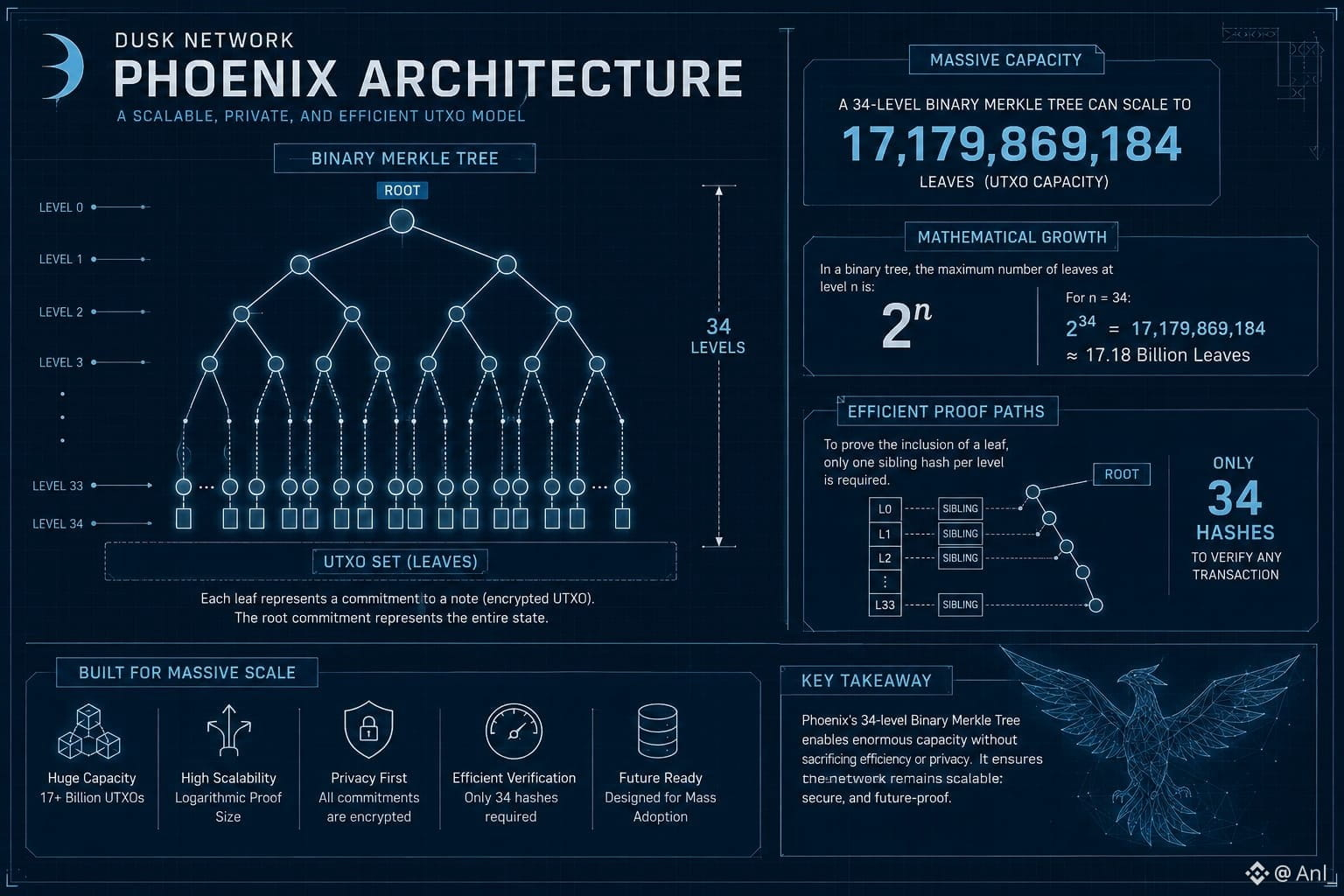
One number stopped me: capacity for over 17 billion leaves, from a tree that's only 34 levels deep.
Dusk's Phoenix model uses a binary Merkle tree to hold the proof for every note, and that's where the real trick sits — capacity grows exponentially while the inclusion path only grows linearly. Go from depth 34 to 35 and capacity doubles, but the proof path only gets a few percent longer. That asymmetry matters a lot for a privacy-focused chain, since every transaction carries a zero-knowledge proof, and the smaller that proof stays, the better.
But the size of the number is only a theoretical ceiling. What actually determines how long that capacity lasts is how fast new notes are being created in practice. At low transaction throughput, the tree could take decades to fill. If adoption spikes, that same capacity could come under real pressure in a matter of months.
That raises the more interesting question — what happens as the tree fills up? Archival storage, proving costs, state sync — do these scale gracefully alongside note creation, or does something start to strain first? A huge number looks impressive on paper, but long-term usability depends on how that number gets used, not just how big it is.
Is having a mathematically enormous capacity the same thing as staying comfortable to operate under years of real usage?
#dusk $DUSK @Dusk
Dusk's Phoenix model uses a binary Merkle tree to hold the proof for every note, and that's where the real trick sits — capacity grows exponentially while the inclusion path only grows linearly. Go from depth 34 to 35 and capacity doubles, but the proof path only gets a few percent longer. That asymmetry matters a lot for a privacy-focused chain, since every transaction carries a zero-knowledge proof, and the smaller that proof stays, the better.
But the size of the number is only a theoretical ceiling. What actually determines how long that capacity lasts is how fast new notes are being created in practice. At low transaction throughput, the tree could take decades to fill. If adoption spikes, that same capacity could come under real pressure in a matter of months.
That raises the more interesting question — what happens as the tree fills up? Archival storage, proving costs, state sync — do these scale gracefully alongside note creation, or does something start to strain first? A huge number looks impressive on paper, but long-term usability depends on how that number gets used, not just how big it is.
Is having a mathematically enormous capacity the same thing as staying comfortable to operate under years of real usage?
#dusk $DUSK @Dusk