
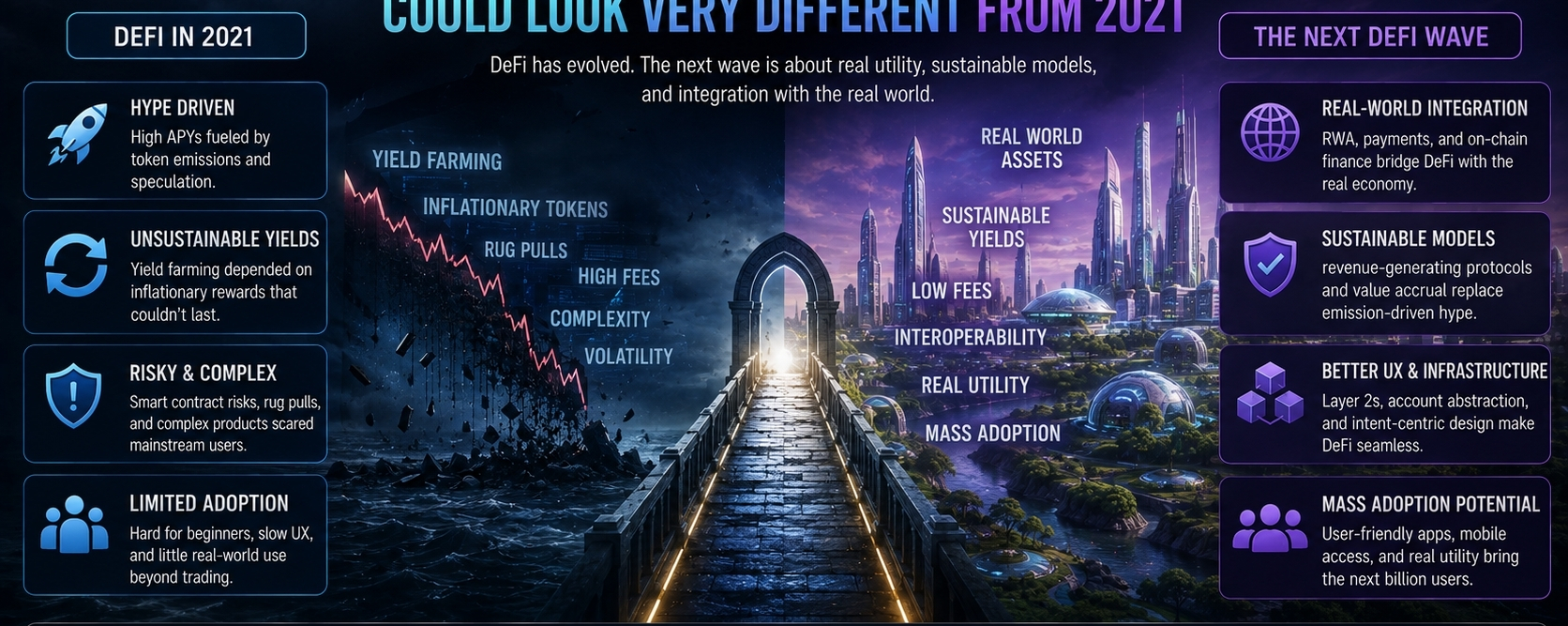

DeFi was one of the biggest stories of the 2021 crypto cycle. Decentralized exchanges exploded in popularity, yield farming attracted huge amounts of capital, and new tokens seemed to launch almost every day.
But if DeFi experiences another major expansion in 2026 and beyond, it may look very different.
The next phase could be less about extreme yields and short-term token incentives and more about stablecoins, real-world assets, sustainable lending, institutional participation and useful financial infrastructure.
2021 DeFi Was Driven by Incentives
During the previous DeFi boom, one of the biggest attractions was yield.
Protocols offered token rewards to attract liquidity, and users frequently moved funds between platforms looking for better returns.
This strategy helped DeFi grow extremely quickly, but it also created weaknesses. High yields were sometimes supported by constant token issuance rather than sustainable economic activity.
When market conditions changed, many incentives became less attractive and liquidity disappeared.
The next DeFi cycle may need a stronger foundation.
DeFi Is Becoming More Mature
The industry has spent several years building better infrastructure.
Lending markets have developed. Decentralized exchanges have improved. Stablecoins have expanded significantly, and blockchain networks have become faster and cheaper.
DeFi is also increasingly being judged by metrics such as fees, revenue, borrowers, trading volume and active users rather than simply total value locked.
This represents an important change.
Instead of asking, "How high is the yield?", the market is increasingly asking, "Is anyone actually using this protocol?"
That question could define the next DeFi wave.
Stablecoins Could Become the Foundation
Stablecoins may be one of the most important differences between 2021 DeFi and the next cycle.
They have evolved from mainly being trading tools into important pieces of blockchain financial infrastructure.
Stablecoins can be used for payments, international transfers, lending, collateral, trading and settlement.
That gives DeFi something extremely valuable: digital money that can move between financial applications around the clock.
If stablecoin adoption continues expanding, DeFi protocols could become part of a much larger financial ecosystem rather than remaining isolated crypto applications.
Real-World Assets Could Change DeFi Completely
Real-world asset tokenization could be another major catalyst.
Tokenized government securities, private credit, funds and other traditional assets are increasingly moving onto blockchain infrastructure.
This creates possibilities that barely existed during the 2021 DeFi boom.
Instead of DeFi being built almost entirely around cryptocurrencies, future protocols could potentially connect crypto assets, stablecoins and tokenized traditional financial products within the same ecosystem.
That would significantly expand what DeFi can actually do.
DeFi and Traditional Finance Are Moving Closer
In 2021, DeFi was frequently presented as an alternative to traditional banks.
The next phase may be more complicated.
Rather than completely replacing traditional finance, blockchain infrastructure could increasingly connect with it.
Financial institutions are exploring tokenization, stablecoins and blockchain settlement. At the same time, crypto developers are building products that resemble traditional financial services but operate through smart contracts.
Eventually, the line separating DeFi and traditional finance could become much less obvious.
Lending Could Become One of the Biggest Winners
Decentralized lending remains one of DeFi's clearest use cases.
Users can supply assets, borrow against collateral and interact with lending markets without relying on the traditional banking process.
The next stage could become more sophisticated.
Better risk management, improved collateral systems and the introduction of tokenized real-world assets could potentially expand the types of lending available onchain.
If institutional capital becomes more comfortable interacting with decentralized markets, lending protocols could become an important bridge between crypto-native and traditional financial activity.
DEXs Are Becoming Serious Trading Infrastructure
Decentralized exchanges have also changed significantly since 2021.
Earlier DEXs often struggled with high transaction costs and slower execution, particularly when blockchain networks became congested.
Today, faster Layer-1 networks and Ethereum scaling solutions have improved the experience.
DEXs are also expanding beyond simple token swaps. Onchain perpetual futures, advanced trading interfaces and improved liquidity systems are making decentralized trading more competitive.
This means the next DeFi cycle could involve traders using decentralized platforms because the products are genuinely useful—not simply because they are chasing token rewards.
Layer-2 Networks Could Help Ethereum DeFi Scale
Ethereum remains deeply connected with DeFi, but high transaction costs were a major problem during the 2021 cycle.
Layer-2 networks are helping change that.
By processing activity more efficiently while connecting back to Ethereum, these networks can make DeFi applications cheaper and more accessible.
At the same time, Ethereum is improving its own scalability through protocol upgrades.
If these improvements continue, Ethereum-based DeFi could potentially support much larger numbers of users than during the previous cycle.
Solana and BNB Chain Are Changing the Competition
Ethereum is no longer the only major DeFi ecosystem worth watching.
Solana's high throughput and inexpensive transactions have helped create an active environment for decentralized trading and other financial applications.
BNB Chain also has significant retail activity, stablecoin usage and DeFi infrastructure.
This means the next DeFi boom could be much more multi-chain.
Instead of almost all major activity concentrating around Ethereum, liquidity could move between Ethereum, Layer-2 networks, Solana, BNB Chain and other ecosystems.
The networks providing the best combination of liquidity, security, speed and user experience could capture the most activity.
Sustainable Revenue Could Matter More Than Token Hype
One of the biggest lessons from 2021 is that token price alone does not prove a protocol is successful.
A DeFi token can rally dramatically while the underlying platform generates very little sustainable activity.
The next cycle could place much greater attention on protocol economics.
Investors may increasingly examine trading fees, lending revenue, active borrowers, stablecoin liquidity and whether token holders actually benefit from the growth of a protocol.
That could create a much more selective DeFi market.
Projects with real usage may separate themselves from protocols surviving mainly on incentives.
Better User Experience Is Essential
DeFi is still complicated for many ordinary users.
Wallets, gas fees, bridges, seed phrases and smart-contract interactions can create significant barriers.
For DeFi to reach mainstream adoption, much of this complexity may eventually need to disappear from the user's experience.
Future applications could make blockchain technology almost invisible.
Users might simply see a financial application that allows them to save, trade, borrow or transfer money while blockchain infrastructure operates underneath.
That could represent a much bigger adoption opportunity than another round of yield farming.
AI Could Eventually Enter the DeFi Story
Artificial intelligence could add another layer.
AI-powered applications may eventually help users analyze markets, manage portfolios, identify risks or interact with complex blockchain protocols more easily.
Autonomous AI agents could also potentially execute certain predefined onchain actions.
However, this area remains experimental and introduces serious security and reliability questions.
If those problems are solved, the combination of AI and DeFi could become another major narrative.
Risks Have Not Disappeared
A more mature DeFi market does not mean a risk-free one.
Smart-contract vulnerabilities, hacks, oracle failures, liquidation events and poorly designed tokens remain important risks.
Real-world assets introduce additional questions around regulation, custody and whether token holders have enforceable rights to underlying assets.
Stablecoins also introduce reserve, issuer and regulatory risks.
The next DeFi wave could therefore become bigger and more sophisticated while still requiring users to understand what they are interacting with.
The Next DeFi Cycle Could Be About Utility
The biggest difference between 2021 and the next DeFi wave may ultimately be why people use it.
In 2021, many users arrived because enormous yields and rapidly rising token prices created opportunities for speculation.
The next wave could increasingly attract users because decentralized financial infrastructure actually solves problems.
Stablecoins can move value globally.
DEXs can provide permissionless trading.
Lending protocols can create onchain credit markets.
Tokenization can connect traditional assets with blockchain infrastructure.
And faster networks can make these services increasingly practical.
The Bigger Picture
The next DeFi wave probably won't be a simple repeat of 2021.
The market has changed too much.
Stablecoins are larger, tokenization is expanding, blockchain infrastructure is faster, institutions are more involved and users increasingly expect protocols to demonstrate sustainable activity.
That could create a DeFi cycle built less around "Which token offers the biggest yield?" and more around "Which protocol provides something people genuinely need?"
If that transformation continues, DeFi's next major growth phase could be less explosive at first but potentially much more important.
Because the biggest DeFi story may no longer be about recreating the 2021 boom.
It may be about building financial infrastructure that can survive long after the hype disappears.