I went looking at Hedger, Dusk's new privacy layer for the EVM side, expecting it to work like most confidential-transaction systems I'd looked at before — hide the amount, hide who's involved, done. That's not what it does.
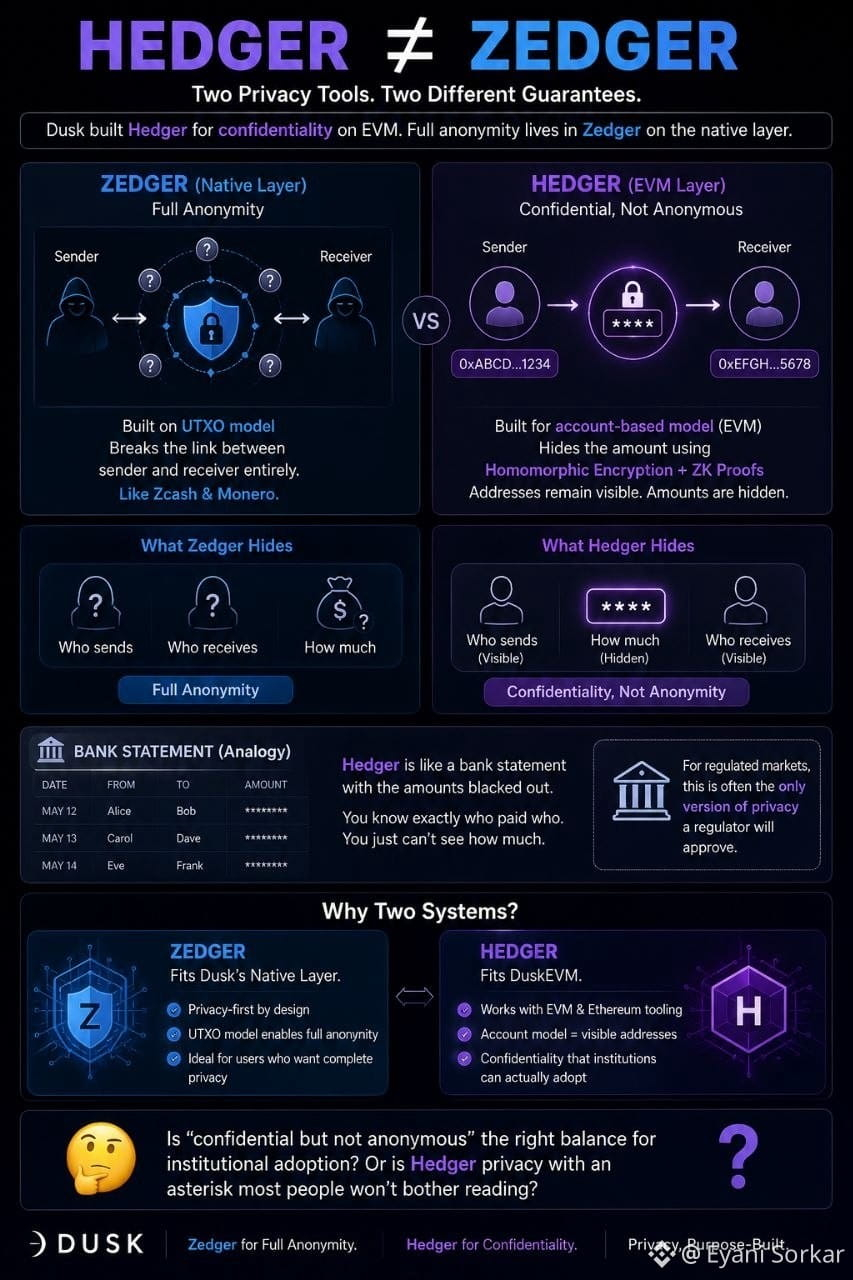
Dusk already has a privacy tool for its native layer called Zedger, and Zedger can deliver full anonymity — because the native layer uses a UTXO model, the same structural trick Zcash and Monero lean on to break the link between sender and receiver entirely. Hedger can't do that. It's built for the EVM side, which runs on an account-based model, and an account-based model means every transaction is still tied to a visible address by design. No UTXO shuffling to hide behind.
So Hedger does something narrower on purpose: it hides the amount, using homomorphic encryption paired with zero-knowledge proofs to prove a transaction is valid without revealing the number, while leaving sender and receiver addresses visible. Confidential, not anonymous.
Reminded me of a bank statement with the transaction amounts blacked out but the account names still printed at the top. You can see exactly who paid who. You just can't see how much. For a personal wallet that might feel like half a privacy tool. For a regulated financial market, that's the only version of privacy a regulator would sign off on — you need to know who's trading, not the size of the trade.
Makes sense why Dusk built two separate systems. Zedger's full anonymity fits Dusk's native layer, where the whole design starts from privacy first. Hedger's narrower confidentiality fits DuskEVM, where the whole point is plugging into the existing Ethereum tooling and account-based standards institutions already run on — full anonymity was never compatible with that starting point.
Still turning over whether "confidential but not anonymous" ends up being the more useful design for institutional adoption, or whether it just means Hedger is privacy with an asterisk most people posting about it won't read.
#dusk $DUSK @Dusk
Dusk already has a privacy tool for its native layer called Zedger, and Zedger can deliver full anonymity — because the native layer uses a UTXO model, the same structural trick Zcash and Monero lean on to break the link between sender and receiver entirely. Hedger can't do that. It's built for the EVM side, which runs on an account-based model, and an account-based model means every transaction is still tied to a visible address by design. No UTXO shuffling to hide behind.
So Hedger does something narrower on purpose: it hides the amount, using homomorphic encryption paired with zero-knowledge proofs to prove a transaction is valid without revealing the number, while leaving sender and receiver addresses visible. Confidential, not anonymous.
Reminded me of a bank statement with the transaction amounts blacked out but the account names still printed at the top. You can see exactly who paid who. You just can't see how much. For a personal wallet that might feel like half a privacy tool. For a regulated financial market, that's the only version of privacy a regulator would sign off on — you need to know who's trading, not the size of the trade.
Makes sense why Dusk built two separate systems. Zedger's full anonymity fits Dusk's native layer, where the whole design starts from privacy first. Hedger's narrower confidentiality fits DuskEVM, where the whole point is plugging into the existing Ethereum tooling and account-based standards institutions already run on — full anonymity was never compatible with that starting point.
Still turning over whether "confidential but not anonymous" ends up being the more useful design for institutional adoption, or whether it just means Hedger is privacy with an asterisk most people posting about it won't read.
#dusk $DUSK @Dusk