I kept ignoring Dusk because privacy L1 for finance sounded like a pitch I've heard 40 times.
Then I actually opened it.
It's not trying to be a hidden Ethereum. It's trying to be what settlement should have been.
They call it a privacy blockchain for financial applications L1 for XSC and confidential contracts. On paper okay. On chain it feels different.
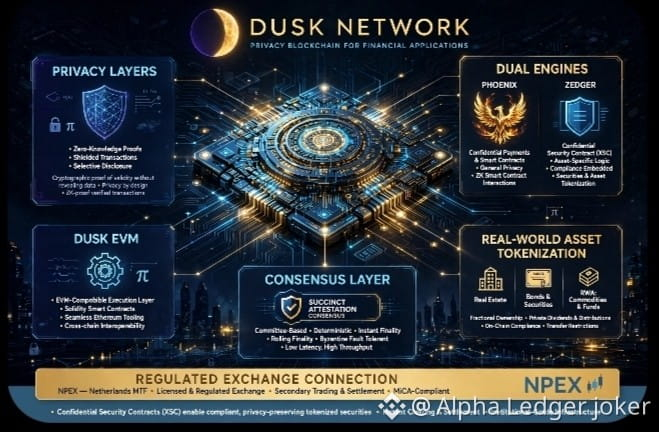
First transaction I sent - it didn't linger. No 12 confirmations anxiety. Their thing Succinct Attestation gives you that instant finality. Done is done. Later I learned why: it uses these small committees 67 stakers per step instead of thousands BLS aggregated invented by their own CEO. Built for a market that can't wait.
And they have two hearts beating inside.
Phoenix - that's your private cash. UTXO, quiet. Nobody sees.
Zedger - this is the one no one talks about. It's not a privacy feature it's a whole protocol for securities. It handles the entire life of a tokenized asset. That's what makes XSC - Confidential Security Contract actually work. It's not a token standard it's a security lifecycle with privacy built in.
That clicked when I saw the NPEX thing. Dusk didn't just do a press release partnership. They took a 10% stake in NPEX a real regulated Dutch exchange with 15k real investors. That's why there's not $5k of test TVL but €200M-500M+ of actual bonds and equities being pushed on-chain. Under MiCA. Under MiFID II. Real stuff paying real fees.
Then this year they made it weirdly easy. Mainnet evolved into DuskEVM. Same Solidity same MetaMask same Hardhat. But now your contracts can be confidential. No new language to learn. They split the stack into DuskDS for settlement DuskEVM for execution, DuskVM for privacy later. Smart they lowered the wall instead of raising it.
Most privacy chains want you to disappear.
Dusk is building for people who can't afford to disappear - they have to stay visible to a regulator, and invisible to everyone else.
#dusk $DUSK @Dusk $EVAA $PEPE $SkyAi
Then I actually opened it.
It's not trying to be a hidden Ethereum. It's trying to be what settlement should have been.
They call it a privacy blockchain for financial applications L1 for XSC and confidential contracts. On paper okay. On chain it feels different.
First transaction I sent - it didn't linger. No 12 confirmations anxiety. Their thing Succinct Attestation gives you that instant finality. Done is done. Later I learned why: it uses these small committees 67 stakers per step instead of thousands BLS aggregated invented by their own CEO. Built for a market that can't wait.
And they have two hearts beating inside.
Phoenix - that's your private cash. UTXO, quiet. Nobody sees.
Zedger - this is the one no one talks about. It's not a privacy feature it's a whole protocol for securities. It handles the entire life of a tokenized asset. That's what makes XSC - Confidential Security Contract actually work. It's not a token standard it's a security lifecycle with privacy built in.
That clicked when I saw the NPEX thing. Dusk didn't just do a press release partnership. They took a 10% stake in NPEX a real regulated Dutch exchange with 15k real investors. That's why there's not $5k of test TVL but €200M-500M+ of actual bonds and equities being pushed on-chain. Under MiCA. Under MiFID II. Real stuff paying real fees.
Then this year they made it weirdly easy. Mainnet evolved into DuskEVM. Same Solidity same MetaMask same Hardhat. But now your contracts can be confidential. No new language to learn. They split the stack into DuskDS for settlement DuskEVM for execution, DuskVM for privacy later. Smart they lowered the wall instead of raising it.
Most privacy chains want you to disappear.
Dusk is building for people who can't afford to disappear - they have to stay visible to a regulator, and invisible to everyone else.
#dusk $DUSK @Dusk $EVAA $PEPE $SkyAi