
Vanar is often discussed through the lens of AI readiness, but that phrase can feel abstract if it is not anchored to something concrete. For Vanar, the most concrete design choice is also the least glamorous one. Payments are not treated as an application layer feature or a user interface problem. They are treated as infrastructure. This matters because the moment you stop designing for human users and start designing for autonomous systems, the assumptions that shaped most Layer 1 blockchains begin to break down.
AI agents do not interact with networks the way people do. They do not browse interfaces, manage wallets, or approve transactions through prompts. They operate continuously, often in the background, and their economic activity is programmatic by default. That means settlement cannot depend on human intervention, unpredictable fee dynamics, or ad hoc tooling layered on later. Vanar starts from this constraint rather than trying to patch around it.
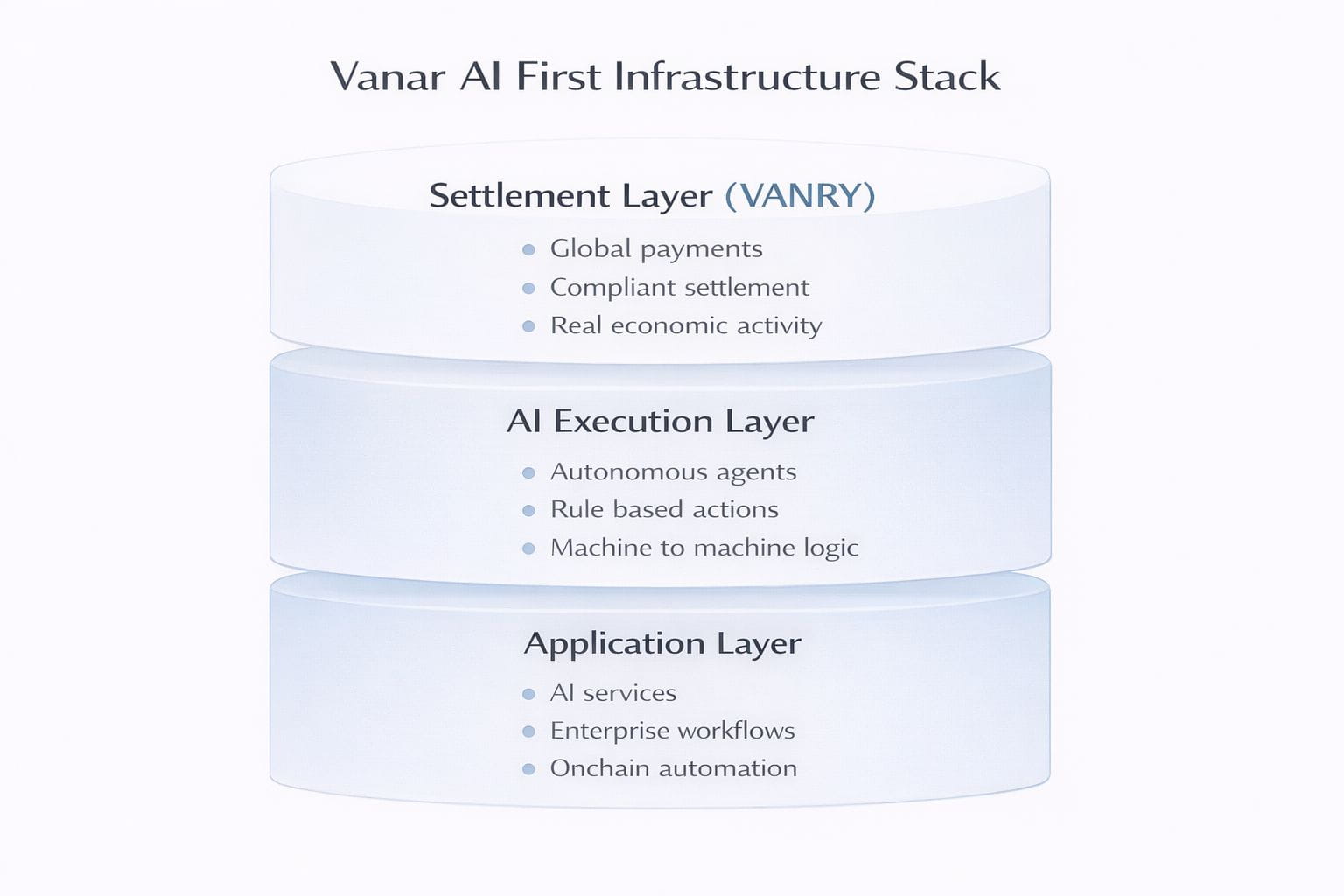
The key insight behind Vanar’s approach is simple but easy to underestimate. Intelligence without the ability to settle value is not infrastructure. It is a demo. Many AI focused narratives stop at reasoning, memory, or automation, but those capabilities only become economically real when actions can be finalized, paid for, and verified without friction. Vanar positions payments as the final step that turns intelligence into real activity.
This is where many Layer 1 designs struggle in an AI driven environment. Payment systems in legacy blockchain architectures were built around users submitting transactions manually. Fee markets react to congestion. Settlement finality is optimized for bursts of human demand rather than continuous machine activity. These systems can support AI applications at low scale, but they degrade quickly when agents operate at volume. Costs become unstable, execution timing becomes uncertain, and reliability turns probabilistic rather than guaranteed.
Vanar does not try to solve this by promising raw throughput or headline transaction speeds. Instead, it treats settlement as a predictable service layer that autonomous systems can rely on. Payments on Vanar are designed to be stable, composable, and compatible with continuous execution. This is a subtle shift, but it changes how the network is used. Rather than asking whether an AI application can fit into the network, Vanar asks how the network should behave so AI systems do not need to adapt at all.
This design philosophy becomes clearer when you look at how Vanar frames real usage. Many networks showcase AI readiness through prototypes or isolated features. Vanar ties readiness to whether intelligence can transact safely and repeatedly in production conditions. Payments are not a showcase feature. They are the enforcement mechanism that keeps AI systems honest, accountable, and economically grounded.
An AI agent that can reason but cannot settle is effectively sandboxed. It can simulate decisions but cannot participate in markets, services, or coordination. On Vanar, settlement is native to the intelligent stack. When an agent executes an action, that action can carry economic weight immediately. This is where VANRY becomes relevant, not as a speculative asset, but as the unit that underpins activity across the system.
The distinction here is important. VANRY is not positioned as a reward for attention or participation. It functions as the settlement medium that aligns incentives between autonomous agents, infrastructure providers, and applications. As AI driven activity increases, settlement volume becomes the measurable signal of real usage. Vanar’s architecture allows that signal to compound rather than fragment across layers and wrappers.
Another reason payments complete AI first infrastructure is compliance. Autonomous systems operating at scale cannot rely on informal trust. Enterprises and institutions require predictable settlement rails that integrate rule enforcement directly into execution. Vanar treats this requirement as a first order constraint. Instead of handling compliance after the fact, it is embedded into how transactions are validated and finalized. This allows AI systems to operate globally without creating governance blind spots.
This approach also explains why Vanar emphasizes readiness over narrative. Payments are unforgiving. They expose whether a system can handle load, edge cases, and long tail risk. You cannot fake settlement reliability with branding. Either the system clears transactions consistently under real conditions, or it does not. By anchoring its AI strategy to payments, Vanar forces itself to deliver functionality that holds up under scrutiny.
In practice, this means Vanar’s AI stack is not judged by how impressive its reasoning looks, but by whether that reasoning can result in finalized economic outcomes. Intelligence becomes measurable through settlement. Usage becomes visible through transaction flow rather than social metrics. Over time, this creates a feedback loop where real activity reinforces the value of the infrastructure itself.
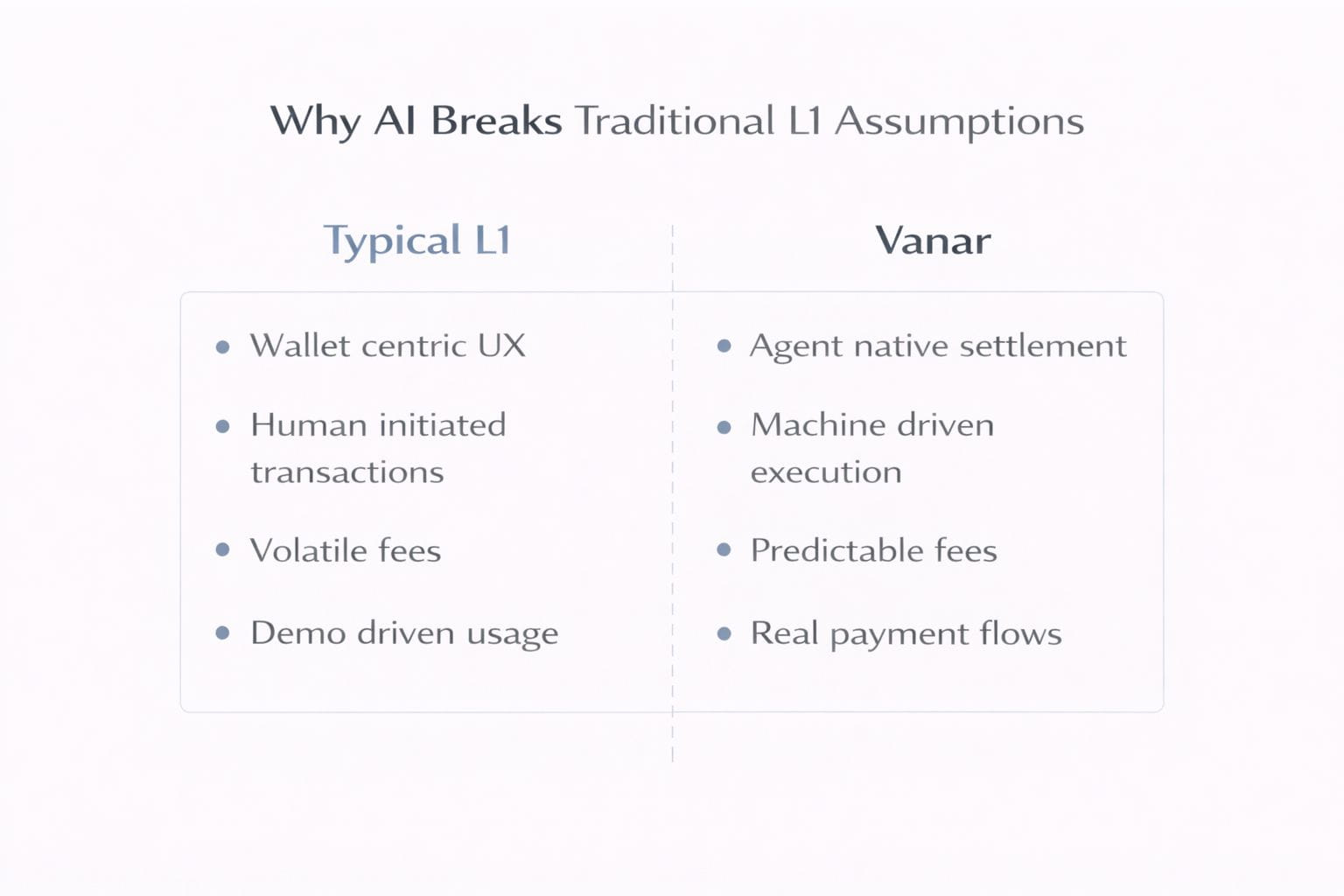
From a longer term perspective, this is where Vanar differentiates itself as a Layer 1 in an AI era. There is no shortage of chains that can host smart contracts or run experimental AI features. What is scarce is infrastructure that treats autonomous economic activity as the default case rather than an edge case. Payments are the point where theory meets reality, and Vanar chose to build from that point outward.
The result is not a network optimized for demos, but one structured around sustained operation. AI agents on Vanar are not expected to ask for permission, wait for users, or adapt to volatile conditions. They are expected to execute, settle, and move on. Payments make that possible. Without them, AI remains a concept. With them, it becomes infrastructure.
That is why payments do not sit at the edge of Vanar’s design. They sit at the center.
