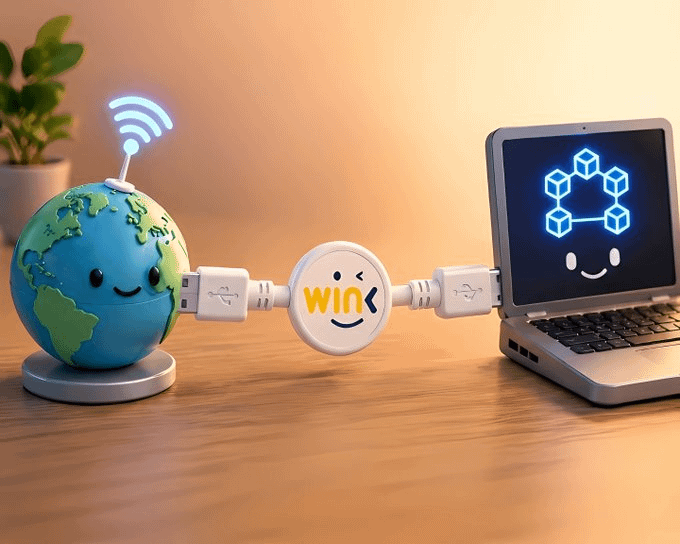
🔗 Smart Contracts Execute. Oracles Help Them Understand.
⚙️ Execution Without External Awareness
Smart contracts are powerful because they execute rules exactly as written.
Once deployed, they can transfer assets, calculate rewards, manage collateral or settle agreements when predefined conditions are satisfied. Their execution is transparent and independently verifiable through the blockchain.
However, a smart contract can only use the information available within its own network.
It cannot independently check the market price of an asset, confirm a weather event, learn the result of a competition or determine whether an off-chain service completed a task.
The contract may contain perfect logic, but without external information, it remains isolated from much of the world it is intended to serve.
🌐 Oracles Provide the Connection
Oracles create a communication layer between blockchain applications and external data.
When a smart contract requires information, an oracle network retrieves observations from relevant data sources, processes or aggregates them and submits a result on-chain. The contract can then respond automatically according to its original rules.
The relationship is simple:
The smart contract defines what should happen;
The oracle supplies the information required to evaluate the condition;
The blockchain verifies and records the resulting execution.
For example, a lending protocol may define that a position must be liquidated if its collateral value falls below a threshold. The smart contract executes that rule, but an oracle price feed provides the market information needed to determine whether the threshold has actually been crossed.
🛡️ The Data Layer Must Be Reliable
Automation is only as dependable as the information that activates it.
If a protocol receives delayed, inaccurate or manipulated data, even correctly written smart contract code can produce an incorrect result. This makes oracle architecture an essential component of application security.
A robust oracle system must consider where data originates, how frequently it is updated, how observations are aggregated and how the network reduces dependence on a single source.
WINkLink provides decentralized data services for smart contracts on TRON. Its infrastructure can connect blockchain applications with external sources while using node-based reporting and on-chain contracts to support data reliability.
This allows developers to build applications that react to external conditions without relying entirely on one centralized data provider.
🚀 Keeping Web3 Connected
Oracles are not mysterious prediction machines. They are infrastructure.
They expand the operating range of smart contracts by giving deterministic code access to information from outside the blockchain. That connection supports price feeds for DeFi, verifiable randomness for games, automated task execution and customized data access through APIs.
Smart contracts provide rules. Blockchains provide verification. Oracles provide context.
Together, these components allow Web3 applications to respond to the world around them—and transform on-chain code into useful, connected digital infrastructure.
@WINkLink_Official @TRON DAO @Justin Sun孙宇晨 #Oracles #WINkLink #TRON #SmartContracts #Web3 #TRONEcoStar