
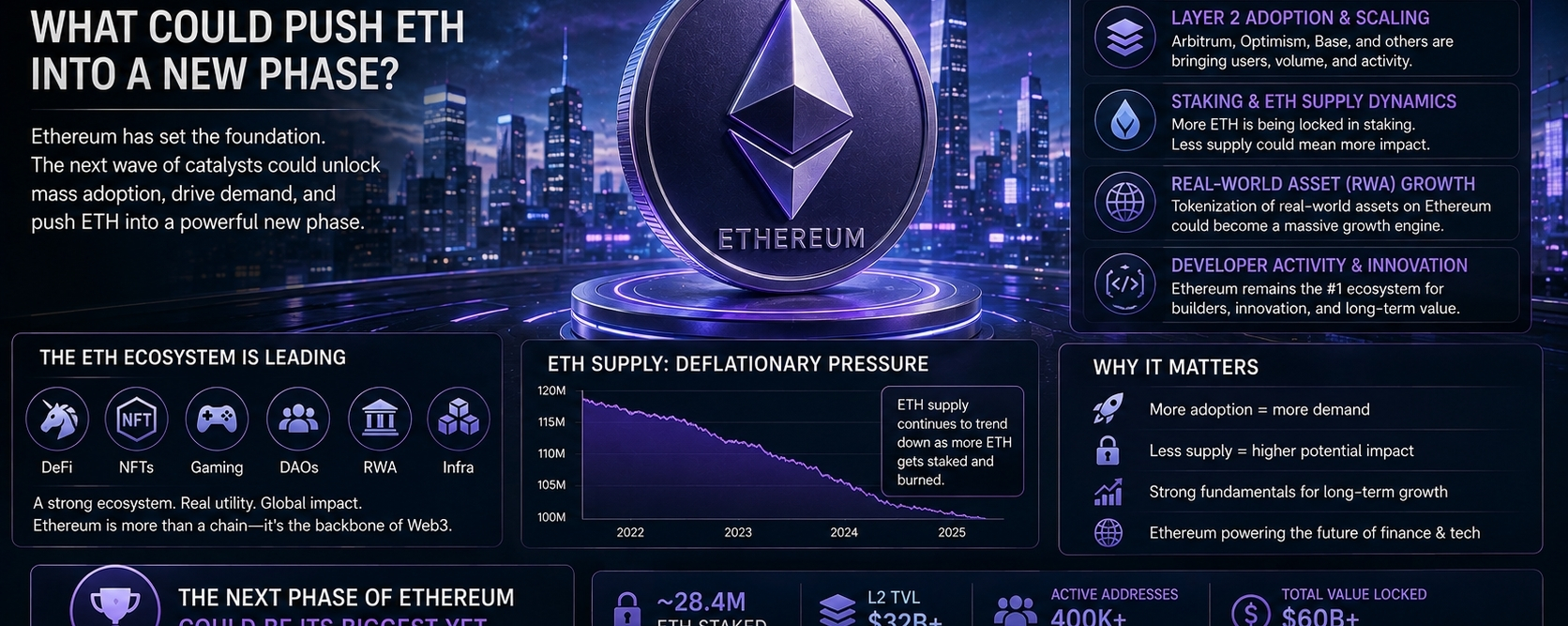

Ethereum has been at the center of the crypto ecosystem for years. From DeFi and stablecoins to NFTs, Layer-2 networks, and tokenization, many of crypto’s biggest trends have been built around Ethereum.
But as competition from faster blockchains grows, investors are asking a bigger question: what could become Ethereum’s next major catalyst?
The answer may not come from one event. A combination of institutional adoption, real-world assets, stablecoin growth, network improvements, and stronger on-chain activity could push ETH into its next phase.
Institutional Demand Could Change the Story
Institutional participation remains one of Ethereum’s biggest potential catalysts.
Ethereum is more than a cryptocurrency. It is infrastructure that supports financial applications, digital assets, and programmable transactions.
As traditional financial companies explore blockchain technology, Ethereum’s established ecosystem could make it an attractive platform for institutional products.
If more capital moves into Ethereum-based financial infrastructure, the market could increasingly value ETH based on network usage rather than speculation alone.
Tokenization Could Become Ethereum’s Biggest Opportunity
Real-World Assets could be especially important.
Tokenization allows traditional assets such as funds, bonds, private credit, and other financial products to be represented on blockchain networks.
Ethereum already has a large ecosystem of developers, stablecoins, DeFi protocols, and financial infrastructure. These pieces could make it a natural home for more tokenized assets.
If tokenization becomes a major part of global finance, Ethereum could benefit from being one of the networks connecting traditional markets with on-chain markets.
Stablecoin Growth Could Strengthen Ethereum
Stablecoins are another major part of the Ethereum story.
They provide liquidity for trading, lending, payments, and decentralized finance. They could also become increasingly important for settling transactions involving tokenized assets.
Greater stablecoin activity can create more opportunities for applications built around that liquidity.
The important question is whether Ethereum and its wider ecosystem can retain a significant share of stablecoin activity while networks such as Solana compete with lower transaction costs.
Layer-2 Networks Could Unlock More Growth
Ethereum has historically faced criticism over transaction costs and scalability.
Layer-2 networks are designed to address some of these limitations by processing activity more efficiently while remaining connected to Ethereum.
If Layer-2 networks continue improving, Ethereum could support much larger numbers of users and applications without requiring every transaction to happen directly on its main network.
The challenge is making the ecosystem simple. Users should be able to move between applications and networks without unnecessary complexity.
DeFi Could Become Important Again
Ethereum remains deeply connected to decentralized finance.
A renewed DeFi cycle could increase demand for decentralized exchanges, lending, staking, derivatives, and other financial applications.
But the next DeFi phase may look different from earlier cycles.
Instead of depending mainly on speculative tokens and extremely high yields, future growth could increasingly involve stablecoins, sustainable protocol revenue, institutional capital, and tokenized real-world assets.
That could strengthen Ethereum’s position as financial infrastructure.
Network Improvements Still Matter
Ethereum continues evolving technically.
Improvements that increase scalability, reduce costs, improve the user experience, or make Layer-2 networks work more efficiently could strengthen the overall ecosystem.
These changes may not always create immediate market excitement, but they can increase Ethereum's ability to support long-term adoption.
For ETH, technological progress matters most when it translates into more users, applications, liquidity, and economic activity.
Solana Is the Competition Ethereum Cannot Ignore
Ethereum does not operate without competition.
Solana has attracted significant activity because of its speed and relatively low fees. Other Layer-1 networks and Ethereum Layer-2 solutions are also competing for developers and liquidity.
Competition could actually benefit Ethereum by forcing its ecosystem to improve faster.
The key question is whether Ethereum can maintain its network effects while making blockchain applications cheaper and easier to use.
ETH Needs More Than Hype
For Ethereum to enter a genuinely new phase, price speculation alone may not be enough.
Investors will likely watch network activity, institutional demand, stablecoin liquidity, tokenized assets, DeFi usage, staking, and Ethereum's ability to generate economic value.
If several of these areas begin strengthening together, the ETH narrative could become much more powerful.
The Bigger Picture
Ethereum’s next catalyst may not be a single announcement or market event.
It could be the moment when institutional adoption, tokenization, stablecoins, DeFi, Layer-2 scaling, and stronger network usage begin reinforcing each other.
Bitcoin has strengthened its position as a scarce digital asset. Solana is pushing toward high-speed consumer and financial applications.
Ethereum’s opportunity is different.
If Ethereum becomes a major settlement and financial infrastructure layer for the on-chain economy, that could be the catalyst that pushes ETH into an entirely new phase.