
When I first saw a serious DeFi team attempt to pitch a bank partner, the discussion ended in less than ten minutes. The group wasn't inept. The technology was effective. There were even users of the product. However, the audience fell silent when the institution asked, "Can we prove compliance without exposing every client's positions and transfers to the entire internet?" Although public blockchains excel at openness, a lot of information in the banking industry cannot be made public by default. Competitive and regulated data include salaries, trade sizes, customer identities, collateral information, and even simple portfolio rebalancing. This is precisely the gap that Dusk is attempting to fill, which is why the term "EVM compatibility with a twist" is a true design philosophy rather than marketing.
The majority of traders and investors are already aware of the importance of EVM compatibility. The most popular smart contract execution standard is still the Ethereum Virtual Machine. The tools ecosystem, which includes Solidity, Hardhat, Foundry, MetaMask processes, auditors who comprehend common contract patterns, and thousands of programmers who can produce work fast, is just as important as Ethereum itself. Friction is significantly reduced by a chain that facilitates EVM development. It is not necessary for builders to start from scratch while learning a new contract language. Migration of liquidity is easier. Integrations becoming easier. Because of this, EVM compatibility is now a must for any cryptocurrency infrastructure.
Dusk argues that while standard EVM execution environments were initially designed for transparency, EVM is insufficient for actual financial markets. When transparency is the aim, they do exceptionally well. However, structural problems arise when you transition from retail DeFi to regulated assets like tokenized stocks, ETFs, bonds, RWAs, and institutional settlement. Selective disclosure is necessary for compliance. Confidentiality is essential for institutions. Verifiability is necessary for regulators. Users must have privacy without become "unbankable." Instead of bolting it on later, Dusk attempts to incorporate all of that into the foundation layer.
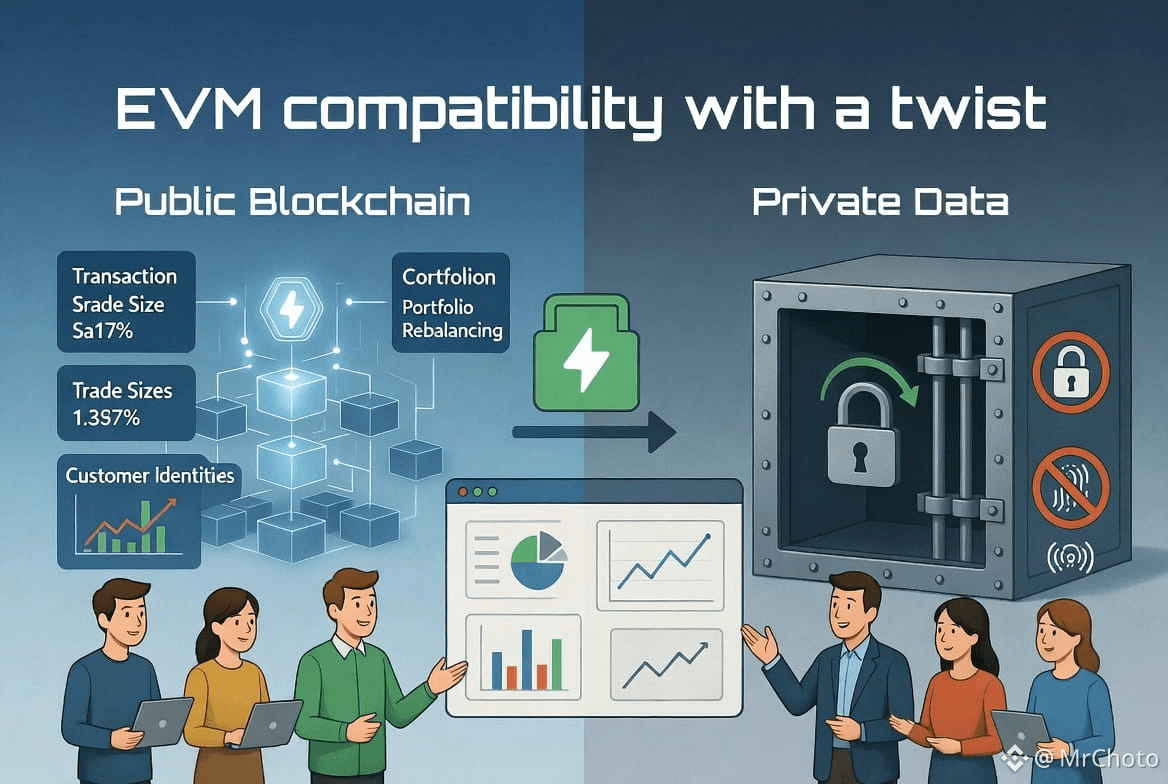
DuskEVM is Dusk's EVM equivalent execution environment, which allows developers to work inside Dusk's modular stack and financial-market design limitations while utilizing traditional EVM tooling. To put it simply, the network itself is designed for regulated contexts, yet developers can implement smart contracts using well-known methods. DuskEVM is positioned in Dusk's whitepaper as a means of executing EVM smart contracts while taking advantage of architecture designed to meet institutional and compliance standards.
Even still, the difficult question remains: what is the "twist"?
The twist is that Dusk isn't attempting to keep things hidden in the same manner. Rather, privacy is designed as a controlled feature that can coexist with proofs. Enabling regulated, real-world assets on-chain while maintaining secrecy is Dusk's clear overarching goal. Because tokenized finance is worthless if it doesn't adhere to institutional standards, the network bases itself on three pillars: privacy, compliance, and real-world assets.
This modifies your perspective on Dusk's smart contracts. Once a contract interaction is submitted, it enters public history on a normal EVM chain. Addresses can be traced, strategies can be deduced, and an increasingly precise behavior map can be created by anyone. In serious markets, such is not just inconvenient but also financially risky. Consider a market maker who broadcasts position changes while executing strategies. Or a fund that rebalances and makes the trade size visible to all rivals. Payroll, invoices, supplier payments, and treasury management are not things that businesses want to make permanently public, so even basic corporate finance gets complex.
In essence, Dusk's strategy is that privacy may be the mechanism that enables compliance without converting markets into surveillance systems, rather than being the enemy of compliance. This is important since complete openness is rarely associated with "compliance" in the financial industry. Controlled accountability is what it means. It entails being able to demonstrate to the appropriate auditors, exchanges, and regulators that regulations were adhered to without disclosing confidential information to third parties.
Zero-knowledge proofs become crucial in this situation. ZK systems enable one side to demonstrate the veracity of a claim without disclosing the underlying private data. That is strong in regulated finance. Without disclosing an investor's identify to the public, you can demonstrate that they are qualified to own an asset. Without disclosing every element of the cap table, you can demonstrate that a transfer complies with limits. It is possible to demonstrate collateralization thresholds or solvency without revealing every line of the balance sheet.
Dusk's whitepaper emphasizes deterministic finality and financial-market compatibility at the base layer, and the company has long positioned itself as a privacy-focused chain designed for regulated finance. For investors assessing settlement networks, deterministic finality is an important consideration. Many chains have probabilistic finality, which means that while transactions are never completely final at any one time, they grow "more final" as additional blocks are added. Because settlement requires legal certainty, institutions detest this. A trade needs to be settled when it does. Once a block is approved, Dusk characterizes its settlement as deterministic, with no user-facing reorganizations during regular operation. This predictability is more in line with how actual markets currently function for tokenized securities or regulated assets.
Reconnect this to EVM compatibility now. A whole different type of "EVM chain" will result from Dusk's ability to integrate EVM smart contract creation into a setting with integrated privacy and compliance logic. You're doing more than just creating DeFi dApps. You may be creating compliant smart contracts, which are capable of encoding institutional settlement flows, whitelisting/eligibility, transfer limits, and disclosure regulations.
This is demonstrated by a real-world example. Let's say a regulated fund wishes to issue a class of tokenized shares. The fund may implement an ERC-20 or ERC-1400 style contract with limitations on a typical EVM chain; however, enforcement is dependent upon observable transfers and a public allowlist. This puts investor behavior at danger and compromises privacy. You strive for something more akin to "confidential compliance" under Dusk's model: investors can demonstrate eligibility,
Additionally, traders should be aware of this. The "next wave" of on-chain volume is increasingly about stable, regulated flows rather than just speculative memecoins, even if you don't personally care about RWAs. On Crypto Twitter, tokenization pilots, exchange integrations, and institutional testing may not seem thrilling, but they result in sticky usage. According to Dusk, if regulated finance moves at all, it won't go on completely transparent rails.
From the standpoint of an investor, this produces a helpful assessment lens. Rather than focusing solely on "TPS" or "TVL," consider whether the chain's architecture truly aligns with the demands of the market it seeks to dominate. Dusk was purposefully designed with that set of constraints in mind: settlement features that are in line with regulated markets, auditability, and privacy-preserving execution.
I'll include a personal perspective here since it emphasizes the psychological shifts this design brings about. I act differently when I trade on completely transparent chains. I divide up orders not only to minimize slippage but also to minimize tracking. I steer clear of size changes that could encourage copy traders. Any profitable conduct will, I assume, be observed and possibly targeted. The majority of individuals fail to account for this unseen "tax" of transparency in their models. Information leaking is a major expense in the financial industry. Infrastructure that lowers it without violating compliance can encourage participation and activities that would not otherwise occur.
Therefore, Dusk's compatibility with EVM is not the "twist." There are several chains. The twist is that it aims to make EVM development feasible in an environment that prioritizes privacy and compliance, so smart contracts are not compelled to pick between regulation and secrecy. DuskEVM is the link between developers' familiar execution and a settlement layer designed with regulated markets in mind.
The long-term effects of Dusk's success extend beyond a single network. It implies that smart contracts won't be exclusively private or public in the future. It will be selectively private, allowing institutions to employ smart contracts without feeling as though they are working on a glass floor, the market to remain secret, and the system to remain verifiable. @Dusk
