

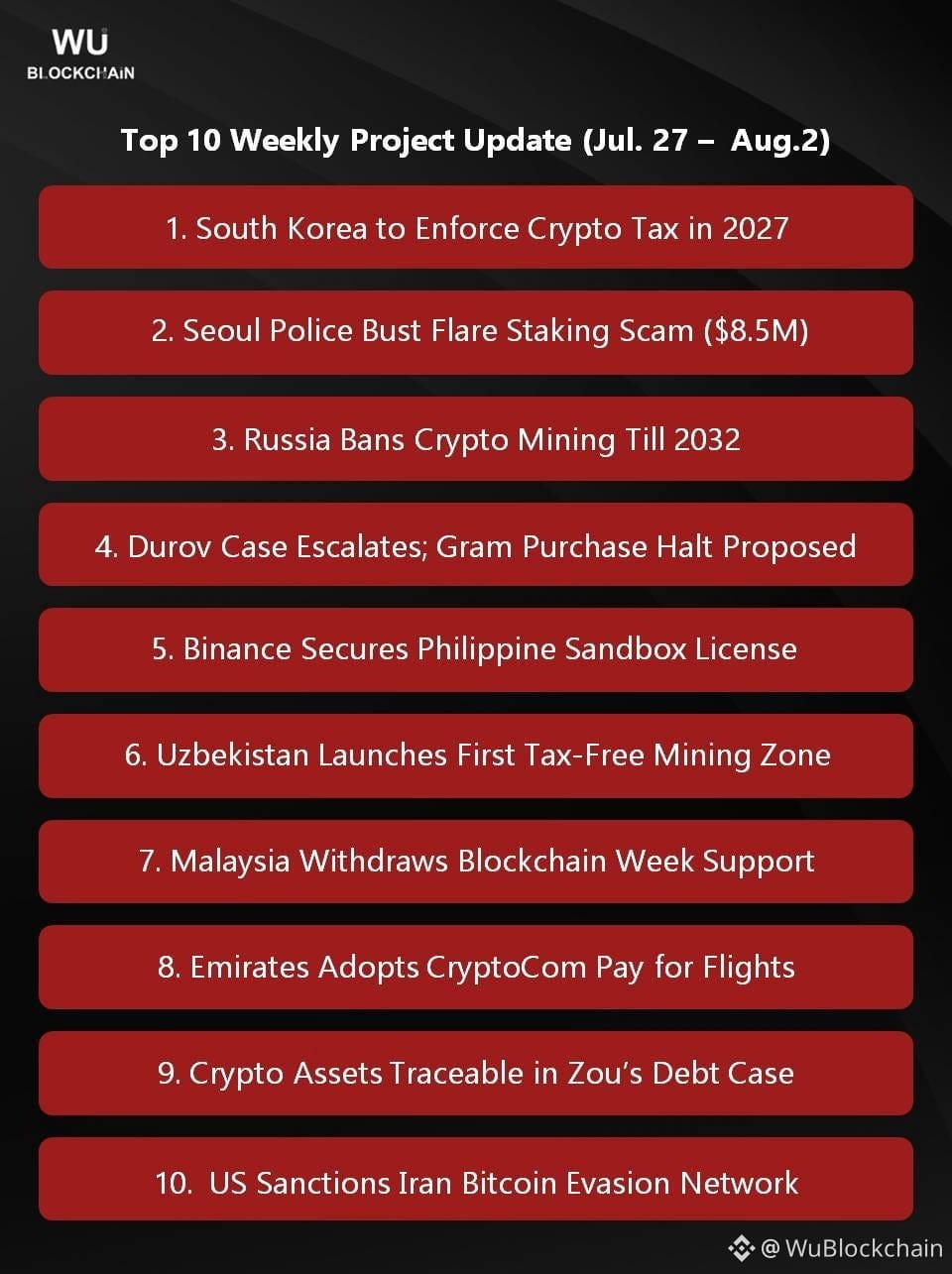
1. South Korea to Roll Out Crypto Asset Taxation as Scheduled in 2027 link
South Korea’s Deputy Prime Minister and Minister of Economy and Finance Koo Yun-cheol stated that crypto asset taxation in South Korea will be implemented as scheduled starting in 2027 after the extension expires at the end of this year. The government will continue evaluating and refining relevant rules during enforcement. This marks Koo’s first public clear commitment to launch crypto taxation on schedule. Reports note that under the current South Korean framework, investors cannot carry forward crypto asset losses to offset future gains, sparking market concerns over unfair treatment for domestic investors. Some investors may shift to overseas exchanges, potentially eroding trading volumes and competitiveness of South Korea’s local market.
2. Seoul Police Bust Fake Flare Network Staking Scam Worth $8.5 Million link
Seoul police stated that a fake Flare Network staking website operating for eight days last October defrauded 3.4 million XRP from 71 investors, worth 12.3 billion South Korean won ($8.5 million). The scam group impersonated Flare Network and its FXRP token via forged Wikipedia entries, blog posts and YouTube videos. Investigators traced 27.3 billion won ($18.8 million) in funds linked to the gang and froze 17.3 billion won of it. Two 29-year-old men have been referred to prosecutors on aggravated fraud charges, a 34-year-old stunt actor faces fraud allegations, and another 29-year-old suspect is subject to an Interpol Red Notice.
3. Russia Bans Crypto Mining in Moscow and Other Regions Until 2032 link
The Russian government will ban cryptocurrency mining in Moscow, the Moscow Oblast, and parts of the Kursk Oblast starting August 15, 2026, with the restriction remaining in force until December 31, 2032. The restrictions cover eight municipal districts and the town of Lgov in the Kursk Oblast and apply to local residents participating in mining pools and related activities. The relevant government decree was signed by Russian Prime Minister Mikhail Mishustin.
4. Durov Terrorism Case Escalates; Russian Lawmakers Propose Halting Gram Purchases link
Andrey Svintsov, Deputy Chairman of the Information Policy Committee of Russia’s State Duma, advised citizens to postpone purchases of Gram (formerly TON), Telegram Premium and other paid services within the ecosystem pending official clarifications from the FSB and communications regulator. The remarks came after Russian authorities accused Telegram founder Pavel Durov of aiding terrorist activities. The statement constitutes only a parliamentary recommendation and not a trading ban.
5. Binance Secures Special Sandbox License in Philippines, Fiat Gateway Imminent link
Binance founder CZ posted on X that Binance has obtained a special sandbox license in the Philippines, its official website has been unblocked locally, and fiat channels are set to launch soon. He also mentioned meeting the prime minister of another Asian country on the same day to further advance cryptocurrency development.
6. Uzbekistan Launches First Tax-Free Crypto Mining Zone Besqala Mining Valley link
Uzbekistan has officially launched its first tax-free crypto mining zone, Besqala Mining Valley. The park offers tax exemptions until 2035, charges miners a 1% revenue fee, and applies double electricity tariffs.
7. Malaysia Withdraws Blockchain Week Support Over Event Invite to Ex-OnlyFans Creator link
Malaysia’s Ministry of Digital and the Malaysia Digital Economy Corporation (MDEC) have both withdrawn support for the two-day Malaysia Blockchain Week 2026, which opened in Kuala Lumpur on Wednesday. The controversy arose after promotional materials for an after-party featuring a former OnlyFans creator sparked widespread backlash in the Muslim-majority nation. Event organisers had apologised to the ministry and government agency, stating they had not consulted the two bodies regarding the gathering. As of Wednesday, all references to the after-party and official government backing had been removed from the event website.
8. Emirates Rolls Out CryptoCom Pay for UAE Residents to Purchase Flight Tickets link
Emirates has rolled out CryptoCom Pay on its official website and mobile app. Eligible UAE residents can use this payment method for airfare orders denominated and settled in UAE dirhams. Mobile users will be redirected to the CryptoCom App to complete payment, while desktop users scan a QR code and confirm within the app. The launch follows a memorandum of understanding signed by both parties in July 2025. The service is offered by CryptoCom’s Dubai entity, which holds a stored-value facility license issued by the Central Bank of the UAE.
9. Cryptocurrencies Among Few Recoverable Assets in Zou Shiming Couple’s Debt Dispute link
According to Caixin’s article “Balance Sheet of a Fallen Boxing Champion”, for six individual creditors who are friends of Zou Shiming and his wife, funds invested in P2P platforms and virtual currencies represent the only potentially recoverable assets, in contrast to irreversible sunk costs including sold real estate, discounted luxury goods, abandoned boxing gym renovations and terminated cross-industry projects. The article notes that subrogation recovery is theoretically feasible if relevant platforms have not completed liquidation or wallet addresses remain traceable. For instance, Beijing procuratorial authorities once traced virtual currency flows through penetrating reviews and blockchain big-data analytics tools, successfully recovering more than 89 million yuan in illicit funds.
10. US Treasury Sanctions Iranian Strait of Hormuz “Forced Insurance” Network Using Bitcoin to Evade Sanctions link
The US Treasury’s OFAC sanctioned Persian Gulf Marine Insurance Company and HormuzSafe Marine Services Authority, accusing the two entities of involvement in an IRGC-backed toll scheme in the Strait of Hormuz that forced passing merchant vessels to purchase marine insurance. HormuzSafe accepted payments in Bitcoin and other digital assets to evade sanctions and raise funds for the IRGC. OFAC also sanctioned eight shipping firms involved in transporting Iranian crude and petroleum products, and designated eight vessels — WELL SAIL, LILY, AL SALMI, BREEZE V, NATSUMI, CRYSTAL, NIRETA and YEHOPE — as blocked property.
Follow us
Twitter: https://twitter.com/WuBlockchain
Telegram: https://t.me/wublockchainenglish