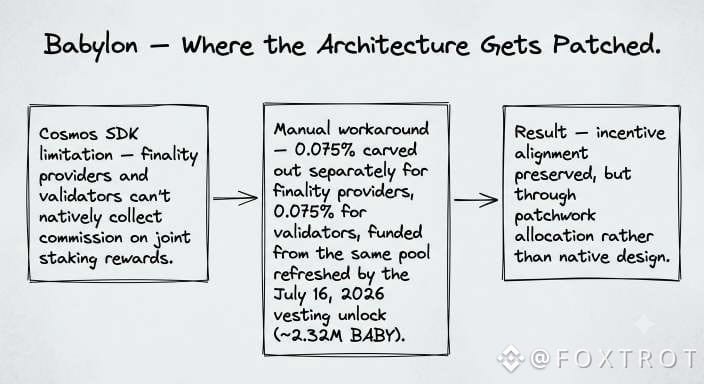
Been sitting with one specific line from Babylon's (@BabylonLabs_io ) tokenomics proposal since finishing the task — the part where finality providers and validators technically can't collect commission on joint staking rewards, some Cosmos SDK limitation, so the protocol just... patches around it. Extra 0.075% carved out for each group separately, manually compensating for what the architecture can't natively support.
That's the hidden design philosophy right there, hold up — it's not elegant, it's not some unified clean system. $BABY economics are stitched together wherever the base layer falls short, patch by patch, prioritizing that incentives stay aligned over the code staying tidy. Checked this against the July 16 vesting unlock too, ~2.32M BABY released under the same monthly schedule that's been quietly funding every one of these workaround allocations since the proposal passed. #baby doesn't market "we patch things," obviously, the pitch is all seamless Bitcoin security — but the actual token distribution reads more like duct tape wrapped around a genuinely sound idea.
Snacked through half this realization before it landed… there's something almost more trustworthy about a system that admits its own limitations in the reward math instead of hiding them. Or maybe that's just me being generous toward a protocol that hasn't broken yet.
Either way — how many "clean" designs out there are actually just better at hiding the same kind of patchwork?
That's the hidden design philosophy right there, hold up — it's not elegant, it's not some unified clean system. $BABY economics are stitched together wherever the base layer falls short, patch by patch, prioritizing that incentives stay aligned over the code staying tidy. Checked this against the July 16 vesting unlock too, ~2.32M BABY released under the same monthly schedule that's been quietly funding every one of these workaround allocations since the proposal passed. #baby doesn't market "we patch things," obviously, the pitch is all seamless Bitcoin security — but the actual token distribution reads more like duct tape wrapped around a genuinely sound idea.
Snacked through half this realization before it landed… there's something almost more trustworthy about a system that admits its own limitations in the reward math instead of hiding them. Or maybe that's just me being generous toward a protocol that hasn't broken yet.
Either way — how many "clean" designs out there are actually just better at hiding the same kind of patchwork?