

I remember watching an automated vault rebalance during a messy market move and thinking, this is where the story gets uncomfortable. The bot wasn’t malicious. The strategy wasn’t even stupid on paper. It just kept following instructions after the market context had changed. That’s the part traders usually underestimate with AI agents. The risk isn’t only that an agent goes rogue. Sometimes the bigger risk is that it behaves exactly as designed, but the design has no real-time guardrail strong enough to stop it.
That’s why I’ve been paying closer attention to Newton. Not because on-chain AI agents sound cleaner than off-chain automation, but because the weak spot is practical. If an agent makes decisions off-chain, then signs a transaction, the chain usually only sees the final action. It doesn’t know whether the agent checked risk, respected a mandate, avoided a sanctioned address, or got pushed by a bad prompt. Newton is trying to put the missing checkpoint closer to settlement. Its mainnet beta is live on Base and Ethereum, and its stated role is to enforce rules before a transaction executes, not simply report problems after value has already moved.
That difference matters if you trade or allocate capital. Think of off-chain automation like giving a junior trader a wallet and a private checklist. Maybe they follow it. Maybe they skip a line under pressure. Maybe the checklist changes but nobody updates the workflow fast enough. On-chain enforcement is more like putting the checklist inside the execution path itself. The trade doesn’t pass because someone promised discipline. It passes because the rule was checked.
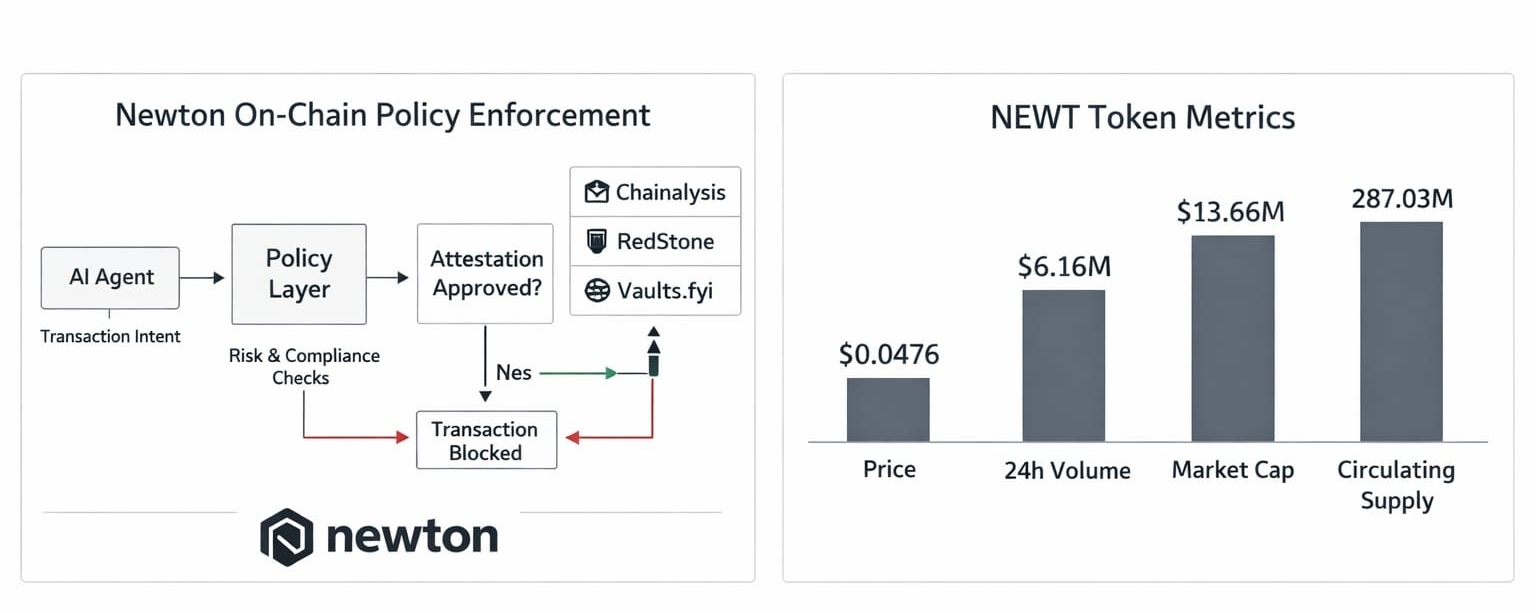
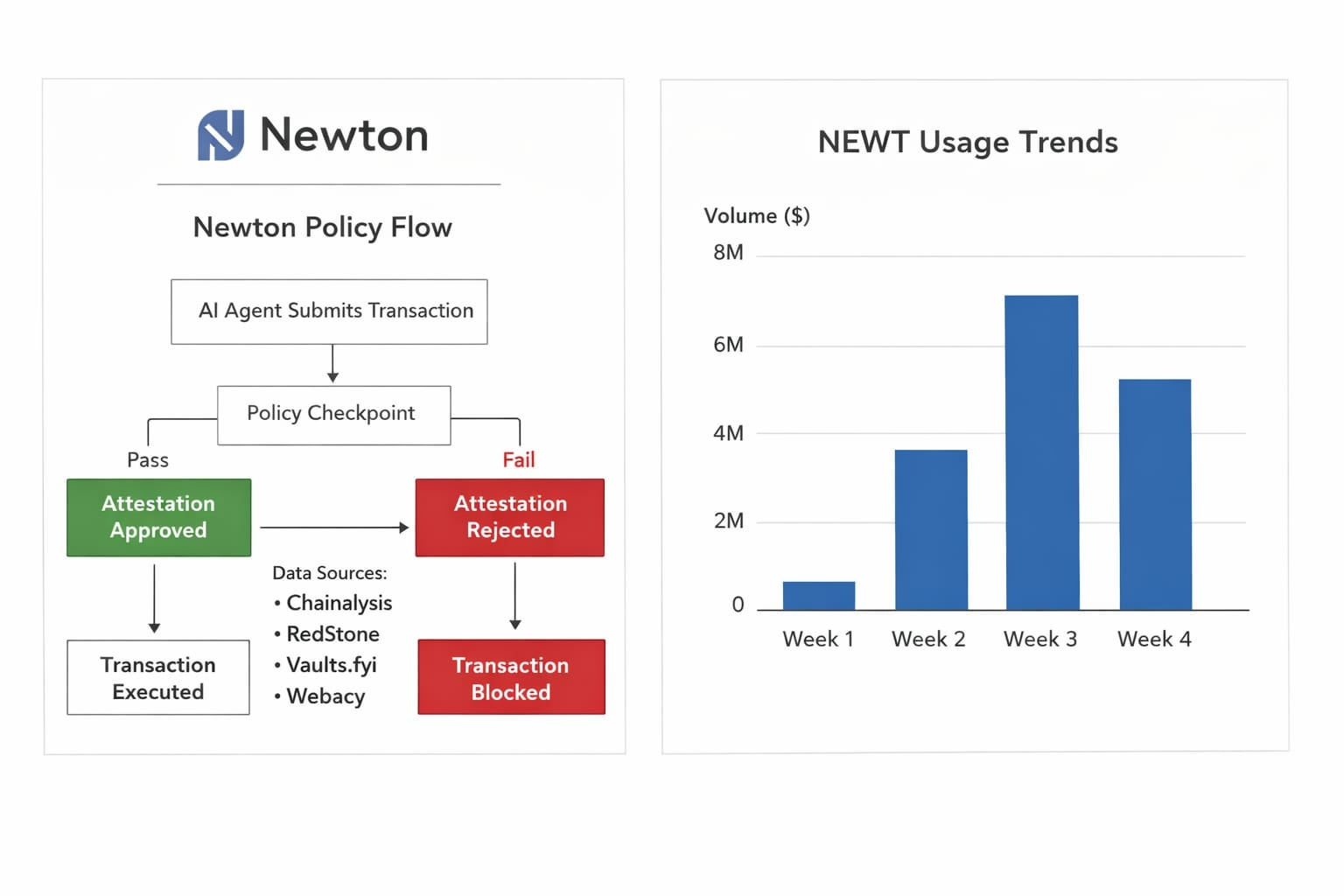
Newton’s edge is this pre-settlement policy layer. A transaction gets evaluated against a policy, operators sign off, and an attestation acts like a green light or red light before the smart contract lets it through. The newer Newton explanation says policies can read data from providers such as Chainalysis, RedStone, vaults.fyi, and Webacy, while the final proof is enforced back in the destination contract. That’s not a small workflow change. It shifts trust from “the bot probably did the right thing” to “the action had to satisfy the rule before settlement.”
But here’s the thing. I don’t think this removes risk. It changes where the risk sits. If the policy is badly written, Newton won’t magically create good judgment. If a data provider is stale, too slow, or wrong at the exact wrong moment, the policy can still make a poor decision. RedStone’s own writeup makes the same point in simpler terms, a policy is only as strong as the data behind it, and Newton’s first vault use case depends on transaction-time checks using price data and risk ratings. That’s useful, but it also means traders should watch latency, data quality, operator decentralization, and how disputes work after beta.
The market data is still early-stage too. CoinMarketCap showed NEWT around $0.0476, about $6.16 million in 24-hour volume, roughly $13.66 million market cap, 287.03 million circulating supply, and 1 billion max supply when I checked. That tells me one thing. The token is not being priced like mature infrastructure yet. Maybe the market is ignoring it. Maybe the market is correctly waiting for proof of adoption. I’m not pretending to know which one. What would change my mind positively is visible usage, more integrations, real vault activity, and proof that policy checks stay reliable when markets get ugly.
The retention problem is the part I keep coming back to. Crypto users try new tools quickly, but they don’t stay unless the tool protects money, saves time, or makes risk easier to explain. AI agents have this problem even harder. A trader may test an agent once, but long-term involvement only happens when the trader feels control, not just convenience. Newton’s advantage is that it could make agent activity more reviewable and harder to quietly misuse. The signed record matters because allocators, vault managers, and serious traders don’t just need execution. They need evidence.
Still, I’m slightly frustrated by how much of the AI-agent conversation stays at the surface. Everyone talks about smarter agents. Fewer people ask whether those agents can be constrained when incentives, markets, or prompts turn messy. That’s where Newton feels relevant. Not as a magic fix, but as a serious answer to a boring problem that actually matters.
If you’re eyeing Newton, don’t just watch the chart. Watch whether real capital keeps using these policies after the first launch excitement fades. Track integrations. Read the attestations. Test the workflow. Because the winner in on-chain AI won’t be the agent that sounds smartest. It’ll be the one traders can trust when the market stops being polite.