

#tokenomics
tokenomics
2.1M vues
4,715 mentions
Populaire
Récents

·
--
Le moteur déflationniste caché du Bitcoin : pourquoi l’offre flottante est plus faible que vous ne le pensez
Alors que les tableaux de déblocage de jetons classiques mettent l’accent sur les périodes d’acquisition avec déblocage massif des investissements en capital-risque dans les nouveaux protocoles de couche 1, le Bitcoin obéit à un tout autre paradigme économique. Avec le halving d’avril, l’émission quotidienne est passée de 900 à 450 pièces, faisant chuter la croissance annuelle de l’offre sous les 0,85 %. Mais s’en tenir au calendrier d’émission du protocole, c’est passer à côté de plus de la moitié de la réalité côté offre.
Contrairement aux altcoins soumis à des déblocages périodiques qui diluent l’offre, $BTC connaît chaque jour une réduction organique et non planifiée de son offre. Les analyses forensiques on-chain indiquent qu’environ 3,7 millions de pièces sont définitivement hors circulation, en raison de clés privées perdues, de portefeuilles des débuts restés inactifs et de récompenses de minage anciennes irrécupérables. Si l’on soustrait ces pièces perdues des 19,7 millions actuellement minées, l’offre flottante réellement disponible tombe à près de 16 millions de pièces.
Avec un cours au comptant autour de 80060 USD, l’offre illiquide détenue depuis plus d’un an par des acteurs de long terme se maintient à des sommets inégalés depuis plusieurs années. Cette offre flottante illiquide très limitée permet au marché d’absorber sans difficulté l’émission quotidienne des mineurs. Contrairement aux banques centrales, qui accroissent sans cesse l’offre de monnaie fiduciaire, le BTC associe un plafond strict de 21 millions à une illiquidité structurelle persistante, créant un resserrement de l’offre qui s’intensifie au fil des cycles pluriannuels.
La vraie question n’est pas seulement de savoir combien de nouvelles pièces arrivent sur le marché à chaque bloc, mais combien sont réellement disponibles pour les acheteurs au comptant à l’heure actuelle. Suivez-vous l’offre flottante effectivement liquide, ou vous contentez-vous de regarder la capitalisation boursière totale ?
#TokenUnlocks #Tokenomics
Le moteur déflationniste caché du Bitcoin : pourquoi l’offre flottante est plus faible que vous ne le pensez
Alors que les tableaux de déblocage de jetons classiques mettent l’accent sur les périodes d’acquisition avec déblocage massif des investissements en capital-risque dans les nouveaux protocoles de couche 1, le Bitcoin obéit à un tout autre paradigme économique. Avec le halving d’avril, l’émission quotidienne est passée de 900 à 450 pièces, faisant chuter la croissance annuelle de l’offre sous les 0,85 %. Mais s’en tenir au calendrier d’émission du protocole, c’est passer à côté de plus de la moitié de la réalité côté offre.
Contrairement aux altcoins soumis à des déblocages périodiques qui diluent l’offre, $BTC connaît chaque jour une réduction organique et non planifiée de son offre. Les analyses forensiques on-chain indiquent qu’environ 3,7 millions de pièces sont définitivement hors circulation, en raison de clés privées perdues, de portefeuilles des débuts restés inactifs et de récompenses de minage anciennes irrécupérables. Si l’on soustrait ces pièces perdues des 19,7 millions actuellement minées, l’offre flottante réellement disponible tombe à près de 16 millions de pièces.
Avec un cours au comptant autour de 80060 USD, l’offre illiquide détenue depuis plus d’un an par des acteurs de long terme se maintient à des sommets inégalés depuis plusieurs années. Cette offre flottante illiquide très limitée permet au marché d’absorber sans difficulté l’émission quotidienne des mineurs. Contrairement aux banques centrales, qui accroissent sans cesse l’offre de monnaie fiduciaire, le BTC associe un plafond strict de 21 millions à une illiquidité structurelle persistante, créant un resserrement de l’offre qui s’intensifie au fil des cycles pluriannuels.
La vraie question n’est pas seulement de savoir combien de nouvelles pièces arrivent sur le marché à chaque bloc, mais combien sont réellement disponibles pour les acheteurs au comptant à l’heure actuelle. Suivez-vous l’offre flottante effectivement liquide, ou vous contentez-vous de regarder la capitalisation boursière totale ?
#TokenUnlocks #Tokenomics
Alors que les tableaux de déblocage de jetons classiques mettent l’accent sur les périodes d’acquisition avec déblocage massif des investissements en capital-risque dans les nouveaux protocoles de couche 1, le Bitcoin obéit à un tout autre paradigme économique. Avec le halving d’avril, l’émission quotidienne est passée de 900 à 450 pièces, faisant chuter la croissance annuelle de l’offre sous les 0,85 %. Mais s’en tenir au calendrier d’émission du protocole, c’est passer à côté de plus de la moitié de la réalité côté offre.
Contrairement aux altcoins soumis à des déblocages périodiques qui diluent l’offre, $BTC connaît chaque jour une réduction organique et non planifiée de son offre. Les analyses forensiques on-chain indiquent qu’environ 3,7 millions de pièces sont définitivement hors circulation, en raison de clés privées perdues, de portefeuilles des débuts restés inactifs et de récompenses de minage anciennes irrécupérables. Si l’on soustrait ces pièces perdues des 19,7 millions actuellement minées, l’offre flottante réellement disponible tombe à près de 16 millions de pièces.
Avec un cours au comptant autour de 80060 USD, l’offre illiquide détenue depuis plus d’un an par des acteurs de long terme se maintient à des sommets inégalés depuis plusieurs années. Cette offre flottante illiquide très limitée permet au marché d’absorber sans difficulté l’émission quotidienne des mineurs. Contrairement aux banques centrales, qui accroissent sans cesse l’offre de monnaie fiduciaire, le BTC associe un plafond strict de 21 millions à une illiquidité structurelle persistante, créant un resserrement de l’offre qui s’intensifie au fil des cycles pluriannuels.
La vraie question n’est pas seulement de savoir combien de nouvelles pièces arrivent sur le marché à chaque bloc, mais combien sont réellement disponibles pour les acheteurs au comptant à l’heure actuelle. Suivez-vous l’offre flottante effectivement liquide, ou vous contentez-vous de regarder la capitalisation boursière totale ?
#TokenUnlocks #Tokenomics


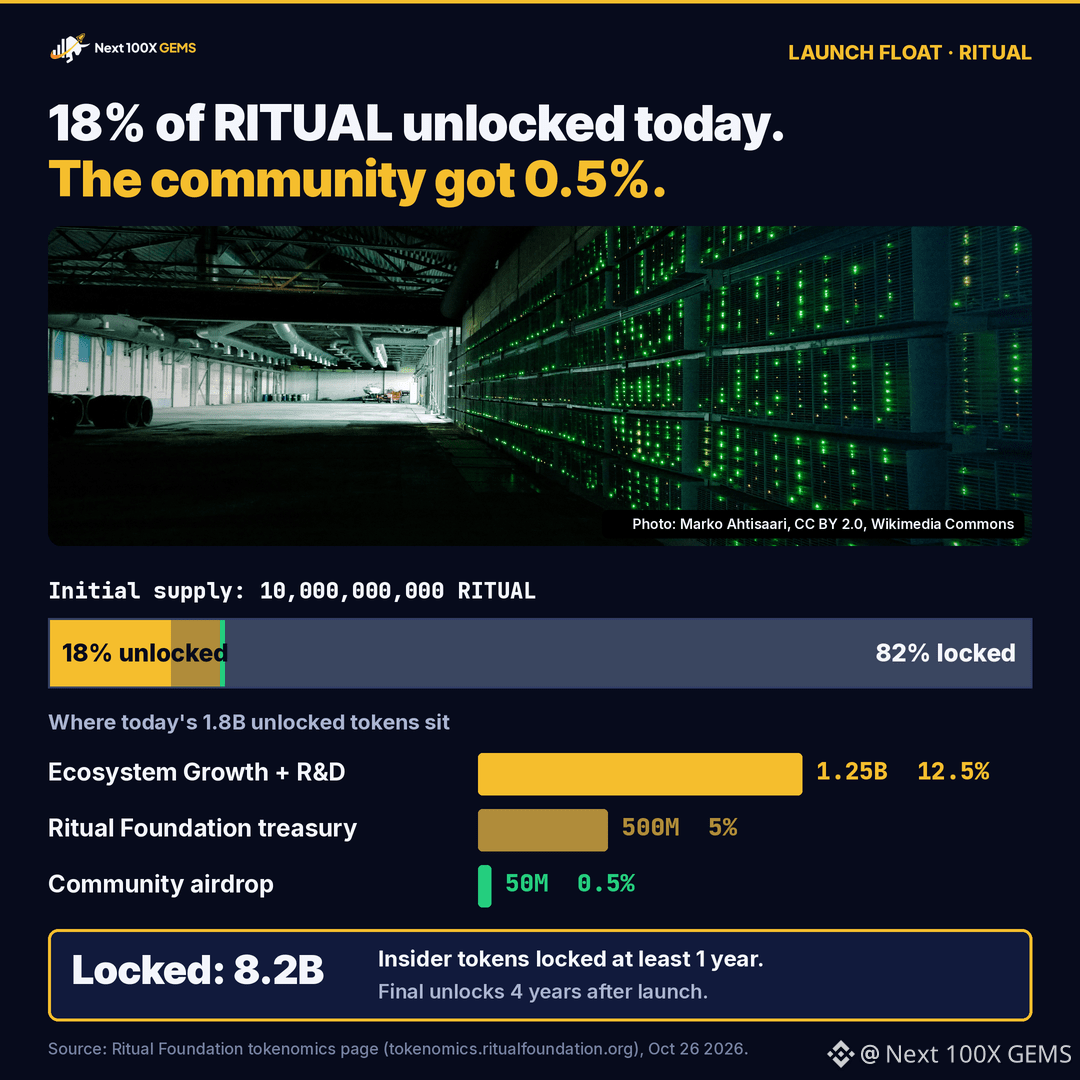
Ritual a été lancé sur le mainnet aujourd’hui, et la page du token indique que 18 % des RITUAL sont débloqués au lancement. Cela représente 1,8 milliard de tokens sur une offre initiale de 10 milliards. Coinbase a également ajouté la paire RITUAL-USD aujourd’hui, les échanges devant commencer une fois les conditions de liquidité réunies.
Le détail à examiner de près, c’est la provenance de ces 1,8 milliard. 1,25 milliard proviennent du fonds consacré à la croissance de l’écosystème et à la R&D, et 500 millions de la trésorerie de la Ritual Foundation. L’airdrop communautaire destiné aux opérateurs de nœuds, aux utilisateurs de Frenrug et aux membres de longue date représente 50 millions de tokens, soit 0,5 % de l’offre, entièrement débloqués.
Ainsi, 97 % des tokens en circulation dès le premier jour sont détenus par le projet, et non par les bénéficiaires de l’airdrop. Si vous essayez d’évaluer la pression vendeuse cette semaine, les portefeuilles de l’airdrop ne sont qu’un petit élément de l’équation. Les mouvements vers les plateformes d’échange des portefeuilles de la fondation et de l’écosystème seraient bien plus importants.
Les 8,2 milliards restants sont bloqués. Les principaux contributeurs (29 %) et les investisseurs de Labs (11,3 %) doivent attendre au moins un an, et les derniers tokens ne seront débloqués que quatre ans après le lancement. L’offre n’est pas plafonnée non plus : l’émission annuelle est d’environ 5 %, en partie compensée par la destruction des frais de base.
Avant de trader après l’arrivée sur la plateforme, vérifiez le calcul de l’offre en circulation, pas seulement le graphique.
$RITUAL
#Ritual #Tokenomics
Ceci ne constitue pas un conseil financier. Faites vos propres recherches.
Ritual a été lancé sur le mainnet aujourd’hui, et la page du token indique que 18 % des RITUAL sont débloqués au lancement. Cela représente 1,8 milliard de tokens sur une offre initiale de 10 milliards. Coinbase a également ajouté la paire RITUAL-USD aujourd’hui, les échanges devant commencer une fois les conditions de liquidité réunies.
Le détail à examiner de près, c’est la provenance de ces 1,8 milliard. 1,25 milliard proviennent du fonds consacré à la croissance de l’écosystème et à la R&D, et 500 millions de la trésorerie de la Ritual Foundation. L’airdrop communautaire destiné aux opérateurs de nœuds, aux utilisateurs de Frenrug et aux membres de longue date représente 50 millions de tokens, soit 0,5 % de l’offre, entièrement débloqués.
Ainsi, 97 % des tokens en circulation dès le premier jour sont détenus par le projet, et non par les bénéficiaires de l’airdrop. Si vous essayez d’évaluer la pression vendeuse cette semaine, les portefeuilles de l’airdrop ne sont qu’un petit élément de l’équation. Les mouvements vers les plateformes d’échange des portefeuilles de la fondation et de l’écosystème seraient bien plus importants.
Les 8,2 milliards restants sont bloqués. Les principaux contributeurs (29 %) et les investisseurs de Labs (11,3 %) doivent attendre au moins un an, et les derniers tokens ne seront débloqués que quatre ans après le lancement. L’offre n’est pas plafonnée non plus : l’émission annuelle est d’environ 5 %, en partie compensée par la destruction des frais de base.
Avant de trader après l’arrivée sur la plateforme, vérifiez le calcul de l’offre en circulation, pas seulement le graphique.
$RITUAL
#Ritual #Tokenomics
Ceci ne constitue pas un conseil financier. Faites vos propres recherches.
Le détail à examiner de près, c’est la provenance de ces 1,8 milliard. 1,25 milliard proviennent du fonds consacré à la croissance de l’écosystème et à la R&D, et 500 millions de la trésorerie de la Ritual Foundation. L’airdrop communautaire destiné aux opérateurs de nœuds, aux utilisateurs de Frenrug et aux membres de longue date représente 50 millions de tokens, soit 0,5 % de l’offre, entièrement débloqués.
Ainsi, 97 % des tokens en circulation dès le premier jour sont détenus par le projet, et non par les bénéficiaires de l’airdrop. Si vous essayez d’évaluer la pression vendeuse cette semaine, les portefeuilles de l’airdrop ne sont qu’un petit élément de l’équation. Les mouvements vers les plateformes d’échange des portefeuilles de la fondation et de l’écosystème seraient bien plus importants.
Les 8,2 milliards restants sont bloqués. Les principaux contributeurs (29 %) et les investisseurs de Labs (11,3 %) doivent attendre au moins un an, et les derniers tokens ne seront débloqués que quatre ans après le lancement. L’offre n’est pas plafonnée non plus : l’émission annuelle est d’environ 5 %, en partie compensée par la destruction des frais de base.
Avant de trader après l’arrivée sur la plateforme, vérifiez le calcul de l’offre en circulation, pas seulement le graphique.
$RITUAL
#Ritual #Tokenomics
Ceci ne constitue pas un conseil financier. Faites vos propres recherches.
54

Voir la traduction
$SHELL | Why Market-Cap Figures Differ Between Data Sites
The research report found that recent $SHELL market-cap estimates varied from roughly $6 million to 10.4 million. It also noted a substantial difference in reported circulating supply, with some sources listing approximately 270 million tokens and others around 458 million.
That discrepancy matters because market capitalization is calculated by multiplying the current token price by the circulating supply used by the data provider.
If two platforms use different circulating-supply figures, their market-cap estimates can differ even when they show nearly identical prices. This does not automatically mean one platform has made a mistake, but it does mean the underlying methodology needs to be checked.
Three terms are especially important.
Circulating market capitalization uses the provider's estimate of tokens currently circulating.
Fully diluted valuation, or FDV, generally uses the total or maximum token supply specified by the relevant methodology.
Total supply describes tokens that have been created, although the exact treatment of locked, burned or otherwise restricted tokens may vary by provider.
These measures answer different questions. Market cap estimates the value of the circulating supply at the current price, while FDV illustrates what valuation would look like under a broader supply assumption. Neither number alone tells us whether a token is cheap or expensive.
When comparing tokens, record the source, timestamp, circulating supply and calculation method. Consistent methodology makes comparisons far more meaningful.
#Tokenomics #MarketCap #DataQuality CryptoEducation Fundamentals
$SHELL | Why Market-Cap Figures Differ Between Data Sites
The research report found that recent $SHELL market-cap estimates varied from roughly $6 million to 10.4 million. It also noted a substantial difference in reported circulating supply, with some sources listing approximately 270 million tokens and others around 458 million.
That discrepancy matters because market capitalization is calculated by multiplying the current token price by the circulating supply used by the data provider.
If two platforms use different circulating-supply figures, their market-cap estimates can differ even when they show nearly identical prices. This does not automatically mean one platform has made a mistake, but it does mean the underlying methodology needs to be checked.
Three terms are especially important.
Circulating market capitalization uses the provider's estimate of tokens currently circulating.
Fully diluted valuation, or FDV, generally uses the total or maximum token supply specified by the relevant methodology.
Total supply describes tokens that have been created, although the exact treatment of locked, burned or otherwise restricted tokens may vary by provider.
These measures answer different questions. Market cap estimates the value of the circulating supply at the current price, while FDV illustrates what valuation would look like under a broader supply assumption. Neither number alone tells us whether a token is cheap or expensive.
When comparing tokens, record the source, timestamp, circulating supply and calculation method. Consistent methodology makes comparisons far more meaningful.
#Tokenomics #MarketCap #DataQuality CryptoEducation Fundamentals
The research report found that recent $SHELL market-cap estimates varied from roughly $6 million to 10.4 million. It also noted a substantial difference in reported circulating supply, with some sources listing approximately 270 million tokens and others around 458 million.
That discrepancy matters because market capitalization is calculated by multiplying the current token price by the circulating supply used by the data provider.
If two platforms use different circulating-supply figures, their market-cap estimates can differ even when they show nearly identical prices. This does not automatically mean one platform has made a mistake, but it does mean the underlying methodology needs to be checked.
Three terms are especially important.
Circulating market capitalization uses the provider's estimate of tokens currently circulating.
Fully diluted valuation, or FDV, generally uses the total or maximum token supply specified by the relevant methodology.
Total supply describes tokens that have been created, although the exact treatment of locked, burned or otherwise restricted tokens may vary by provider.
These measures answer different questions. Market cap estimates the value of the circulating supply at the current price, while FDV illustrates what valuation would look like under a broader supply assumption. Neither number alone tells us whether a token is cheap or expensive.
When comparing tokens, record the source, timestamp, circulating supply and calculation method. Consistent methodology makes comparisons far more meaningful.
#Tokenomics #MarketCap #DataQuality CryptoEducation Fundamentals

1
33
·
--
Voir la traduction
Traders staring exclusively at the spot ticker hovering near 740.87 are missing the structural plumbing that is quietly altering the entire market dynamics for $BNB. While legacy altcoins bleed liquidity into heavy vesting schedules and recurring team unlocks, the Binance ecosystem operates in a completely different reality. The era of early investor dilution is long gone, replaced by a ruthless, automated supply contraction that changes how base layer economics function.
The core of this supply squeeze comes down to the relentless velocity of the BNB Auto-Burn mechanism paired with massive staking participation. When you calculate the actual circulating float against the volume of protocol fees being permanently removed from circulation every quarter, the net issuance rate dips deep into negative territory. Unlike inflationary layer-ones that constantly fight sell pressure from emissions, BNB runs on a deflationary engine driven by real platform revenue recycling.
On top of the burn mechanics, a staggering percentage of the total supply is currently locked up in validator nodes and ecosystem staking contracts. This creates an intense supply vacuum on open order books. Institutional money isn't chasing short-term hype waves here; they are positioning themselves around the base layer maths where available tradeable float shrinks quarter after quarter. With no looming cliff unlocks or venture capital distribution overhangs left to pressure spot markets, the supply-demand imbalance becomes mathematically severe.
Are you factoring these deep deflationary metrics into your long-term thesis, or are you still just watching the order book?
#TokenUnlocks #Tokenomics
Traders staring exclusively at the spot ticker hovering near 740.87 are missing the structural plumbing that is quietly altering the entire market dynamics for $BNB . While legacy altcoins bleed liquidity into heavy vesting schedules and recurring team unlocks, the Binance ecosystem operates in a completely different reality. The era of early investor dilution is long gone, replaced by a ruthless, automated supply contraction that changes how base layer economics function.
The core of this supply squeeze comes down to the relentless velocity of the BNB Auto-Burn mechanism paired with massive staking participation. When you calculate the actual circulating float against the volume of protocol fees being permanently removed from circulation every quarter, the net issuance rate dips deep into negative territory. Unlike inflationary layer-ones that constantly fight sell pressure from emissions, BNB runs on a deflationary engine driven by real platform revenue recycling.
On top of the burn mechanics, a staggering percentage of the total supply is currently locked up in validator nodes and ecosystem staking contracts. This creates an intense supply vacuum on open order books. Institutional money isn't chasing short-term hype waves here; they are positioning themselves around the base layer maths where available tradeable float shrinks quarter after quarter. With no looming cliff unlocks or venture capital distribution overhangs left to pressure spot markets, the supply-demand imbalance becomes mathematically severe.
Are you factoring these deep deflationary metrics into your long-term thesis, or are you still just watching the order book?
#TokenUnlocks #Tokenomics
The core of this supply squeeze comes down to the relentless velocity of the BNB Auto-Burn mechanism paired with massive staking participation. When you calculate the actual circulating float against the volume of protocol fees being permanently removed from circulation every quarter, the net issuance rate dips deep into negative territory. Unlike inflationary layer-ones that constantly fight sell pressure from emissions, BNB runs on a deflationary engine driven by real platform revenue recycling.
On top of the burn mechanics, a staggering percentage of the total supply is currently locked up in validator nodes and ecosystem staking contracts. This creates an intense supply vacuum on open order books. Institutional money isn't chasing short-term hype waves here; they are positioning themselves around the base layer maths where available tradeable float shrinks quarter after quarter. With no looming cliff unlocks or venture capital distribution overhangs left to pressure spot markets, the supply-demand imbalance becomes mathematically severe.
Are you factoring these deep deflationary metrics into your long-term thesis, or are you still just watching the order book?
#TokenUnlocks #Tokenomics
56

·
--
🔥 $APT PÉNURIE D’OFFRE EN COURS : LE TAUX DE DESTRUCTION ANNUEL ATTEINT 1,8 M DE TOKENS ! 📊
Les investisseurs avisés suivent la dynamique de l’offre bien avant que les prix ne reflètent la pénurie. $APT vient de détruire à lui seul 152,9 K tokens en août, portant le total des tokens détruits sur le mainnet à plus de 1,7 million. 📊
Avec des frais de transaction moyens de seulement 0,0005 $, l’utilisation du réseau s’accélère tandis que le taux de destruction annuel projeté atteint 1,8 million d’APT. 🔍 La pression constante à la baisse sur l’offre, combinée à des coûts ultra-faibles pour les utilisateurs, crée un puissant vent arrière structurel pour les stratégies de momentum à long terme.
🤔 Pensez-vous que ce mécanisme de destruction continu déclenchera un choc d’offre macroéconomique pour $APT , ou attendez-vous une confirmation par une hausse du volume de transactions ? 👇
⚠️ Ceci ne constitue pas un conseil financier. Gérez toujours vos risques. 🛡️
🏷️ #APT #Layer1 #Crypto #Tokenomics
⚡ 💎
🔥 $APT PÉNURIE D’OFFRE EN COURS : LE TAUX DE DESTRUCTION ANNUEL ATTEINT 1,8 M DE TOKENS ! 📊
Les investisseurs avisés suivent la dynamique de l’offre bien avant que les prix ne reflètent la pénurie. $APT vient de détruire à lui seul 152,9 K tokens en août, portant le total des tokens détruits sur le mainnet à plus de 1,7 million. 📊
Avec des frais de transaction moyens de seulement 0,0005 $, l’utilisation du réseau s’accélère tandis que le taux de destruction annuel projeté atteint 1,8 million d’APT. 🔍 La pression constante à la baisse sur l’offre, combinée à des coûts ultra-faibles pour les utilisateurs, crée un puissant vent arrière structurel pour les stratégies de momentum à long terme.
🤔 Pensez-vous que ce mécanisme de destruction continu déclenchera un choc d’offre macroéconomique pour $APT , ou attendez-vous une confirmation par une hausse du volume de transactions ? 👇
⚠️ Ceci ne constitue pas un conseil financier. Gérez toujours vos risques. 🛡️
🏷️ #APT #Layer1 #Crypto #Tokenomics
⚡ 💎
Les investisseurs avisés suivent la dynamique de l’offre bien avant que les prix ne reflètent la pénurie. $APT vient de détruire à lui seul 152,9 K tokens en août, portant le total des tokens détruits sur le mainnet à plus de 1,7 million. 📊
Avec des frais de transaction moyens de seulement 0,0005 $, l’utilisation du réseau s’accélère tandis que le taux de destruction annuel projeté atteint 1,8 million d’APT. 🔍 La pression constante à la baisse sur l’offre, combinée à des coûts ultra-faibles pour les utilisateurs, crée un puissant vent arrière structurel pour les stratégies de momentum à long terme.
🤔 Pensez-vous que ce mécanisme de destruction continu déclenchera un choc d’offre macroéconomique pour $APT , ou attendez-vous une confirmation par une hausse du volume de transactions ? 👇
⚠️ Ceci ne constitue pas un conseil financier. Gérez toujours vos risques. 🛡️
🏷️ #APT #Layer1 #Crypto #Tokenomics
⚡ 💎
21

·
--
Haussier
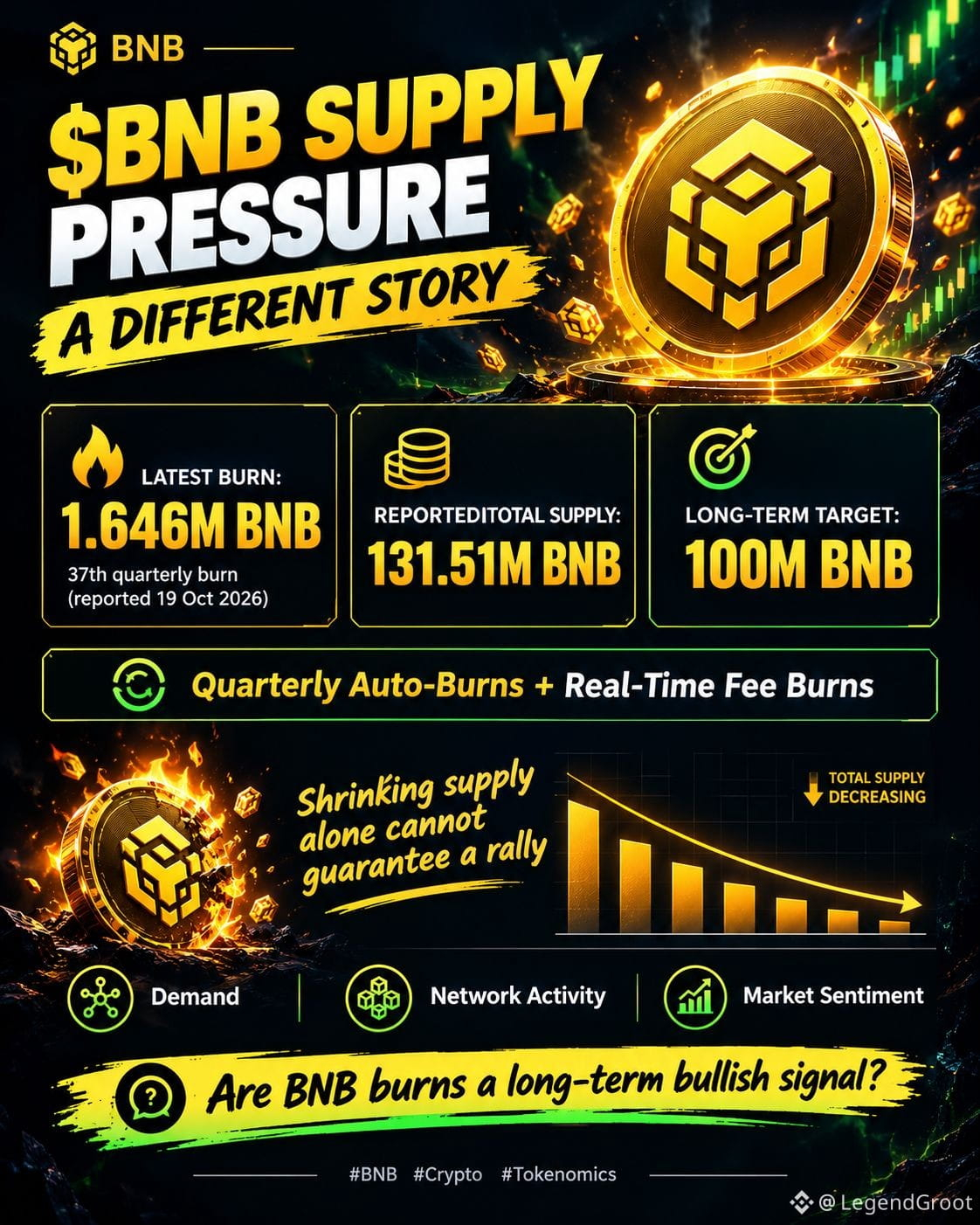
🚨 $BNB LA PRESSION SUR L’OFFRE RACONTE UNE AUTRE HISTOIRE !
Contrairement aux tokens soumis à des calendriers de déblocage importants, le BNB est conçu pour réduire son offre grâce aux brûlages automatiques trimestriels et aux brûlages de frais en temps réel.
🔥 Dernier brûlage : 1,646 M de BNB
📉 Offre totale déclarée : 131,51 M de BNB
🎯 Objectif à long terme : 100 M de BNB
Mais n’oubliez pas : la réduction de l’offre à elle seule ne peut pas garantir une hausse des cours. La demande, l’activité du réseau et le sentiment du marché restent importants.
Les brûlages de BNB sont-ils un signal haussier à long terme ? 👀
#BNB #Crypto #Tokenomics
🚨 $BNB LA PRESSION SUR L’OFFRE RACONTE UNE AUTRE HISTOIRE !
Contrairement aux tokens soumis à des calendriers de déblocage importants, le BNB est conçu pour réduire son offre grâce aux brûlages automatiques trimestriels et aux brûlages de frais en temps réel.
🔥 Dernier brûlage : 1,646 M de BNB
📉 Offre totale déclarée : 131,51 M de BNB
🎯 Objectif à long terme : 100 M de BNB
Mais n’oubliez pas : la réduction de l’offre à elle seule ne peut pas garantir une hausse des cours. La demande, l’activité du réseau et le sentiment du marché restent importants.
Les brûlages de BNB sont-ils un signal haussier à long terme ? 👀
#BNB #Crypto #Tokenomics
Contrairement aux tokens soumis à des calendriers de déblocage importants, le BNB est conçu pour réduire son offre grâce aux brûlages automatiques trimestriels et aux brûlages de frais en temps réel.
🔥 Dernier brûlage : 1,646 M de BNB
📉 Offre totale déclarée : 131,51 M de BNB
🎯 Objectif à long terme : 100 M de BNB
Mais n’oubliez pas : la réduction de l’offre à elle seule ne peut pas garantir une hausse des cours. La demande, l’activité du réseau et le sentiment du marché restent importants.
Les brûlages de BNB sont-ils un signal haussier à long terme ? 👀
#BNB #Crypto #Tokenomics
172

·
--
💡 Une crypto à 0,01 $ n’est pas toujours bon marché !
Beaucoup de débutants voient une cryptomonnaie à 0,01 $ et pensent qu’elle a un énorme potentiel de croissance.
Mais le prix d’une seule pièce ne dit pas tout. 👇
📊 Exemple :
🔹 Pièce A : prix de 0,01 $ × 100 milliards de tokens = capitalisation boursière de 1 milliard de dollars.
🔹 Pièce B : prix de 100 $ × 10 millions de tokens = capitalisation boursière de 1 milliard de dollars.
Les deux ont la même capitalisation boursière, malgré des prix par pièce très différents.
Avant d’investir, examinez :
✅ La capitalisation boursière
✅ L’offre en circulation
✅ La valorisation entièrement diluée (FDV)
✅ Les déblocages de tokens et l’inflation de l’offre
Un prix bas par token ne signifie pas automatiquement qu’une cryptomonnaie est sous-évaluée.
Vérifiez-vous la capitalisation boursière avant d’acheter une cryptomonnaie, ou regardez-vous surtout son prix ? 👇
Suivez-moi pour des analyses quotidiennes sur les cryptos et l’actualité des marchés. 🚀📊
#CryptoEducation #MarketCap #Altcoins #Tokenomics #BinanceSquare
💡 Une crypto à 0,01 $ n’est pas toujours bon marché !
Beaucoup de débutants voient une cryptomonnaie à 0,01 $ et pensent qu’elle a un énorme potentiel de croissance.
Mais le prix d’une seule pièce ne dit pas tout. 👇
📊 Exemple :
🔹 Pièce A : prix de 0,01 $ × 100 milliards de tokens = capitalisation boursière de 1 milliard de dollars.
🔹 Pièce B : prix de 100 $ × 10 millions de tokens = capitalisation boursière de 1 milliard de dollars.
Les deux ont la même capitalisation boursière, malgré des prix par pièce très différents.
Avant d’investir, examinez :
✅ La capitalisation boursière
✅ L’offre en circulation
✅ La valorisation entièrement diluée (FDV)
✅ Les déblocages de tokens et l’inflation de l’offre
Un prix bas par token ne signifie pas automatiquement qu’une cryptomonnaie est sous-évaluée.
Vérifiez-vous la capitalisation boursière avant d’acheter une cryptomonnaie, ou regardez-vous surtout son prix ? 👇
Suivez-moi pour des analyses quotidiennes sur les cryptos et l’actualité des marchés. 🚀📊
#CryptoEducation #MarketCap #Altcoins #Tokenomics #BinanceSquare
Beaucoup de débutants voient une cryptomonnaie à 0,01 $ et pensent qu’elle a un énorme potentiel de croissance.
Mais le prix d’une seule pièce ne dit pas tout. 👇
📊 Exemple :
🔹 Pièce A : prix de 0,01 $ × 100 milliards de tokens = capitalisation boursière de 1 milliard de dollars.
🔹 Pièce B : prix de 100 $ × 10 millions de tokens = capitalisation boursière de 1 milliard de dollars.
Les deux ont la même capitalisation boursière, malgré des prix par pièce très différents.
Avant d’investir, examinez :
✅ La capitalisation boursière
✅ L’offre en circulation
✅ La valorisation entièrement diluée (FDV)
✅ Les déblocages de tokens et l’inflation de l’offre
Un prix bas par token ne signifie pas automatiquement qu’une cryptomonnaie est sous-évaluée.
Vérifiez-vous la capitalisation boursière avant d’acheter une cryptomonnaie, ou regardez-vous surtout son prix ? 👇
Suivez-moi pour des analyses quotidiennes sur les cryptos et l’actualité des marchés. 🚀📊
#CryptoEducation #MarketCap #Altcoins #Tokenomics #BinanceSquare
1
106
·
--
Voir la traduction
Checking $ADA supply dynamics today at 0.2054. The ~70% staking ratio is doing heavy lifting by keeping effective circulation super tight. No heavy VC vesting cliffs ahead means low net inflation pressure. Healthy setup for $BTC correlation.
#TokenUnlocks #Tokenomics #ADA
Checking $ADA supply dynamics today at 0.2054. The ~70% staking ratio is doing heavy lifting by keeping effective circulation super tight. No heavy VC vesting cliffs ahead means low net inflation pressure. Healthy setup for $BTC correlation.
#TokenUnlocks #Tokenomics #ADA
#TokenUnlocks #Tokenomics #ADA
3

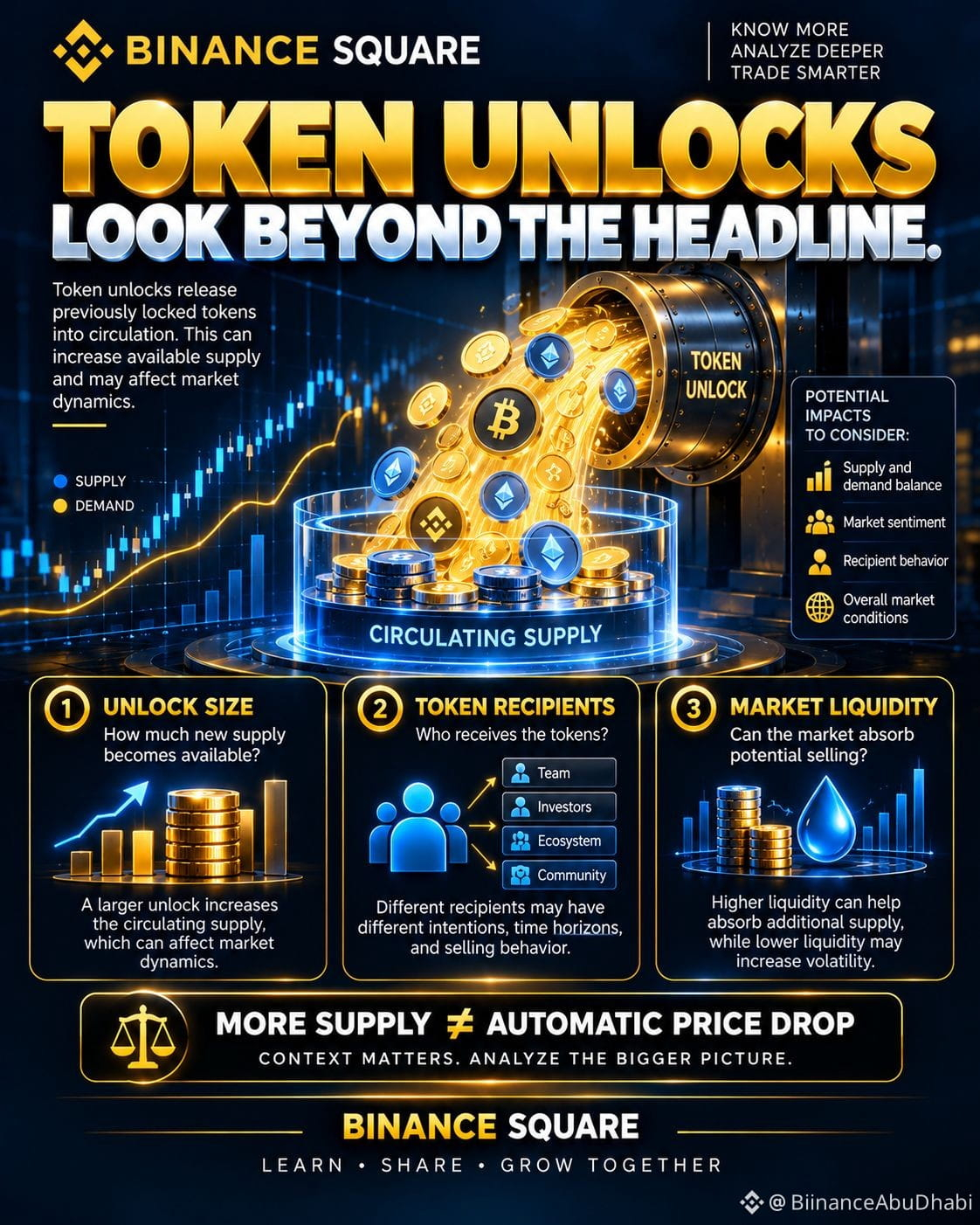
🚨 DÉBLOCAGE DE TOKENS : NE VOUS ARRÊTEZ PAS AUX GROS TITRES.
.
Un déblocage de tokens prévu ne signifie pas automatiquement une chute des prix. Mais il peut modifier l’équilibre entre l’offre et la demande.
.
Avant de trader, vérifiez trois choses :
.
🔹 Taille du déblocage : quelle part de l’offre en circulation devient disponible ?
🔹 Bénéficiaires : qui reçoit les tokens et que pourrait-il en faire ?
🔹 Liquidité du marché : le marché peut-il absorber une éventuelle pression vendeuse ?
.
La mise en circulation de tokens supplémentaires ne garantit pas une vague de ventes. Le contexte compte plus que les gros titres.
.
Les traders avisés étudient l’offre, pas seulement le sentiment du marché.
.
Que vérifiez-vous en premier lorsque vous vous renseignez sur le déblocage d’un token ?
.
#BTC $BTC #Tokenomics #CryptoEducation #TradingTips #BinanceSquare
🚨 DÉBLOCAGE DE TOKENS : NE VOUS ARRÊTEZ PAS AUX GROS TITRES.
.
Un déblocage de tokens prévu ne signifie pas automatiquement une chute des prix. Mais il peut modifier l’équilibre entre l’offre et la demande.
.
Avant de trader, vérifiez trois choses :
.
🔹 Taille du déblocage : quelle part de l’offre en circulation devient disponible ?
🔹 Bénéficiaires : qui reçoit les tokens et que pourrait-il en faire ?
🔹 Liquidité du marché : le marché peut-il absorber une éventuelle pression vendeuse ?
.
La mise en circulation de tokens supplémentaires ne garantit pas une vague de ventes. Le contexte compte plus que les gros titres.
.
Les traders avisés étudient l’offre, pas seulement le sentiment du marché.
.
Que vérifiez-vous en premier lorsque vous vous renseignez sur le déblocage d’un token ?
.
#BTC $BTC #Tokenomics #CryptoEducation #TradingTips #BinanceSquare
.
Un déblocage de tokens prévu ne signifie pas automatiquement une chute des prix. Mais il peut modifier l’équilibre entre l’offre et la demande.
.
Avant de trader, vérifiez trois choses :
.
🔹 Taille du déblocage : quelle part de l’offre en circulation devient disponible ?
🔹 Bénéficiaires : qui reçoit les tokens et que pourrait-il en faire ?
🔹 Liquidité du marché : le marché peut-il absorber une éventuelle pression vendeuse ?
.
La mise en circulation de tokens supplémentaires ne garantit pas une vague de ventes. Le contexte compte plus que les gros titres.
.
Les traders avisés étudient l’offre, pas seulement le sentiment du marché.
.
Que vérifiez-vous en premier lorsque vous vous renseignez sur le déblocage d’un token ?
.
#BTC $BTC #Tokenomics #CryptoEducation #TradingTips #BinanceSquare
16

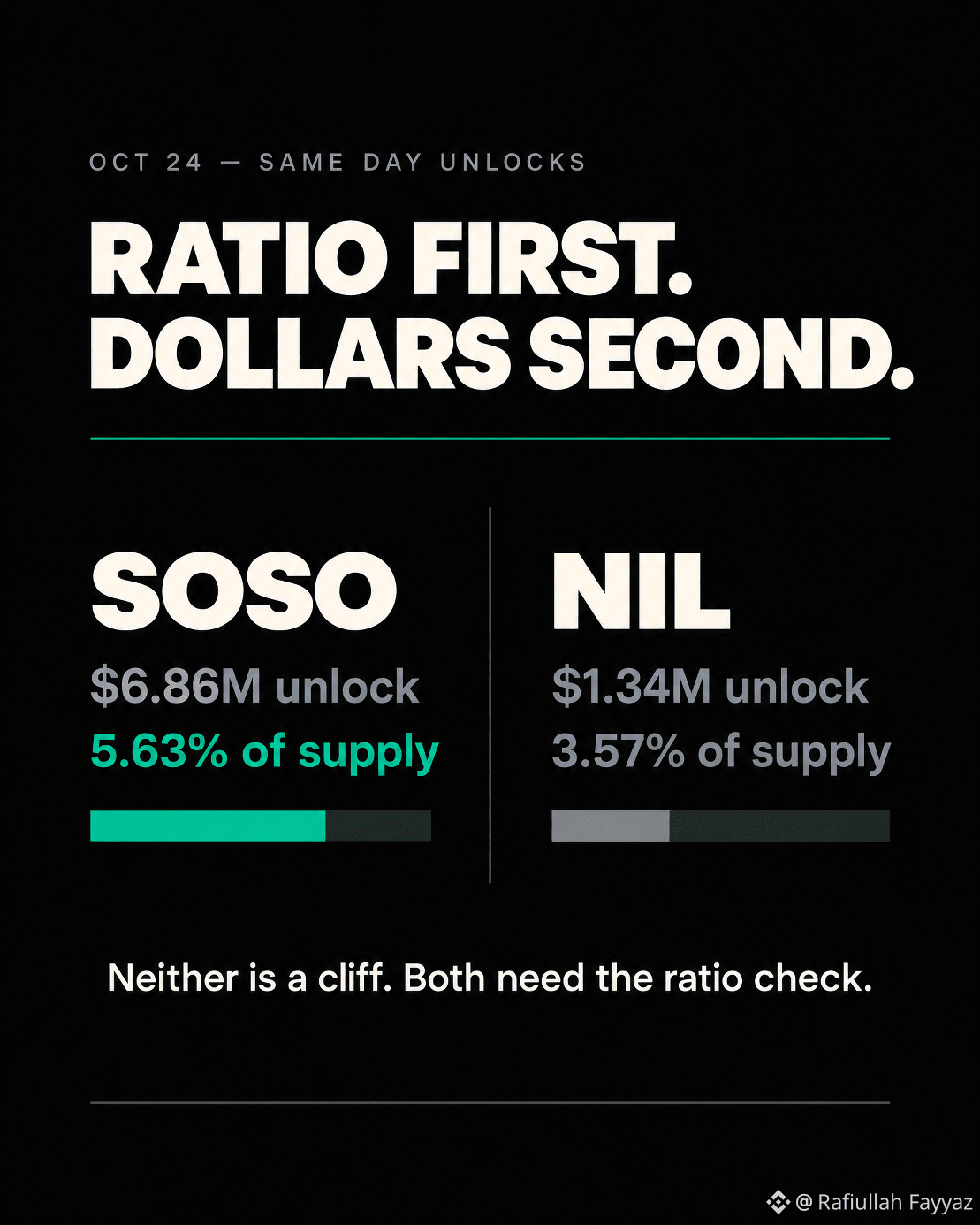
SOSO a débloqué 6,86 millions de dollars aujourd’hui. NIL débloque 1,34 million de dollars.
Le montant en dollars de SOSO est cinq fois plus élevé. Mais son déblocage représente 5,63 % de son offre en circulation. Celui de NIL en représente 3,57 %.
Aucun des deux n’est un déblocage en cliff. Les deux ratios sont relativement faibles. Mais la comparaison reste importante.
La plupart des gens évaluent les déblocages en fonction de leur valeur en dollars. C’est le mauvais critère. Un déblocage de 50 M$ pour un projet valorisé à un milliard de dollars représente une dilution de 5 %. Un déblocage de 5 M$ pour un projet valorisé à 40 M$ en représente 12,5 %. Le montant en dollars le plus faible correspond à l’événement le plus important.
SOSO et NIL se situent tous deux dans la moyenne. Mais le principe reste le même : le ratio d’abord, les dollars ensuite.
$SOSO $NIL
#crypto #EducationalContent #Tokenomics #unlocks #BinanceSquare
{spot}(NILUSDT)
SOSO a débloqué 6,86 millions de dollars aujourd’hui. NIL débloque 1,34 million de dollars.
Le montant en dollars de SOSO est cinq fois plus élevé. Mais son déblocage représente 5,63 % de son offre en circulation. Celui de NIL en représente 3,57 %.
Aucun des deux n’est un déblocage en cliff. Les deux ratios sont relativement faibles. Mais la comparaison reste importante.
La plupart des gens évaluent les déblocages en fonction de leur valeur en dollars. C’est le mauvais critère. Un déblocage de 50 M$ pour un projet valorisé à un milliard de dollars représente une dilution de 5 %. Un déblocage de 5 M$ pour un projet valorisé à 40 M$ en représente 12,5 %. Le montant en dollars le plus faible correspond à l’événement le plus important.
SOSO et NIL se situent tous deux dans la moyenne. Mais le principe reste le même : le ratio d’abord, les dollars ensuite.
$SOSO $NIL
#crypto #EducationalContent #Tokenomics #unlocks #BinanceSquare
Le montant en dollars de SOSO est cinq fois plus élevé. Mais son déblocage représente 5,63 % de son offre en circulation. Celui de NIL en représente 3,57 %.
Aucun des deux n’est un déblocage en cliff. Les deux ratios sont relativement faibles. Mais la comparaison reste importante.
La plupart des gens évaluent les déblocages en fonction de leur valeur en dollars. C’est le mauvais critère. Un déblocage de 50 M$ pour un projet valorisé à un milliard de dollars représente une dilution de 5 %. Un déblocage de 5 M$ pour un projet valorisé à 40 M$ en représente 12,5 %. Le montant en dollars le plus faible correspond à l’événement le plus important.
SOSO et NIL se situent tous deux dans la moyenne. Mais le principe reste le même : le ratio d’abord, les dollars ensuite.
$SOSO $NIL
#crypto #EducationalContent #Tokenomics #unlocks #BinanceSquare
1
261

·
--
L’économie du token Backpack (BP) fait de nouveau l’objet de discussions (2026-10-23) : offre totale de 1 milliard de tokens ; 25 % débloqués au TGE (240 millions pour les utilisateurs de points + 10 millions pour Mad Lads) ; les 37,5 % restants sont affectés au pool de jalons Pre-IPO et 37,5 % au trésor Post-IPO (tokens bloqués pendant ≥1 an après l’IPO). Fondateurs / dirigeants / investisseurs : aucun token, aucun bon de souscription. Le staking donne droit à des réductions sur les frais ; les tokens Pre-IPO peuvent être convertis en une participation pouvant atteindre environ 20 % du capital. Cours actuel : environ 0,99 $ ; taux de staking : environ 56,4 % (environ 140,88 millions de tokens).
Points clés du mécanisme : il s’agit d’une structure « sans allocation aux initiés + double voie jalons/trésor », qui lie le déblocage de l’offre à la gouvernance après la cotation, plutôt qu’à un déblocage linéaire traditionnel pour l’équipe et les VC. Un taux de staking supérieur à 50 % indique un lien étroit entre les contraintes pesant sur l’offre en circulation et les frais, mais il reste à surveiller le rythme de réalisation des jalons et les modalités de mise en œuvre de la conversion en capital.
Prochain point à surveiller : les conditions de déclenchement des jalons Pre-IPO seront-elles rendues publiques et vérifiables, et le taux de staking restera-t-il supérieur à 50 % en période de volatilité des marchés ?
Sources : Crypto Briefing https://cryptobriefing.com/backpack-founder-extreme-tokenomics-no-insider-tokens/ ; Backpack https://backpack.exchange/bp ; Backpack officiel https://x.com/Backpack/status/2113643108449837214
#Backpack #BP #Web3 #Tokenomics $BP
À titre informatif uniquement ; ne constitue pas un conseil en investissement / NFA
L’économie du token Backpack (BP) fait de nouveau l’objet de discussions (2026-10-23) : offre totale de 1 milliard de tokens ; 25 % débloqués au TGE (240 millions pour les utilisateurs de points + 10 millions pour Mad Lads) ; les 37,5 % restants sont affectés au pool de jalons Pre-IPO et 37,5 % au trésor Post-IPO (tokens bloqués pendant ≥1 an après l’IPO). Fondateurs / dirigeants / investisseurs : aucun token, aucun bon de souscription. Le staking donne droit à des réductions sur les frais ; les tokens Pre-IPO peuvent être convertis en une participation pouvant atteindre environ 20 % du capital. Cours actuel : environ 0,99 $ ; taux de staking : environ 56,4 % (environ 140,88 millions de tokens).
Points clés du mécanisme : il s’agit d’une structure « sans allocation aux initiés + double voie jalons/trésor », qui lie le déblocage de l’offre à la gouvernance après la cotation, plutôt qu’à un déblocage linéaire traditionnel pour l’équipe et les VC. Un taux de staking supérieur à 50 % indique un lien étroit entre les contraintes pesant sur l’offre en circulation et les frais, mais il reste à surveiller le rythme de réalisation des jalons et les modalités de mise en œuvre de la conversion en capital.
Prochain point à surveiller : les conditions de déclenchement des jalons Pre-IPO seront-elles rendues publiques et vérifiables, et le taux de staking restera-t-il supérieur à 50 % en période de volatilité des marchés ?
Sources : Crypto Briefing https://cryptobriefing.com/backpack-founder-extreme-tokenomics-no-insider-tokens/ ; Backpack https://backpack.exchange/bp ; Backpack officiel https://x.com/Backpack/status/2113643108449837214
#Backpack #BP #Web3 #Tokenomics $BP
À titre informatif uniquement ; ne constitue pas un conseil en investissement / NFA
Points clés du mécanisme : il s’agit d’une structure « sans allocation aux initiés + double voie jalons/trésor », qui lie le déblocage de l’offre à la gouvernance après la cotation, plutôt qu’à un déblocage linéaire traditionnel pour l’équipe et les VC. Un taux de staking supérieur à 50 % indique un lien étroit entre les contraintes pesant sur l’offre en circulation et les frais, mais il reste à surveiller le rythme de réalisation des jalons et les modalités de mise en œuvre de la conversion en capital.
Prochain point à surveiller : les conditions de déclenchement des jalons Pre-IPO seront-elles rendues publiques et vérifiables, et le taux de staking restera-t-il supérieur à 50 % en période de volatilité des marchés ?
Sources : Crypto Briefing https://cryptobriefing.com/backpack-founder-extreme-tokenomics-no-insider-tokens/ ; Backpack https://backpack.exchange/bp ; Backpack officiel https://x.com/Backpack/status/2113643108449837214
#Backpack #BP #Web3 #Tokenomics $BP
À titre informatif uniquement ; ne constitue pas un conseil en investissement / NFA
26
·
--
Haussier
5 QUESTIONS À SE POSER AVANT D’INVESTIR DANS UN TOKEN 🔍
Ne vous contentez pas de regarder le graphique des prix ou d’écouter les discours promotionnels. Commencez par faire vos recherches :
1️⃣ Quel problème le projet résout-il ?
Répond-il à un besoin réel ou repose-t-il uniquement sur l’attention de la communauté ?
2️⃣ À quoi sert le token ?
A-t-il une utilité claire au sein de l’écosystème, ou sa valeur repose-t-elle surtout sur les attentes ?
3️⃣ Quelle est sa tokenomics ?
L’offre totale, la quantité en circulation, le calendrier de déblocage des tokens et leur répartition au sein de l’équipe peuvent influencer la pression vendeuse.
4️⃣ Qu’en est-il de l’équipe et de l’écosystème ?
Y a-t-il un produit, une activité de développement et de vrais utilisateurs ?
5️⃣ Quel est le principal risque ?
La concurrence, la sécurité, la réglementation, la liquidité ou la dépendance à un petit groupe ?
Même pour un écosystème majeur comme Ethereum ($ETH ), des recherches approfondies ne peuvent pas garantir des bénéfices.
À mon avis, comprendre pourquoi on détient un actif est plus important que de l’acheter simplement parce que d’autres le font.
Si vous ne pouviez choisir qu’un seul critère pour évaluer un projet crypto, choisiriez-vous la technologie, l’équipe ou la tokenomics ?
#Ethereum #ETH #CryptoResearch #Tokenomics #Web3
{future}(ETHUSDT)
5 QUESTIONS À SE POSER AVANT D’INVESTIR DANS UN TOKEN 🔍
Ne vous contentez pas de regarder le graphique des prix ou d’écouter les discours promotionnels. Commencez par faire vos recherches :
1️⃣ Quel problème le projet résout-il ?
Répond-il à un besoin réel ou repose-t-il uniquement sur l’attention de la communauté ?
2️⃣ À quoi sert le token ?
A-t-il une utilité claire au sein de l’écosystème, ou sa valeur repose-t-elle surtout sur les attentes ?
3️⃣ Quelle est sa tokenomics ?
L’offre totale, la quantité en circulation, le calendrier de déblocage des tokens et leur répartition au sein de l’équipe peuvent influencer la pression vendeuse.
4️⃣ Qu’en est-il de l’équipe et de l’écosystème ?
Y a-t-il un produit, une activité de développement et de vrais utilisateurs ?
5️⃣ Quel est le principal risque ?
La concurrence, la sécurité, la réglementation, la liquidité ou la dépendance à un petit groupe ?
Même pour un écosystème majeur comme Ethereum ($ETH ), des recherches approfondies ne peuvent pas garantir des bénéfices.
À mon avis, comprendre pourquoi on détient un actif est plus important que de l’acheter simplement parce que d’autres le font.
Si vous ne pouviez choisir qu’un seul critère pour évaluer un projet crypto, choisiriez-vous la technologie, l’équipe ou la tokenomics ?
#Ethereum #ETH #CryptoResearch #Tokenomics #Web3
Ne vous contentez pas de regarder le graphique des prix ou d’écouter les discours promotionnels. Commencez par faire vos recherches :
1️⃣ Quel problème le projet résout-il ?
Répond-il à un besoin réel ou repose-t-il uniquement sur l’attention de la communauté ?
2️⃣ À quoi sert le token ?
A-t-il une utilité claire au sein de l’écosystème, ou sa valeur repose-t-elle surtout sur les attentes ?
3️⃣ Quelle est sa tokenomics ?
L’offre totale, la quantité en circulation, le calendrier de déblocage des tokens et leur répartition au sein de l’équipe peuvent influencer la pression vendeuse.
4️⃣ Qu’en est-il de l’équipe et de l’écosystème ?
Y a-t-il un produit, une activité de développement et de vrais utilisateurs ?
5️⃣ Quel est le principal risque ?
La concurrence, la sécurité, la réglementation, la liquidité ou la dépendance à un petit groupe ?
Même pour un écosystème majeur comme Ethereum ($ETH ), des recherches approfondies ne peuvent pas garantir des bénéfices.
À mon avis, comprendre pourquoi on détient un actif est plus important que de l’acheter simplement parce que d’autres le font.
Si vous ne pouviez choisir qu’un seul critère pour évaluer un projet crypto, choisiriez-vous la technologie, l’équipe ou la tokenomics ?
#Ethereum #ETH #CryptoResearch #Tokenomics #Web3
2
58
·
--
Je surveille de près le calendrier d’approvisionnement de $SOL . Les prochaines périodes de déblocage massif du vesting et les déblocages linéaires sont des facteurs majeurs, tandis que le prix s’établit à 101,9. C’est dans la répartition entre la croissance de l’écosystème et les allocations aux premiers investisseurs que se joue l’essentiel. Des taux de staking élevés sont un atout, mais l’inflation nette et la vitesse de destruction des frais sont les indicateurs à surveiller. La dynamique de l’offre ne ment jamais. _
#TokenUnlocks #Tokenomics #SOL
Je surveille de près le calendrier d’approvisionnement de $SOL . Les prochaines périodes de déblocage massif du vesting et les déblocages linéaires sont des facteurs majeurs, tandis que le prix s’établit à 101,9. C’est dans la répartition entre la croissance de l’écosystème et les allocations aux premiers investisseurs que se joue l’essentiel. Des taux de staking élevés sont un atout, mais l’inflation nette et la vitesse de destruction des frais sont les indicateurs à surveiller. La dynamique de l’offre ne ment jamais. _
#TokenUnlocks #Tokenomics #SOL
#TokenUnlocks #Tokenomics #SOL
1
1

Voir la traduction
🚨 $JST
{spot}(JSTUSDT)
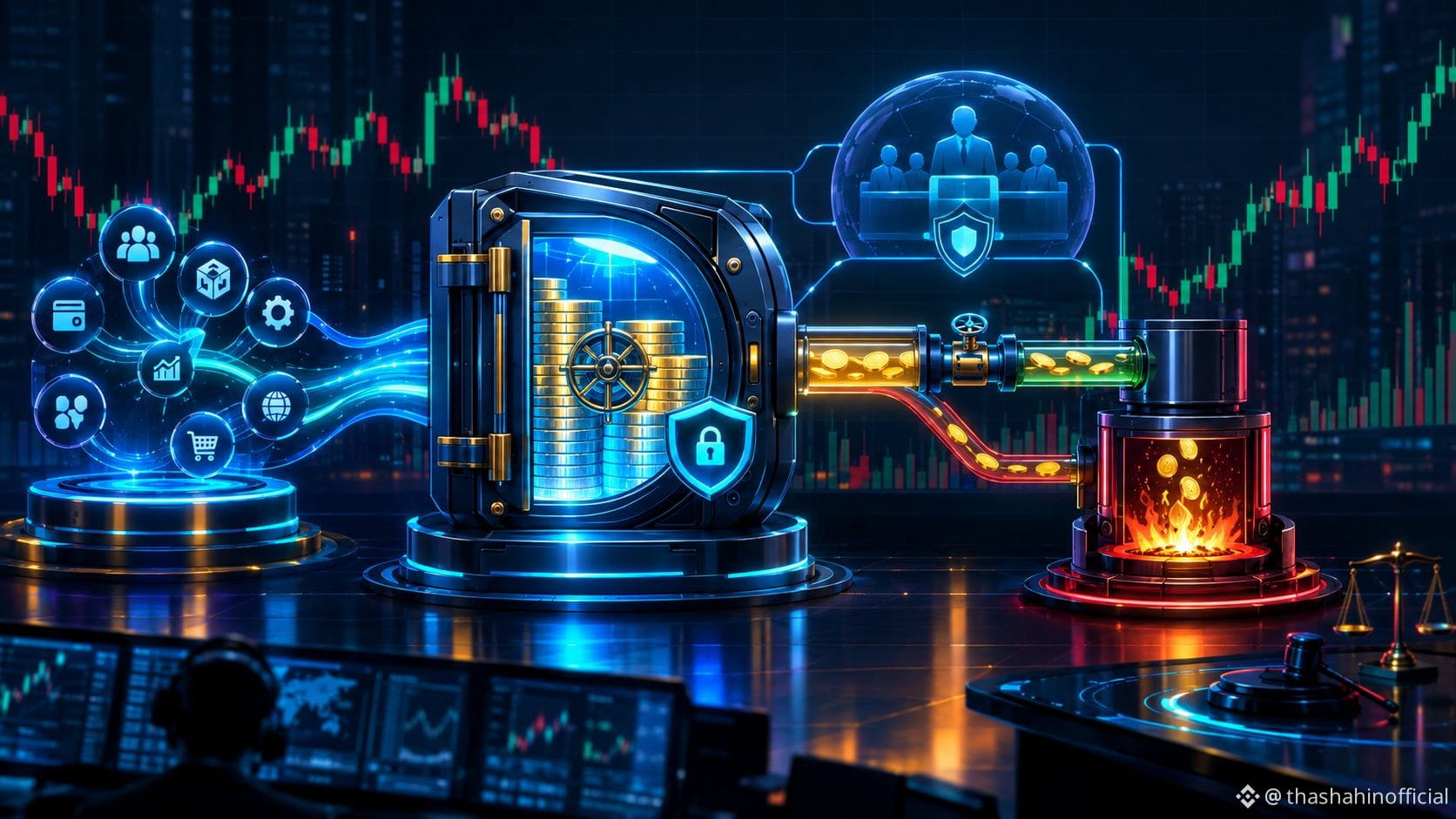
A $50M TREASURY FLOOR CHANGES THE BUYBACK STORY.
JUST announced a redesigned buyback-and-burn mechanism on October 23, placing governance under JUST DAO and requiring at least $50M in treasury reserves. Buybacks are funded by sustainable quarterly ecosystem revenue—not unlimited spending.
For JST holders, the key test is whether revenue consistently exceeds reserve and operating needs. Track actual buyback transactions, revenue disclosures, and tokens burned. A new mechanism is not a guarantee of price gains.
Can revenue-driven burns create lasting value for JST?
#JST #JUST #Tokenomics #CryptoNews
🚨 $JST
A $50M TREASURY FLOOR CHANGES THE BUYBACK STORY.
JUST announced a redesigned buyback-and-burn mechanism on October 23, placing governance under JUST DAO and requiring at least $50M in treasury reserves. Buybacks are funded by sustainable quarterly ecosystem revenue—not unlimited spending.
For JST holders, the key test is whether revenue consistently exceeds reserve and operating needs. Track actual buyback transactions, revenue disclosures, and tokens burned. A new mechanism is not a guarantee of price gains.
Can revenue-driven burns create lasting value for JST?
#JST #JUST #Tokenomics #CryptoNews
A $50M TREASURY FLOOR CHANGES THE BUYBACK STORY.
JUST announced a redesigned buyback-and-burn mechanism on October 23, placing governance under JUST DAO and requiring at least $50M in treasury reserves. Buybacks are funded by sustainable quarterly ecosystem revenue—not unlimited spending.
For JST holders, the key test is whether revenue consistently exceeds reserve and operating needs. Track actual buyback transactions, revenue disclosures, and tokens burned. A new mechanism is not a guarantee of price gains.
Can revenue-driven burns create lasting value for JST?
#JST #JUST #Tokenomics #CryptoNews
146

·
--
Pourquoi 80 % des tokens à FDV élevée s’effondrent : le danger caché des tokens à faible flottant 🚨📉
Vous repérez un nouveau token dont le cours s’envole juste après son introduction en bourse. Sa capitalisation boursière n’est que de 200 millions de dollars, la communauté crie au « bijou qui va faire x100 » et vous vous lancez.
Six mois plus tard, le cours a chuté de 70 % — alors même que l’équipe a tenu chacune des promesses de sa feuille de route.
Que s’est-il passé ? Vous êtes tombé directement dans le piège des tokens à faible flottant et à FDV élevée.
1. Capitalisation boursière vs valorisation entièrement diluée (FDV)
Pour survivre sur ce marché, vous devez comprendre l’écart entre ces deux chiffres :
Capitalisation boursière (MCap) : cours actuel × offre en circulation
Cela ne représente que les tokens actuellement liquides et échangeables.
Valorisation entièrement diluée (FDV) : cours actuel × offre maximale totale
C’est la valeur du projet une fois que tous les tokens auront été débloqués.
Le signal d’alerte :
Si un token affiche une capitalisation boursière de 200 millions de dollars, mais une FDV de 2 milliards de dollars, cela signifie que seulement 10 % de l’offre est actuellement en circulation.
Les 90 % restants sont verrouillés — et ils se dirigent tout droit vers le marché
$BTC #ETH #Tokenomics #BinanceSquare #CryptoTradingInsights
Pourquoi 80 % des tokens à FDV élevée s’effondrent : le danger caché des tokens à faible flottant 🚨📉
Vous repérez un nouveau token dont le cours s’envole juste après son introduction en bourse. Sa capitalisation boursière n’est que de 200 millions de dollars, la communauté crie au « bijou qui va faire x100 » et vous vous lancez.
Six mois plus tard, le cours a chuté de 70 % — alors même que l’équipe a tenu chacune des promesses de sa feuille de route.
Que s’est-il passé ? Vous êtes tombé directement dans le piège des tokens à faible flottant et à FDV élevée.
1. Capitalisation boursière vs valorisation entièrement diluée (FDV)
Pour survivre sur ce marché, vous devez comprendre l’écart entre ces deux chiffres :
Capitalisation boursière (MCap) : cours actuel × offre en circulation
Cela ne représente que les tokens actuellement liquides et échangeables.
Valorisation entièrement diluée (FDV) : cours actuel × offre maximale totale
C’est la valeur du projet une fois que tous les tokens auront été débloqués.
Le signal d’alerte :
Si un token affiche une capitalisation boursière de 200 millions de dollars, mais une FDV de 2 milliards de dollars, cela signifie que seulement 10 % de l’offre est actuellement en circulation.
Les 90 % restants sont verrouillés — et ils se dirigent tout droit vers le marché
$BTC #ETH #Tokenomics #BinanceSquare #CryptoTradingInsights
Vous repérez un nouveau token dont le cours s’envole juste après son introduction en bourse. Sa capitalisation boursière n’est que de 200 millions de dollars, la communauté crie au « bijou qui va faire x100 » et vous vous lancez.
Six mois plus tard, le cours a chuté de 70 % — alors même que l’équipe a tenu chacune des promesses de sa feuille de route.
Que s’est-il passé ? Vous êtes tombé directement dans le piège des tokens à faible flottant et à FDV élevée.
1. Capitalisation boursière vs valorisation entièrement diluée (FDV)
Pour survivre sur ce marché, vous devez comprendre l’écart entre ces deux chiffres :
Capitalisation boursière (MCap) : cours actuel × offre en circulation
Cela ne représente que les tokens actuellement liquides et échangeables.
Valorisation entièrement diluée (FDV) : cours actuel × offre maximale totale
C’est la valeur du projet une fois que tous les tokens auront été débloqués.
Le signal d’alerte :
Si un token affiche une capitalisation boursière de 200 millions de dollars, mais une FDV de 2 milliards de dollars, cela signifie que seulement 10 % de l’offre est actuellement en circulation.
Les 90 % restants sont verrouillés — et ils se dirigent tout droit vers le marché
$BTC #ETH #Tokenomics #BinanceSquare #CryptoTradingInsights
Mo7_Aj:
DONE ✅
100
5
100
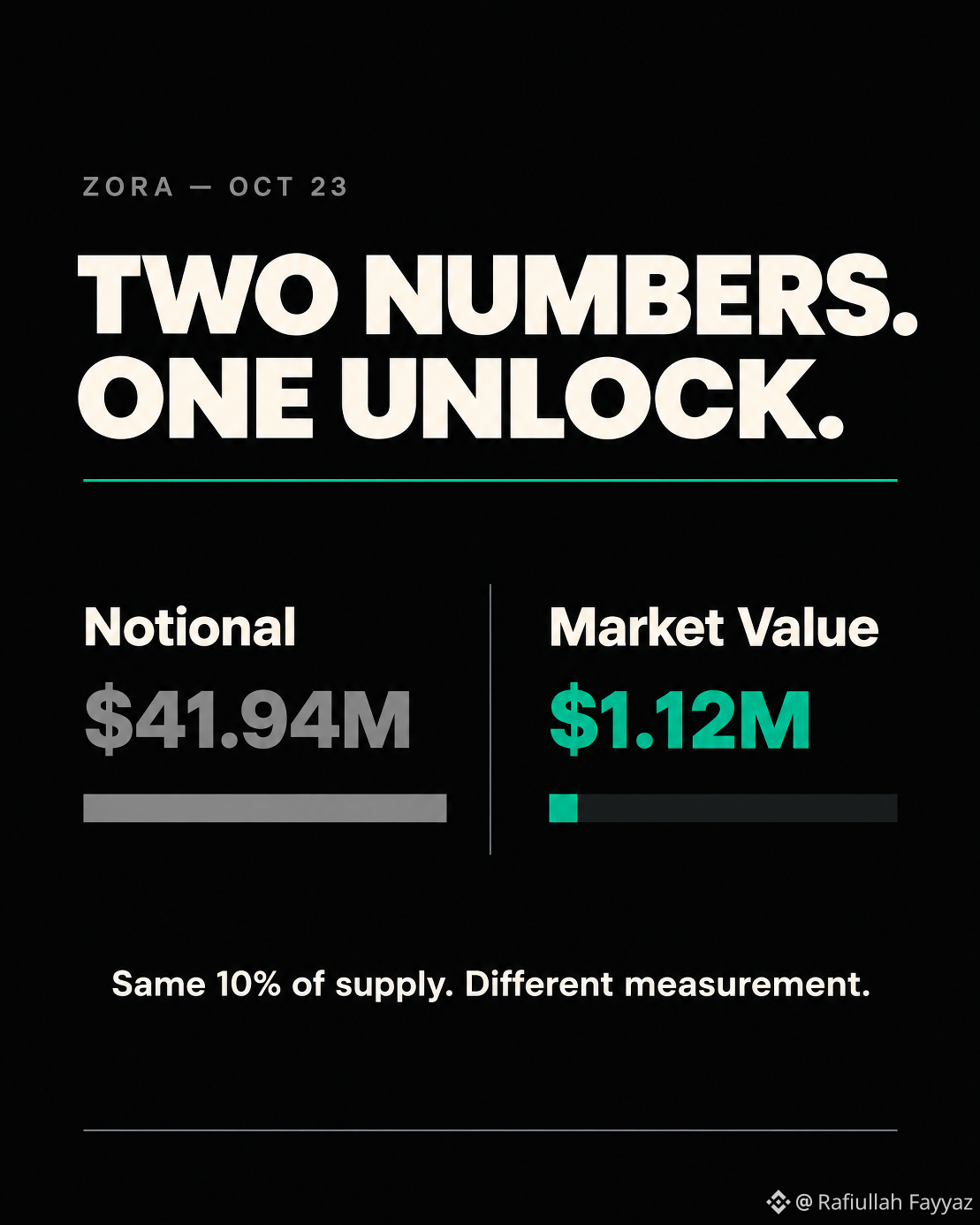
Le déblocage de ZORA a lieu aujourd'hui. Une source annonce 41,94 M$. Une autre, 1,12 M$.
Les deux ont raison. Elles mesurent des choses différentes.
Le chiffre de 41,94 M$ correspond à la valeur notionnelle de 1,67 milliard de jetons, calculée à partir d'un prix de référence. Le chiffre de 1,12 M$ correspond à la valeur réelle sur le marché aux prix actuels. L'offre concernée représente environ 10 % de l'offre en circulation.
C'est le problème des données de déblocage. La valeur notionnelle et la valeur de marché peuvent différer d'un facteur 30. Si vous ne lisez que le chiffre mis en avant, vous ne mesurez pas la bonne chose.
Le ratio est de 10 %. Ça ne change pas.
$ZORA
#crypto #EducationalContent #Tokenomics #unlocks #BinanceSquare
{future}(ZORAUSDT)
Le déblocage de ZORA a lieu aujourd'hui. Une source annonce 41,94 M$. Une autre, 1,12 M$.
Les deux ont raison. Elles mesurent des choses différentes.
Le chiffre de 41,94 M$ correspond à la valeur notionnelle de 1,67 milliard de jetons, calculée à partir d'un prix de référence. Le chiffre de 1,12 M$ correspond à la valeur réelle sur le marché aux prix actuels. L'offre concernée représente environ 10 % de l'offre en circulation.
C'est le problème des données de déblocage. La valeur notionnelle et la valeur de marché peuvent différer d'un facteur 30. Si vous ne lisez que le chiffre mis en avant, vous ne mesurez pas la bonne chose.
Le ratio est de 10 %. Ça ne change pas.
$ZORA
#crypto #EducationalContent #Tokenomics #unlocks #BinanceSquare
Les deux ont raison. Elles mesurent des choses différentes.
Le chiffre de 41,94 M$ correspond à la valeur notionnelle de 1,67 milliard de jetons, calculée à partir d'un prix de référence. Le chiffre de 1,12 M$ correspond à la valeur réelle sur le marché aux prix actuels. L'offre concernée représente environ 10 % de l'offre en circulation.
C'est le problème des données de déblocage. La valeur notionnelle et la valeur de marché peuvent différer d'un facteur 30. Si vous ne lisez que le chiffre mis en avant, vous ne mesurez pas la bonne chose.
Le ratio est de 10 %. Ça ne change pas.
$ZORA
#crypto #EducationalContent #Tokenomics #unlocks #BinanceSquare
185

🚀 $OG : seulement 5 millions de tokens ? #Scarcity peut-il alimenter le prochain rallye ?
💎 Si $OG dispose d’une offre totale fixe de seulement 5 millions de tokens, sans émission supplémentaire, la rareté pourrait devenir un élément intéressant de son récit de marché.
📈 15 $ pourraient-ils être le prochain objectif ? À 15 $ par token, une offre entièrement en circulation de 5 millions de tokens impliquerait une capitalisation boursière d’environ 75 millions de dollars.
{spot}(OGUSDT)
🎯 À surveiller pour les investisseurs : avant d’anticiper une envolée, vérifiez la tokenomics officielle, l’offre en circulation, la liquidité sur les plateformes d’échange et le volume d’achat. Une offre limitée peut étayer une thèse haussière, mais atteindre 15 $ nécessiterait tout de même une demande suffisante et une dynamique de marché favorable.
👀 $OG se prépare-t-il à un mouvement majeur, ou faut-il d’abord des signes de confirmation plus solides ? Partagez votre avis ci-dessous ! 💬
#OG #CryptoAnalysis #Tokenomics #CoinVahini
🚀 $OG : seulement 5 millions de tokens ? #Scarcity peut-il alimenter le prochain rallye ?
💎 Si $OG dispose d’une offre totale fixe de seulement 5 millions de tokens, sans émission supplémentaire, la rareté pourrait devenir un élément intéressant de son récit de marché.
📈 15 $ pourraient-ils être le prochain objectif ? À 15 $ par token, une offre entièrement en circulation de 5 millions de tokens impliquerait une capitalisation boursière d’environ 75 millions de dollars.
🎯 À surveiller pour les investisseurs : avant d’anticiper une envolée, vérifiez la tokenomics officielle, l’offre en circulation, la liquidité sur les plateformes d’échange et le volume d’achat. Une offre limitée peut étayer une thèse haussière, mais atteindre 15 $ nécessiterait tout de même une demande suffisante et une dynamique de marché favorable.
👀 $OG se prépare-t-il à un mouvement majeur, ou faut-il d’abord des signes de confirmation plus solides ? Partagez votre avis ci-dessous ! 💬
#OG #CryptoAnalysis #Tokenomics #CoinVahini
💎 Si $OG dispose d’une offre totale fixe de seulement 5 millions de tokens, sans émission supplémentaire, la rareté pourrait devenir un élément intéressant de son récit de marché.
📈 15 $ pourraient-ils être le prochain objectif ? À 15 $ par token, une offre entièrement en circulation de 5 millions de tokens impliquerait une capitalisation boursière d’environ 75 millions de dollars.
🎯 À surveiller pour les investisseurs : avant d’anticiper une envolée, vérifiez la tokenomics officielle, l’offre en circulation, la liquidité sur les plateformes d’échange et le volume d’achat. Une offre limitée peut étayer une thèse haussière, mais atteindre 15 $ nécessiterait tout de même une demande suffisante et une dynamique de marché favorable.
👀 $OG se prépare-t-il à un mouvement majeur, ou faut-il d’abord des signes de confirmation plus solides ? Partagez votre avis ci-dessous ! 💬
#OG #CryptoAnalysis #Tokenomics #CoinVahini
15
·
--
La dynamique de l’offre de $SILVER connaît actuellement une transition majeure que beaucoup négligent au profit de la volatilité à bêta élevé. Alors que l’argent physique se maintient à 60.27 et que l’or grimpe à 4,140, le ratio or/argent, à 68.5, indique que le complexe des matières premières penche en faveur d’une surperformance de l’argent. Dans l’univers numérique, les données relatives à SILVER sont encore plus convaincantes : nous sortons de la phase de déblocages massifs et entrons dans un cycle structurel de destruction de jetons.
Les données actuelles sur la chaîne montrent que l’offre en circulation se resserre, les 12 derniers pour cent des jetons issus des tours de financement d’amorçage ayant été absorbés par des bureaux institutionnels. Avec une référence au comptant à 53.716, l’écart entre la valeur tokenisée et les lingots physiques crée une pression d’arbitrage unique. Contrairement à PAXG, qui suit le cours de l’or à 1:1, les mécanismes propres à SILVER prévoient une destruction périodique de jetons déclenchée par le volume des transactions, ce qui réduit effectivement l’offre totale à chaque fois qu’une baleine transfère des liquidités entre des plateformes d’échange.
Les banques centrales continuent de gonfler agressivement leurs réserves, et la corrélation inverse avec le DXY demeure le principal facteur macroéconomique. Alors que l’indice du dollar montre des signes d’essoufflement, les capitaux se ruent de plus en plus vers les actifs adossés aux matières premières. Nous observons d’importantes sorties des plateformes d’échange centralisées vers des portefeuilles hors ligne, à l’image du marché des lingots physiques, où les stocks du COMEX atteignent leur plus bas niveau depuis plusieurs années. La pression déflationniste n’est pas qu’un argument marketing : elle repose sur des calendriers de déblocage codés en dur, qui sont officiellement passés d’un régime inflationniste à un régime contractionniste.
Les prochaines semaines permettront de déterminer si le rythme actuel de destruction peut suivre la demande croissante d’exposition aux matières premières sur la chaîne. Voyez-vous davantage de valeur, en ce moment, dans la détention d’actifs adossés à des biens physiques, ou continuez-vous à miser sur des projets purement algorithmiques ?
#TokenUnlocks #Tokenomics
La dynamique de l’offre de $SILVER connaît actuellement une transition majeure que beaucoup négligent au profit de la volatilité à bêta élevé. Alors que l’argent physique se maintient à 60.27 et que l’or grimpe à 4,140, le ratio or/argent, à 68.5, indique que le complexe des matières premières penche en faveur d’une surperformance de l’argent. Dans l’univers numérique, les données relatives à SILVER sont encore plus convaincantes : nous sortons de la phase de déblocages massifs et entrons dans un cycle structurel de destruction de jetons.
Les données actuelles sur la chaîne montrent que l’offre en circulation se resserre, les 12 derniers pour cent des jetons issus des tours de financement d’amorçage ayant été absorbés par des bureaux institutionnels. Avec une référence au comptant à 53.716, l’écart entre la valeur tokenisée et les lingots physiques crée une pression d’arbitrage unique. Contrairement à PAXG, qui suit le cours de l’or à 1:1, les mécanismes propres à SILVER prévoient une destruction périodique de jetons déclenchée par le volume des transactions, ce qui réduit effectivement l’offre totale à chaque fois qu’une baleine transfère des liquidités entre des plateformes d’échange.
Les banques centrales continuent de gonfler agressivement leurs réserves, et la corrélation inverse avec le DXY demeure le principal facteur macroéconomique. Alors que l’indice du dollar montre des signes d’essoufflement, les capitaux se ruent de plus en plus vers les actifs adossés aux matières premières. Nous observons d’importantes sorties des plateformes d’échange centralisées vers des portefeuilles hors ligne, à l’image du marché des lingots physiques, où les stocks du COMEX atteignent leur plus bas niveau depuis plusieurs années. La pression déflationniste n’est pas qu’un argument marketing : elle repose sur des calendriers de déblocage codés en dur, qui sont officiellement passés d’un régime inflationniste à un régime contractionniste.
Les prochaines semaines permettront de déterminer si le rythme actuel de destruction peut suivre la demande croissante d’exposition aux matières premières sur la chaîne. Voyez-vous davantage de valeur, en ce moment, dans la détention d’actifs adossés à des biens physiques, ou continuez-vous à miser sur des projets purement algorithmiques ?
#TokenUnlocks #Tokenomics
Les données actuelles sur la chaîne montrent que l’offre en circulation se resserre, les 12 derniers pour cent des jetons issus des tours de financement d’amorçage ayant été absorbés par des bureaux institutionnels. Avec une référence au comptant à 53.716, l’écart entre la valeur tokenisée et les lingots physiques crée une pression d’arbitrage unique. Contrairement à PAXG, qui suit le cours de l’or à 1:1, les mécanismes propres à SILVER prévoient une destruction périodique de jetons déclenchée par le volume des transactions, ce qui réduit effectivement l’offre totale à chaque fois qu’une baleine transfère des liquidités entre des plateformes d’échange.
Les banques centrales continuent de gonfler agressivement leurs réserves, et la corrélation inverse avec le DXY demeure le principal facteur macroéconomique. Alors que l’indice du dollar montre des signes d’essoufflement, les capitaux se ruent de plus en plus vers les actifs adossés aux matières premières. Nous observons d’importantes sorties des plateformes d’échange centralisées vers des portefeuilles hors ligne, à l’image du marché des lingots physiques, où les stocks du COMEX atteignent leur plus bas niveau depuis plusieurs années. La pression déflationniste n’est pas qu’un argument marketing : elle repose sur des calendriers de déblocage codés en dur, qui sont officiellement passés d’un régime inflationniste à un régime contractionniste.
Les prochaines semaines permettront de déterminer si le rythme actuel de destruction peut suivre la demande croissante d’exposition aux matières premières sur la chaîne. Voyez-vous davantage de valeur, en ce moment, dans la détention d’actifs adossés à des biens physiques, ou continuez-vous à miser sur des projets purement algorithmiques ?
#TokenUnlocks #Tokenomics

1
3

Voir la traduction
Cảnh báo tổng cung & Lịch xả hàng: Có phải red flag cho holder? Cảnh báo tổng cung & Lịch xả hàng: Có phải red flag cho holder?
Bóc tách số liệu:
• Cung lưu hành: 3.82B WLD (khoảng 38.2% trên Max Supply 10B WLD).
• FDV: ~5.4 tỷ USD (gấp 2.6 lần Market Cap thực tế ~2.06 tỷ USD quanh mốc 0.54 USD).
• Lịch xả rỉ máu: Mỗi tuần mở khóa đều đặn ~5.59M WLD (~3 triệu USD/tuần) phân bổ tuyến tính kéo dài đến tận 2028-2029.
• Data phái sinh Binance: Top Trader L/S đang gồng Long áp đảo (76.42% Long vs 23.58% Short), OI neo cao 95.1M USD (176M WLD).
Góc nhìn: Đám đông phái sinh đang cố bắt dao rơi kỳ vọng narrative AI bùng nổ trở lại, nhưng mô hình lạm phát cung liên tục bào mòn thanh khoản thứ cấp. Nếu không có dòng tiền tổ chức mới hấp thụ lượng xả mỗi tuần, việc hold mà không hedging là rủi ro bị pha loãng tài sản rất cao.
Ae đang kiên nhẫn gom thêm hay tính đường cơ cấu danh mục trước áp lực unlock?
#Tokenomics #Worldcoin #Crypto #BinanceSquare #Trading
Cảnh báo tổng cung & Lịch xả hàng: Có phải red flag cho holder?
Cảnh báo tổng cung & Lịch xả hàng: Có phải red flag cho holder?
Bóc tách số liệu:
• Cung lưu hành: 3.82B WLD (khoảng 38.2% trên Max Supply 10B WLD).
• FDV: ~5.4 tỷ USD (gấp 2.6 lần Market Cap thực tế ~2.06 tỷ USD quanh mốc 0.54 USD).
• Lịch xả rỉ máu: Mỗi tuần mở khóa đều đặn ~5.59M WLD (~3 triệu USD/tuần) phân bổ tuyến tính kéo dài đến tận 2028-2029.
• Data phái sinh Binance: Top Trader L/S đang gồng Long áp đảo (76.42% Long vs 23.58% Short), OI neo cao 95.1M USD (176M WLD).
Góc nhìn: Đám đông phái sinh đang cố bắt dao rơi kỳ vọng narrative AI bùng nổ trở lại, nhưng mô hình lạm phát cung liên tục bào mòn thanh khoản thứ cấp. Nếu không có dòng tiền tổ chức mới hấp thụ lượng xả mỗi tuần, việc hold mà không hedging là rủi ro bị pha loãng tài sản rất cao.
Ae đang kiên nhẫn gom thêm hay tính đường cơ cấu danh mục trước áp lực unlock?
#Tokenomics #Worldcoin #Crypto #BinanceSquare #Trading
Bóc tách số liệu:
• Cung lưu hành: 3.82B WLD (khoảng 38.2% trên Max Supply 10B WLD).
• FDV: ~5.4 tỷ USD (gấp 2.6 lần Market Cap thực tế ~2.06 tỷ USD quanh mốc 0.54 USD).
• Lịch xả rỉ máu: Mỗi tuần mở khóa đều đặn ~5.59M WLD (~3 triệu USD/tuần) phân bổ tuyến tính kéo dài đến tận 2028-2029.
• Data phái sinh Binance: Top Trader L/S đang gồng Long áp đảo (76.42% Long vs 23.58% Short), OI neo cao 95.1M USD (176M WLD).
Góc nhìn: Đám đông phái sinh đang cố bắt dao rơi kỳ vọng narrative AI bùng nổ trở lại, nhưng mô hình lạm phát cung liên tục bào mòn thanh khoản thứ cấp. Nếu không có dòng tiền tổ chức mới hấp thụ lượng xả mỗi tuần, việc hold mà không hedging là rủi ro bị pha loãng tài sản rất cao.
Ae đang kiên nhẫn gom thêm hay tính đường cơ cấu danh mục trước áp lực unlock?
#Tokenomics #Worldcoin #Crypto #BinanceSquare #Trading
5

·
--
Vérifié

Article
TOKENOMIE AAVE 3.0 : RACHATS, STAKING ET DESTRUCTION !Aave ($AAVE ) prépare une importante mise à jour de sa tokenomie !
Le fondateur Stani Kulechov a confirmé qu’Aavenomics 3.0 inclura trois mécanismes clés :
💰 Rachats — achat de jetons AAVE sur le marché.
🔒 Staking — possibilité pour les détenteurs de jetons de mettre leurs jetons en staking dans le cadre du système mis à jour.
🔥 Destruction de jetons — retrait définitif des jetons de la circulation.
📉 Pourquoi est-ce important ?
Les rachats précédents d’Aave ont permis d’accumuler des jetons dans sa trésorerie au lieu de les détruire définitivement. L’ajout d’un mécanisme de destruction pourrait réduire directement l’offre.
TOKENOMIE AAVE 3.0 : RACHATS, STAKING ET DESTRUCTION !
Aave ($AAVE ) prépare une importante mise à jour de sa tokenomie !
Le fondateur Stani Kulechov a confirmé qu’Aavenomics 3.0 inclura trois mécanismes clés :
💰 Rachats — achat de jetons AAVE sur le marché.
🔒 Staking — possibilité pour les détenteurs de jetons de mettre leurs jetons en staking dans le cadre du système mis à jour.
🔥 Destruction de jetons — retrait définitif des jetons de la circulation.
📉 Pourquoi est-ce important ?
Les rachats précédents d’Aave ont permis d’accumuler des jetons dans sa trésorerie au lieu de les détruire définitivement. L’ajout d’un mécanisme de destruction pourrait réduire directement l’offre.
Le fondateur Stani Kulechov a confirmé qu’Aavenomics 3.0 inclura trois mécanismes clés :
💰 Rachats — achat de jetons AAVE sur le marché.
🔒 Staking — possibilité pour les détenteurs de jetons de mettre leurs jetons en staking dans le cadre du système mis à jour.
🔥 Destruction de jetons — retrait définitif des jetons de la circulation.
📉 Pourquoi est-ce important ?
Les rachats précédents d’Aave ont permis d’accumuler des jetons dans sa trésorerie au lieu de les détruire définitivement. L’ajout d’un mécanisme de destruction pourrait réduire directement l’offre.
Rao G 914:
Great insight
1
2
62
Connectez-vous pour découvrir plus de contenu
Rejoignez la communauté mondiale des adeptes de cryptomonnaies sur Binance Square
⚡️ Suviez les dernières informations importantes sur les cryptomonnaies.
💬 Jugé digne de confiance par la plus grande plateforme d’échange de cryptomonnaies au monde.
👍 Découvrez les connaissances que partagent les créateurs vérifiés.
Adresse e-mail/Nº de téléphone
Sujets d’actualité
1
#BinancePick
3.1M vues
153,869 mentions
2
#EarningsSeason
5.3M vues
26,085 mentions
3
#AnthropicTTMRevenueGrewAbout1200%
36,565 vues
448 mentions
4
#AnthropicS1ExpectedToday
30,097 vues
364 mentions
5
#SouthKoreaReportedlyWeighsFourthCryptoTaxDelay
33,330 vues
495 mentions
6
#FranklinTempletonFilesForTwoDividendToBitcoinETFs
44,300 vues
563 mentions
7
#StrategyMSTRSurpassesNasdaqInMarketCap
34,086 vues
399 mentions
8
#CanadaProposesStablecoinRedemptionWithin3BusinessDays
1,427 vues
37 mentions
9
#ElectrumWalletBugLetRogueServersStealFunds
33,251 vues
480 mentions
10
#ArgentineCourtDismissesLIBRACaseAgainstMilei
49,597 vues
604 mentions