
#liquidcooling
liquidcooling
68 vues
4 mentions
Populaire
Récents

·
--
Article
Voir la traduction
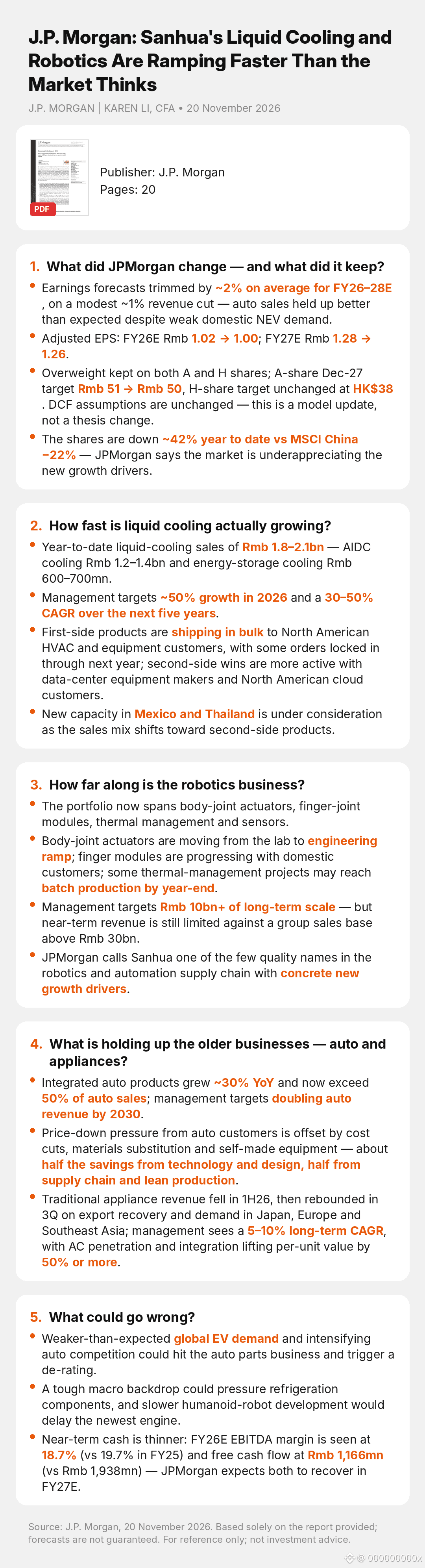
J.P. Morgan: Sanhua's Liquid Cooling and Robotics Are Ramping Faster Than the Market ThinksJ.P. Morgan: Sanhua's Liquid Cooling and Robotics Are Ramping Faster Than the Market Thinks
$002050.SZ $2050.HK
J.P. MORGAN | KAREN LI, CFA • 20 November 2026
1. What did JPMorgan change — and what did it keep?
• Earnings forecasts trimmed by ~2% on average for FY26–28E, on a modest ~1% revenue cut — auto sales held up better than expected despite weak domestic NEV demand.
• Adjusted EPS: FY26E Rmb 1.02 → 1.00; FY27E Rmb 1.28 → 1.26.
• Overweight kept on both A and H shares; A-share Dec-27 target Rmb 51 → Rmb 50, H-share target unchanged at HK$38. DCF assumptions are unchanged — this is a model update, not a thesis change.
• The shares are down ~42% year to date vs MSCI China −22% — JPMorgan says the market is underappreciating the new growth drivers.
2. How fast is liquid cooling actually growing?
• Year-to-date liquid-cooling sales of Rmb 1.8–2.1bn — AIDC cooling Rmb 1.2–1.4bn and energy-storage cooling Rmb 600–700mn.
• Management targets ~50% growth in 2026 and a 30–50% CAGR over the next five years.
• First-side products are shipping in bulk to North American HVAC and equipment customers, with some orders locked in through next year; second-side wins are more active with data-center equipment makers and North American cloud customers.
• New capacity in Mexico and Thailand is under consideration as the sales mix shifts toward second-side products.
3. How far along is the robotics business?
• The portfolio now spans body-joint actuators, finger-joint modules, thermal management and sensors.
• Body-joint actuators are moving from the lab to engineering ramp; finger modules are progressing with domestic customers; some thermal-management projects may reach batch production by year-end.
• Management targets Rmb 10bn+ of long-term scale — but near-term revenue is still limited against a group sales base above Rmb 30bn.
• JPMorgan calls Sanhua one of the few quality names in the robotics and automation supply chain with concrete new growth drivers.
4. What is holding up the older businesses — auto and appliances?
• Integrated auto products grew ~30% YoY and now exceed 50% of auto sales; management targets doubling auto revenue by 2030.
• Price-down pressure from auto customers is offset by cost cuts, materials substitution and self-made equipment — about half the savings from technology and design, half from supply chain and lean production.
• Traditional appliance revenue fell in 1H26, then rebounded in 3Q on export recovery and demand in Japan, Europe and Southeast Asia; management sees a 5–10% long-term CAGR, with AC penetration and integration lifting per-unit value by 50% or more.
5. What could go wrong?
• Weaker-than-expected global EV demand and intensifying auto competition could hit the auto parts business and trigger a de-rating.
• A tough macro backdrop could pressure refrigeration components, and slower humanoid-robot development would delay the newest engine.
• Near-term cash is thinner: FY26E EBITDA margin is seen at 18.7% (vs 19.7% in FY25) and free cash flow at Rmb 1,166mn (vs Rmb 1,938mn) — JPMorgan expects both to recover in FY27E.
#LiquidCooling #Robotics #AI #DataCenters #EV
Source: J.P. Morgan, 20 November 2026. Based solely on the report provided; forecasts are not guaranteed. For reference only; not investment advice.
Read the full breakdown on Unhidea: https://unhidea.com/en/articles/research-d235c7e7a40e4679a26c27b676e3721d-en
Visit unhidea.com for more of the latest sell-side research interpretations.
J.P. Morgan: Sanhua's Liquid Cooling and Robotics Are Ramping Faster Than the Market Thinks
J.P. Morgan: Sanhua's Liquid Cooling and Robotics Are Ramping Faster Than the Market Thinks
$002050.SZ $2050.HK
J.P. MORGAN | KAREN LI, CFA • 20 November 2026
1. What did JPMorgan change — and what did it keep?
• Earnings forecasts trimmed by ~2% on average for FY26–28E, on a modest ~1% revenue cut — auto sales held up better than expected despite weak domestic NEV demand.
• Adjusted EPS: FY26E Rmb 1.02 → 1.00; FY27E Rmb 1.28 → 1.26.
• Overweight kept on both A and H shares; A-share Dec-27 target Rmb 51 → Rmb 50, H-share target unchanged at HK$38. DCF assumptions are unchanged — this is a model update, not a thesis change.
• The shares are down ~42% year to date vs MSCI China −22% — JPMorgan says the market is underappreciating the new growth drivers.
2. How fast is liquid cooling actually growing?
• Year-to-date liquid-cooling sales of Rmb 1.8–2.1bn — AIDC cooling Rmb 1.2–1.4bn and energy-storage cooling Rmb 600–700mn.
• Management targets ~50% growth in 2026 and a 30–50% CAGR over the next five years.
• First-side products are shipping in bulk to North American HVAC and equipment customers, with some orders locked in through next year; second-side wins are more active with data-center equipment makers and North American cloud customers.
• New capacity in Mexico and Thailand is under consideration as the sales mix shifts toward second-side products.
3. How far along is the robotics business?
• The portfolio now spans body-joint actuators, finger-joint modules, thermal management and sensors.
• Body-joint actuators are moving from the lab to engineering ramp; finger modules are progressing with domestic customers; some thermal-management projects may reach batch production by year-end.
• Management targets Rmb 10bn+ of long-term scale — but near-term revenue is still limited against a group sales base above Rmb 30bn.
• JPMorgan calls Sanhua one of the few quality names in the robotics and automation supply chain with concrete new growth drivers.
4. What is holding up the older businesses — auto and appliances?
• Integrated auto products grew ~30% YoY and now exceed 50% of auto sales; management targets doubling auto revenue by 2030.
• Price-down pressure from auto customers is offset by cost cuts, materials substitution and self-made equipment — about half the savings from technology and design, half from supply chain and lean production.
• Traditional appliance revenue fell in 1H26, then rebounded in 3Q on export recovery and demand in Japan, Europe and Southeast Asia; management sees a 5–10% long-term CAGR, with AC penetration and integration lifting per-unit value by 50% or more.
5. What could go wrong?
• Weaker-than-expected global EV demand and intensifying auto competition could hit the auto parts business and trigger a de-rating.
• A tough macro backdrop could pressure refrigeration components, and slower humanoid-robot development would delay the newest engine.
• Near-term cash is thinner: FY26E EBITDA margin is seen at 18.7% (vs 19.7% in FY25) and free cash flow at Rmb 1,166mn (vs Rmb 1,938mn) — JPMorgan expects both to recover in FY27E.
#LiquidCooling #Robotics #AI #DataCenters #EV
Source: J.P. Morgan, 20 November 2026. Based solely on the report provided; forecasts are not guaranteed. For reference only; not investment advice.
Read the full breakdown on Unhidea: https://unhidea.com/en/articles/research-d235c7e7a40e4679a26c27b676e3721d-en
Visit unhidea.com for more of the latest sell-side research interpretations.
MSCIUS+2,39%

💻 Multipliez la capacité de refroidissement des systèmes de refroidissement liquide dans les centres de données d’intelligence artificielle
Les centres de données d’intelligence artificielle se tournent vers l’adoption de systèmes de refroidissement liquide plutôt que du refroidissement à air traditionnel. Des rapports indiquent que cette transition vise à améliorer l’efficacité opérationnelle et à accroître la densité informatique, ce qui représente une avancée technologique importante dans l’infrastructure des centres de données.
━━━━━━━━━━━━━━
📊 Impact : 📈 Élevé
🏷️ AUTRE
#AI #DataCenters #Technology #LiquidCooling #Infrastructure
📰 Source : cryptobriefing.com
4
Connectez-vous pour découvrir plus de contenu
Rejoignez la communauté mondiale des adeptes de cryptomonnaies sur Binance Square
⚡️ Suviez les dernières informations importantes sur les cryptomonnaies.
💬 Jugé digne de confiance par la plus grande plateforme d’échange de cryptomonnaies au monde.
👍 Découvrez les connaissances que partagent les créateurs vérifiés.
Adresse e-mail/Nº de téléphone
Sujets d’actualité
1
#NVIDIAReinstatesJensenHuangasCEO
2,531 vues
250 mentions
2
#WillMarketsStageAThanksgivingReliefRally?
101,051 vues
1,468 mentions
3
#WillOctCorePCEShiftFedHikeExpectations?
35,334 vues
567 mentions
4
#BitcoinEndsRecord17DayStreakOfLowerHighs
115 vues
71 mentions
5
#TradersPriceOut50bpDecemberFedHike
716 vues
64 mentions
6
#EvolveAtBinanceBlockchainWeek
86,545 vues
854 mentions
7
#BlackRockETHNetOutflowsReach$1.75BSinceOct1
303 vues
10 mentions
8
#TrumpBackedAmericanBitcoinRaisesHoldingsToOver8500BTC
553 vues
25 mentions
9
#MuskWarnsOfAICashCrunch
48,608 vues
635 mentions
10
#SkyPSMUSDCLiquidityReboundsTo$1.77B
371 vues
9 mentions