

Honey With Crypto
110 Publications

Honey With Crypto
Signaler
Bloquer l’utilisateur
Crypto Content - Creator Not a Influencer 😎
Web 3.0 Contributors
Ouvert au trading
Trade régulièrement
5.2 an(s)
32 Suivis
1.0K+ Abonnés
806 J’aime
Publications
Portefeuille
Tous
Citations
Vidéos
Article
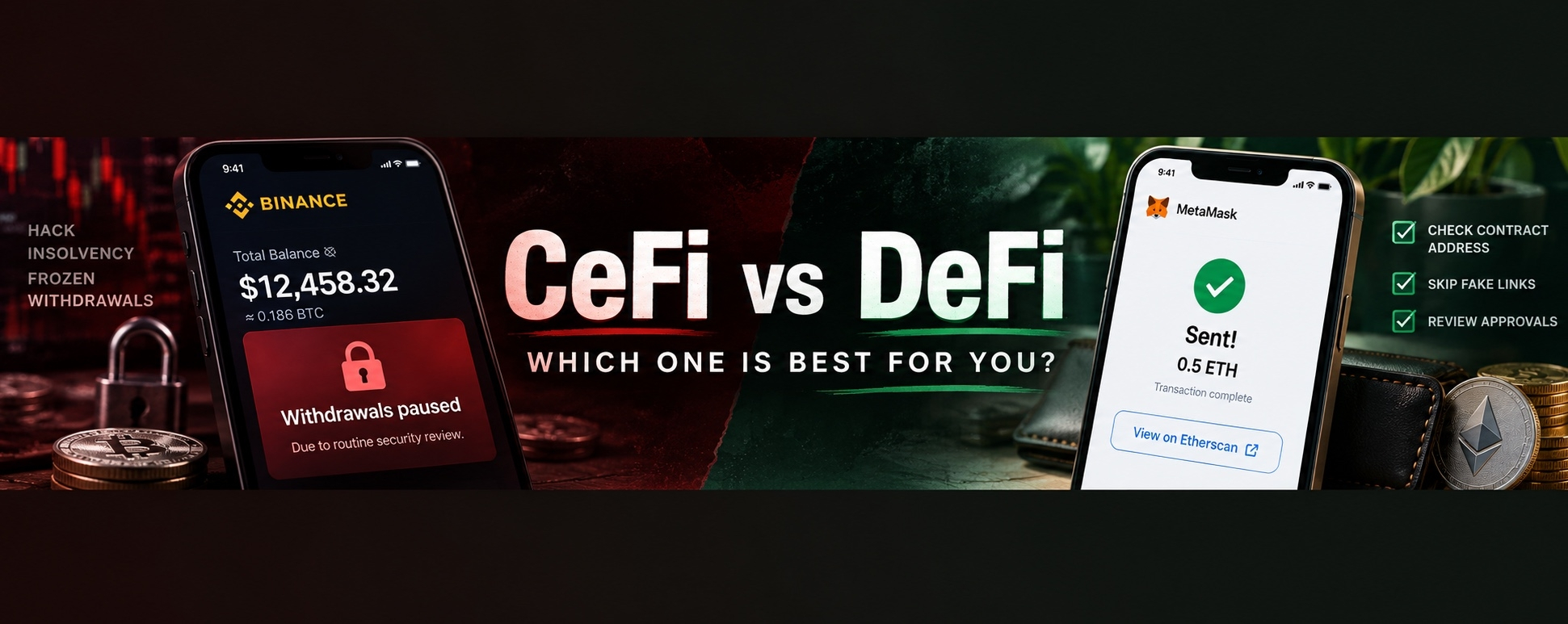
CeFi vs DeFi: Which One Is Best for You?Your exchange can freeze your account in one click, while your own wallet has no such button.
That one difference decides most of this debate.
CeFi: Convenient, but You're the Guest
Centralized exchanges give you deep liquidity, easy onboarding, and a familiar app, which makes them a decent doorway into crypto.
The risks come with the same package:
🏦 The exchange holds your keys, so a hack, insolvency, or frozen withdrawals leave you waiting and hoping
👀 KYC links your identity to every deposit, trade, and withdrawal, and governments and tax authorities can see all of it
🔒 Your account can be restricted without warning
Liquidity is great, but you're paying for it with total visibility.
DeFi: Your Money, Your Rules
On a DEX you trade straight from your own wallet, with no signup and no account for anyone to freeze.
> Self-custody by default, so NO ONE CAN FREEZE IT
> Smart contracts are open, so you can verify what they do
> Early access to tokens long before big exchanges list them
> Open 24/7 with no gatekeepers
DeFi has risks too, like scam tokens, bad approvals, and phishing links. But those are mistakes you can learn to avoid, while an exchange collapse is something you can't do anything about. Always check the contract address first, and remember wallets are pseudonymous, not invisible.
New to this?( Whatisdex dot com )explains how a DEX works in plain language.
The Top Swap for Every Chain
Skip the endless options and use the leader on each chain:
✅ BNB: PancakeSwap, the biggest DEX on BNB Chain
✅$ETH : Uniswap, the original and still the most trusted
✅ $SOL : Jupiter, which routes your swap to the best price on Solana
✅ $TON : @stonfi , built for the TON ecosystem and Telegram users
✅ Base: Aerodrome, the liquidity hub of the chain
Moving between chains doesn't need an exchange either.
STON.fi lets you swap from TON to Base directly from your own wallet, so your funds never sit on a platform that logs your identity.
So Which Is Best for You?
If you just want to buy a little and hold, a CeFi exchange works as an on-ramp. Treat it as a doorway, not a home, and once your coins land, move them to your own wallet and trade on the best DEX for your chain.
Control, privacy, and zero freeze risk all point the same way, which is why I'm super bullish on DeFi 🚀
Are you still keeping your funds on an exchange, or have you moved to self-custody?
CeFi vs DeFi: Which One Is Best for You?
Your exchange can freeze your account in one click, while your own wallet has no such button.
That one difference decides most of this debate.
CeFi: Convenient, but You're the Guest
Centralized exchanges give you deep liquidity, easy onboarding, and a familiar app, which makes them a decent doorway into crypto.
The risks come with the same package:
🏦 The exchange holds your keys, so a hack, insolvency, or frozen withdrawals leave you waiting and hoping
👀 KYC links your identity to every deposit, trade, and withdrawal, and governments and tax authorities can see all of it
🔒 Your account can be restricted without warning
Liquidity is great, but you're paying for it with total visibility.
DeFi: Your Money, Your Rules
On a DEX you trade straight from your own wallet, with no signup and no account for anyone to freeze.
> Self-custody by default, so NO ONE CAN FREEZE IT
> Smart contracts are open, so you can verify what they do
> Early access to tokens long before big exchanges list them
> Open 24/7 with no gatekeepers
DeFi has risks too, like scam tokens, bad approvals, and phishing links. But those are mistakes you can learn to avoid, while an exchange collapse is something you can't do anything about. Always check the contract address first, and remember wallets are pseudonymous, not invisible.
New to this?( Whatisdex dot com )explains how a DEX works in plain language.
The Top Swap for Every Chain
Skip the endless options and use the leader on each chain:
✅ BNB: PancakeSwap, the biggest DEX on BNB Chain
✅$ETH : Uniswap, the original and still the most trusted
✅ $SOL : Jupiter, which routes your swap to the best price on Solana
✅ $TON : @STONfi DEX , built for the TON ecosystem and Telegram users
✅ Base: Aerodrome, the liquidity hub of the chain
Moving between chains doesn't need an exchange either.
STON.fi lets you swap from TON to Base directly from your own wallet, so your funds never sit on a platform that logs your identity.
So Which Is Best for You?
If you just want to buy a little and hold, a CeFi exchange works as an on-ramp. Treat it as a doorway, not a home, and once your coins land, move them to your own wallet and trade on the best DEX for your chain.
Control, privacy, and zero freeze risk all point the same way, which is why I'm super bullish on DeFi 🚀
Are you still keeping your funds on an exchange, or have you moved to self-custody?
1
177

Article
Why I'm Still So Bullish on TONPeople keep asking:
“Why are you so bullish on TON?”
It’s not simply because telegram has 1B+ users.
That’s the obvious part.
The interesting part is the story.
TON went from:
creation → SEC shutdown → community revival → Telegram integration → comeback.
And I think the most interesting chapter is just starting.
Chapter 1: TON almost died
@ton_blockchain-1 , or The Open Network, was originally built around Telegram’s vision for a crypto ecosystem.
The token was originally called GramTelegram raised ~$1.7BThen the SEC stepped inTelegram eventually settled in 2020, returned funds to investors and paid an $18.5M penaltyTelegram stepped awayMost projects would have died thereTON didn’tThe community kept building, and TON evolved into an independent network
Chapter 2: Telegram came back
In 2023, Telegram selected TON as its Web3 infrastructure partner. Suddenly, TON had something most blockchains spend years trying to find:
DistributionWalletsPaymentsMini AppsGamesDigital assetsDeFi
TON wasn’t just trying to attract Telegram users. It was becoming part of Telegram’s product layer.
And that changes everything.
Chapter 3: The TON ecosystem
Look at DeFi.
STON.fi is the leading DEX by trading activity on TON, with current 30-day volume in the $70M+ range, ahead of other major TON DEXs such as DeDust and TONCO.
But the interesting part isn't just swapping tokens.
STON.fi is becoming a liquidity gateway for TON.
And now you can go beyond TON.
Through its Omniston-powered cross-chain infrastructure, users can swap between TON and networks such as Ethereum, BNB Chain, Base, Polygon, Arbitrum and others.
So instead of:
TON → bridge → another chain → swap
you can use STON.fi cross-chain flow to move between ecosystems in one interface.
And importantly, it's designed as a non-custodial cross-chain swap not a traditional bridge where users deposit funds into a centralized platform.
That makes @stonfi STON.fi more than a DEX.
It's becoming one of the gateways connecting TON to the rest of crypto
Then you have:
Payments → fast transfers and stablecoins.Mini Apps → applications without leaving Telegram.Gaming → games distributed directly through the messenger.AI agents → software that can interact with wallets, assets and transactions.The pieces are starting to connect.
Chapter 4: Then AI entered
This might be the most interesting part.
TON is building infrastructure for AI agents that can interact with wallets, swaps and on-chain transactions.
Imagine:
AI finds something → buys it → pays → swaps → manages the funds.Telegram becomes the interface.TON becomes the financial layer.AI becomes the actor.That’s much bigger than simply calling TON “another L1.”
Chapter 5: And Gram came back
In 2026, Pavel Durov announced “Make TON Great Again”, a seven-step initiative focused on performance, fees and deeper Telegram involvement.
And then came the full-circle moment:
$GRAM
{spot}(GRAMUSDT)
The blockchain remains TON, but the native currency returned to its original name.
> Telegram created it.
> The SEC stopped it.
> The community revived it.
> Telegram came back.
> And now Durov is pushing it forward again.
So why am I bullish?
Not because TON is “the next Ethereum.”
I’m bullish because distribution is finally meeting infrastructure.
Telegram has the users.TON has the infrastructure.STON.fi connects liquidity.Stablecoins provide the money.Mini Apps provide the applications.AI agents could provide the automation.And if these pieces converge at scale...People may use crypto without even realizing they're using crypto.
That’s the TON thesis I’m betting on.
Not financial advice. Just how I currently see the TON thesis.
Why I'm Still So Bullish on TON
People keep asking:
“Why are you so bullish on TON?”
It’s not simply because telegram has 1B+ users.
That’s the obvious part.
The interesting part is the story.
TON went from:
creation → SEC shutdown → community revival → Telegram integration → comeback.
And I think the most interesting chapter is just starting.
Chapter 1: TON almost died
@ton_blockchain , or The Open Network, was originally built around Telegram’s vision for a crypto ecosystem.
The token was originally called GramTelegram raised ~$1.7BThen the SEC stepped inTelegram eventually settled in 2020, returned funds to investors and paid an $18.5M penaltyTelegram stepped awayMost projects would have died thereTON didn’tThe community kept building, and TON evolved into an independent network
Chapter 2: Telegram came back
In 2023, Telegram selected TON as its Web3 infrastructure partner. Suddenly, TON had something most blockchains spend years trying to find:
DistributionWalletsPaymentsMini AppsGamesDigital assetsDeFi
TON wasn’t just trying to attract Telegram users. It was becoming part of Telegram’s product layer.
And that changes everything.
Chapter 3: The TON ecosystem
Look at DeFi.
STON.fi is the leading DEX by trading activity on TON, with current 30-day volume in the $70M+ range, ahead of other major TON DEXs such as DeDust and TONCO.
But the interesting part isn't just swapping tokens.
STON.fi is becoming a liquidity gateway for TON.
And now you can go beyond TON.
Through its Omniston-powered cross-chain infrastructure, users can swap between TON and networks such as Ethereum, BNB Chain, Base, Polygon, Arbitrum and others.
So instead of:
TON → bridge → another chain → swap
you can use STON.fi cross-chain flow to move between ecosystems in one interface.
And importantly, it's designed as a non-custodial cross-chain swap not a traditional bridge where users deposit funds into a centralized platform.
That makes @STONfi DEX STON.fi more than a DEX.
It's becoming one of the gateways connecting TON to the rest of crypto
Then you have:
Payments → fast transfers and stablecoins.Mini Apps → applications without leaving Telegram.Gaming → games distributed directly through the messenger.AI agents → software that can interact with wallets, assets and transactions.The pieces are starting to connect.
Chapter 4: Then AI entered
This might be the most interesting part.
TON is building infrastructure for AI agents that can interact with wallets, swaps and on-chain transactions.
Imagine:
AI finds something → buys it → pays → swaps → manages the funds.Telegram becomes the interface.TON becomes the financial layer.AI becomes the actor.That’s much bigger than simply calling TON “another L1.”
Chapter 5: And Gram came back
In 2026, Pavel Durov announced “Make TON Great Again”, a seven-step initiative focused on performance, fees and deeper Telegram involvement.
And then came the full-circle moment:
$GRAM
The blockchain remains TON, but the native currency returned to its original name.
> Telegram created it.
> The SEC stopped it.
> The community revived it.
> Telegram came back.
> And now Durov is pushing it forward again.
So why am I bullish?
Not because TON is “the next Ethereum.”
I’m bullish because distribution is finally meeting infrastructure.
Telegram has the users.TON has the infrastructure.STON.fi connects liquidity.Stablecoins provide the money.Mini Apps provide the applications.AI agents could provide the automation.And if these pieces converge at scale...People may use crypto without even realizing they're using crypto.
That’s the TON thesis I’m betting on.
Not financial advice. Just how I currently see the TON thesis.
1
399
·
--
Haussier
This makes cross-chain swaps feel much less annoying.
Previously, swapping between chains could mean connecting wallets on both sides.
Now on @stonfi you can simply: $GRAM
1. Connect the wallet you're swapping from
2. Turn on "𝗥𝗲𝗰𝗲𝗶𝘃𝗲 𝘁𝗼 𝗰𝘂𝘀𝘁𝗼𝗺 𝗮𝗱𝗱𝗿𝗲𝘀𝘀"
3. Paste the destination wallet address
4. Swap
That's it.
Your swapped tokens are delivered directly to that address.
This is especially useful when you're sending assets to someone else or moving funds into a wallet you don't want to connect.
Crypto doesn't always need more features.
Sometimes it just needs fewer annoying steps.
𝗧𝗵𝗶𝘀 𝗶𝘀 𝗼𝗻𝗲 𝗼𝗳 𝘁𝗵𝗼𝘀𝗲 𝗳𝗲𝗮𝘁𝘂𝗿𝗲𝘀.
This makes cross-chain swaps feel much less annoying.
Previously, swapping between chains could mean connecting wallets on both sides.
Now on @STONfi DEX you can simply: $GRAM
1. Connect the wallet you're swapping from
2. Turn on "𝗥𝗲𝗰𝗲𝗶𝘃𝗲 𝘁𝗼 𝗰𝘂𝘀𝘁𝗼𝗺 𝗮𝗱𝗱𝗿𝗲𝘀𝘀"
3. Paste the destination wallet address
4. Swap
That's it.
Your swapped tokens are delivered directly to that address.
This is especially useful when you're sending assets to someone else or moving funds into a wallet you don't want to connect.
Crypto doesn't always need more features.
Sometimes it just needs fewer annoying steps.
𝗧𝗵𝗶𝘀 𝗶𝘀 𝗼𝗻𝗲 𝗼𝗳 𝘁𝗵𝗼𝘀𝗲 𝗳𝗲𝗮𝘁𝘂𝗿𝗲𝘀.

1
187
·
--
Haussier
We are seeing a strong buying opportunity 🚀
$BTC in the $73,000 – $74,000 range. 📈
Why this trade?
Strong Support: We have identified massive support on the daily timeframe.
Liquidity Sweep: The $74,000 liquidity level has been successfully swiped following the market break at the $74,500 area.
Trade Details:
> Entry: $73,000 – $74,000
> Stop Loss (SL): Around $73,000
> TP1 - $78,000
Always remember to manage your risk #TradersShiftBTCToStablecoins

1
1
444
Real ALPHA 🚀
> Smart money follows development, not trends.
> Handling 50%+ of $TON entire network volume
@stonfi having everything you need inside a single platform:
- TradFi & RWA
- Instant Swapping (Lowest slippage on TON)
- LP Pools (Earn massive passive yield)
DeFi powerhouse $STON ✨
Real ALPHA 🚀
> Smart money follows development, not trends.
> Handling 50%+ of $TON entire network volume
@STONfi DEX having everything you need inside a single platform:
- TradFi & RWA
- Instant Swapping (Lowest slippage on TON)
- LP Pools (Earn massive passive yield)
DeFi powerhouse $STON ✨
> Smart money follows development, not trends.
> Handling 50%+ of $TON entire network volume
@STONfi DEX having everything you need inside a single platform:
- TradFi & RWA
- Instant Swapping (Lowest slippage on TON)
- LP Pools (Earn massive passive yield)
DeFi powerhouse $STON ✨
1
132
Airdrop Hunters🪂
Are you still lossing your money on @polymarket & @Kalshi
🚨India Bans @polymarket & Kalshi :
> Indian government has shutdown on offshore prediction markets like Polymarket and Kalshi.
> If a platform isn’t legally allowed in your country, they will actively filter you out of future incentives, rewards, and ecosystem airdrops.
> Think you can just hide behind a VPN? Think again, i think you already connect your X account.
Whats your oppinion on this?
Airdrop Hunters🪂
Are you still lossing your money on @Polymarket & @Kalshi
🚨India Bans @Polymarket & Kalshi :
> Indian government has shutdown on offshore prediction markets like Polymarket and Kalshi.
> If a platform isn’t legally allowed in your country, they will actively filter you out of future incentives, rewards, and ecosystem airdrops.
> Think you can just hide behind a VPN? Think again, i think you already connect your X account.
Whats your oppinion on this?

3
2
291
·
--
Haussier
What the hell 🤩
$HYPE is pumped $9126 on Bitfinex CEX 😱
Now i m super bullish on $HYPE after this pump
What the hell 🤩
$HYPE is pumped $9126 on Bitfinex CEX 😱
Now i m super bullish on $HYPE after this pump
$HYPE is pumped $9126 on Bitfinex CEX 😱
Now i m super bullish on $HYPE after this pump

1
2
1k
·
--
Haussier
Vérifié
In my upcoming video, I’m breaking down @stonfi & @ton_blockchain-1 💎
🔥The locked supply dynamics primed for a pump.
🔥The live RWA utility driving massive adoption.
Full video dropping very soon. BULLISH On $TON
Turn notifications ON 🔔
In my upcoming video, I’m breaking down @STONfi DEX & @ton_blockchain 💎
🔥The locked supply dynamics primed for a pump.
🔥The live RWA utility driving massive adoption.
Full video dropping very soon. BULLISH On $TON
Turn notifications ON 🔔
🔥The locked supply dynamics primed for a pump.
🔥The live RWA utility driving massive adoption.
Full video dropping very soon. BULLISH On $TON
Turn notifications ON 🔔

3
3
1.1k
Here is why I strongly believe in $STON right now.
Hidden Gem💎
1️⃣ Not on Major CEXs Yet
2️⃣ Locked Supply
3⃣ Total Supply - 100M
4⃣ Circulating - 35.39M
Why @stonfi ?
We all saw how $TON surged from $1.2 to $2.9.
Why?
Because the TON ecosystem has the unique power to seamlessly onboard millions of Web2 users straight into Web3 via @telegram
But here is the secret STON.fi is the backbone of @ton_blockchain-1 . It provides the vital liquidity that keeps the entire ecosystem running.
If $TON grows, explodes 🔥
Right now, is trading at just $0.75. The upside potential from here is absolutely massive.
DYOR 🔖
Here is why I strongly believe in $STON right now.
Hidden Gem💎
1️⃣ Not on Major CEXs Yet
2️⃣ Locked Supply
3⃣ Total Supply - 100M
4⃣ Circulating - 35.39M
Why @STONfi DEX ?
We all saw how $TON surged from $1.2 to $2.9.
Why?
Because the TON ecosystem has the unique power to seamlessly onboard millions of Web2 users straight into Web3 via @telegram
But here is the secret STON.fi is the backbone of @ton_blockchain . It provides the vital liquidity that keeps the entire ecosystem running.
If $TON grows, explodes 🔥
Right now, is trading at just $0.75. The upside potential from here is absolutely massive.
DYOR 🔖

1
225
Strongly bullish on $XMR
Mine 0.6 XMR with your PC/Laptop - Solo Mining
My PC is officially converted to a Monero Solo miner!
Testing the limits of solo mining on my home setup. Monero is one of those few Blue Chip coins that actually stays true to the vision of crypto.
Privacy Gem 🚀
Strongly bullish on $XMR
Mine 0.6 XMR with your PC/Laptop - Solo Mining
My PC is officially converted to a Monero Solo miner!
Testing the limits of solo mining on my home setup. Monero is one of those few Blue Chip coins that actually stays true to the vision of crypto.
Privacy Gem 🚀
Mine 0.6 XMR with your PC/Laptop - Solo Mining
My PC is officially converted to a Monero Solo miner!
Testing the limits of solo mining on my home setup. Monero is one of those few Blue Chip coins that actually stays true to the vision of crypto.
Privacy Gem 🚀
1
195
·
--
Haussier
Why we hold $TON 💎
- Massive user base
- Easy to use any Dapps
- Usecase with internal ecosystem
- Low Data & Fast Loading
- No need to install any dapps and visit websites
- Real-World Assets (RWA) hub like tokenized stocks and assets
In One Place 📊
Wallets . Gamified . DEX . L2 . RWA
- Biggest dex @stonfi
- Biggest wallet tonkeeper
- Biggest gamified hamster_kombat
- Biggest L2 Duck_Chain
- Biggest RWA telegram
Still time to accumulate 🚀
#DYOR
Why we hold $TON 💎
- Massive user base
- Easy to use any Dapps
- Usecase with internal ecosystem
- Low Data & Fast Loading
- No need to install any dapps and visit websites
- Real-World Assets (RWA) hub like tokenized stocks and assets
In One Place 📊
Wallets . Gamified . DEX . L2 . RWA
- Biggest dex @STONfi DEX
- Biggest wallet tonkeeper
- Biggest gamified hamster_kombat
- Biggest L2 Duck_Chain
- Biggest RWA telegram
Still time to accumulate 🚀
#DYOR

1
118
🚨 $OM is now $MANTRA.
Here's the full breakdown🕉️
@MANTRA_Chain is a Layer 1 blockchain focused on real-world assets think tokenized real estate, bonds, and regulated financial instruments on-chain.
> On March 2, 2026, the ticker officially switched from $OM to $MANTRA with a 1:4 coin split.
> Every 100 OM became 400 $MANTRA.
> Migration completed on Binance.
Alert 🚨
> Since the migration went live MANTRA is up 65.3%. Post-rebrand momentum is real, at least in the short term.
> OM dropped over 90% in April 2025 from around $6.00 to below $0.70. The rebrand is partly a reset of that narrative.
> New name. New ticker. Same chain.
🙄 Note - The RWA space is growing whether MANTRA grows with it is the real question.
🚨 $OM is now $MANTRA .
Here's the full breakdown🕉️
@MANTRA is a Layer 1 blockchain focused on real-world assets think tokenized real estate, bonds, and regulated financial instruments on-chain.
> On March 2, 2026, the ticker officially switched from $OM to $MANTRA with a 1:4 coin split.
> Every 100 OM became 400 $MANTRA .
> Migration completed on Binance.
Alert 🚨
> Since the migration went live MANTRA is up 65.3%. Post-rebrand momentum is real, at least in the short term.
> OM dropped over 90% in April 2025 from around $6.00 to below $0.70. The rebrand is partly a reset of that narrative.
> New name. New ticker. Same chain.
🙄 Note - The RWA space is growing whether MANTRA grows with it is the real question.

1
113
Telegram no more brokerage accounts or bank transfers required.
In 2026, tokenized stocks it means real shares
Nvidia (NVDAx)
Tesla (TSLAx)
Apple (AAPLx)
Quick Start Guide:
1. Open Telegram and find ston fi dex bot.
2. Launch @stonfi Telegram Bot No Browser Needed.
3. Connect Any $TON Wallet
3. Choose Your stocks
4. Confirm Your Purchase
Why This Matters:
- Global Access
- Diversification
- Control In Your Hand
- Flexible Investments
Note: Trade 24/7 and they are fully backed by the actual assets.
Telegram no more brokerage accounts or bank transfers required.
In 2026, tokenized stocks it means real shares
Nvidia (NVDAx)
Tesla (TSLAx)
Apple (AAPLx)
Quick Start Guide:
1. Open Telegram and find ston fi dex bot.
2. Launch @STONfi DEX Telegram Bot No Browser Needed.
3. Connect Any $TON Wallet
3. Choose Your stocks
4. Confirm Your Purchase
Why This Matters:
- Global Access
- Diversification
- Control In Your Hand
- Flexible Investments
Note: Trade 24/7 and they are fully backed by the actual assets.
2
5
·
--
Haussier
After delisted from Tier 1 exchange, still $XMR sitting at $6B + marketcap
💰
Undervalued at - $334
Why?
▶️ Organic Utility: It is the only cryptocurrency with massive, daily real-world usage as an actual medium of exchange.
▶️ True Fungibility: Every XMR is identical and carries no "dirty" history, making it impossible to blacklist or censor.
▶️ Censorship Resistance: Its decentralized mining and privacy tech protect it from government or exchange “freeze” buttons.
▶️ Supply Integrity: Unlike CEX-manipulated tokens, XMR's privacy prevents "paper supply" inflation, ensuring 100% real scarcity.
▶️ Surveillance Hedge: As CBDCs and tracking increase, whales use XMR as a private vault to preserve wealth anonymously.

3
146
·
--
Haussier
ALPHA: DON’T MISS OUT ON MIDEN
What is Miden?
Miden is a cutting-edge ZK-Rollup Layer 2 solution designed for maximum scalability and user privacy.
By shifting transaction processing to the client-side, it's revolutionizing blockchain security.
Another privacy @Dusk_Foundation $DUSK
💰 Funding: $25M
🤝 Backers: a16z, sandeepnailwal & hack_vc
🔥 How to Get in on This Airdrop (Step-by-Step Guide)
1️⃣ Install the Miden Wallet 💳
Start by getting the official extension and setting up your self-custody vault.
2️⃣ Claim Your Testnet Tokens
Remember, don’t use any of your own money! Just hit the faucet to grab some test tokens.
3️⃣ Dive into the Ecosystem 🌐
Engage with the early dApps being developed on the platform.
The more you interact, the better your chances of eligibility.
Ecosystem Dapps 👇
> Trade on ZoroSwap
> Register Miden Name
> Use Dome (private transfers)
> Complete Playground tutorial
🚀 Note : Details on OG NFTs are not announced yet maybe will be announced later. So start your contribution on social media and tag to team 😇
BOLD - Still not true privacy 🤯
ALPHA: DON’T MISS OUT ON MIDEN
What is Miden?
Miden is a cutting-edge ZK-Rollup Layer 2 solution designed for maximum scalability and user privacy.
By shifting transaction processing to the client-side, it's revolutionizing blockchain security.
Another privacy @Dusk $DUSK
💰 Funding: $25M
🤝 Backers: a16z, sandeepnailwal & hack_vc
🔥 How to Get in on This Airdrop (Step-by-Step Guide)
1️⃣ Install the Miden Wallet 💳
Start by getting the official extension and setting up your self-custody vault.
2️⃣ Claim Your Testnet Tokens
Remember, don’t use any of your own money! Just hit the faucet to grab some test tokens.
3️⃣ Dive into the Ecosystem 🌐
Engage with the early dApps being developed on the platform.
The more you interact, the better your chances of eligibility.
Ecosystem Dapps 👇
> Trade on ZoroSwap
> Register Miden Name
> Use Dome (private transfers)
> Complete Playground tutorial
🚀 Note : Details on OG NFTs are not announced yet maybe will be announced later. So start your contribution on social media and tag to team 😇
BOLD - Still not true privacy 🤯

2
55
I just put the Tangem Hardware Wallet to the ultimate durability test & Water Resistance Test.
Here’s why this card-shaped vault is a game-changer for 2026:
✅ Extreme Durability: With an IP68 rating
✅ Bank-Grade Security: Equipped with an EAL6+ certified chip.
✅ Zero Friction: No batteries, no cables, and no charging.
✅ Smart Backup: No more writing down 12-word seed phrases on paper.
In 2026, self-custody isn't just an option it’s a necessity.
Discounts Code : BN855U
Buy Only From Official Website
2
25

Article
Beyond The Hype: Why ZAMA isn't The Future Of Sovereign PrivacyIntroduction: The Great Encryption Mirage 🌅
We were promised a world where "code is law" and no central authority could freeze our digital lives.
We moved from Web2 to Web3 to escape the "god mode" of big tech companies and governments.
Now, new buzzword: FHE (Fully Homomorphic Encryption), with $ZAMA leading the charge. On paper, it looks like magic computing on encrypted data.
But if we look past the $1 Billion valuation and the VC-funded marketing, a dark reality emerges. Zama isn't building a decentralized revolution; it’s building a more sophisticated digital cage.
@Dusk_Foundation is also similar like a ZAMA but its working on ZK protocol, in short-term i'm bullish on #DUSK but in long term if EVM adoption in large scale then both the protocol are booming 🔥
The SSL Trap (Privacy vs Sovereignty) 💻
In Web2, we have HTTPS (SSL). It protects our data from the neighbor, but the "Bank" and the "Server" still own the keys. They can pause your account, freeze your funds, and de-platform you at will.
Zama is essentially "SSL for Blockchains." It offers Confidentiality (hiding data) but completely ignores Sovereignty (owning the system).
If a protocol is built to be "compliant" and "VC-governed," it is just a "Privacy-as-a-Service" model.
If there is a "Freeze" button behind the encryption, we haven't moved to Web3 we havve just given Web2 a face lift.
For E.g 👇
To understand why Zama fails the test of true decentralization, we must look at how it fits into the current ecosystem.
The Bank (It Means Ethereum is a bank) : Today, Ethereum is moving toward becoming a "Regulated Digital Bank." With the arrival of ETFs and the dominance of centralized staking providers (like Coinbase and Lido), Ethereum is increasingly under the thumb of institutional compliance.The SSL (Zama): Think of Zama as the SSL/HTTPS certificate for this bank. When you use a banking website, the "Lock" icon in your browser hides your password from your neighbor, but the Bank still sees everything. Zama provides Confidentiality (hiding data from other users), but it does not provide Sovereignty (freedom from the system). If the underlying "Bank" (Ethereum) is compromised or regulated, the "Curtain" (Zama) is useless.
Proof, Do you know about DAO Hack (When History Was Rewritten)
"Has Ethereum ever actually been compromised?" The answer lies in its history.
The Event: In 2016, following The DAO Hack, the Ethereum community decided to "Roll Back" the blockchain to recover stolen funds.The Lesson: This event proved that Ethereum is not "Unstoppable." If the system can rewrite its history to fix a hack, it can certainly rewrite its history or your balance at the request of a government. Zama is an encryption layer on a foundation that has already proven it can be manipulated.
The B2B Pivot (Corporate Privacy, Not Human Rights)🤝
Zama’s true future lies in the B2B (Business-to-Business) sector, not in individual freedom.
Corporate Tool: Institutions love Zama because it allows them to hide trade secrets from competitors while remaining "Compliant" with regulators.The Difference: Monero $XMR , $Firo, and $ZEC were built as "Human Rights" tools. They have no CEO, no boardrooms, and no "Pause" button. They are built for the sovereign individual. Zama, however, is a VC-funded product built for the boardroom. It is designed to be "Acceptable" to the system, and anything acceptable to the system cannot truly disrupt it.
Conclusion: ZAMA Is Not A Real Decentralization 😱
Zama will likely be a massive financial success. It will likely become the "Amazon Web Services" of private data computation. But it will fail as the future of Sovereign Privacy.
As early adopters, we moved from Web2 to Web3 to escape the "God Mode" of centralized entities. By adopting Zama & $DUSK as the "Standard," we are merely moving back into a system where our data is hidden by a curtain, but the key to the room is still held by a landlord.
Final Verdict: An encrypted jail is still a jail. If you are looking for hype and profit, Zama is a play. But if you are looking for the future of freedom, look toward the chains that have no master.
Beyond The Hype: Why ZAMA isn't The Future Of Sovereign Privacy
Introduction: The Great Encryption Mirage 🌅
We were promised a world where "code is law" and no central authority could freeze our digital lives.
We moved from Web2 to Web3 to escape the "god mode" of big tech companies and governments.
Now, new buzzword: FHE (Fully Homomorphic Encryption), with $ZAMA leading the charge. On paper, it looks like magic computing on encrypted data.
But if we look past the $1 Billion valuation and the VC-funded marketing, a dark reality emerges. Zama isn't building a decentralized revolution; it’s building a more sophisticated digital cage.
@Dusk is also similar like a ZAMA but its working on ZK protocol, in short-term i'm bullish on #DUSK but in long term if EVM adoption in large scale then both the protocol are booming 🔥
The SSL Trap (Privacy vs Sovereignty) 💻
In Web2, we have HTTPS (SSL). It protects our data from the neighbor, but the "Bank" and the "Server" still own the keys. They can pause your account, freeze your funds, and de-platform you at will.
Zama is essentially "SSL for Blockchains." It offers Confidentiality (hiding data) but completely ignores Sovereignty (owning the system).
If a protocol is built to be "compliant" and "VC-governed," it is just a "Privacy-as-a-Service" model.
If there is a "Freeze" button behind the encryption, we haven't moved to Web3 we havve just given Web2 a face lift.
For E.g 👇
To understand why Zama fails the test of true decentralization, we must look at how it fits into the current ecosystem.
The Bank (It Means Ethereum is a bank) : Today, Ethereum is moving toward becoming a "Regulated Digital Bank." With the arrival of ETFs and the dominance of centralized staking providers (like Coinbase and Lido), Ethereum is increasingly under the thumb of institutional compliance.The SSL (Zama): Think of Zama as the SSL/HTTPS certificate for this bank. When you use a banking website, the "Lock" icon in your browser hides your password from your neighbor, but the Bank still sees everything. Zama provides Confidentiality (hiding data from other users), but it does not provide Sovereignty (freedom from the system). If the underlying "Bank" (Ethereum) is compromised or regulated, the "Curtain" (Zama) is useless.
Proof, Do you know about DAO Hack (When History Was Rewritten)
"Has Ethereum ever actually been compromised?" The answer lies in its history.
The Event: In 2016, following The DAO Hack, the Ethereum community decided to "Roll Back" the blockchain to recover stolen funds.The Lesson: This event proved that Ethereum is not "Unstoppable." If the system can rewrite its history to fix a hack, it can certainly rewrite its history or your balance at the request of a government. Zama is an encryption layer on a foundation that has already proven it can be manipulated.
The B2B Pivot (Corporate Privacy, Not Human Rights)🤝
Zama’s true future lies in the B2B (Business-to-Business) sector, not in individual freedom.
Corporate Tool: Institutions love Zama because it allows them to hide trade secrets from competitors while remaining "Compliant" with regulators.The Difference: Monero $XMR , $Firo, and $ZEC were built as "Human Rights" tools. They have no CEO, no boardrooms, and no "Pause" button. They are built for the sovereign individual. Zama, however, is a VC-funded product built for the boardroom. It is designed to be "Acceptable" to the system, and anything acceptable to the system cannot truly disrupt it.
Conclusion: ZAMA Is Not A Real Decentralization 😱
Zama will likely be a massive financial success. It will likely become the "Amazon Web Services" of private data computation. But it will fail as the future of Sovereign Privacy.
As early adopters, we moved from Web2 to Web3 to escape the "God Mode" of centralized entities. By adopting Zama & $DUSK as the "Standard," we are merely moving back into a system where our data is hidden by a curtain, but the key to the room is still held by a landlord.
Final Verdict: An encrypted jail is still a jail. If you are looking for hype and profit, Zama is a play. But if you are looking for the future of freedom, look toward the chains that have no master.
2
545
·
--
Haussier
Meta Shifted 🤯
Late nights and deep research because you deserve more than just 'hype' content.
💨 Behind every thumbnail is hours of analyzing the next big shift in the ecosystem.
📈 Transitioning from the Info-fi airdrop to the next phase of growth.
Stay tuned for the next video dropping soon! 🔔
Meta Shifted 🤯
Late nights and deep research because you deserve more than just 'hype' content.
💨 Behind every thumbnail is hours of analyzing the next big shift in the ecosystem.
📈 Transitioning from the Info-fi airdrop to the next phase of growth.
Stay tuned for the next video dropping soon! 🔔
Late nights and deep research because you deserve more than just 'hype' content.
💨 Behind every thumbnail is hours of analyzing the next big shift in the ecosystem.
📈 Transitioning from the Info-fi airdrop to the next phase of growth.
Stay tuned for the next video dropping soon! 🔔

3
71
Connectez-vous pour découvrir plus de contenu
Rejoignez la communauté mondiale des adeptes de cryptomonnaies sur Binance Square
⚡️ Suviez les dernières informations importantes sur les cryptomonnaies.
💬 Jugé digne de confiance par la plus grande plateforme d’échange de cryptomonnaies au monde.
👍 Découvrez les connaissances que partagent les créateurs vérifiés.
Adresse e-mail/Nº de téléphone