

babulivo
154 Publications

babulivo
Signaler
Bloquer l’utilisateur
49 Suivis
52 Abonnés
212 J’aime
Publications
Tous
Citations
·
--
Стратегія інвестування: три шари портфеля
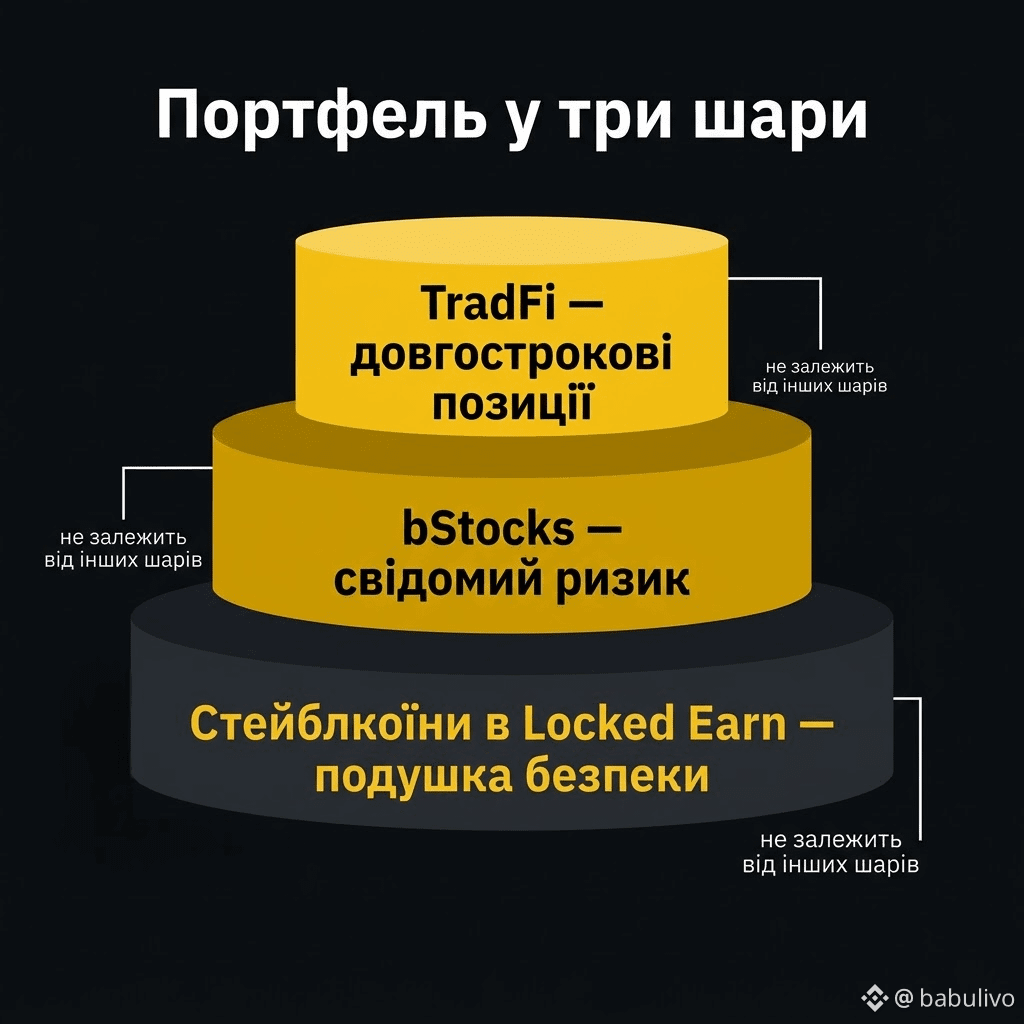
Почав дивитись на свій портфель не як на один список активів, а як на три шари з різними задачами.
> Перший шар : стейблкоїни в Locked Earn, як подушка безпеки, яка просто повільно росте на фоні.
> Другий шар : bStocks на кілька волатильних імен, де свідомо приймаю ризик заради потенційного руху ціни.
> Третій шар : TradFi-позиції на довгострок, які не потребують щоденної уваги.
Кожен шар виконує свою функцію, і жоден не заважає іншому: подушка безпеки не залежить від того, як поводиться волатильна частина.
Як у вас зазвичай виглядає розподіл? Є свідома структура, чи все в одному кошику?
Стратегія інвестування: три шари портфеля
Почав дивитись на свій портфель не як на один список активів, а як на три шари з різними задачами.
> Перший шар : стейблкоїни в Locked Earn, як подушка безпеки, яка просто повільно росте на фоні.
> Другий шар : bStocks на кілька волатильних імен, де свідомо приймаю ризик заради потенційного руху ціни.
> Третій шар : TradFi-позиції на довгострок, які не потребують щоденної уваги.
Кожен шар виконує свою функцію, і жоден не заважає іншому: подушка безпеки не залежить від того, як поводиться волатильна частина.
Як у вас зазвичай виглядає розподіл? Є свідома структура, чи все в одному кошику?
Почав дивитись на свій портфель не як на один список активів, а як на три шари з різними задачами.
> Перший шар : стейблкоїни в Locked Earn, як подушка безпеки, яка просто повільно росте на фоні.
> Другий шар : bStocks на кілька волатильних імен, де свідомо приймаю ризик заради потенційного руху ціни.
> Третій шар : TradFi-позиції на довгострок, які не потребують щоденної уваги.
Кожен шар виконує свою функцію, і жоден не заважає іншому: подушка безпеки не залежить від того, як поводиться волатильна частина.
Як у вас зазвичай виглядає розподіл? Є свідома структура, чи все в одному кошику?
3
319
·
--
Досвід використання: паралельний тест трьох продуктів
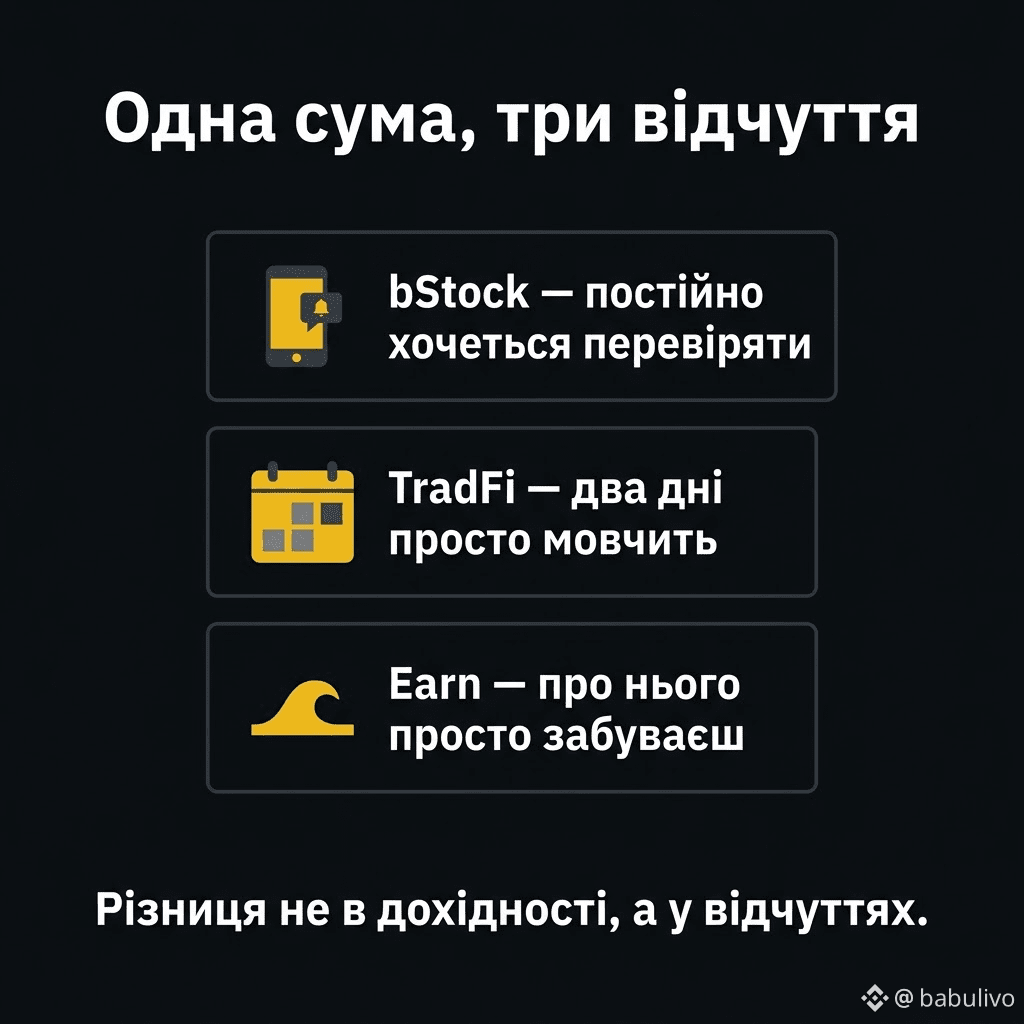
Вирішив протестувати на собі: поклав однакову суму паралельно в bStock Apple, у TradFi Apple і в Simple Earn на USDT, і подивився, що відчувається інакше вже за тиждень.
bStock : можна було зайти й вийти будь-якої миті, включно з суботою ввечері. TradFi-позиція за цей же тиждень просто "мовчала" два дні поспіль, поки ринок був закритий. Earn на USDT - взагалі жодних емоцій, тільки рівний маленький приріст щодня, без потреби щось перевіряти.
Найбільше здивувало не прибутковість, а різниця у відчуттях: bStock викликає бажання постійно перевіряти графік, Earn - повна протилежність, про нього просто забуваєш.
Який із трьох типів активів викликає у вас найбільше бажання постійно заглядати в застосунок?
Досвід використання: паралельний тест трьох продуктів
Вирішив протестувати на собі: поклав однакову суму паралельно в bStock Apple, у TradFi Apple і в Simple Earn на USDT, і подивився, що відчувається інакше вже за тиждень.
bStock : можна було зайти й вийти будь-якої миті, включно з суботою ввечері. TradFi-позиція за цей же тиждень просто "мовчала" два дні поспіль, поки ринок був закритий. Earn на USDT - взагалі жодних емоцій, тільки рівний маленький приріст щодня, без потреби щось перевіряти.
Найбільше здивувало не прибутковість, а різниця у відчуттях: bStock викликає бажання постійно перевіряти графік, Earn - повна протилежність, про нього просто забуваєш.
Який із трьох типів активів викликає у вас найбільше бажання постійно заглядати в застосунок?
Вирішив протестувати на собі: поклав однакову суму паралельно в bStock Apple, у TradFi Apple і в Simple Earn на USDT, і подивився, що відчувається інакше вже за тиждень.
bStock : можна було зайти й вийти будь-якої миті, включно з суботою ввечері. TradFi-позиція за цей же тиждень просто "мовчала" два дні поспіль, поки ринок був закритий. Earn на USDT - взагалі жодних емоцій, тільки рівний маленький приріст щодня, без потреби щось перевіряти.
Найбільше здивувало не прибутковість, а різниця у відчуттях: bStock викликає бажання постійно перевіряти графік, Earn - повна протилежність, про нього просто забуваєш.
Який із трьох типів активів викликає у вас найбільше бажання постійно заглядати в застосунок?
3
5
809
·
--
Технологічні акції останнім часом рухаються дуже сильно, буває й по 5-10% за день.
Класичний ринок акцій не працює у вихідні. Тому весь рух, який назбирався за два дні, розкривається одразу в понеділок.
bStocks торгуються 24/7, тому цей момент очікування просто відсутній. Ціна рухається постійно, без пауз на вихідні.
Вам траплялось бачити, що акція сильно змінилась у ціні саме в понеділок вранці?
Технологічні акції останнім часом рухаються дуже сильно, буває й по 5-10% за день.
Класичний ринок акцій не працює у вихідні. Тому весь рух, який назбирався за два дні, розкривається одразу в понеділок.
bStocks торгуються 24/7, тому цей момент очікування просто відсутній. Ціна рухається постійно, без пауз на вихідні.
Вам траплялось бачити, що акція сильно змінилась у ціні саме в понеділок вранці?
Класичний ринок акцій не працює у вихідні. Тому весь рух, який назбирався за два дні, розкривається одразу в понеділок.
bStocks торгуються 24/7, тому цей момент очікування просто відсутній. Ціна рухається постійно, без пауз на вихідні.
Вам траплялось бачити, що акція сильно змінилась у ціні саме в понеділок вранці?

1
3
·
--
Практичний кейс: $500 на три продукти
Уявімо конкретний сценарій: у тебе $500 і хочеться спробувати одразу bStocks, TradFi та Earn, а не вибирати щось одне.
Наприклад: $200 у bStock волатильної акції на кшталт Nvidia чи Tesla, там, де хочеться ловити рух ціни. $200 у TradFi на щось стабільніше, довгострокове, без потреби постійно перевіряти графік. І $100 у Flexible Earn на стейблкоїні, як подушка, яку можна вивести миттєво, якщо десь знадобляться гроші.
Жодна з трьох частин не залежить від інших: волатильна позиція не зачепить подушку безпеки, а подушка не заважає ризикованій частині працювати.
Ви б розподілили $500 так само, чи зробили б інакше?
Практичний кейс: $500 на три продукти
Уявімо конкретний сценарій: у тебе $500 і хочеться спробувати одразу bStocks, TradFi та Earn, а не вибирати щось одне.
Наприклад: $200 у bStock волатильної акції на кшталт Nvidia чи Tesla, там, де хочеться ловити рух ціни. $200 у TradFi на щось стабільніше, довгострокове, без потреби постійно перевіряти графік. І $100 у Flexible Earn на стейблкоїні, як подушка, яку можна вивести миттєво, якщо десь знадобляться гроші.
Жодна з трьох частин не залежить від інших: волатильна позиція не зачепить подушку безпеки, а подушка не заважає ризикованій частині працювати.
Ви б розподілили $500 так само, чи зробили б інакше?
Уявімо конкретний сценарій: у тебе $500 і хочеться спробувати одразу bStocks, TradFi та Earn, а не вибирати щось одне.
Наприклад: $200 у bStock волатильної акції на кшталт Nvidia чи Tesla, там, де хочеться ловити рух ціни. $200 у TradFi на щось стабільніше, довгострокове, без потреби постійно перевіряти графік. І $100 у Flexible Earn на стейблкоїні, як подушка, яку можна вивести миттєво, якщо десь знадобляться гроші.
Жодна з трьох частин не залежить від інших: волатильна позиція не зачепить подушку безпеки, а подушка не заважає ризикованій частині працювати.
Ви б розподілили $500 так само, чи зробили б інакше?

2
104
·
--
Побачив високий APR на Dual Investment і спочатку подумав, що це просто "кращий стейкінг". Виявилось, що ні :)
Це продукт, де ти по суті продаєш опціон. Якщо твій прогноз щодо ціни збігається - отримуєш високу дохідність у тому активі, який поклав. Якщо ні - тебе розраховують у іншому активі, часто за гіршою для тебе ціною, ніж поточна ринкова.
Тобто високий відсоток - це не подарунок, а плата за ризик, який ти на себе береш. Простий стейкінг і Dual Investment виглядають схоже в інтерфейсі, але це зовсім різні механіки з різним профілем ризику.
Багато хто заходить туди лише заради цифри APR, навіть не читаючи, що саме означає "розрахунок в іншому активі".
А ви перевіряли цей момент перед тим, як заходити в Dual Investment?
Побачив високий APR на Dual Investment і спочатку подумав, що це просто "кращий стейкінг". Виявилось, що ні :)
Це продукт, де ти по суті продаєш опціон. Якщо твій прогноз щодо ціни збігається - отримуєш високу дохідність у тому активі, який поклав. Якщо ні - тебе розраховують у іншому активі, часто за гіршою для тебе ціною, ніж поточна ринкова.
Тобто високий відсоток - це не подарунок, а плата за ризик, який ти на себе береш. Простий стейкінг і Dual Investment виглядають схоже в інтерфейсі, але це зовсім різні механіки з різним профілем ризику.
Багато хто заходить туди лише заради цифри APR, навіть не читаючи, що саме означає "розрахунок в іншому активі".
А ви перевіряли цей момент перед тим, як заходити в Dual Investment?
Це продукт, де ти по суті продаєш опціон. Якщо твій прогноз щодо ціни збігається - отримуєш високу дохідність у тому активі, який поклав. Якщо ні - тебе розраховують у іншому активі, часто за гіршою для тебе ціною, ніж поточна ринкова.
Тобто високий відсоток - це не подарунок, а плата за ризик, який ти на себе береш. Простий стейкінг і Dual Investment виглядають схоже в інтерфейсі, але це зовсім різні механіки з різним профілем ризику.
Багато хто заходить туди лише заради цифри APR, навіть не читаючи, що саме означає "розрахунок в іншому активі".
А ви перевіряли цей момент перед тим, як заходити в Dual Investment?
2
125
·
--
когда там уже трамп и его семья запустит какой-то очередной проект, чтобы мы пошли на атх и я вышел хотя бы в бу?
когда там уже трамп и его семья запустит какой-то очередной проект, чтобы мы пошли на атх и я вышел хотя бы в бу?
3
149
·
--
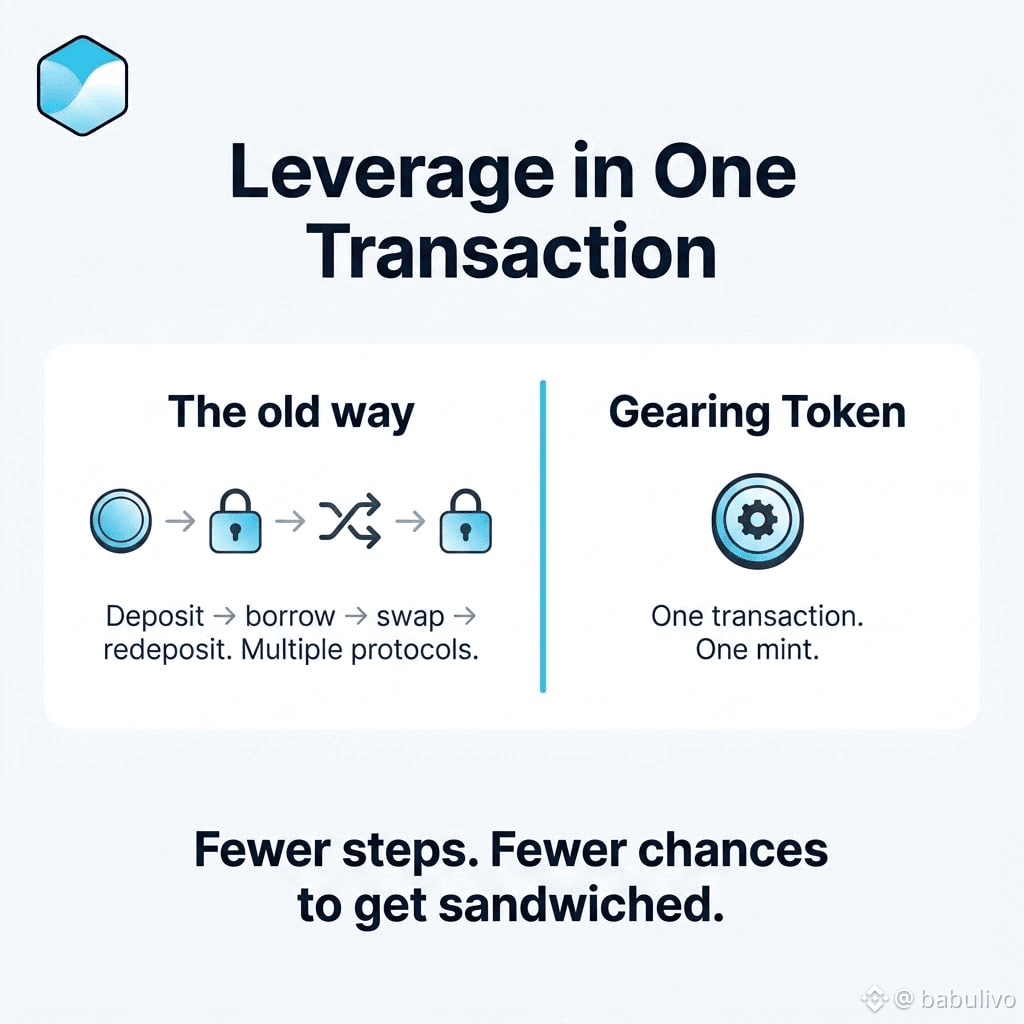
Normally getting leveraged exposure in DeFi means a whole sequence of manual steps : deposit collateral, borrow against it, swap the borrowed asset, redeposit, sometimes across two or three different protocols just to get one leveraged position open.
TermMax packages that entire sequence into something called a Gearing Token. One transaction, and the leverage process that would've taken multiple steps (and multiple chances to mess something up or get sandwiched) just happens as a single token mint.
Feels like the kind of thing that quietly removes a ton of the operational risk people don't talk about. Every extra manual step in a leverage loop is another spot where slippage or a failed transaction can wreck the position before it's even open.
Anyone here actually built a leverage position the old manual way across multiple protocols before? Curious how much of a pain it actually was compared to this.
#termmax @termmax
Normally getting leveraged exposure in DeFi means a whole sequence of manual steps : deposit collateral, borrow against it, swap the borrowed asset, redeposit, sometimes across two or three different protocols just to get one leveraged position open.
TermMax packages that entire sequence into something called a Gearing Token. One transaction, and the leverage process that would've taken multiple steps (and multiple chances to mess something up or get sandwiched) just happens as a single token mint.
Feels like the kind of thing that quietly removes a ton of the operational risk people don't talk about. Every extra manual step in a leverage loop is another spot where slippage or a failed transaction can wreck the position before it's even open.
Anyone here actually built a leverage position the old manual way across multiple protocols before? Curious how much of a pain it actually was compared to this.
#termmax @TermMax
TermMax packages that entire sequence into something called a Gearing Token. One transaction, and the leverage process that would've taken multiple steps (and multiple chances to mess something up or get sandwiched) just happens as a single token mint.
Feels like the kind of thing that quietly removes a ton of the operational risk people don't talk about. Every extra manual step in a leverage loop is another spot where slippage or a failed transaction can wreck the position before it's even open.
Anyone here actually built a leverage position the old manual way across multiple protocols before? Curious how much of a pain it actually was compared to this.
#termmax @TermMax
19
13
115
·
--
Vérifié
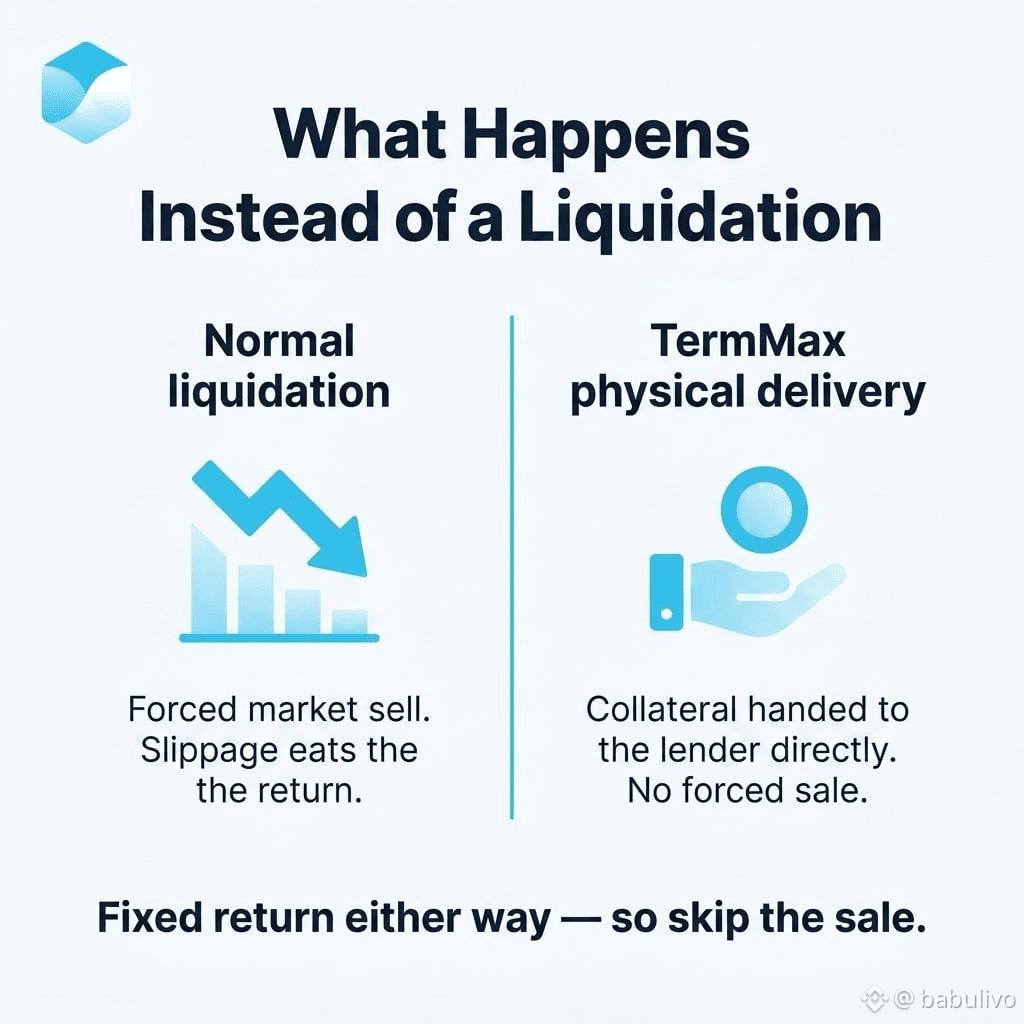
normally when a lending protocol runs into extreme volatility or thin liquidity, you know what happens : forced liquidation, collateral gets dumped on the open market, lender eats whatever slippage that creates
TermMax has this physical delivery mechanism I didn't know about until digging into the docs. instead of forcing a liquidation sale during bad conditions, the protocol just delivers the collateral itself directly to the lender as compensation. no forced market sell, no extra slippage from dumping into a thin order book
makes sense once you think about it -> the lender was promised a fixed return either way, so why route through a liquidation sale at all if you can just hand over the asset directly?
feels like a detail most people never think about until the exact moment they'd actually need it to work
anyone actually had this trigger for them, or is this more of a "good to know it exists" kind of feature?
#termmax @termmax
normally when a lending protocol runs into extreme volatility or thin liquidity, you know what happens : forced liquidation, collateral gets dumped on the open market, lender eats whatever slippage that creates
TermMax has this physical delivery mechanism I didn't know about until digging into the docs. instead of forcing a liquidation sale during bad conditions, the protocol just delivers the collateral itself directly to the lender as compensation. no forced market sell, no extra slippage from dumping into a thin order book
makes sense once you think about it -> the lender was promised a fixed return either way, so why route through a liquidation sale at all if you can just hand over the asset directly?
feels like a detail most people never think about until the exact moment they'd actually need it to work
anyone actually had this trigger for them, or is this more of a "good to know it exists" kind of feature?
#termmax @TermMax
TermMax has this physical delivery mechanism I didn't know about until digging into the docs. instead of forcing a liquidation sale during bad conditions, the protocol just delivers the collateral itself directly to the lender as compensation. no forced market sell, no extra slippage from dumping into a thin order book
makes sense once you think about it -> the lender was promised a fixed return either way, so why route through a liquidation sale at all if you can just hand over the asset directly?
feels like a detail most people never think about until the exact moment they'd actually need it to work
anyone actually had this trigger for them, or is this more of a "good to know it exists" kind of feature?
#termmax @TermMax
12
11
91
·
--
Vérifié
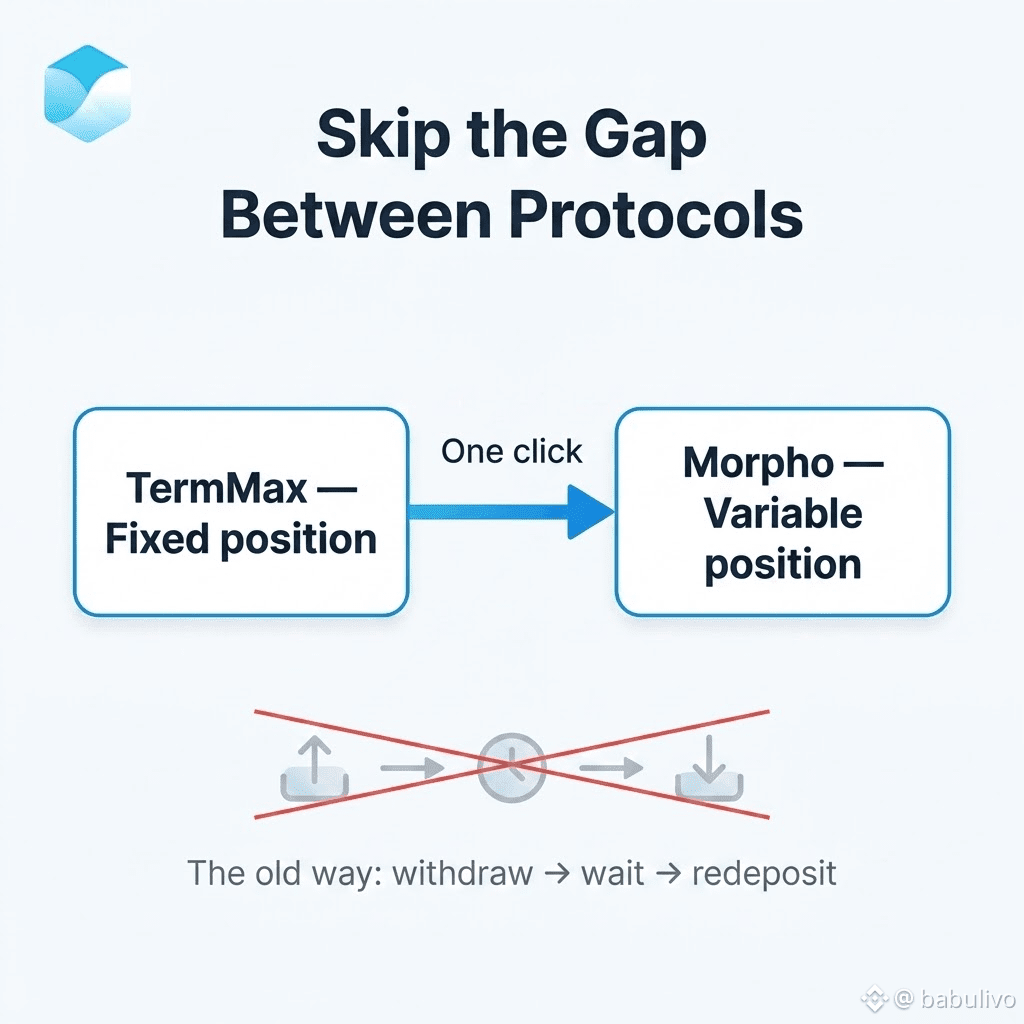
normally rolling a position from one protocol to another means: withdraw, wait, bridge maybe, deposit again, hope nothing breaks in between. that's just how DeFi has worked for years
TermMax skips all of it for this specific move. you can roll a fixed position on TermMax straight into a variable position on Morpho, one click, no manual withdraw/redeposit cycle in between. or exit before maturity if you want out early instead
feels like a small UX detail until you remember how much slippage/gas/downtime usually happens in that gap between protocols. this just removes the gap
anyone actually used this rollover yet, or still doing it the old manual way?
#termmax @termmax
normally rolling a position from one protocol to another means: withdraw, wait, bridge maybe, deposit again, hope nothing breaks in between. that's just how DeFi has worked for years
TermMax skips all of it for this specific move. you can roll a fixed position on TermMax straight into a variable position on Morpho, one click, no manual withdraw/redeposit cycle in between. or exit before maturity if you want out early instead
feels like a small UX detail until you remember how much slippage/gas/downtime usually happens in that gap between protocols. this just removes the gap
anyone actually used this rollover yet, or still doing it the old manual way?
#termmax @TermMax
TermMax skips all of it for this specific move. you can roll a fixed position on TermMax straight into a variable position on Morpho, one click, no manual withdraw/redeposit cycle in between. or exit before maturity if you want out early instead
feels like a small UX detail until you remember how much slippage/gas/downtime usually happens in that gap between protocols. this just removes the gap
anyone actually used this rollover yet, or still doing it the old manual way?
#termmax @TermMax
8
8
89
·
--
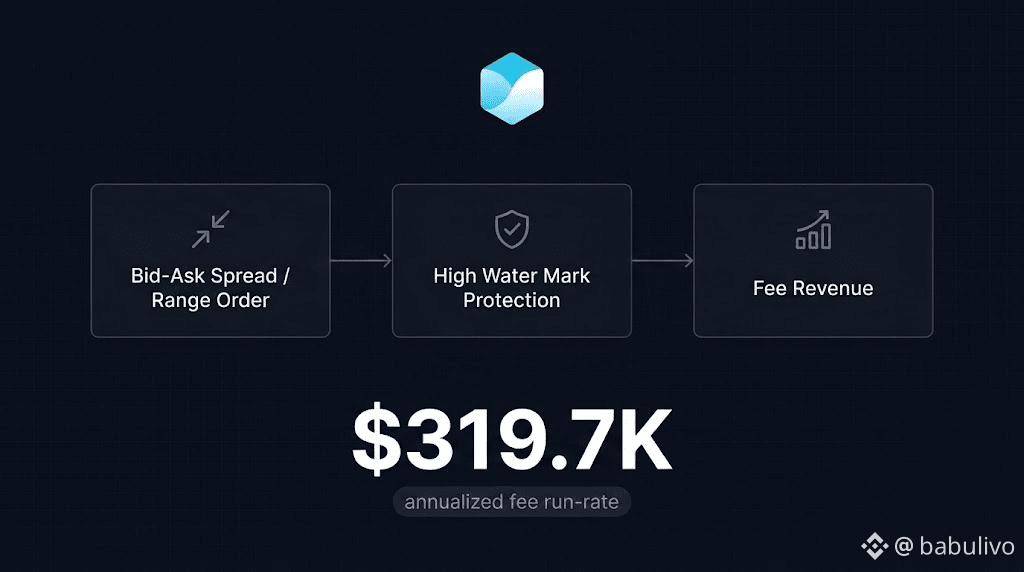
TermMax's curator model isn't just "someone manages a vault" : curators actively set bid-ask spreads on fixed-term loans via Range Orders, basically acting as bond traders pricing different maturities.
That's a market-making role bolted onto risk management, which I haven't seen combined this directly anywhere else.
The part I actually like: performance fees only kick in above a High Water Mark, curators can't collect on gains until they've offset prior losses first. No free rides on volatility.
At a $319.7K annualized fee run-rate on just $34M TVL, the take-rate here is doing more work per dollar than most protocols 10x its size. Curious if that ratio holds once TVL scales past the current concentration on Ethereum.
#termmax @termmax
TermMax's curator model isn't just "someone manages a vault" : curators actively set bid-ask spreads on fixed-term loans via Range Orders, basically acting as bond traders pricing different maturities.
That's a market-making role bolted onto risk management, which I haven't seen combined this directly anywhere else.
The part I actually like: performance fees only kick in above a High Water Mark, curators can't collect on gains until they've offset prior losses first. No free rides on volatility.
At a $319.7K annualized fee run-rate on just $34M TVL, the take-rate here is doing more work per dollar than most protocols 10x its size. Curious if that ratio holds once TVL scales past the current concentration on Ethereum.
#termmax @TermMax
That's a market-making role bolted onto risk management, which I haven't seen combined this directly anywhere else.
The part I actually like: performance fees only kick in above a High Water Mark, curators can't collect on gains until they've offset prior losses first. No free rides on volatility.
At a $319.7K annualized fee run-rate on just $34M TVL, the take-rate here is doing more work per dollar than most protocols 10x its size. Curious if that ratio holds once TVL scales past the current concentration on Ethereum.
#termmax @TermMax
2
7
58
·
--
Vérifié
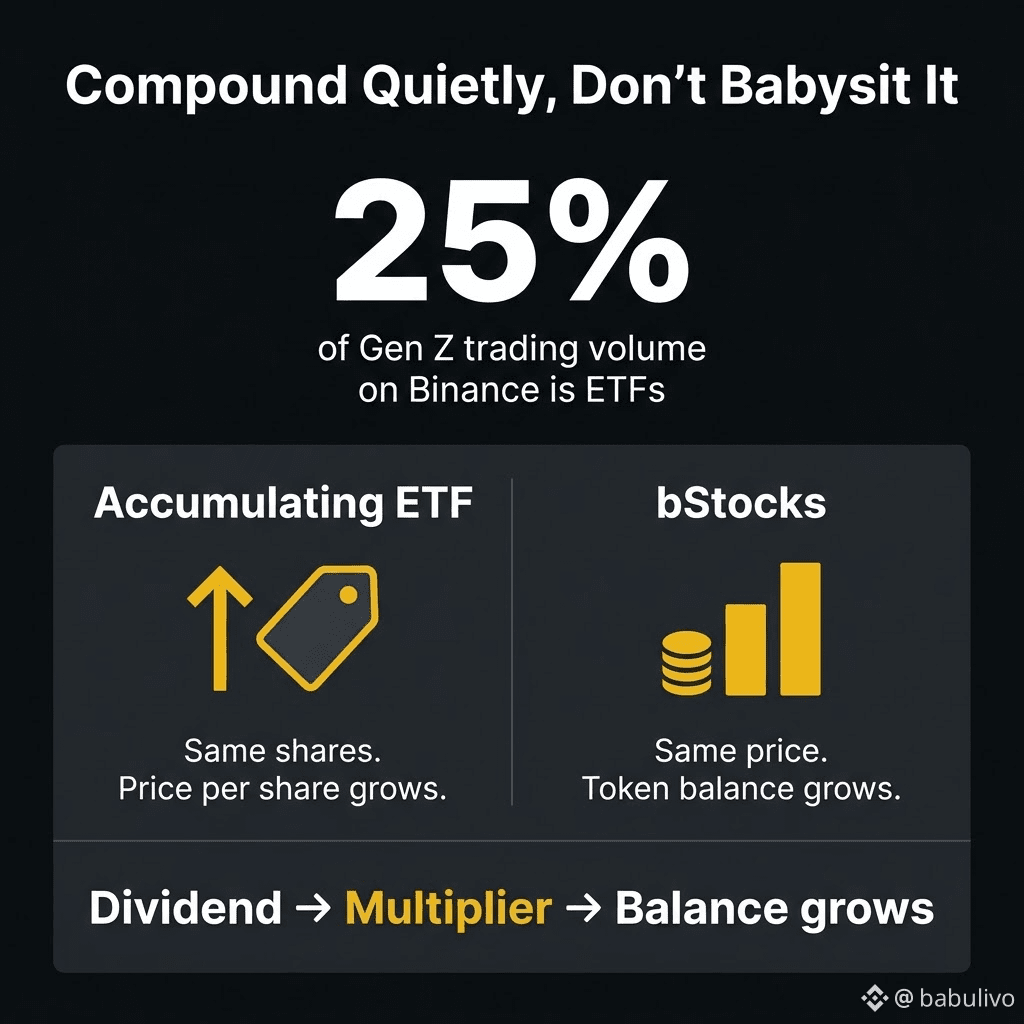
25% of Gen Z's trading volume on Binance right now is ETFs. not single stocks, ETFs
and once you look at how bStocks handles dividends on something like SPY [ $SPYB ], it kind of makes sense why. accumulating ETFs in TradFi never pay cash either, the fund reinvests internally and price per share goes up instead
bStocks does the same idea differently: instead of price moving, your token balance grows through the multiplier. no dividend to claim, no active management, it just compounds on its own
makes me wonder if that Gen Z shift toward ETFs isn't really about chasing 10x anymore, it's more like building something that just compounds quietly on its own, no active management needed. can't say for sure that's the reason, but it lines up with how a lot of people my age talk about not counting on much long-term support elsewhere
is that the actual mindset, or is one stat making me overthink this?
#bstockscis @BinanceCIS
25% of Gen Z's trading volume on Binance right now is ETFs. not single stocks, ETFs
and once you look at how bStocks handles dividends on something like SPY [ $SPYB ], it kind of makes sense why. accumulating ETFs in TradFi never pay cash either, the fund reinvests internally and price per share goes up instead
bStocks does the same idea differently: instead of price moving, your token balance grows through the multiplier. no dividend to claim, no active management, it just compounds on its own
makes me wonder if that Gen Z shift toward ETFs isn't really about chasing 10x anymore, it's more like building something that just compounds quietly on its own, no active management needed. can't say for sure that's the reason, but it lines up with how a lot of people my age talk about not counting on much long-term support elsewhere
is that the actual mindset, or is one stat making me overthink this?
#bstockscis @BinanceCIS
and once you look at how bStocks handles dividends on something like SPY [ $SPYB ], it kind of makes sense why. accumulating ETFs in TradFi never pay cash either, the fund reinvests internally and price per share goes up instead
bStocks does the same idea differently: instead of price moving, your token balance grows through the multiplier. no dividend to claim, no active management, it just compounds on its own
makes me wonder if that Gen Z shift toward ETFs isn't really about chasing 10x anymore, it's more like building something that just compounds quietly on its own, no active management needed. can't say for sure that's the reason, but it lines up with how a lot of people my age talk about not counting on much long-term support elsewhere
is that the actual mindset, or is one stat making me overthink this?
#bstockscis @BinanceCIS
5
9
70
·
--
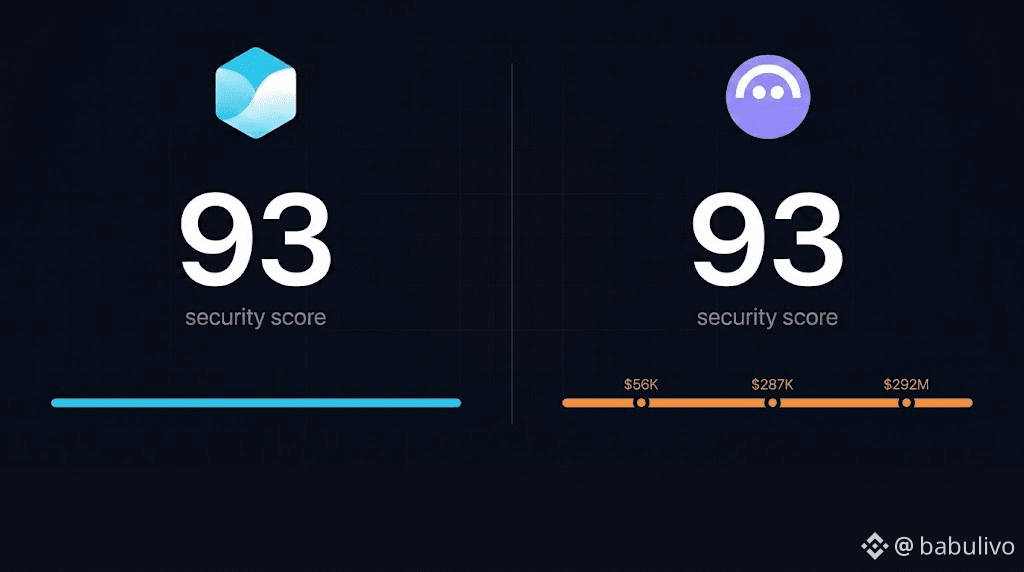
93% security score, same bracket as Aave, but the track records aren't identical.
TermMax: zero incidents since April 2025 launch.
Aave: core contracts never directly exploited, but periphery and integrations have bled hundreds of millions : $56K via an unaudited ParaSwap adapter, $292M exposure through the rsETH/Kelp bridge collapse in April.
Same score doesn't mean same history. Newer isn't automatically less trustworthy.
#termmax @termmax
93% security score, same bracket as Aave, but the track records aren't identical.
TermMax: zero incidents since April 2025 launch.
Aave: core contracts never directly exploited, but periphery and integrations have bled hundreds of millions : $56K via an unaudited ParaSwap adapter, $292M exposure through the rsETH/Kelp bridge collapse in April.
Same score doesn't mean same history. Newer isn't automatically less trustworthy.
#termmax @TermMax
TermMax: zero incidents since April 2025 launch.
Aave: core contracts never directly exploited, but periphery and integrations have bled hundreds of millions : $56K via an unaudited ParaSwap adapter, $292M exposure through the rsETH/Kelp bridge collapse in April.
Same score doesn't mean same history. Newer isn't automatically less trustworthy.
#termmax @TermMax
5
108
·
--
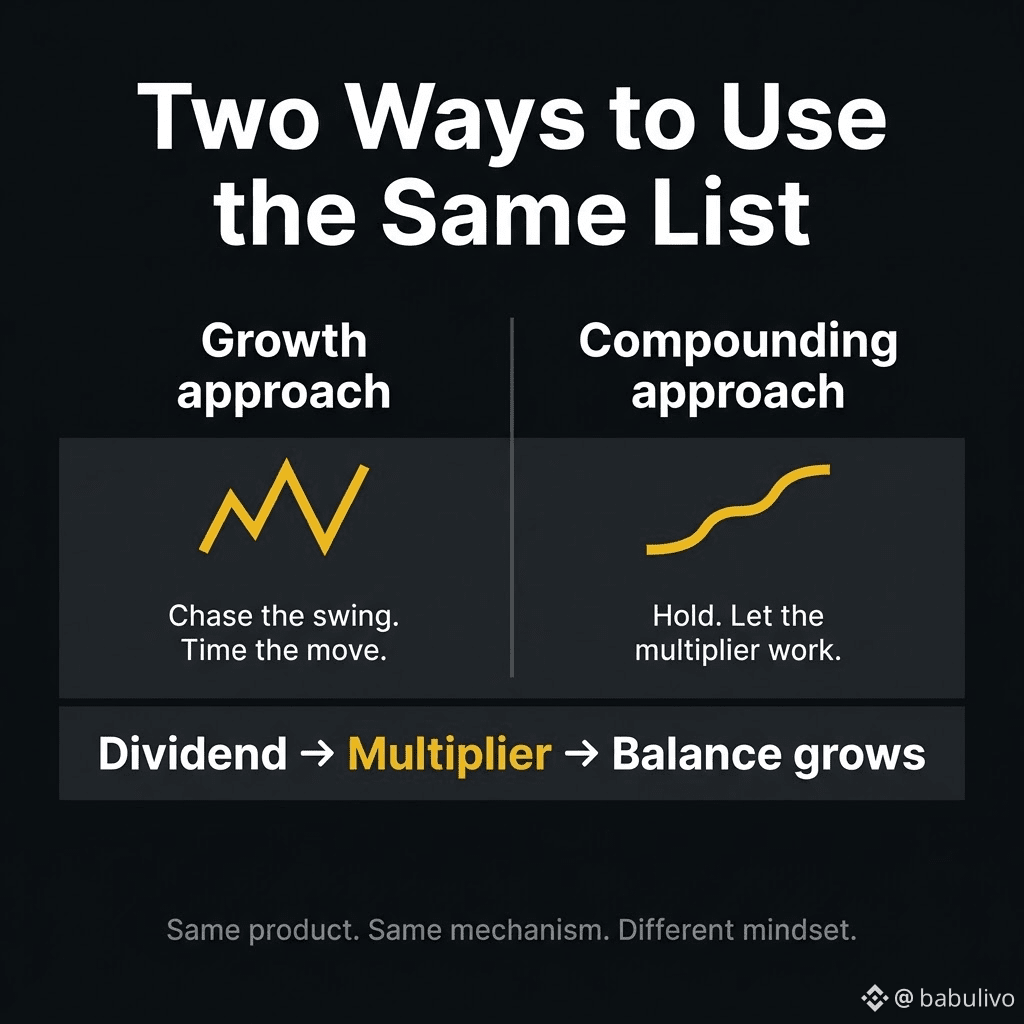
people usually think of bStocks as the "buy Tesla, buy Nvidia, chase the next 10x" product, and sure, that's most of the volume. but there's a second way to use the same list that barely gets talked about
some of the tickers on there like IBM [ $IBMB ], for example, aren't growth plays. they're steady dividend payers. and because of how the multiplier mechanism works, that dividend doesn't sit there waiting for you to claim it, it just accrues straight into your bStock balance automatically. no transfer, no manual reinvestment, it compounds in the background whether you're watching or not
so you end up with two completely different strategies living on the exact same list : one is "buy the volatile name, try to time the swing." the other is "buy the boring name, do nothing, let the multiplier quietly stack shares for you."
same product, same mechanism, opposite mindset
which camp are you actually in : chasing the swings, or letting something boring sit and compound?
i'm chasing the swings btw :)
#bstockscis @BinanceCIS
people usually think of bStocks as the "buy Tesla, buy Nvidia, chase the next 10x" product, and sure, that's most of the volume. but there's a second way to use the same list that barely gets talked about
some of the tickers on there like IBM [ $IBMB ], for example, aren't growth plays. they're steady dividend payers. and because of how the multiplier mechanism works, that dividend doesn't sit there waiting for you to claim it, it just accrues straight into your bStock balance automatically. no transfer, no manual reinvestment, it compounds in the background whether you're watching or not
so you end up with two completely different strategies living on the exact same list : one is "buy the volatile name, try to time the swing." the other is "buy the boring name, do nothing, let the multiplier quietly stack shares for you."
same product, same mechanism, opposite mindset
which camp are you actually in : chasing the swings, or letting something boring sit and compound?
i'm chasing the swings btw :)
#bstockscis @BinanceCIS
some of the tickers on there like IBM [ $IBMB ], for example, aren't growth plays. they're steady dividend payers. and because of how the multiplier mechanism works, that dividend doesn't sit there waiting for you to claim it, it just accrues straight into your bStock balance automatically. no transfer, no manual reinvestment, it compounds in the background whether you're watching or not
so you end up with two completely different strategies living on the exact same list : one is "buy the volatile name, try to time the swing." the other is "buy the boring name, do nothing, let the multiplier quietly stack shares for you."
same product, same mechanism, opposite mindset
which camp are you actually in : chasing the swings, or letting something boring sit and compound?
i'm chasing the swings btw :)
#bstockscis @BinanceCIS
3
5
71
·
--
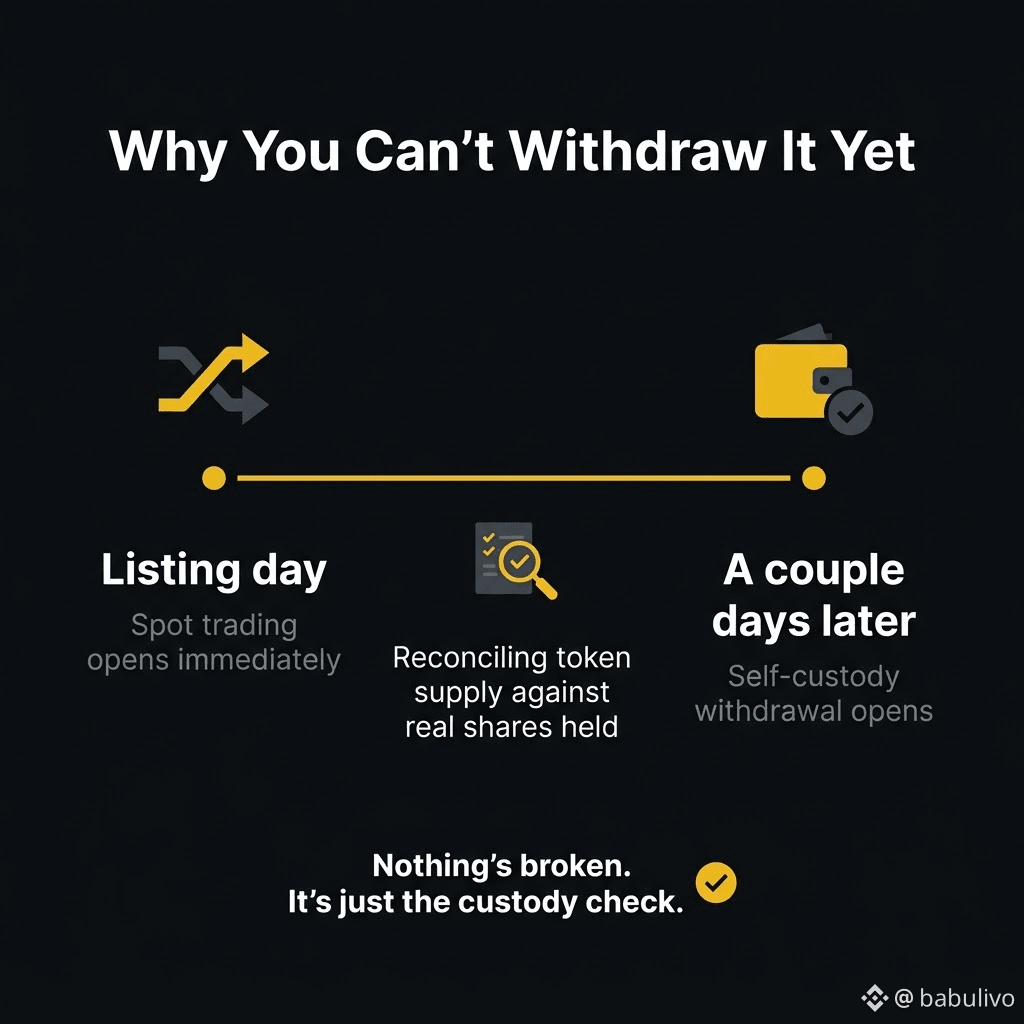
saw someone in a group chat panicking because they bought a fresh bStock listing and couldn't withdraw it to their wallet yet, thought something was broken
nothing's broken, it's just how the rollout works. when a new bStock lists, spot trading opens immediately, but self-custody withdrawal to your own wallet opens a couple days later. for example, trading started on the 27th and withdrawals didn't open until the 29th
makes sense once you think about why. every token has to be backed 1:1 by a real share held with the custodian first, and that reconciliation between "how many tokens exist" and "how many real shares are actually held" needs to actually happen before anyone's allowed to move tokens off-platform. trading against existing liquidity is fine in the meantime, self-custody isn't, until that's confirmed
good thing to know before you panic-refresh your wallet after buying something on day one
did the delay ever throw you off, or is this common knowledge by now and I'm just late to it?
#bstockscis @BinanceCIS
saw someone in a group chat panicking because they bought a fresh bStock listing and couldn't withdraw it to their wallet yet, thought something was broken
nothing's broken, it's just how the rollout works. when a new bStock lists, spot trading opens immediately, but self-custody withdrawal to your own wallet opens a couple days later. for example, trading started on the 27th and withdrawals didn't open until the 29th
makes sense once you think about why. every token has to be backed 1:1 by a real share held with the custodian first, and that reconciliation between "how many tokens exist" and "how many real shares are actually held" needs to actually happen before anyone's allowed to move tokens off-platform. trading against existing liquidity is fine in the meantime, self-custody isn't, until that's confirmed
good thing to know before you panic-refresh your wallet after buying something on day one
did the delay ever throw you off, or is this common knowledge by now and I'm just late to it?
#bstockscis @BinanceCIS
nothing's broken, it's just how the rollout works. when a new bStock lists, spot trading opens immediately, but self-custody withdrawal to your own wallet opens a couple days later. for example, trading started on the 27th and withdrawals didn't open until the 29th
makes sense once you think about why. every token has to be backed 1:1 by a real share held with the custodian first, and that reconciliation between "how many tokens exist" and "how many real shares are actually held" needs to actually happen before anyone's allowed to move tokens off-platform. trading against existing liquidity is fine in the meantime, self-custody isn't, until that's confirmed
good thing to know before you panic-refresh your wallet after buying something on day one
did the delay ever throw you off, or is this common knowledge by now and I'm just late to it?
#bstockscis @BinanceCIS
2
77
·
--
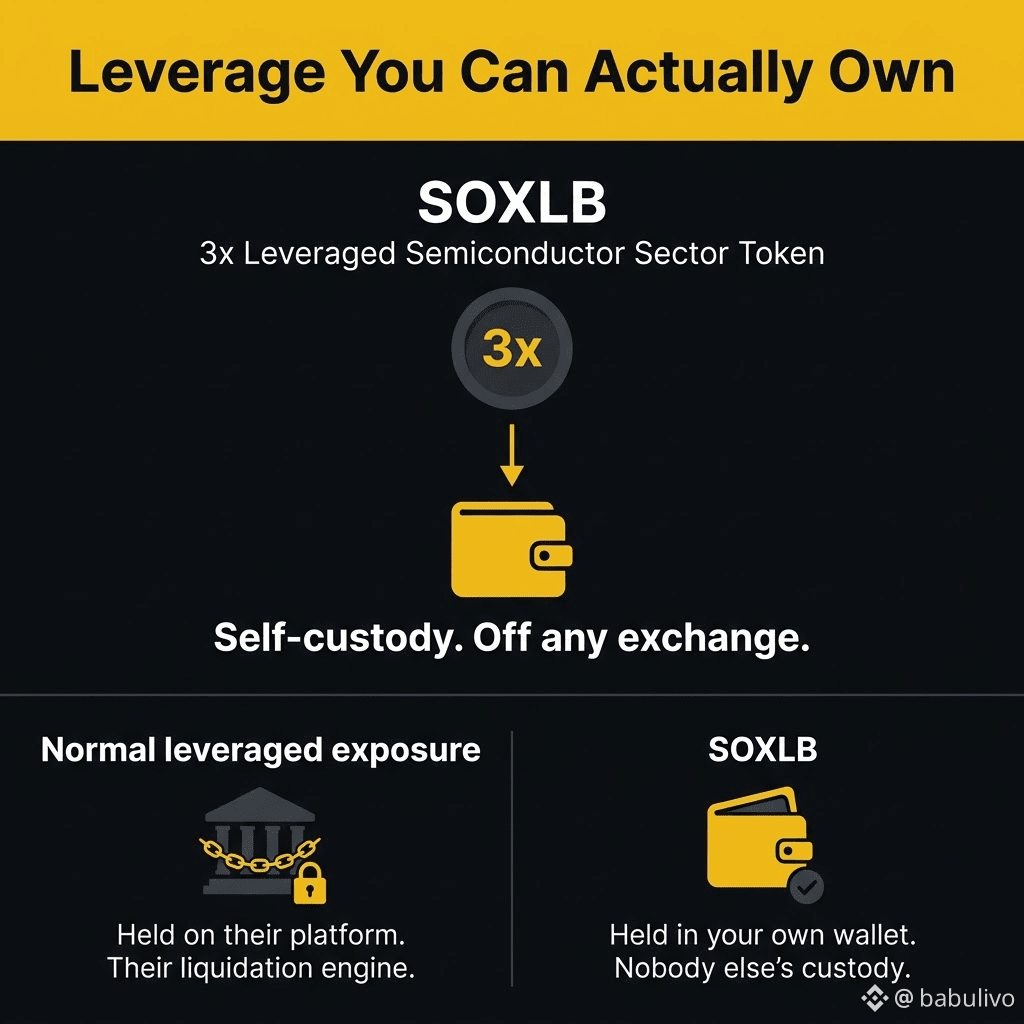
most people scrolling the bStocks list are looking for Apple or Tesla and skip right past $SOXLB , which is honestly the more interesting listing if you actually read what it is
it's not just a semiconductor stock. it's a 3x leveraged token tracking the whole chip sector : Nvidia, AMD, Micron, that whole basket, amplified. on a regular brokerage account, getting that kind of leverage means options, futures, or a margin account with actual approval requirements
here it's just a BEP-20 token. so you can withdraw a literal 3x leveraged position to your own cold wallet. no CEX holding your position, no perp-DEX tracking your margin, no liquidation engine watching you 24/7 in someone else's hands. the leverage is baked into the token itself, sitting in your own custody
that's not really a thing anywhere else. leveraged exposure usually means someone else is holding your position hostage on their platform. this is leverage you can just... own
would you actually hold something like this, or does 3x leverage on an entire sector sound like a fast way to get zeroed?
#bstockscis @BinanceCIS
most people scrolling the bStocks list are looking for Apple or Tesla and skip right past $SOXLB , which is honestly the more interesting listing if you actually read what it is
it's not just a semiconductor stock. it's a 3x leveraged token tracking the whole chip sector : Nvidia, AMD, Micron, that whole basket, amplified. on a regular brokerage account, getting that kind of leverage means options, futures, or a margin account with actual approval requirements
here it's just a BEP-20 token. so you can withdraw a literal 3x leveraged position to your own cold wallet. no CEX holding your position, no perp-DEX tracking your margin, no liquidation engine watching you 24/7 in someone else's hands. the leverage is baked into the token itself, sitting in your own custody
that's not really a thing anywhere else. leveraged exposure usually means someone else is holding your position hostage on their platform. this is leverage you can just... own
would you actually hold something like this, or does 3x leverage on an entire sector sound like a fast way to get zeroed?
#bstockscis @BinanceCIS
it's not just a semiconductor stock. it's a 3x leveraged token tracking the whole chip sector : Nvidia, AMD, Micron, that whole basket, amplified. on a regular brokerage account, getting that kind of leverage means options, futures, or a margin account with actual approval requirements
here it's just a BEP-20 token. so you can withdraw a literal 3x leveraged position to your own cold wallet. no CEX holding your position, no perp-DEX tracking your margin, no liquidation engine watching you 24/7 in someone else's hands. the leverage is baked into the token itself, sitting in your own custody
that's not really a thing anywhere else. leveraged exposure usually means someone else is holding your position hostage on their platform. this is leverage you can just... own
would you actually hold something like this, or does 3x leverage on an entire sector sound like a fast way to get zeroed?
#bstockscis @BinanceCIS
3
79
·
--
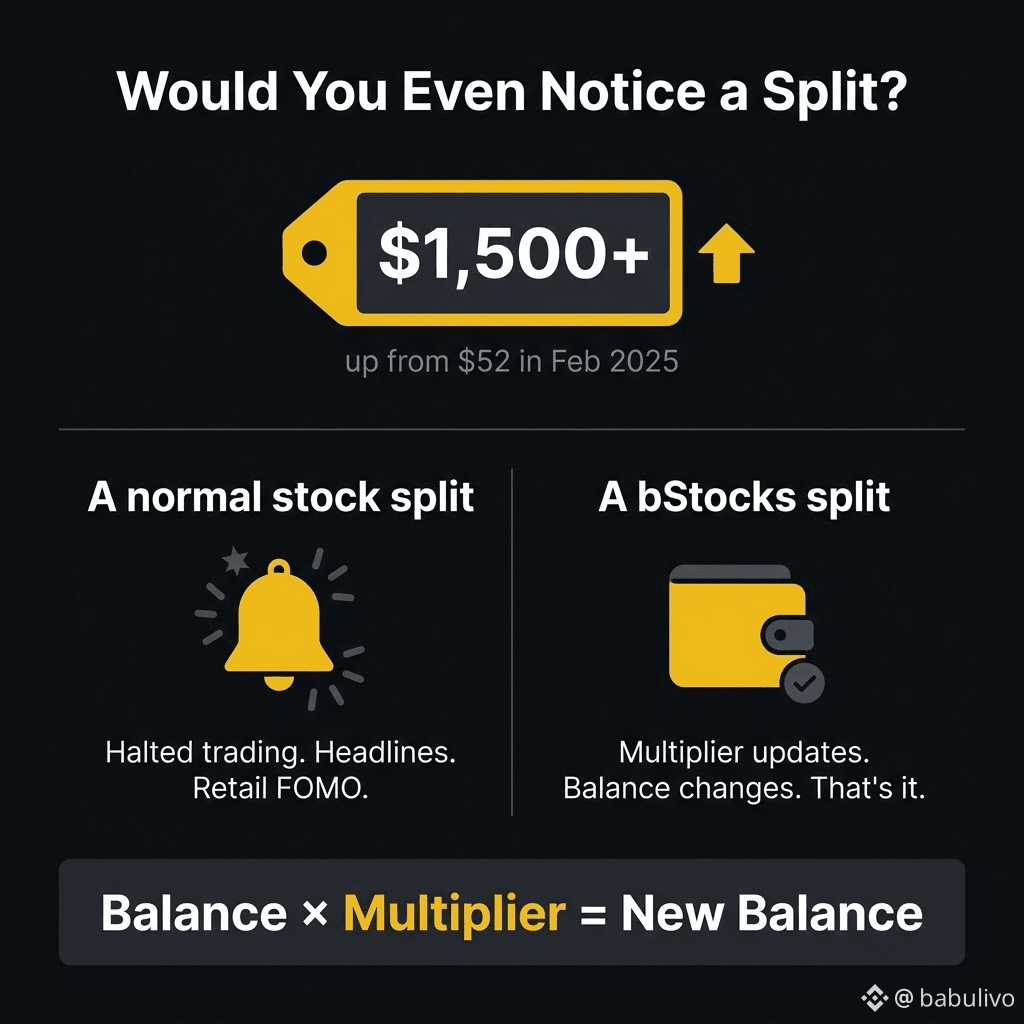
wow. SanDisk is trading north of $1,500 a share right now. up more than 3,000% since it spun off from Western Digital at $52 in February 2025. and it's never once split its stock
Motley Fool put out a piece this week basically saying SanDisk checks every box for a split candidate - quadruple-digit price, huge retail interest, zero splits in its history as a standalone company. nothing confirmed, just the obvious speculation everyone's having
here's the part I actually care about: if SanDisk does split, what does a $SNDKB holder even see happen? based on how the multiplier mechanism works, probably nothing. no new tokens landing in your wallet, no transaction to point to. the split just gets absorbed and your existing balance quietly reflects it
which is kind of wild given how much attention split announcements usually get on a normal stock : halted trading, headlines, retail FOMO buying in anticipation. on bStocks it might just be a non-event you'd only notice by checking your balance
curious if people would even want a heads up before that happens, or if it not mattering is the whole point...
#bstockscis @BinanceCIS
wow. SanDisk is trading north of $1,500 a share right now. up more than 3,000% since it spun off from Western Digital at $52 in February 2025. and it's never once split its stock
Motley Fool put out a piece this week basically saying SanDisk checks every box for a split candidate - quadruple-digit price, huge retail interest, zero splits in its history as a standalone company. nothing confirmed, just the obvious speculation everyone's having
here's the part I actually care about: if SanDisk does split, what does a $SNDKB holder even see happen? based on how the multiplier mechanism works, probably nothing. no new tokens landing in your wallet, no transaction to point to. the split just gets absorbed and your existing balance quietly reflects it
which is kind of wild given how much attention split announcements usually get on a normal stock : halted trading, headlines, retail FOMO buying in anticipation. on bStocks it might just be a non-event you'd only notice by checking your balance
curious if people would even want a heads up before that happens, or if it not mattering is the whole point...
#bstockscis @BinanceCIS
Motley Fool put out a piece this week basically saying SanDisk checks every box for a split candidate - quadruple-digit price, huge retail interest, zero splits in its history as a standalone company. nothing confirmed, just the obvious speculation everyone's having
here's the part I actually care about: if SanDisk does split, what does a $SNDKB holder even see happen? based on how the multiplier mechanism works, probably nothing. no new tokens landing in your wallet, no transaction to point to. the split just gets absorbed and your existing balance quietly reflects it
which is kind of wild given how much attention split announcements usually get on a normal stock : halted trading, headlines, retail FOMO buying in anticipation. on bStocks it might just be a non-event you'd only notice by checking your balance
curious if people would even want a heads up before that happens, or if it not mattering is the whole point...
#bstockscis @BinanceCIS
1
138
·
--
this is a name literally nobody in this whole campaign has mentioned once, and I get why. I only found it by accident lol
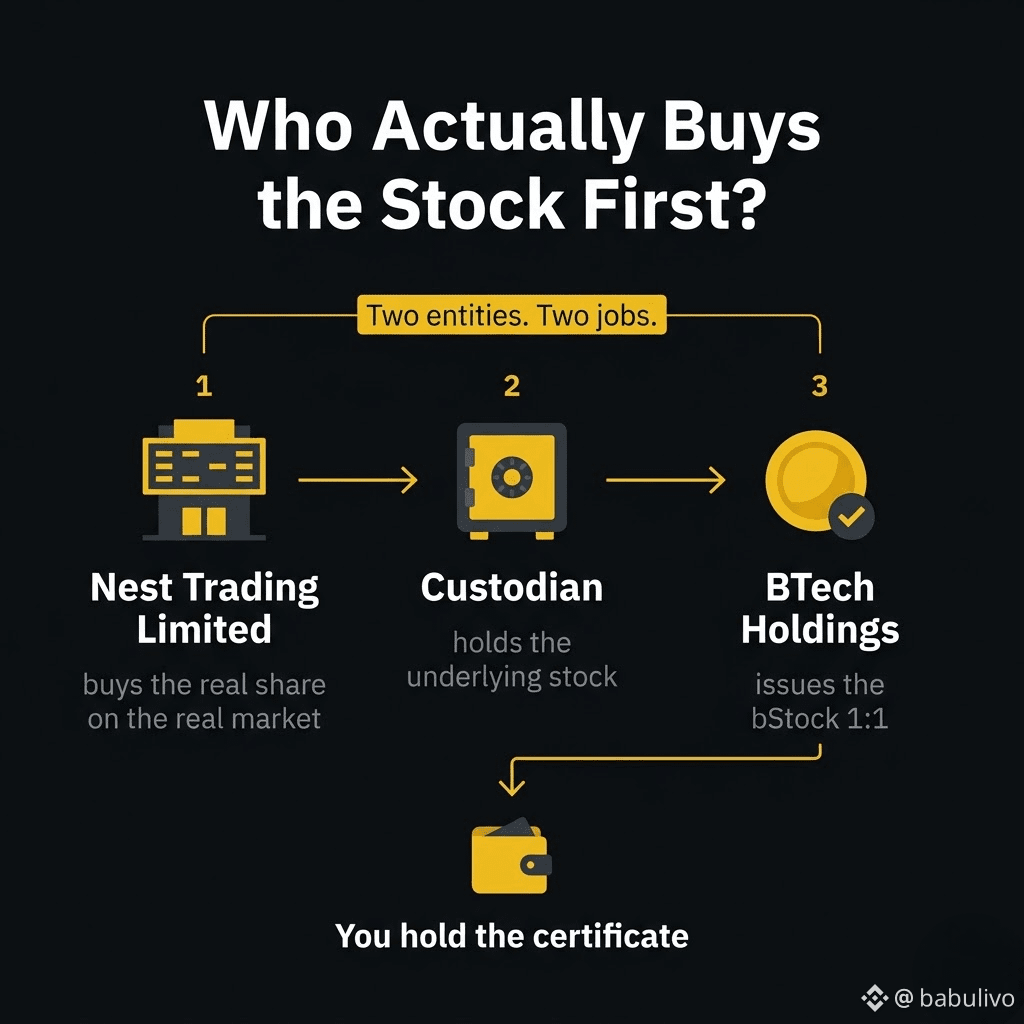
before a bStock exists, someone has to actually go buy the real share first. that someone is a broker-dealer called Nest Trading Limited. it buys Nvidia [ $NVDAB ], Tesla [ $TSLAB ], whatever the underlying is, on the actual market, holds it with a custodian, and only then does BTech Holdings issue the token against it
two completely separate entities doing two completely separate jobs. one is out there executing a real trade on a real exchange, the other one is the name that shows up when you check what "issues" your bStock
anyone here actually knew this names before now?
#bstockscis @BinanceCIS
this is a name literally nobody in this whole campaign has mentioned once, and I get why. I only found it by accident lol
before a bStock exists, someone has to actually go buy the real share first. that someone is a broker-dealer called Nest Trading Limited. it buys Nvidia [ $NVDAB ], Tesla [ $TSLAB ], whatever the underlying is, on the actual market, holds it with a custodian, and only then does BTech Holdings issue the token against it
two completely separate entities doing two completely separate jobs. one is out there executing a real trade on a real exchange, the other one is the name that shows up when you check what "issues" your bStock
anyone here actually knew this names before now?
#bstockscis @BinanceCIS
before a bStock exists, someone has to actually go buy the real share first. that someone is a broker-dealer called Nest Trading Limited. it buys Nvidia [ $NVDAB ], Tesla [ $TSLAB ], whatever the underlying is, on the actual market, holds it with a custodian, and only then does BTech Holdings issue the token against it
two completely separate entities doing two completely separate jobs. one is out there executing a real trade on a real exchange, the other one is the name that shows up when you check what "issues" your bStock
anyone here actually knew this names before now?
#bstockscis @BinanceCIS
1
88
·
--
ok, following up on the dividend thing from before, because turns out it's not just dividends
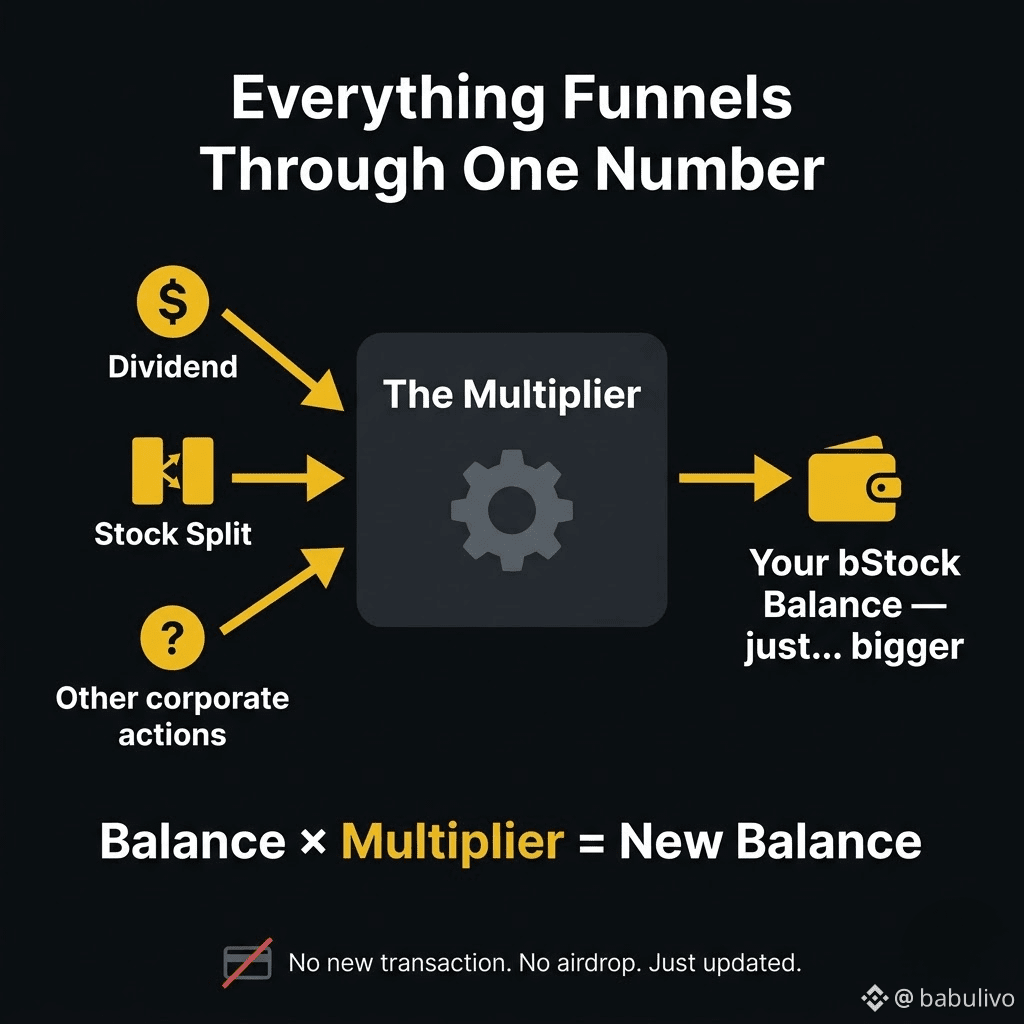
stock splits work through the exact same mechanism. if Tesla [ $TSLAB ] ever does a 2-for-1 split, you don't get airdropped extra tokens and you don't see a new transaction either. the multiplier just adjusts and your existing balance reflects the split automatically
so basically every corporate action : dividends, splits, whatever, funnels through this one invisible number instead of triggering separate events onchain. kind of elegant once you see it, but also means you'll never "see" a split happen, it just already happened by the time you check
makes me wonder what other corporate actions get quietly folded into this before people even notice?
#bstockscis @BinanceCIS
ok, following up on the dividend thing from before, because turns out it's not just dividends
stock splits work through the exact same mechanism. if Tesla [ $TSLAB ] ever does a 2-for-1 split, you don't get airdropped extra tokens and you don't see a new transaction either. the multiplier just adjusts and your existing balance reflects the split automatically
so basically every corporate action : dividends, splits, whatever, funnels through this one invisible number instead of triggering separate events onchain. kind of elegant once you see it, but also means you'll never "see" a split happen, it just already happened by the time you check
makes me wonder what other corporate actions get quietly folded into this before people even notice?
#bstockscis @BinanceCIS
stock splits work through the exact same mechanism. if Tesla [ $TSLAB ] ever does a 2-for-1 split, you don't get airdropped extra tokens and you don't see a new transaction either. the multiplier just adjusts and your existing balance reflects the split automatically
so basically every corporate action : dividends, splits, whatever, funnels through this one invisible number instead of triggering separate events onchain. kind of elegant once you see it, but also means you'll never "see" a split happen, it just already happened by the time you check
makes me wonder what other corporate actions get quietly folded into this before people even notice?
#bstockscis @BinanceCIS
86
·
--
honestly asking, not trying to sell anyone on anything... did you actually buy real or tokenized stocks before, like with your own money, not for promo or something?
because right now stocks are genuinely more volatile and more interesting to watch than most of crypto lol. Tesla [ $TSLAB ] or Nvidia [ $NVDAB ] moving 10% in a day hits different than watching $BTC do nothing for a week
but let's be real, a lot of people got wrecked in the bear market and there's just... no capital left for a second asset class lol. crypto ate all the deposit
the fact, that around 4 in 10 of bStocks users never touched TradFi before, makes me wonder how much of that is genuine curiosity about stocks vs just another try to catch the moonshot after the bear market...
#bstockscis @BinanceCIS
honestly asking, not trying to sell anyone on anything... did you actually buy real or tokenized stocks before, like with your own money, not for promo or something?
because right now stocks are genuinely more volatile and more interesting to watch than most of crypto lol. Tesla [ $TSLAB ] or Nvidia [ $NVDAB ] moving 10% in a day hits different than watching $BTC do nothing for a week
but let's be real, a lot of people got wrecked in the bear market and there's just... no capital left for a second asset class lol. crypto ate all the deposit
the fact, that around 4 in 10 of bStocks users never touched TradFi before, makes me wonder how much of that is genuine curiosity about stocks vs just another try to catch the moonshot after the bear market...
#bstockscis @BinanceCIS
because right now stocks are genuinely more volatile and more interesting to watch than most of crypto lol. Tesla [ $TSLAB ] or Nvidia [ $NVDAB ] moving 10% in a day hits different than watching $BTC do nothing for a week
but let's be real, a lot of people got wrecked in the bear market and there's just... no capital left for a second asset class lol. crypto ate all the deposit
the fact, that around 4 in 10 of bStocks users never touched TradFi before, makes me wonder how much of that is genuine curiosity about stocks vs just another try to catch the moonshot after the bear market...
#bstockscis @BinanceCIS
buy mostly spot
100%
trade mostly futures
0%
promo only or not interested
0%
2 Votes • Vote fermé
232
·
--
wait, how do dividends even work if you're holding a token instead of the actual stock?
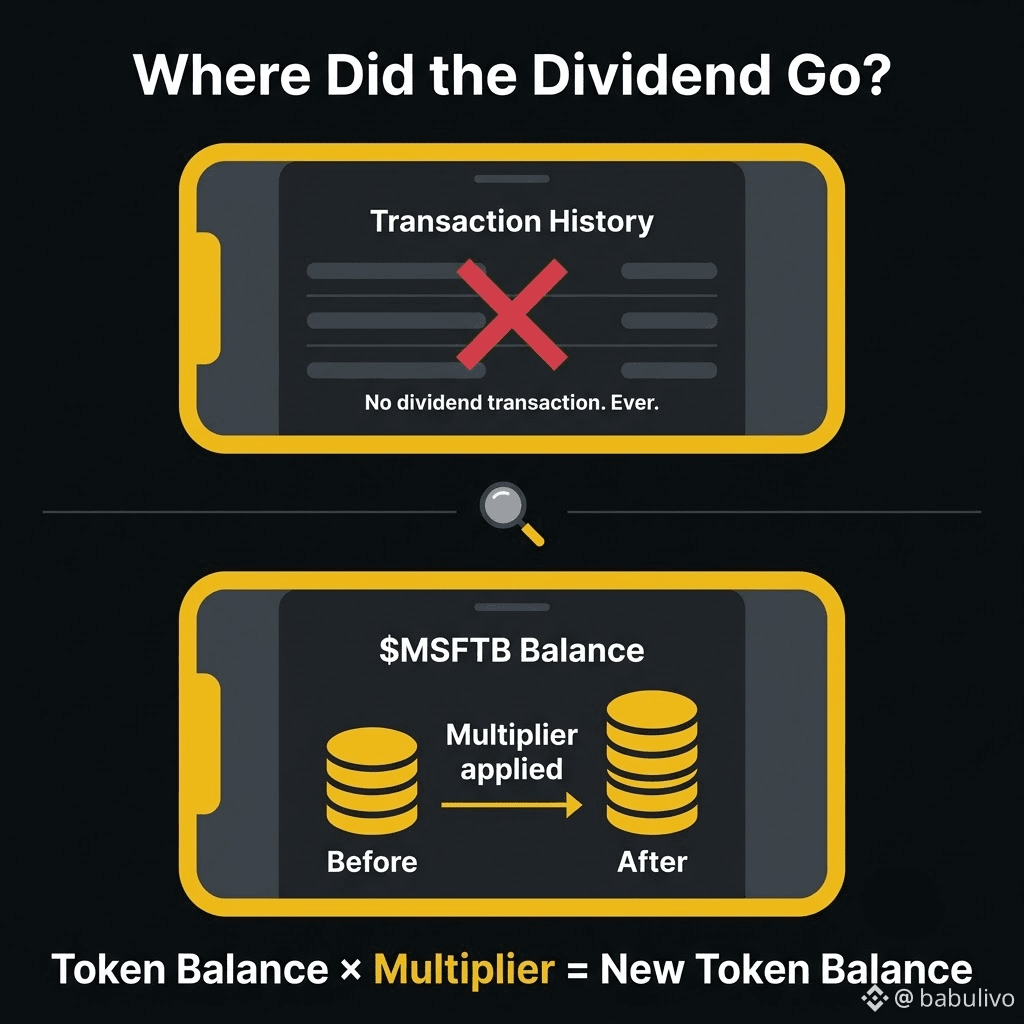
spent way too long down this rabbit hole last night... turns out bStocks don't send you a dividend as a transaction at all. Microsoft pays $0.91 per share quarterly, the network doesn't move that cash to you as a USDC transfer, for example. instead, your total bStock token balance itself increases automatically, through a "multiplier" applied to your holdings, and that's what reflects the dividend
so if you're holding $MSFTB and a dividend hits, nothing shows up in your transaction history. no incoming transfer, no notification you'd recognize as "a dividend." you just check your wallet later and your bStock balance is simply bigger than it was - that's the payout, sitting right there as more tokens
makes sense once you get it, but I get why people scroll their history looking for a payment that was never going to be there in the first place
did anyone else assume this worked like a regular USDC transfer or something before checking?
#bstockscis @BinanceCIS
wait, how do dividends even work if you're holding a token instead of the actual stock?
spent way too long down this rabbit hole last night... turns out bStocks don't send you a dividend as a transaction at all. Microsoft pays $0.91 per share quarterly, the network doesn't move that cash to you as a USDC transfer, for example. instead, your total bStock token balance itself increases automatically, through a "multiplier" applied to your holdings, and that's what reflects the dividend
so if you're holding $MSFTB and a dividend hits, nothing shows up in your transaction history. no incoming transfer, no notification you'd recognize as "a dividend." you just check your wallet later and your bStock balance is simply bigger than it was - that's the payout, sitting right there as more tokens
makes sense once you get it, but I get why people scroll their history looking for a payment that was never going to be there in the first place
did anyone else assume this worked like a regular USDC transfer or something before checking?
#bstockscis @BinanceCIS
spent way too long down this rabbit hole last night... turns out bStocks don't send you a dividend as a transaction at all. Microsoft pays $0.91 per share quarterly, the network doesn't move that cash to you as a USDC transfer, for example. instead, your total bStock token balance itself increases automatically, through a "multiplier" applied to your holdings, and that's what reflects the dividend
so if you're holding $MSFTB and a dividend hits, nothing shows up in your transaction history. no incoming transfer, no notification you'd recognize as "a dividend." you just check your wallet later and your bStock balance is simply bigger than it was - that's the payout, sitting right there as more tokens
makes sense once you get it, but I get why people scroll their history looking for a payment that was never going to be there in the first place
did anyone else assume this worked like a regular USDC transfer or something before checking?
#bstockscis @BinanceCIS
1
108
Connectez-vous pour découvrir plus de contenu
Rejoignez la communauté mondiale des adeptes de cryptomonnaies sur Binance Square
⚡️ Suviez les dernières informations importantes sur les cryptomonnaies.
💬 Jugé digne de confiance par la plus grande plateforme d’échange de cryptomonnaies au monde.
👍 Découvrez les connaissances que partagent les créateurs vérifiés.
Adresse e-mail/Nº de téléphone
Sujets d’actualité
BTCFallsBelow$83000
3,364 vues
62 mentions
🚀 *BTC/USDT — LONG*
💎 75X Cross
📍 *Entry:* 83000 – 82400
🎯 *TP:* 83600 • 84200 • 84800 • 85400
🛑 *SL:* 81388
⚠️ *Risk:* Max 3–5% per trade.
$BTC
jinifer
·3 mentions J’aime
·2.6k vues
BitcoinSpotETFs$2.39BWeeklyNetInflow
144 vues
8 mentions
FedProposesPaymentStablecoinRules
14,534 vues
338 mentions