

Sonu7856
181 Publications

Sonu7856
Signaler
Bloquer l’utilisateur
I am good trader in spot . Binance is a good platform for people
Ouvert au trading
Trade régulièrement
7.3 mois
599 Suivis
10.2K+ Abonnés
1.9K+ J’aime
Publications
Portefeuille
Tous
Citations
PINNED
·
--
#Sonu7856 BNB SURPRISE DROP! 🎁
✨ The Red Packet is full and ready to open! ✨
👇 Simple Steps to Participate 👇
❤️ Follow #Sonu7856
🔁 Like & Share
💬 Comment “BNB”
🔔 Stay connected and active for upcoming surprise drops!
#Crypto #RedPacket #Binance $BNB
#Sonu7856 BNB SURPRISE DROP! 🎁
✨ The Red Packet is full and ready to open! ✨
👇 Simple Steps to Participate 👇
❤️ Follow #Sonu7856
🔁 Like & Share
💬 Comment “BNB”
🔔 Stay connected and active for upcoming surprise drops!
#Crypto #RedPacket #Binance $BNB
✨ The Red Packet is full and ready to open! ✨
👇 Simple Steps to Participate 👇
❤️ Follow #Sonu7856
🔁 Like & Share
💬 Comment “BNB”
🔔 Stay connected and active for upcoming surprise drops!
#Crypto #RedPacket #Binance $BNB

1.3k
16
66
1.3k
·
--
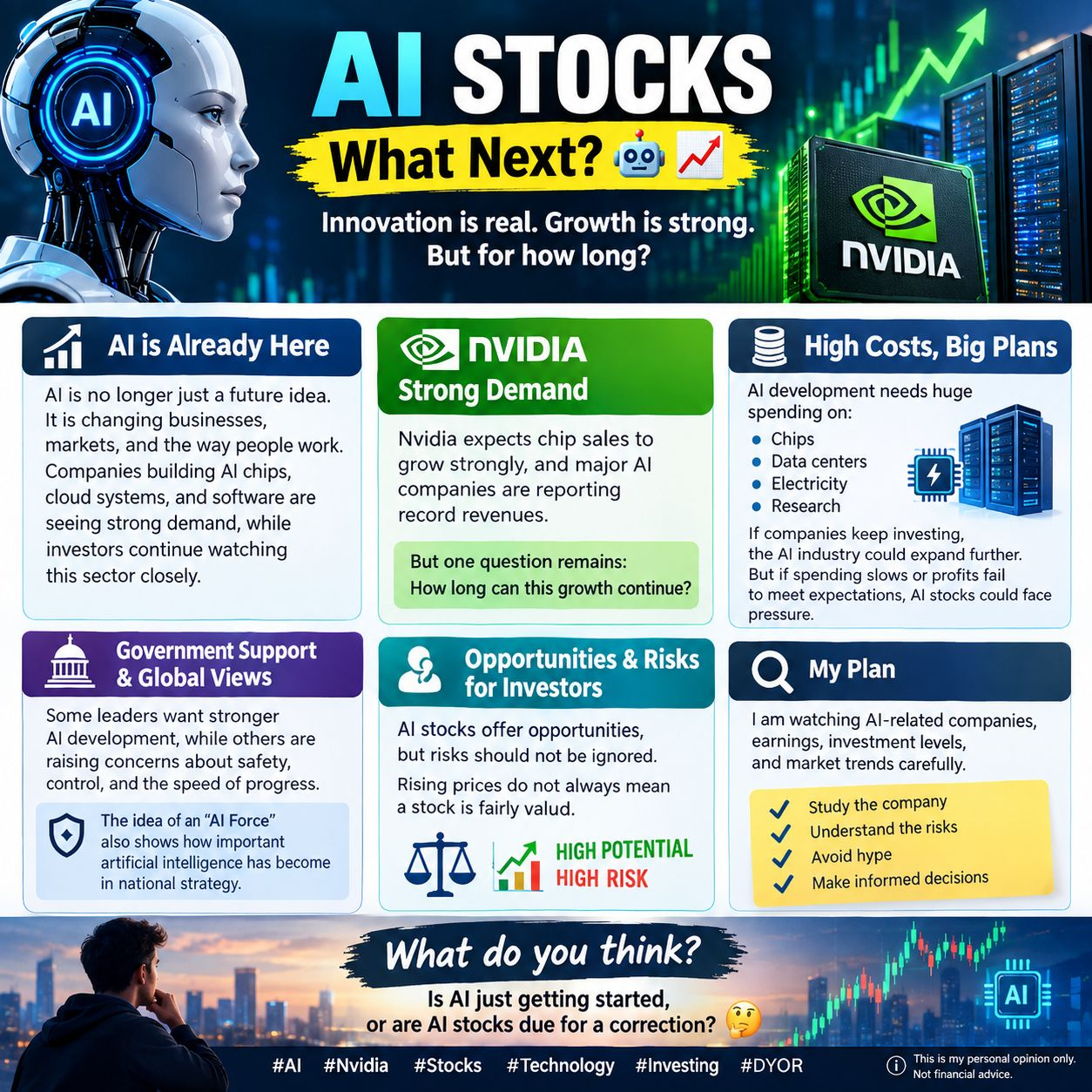
#AIStocksWhatNext 🤖📈
AI is no longer just a future idea. It is already changing businesses, markets, and the way people work. Companies building AI chips, cloud systems, and software are seeing strong demand, while investors continue watching this sector closely.
Nvidia expects chip sales to grow strongly, and major AI companies are reporting record revenues. But one question remains: How long can this growth continue?
AI development needs huge spending on chips, data centers, electricity, and research. If companies keep investing, the AI industry could expand further. However, if spending slows or profits fail to match expectations, AI stocks could face pressure.
Another important point is government support. Some leaders want stronger AI development, while others are raising concerns about safety, control, and the speed of progress. The idea of an “AI Force” also shows how important artificial intelligence has become in national strategy.
For investors, AI stocks offer opportunities, but risks should not be ignored. Rising prices do not always mean a stock is fairly valued.
I am watching AI-related companies, earnings, investment levels, and market trends carefully. Before making any trade, it is important to study the company, understand the risks, and avoid following hype blindly.
What do you think? Is AI just getting started, or are AI stocks due for a correction? 🤔
#Nvidia #Stocks #Technology #DYOR
#AIStocksWhatNext 🤖📈
AI is no longer just a future idea. It is already changing businesses, markets, and the way people work. Companies building AI chips, cloud systems, and software are seeing strong demand, while investors continue watching this sector closely.
Nvidia expects chip sales to grow strongly, and major AI companies are reporting record revenues. But one question remains: How long can this growth continue?
AI development needs huge spending on chips, data centers, electricity, and research. If companies keep investing, the AI industry could expand further. However, if spending slows or profits fail to match expectations, AI stocks could face pressure.
Another important point is government support. Some leaders want stronger AI development, while others are raising concerns about safety, control, and the speed of progress. The idea of an “AI Force” also shows how important artificial intelligence has become in national strategy.
For investors, AI stocks offer opportunities, but risks should not be ignored. Rising prices do not always mean a stock is fairly valued.
I am watching AI-related companies, earnings, investment levels, and market trends carefully. Before making any trade, it is important to study the company, understand the risks, and avoid following hype blindly.
What do you think? Is AI just getting started, or are AI stocks due for a correction? 🤔
#Nvidia #Stocks #Technology #DYOR
AI is no longer just a future idea. It is already changing businesses, markets, and the way people work. Companies building AI chips, cloud systems, and software are seeing strong demand, while investors continue watching this sector closely.
Nvidia expects chip sales to grow strongly, and major AI companies are reporting record revenues. But one question remains: How long can this growth continue?
AI development needs huge spending on chips, data centers, electricity, and research. If companies keep investing, the AI industry could expand further. However, if spending slows or profits fail to match expectations, AI stocks could face pressure.
Another important point is government support. Some leaders want stronger AI development, while others are raising concerns about safety, control, and the speed of progress. The idea of an “AI Force” also shows how important artificial intelligence has become in national strategy.
For investors, AI stocks offer opportunities, but risks should not be ignored. Rising prices do not always mean a stock is fairly valued.
I am watching AI-related companies, earnings, investment levels, and market trends carefully. Before making any trade, it is important to study the company, understand the risks, and avoid following hype blindly.
What do you think? Is AI just getting started, or are AI stocks due for a correction? 🤔
#Nvidia #Stocks #Technology #DYOR
3
244
·
--
$Ethereum (ETH) is one of the most important cryptocurrencies because it powers smart contracts and decentralized applications (dApps). Unlike digital currencies used only for payments, Ethereum enables developers to build DeFi platforms, NFTs, blockchain games, and other innovative services. ETH is also used to pay network transaction fees and secure the blockchain through staking, making it a key part of the growing Web3 ecosystem.
#ClaimYourReward #Ethereum #BinanceSquareFamily
$Ethereum (ETH) is one of the most important cryptocurrencies because it powers smart contracts and decentralized applications (dApps). Unlike digital currencies used only for payments, Ethereum enables developers to build DeFi platforms, NFTs, blockchain games, and other innovative services. ETH is also used to pay network transaction fees and secure the blockchain through staking, making it a key part of the growing Web3 ecosystem.
#ClaimYourReward #Ethereum #BinanceSquareFamily
#ClaimYourReward #Ethereum #BinanceSquareFamily
1.4k
16
79
1.4k
·
--
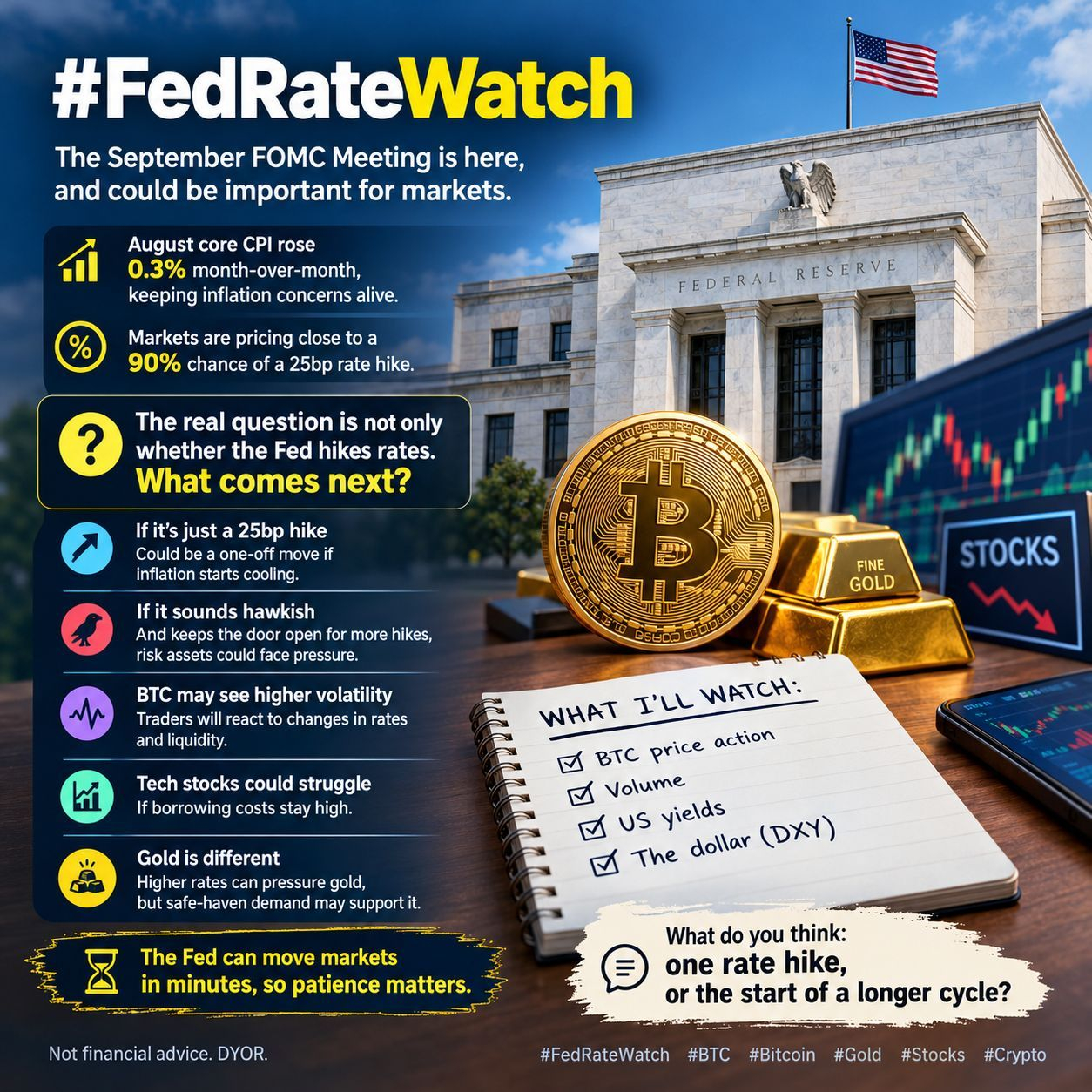
The September FOMC meeting is here, and could be important for markets. August core CPI rose 0.3% month-over-month, keeping inflation concerns alive. Markets are pricing close to a 90% chance of a 25bp rate hike.
For me, the real question is not only whether the Fed hikes rates. The question is what comes next.
If the Fed delivers a 25bp hike, I would not immediately assume a long hiking cycle. It could be a one-off move if inflation starts cooling. But if the Fed sounds more hawkish and keeps the door open for more hikes, risk assets could face pressure.
BTC may see higher volatility because traders will react to changes in rates and liquidity. Tech stocks could also struggle if borrowing costs stay high. Gold is different. Higher rates can pressure gold, but safe-haven demand may support it.
My plan is simple: avoid chasing the first move. I want to watch BTC price action, volume, US yields, and the dollar before making a decision.
The Fed can move markets in minutes, so patience matters.
What do you think: one rate hike, or the start of a longer cycle?
Not financial advice. DYOR.
#FedRateWatch #BTC #Bitcoin #Gold #Stocks
The September FOMC meeting is here, and could be important for markets. August core CPI rose 0.3% month-over-month, keeping inflation concerns alive. Markets are pricing close to a 90% chance of a 25bp rate hike.
For me, the real question is not only whether the Fed hikes rates. The question is what comes next.
If the Fed delivers a 25bp hike, I would not immediately assume a long hiking cycle. It could be a one-off move if inflation starts cooling. But if the Fed sounds more hawkish and keeps the door open for more hikes, risk assets could face pressure.
BTC may see higher volatility because traders will react to changes in rates and liquidity. Tech stocks could also struggle if borrowing costs stay high. Gold is different. Higher rates can pressure gold, but safe-haven demand may support it.
My plan is simple: avoid chasing the first move. I want to watch BTC price action, volume, US yields, and the dollar before making a decision.
The Fed can move markets in minutes, so patience matters.
What do you think: one rate hike, or the start of a longer cycle?
Not financial advice. DYOR.
#FedRateWatch #BTC #Bitcoin #Gold #Stocks
For me, the real question is not only whether the Fed hikes rates. The question is what comes next.
If the Fed delivers a 25bp hike, I would not immediately assume a long hiking cycle. It could be a one-off move if inflation starts cooling. But if the Fed sounds more hawkish and keeps the door open for more hikes, risk assets could face pressure.
BTC may see higher volatility because traders will react to changes in rates and liquidity. Tech stocks could also struggle if borrowing costs stay high. Gold is different. Higher rates can pressure gold, but safe-haven demand may support it.
My plan is simple: avoid chasing the first move. I want to watch BTC price action, volume, US yields, and the dollar before making a decision.
The Fed can move markets in minutes, so patience matters.
What do you think: one rate hike, or the start of a longer cycle?
Not financial advice. DYOR.
#FedRateWatch #BTC #Bitcoin #Gold #Stocks
1
5
562
·
--
‼️$DOGE 🐕 Reward is here ‼️
I’m sharing $DOGE rewards with the community as a Bigger thank-you.
✨ Just claim your reward and enjoy! ✨
Claim it. Get rewarded
@dogecoin_official _ $DOGE #doge⚡
‼️$DOGE 🐕 Reward is here ‼️
I’m sharing $DOGE rewards with the community as a Bigger thank-you.
✨ Just claim your reward and enjoy! ✨
Claim it. Get rewarded
@Doge Coin _ $DOGE #doge⚡
I’m sharing $DOGE rewards with the community as a Bigger thank-you.
✨ Just claim your reward and enjoy! ✨
Claim it. Get rewarded
@Doge Coin _ $DOGE #doge⚡

1.2k
15
65
1.2k
·
--
$SOL 🐕 Reward is here ‼️
I’m sharing $SOL rewards with the community as a Bigger thank-you.
✨ Just claim your reward and enjoy! ✨
Claim it. Get rewarded
$SOL #solana
$SOL 🐕 Reward is here ‼️
I’m sharing $SOL rewards with the community as a Bigger thank-you.
✨ Just claim your reward and enjoy! ✨
Claim it. Get rewarded
$SOL #solana
I’m sharing $SOL rewards with the community as a Bigger thank-you.
✨ Just claim your reward and enjoy! ✨
Claim it. Get rewarded
$SOL #solana


1.4k
24
94
1.4k
·
--
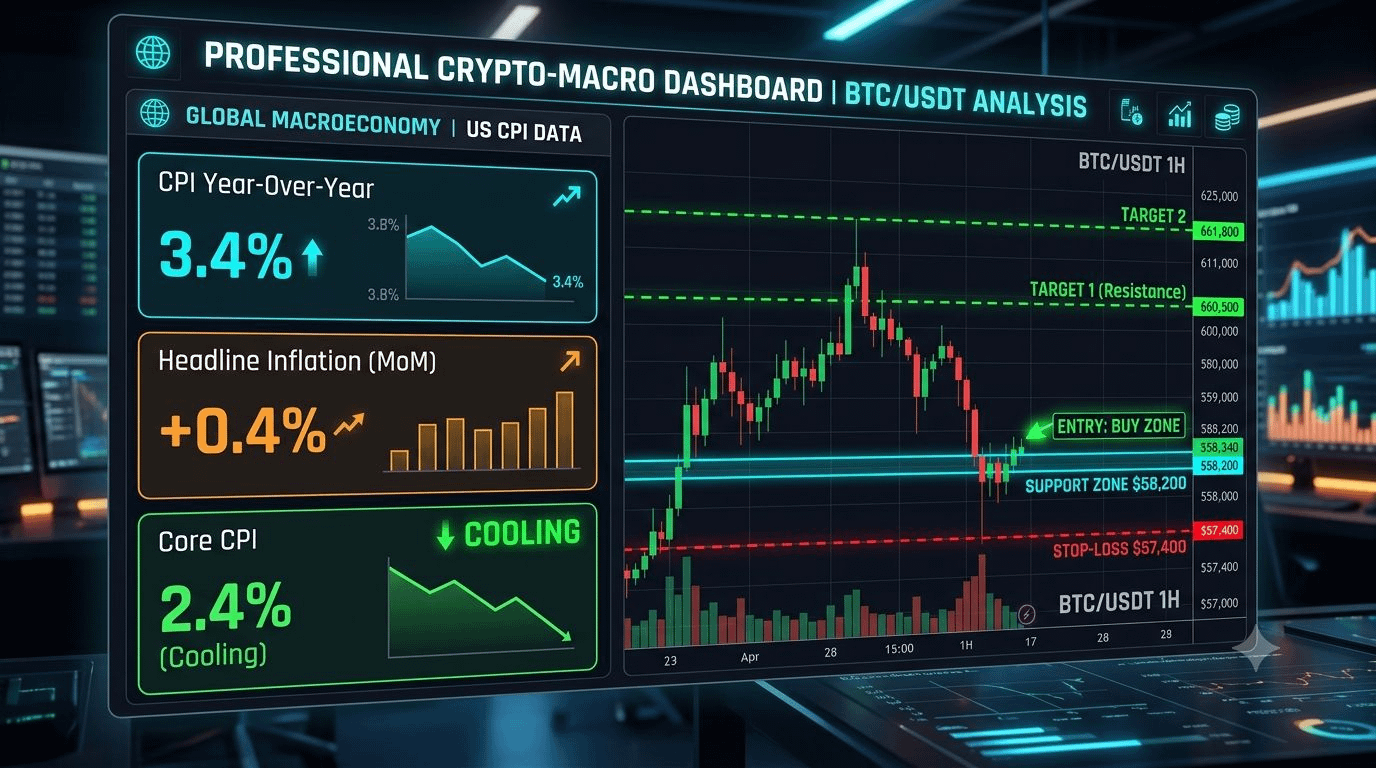
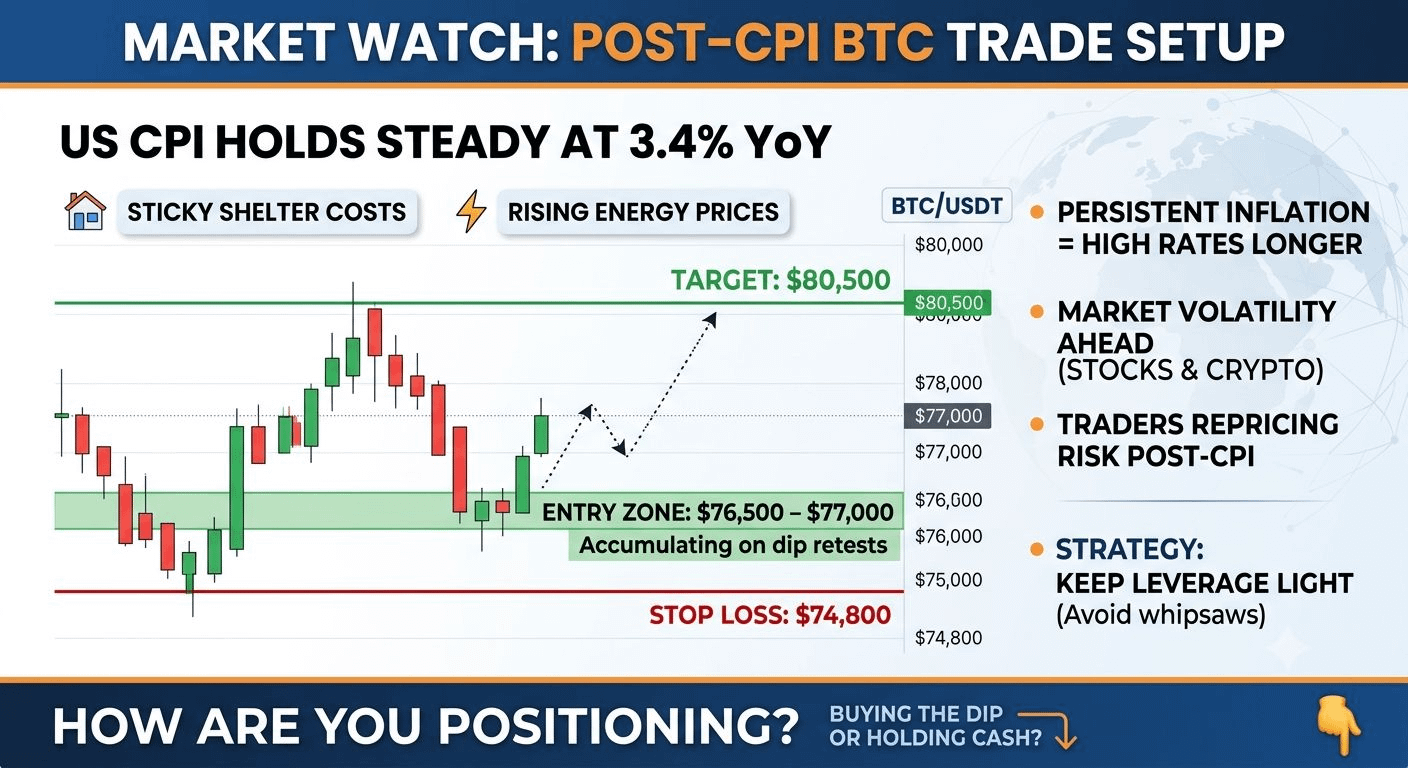
The latest US CPI report is out, and inflation holds steady at 3.4% year-over-year. As expected, sticky shelter costs and rising energy prices kept the numbers elevated.
My Take: Markets took an immediate dip right after the release before quickly absorbing the shock.
The real tension isn't just inflation itself—it is what the Federal Reserve will do next. With persistent price pressures, the chances of high interest rates sticking around longer are very real. Expect sharp short-term volatility across both traditional stock indices and crypto markets as traders reprice risk before the upcoming Fed meeting.
My Trade Setup:
Pair: BTC/USDT
Entry Zone: $76,500 – $77,000 (Accumulating on dip retests)
Target: $80,500
Stop Loss: $74,800
Strategy: Keeping leverage light to avoid unexpected volatility whipsaws.
How are you positioning your portfolio after this inflation update? Are you buying the dip or holding cash on the sidelines? Let me know below! 👇
#CPIWatch
#BTC
The latest US CPI report is out, and inflation holds steady at 3.4% year-over-year. As expected, sticky shelter costs and rising energy prices kept the numbers elevated.
My Take: Markets took an immediate dip right after the release before quickly absorbing the shock.
The real tension isn't just inflation itself—it is what the Federal Reserve will do next. With persistent price pressures, the chances of high interest rates sticking around longer are very real. Expect sharp short-term volatility across both traditional stock indices and crypto markets as traders reprice risk before the upcoming Fed meeting.
My Trade Setup:
Pair: BTC/USDT
Entry Zone: $76,500 – $77,000 (Accumulating on dip retests)
Target: $80,500
Stop Loss: $74,800
Strategy: Keeping leverage light to avoid unexpected volatility whipsaws.
How are you positioning your portfolio after this inflation update? Are you buying the dip or holding cash on the sidelines? Let me know below! 👇
#CPIWatch
#BTC
My Take: Markets took an immediate dip right after the release before quickly absorbing the shock.
The real tension isn't just inflation itself—it is what the Federal Reserve will do next. With persistent price pressures, the chances of high interest rates sticking around longer are very real. Expect sharp short-term volatility across both traditional stock indices and crypto markets as traders reprice risk before the upcoming Fed meeting.
My Trade Setup:
Pair: BTC/USDT
Entry Zone: $76,500 – $77,000 (Accumulating on dip retests)
Target: $80,500
Stop Loss: $74,800
Strategy: Keeping leverage light to avoid unexpected volatility whipsaws.
How are you positioning your portfolio after this inflation update? Are you buying the dip or holding cash on the sidelines? Let me know below! 👇
#CPIWatch
#BTC
3
4
451
·
--
‼️$DOGE 🐕 Reward is here ‼️
I’m sharing $DOGE rewards with the community as a Bigger thank-you.
✨ Just claim your reward and enjoy! ✨
Claim it. Get rewarded
@dogecoin_official _ $DOGE #doge⚡
‼️$DOGE 🐕 Reward is here ‼️
I’m sharing $DOGE rewards with the community as a Bigger thank-you.
✨ Just claim your reward and enjoy! ✨
Claim it. Get rewarded
@Doge Coin _ $DOGE #doge⚡
I’m sharing $DOGE rewards with the community as a Bigger thank-you.
✨ Just claim your reward and enjoy! ✨
Claim it. Get rewarded
@Doge Coin _ $DOGE #doge⚡

2.8k
22
151
2.8k
·
--
‼️$BTTC Reward is here ‼️
I’m sharing $BTTC rewards with the community as a Bigger thank-you.
✨ Just claim your reward and enjoy! ✨
Claim it. Get rewarded
@BTTCPioneer _ $BTTC #BTTC
‼️$BTTC Reward is here ‼️
I’m sharing $BTTC rewards with the community as a Bigger thank-you.
✨ Just claim your reward and enjoy! ✨
Claim it. Get rewarded
@BTTC_Pioneer _ $BTTC #BTTC
I’m sharing $BTTC rewards with the community as a Bigger thank-you.
✨ Just claim your reward and enjoy! ✨
Claim it. Get rewarded
@BTTC_Pioneer _ $BTTC #BTTC

1.2k
10
81
1.2k
·
--
‼️$DOGE 🐕 Reward is here ‼️
I’m sharing $DOGE rewards with the community as a Bigger thank-you.
✨ Just claim your reward and enjoy! ✨
Claim it. Get rewarded
@dogecoin_official _ $DOGE
‼️$DOGE 🐕 Reward is here ‼️
I’m sharing $DOGE rewards with the community as a Bigger thank-you.
✨ Just claim your reward and enjoy! ✨
Claim it. Get rewarded
@Doge Coin _ $DOGE
I’m sharing $DOGE rewards with the community as a Bigger thank-you.
✨ Just claim your reward and enjoy! ✨
Claim it. Get rewarded
@Doge Coin _ $DOGE

3.1k
57
191
3.1k
·
--
‼️$DOGE 🐕 Reward is here ‼️
I’m sharing $DOGE rewards with the community as a Bigger thank-you.
✨ Just claim your reward and enjoy! ✨
Claim it. Get rewarded
@dogecoin_official _ $DOGE
‼️$DOGE 🐕 Reward is here ‼️
I’m sharing $DOGE rewards with the community as a Bigger thank-you.
✨ Just claim your reward and enjoy! ✨
Claim it. Get rewarded
@Doge Coin _ $DOGE
I’m sharing $DOGE rewards with the community as a Bigger thank-you.
✨ Just claim your reward and enjoy! ✨
Claim it. Get rewarded
@Doge Coin _ $DOGE

3.7k
32
222
3.7k
·
--
‼️$DOGE 🐕 Reward is here ‼️
I’m sharing $DOGE rewards with the community as a Bigger thank-you.
✨ Just claim your reward and enjoy! ✨
Claim it. Get rewarded
@dogecoin_official _ $DOGE
‼️$DOGE 🐕 Reward is here ‼️
I’m sharing $DOGE rewards with the community as a Bigger thank-you.
✨ Just claim your reward and enjoy! ✨
Claim it. Get rewarded
@Doge Coin _ $DOGE
I’m sharing $DOGE rewards with the community as a Bigger thank-you.
✨ Just claim your reward and enjoy! ✨
Claim it. Get rewarded
@Doge Coin _ $DOGE

2.1k
25
145
2.1k
·
--
Ethereum (ETH) is one of the most important cryptocurrencies because it powers smart contracts and decentralized applications (dApps). Unlike digital currencies used only for payments, Ethereum enables developers to build DeFi platforms, NFTs, blockchain games, and other innovative services. ETH is also used to pay network transaction fees and secure the blockchain through staking, making it a key part of the growing Web3 ecosystem.
#ClaimYourReward #claimRedPacket #Ethereum #BinanceSquareFamily
Ethereum (ETH) is one of the most important cryptocurrencies because it powers smart contracts and decentralized applications (dApps). Unlike digital currencies used only for payments, Ethereum enables developers to build DeFi platforms, NFTs, blockchain games, and other innovative services. ETH is also used to pay network transaction fees and secure the blockchain through staking, making it a key part of the growing Web3 ecosystem.
#ClaimYourReward #claimRedPacket #Ethereum #BinanceSquareFamily
#ClaimYourReward #claimRedPacket #Ethereum #BinanceSquareFamily

1.8k
17
104
1.8k
·
--
Random thought I had the other day — what if every financial transaction I made was visible to everyone, name and all? Sounds like a simple thought experiment, right? But sit with it for a second and it gets uncomfortable fast.
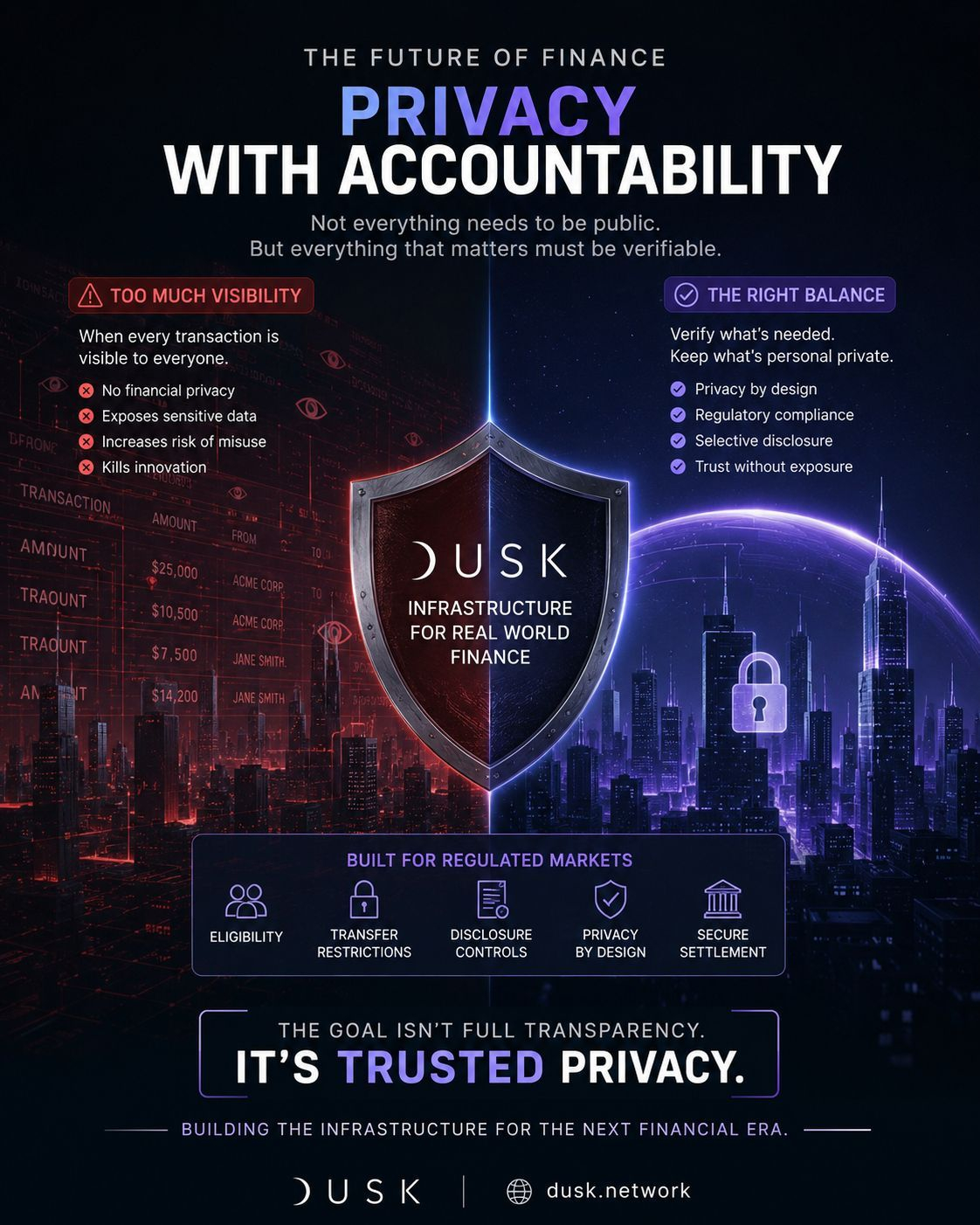
Because that's not actually how real financial markets work. Not everything is public. Who owns what, who's allowed to buy it, what needs to be disclosed and to whom, what stays private — that tension is basically the whole structure of finance. And that's what got me thinking about Dusk.
Full transparency isn't really the goal here. It's almost the opposite question: how do you verify what needs verifying without exposing someone's entire financial life to the world?
This matters even more with regulated assets. Slapping a token on something doesn't magically bring real market rules with it. Eligibility, transfer restrictions, privacy, disclosure requirements, settlement — all of that has to actually be built into the system, not bolted on after. That's the problem Dusk seems to be going after.
But here's what I keep coming back to: building this kind of infrastructure is obviously hard. The real question is whether future financial markets actually want more transparency — or whether what they really want is privacy paired with accountability.
I think that's where the real test is. Guess we'll find out 👍
@Dusk_Foundation $DUSK #dusk
Random thought I had the other day — what if every financial transaction I made was visible to everyone, name and all? Sounds like a simple thought experiment, right? But sit with it for a second and it gets uncomfortable fast.
Because that's not actually how real financial markets work. Not everything is public. Who owns what, who's allowed to buy it, what needs to be disclosed and to whom, what stays private — that tension is basically the whole structure of finance. And that's what got me thinking about Dusk.
Full transparency isn't really the goal here. It's almost the opposite question: how do you verify what needs verifying without exposing someone's entire financial life to the world?
This matters even more with regulated assets. Slapping a token on something doesn't magically bring real market rules with it. Eligibility, transfer restrictions, privacy, disclosure requirements, settlement — all of that has to actually be built into the system, not bolted on after. That's the problem Dusk seems to be going after.
But here's what I keep coming back to: building this kind of infrastructure is obviously hard. The real question is whether future financial markets actually want more transparency — or whether what they really want is privacy paired with accountability.
I think that's where the real test is. Guess we'll find out 👍
@Dusk $DUSK #dusk
Because that's not actually how real financial markets work. Not everything is public. Who owns what, who's allowed to buy it, what needs to be disclosed and to whom, what stays private — that tension is basically the whole structure of finance. And that's what got me thinking about Dusk.
Full transparency isn't really the goal here. It's almost the opposite question: how do you verify what needs verifying without exposing someone's entire financial life to the world?
This matters even more with regulated assets. Slapping a token on something doesn't magically bring real market rules with it. Eligibility, transfer restrictions, privacy, disclosure requirements, settlement — all of that has to actually be built into the system, not bolted on after. That's the problem Dusk seems to be going after.
But here's what I keep coming back to: building this kind of infrastructure is obviously hard. The real question is whether future financial markets actually want more transparency — or whether what they really want is privacy paired with accountability.
I think that's where the real test is. Guess we'll find out 👍
@Dusk $DUSK #dusk
2
4
584
·
--
Ethereum (ETH) is one of the most important cryptocurrencies because it powers smart contracts and decentralized applications (dApps). Unlike digital currencies used only for payments, Ethereum enables developers to build DeFi platforms, NFTs, blockchain games, and other innovative services. ETH is also used to pay network transaction fees and secure the blockchain through staking, making it a key part of the growing Web3 ecosystem.
#ClaimYourReward #claimRedPacket #Ethereum #BinanceSquareFamily
Ethereum (ETH) is one of the most important cryptocurrencies because it powers smart contracts and decentralized applications (dApps). Unlike digital currencies used only for payments, Ethereum enables developers to build DeFi platforms, NFTs, blockchain games, and other innovative services. ETH is also used to pay network transaction fees and secure the blockchain through staking, making it a key part of the growing Web3 ecosystem.
#ClaimYourReward #claimRedPacket #Ethereum #BinanceSquareFamily
#ClaimYourReward #claimRedPacket #Ethereum #BinanceSquareFamily

1.8k
17
97
1.8k
·
--
#dusk $DUSK @Dusk_Foundation
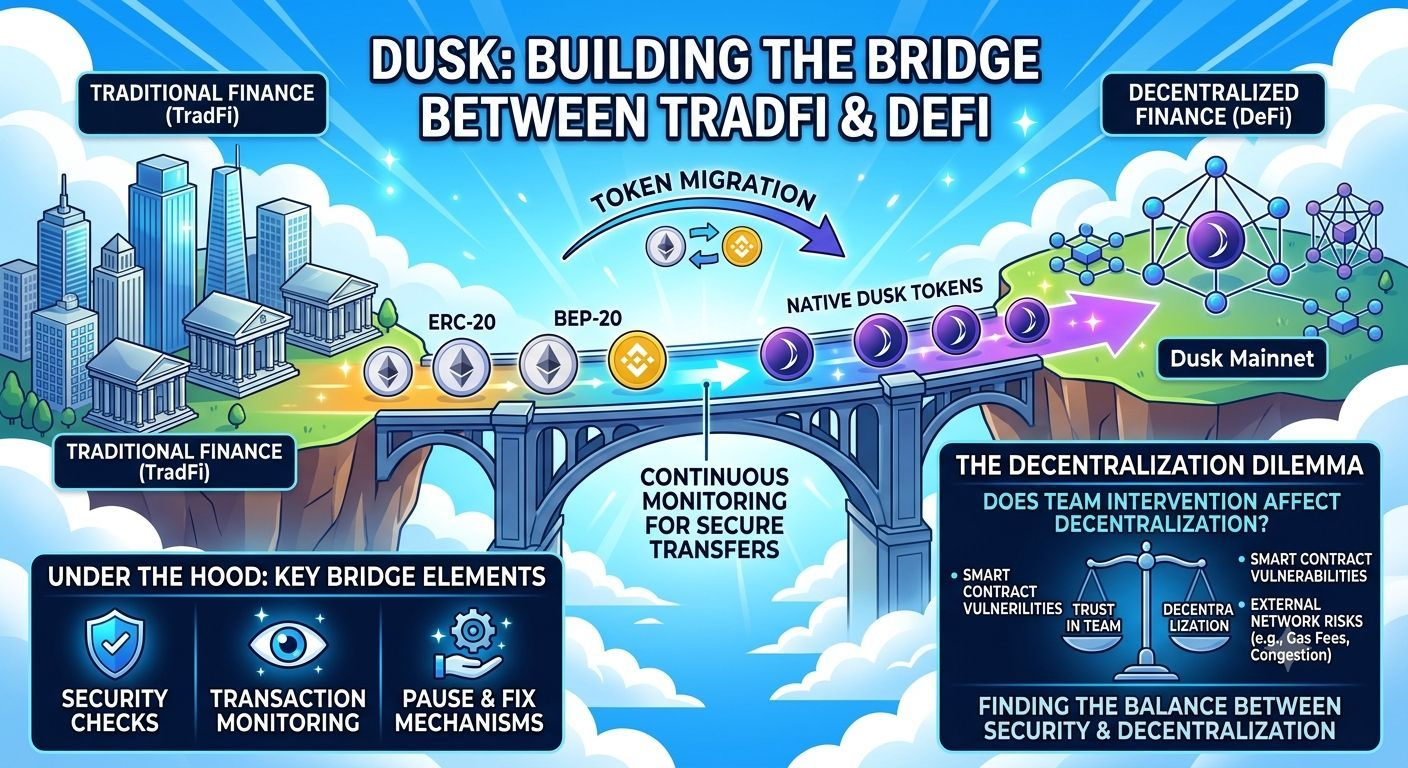
Earlier today, I was chatting with my brother about Dusk. He mentioned that Dusk’s main goal is to build a bridge between traditional finance (TradFi) and decentralized finance (DeFi).
That got me thinking: How does this bridge and token migration actually work under the hood?
At first, it sounds simple enough. You swap your ERC-20 or BEP-20 $DUSK tokens for native Dusk Mainnet tokens, or move them back whenever you need to. On paper, a bridge just moves assets from one network to another.
But when you look closer, it’s about way more than just transferring tokens.
To keep things secure, the bridge constantly monitors transactions. If something looks suspicious or a technical glitch happens, the team can step in to pause or fix it. On one hand, that extra layer of protection is great for safety. But on the other hand, it raises a big question: Does having that kind of control make the system less decentralized?
Whenever a team can intervene, you have to trust them to make the right call. On top of that, you still have to deal with typical crypto risks:
Smart contract vulnerabilities
External network issues (like high gas fees or congestion on Ethereum and BNB Chain slowing things down)
We often think of crypto bridges as simple, invisible tunnels. In reality, they are a complex mix of security checks, manual controls, and reliance on outside blockchains.
I'm not saying the Dusk bridge is unsafe—far from it. But it highlights a really interesting dilemma: How secure a system is on a technical level isn't the same as how decentralized it is in practice.
Finding the right balance between the two is where the real challenge lies.
#dusk @Dusk_Foundation $DUSK
#dusk $DUSK @Dusk
Earlier today, I was chatting with my brother about Dusk. He mentioned that Dusk’s main goal is to build a bridge between traditional finance (TradFi) and decentralized finance (DeFi).
That got me thinking: How does this bridge and token migration actually work under the hood?
At first, it sounds simple enough. You swap your ERC-20 or BEP-20 $DUSK tokens for native Dusk Mainnet tokens, or move them back whenever you need to. On paper, a bridge just moves assets from one network to another.
But when you look closer, it’s about way more than just transferring tokens.
To keep things secure, the bridge constantly monitors transactions. If something looks suspicious or a technical glitch happens, the team can step in to pause or fix it. On one hand, that extra layer of protection is great for safety. But on the other hand, it raises a big question: Does having that kind of control make the system less decentralized?
Whenever a team can intervene, you have to trust them to make the right call. On top of that, you still have to deal with typical crypto risks:
Smart contract vulnerabilities
External network issues (like high gas fees or congestion on Ethereum and BNB Chain slowing things down)
We often think of crypto bridges as simple, invisible tunnels. In reality, they are a complex mix of security checks, manual controls, and reliance on outside blockchains.
I'm not saying the Dusk bridge is unsafe—far from it. But it highlights a really interesting dilemma: How secure a system is on a technical level isn't the same as how decentralized it is in practice.
Finding the right balance between the two is where the real challenge lies.
#dusk @Dusk $DUSK
Earlier today, I was chatting with my brother about Dusk. He mentioned that Dusk’s main goal is to build a bridge between traditional finance (TradFi) and decentralized finance (DeFi).
That got me thinking: How does this bridge and token migration actually work under the hood?
At first, it sounds simple enough. You swap your ERC-20 or BEP-20 $DUSK tokens for native Dusk Mainnet tokens, or move them back whenever you need to. On paper, a bridge just moves assets from one network to another.
But when you look closer, it’s about way more than just transferring tokens.
To keep things secure, the bridge constantly monitors transactions. If something looks suspicious or a technical glitch happens, the team can step in to pause or fix it. On one hand, that extra layer of protection is great for safety. But on the other hand, it raises a big question: Does having that kind of control make the system less decentralized?
Whenever a team can intervene, you have to trust them to make the right call. On top of that, you still have to deal with typical crypto risks:
Smart contract vulnerabilities
External network issues (like high gas fees or congestion on Ethereum and BNB Chain slowing things down)
We often think of crypto bridges as simple, invisible tunnels. In reality, they are a complex mix of security checks, manual controls, and reliance on outside blockchains.
I'm not saying the Dusk bridge is unsafe—far from it. But it highlights a really interesting dilemma: How secure a system is on a technical level isn't the same as how decentralized it is in practice.
Finding the right balance between the two is where the real challenge lies.
#dusk @Dusk $DUSK
2
1
3
643
·
--
Vérifié
#dusk $DUSK @Dusk_Foundation
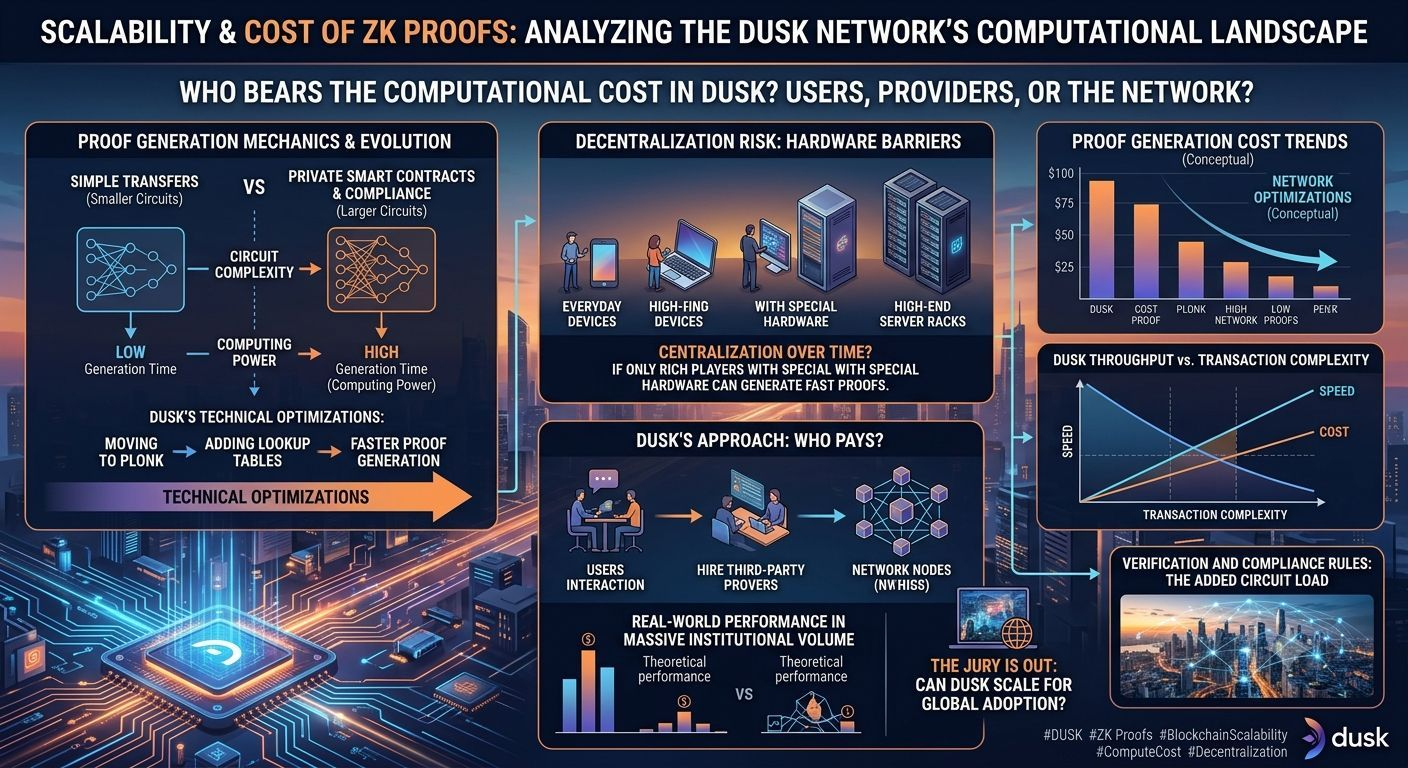
The part of @Dusk_Foundation's design I'm most genuinely uncertain about is proof-generation cost at scale.
Generating a zk-SNARK proof isn't free — computational cost scales with circuit complexity, and across zk systems generally, proving times for complex circuits can run from sub-second to tens of seconds depending on hardware and constraint count.
Confidential smart contracts with compliance logic baked in are, almost by definition, more complex circuits than a plain transfer. That has real implications: who bears the proving cost (the user's device, a delegated prover, the node), and does that create centralization pressure if only well-resourced provers can generate proofs quickly enough to be useful?
Dusk has iterated on this (PLONK, then PlonKup with lookup tables to speed up complex proofs), which shows they're aware of the bottleneck. Whether it's fully solved for institutional-grade transaction volume is an open, empirical question, not something I'd take on faith.
$DUSK #dusk
#dusk $DUSK @Dusk
The part of @Dusk_Foundation's design I'm most genuinely uncertain about is proof-generation cost at scale.
Generating a zk-SNARK proof isn't free — computational cost scales with circuit complexity, and across zk systems generally, proving times for complex circuits can run from sub-second to tens of seconds depending on hardware and constraint count.
Confidential smart contracts with compliance logic baked in are, almost by definition, more complex circuits than a plain transfer. That has real implications: who bears the proving cost (the user's device, a delegated prover, the node), and does that create centralization pressure if only well-resourced provers can generate proofs quickly enough to be useful?
Dusk has iterated on this (PLONK, then PlonKup with lookup tables to speed up complex proofs), which shows they're aware of the bottleneck. Whether it's fully solved for institutional-grade transaction volume is an open, empirical question, not something I'd take on faith.
$DUSK #dusk
The part of @Dusk_Foundation's design I'm most genuinely uncertain about is proof-generation cost at scale.
Generating a zk-SNARK proof isn't free — computational cost scales with circuit complexity, and across zk systems generally, proving times for complex circuits can run from sub-second to tens of seconds depending on hardware and constraint count.
Confidential smart contracts with compliance logic baked in are, almost by definition, more complex circuits than a plain transfer. That has real implications: who bears the proving cost (the user's device, a delegated prover, the node), and does that create centralization pressure if only well-resourced provers can generate proofs quickly enough to be useful?
Dusk has iterated on this (PLONK, then PlonKup with lookup tables to speed up complex proofs), which shows they're aware of the bottleneck. Whether it's fully solved for institutional-grade transaction volume is an open, empirical question, not something I'd take on faith.
$DUSK #dusk
4
4
705

·
--
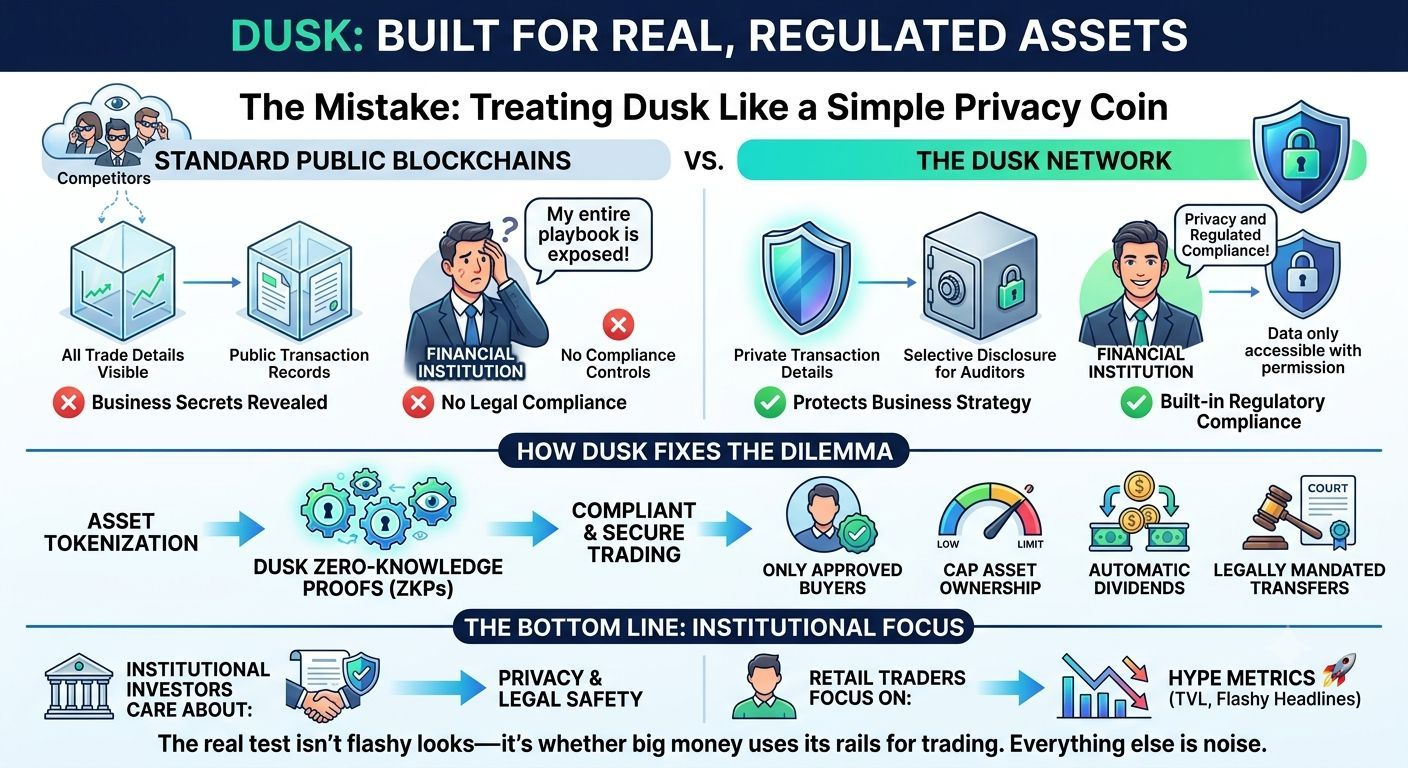
People ignore Dusk because they lump it in with basic privacy coins. That's a huge mistake.
Dusk isn't just about hiding money—it's built for real, regulated assets.
The Big Problem with Normal Blockchains
Tokenizing a real-world asset is easy. The hard part is actually trading it without exposing your business secrets.
On standard blockchains, everything is public. Big financial institutions won't use them because they'd be forced to choose between two bad options:
Show their entire business playbook to competitors.
Stay off the blockchain completely.
How Dusk Fixes It
Big investors need privacy, but they also have to follow strict legal rules. They need to:
Make sure only approved people can buy certain tokens.
Cap how much of an asset one person can own.
Pay out dividends automatically.
Comply with court orders if a transfer is legally required.
Dusk uses selective disclosure. It keeps trade details hidden from the general public, but allows institutions to show proof to auditors or regulators whenever necessary.
The Bottom Line
Retail traders are distracted by simple stats like total locked value (TVL). But big institutions don't care about hype metrics—they care about privacy and legal safety.
The real test isn't how flashy Dusk looks today, but whether big money actually uses its rails to trade tomorrow.
#dusk $DUSK @Dusk_Foundation
People ignore Dusk because they lump it in with basic privacy coins. That's a huge mistake.
Dusk isn't just about hiding money—it's built for real, regulated assets.
The Big Problem with Normal Blockchains
Tokenizing a real-world asset is easy. The hard part is actually trading it without exposing your business secrets.
On standard blockchains, everything is public. Big financial institutions won't use them because they'd be forced to choose between two bad options:
Show their entire business playbook to competitors.
Stay off the blockchain completely.
How Dusk Fixes It
Big investors need privacy, but they also have to follow strict legal rules. They need to:
Make sure only approved people can buy certain tokens.
Cap how much of an asset one person can own.
Pay out dividends automatically.
Comply with court orders if a transfer is legally required.
Dusk uses selective disclosure. It keeps trade details hidden from the general public, but allows institutions to show proof to auditors or regulators whenever necessary.
The Bottom Line
Retail traders are distracted by simple stats like total locked value (TVL). But big institutions don't care about hype metrics—they care about privacy and legal safety.
The real test isn't how flashy Dusk looks today, but whether big money actually uses its rails to trade tomorrow.
#dusk $DUSK @Dusk
Dusk isn't just about hiding money—it's built for real, regulated assets.
The Big Problem with Normal Blockchains
Tokenizing a real-world asset is easy. The hard part is actually trading it without exposing your business secrets.
On standard blockchains, everything is public. Big financial institutions won't use them because they'd be forced to choose between two bad options:
Show their entire business playbook to competitors.
Stay off the blockchain completely.
How Dusk Fixes It
Big investors need privacy, but they also have to follow strict legal rules. They need to:
Make sure only approved people can buy certain tokens.
Cap how much of an asset one person can own.
Pay out dividends automatically.
Comply with court orders if a transfer is legally required.
Dusk uses selective disclosure. It keeps trade details hidden from the general public, but allows institutions to show proof to auditors or regulators whenever necessary.
The Bottom Line
Retail traders are distracted by simple stats like total locked value (TVL). But big institutions don't care about hype metrics—they care about privacy and legal safety.
The real test isn't how flashy Dusk looks today, but whether big money actually uses its rails to trade tomorrow.
#dusk $DUSK @Dusk
1
2
231
Connectez-vous pour découvrir plus de contenu
Rejoignez la communauté mondiale des adeptes de cryptomonnaies sur Binance Square
⚡️ Suviez les dernières informations importantes sur les cryptomonnaies.
💬 Jugé digne de confiance par la plus grande plateforme d’échange de cryptomonnaies au monde.
👍 Découvrez les connaissances que partagent les créateurs vérifiés.
Adresse e-mail/Nº de téléphone
Sujets d’actualité
EarningsSeason
107,718 vues
1,026 mentions
Earnings Season: Micron Q4 Earnings — Bullish or Bearish?
Binance Square Official
·211 mentions J’aime
·347.9k vues
ECBToTestAIAgentsInDigitalEuroPayments
3,290 vues
188 mentions
JapanFSABacksFourthStablecoinTradeSettlementPilot
4,647 vues
260 mentions