

SA 战士 - SILENT SPARK
9.9k Publications

SA 战士 - SILENT SPARK
Signaler
Bloquer l’utilisateur
Skilled in content writing, influencer and trader...
Trade régulièrement
1.1 an(s)
936 Suivis
7.2K+ Abonnés
7.6K+ J’aime
Publications
Tous
Citations
Direct
PINNED
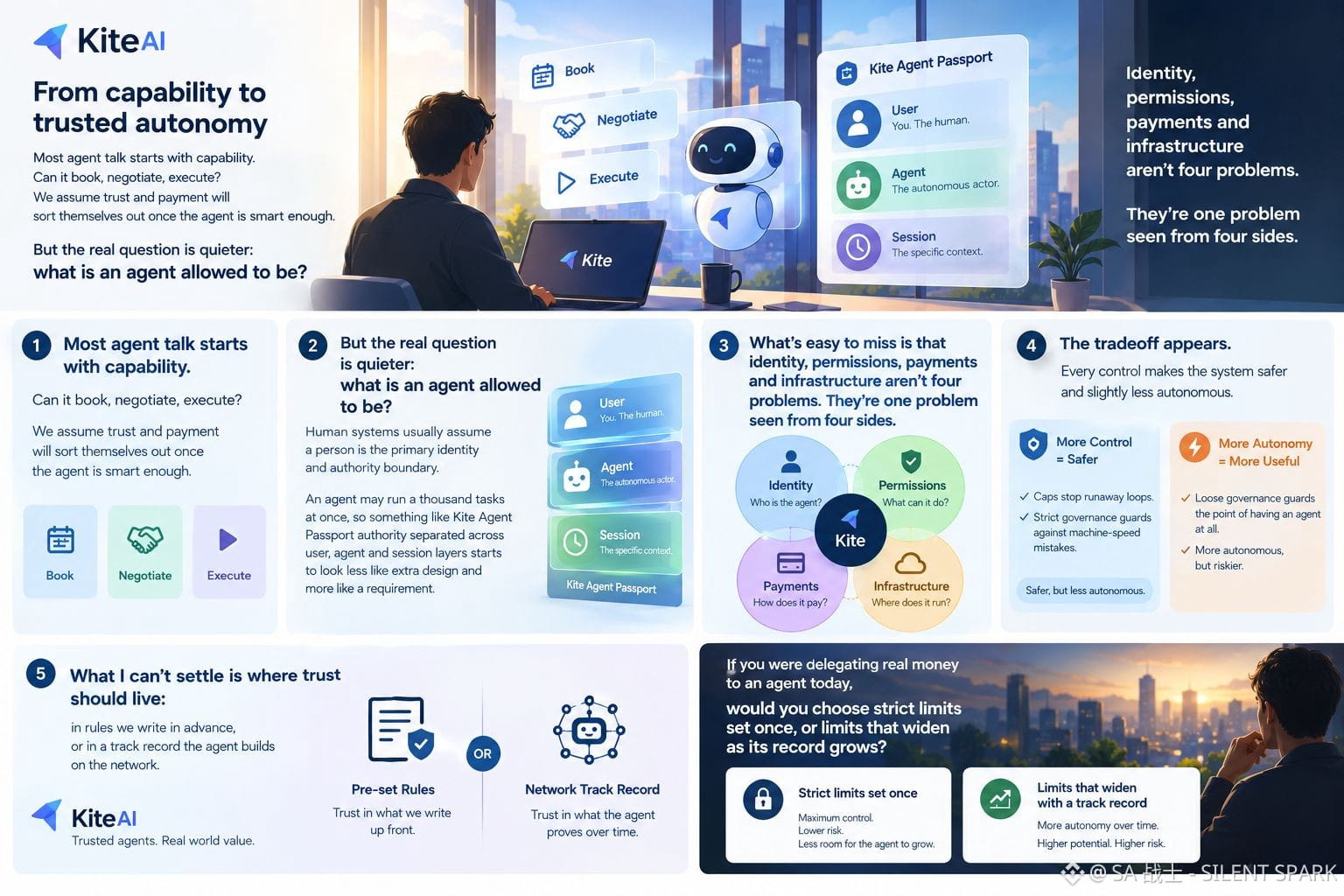
I have been reading Kite's docs again, and the order of the problems keeps bothering me.
Most agent talk starts with capability. Can it book, negotiate, execute? We assume trust and payment will sort themselves out once the agent is smart enough.
I think the real question is quieter,
what is an agent allowed to be?
Human systems usually assume a person is the primary identity and authority boundary. An agent may run a thousand tasks at once, so something like Kite Agent Passport authority is separated across user, agent and session layers starts to look less like extra design and more like a requirement.
What's easy to miss is that identity, permissions, payments and infrastructure aren't four problems. They're one problem seen from four sides. A spending rule means little without a verifiable identity. Micro-transactions only work if rules are enforced at the agent's speed. An agent network only works if the network shows who built what and who answers for it.
Then the tradeoff appears. Every control makes the system safer and slightly less autonomous. A cap stops a runaway loop, but it can also halt the moment the agent was about to be useful. Strict governance guards against machine speed mistakes. Loose governance guards the point of having an agent at all. Both are right about something.
What I can't settle is where trust should live in rules we write in advance, or in a track record the agent builds on the network.
If you were delegating real money to an agent today, would you choose strict limits set once, or limits that widen as its record grows ?
#KiteBBW $KITE
I have been reading Kite's docs again, and the order of the problems keeps bothering me.
Most agent talk starts with capability. Can it book, negotiate, execute? We assume trust and payment will sort themselves out once the agent is smart enough.
I think the real question is quieter,
what is an agent allowed to be?
Human systems usually assume a person is the primary identity and authority boundary. An agent may run a thousand tasks at once, so something like Kite Agent Passport authority is separated across user, agent and session layers starts to look less like extra design and more like a requirement.
What's easy to miss is that identity, permissions, payments and infrastructure aren't four problems. They're one problem seen from four sides. A spending rule means little without a verifiable identity. Micro-transactions only work if rules are enforced at the agent's speed. An agent network only works if the network shows who built what and who answers for it.
Then the tradeoff appears. Every control makes the system safer and slightly less autonomous. A cap stops a runaway loop, but it can also halt the moment the agent was about to be useful. Strict governance guards against machine speed mistakes. Loose governance guards the point of having an agent at all. Both are right about something.
What I can't settle is where trust should live in rules we write in advance, or in a track record the agent builds on the network.
If you were delegating real money to an agent today, would you choose strict limits set once, or limits that widen as its record grows ?
#KiteBBW $KITE
Most agent talk starts with capability. Can it book, negotiate, execute? We assume trust and payment will sort themselves out once the agent is smart enough.
I think the real question is quieter,
what is an agent allowed to be?
Human systems usually assume a person is the primary identity and authority boundary. An agent may run a thousand tasks at once, so something like Kite Agent Passport authority is separated across user, agent and session layers starts to look less like extra design and more like a requirement.
What's easy to miss is that identity, permissions, payments and infrastructure aren't four problems. They're one problem seen from four sides. A spending rule means little without a verifiable identity. Micro-transactions only work if rules are enforced at the agent's speed. An agent network only works if the network shows who built what and who answers for it.
Then the tradeoff appears. Every control makes the system safer and slightly less autonomous. A cap stops a runaway loop, but it can also halt the moment the agent was about to be useful. Strict governance guards against machine speed mistakes. Loose governance guards the point of having an agent at all. Both are right about something.
What I can't settle is where trust should live in rules we write in advance, or in a track record the agent builds on the network.
If you were delegating real money to an agent today, would you choose strict limits set once, or limits that widen as its record grows ?
#KiteBBW $KITE
4
1
5
1.1k
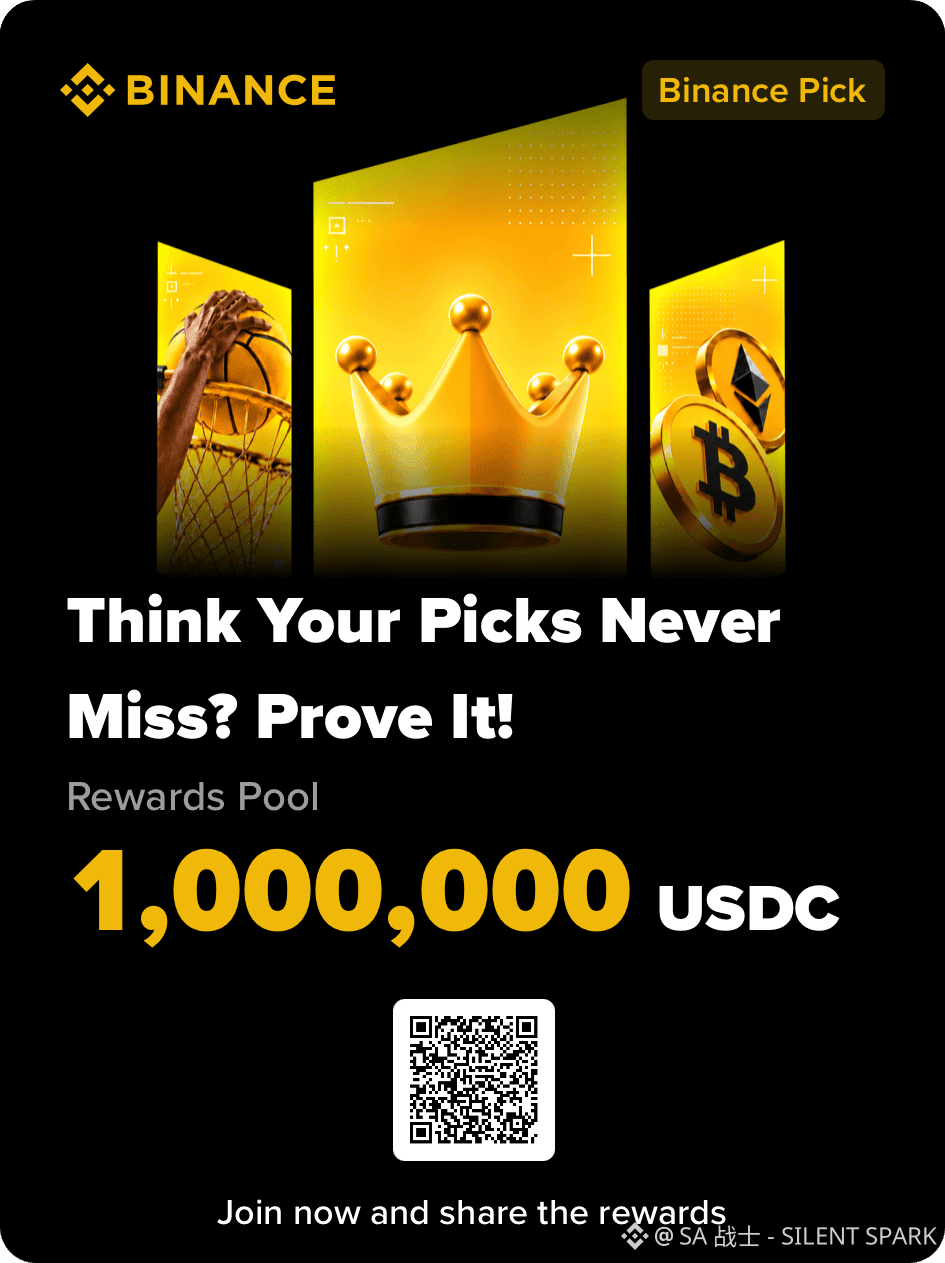
🏆 Climb the Binance Pick Leaderboard & Win Rewards 🚀
Your predictions and consistency can make a difference! Track your ranking and compete for a share of 1,000,000 USDC across the Season Leaderboard, Weekly Leaderboard, and Participation Rewards.
🎯 Make smart predictions, stay active, and don't forget your daily check-ins. Every effort counts..
Ready to climb the leaderboard??
Let's go 🧗🧗🧗
#BinancePick
🏆 Climb the Binance Pick Leaderboard & Win Rewards 🚀
Your predictions and consistency can make a difference! Track your ranking and compete for a share of 1,000,000 USDC across the Season Leaderboard, Weekly Leaderboard, and Participation Rewards.
🎯 Make smart predictions, stay active, and don't forget your daily check-ins. Every effort counts..
Ready to climb the leaderboard??
Let's go 🧗🧗🧗
#BinancePick
Your predictions and consistency can make a difference! Track your ranking and compete for a share of 1,000,000 USDC across the Season Leaderboard, Weekly Leaderboard, and Participation Rewards.
🎯 Make smart predictions, stay active, and don't forget your daily check-ins. Every effort counts..
Ready to climb the leaderboard??
Let's go 🧗🧗🧗
#BinancePick
66
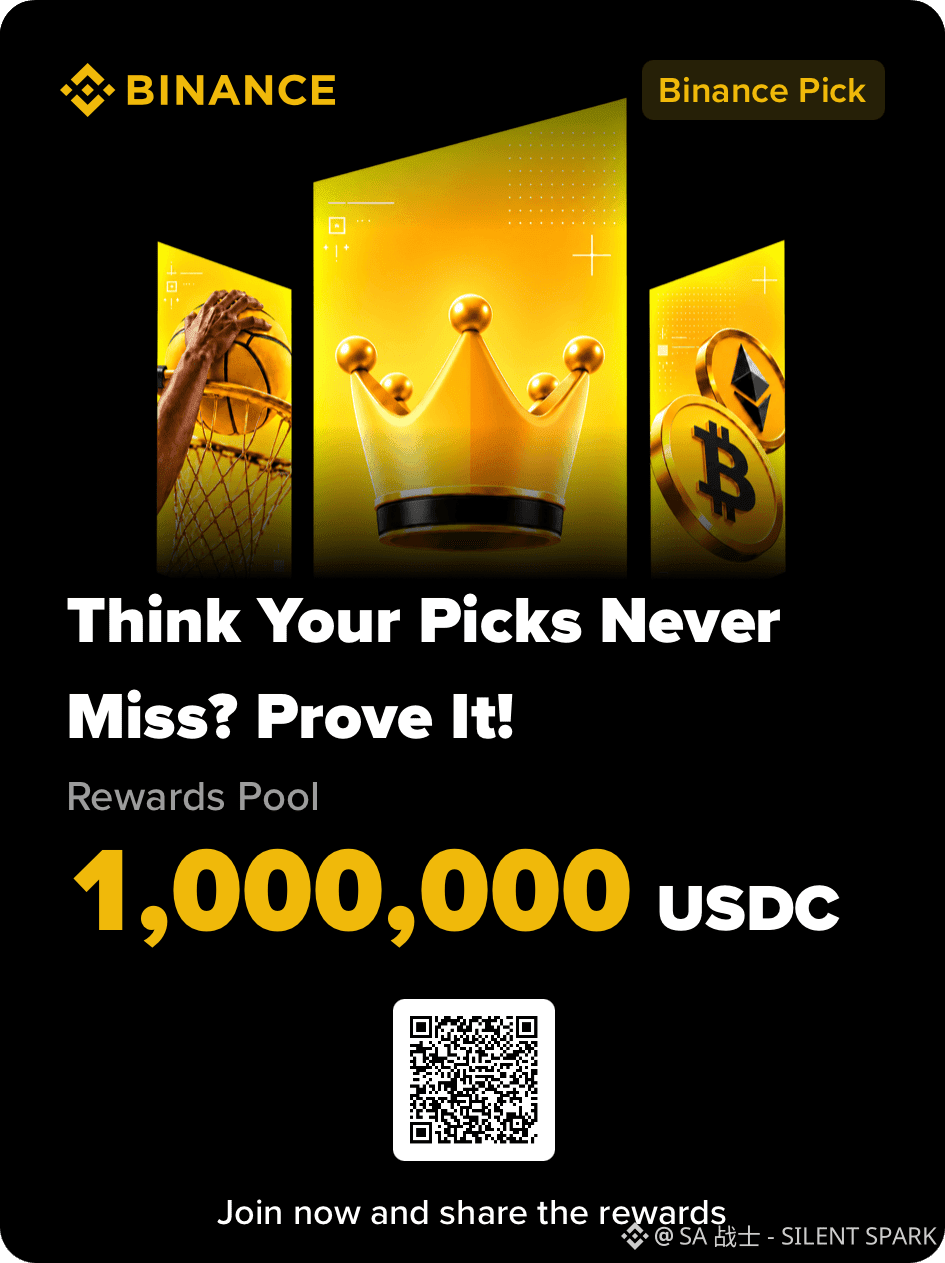
🎯 Ready to test your market instincts with Binance Pick?
Use your Scores to make predictions, choose your strategy, and see how your picks perform.. 📈 A correct prediction can boost your Scores and help improve your campaign ranking.
Remember, Scores are campaign points with no cash value and reset at the end of the season.
Make your picks wisely and enjoy the game! 🚀
#BinancePick
🎯 Ready to test your market instincts with Binance Pick?
Use your Scores to make predictions, choose your strategy, and see how your picks perform.. 📈 A correct prediction can boost your Scores and help improve your campaign ranking.
Remember, Scores are campaign points with no cash value and reset at the end of the season.
Make your picks wisely and enjoy the game! 🚀
#BinancePick
Use your Scores to make predictions, choose your strategy, and see how your picks perform.. 📈 A correct prediction can boost your Scores and help improve your campaign ranking.
Remember, Scores are campaign points with no cash value and reset at the end of the season.
Make your picks wisely and enjoy the game! 🚀
#BinancePick
183
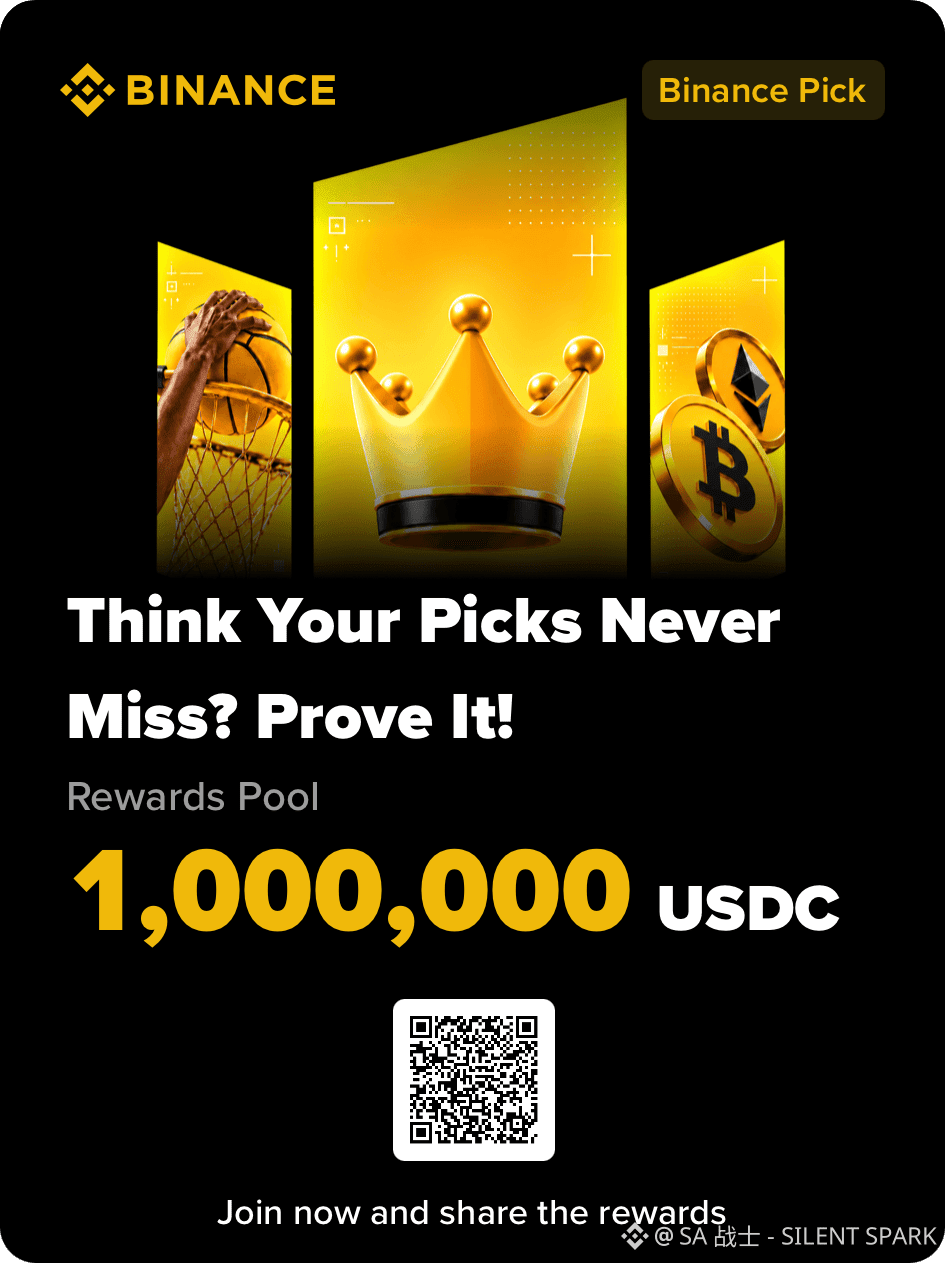
🚀 Ready to join Binance Pick? 👍
Visit the campaign page and hit [Join Now] to get started! Reserve during Early Bird to earn bonus Scores, and eligible new users can unlock additional bonus Scores. 🎯
Join early, make your picks, and compete for a share of the rewards pool! 🏆
#BinancePick
🚀 Ready to join Binance Pick? 👍
Visit the campaign page and hit [Join Now] to get started! Reserve during Early Bird to earn bonus Scores, and eligible new users can unlock additional bonus Scores. 🎯
Join early, make your picks, and compete for a share of the rewards pool! 🏆
#BinancePick
Visit the campaign page and hit [Join Now] to get started! Reserve during Early Bird to earn bonus Scores, and eligible new users can unlock additional bonus Scores. 🎯
Join early, make your picks, and compete for a share of the rewards pool! 🏆
#BinancePick
2
120
Vérifié
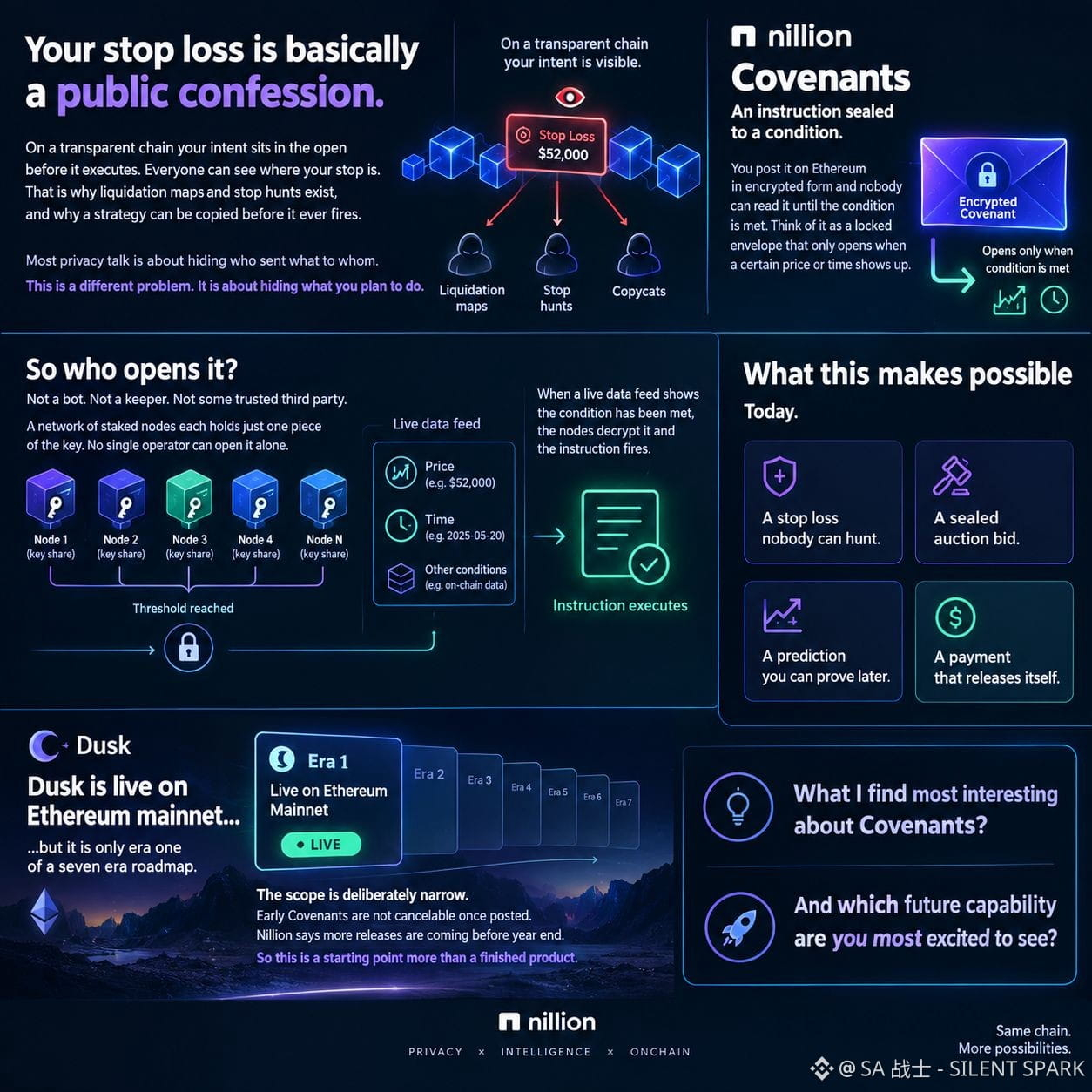
Let me explain why your stop loss is basically a public confession.
On a transparent chain your intent sits in the open before it executes. Everyone can see where your stop is. That is why liquidation maps and stop hunts exist, and why a strategy can be copied before it ever fires. Most privacy talk is about hiding who sent what to whom. This is a different problem. It is about hiding what you plan to do.
Here is where Covenants come in. @nillionnetwork built them as an instruction sealed to a condition. You post it on Ethereum in encrypted form and nobody can read it until the condition is met. The simple way to think about it is a locked envelope that only opens when a certain price or time shows up.
So who opens it? Not a bot. Not a keeper. Not some trusted third party. A network of staked nodes each holds just one piece of the key. No single operator can open it alone. When a live data feed shows the condition has been met the nodes decrypt it and the instruction fires.
That makes a few things possible today. A stop loss nobody can hunt. A sealed auction bid. A prediction you can prove later. A payment that releases itself.
Here is what I find most interesting. Dusk is live on Ethereum mainnet but it is only era one of a seven era roadmap. The scope is deliberately narrow. Early Covenants are not cancelable once posted. Nillion says more releases are coming before year end. So this is a starting point more than a finished product.
What do you like most about Covenants? And which future capability are you most excited to see?
#nil $NIL @nillionnetwork
Let me explain why your stop loss is basically a public confession.
On a transparent chain your intent sits in the open before it executes. Everyone can see where your stop is. That is why liquidation maps and stop hunts exist, and why a strategy can be copied before it ever fires. Most privacy talk is about hiding who sent what to whom. This is a different problem. It is about hiding what you plan to do.
Here is where Covenants come in. @Nillion built them as an instruction sealed to a condition. You post it on Ethereum in encrypted form and nobody can read it until the condition is met. The simple way to think about it is a locked envelope that only opens when a certain price or time shows up.
So who opens it? Not a bot. Not a keeper. Not some trusted third party. A network of staked nodes each holds just one piece of the key. No single operator can open it alone. When a live data feed shows the condition has been met the nodes decrypt it and the instruction fires.
That makes a few things possible today. A stop loss nobody can hunt. A sealed auction bid. A prediction you can prove later. A payment that releases itself.
Here is what I find most interesting. Dusk is live on Ethereum mainnet but it is only era one of a seven era roadmap. The scope is deliberately narrow. Early Covenants are not cancelable once posted. Nillion says more releases are coming before year end. So this is a starting point more than a finished product.
What do you like most about Covenants? And which future capability are you most excited to see?
#nil $NIL @Nillion
On a transparent chain your intent sits in the open before it executes. Everyone can see where your stop is. That is why liquidation maps and stop hunts exist, and why a strategy can be copied before it ever fires. Most privacy talk is about hiding who sent what to whom. This is a different problem. It is about hiding what you plan to do.
Here is where Covenants come in. @Nillion built them as an instruction sealed to a condition. You post it on Ethereum in encrypted form and nobody can read it until the condition is met. The simple way to think about it is a locked envelope that only opens when a certain price or time shows up.
So who opens it? Not a bot. Not a keeper. Not some trusted third party. A network of staked nodes each holds just one piece of the key. No single operator can open it alone. When a live data feed shows the condition has been met the nodes decrypt it and the instruction fires.
That makes a few things possible today. A stop loss nobody can hunt. A sealed auction bid. A prediction you can prove later. A payment that releases itself.
Here is what I find most interesting. Dusk is live on Ethereum mainnet but it is only era one of a seven era roadmap. The scope is deliberately narrow. Early Covenants are not cancelable once posted. Nillion says more releases are coming before year end. So this is a starting point more than a finished product.
What do you like most about Covenants? And which future capability are you most excited to see?
#nil $NIL @Nillion
6
8
1.4k
Crypto Abbreviations You Should Know Before You Start.. PART 2
If you’re new to crypto, you’ve probably seen terms like DAO, NFT, DeFI and wondered,
What does that even mean ? 🤔
Here’s a quick cheat sheet 👇
🔹1. DAO — Decentralized Autonomous Organization
A blockchain-based organization where governance can be carried out through predefined rules and token-based voting.
🔹2. NFT — Non-Fungible Token
A unique blockchain-based token that can represent ownership or access to digital or physical items.
🔹3. DeFi — Decentralized Finance
Financial applications built using blockchain technology, such as lending, borrowing and decentralized trading.
🔹4. TVL — Total Value Locked
The total value of assets deposited in a DeFi protocol or ecosystem.
🔹5. APY — Annual Percentage Yield
A rate that reflects the potential annual return including the effect of compounding.
🔹6. LFG — Let’s Fing Go*
A phrase used to express excitement or optimism about a crypto project, token, or market move. 🚀
🔹7. MC — Market Cap
The total market value of a cryptocurrency.
💡 Formula: Price × Circulating Supply
🔹8. FDV — Fully Diluted Valuation
The theoretical market value of a crypto project if all tokens that can ever exist were already in circulation.
🔹9. APR — Annual Percentage Rate
The annualized rate of return or interest, generally without including compounding.
🔹10. WBTC — Wrapped Bitcoin
A token representing Bitcoin on another blockchain, most commonly Ethereum, allowing BTC exposure to be used in DeFi applications.
Understanding the language of crypto is just as important as understanding the technology...
#Binance #cryptoeducation #crypto
Crypto Abbreviations You Should Know Before You Start.. PART 2
If you’re new to crypto, you’ve probably seen terms like DAO, NFT, DeFI and wondered,
What does that even mean ? 🤔
Here’s a quick cheat sheet 👇
🔹1. DAO — Decentralized Autonomous Organization
A blockchain-based organization where governance can be carried out through predefined rules and token-based voting.
🔹2. NFT — Non-Fungible Token
A unique blockchain-based token that can represent ownership or access to digital or physical items.
🔹3. DeFi — Decentralized Finance
Financial applications built using blockchain technology, such as lending, borrowing and decentralized trading.
🔹4. TVL — Total Value Locked
The total value of assets deposited in a DeFi protocol or ecosystem.
🔹5. APY — Annual Percentage Yield
A rate that reflects the potential annual return including the effect of compounding.
🔹6. LFG — Let’s Fing Go*
A phrase used to express excitement or optimism about a crypto project, token, or market move. 🚀
🔹7. MC — Market Cap
The total market value of a cryptocurrency.
💡 Formula: Price × Circulating Supply
🔹8. FDV — Fully Diluted Valuation
The theoretical market value of a crypto project if all tokens that can ever exist were already in circulation.
🔹9. APR — Annual Percentage Rate
The annualized rate of return or interest, generally without including compounding.
🔹10. WBTC — Wrapped Bitcoin
A token representing Bitcoin on another blockchain, most commonly Ethereum, allowing BTC exposure to be used in DeFi applications.
Understanding the language of crypto is just as important as understanding the technology...
#Binance #cryptoeducation #crypto
If you’re new to crypto, you’ve probably seen terms like DAO, NFT, DeFI and wondered,
What does that even mean ? 🤔
Here’s a quick cheat sheet 👇
🔹1. DAO — Decentralized Autonomous Organization
A blockchain-based organization where governance can be carried out through predefined rules and token-based voting.
🔹2. NFT — Non-Fungible Token
A unique blockchain-based token that can represent ownership or access to digital or physical items.
🔹3. DeFi — Decentralized Finance
Financial applications built using blockchain technology, such as lending, borrowing and decentralized trading.
🔹4. TVL — Total Value Locked
The total value of assets deposited in a DeFi protocol or ecosystem.
🔹5. APY — Annual Percentage Yield
A rate that reflects the potential annual return including the effect of compounding.
🔹6. LFG — Let’s Fing Go*
A phrase used to express excitement or optimism about a crypto project, token, or market move. 🚀
🔹7. MC — Market Cap
The total market value of a cryptocurrency.
💡 Formula: Price × Circulating Supply
🔹8. FDV — Fully Diluted Valuation
The theoretical market value of a crypto project if all tokens that can ever exist were already in circulation.
🔹9. APR — Annual Percentage Rate
The annualized rate of return or interest, generally without including compounding.
🔹10. WBTC — Wrapped Bitcoin
A token representing Bitcoin on another blockchain, most commonly Ethereum, allowing BTC exposure to be used in DeFi applications.
Understanding the language of crypto is just as important as understanding the technology...
#Binance #cryptoeducation #crypto
2
1.3k
Crypto Abbreviations You Should Know Before You Start..
If you’re new to crypto, you’ve probably seen terms like DYOR, P2P, DePIN, HODL and wondered, “What does that even mean?” 😅
Here’s a quick cheat sheet 👇
🔹 1. P2P — Peer-to-Peer
Trading directly between users without a traditional intermediary.
👉 Example: Buying USDT directly from another user.
🔹 2. DYOR — Do Your Own Research
A reminder to research a project before investing or trading.
📚 Don’t rely solely on influencers or social media.
🔹 3. DePIN — Decentralized Physical Infrastructure Networks
Blockchain-based networks that coordinate real-world infrastructure through decentralized participants.
🌐 Think connectivity, storage, computing and other physical resources.
🔹 4. HODL — Hold On for Dear Life
Crypto slang for holding an asset rather than selling during short-term volatility. 💎
🔹 5. FOMO — Fear of Missing Out
Buying because you’re afraid the price will keep going up without you.
⚠️ Emotional decisions can be risky.
🔹 6. FUD — Fear, Uncertainty & Doubt
Negative information, rumors or sentiment that can create fear around a crypto project or market.
🔹 7. ATH — All-Time High
The highest price an asset has ever reached. 📈
🔹 8. ATL — All-Time Low
The lowest recorded price of an asset. 📉
🔹 9. DEX — Decentralized Exchange
A blockchain-based exchange that allows users to trade assets without relying on a traditional centralized exchange.
🔹 10. CEX — Centralized Exchange
A crypto exchange operated by a centralized company or organization.
How many of these abbreviations did you already know ?
#Binance #cryptoeducation #crypto
Crypto Abbreviations You Should Know Before You Start..
If you’re new to crypto, you’ve probably seen terms like DYOR, P2P, DePIN, HODL and wondered, “What does that even mean?” 😅
Here’s a quick cheat sheet 👇
🔹 1. P2P — Peer-to-Peer
Trading directly between users without a traditional intermediary.
👉 Example: Buying USDT directly from another user.
🔹 2. DYOR — Do Your Own Research
A reminder to research a project before investing or trading.
📚 Don’t rely solely on influencers or social media.
🔹 3. DePIN — Decentralized Physical Infrastructure Networks
Blockchain-based networks that coordinate real-world infrastructure through decentralized participants.
🌐 Think connectivity, storage, computing and other physical resources.
🔹 4. HODL — Hold On for Dear Life
Crypto slang for holding an asset rather than selling during short-term volatility. 💎
🔹 5. FOMO — Fear of Missing Out
Buying because you’re afraid the price will keep going up without you.
⚠️ Emotional decisions can be risky.
🔹 6. FUD — Fear, Uncertainty & Doubt
Negative information, rumors or sentiment that can create fear around a crypto project or market.
🔹 7. ATH — All-Time High
The highest price an asset has ever reached. 📈
🔹 8. ATL — All-Time Low
The lowest recorded price of an asset. 📉
🔹 9. DEX — Decentralized Exchange
A blockchain-based exchange that allows users to trade assets without relying on a traditional centralized exchange.
🔹 10. CEX — Centralized Exchange
A crypto exchange operated by a centralized company or organization.
How many of these abbreviations did you already know ?
#Binance #cryptoeducation #crypto
If you’re new to crypto, you’ve probably seen terms like DYOR, P2P, DePIN, HODL and wondered, “What does that even mean?” 😅
Here’s a quick cheat sheet 👇
🔹 1. P2P — Peer-to-Peer
Trading directly between users without a traditional intermediary.
👉 Example: Buying USDT directly from another user.
🔹 2. DYOR — Do Your Own Research
A reminder to research a project before investing or trading.
📚 Don’t rely solely on influencers or social media.
🔹 3. DePIN — Decentralized Physical Infrastructure Networks
Blockchain-based networks that coordinate real-world infrastructure through decentralized participants.
🌐 Think connectivity, storage, computing and other physical resources.
🔹 4. HODL — Hold On for Dear Life
Crypto slang for holding an asset rather than selling during short-term volatility. 💎
🔹 5. FOMO — Fear of Missing Out
Buying because you’re afraid the price will keep going up without you.
⚠️ Emotional decisions can be risky.
🔹 6. FUD — Fear, Uncertainty & Doubt
Negative information, rumors or sentiment that can create fear around a crypto project or market.
🔹 7. ATH — All-Time High
The highest price an asset has ever reached. 📈
🔹 8. ATL — All-Time Low
The lowest recorded price of an asset. 📉
🔹 9. DEX — Decentralized Exchange
A blockchain-based exchange that allows users to trade assets without relying on a traditional centralized exchange.
🔹 10. CEX — Centralized Exchange
A crypto exchange operated by a centralized company or organization.
How many of these abbreviations did you already know ?
#Binance #cryptoeducation #crypto
3
4.1k
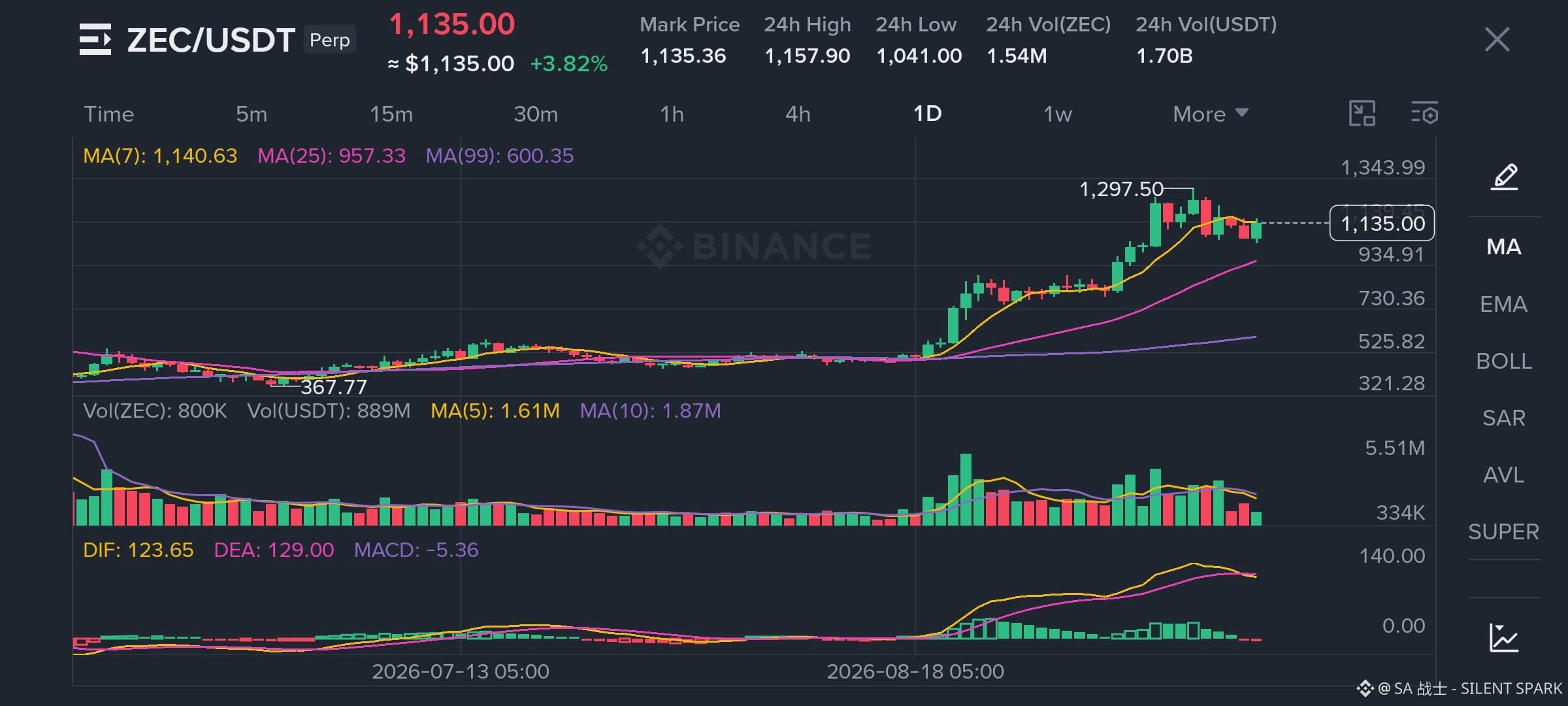
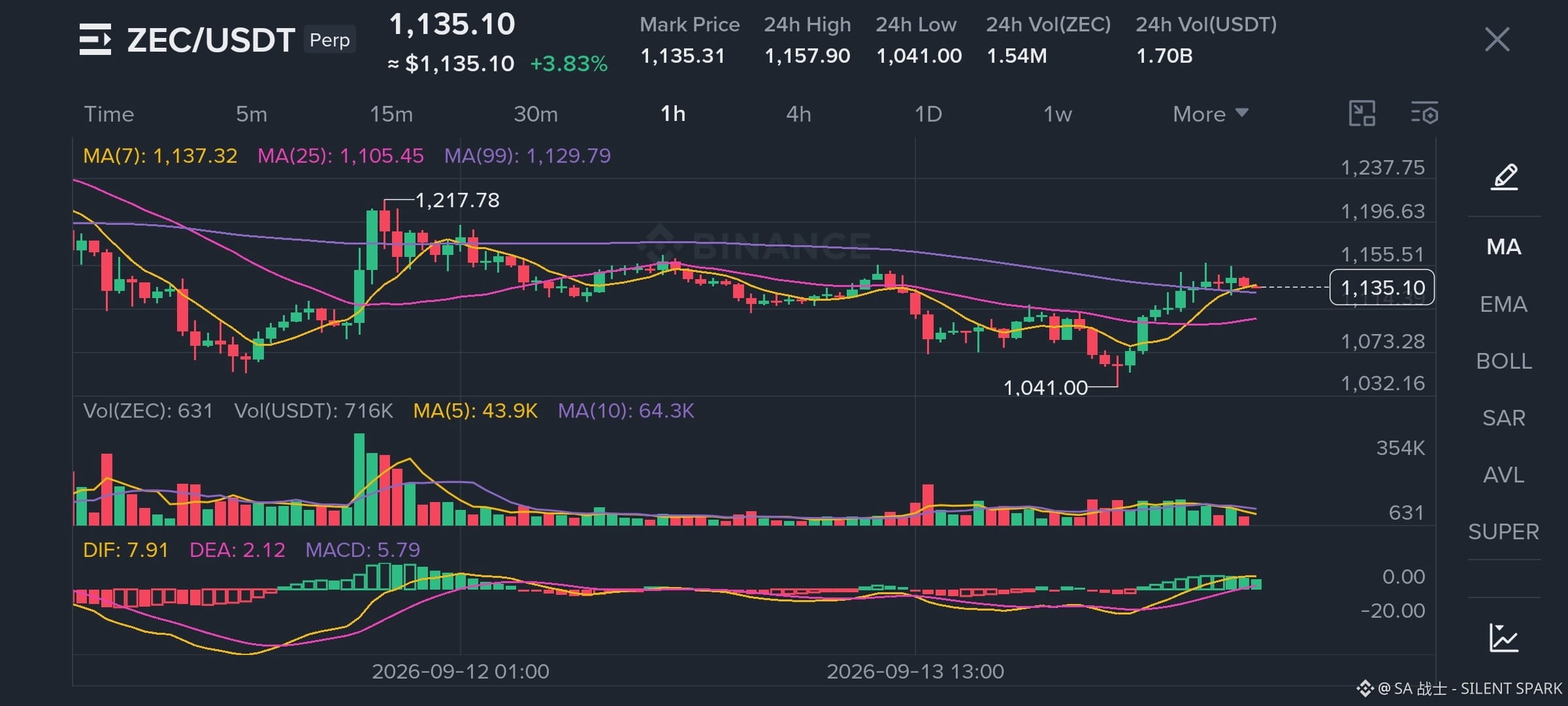
$ZEC LONG 🟢
Bullish higher-timeframe structure remains intact after the sharp rebound from $1,041, with price holding above key 4H/1H moving-average support around $1,105–$1,130. The setup favors a long on a controlled pullback, with $1,158 acting as the immediate breakout barrier and the next liquidity levels higher.
Entry: $1,120–$1,135
SL: $1,095
TP1: $1,158
TP2: $1,190
TP3: $1,235
TP4: $1,295–$1,300
A clean 4H breakout and hold above $1,158 should trigger stronger bullish momentum toward the higher targets.
Invalidation: Sustained loss of $1,095, especially if price falls back below the $1,073 support zone.
Trade the setup, manage the risk.
⚠️ DYOR Not a financial advice.
#crypto #writetoearn
$ZEC LONG 🟢
Bullish higher-timeframe structure remains intact after the sharp rebound from $1,041, with price holding above key 4H/1H moving-average support around $1,105–$1,130. The setup favors a long on a controlled pullback, with $1,158 acting as the immediate breakout barrier and the next liquidity levels higher.
Entry: $1,120–$1,135
SL: $1,095
TP1: $1,158
TP2: $1,190
TP3: $1,235
TP4: $1,295–$1,300
A clean 4H breakout and hold above $1,158 should trigger stronger bullish momentum toward the higher targets.
Invalidation: Sustained loss of $1,095, especially if price falls back below the $1,073 support zone.
Trade the setup, manage the risk.
⚠️ DYOR Not a financial advice.
#crypto #writetoearn
Bullish higher-timeframe structure remains intact after the sharp rebound from $1,041, with price holding above key 4H/1H moving-average support around $1,105–$1,130. The setup favors a long on a controlled pullback, with $1,158 acting as the immediate breakout barrier and the next liquidity levels higher.
Entry: $1,120–$1,135
SL: $1,095
TP1: $1,158
TP2: $1,190
TP3: $1,235
TP4: $1,295–$1,300
A clean 4H breakout and hold above $1,158 should trigger stronger bullish momentum toward the higher targets.
Invalidation: Sustained loss of $1,095, especially if price falls back below the $1,073 support zone.
Trade the setup, manage the risk.
⚠️ DYOR Not a financial advice.
#crypto #writetoearn
1
211
🚨 BITCOIN IS UNDER PRESSURE — BUT DON’T PANIC YET
Bitcoin is hovering around the $77K area today, and the market suddenly feels much more cautious.
But here’s what I think traders should be watching 👇
📉 1. BTC IS FACING MACRO PRESSURE
Oil prices have surged above $100, while inflation concerns are pushing markets to rethink the path of interest rates.
When yields rise and traders expect tighter monetary policy, risk assets like crypto can feel the pressure.
And BTC is no exception.
🎯 2. $75K–$76K IS AN IMPORTANT ZONE
This is the area I’m watching closely.
If Bitcoin holds this region, we could see buyers step back in.
But if it breaks decisively, the correction could become deeper.
On the upside, reclaiming the $77.5K–$78K area would be an encouraging first step.
🔥 3. THE BIGGEST CATALYST?
US inflation data.
Markets are waiting for fresh inflation numbers, and the result could influence expectations for the Federal Reserve’s next move.
That means Bitcoin could remain volatile.
MY TAKE:
I wouldn't chase a green candle or panic-sell a red one.
Right now, patience + risk management matter more than predictions.
The market will eventually tell us which direction it wants.
👀 What do you think?
Will BTC defend $75K–$76K and bounce…
OR
Are we heading toward a deeper correction?
$BTC $ETH $BNB
#bitcoin #crypto #BinanceSquar #writetoearn
🚨 BITCOIN IS UNDER PRESSURE — BUT DON’T PANIC YET
Bitcoin is hovering around the $77K area today, and the market suddenly feels much more cautious.
But here’s what I think traders should be watching 👇
📉 1. BTC IS FACING MACRO PRESSURE
Oil prices have surged above $100, while inflation concerns are pushing markets to rethink the path of interest rates.
When yields rise and traders expect tighter monetary policy, risk assets like crypto can feel the pressure.
And BTC is no exception.
🎯 2. $75K–$76K IS AN IMPORTANT ZONE
This is the area I’m watching closely.
If Bitcoin holds this region, we could see buyers step back in.
But if it breaks decisively, the correction could become deeper.
On the upside, reclaiming the $77.5K–$78K area would be an encouraging first step.
🔥 3. THE BIGGEST CATALYST?
US inflation data.
Markets are waiting for fresh inflation numbers, and the result could influence expectations for the Federal Reserve’s next move.
That means Bitcoin could remain volatile.
MY TAKE:
I wouldn't chase a green candle or panic-sell a red one.
Right now, patience + risk management matter more than predictions.
The market will eventually tell us which direction it wants.
👀 What do you think?
Will BTC defend $75K–$76K and bounce…
OR
Are we heading toward a deeper correction?
$BTC $ETH $BNB
#bitcoin #crypto #BinanceSquar #writetoearn
Bitcoin is hovering around the $77K area today, and the market suddenly feels much more cautious.
But here’s what I think traders should be watching 👇
📉 1. BTC IS FACING MACRO PRESSURE
Oil prices have surged above $100, while inflation concerns are pushing markets to rethink the path of interest rates.
When yields rise and traders expect tighter monetary policy, risk assets like crypto can feel the pressure.
And BTC is no exception.
🎯 2. $75K–$76K IS AN IMPORTANT ZONE
This is the area I’m watching closely.
If Bitcoin holds this region, we could see buyers step back in.
But if it breaks decisively, the correction could become deeper.
On the upside, reclaiming the $77.5K–$78K area would be an encouraging first step.
🔥 3. THE BIGGEST CATALYST?
US inflation data.
Markets are waiting for fresh inflation numbers, and the result could influence expectations for the Federal Reserve’s next move.
That means Bitcoin could remain volatile.
MY TAKE:
I wouldn't chase a green candle or panic-sell a red one.
Right now, patience + risk management matter more than predictions.
The market will eventually tell us which direction it wants.
👀 What do you think?
Will BTC defend $75K–$76K and bounce…
OR
Are we heading toward a deeper correction?
$BTC $ETH $BNB
#bitcoin #crypto #BinanceSquar #writetoearn

1
144
🚨 BTC IS MOVING — BUT HERE'S WHAT I AM WATCHING NEXT
Everyone is watching Bitcoin's price.
But smart traders aren't only asking:
“Is BTC going up or down ?”
They're asking:
👉 Is the current momentum sustainable?
Here are 3 things I'm watching closely:
1️⃣ BTC MARKET STRUCTURE
If Bitcoin continues making higher highs and higher lows, bullish momentum remains interesting.
But if BTC loses an important support level, the market could quickly shift from “buy the dip” to “protect capital.”
2️⃣ ALTS NEED CONFIRMATION
When Bitcoin becomes stable after a strong move, capital can start rotating into Ethereum and selected altcoins.
That's when traders usually start looking for opportunities outside BTC.
But remember: not every altcoin deserves attention just because the market is green.
3️⃣ VOLUME MATTERS
Price can move quickly.
Real conviction usually needs volume behind it.
A breakout with strong participation is much more interesting than a breakout that happens on weak volume.
🎯 MY TAKE:
I am not interested in blindly chasing green candles.
I would rather wait for confirmation, identify important support/resistance levels, and manage risk.
Crypto rewards patience just as much as aggression.
What are you watching right now?
🔥 BTC
⚡ ETH
🚀 BNB
💎 Altcoins
Drop your choice below 👇
$BTC $ETH $BNB
#Bitcoin❗ #crypto #BinanceSquare #trading #CryptoAnalysis
{future}(BTCUSDT)
{future}(ETHUSDT)
{future}(BNBUSDT)
🚨 BTC IS MOVING — BUT HERE'S WHAT I AM WATCHING NEXT
Everyone is watching Bitcoin's price.
But smart traders aren't only asking:
“Is BTC going up or down ?”
They're asking:
👉 Is the current momentum sustainable?
Here are 3 things I'm watching closely:
1️⃣ BTC MARKET STRUCTURE
If Bitcoin continues making higher highs and higher lows, bullish momentum remains interesting.
But if BTC loses an important support level, the market could quickly shift from “buy the dip” to “protect capital.”
2️⃣ ALTS NEED CONFIRMATION
When Bitcoin becomes stable after a strong move, capital can start rotating into Ethereum and selected altcoins.
That's when traders usually start looking for opportunities outside BTC.
But remember: not every altcoin deserves attention just because the market is green.
3️⃣ VOLUME MATTERS
Price can move quickly.
Real conviction usually needs volume behind it.
A breakout with strong participation is much more interesting than a breakout that happens on weak volume.
🎯 MY TAKE:
I am not interested in blindly chasing green candles.
I would rather wait for confirmation, identify important support/resistance levels, and manage risk.
Crypto rewards patience just as much as aggression.
What are you watching right now?
🔥 BTC
⚡ ETH
🚀 BNB
💎 Altcoins
Drop your choice below 👇
$BTC $ETH $BNB
#Bitcoin❗ #crypto #BinanceSquare #trading #CryptoAnalysis
Everyone is watching Bitcoin's price.
But smart traders aren't only asking:
“Is BTC going up or down ?”
They're asking:
👉 Is the current momentum sustainable?
Here are 3 things I'm watching closely:
1️⃣ BTC MARKET STRUCTURE
If Bitcoin continues making higher highs and higher lows, bullish momentum remains interesting.
But if BTC loses an important support level, the market could quickly shift from “buy the dip” to “protect capital.”
2️⃣ ALTS NEED CONFIRMATION
When Bitcoin becomes stable after a strong move, capital can start rotating into Ethereum and selected altcoins.
That's when traders usually start looking for opportunities outside BTC.
But remember: not every altcoin deserves attention just because the market is green.
3️⃣ VOLUME MATTERS
Price can move quickly.
Real conviction usually needs volume behind it.
A breakout with strong participation is much more interesting than a breakout that happens on weak volume.
🎯 MY TAKE:
I am not interested in blindly chasing green candles.
I would rather wait for confirmation, identify important support/resistance levels, and manage risk.
Crypto rewards patience just as much as aggression.
What are you watching right now?
🔥 BTC
⚡ ETH
🚀 BNB
💎 Altcoins
Drop your choice below 👇
$BTC $ETH $BNB
#Bitcoin❗ #crypto #BinanceSquare #trading #CryptoAnalysis
1
265
Gold buying interest appears to be gaining momentum, raising expectations that traders may be positioning ahead of a potential breakout. According to Jin10, the increase in buying activity suggests that market participants are becoming more optimistic about gold’s near-term direction, especially as investors closely watch key technical levels and broader market developments.
Growing interest in gold often reflects a combination of factors, including expectations surrounding monetary policy, changes in the US dollar, bond yields, and demand for safe-haven assets. If buying pressure continues to strengthen, gold could gain the momentum needed to challenge important resistance levels and potentially trigger a stronger directional move.
Silver, meanwhile, is showing a different but equally interesting pattern. The metal is currently trading sideways, indicating a period of consolidation rather than a clear trend. However, its overall performance remains relatively strong compared with broader market expectations. This resilience suggests that buyers are still supporting prices despite the absence of a decisive breakout.
At the same time, short-term speculative sentiment in silver is increasing. Rising speculative interest can create additional volatility, particularly if traders begin aggressively positioning for a breakout from the current trading range. A sustained move above resistance could attract further momentum-driven buying, while a breakdown could quickly trigger profit-taking.
For now, the precious metals market remains in a watch-and-wait phase, but the underlying signals are becoming increasingly important. Gold’s rising buying interest and silver’s relative strength suggest that traders should closely monitor upcoming price action. With speculative activity building and technical levels coming into focus, both metals may be approaching a period of increased volatility and potentially significant movement. The next breakout could set the tone for the short-term direction of gold and silver.
#BinanceNews #Goldbuying
$XAU $XAG
Gold buying interest appears to be gaining momentum, raising expectations that traders may be positioning ahead of a potential breakout. According to Jin10, the increase in buying activity suggests that market participants are becoming more optimistic about gold’s near-term direction, especially as investors closely watch key technical levels and broader market developments.
Growing interest in gold often reflects a combination of factors, including expectations surrounding monetary policy, changes in the US dollar, bond yields, and demand for safe-haven assets. If buying pressure continues to strengthen, gold could gain the momentum needed to challenge important resistance levels and potentially trigger a stronger directional move.
Silver, meanwhile, is showing a different but equally interesting pattern. The metal is currently trading sideways, indicating a period of consolidation rather than a clear trend. However, its overall performance remains relatively strong compared with broader market expectations. This resilience suggests that buyers are still supporting prices despite the absence of a decisive breakout.
At the same time, short-term speculative sentiment in silver is increasing. Rising speculative interest can create additional volatility, particularly if traders begin aggressively positioning for a breakout from the current trading range. A sustained move above resistance could attract further momentum-driven buying, while a breakdown could quickly trigger profit-taking.
For now, the precious metals market remains in a watch-and-wait phase, but the underlying signals are becoming increasingly important. Gold’s rising buying interest and silver’s relative strength suggest that traders should closely monitor upcoming price action. With speculative activity building and technical levels coming into focus, both metals may be approaching a period of increased volatility and potentially significant movement. The next breakout could set the tone for the short-term direction of gold and silver.
#BinanceNews #Goldbuying
$XAU $XAG
Growing interest in gold often reflects a combination of factors, including expectations surrounding monetary policy, changes in the US dollar, bond yields, and demand for safe-haven assets. If buying pressure continues to strengthen, gold could gain the momentum needed to challenge important resistance levels and potentially trigger a stronger directional move.
Silver, meanwhile, is showing a different but equally interesting pattern. The metal is currently trading sideways, indicating a period of consolidation rather than a clear trend. However, its overall performance remains relatively strong compared with broader market expectations. This resilience suggests that buyers are still supporting prices despite the absence of a decisive breakout.
At the same time, short-term speculative sentiment in silver is increasing. Rising speculative interest can create additional volatility, particularly if traders begin aggressively positioning for a breakout from the current trading range. A sustained move above resistance could attract further momentum-driven buying, while a breakdown could quickly trigger profit-taking.
For now, the precious metals market remains in a watch-and-wait phase, but the underlying signals are becoming increasingly important. Gold’s rising buying interest and silver’s relative strength suggest that traders should closely monitor upcoming price action. With speculative activity building and technical levels coming into focus, both metals may be approaching a period of increased volatility and potentially significant movement. The next breakout could set the tone for the short-term direction of gold and silver.
#BinanceNews #Goldbuying
$XAU $XAG
1
612
The more I looked into how institutions actually use public blockchains the more one thing bothered me.
Every balance is visible. Every transfer amount is visible forever. If a fund moves a large position the market can see it before the fund even reacts. Patterns in transfers start to reveal who trades with who and how often. That's not some edge case. That's just what a public ledger does by default and it's a real cost for anyone managing real money.
This is the actual problem Hedger on Dusk is built around. Not privacy as a feature you toggle on. Privacy as a requirement for any serious institution to touch a public chain at all.
What surprised me is how the workflow handles this. It's not privacy bolted onto a normal transfer. Configure sets the eligibility rules for who can even participate. Verify checks identity and compliance status against those rules. Protect applies encryption and zero knowledge proofs to the transfer itself. Transfer moves the asset while balances and amounts stay hidden from public view. Audit lets a reviewer selectively see what they're allowed to see without exposing everything to everyone else.
That's the part that clicked for me. Privacy and oversight usually get treated like opposites. Here they're built into the same flow. A reviewer can confirm a transfer was compliant without that transfer ever becoming public market data.
For institutions that's the real blocker with public chains right now. Not scalability. Not fees. Exposure.
Curious how others weigh this tradeoff.
#dusk $DUSK @Dusk_Foundation
What matters most for institutions onchain ???
The more I looked into how institutions actually use public blockchains the more one thing bothered me.
Every balance is visible. Every transfer amount is visible forever. If a fund moves a large position the market can see it before the fund even reacts. Patterns in transfers start to reveal who trades with who and how often. That's not some edge case. That's just what a public ledger does by default and it's a real cost for anyone managing real money.
This is the actual problem Hedger on Dusk is built around. Not privacy as a feature you toggle on. Privacy as a requirement for any serious institution to touch a public chain at all.
What surprised me is how the workflow handles this. It's not privacy bolted onto a normal transfer. Configure sets the eligibility rules for who can even participate. Verify checks identity and compliance status against those rules. Protect applies encryption and zero knowledge proofs to the transfer itself. Transfer moves the asset while balances and amounts stay hidden from public view. Audit lets a reviewer selectively see what they're allowed to see without exposing everything to everyone else.
That's the part that clicked for me. Privacy and oversight usually get treated like opposites. Here they're built into the same flow. A reviewer can confirm a transfer was compliant without that transfer ever becoming public market data.
For institutions that's the real blocker with public chains right now. Not scalability. Not fees. Exposure.
Curious how others weigh this tradeoff.
#dusk $DUSK @Dusk
What matters most for institutions onchain ???
Every balance is visible. Every transfer amount is visible forever. If a fund moves a large position the market can see it before the fund even reacts. Patterns in transfers start to reveal who trades with who and how often. That's not some edge case. That's just what a public ledger does by default and it's a real cost for anyone managing real money.
This is the actual problem Hedger on Dusk is built around. Not privacy as a feature you toggle on. Privacy as a requirement for any serious institution to touch a public chain at all.
What surprised me is how the workflow handles this. It's not privacy bolted onto a normal transfer. Configure sets the eligibility rules for who can even participate. Verify checks identity and compliance status against those rules. Protect applies encryption and zero knowledge proofs to the transfer itself. Transfer moves the asset while balances and amounts stay hidden from public view. Audit lets a reviewer selectively see what they're allowed to see without exposing everything to everyone else.
That's the part that clicked for me. Privacy and oversight usually get treated like opposites. Here they're built into the same flow. A reviewer can confirm a transfer was compliant without that transfer ever becoming public market data.
For institutions that's the real blocker with public chains right now. Not scalability. Not fees. Exposure.
Curious how others weigh this tradeoff.
#dusk $DUSK @Dusk
What matters most for institutions onchain ???
Transaction privacy
0%
Regulatory auditability
0%
Both need to coexist
100%
1 Votes • Vote fermé
10
11
1.4k
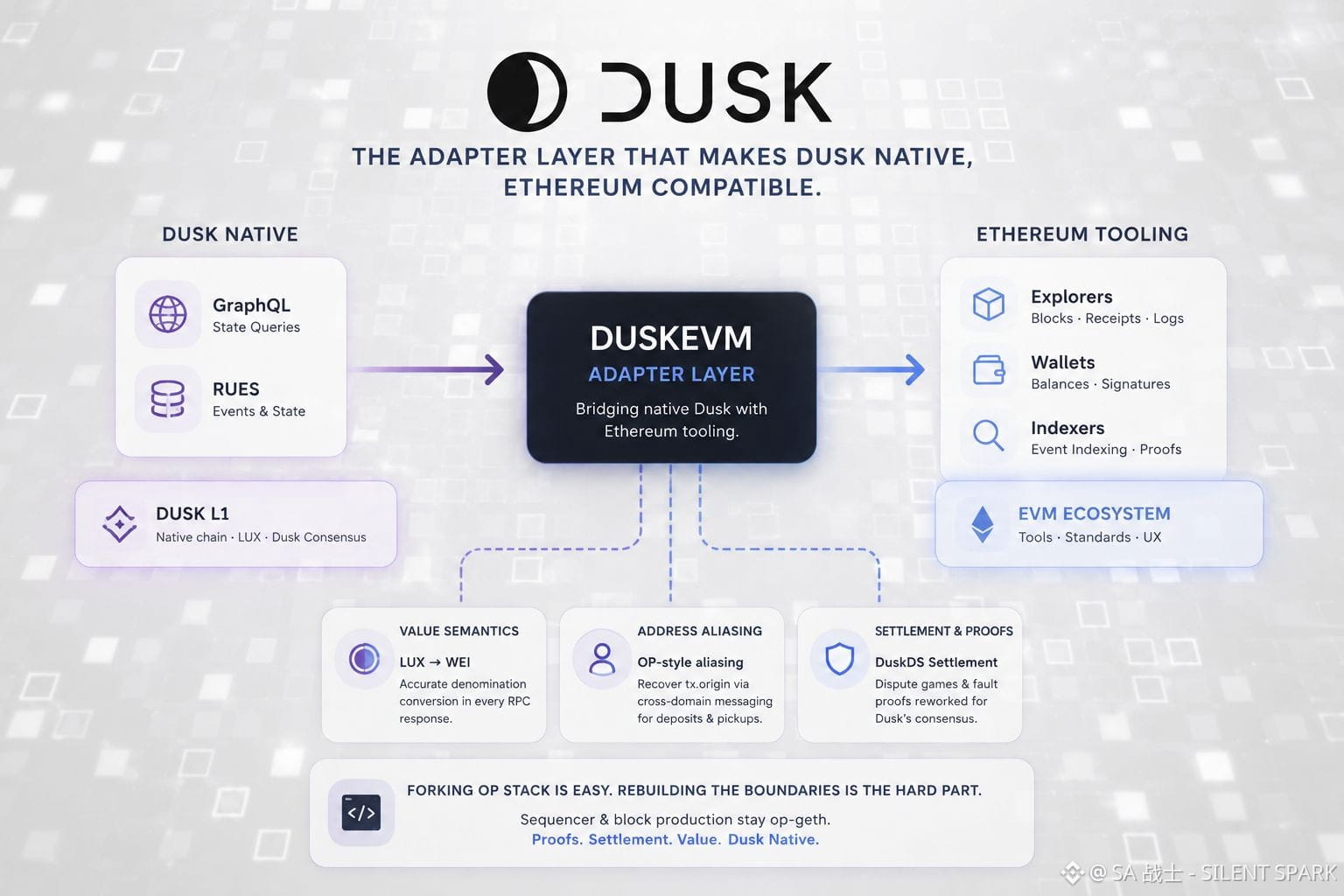
Something about DuskEVM's adapter layer make me curious this week and it's a lot more interesting than the standard "we support Solidity" pitch most EVM chains lead with.
Here's the actual problem. Dusk's native chain speaks GraphQL and something called RUES for events and state. Ethereum tooling has no idea what that is. Every explorer wallet and indexer expects blocks receipts logs and proofs shaped a very specific Ethereum way. So something has to sit between Dusk's native state and that expected shape and translate it correctly every single time. One inconsistent field and the whole downstream stack breaks quietly without anyone noticing right away.
A few mismatches make this concrete. Dusk denominates value in LUX at the base layer while EVM tooling expects wei so every RPC response needs an actual conversion not just a relabel. Deposits moving from the Dusk L1 into DuskEVM use OP style address aliasing because there's no native way to identify which contract actually triggered a bridge or value pickup so tx.origin needs cross domain messaging to recover who really sent it. And since settlement finalizes on DuskDS instead of Ethereum the dispute games and fault proofs borrowed from the OP Stack had to be reworked around Dusk's own consensus rather than Ethereum's.
That's what clicked for me. Forking the OP Stack isn't the hard part. The sequencer and block production stay recognizable as op-geth. But proofs settlement and value semantics had to get rebuilt Dusk native. Deciding where that line sits is the real engineering work here.
#dusk $DUSK @Dusk_Foundation
$ETH
Something about DuskEVM's adapter layer make me curious this week and it's a lot more interesting than the standard "we support Solidity" pitch most EVM chains lead with.
Here's the actual problem. Dusk's native chain speaks GraphQL and something called RUES for events and state. Ethereum tooling has no idea what that is. Every explorer wallet and indexer expects blocks receipts logs and proofs shaped a very specific Ethereum way. So something has to sit between Dusk's native state and that expected shape and translate it correctly every single time. One inconsistent field and the whole downstream stack breaks quietly without anyone noticing right away.
A few mismatches make this concrete. Dusk denominates value in LUX at the base layer while EVM tooling expects wei so every RPC response needs an actual conversion not just a relabel. Deposits moving from the Dusk L1 into DuskEVM use OP style address aliasing because there's no native way to identify which contract actually triggered a bridge or value pickup so tx.origin needs cross domain messaging to recover who really sent it. And since settlement finalizes on DuskDS instead of Ethereum the dispute games and fault proofs borrowed from the OP Stack had to be reworked around Dusk's own consensus rather than Ethereum's.
That's what clicked for me. Forking the OP Stack isn't the hard part. The sequencer and block production stay recognizable as op-geth. But proofs settlement and value semantics had to get rebuilt Dusk native. Deciding where that line sits is the real engineering work here.
#dusk $DUSK @Dusk
$ETH
Here's the actual problem. Dusk's native chain speaks GraphQL and something called RUES for events and state. Ethereum tooling has no idea what that is. Every explorer wallet and indexer expects blocks receipts logs and proofs shaped a very specific Ethereum way. So something has to sit between Dusk's native state and that expected shape and translate it correctly every single time. One inconsistent field and the whole downstream stack breaks quietly without anyone noticing right away.
A few mismatches make this concrete. Dusk denominates value in LUX at the base layer while EVM tooling expects wei so every RPC response needs an actual conversion not just a relabel. Deposits moving from the Dusk L1 into DuskEVM use OP style address aliasing because there's no native way to identify which contract actually triggered a bridge or value pickup so tx.origin needs cross domain messaging to recover who really sent it. And since settlement finalizes on DuskDS instead of Ethereum the dispute games and fault proofs borrowed from the OP Stack had to be reworked around Dusk's own consensus rather than Ethereum's.
That's what clicked for me. Forking the OP Stack isn't the hard part. The sequencer and block production stay recognizable as op-geth. But proofs settlement and value semantics had to get rebuilt Dusk native. Deciding where that line sits is the real engineering work here.
#dusk $DUSK @Dusk
$ETH
2
5
577
I started digging into a question that why crypto privacy projects never make it into serious finance and it comes down to one stubborn assumption. Everyone assumed you had to pick a side. Either the ledger stays fully open and every balance and trade sits there for anyone to see or it stays fully hidden and no regulator will ever touch it. That binary has quietly killed a lot of good ideas.
Then I read into Hedger which is Dusk Network's confidential transaction system built for DuskEVM and it approaches the problem differently. Instead of choosing openness or secrecy it encrypts balances and transaction amounts by default using homomorphic encryption based on ElGamal over elliptic curves. That means computations can happen directly on encrypted data without ever decrypting it first. Zero knowledge proofs sit alongside that to prove a transaction is valid without revealing what's actually inside it.
Here's what surprised me. Dusk's own research describes optional compliance hooks built into the same system so specific auditors can retrieve transaction amounts or intervene when legally required. Nothing gets exposed by default but nothing stays permanently unreachable either. Proofs reportedly generate client side in under two seconds which actually matters if this is meant to run inside normal EVM tooling instead of some separate closed environment.
It reframed the whole debate for me. Privacy and compliance were never really opposites. They just needed a system designed to hold both at once instead of forcing a choice between them.
#dusk $DUSK @Dusk_Foundation
Which matters more to you when real money starts moving on chain ??
I started digging into a question that why crypto privacy projects never make it into serious finance and it comes down to one stubborn assumption. Everyone assumed you had to pick a side. Either the ledger stays fully open and every balance and trade sits there for anyone to see or it stays fully hidden and no regulator will ever touch it. That binary has quietly killed a lot of good ideas.
Then I read into Hedger which is Dusk Network's confidential transaction system built for DuskEVM and it approaches the problem differently. Instead of choosing openness or secrecy it encrypts balances and transaction amounts by default using homomorphic encryption based on ElGamal over elliptic curves. That means computations can happen directly on encrypted data without ever decrypting it first. Zero knowledge proofs sit alongside that to prove a transaction is valid without revealing what's actually inside it.
Here's what surprised me. Dusk's own research describes optional compliance hooks built into the same system so specific auditors can retrieve transaction amounts or intervene when legally required. Nothing gets exposed by default but nothing stays permanently unreachable either. Proofs reportedly generate client side in under two seconds which actually matters if this is meant to run inside normal EVM tooling instead of some separate closed environment.
It reframed the whole debate for me. Privacy and compliance were never really opposites. They just needed a system designed to hold both at once instead of forcing a choice between them.
#dusk $DUSK @Dusk
Which matters more to you when real money starts moving on chain ??
Then I read into Hedger which is Dusk Network's confidential transaction system built for DuskEVM and it approaches the problem differently. Instead of choosing openness or secrecy it encrypts balances and transaction amounts by default using homomorphic encryption based on ElGamal over elliptic curves. That means computations can happen directly on encrypted data without ever decrypting it first. Zero knowledge proofs sit alongside that to prove a transaction is valid without revealing what's actually inside it.
Here's what surprised me. Dusk's own research describes optional compliance hooks built into the same system so specific auditors can retrieve transaction amounts or intervene when legally required. Nothing gets exposed by default but nothing stays permanently unreachable either. Proofs reportedly generate client side in under two seconds which actually matters if this is meant to run inside normal EVM tooling instead of some separate closed environment.
It reframed the whole debate for me. Privacy and compliance were never really opposites. They just needed a system designed to hold both at once instead of forcing a choice between them.
#dusk $DUSK @Dusk
Which matters more to you when real money starts moving on chain ??
Full transparency
50%
Full anonymity
50%
Reviewable privacy
0%
2 Votes • Vote fermé
13
14
859
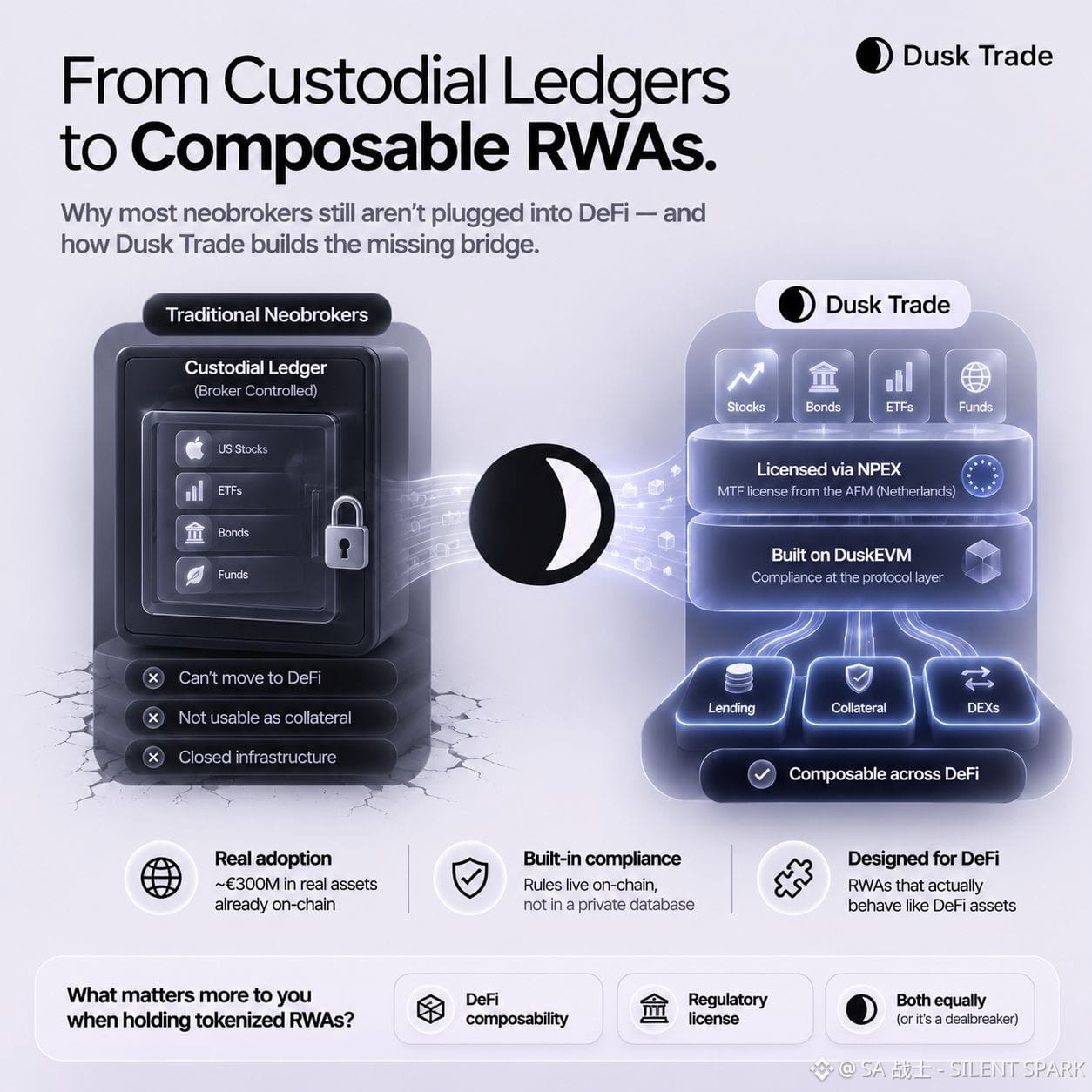
I went down a rabbit hole on why neobrokers still can't plug into DeFi even after years of tokenization hype. Turns out the problem isn't the frontend app. It's that the shares you "own" through something like Robinhood or Trade Republic sit inside a custodial ledger the broker controls. That entry can't move onto a lending protocol or get used as collateral because compliance was bolted onto old infrastructure after the fact.
That's what made Dusk Trade interesting to me. It's positioning itself as a neobroker but built the whole thing as an application layer on DuskEVM instead of wrapping a legacy backend. The regulatory piece comes through NPEX a licensed exchange in the Netherlands already operating under an MTF license from the AFM. And this isn't a roadmap promise. NPEX has reportedly brought around €300M in real assets onto Dusk's infrastructure already.
Here's what clicked for me. For a tokenized fund or bond to actually behave like a DeFi asset it needs the compliance rules baked into the protocol itself. Who can hold it. Where it can move. That logic can't live in a broker's private database if you want the asset to be composable across wallets and protocols. It has to live at the infrastructure layer from day one.
That's the real difference between claiming to be a regulated MTF and actually operating as infrastructure for one.
#dusk $DUSK @Dusk_Foundation
I went down a rabbit hole on why neobrokers still can't plug into DeFi even after years of tokenization hype. Turns out the problem isn't the frontend app. It's that the shares you "own" through something like Robinhood or Trade Republic sit inside a custodial ledger the broker controls. That entry can't move onto a lending protocol or get used as collateral because compliance was bolted onto old infrastructure after the fact.
That's what made Dusk Trade interesting to me. It's positioning itself as a neobroker but built the whole thing as an application layer on DuskEVM instead of wrapping a legacy backend. The regulatory piece comes through NPEX a licensed exchange in the Netherlands already operating under an MTF license from the AFM. And this isn't a roadmap promise. NPEX has reportedly brought around €300M in real assets onto Dusk's infrastructure already.
Here's what clicked for me. For a tokenized fund or bond to actually behave like a DeFi asset it needs the compliance rules baked into the protocol itself. Who can hold it. Where it can move. That logic can't live in a broker's private database if you want the asset to be composable across wallets and protocols. It has to live at the infrastructure layer from day one.
That's the real difference between claiming to be a regulated MTF and actually operating as infrastructure for one.
#dusk $DUSK @Dusk
That's what made Dusk Trade interesting to me. It's positioning itself as a neobroker but built the whole thing as an application layer on DuskEVM instead of wrapping a legacy backend. The regulatory piece comes through NPEX a licensed exchange in the Netherlands already operating under an MTF license from the AFM. And this isn't a roadmap promise. NPEX has reportedly brought around €300M in real assets onto Dusk's infrastructure already.
Here's what clicked for me. For a tokenized fund or bond to actually behave like a DeFi asset it needs the compliance rules baked into the protocol itself. Who can hold it. Where it can move. That logic can't live in a broker's private database if you want the asset to be composable across wallets and protocols. It has to live at the infrastructure layer from day one.
That's the real difference between claiming to be a regulated MTF and actually operating as infrastructure for one.
#dusk $DUSK @Dusk
15
15
986
I kept hearing tokenized money market fund thrown around like it was one simple thing until I actually looked into what happens when you buy one. Turns out most of them work the same way. A custodial fund holds the real shares off chain and a token gets minted that just points to that off chain position. You don't own the fund. You own a claim on someone else's promise that the fund exists and will honor redemption.
That distinction sounds small until you think about what happens during stress. If the custodian freezes redemptions or the bridge breaks or the off chain registry falls behind the on chain token supply your ownership is only as good as that intermediary's willingness and ability to make good on it.
What got me curious about Dusk is the opposite design. The idea is that the token itself is meant to be the actual on chain record of ownership. There's no separate off chain ledger you're hoping stays in sync. When a transfer happens it settles atomically and that settlement is the ownership change itself instead of an instruction sent somewhere else to update a private book.
That's the real difference between holding an IOU and holding the asset itself. Instant settlement isn't just a speed feature here. It's what actually makes the ownership real instead of promised.
#dusk $DUSK @Dusk_Foundation
Poll: Which would you trust more with real money ?
I kept hearing tokenized money market fund thrown around like it was one simple thing until I actually looked into what happens when you buy one. Turns out most of them work the same way. A custodial fund holds the real shares off chain and a token gets minted that just points to that off chain position. You don't own the fund. You own a claim on someone else's promise that the fund exists and will honor redemption.
That distinction sounds small until you think about what happens during stress. If the custodian freezes redemptions or the bridge breaks or the off chain registry falls behind the on chain token supply your ownership is only as good as that intermediary's willingness and ability to make good on it.
What got me curious about Dusk is the opposite design. The idea is that the token itself is meant to be the actual on chain record of ownership. There's no separate off chain ledger you're hoping stays in sync. When a transfer happens it settles atomically and that settlement is the ownership change itself instead of an instruction sent somewhere else to update a private book.
That's the real difference between holding an IOU and holding the asset itself. Instant settlement isn't just a speed feature here. It's what actually makes the ownership real instead of promised.
#dusk $DUSK @Dusk
Poll: Which would you trust more with real money ?
That distinction sounds small until you think about what happens during stress. If the custodian freezes redemptions or the bridge breaks or the off chain registry falls behind the on chain token supply your ownership is only as good as that intermediary's willingness and ability to make good on it.
What got me curious about Dusk is the opposite design. The idea is that the token itself is meant to be the actual on chain record of ownership. There's no separate off chain ledger you're hoping stays in sync. When a transfer happens it settles atomically and that settlement is the ownership change itself instead of an instruction sent somewhere else to update a private book.
That's the real difference between holding an IOU and holding the asset itself. Instant settlement isn't just a speed feature here. It's what actually makes the ownership real instead of promised.
#dusk $DUSK @Dusk
Poll: Which would you trust more with real money ?
Wrapped custodial token
0%
Native on chain ownership
0%
Depends entirely on the issuer
0%
0 Votes • Vote fermé
20
14
943
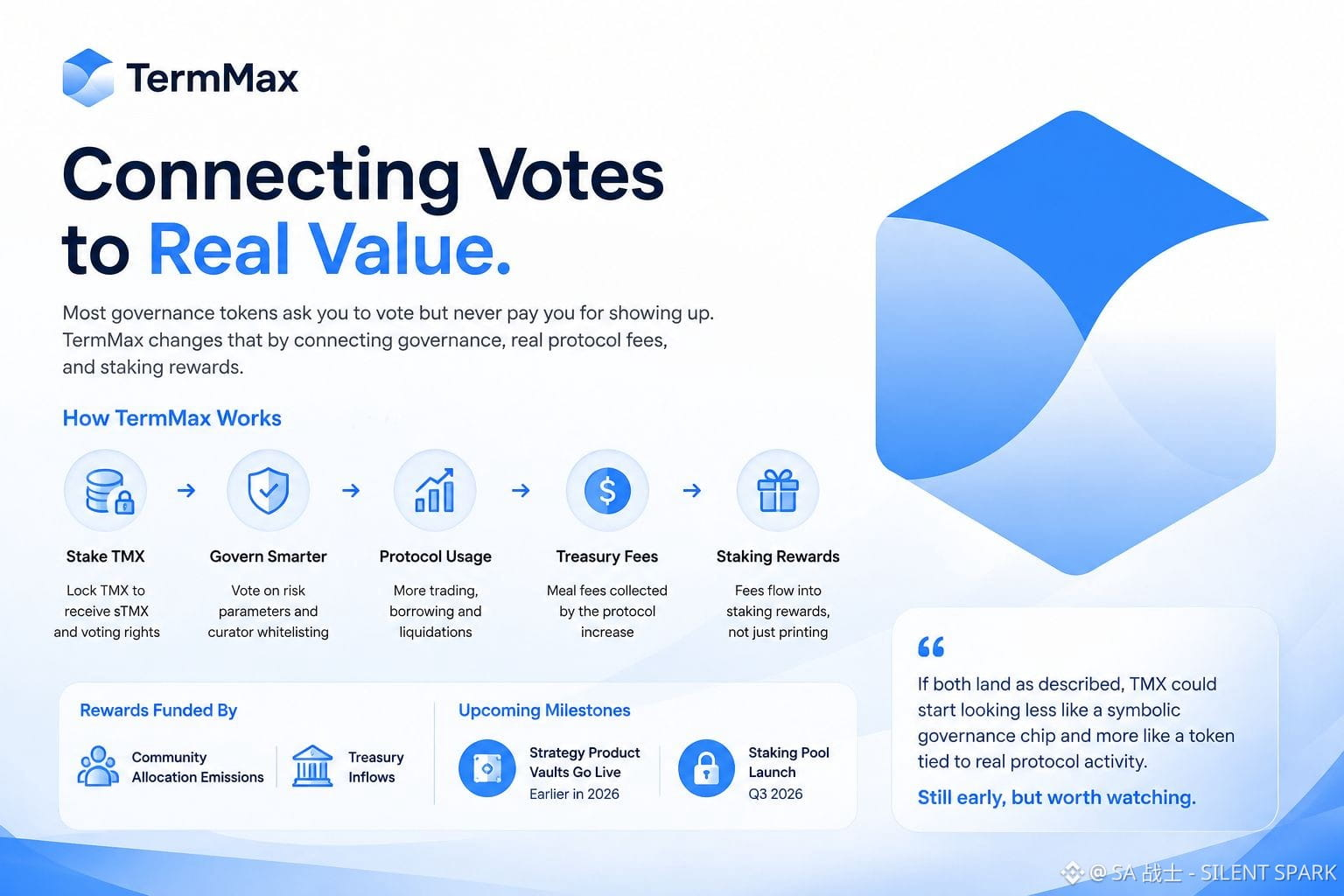
Most governance tokens ask you to vote but never pay you for showing up. You lock a token. You get voting rights. Then nothing happens. There's no real link between that vote and the money the protocol is actually making. That's one of DeFi's oldest unsolved problems.
This matters because holders end up guessing whether they're early backers of a real business or just unpaid voters on parameters nobody outside the protocol cares about. It's hard to build lasting incentives around a vote that may never get used.
TermMax introduces an alternative approach. It's a lending and fixed rate trading protocol built around FT and XT tokens. TMX can be staked for sTMX with rewards funded from two sources: Community allocation emissions and Treasury inflows. The Treasury collects real fees from FT and XT trading borrowing and liquidations. So when protocol usage rises those fees rise too which flows straight into staking rewards rather than just token printing.
Staking also brings sharper governance power over risk parameters and curator whitelisting decisions that shape how the whole system runs.
What stood out to me is the timing. A staking pool launch is planned for Q3 2026 right after Strategy Product Vaults go live earlier that year. If both land as described TMX could start looking less like a symbolic governance chip and more like a token tied to real protocol activity. Still early but worth watching.
#termmax @termmax
Most governance tokens ask you to vote but never pay you for showing up. You lock a token. You get voting rights. Then nothing happens. There's no real link between that vote and the money the protocol is actually making. That's one of DeFi's oldest unsolved problems.
This matters because holders end up guessing whether they're early backers of a real business or just unpaid voters on parameters nobody outside the protocol cares about. It's hard to build lasting incentives around a vote that may never get used.
TermMax introduces an alternative approach. It's a lending and fixed rate trading protocol built around FT and XT tokens. TMX can be staked for sTMX with rewards funded from two sources: Community allocation emissions and Treasury inflows. The Treasury collects real fees from FT and XT trading borrowing and liquidations. So when protocol usage rises those fees rise too which flows straight into staking rewards rather than just token printing.
Staking also brings sharper governance power over risk parameters and curator whitelisting decisions that shape how the whole system runs.
What stood out to me is the timing. A staking pool launch is planned for Q3 2026 right after Strategy Product Vaults go live earlier that year. If both land as described TMX could start looking less like a symbolic governance chip and more like a token tied to real protocol activity. Still early but worth watching.
#termmax @TermMax
This matters because holders end up guessing whether they're early backers of a real business or just unpaid voters on parameters nobody outside the protocol cares about. It's hard to build lasting incentives around a vote that may never get used.
TermMax introduces an alternative approach. It's a lending and fixed rate trading protocol built around FT and XT tokens. TMX can be staked for sTMX with rewards funded from two sources: Community allocation emissions and Treasury inflows. The Treasury collects real fees from FT and XT trading borrowing and liquidations. So when protocol usage rises those fees rise too which flows straight into staking rewards rather than just token printing.
Staking also brings sharper governance power over risk parameters and curator whitelisting decisions that shape how the whole system runs.
What stood out to me is the timing. A staking pool launch is planned for Q3 2026 right after Strategy Product Vaults go live earlier that year. If both land as described TMX could start looking less like a symbolic governance chip and more like a token tied to real protocol activity. Still early but worth watching.
#termmax @TermMax
10
8
741
Vérifié
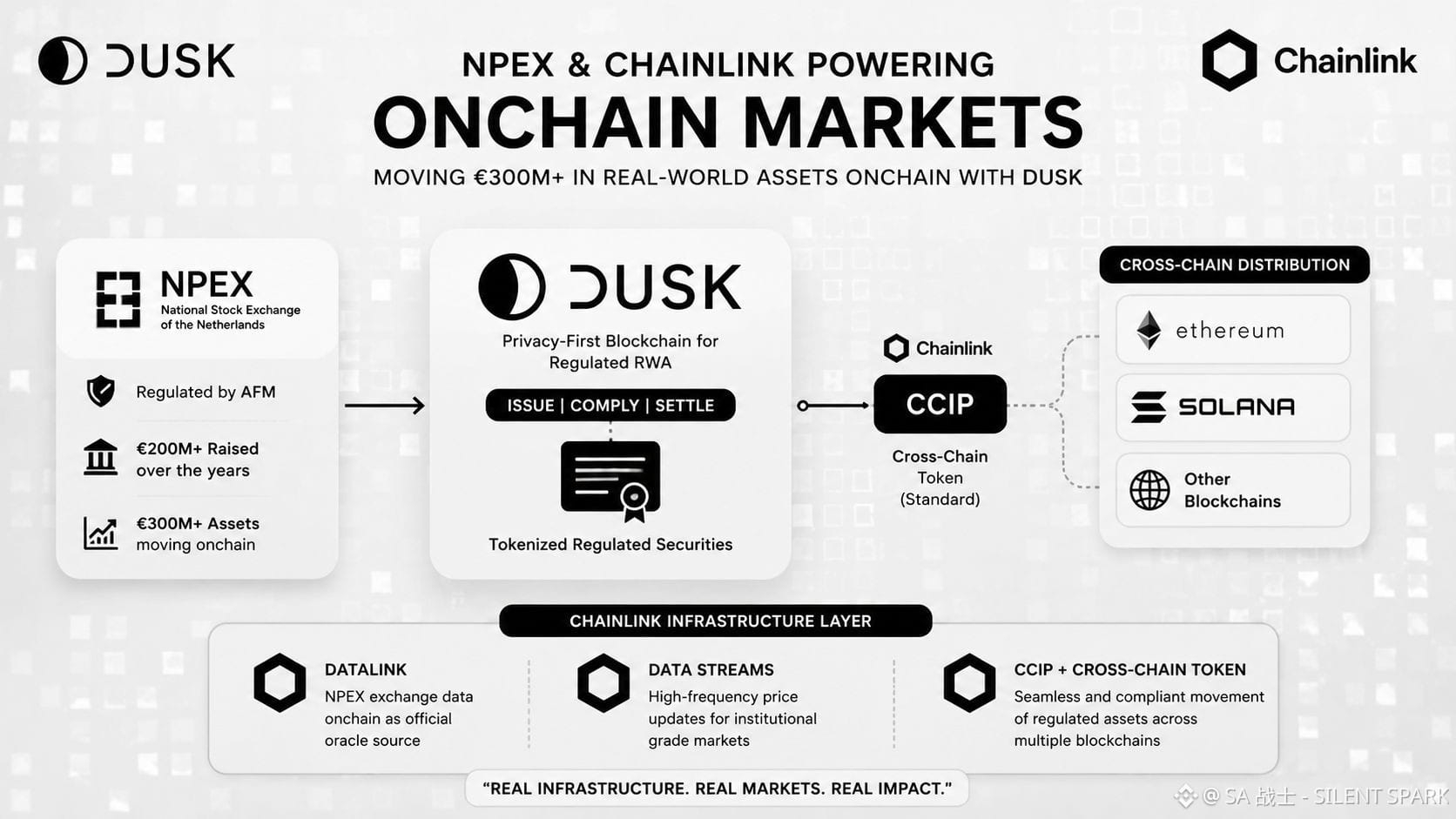
I kept seeing NPEX and Chainlink mentioned together and almost scrolled past it until I actually looked into what NPEX actually is. It's not a startup exchange. It's a Dutch stock exchange regulated by the AFM that has already raised over 200 million euros for real companies over the years. Now they're planning to move over 300 million euros of assets onchain through Dusk and that number made me stop and actually read the details.
Here's what surprised me. Moving a regulated security onchain isn't just about minting a token and calling it done. The exchange still needs official verified price data feeding into smart contracts. It also needs a way for that token to move across different blockchains without breaking the legal wrapper around it. That's where Chainlink fits in. CCIP becomes the interoperability layer so assets issued by NPEX on Dusk can move across chains like Ethereum and Solana using the Cross Chain Token standard. DataLink pipes NPEX's own exchange data onchain as the official oracle source. Data Streams handles the high frequency price updates that institutions actually need.
Basically the blockchain is only one layer of this. The oracle and settlement infrastructure underneath is what actually makes a listed security safe to trade onchain without losing its regulatory status.
This is the first RWA setup I've come across that reads less like an experiment and more like real market infrastructure.
#dusk $DUSK @Dusk_Foundation
I kept seeing NPEX and Chainlink mentioned together and almost scrolled past it until I actually looked into what NPEX actually is. It's not a startup exchange. It's a Dutch stock exchange regulated by the AFM that has already raised over 200 million euros for real companies over the years. Now they're planning to move over 300 million euros of assets onchain through Dusk and that number made me stop and actually read the details.
Here's what surprised me. Moving a regulated security onchain isn't just about minting a token and calling it done. The exchange still needs official verified price data feeding into smart contracts. It also needs a way for that token to move across different blockchains without breaking the legal wrapper around it. That's where Chainlink fits in. CCIP becomes the interoperability layer so assets issued by NPEX on Dusk can move across chains like Ethereum and Solana using the Cross Chain Token standard. DataLink pipes NPEX's own exchange data onchain as the official oracle source. Data Streams handles the high frequency price updates that institutions actually need.
Basically the blockchain is only one layer of this. The oracle and settlement infrastructure underneath is what actually makes a listed security safe to trade onchain without losing its regulatory status.
This is the first RWA setup I've come across that reads less like an experiment and more like real market infrastructure.
#dusk $DUSK @Dusk
Here's what surprised me. Moving a regulated security onchain isn't just about minting a token and calling it done. The exchange still needs official verified price data feeding into smart contracts. It also needs a way for that token to move across different blockchains without breaking the legal wrapper around it. That's where Chainlink fits in. CCIP becomes the interoperability layer so assets issued by NPEX on Dusk can move across chains like Ethereum and Solana using the Cross Chain Token standard. DataLink pipes NPEX's own exchange data onchain as the official oracle source. Data Streams handles the high frequency price updates that institutions actually need.
Basically the blockchain is only one layer of this. The oracle and settlement infrastructure underneath is what actually makes a listed security safe to trade onchain without losing its regulatory status.
This is the first RWA setup I've come across that reads less like an experiment and more like real market infrastructure.
#dusk $DUSK @Dusk
14
10
1.1k
Most people size up a token by glancing at total supply and calling it a day. That's a mistake. Two tokens can both have a billion units and behave completely differently depending on how much unlocks immediately versus how much stays locked.
This matters for more than just traders. Long term holders need to know if they're buying steady dilution or a token that's already mostly circulating. Most surprise unlock dumps were never surprises. Someone just skipped the schedule.
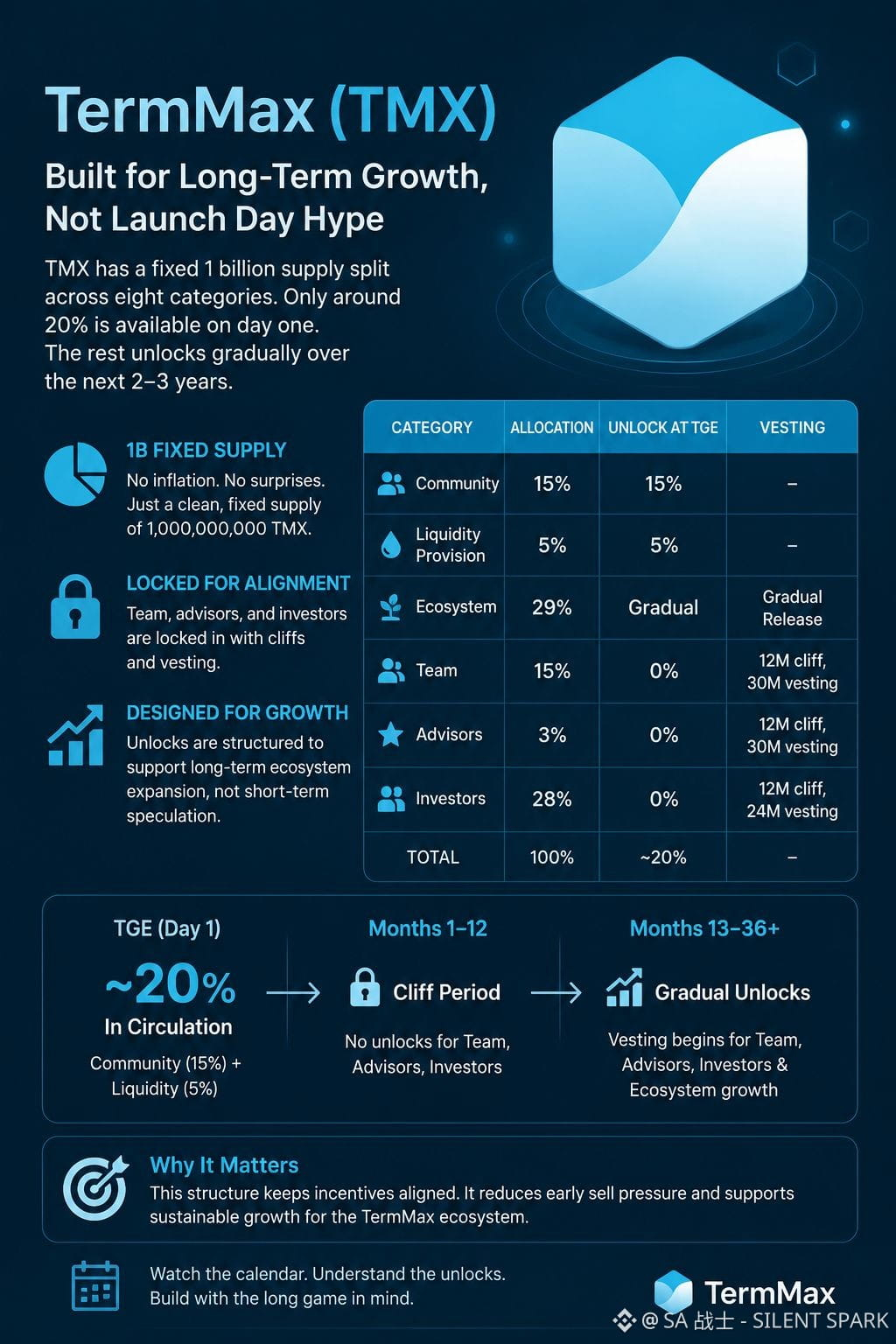
I went through TermMax's allocation table and it's a clean example. TMX has a fixed 1 billion supply split across eight categories. Community holds 15% and Liquidity Provision holds 5% and both unlock at TGE. Ecosystem takes the largest share at 29% released gradually to fund growth. Team holds 15% and Advisors hold 3% both behind a 12 month cliff followed by 30 months of vesting. Investors hold 28% under a 12 month cliff and 24 months of vesting after.
Add it up and only around 20% of TMX sits in the open market on day one. The rest arrives slowly over the next two to three years. Anyone modeling sell pressure may want to watch the calendar as closely as the chart.
What stood out to me is how this keeps team and investor incentives tied to the protocol's growth instead of launch day hype. That doesn't promise anything about price. But it does suggest the token could be designed to track how TermMax matures rather than front run it.
#termmax @termmax
Most people size up a token by glancing at total supply and calling it a day. That's a mistake. Two tokens can both have a billion units and behave completely differently depending on how much unlocks immediately versus how much stays locked.
This matters for more than just traders. Long term holders need to know if they're buying steady dilution or a token that's already mostly circulating. Most surprise unlock dumps were never surprises. Someone just skipped the schedule.
I went through TermMax's allocation table and it's a clean example. TMX has a fixed 1 billion supply split across eight categories. Community holds 15% and Liquidity Provision holds 5% and both unlock at TGE. Ecosystem takes the largest share at 29% released gradually to fund growth. Team holds 15% and Advisors hold 3% both behind a 12 month cliff followed by 30 months of vesting. Investors hold 28% under a 12 month cliff and 24 months of vesting after.
Add it up and only around 20% of TMX sits in the open market on day one. The rest arrives slowly over the next two to three years. Anyone modeling sell pressure may want to watch the calendar as closely as the chart.
What stood out to me is how this keeps team and investor incentives tied to the protocol's growth instead of launch day hype. That doesn't promise anything about price. But it does suggest the token could be designed to track how TermMax matures rather than front run it.
#termmax @TermMax
This matters for more than just traders. Long term holders need to know if they're buying steady dilution or a token that's already mostly circulating. Most surprise unlock dumps were never surprises. Someone just skipped the schedule.
I went through TermMax's allocation table and it's a clean example. TMX has a fixed 1 billion supply split across eight categories. Community holds 15% and Liquidity Provision holds 5% and both unlock at TGE. Ecosystem takes the largest share at 29% released gradually to fund growth. Team holds 15% and Advisors hold 3% both behind a 12 month cliff followed by 30 months of vesting. Investors hold 28% under a 12 month cliff and 24 months of vesting after.
Add it up and only around 20% of TMX sits in the open market on day one. The rest arrives slowly over the next two to three years. Anyone modeling sell pressure may want to watch the calendar as closely as the chart.
What stood out to me is how this keeps team and investor incentives tied to the protocol's growth instead of launch day hype. That doesn't promise anything about price. But it does suggest the token could be designed to track how TermMax matures rather than front run it.
#termmax @TermMax
28
15
1k
·
--
Haussier
I kept seeing the phrase compliant DeFi everywhere and honestly I didn't trust it. Most of the time it just means a KYC form and a geofence stapled onto a chain that has zero real regulatory status underneath. So I went and looked into how Dusk's NPEX partnership actually works and it's a completely different setup than what I expected.
NPEX isn't just some crypto friendly partner. It's a real Dutch exchange founded in 2008 and regulated by the AFM. It holds an MTF license a Broker license and an ECSP license. Through this partnership those licenses now live at Dusk's protocol layer instead of sitting inside a single app.
Here's what surprised me. That means any application built on Dusk inherits the same regulated perimeter by default. You're not asking every new app to go chase its own license and hope it holds up under scrutiny. The compliance is baked into the base layer itself.
The simple way I think about it now is app layer compliance is a sticker on the box. Protocol layer compliance is the material the box is made from. One can be peeled off. The other can't.
This gives me an actual filter now for telling which chains can genuinely host regulated finance and which ones are just repeating the word compliant a lot.
#dusk $DUSK @Dusk_Foundation
What matters more to you when picking infrastructure for regulated assets ?
I kept seeing the phrase compliant DeFi everywhere and honestly I didn't trust it. Most of the time it just means a KYC form and a geofence stapled onto a chain that has zero real regulatory status underneath. So I went and looked into how Dusk's NPEX partnership actually works and it's a completely different setup than what I expected.
NPEX isn't just some crypto friendly partner. It's a real Dutch exchange founded in 2008 and regulated by the AFM. It holds an MTF license a Broker license and an ECSP license. Through this partnership those licenses now live at Dusk's protocol layer instead of sitting inside a single app.
Here's what surprised me. That means any application built on Dusk inherits the same regulated perimeter by default. You're not asking every new app to go chase its own license and hope it holds up under scrutiny. The compliance is baked into the base layer itself.
The simple way I think about it now is app layer compliance is a sticker on the box. Protocol layer compliance is the material the box is made from. One can be peeled off. The other can't.
This gives me an actual filter now for telling which chains can genuinely host regulated finance and which ones are just repeating the word compliant a lot.
#dusk $DUSK @Dusk
What matters more to you when picking infrastructure for regulated assets ?
NPEX isn't just some crypto friendly partner. It's a real Dutch exchange founded in 2008 and regulated by the AFM. It holds an MTF license a Broker license and an ECSP license. Through this partnership those licenses now live at Dusk's protocol layer instead of sitting inside a single app.
Here's what surprised me. That means any application built on Dusk inherits the same regulated perimeter by default. You're not asking every new app to go chase its own license and hope it holds up under scrutiny. The compliance is baked into the base layer itself.
The simple way I think about it now is app layer compliance is a sticker on the box. Protocol layer compliance is the material the box is made from. One can be peeled off. The other can't.
This gives me an actual filter now for telling which chains can genuinely host regulated finance and which ones are just repeating the word compliant a lot.
#dusk $DUSK @Dusk
What matters more to you when picking infrastructure for regulated assets ?
Protocol level licensing
100%
App layer KYC checks
0%
Doesn't matter if it works
0%
4 Votes • Vote fermé
43
20
1.2k
Connectez-vous pour découvrir plus de contenu
Rejoignez la communauté mondiale des adeptes de cryptomonnaies sur Binance Square
⚡️ Suviez les dernières informations importantes sur les cryptomonnaies.
💬 Jugé digne de confiance par la plus grande plateforme d’échange de cryptomonnaies au monde.
👍 Découvrez les connaissances que partagent les créateurs vérifiés.
Adresse e-mail/Nº de téléphone
Sujets d’actualité
StrategySkipsBitcoinPurchasesSpends$205MOnSTRCBuybacks
1,959 vues
52 mentions
Strategy Skips Bitcoin Buying and Spends $205M on STRC Buybacks : What Changed? 👀
Gourav-S
·1 mentions J’aime
·283 vues
BitmineAdds10452ETH
19,048 vues
371 mentions
SouthKoreaConsidersEducationTaxOnCryptoExchanges
13,266 vues
309 mentions