

Ricardo Paul
12k Publications

Ricardo Paul
 Compte Square Vérifié+
Signaler
Bloquer l’utilisateur
Crypto enthusiast sharing market insights, Web3 trends, and real-time narratives. Always watching the next big move.(X Gilded Block )
16 Suivis
42.8K+ Abonnés
30.4K+ J’aime
Publications
Tous
Direct
·
--
🚨 JUST IN: BITCOIN DUMPS TOWARD $83K! 📉🔥
Bitcoin plunged from around $86,600 → $83,300–$83,600, as roughly $550M in leveraged crypto positions were liquidated — mostly longs. 😳
⚠️ Key BTC levels:
🔴 $83K — critical support
📉 Lose $83K → $80K comes into focus
🟢 Reclaim $86.7K–$87K → bulls regain momentum
Rising Treasury yields, a stronger dollar and geopolitical pressure are adding fuel to the sell-off.
Volatility is exploding. Eyes on $83K. 👀🔥
$BTC
#Bitcoin #BTC #Crypto #CryptoMarket
🚨 JUST IN: BITCOIN DUMPS TOWARD $83K! 📉🔥
Bitcoin plunged from around $86,600 → $83,300–$83,600, as roughly $550M in leveraged crypto positions were liquidated — mostly longs. 😳
⚠️ Key BTC levels:
🔴 $83K — critical support
📉 Lose $83K → $80K comes into focus
🟢 Reclaim $86.7K–$87K → bulls regain momentum
Rising Treasury yields, a stronger dollar and geopolitical pressure are adding fuel to the sell-off.
Volatility is exploding. Eyes on $83K. 👀🔥
$BTC
#Bitcoin #BTC #Crypto #CryptoMarket
Bitcoin plunged from around $86,600 → $83,300–$83,600, as roughly $550M in leveraged crypto positions were liquidated — mostly longs. 😳
⚠️ Key BTC levels:
🔴 $83K — critical support
📉 Lose $83K → $80K comes into focus
🟢 Reclaim $86.7K–$87K → bulls regain momentum
Rising Treasury yields, a stronger dollar and geopolitical pressure are adding fuel to the sell-off.
Volatility is exploding. Eyes on $83K. 👀🔥
$BTC
#Bitcoin #BTC #Crypto #CryptoMarket
77
·
--
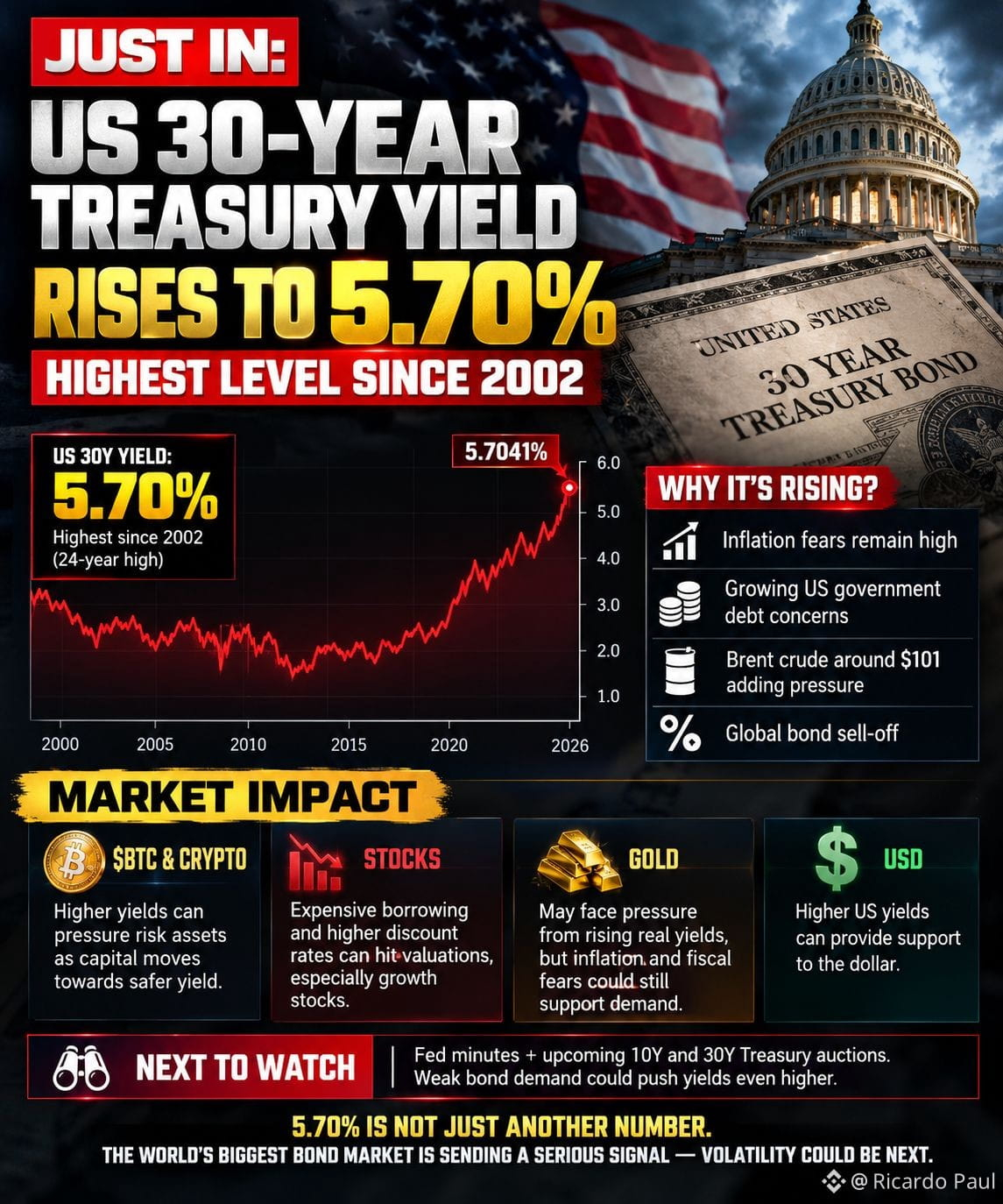
🇺🇸 US 30-YEAR TREASURY YIELD SURGES TO 5.70% — HIGHEST SINCE 2002.
The bond market just flashed a major warning.
US 30Y yield briefly hit 5.7041%, a fresh 24-year high, as global bonds sell off. Inflation fears, rising government debt concerns, and Brent crude around $101 are pushing long-term borrowing costs higher.
WHAT IT MEANS:
$BTC & CRYPTO: Higher yields can pressure risk assets as capital gets attracted toward safer yield.
STOCKS: Expensive borrowing + higher discount rates can hit valuations, especially growth stocks.
GOLD: Could face pressure from rising real yields, but inflation/fiscal fears may support safe-haven demand.
USD: Higher US yields can provide support to the dollar.
NEXT TO WATCH: Fed minutes + upcoming 10Y and 30Y Treasury auctions. Weak bond demand could push yields even higher.
5.70% is not just another number. The world's biggest bond market is sending a serious signal — volatility could be next.
🇺🇸 US 30-YEAR TREASURY YIELD SURGES TO 5.70% — HIGHEST SINCE 2002.
The bond market just flashed a major warning.
US 30Y yield briefly hit 5.7041%, a fresh 24-year high, as global bonds sell off. Inflation fears, rising government debt concerns, and Brent crude around $101 are pushing long-term borrowing costs higher.
WHAT IT MEANS:
$BTC & CRYPTO: Higher yields can pressure risk assets as capital gets attracted toward safer yield.
STOCKS: Expensive borrowing + higher discount rates can hit valuations, especially growth stocks.
GOLD: Could face pressure from rising real yields, but inflation/fiscal fears may support safe-haven demand.
USD: Higher US yields can provide support to the dollar.
NEXT TO WATCH: Fed minutes + upcoming 10Y and 30Y Treasury auctions. Weak bond demand could push yields even higher.
5.70% is not just another number. The world's biggest bond market is sending a serious signal — volatility could be next.
The bond market just flashed a major warning.
US 30Y yield briefly hit 5.7041%, a fresh 24-year high, as global bonds sell off. Inflation fears, rising government debt concerns, and Brent crude around $101 are pushing long-term borrowing costs higher.
WHAT IT MEANS:
$BTC & CRYPTO: Higher yields can pressure risk assets as capital gets attracted toward safer yield.
STOCKS: Expensive borrowing + higher discount rates can hit valuations, especially growth stocks.
GOLD: Could face pressure from rising real yields, but inflation/fiscal fears may support safe-haven demand.
USD: Higher US yields can provide support to the dollar.
NEXT TO WATCH: Fed minutes + upcoming 10Y and 30Y Treasury auctions. Weak bond demand could push yields even higher.
5.70% is not just another number. The world's biggest bond market is sending a serious signal — volatility could be next.
429
·
--
Vérifié
JUST IN: Elon Musk’s SpaceX $SPCX is going VERTICAL.
$SPCX has surged toward $175, pushing its valuation toward a staggering $2.38 TRILLION.
Shares already jumped 7.6% Monday, while Morgan Stanley remains bullish with a massive $300 price target.
From rockets and Starlink to AI — SpaceX is rapidly becoming one of the biggest companies on Earth.
$2.38 TRILLION. And Musk is still aiming for Mars.
JUST IN: Elon Musk’s SpaceX $SPCX is going VERTICAL.
$SPCX has surged toward $175, pushing its valuation toward a staggering $2.38 TRILLION.
Shares already jumped 7.6% Monday, while Morgan Stanley remains bullish with a massive $300 price target.
From rockets and Starlink to AI — SpaceX is rapidly becoming one of the biggest companies on Earth.
$2.38 TRILLION. And Musk is still aiming for Mars.
$SPCX has surged toward $175, pushing its valuation toward a staggering $2.38 TRILLION.
Shares already jumped 7.6% Monday, while Morgan Stanley remains bullish with a massive $300 price target.
From rockets and Starlink to AI — SpaceX is rapidly becoming one of the biggest companies on Earth.
$2.38 TRILLION. And Musk is still aiming for Mars.

1
4
932
·
--
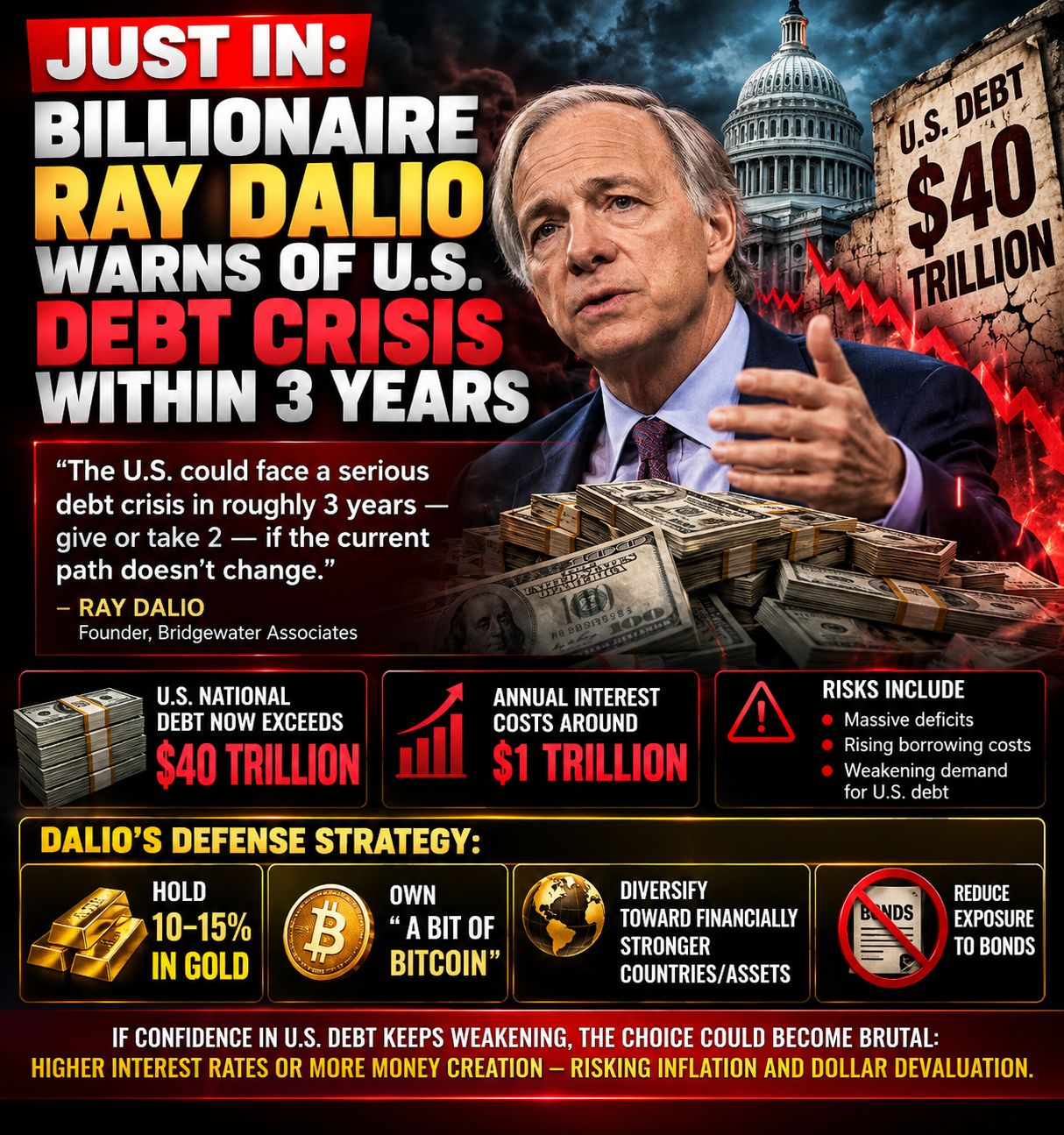
JUST IN: 🇺🇸 BILLIONAIRE RAY DALIO SOUNDS THE ALARM.
Bridgewater founder Ray Dalio warns the U.S. could face a serious debt crisis in roughly 3 years — give or take 2 — if the current path doesn’t change.
U.S. debt has now surpassed $40 TRILLION, while annual interest costs are around $1 TRILLION. Dalio says massive deficits, rising borrowing costs and weakening demand for U.S. debt could eventually create an economic “heart attack.”
His defense?
• Reduce exposure to bonds
• Hold roughly 10–15% in GOLD
• Own “a bit of BITCOIN”
• Diversify toward financially stronger countries/assets
If confidence in U.S. debt keeps weakening, the choice could become brutal: higher interest rates or more money creation — risking inflation and dollar devaluation.
This isn’t just another debt headline.
One of the world’s biggest macro investors is warning the clock is ticking.
$BTC $GOLD.US
JUST IN: 🇺🇸 BILLIONAIRE RAY DALIO SOUNDS THE ALARM.
Bridgewater founder Ray Dalio warns the U.S. could face a serious debt crisis in roughly 3 years — give or take 2 — if the current path doesn’t change.
U.S. debt has now surpassed $40 TRILLION, while annual interest costs are around $1 TRILLION. Dalio says massive deficits, rising borrowing costs and weakening demand for U.S. debt could eventually create an economic “heart attack.”
His defense?
• Reduce exposure to bonds
• Hold roughly 10–15% in GOLD
• Own “a bit of BITCOIN”
• Diversify toward financially stronger countries/assets
If confidence in U.S. debt keeps weakening, the choice could become brutal: higher interest rates or more money creation — risking inflation and dollar devaluation.
This isn’t just another debt headline.
One of the world’s biggest macro investors is warning the clock is ticking.
$BTC $GOLD.US
Bridgewater founder Ray Dalio warns the U.S. could face a serious debt crisis in roughly 3 years — give or take 2 — if the current path doesn’t change.
U.S. debt has now surpassed $40 TRILLION, while annual interest costs are around $1 TRILLION. Dalio says massive deficits, rising borrowing costs and weakening demand for U.S. debt could eventually create an economic “heart attack.”
His defense?
• Reduce exposure to bonds
• Hold roughly 10–15% in GOLD
• Own “a bit of BITCOIN”
• Diversify toward financially stronger countries/assets
If confidence in U.S. debt keeps weakening, the choice could become brutal: higher interest rates or more money creation — risking inflation and dollar devaluation.
This isn’t just another debt headline.
One of the world’s biggest macro investors is warning the clock is ticking.
$BTC $GOLD.US
1
1k
·
--
JUST IN: 🇺🇸 TRUMP ERUPTS OVER SURGING FUEL PRICES!
President Trump is blaming “Dumocrats” and Ukraine’s strikes on Russian oil refineries for adding pressure to fuel markets.
Ukraine says its strikes have knocked out more than HALF of Russia’s refining capacity — a claim not independently verified. Meanwhile, U.S. diesel recently surged to around $6.50/gallon as wars and refinery disruptions tighten global supply.
Trump is now preparing measures aimed at easing diesel costs.
Oil supply shock + geopolitical escalation + soaring fuel costs = ENERGY MARKETS ON HIGH ALERT.
$BTC $ETH
JUST IN: 🇺🇸 TRUMP ERUPTS OVER SURGING FUEL PRICES!
President Trump is blaming “Dumocrats” and Ukraine’s strikes on Russian oil refineries for adding pressure to fuel markets.
Ukraine says its strikes have knocked out more than HALF of Russia’s refining capacity — a claim not independently verified. Meanwhile, U.S. diesel recently surged to around $6.50/gallon as wars and refinery disruptions tighten global supply.
Trump is now preparing measures aimed at easing diesel costs.
Oil supply shock + geopolitical escalation + soaring fuel costs = ENERGY MARKETS ON HIGH ALERT.
$BTC $ETH
President Trump is blaming “Dumocrats” and Ukraine’s strikes on Russian oil refineries for adding pressure to fuel markets.
Ukraine says its strikes have knocked out more than HALF of Russia’s refining capacity — a claim not independently verified. Meanwhile, U.S. diesel recently surged to around $6.50/gallon as wars and refinery disruptions tighten global supply.
Trump is now preparing measures aimed at easing diesel costs.
Oil supply shock + geopolitical escalation + soaring fuel costs = ENERGY MARKETS ON HIGH ALERT.
$BTC $ETH

123
·
--
JUST IN: 🇺🇸 CFTC MOVES TO REGULATE U.S. CRYPTO MARKETS!
The CFTC has kicked off its first major round of crypto market rulemaking, submitting a framework covering crypto asset transactions and markets for White House review.
What this could mean:
• Clearer rules for U.S. crypto markets
• Stronger framework for exchanges and leveraged/margined trading
• More regulatory certainty for institutions
• A major step toward bringing crypto under defined U.S. market rules
The move comes as the CLARITY Act remains stalled in Congress, pushing regulators to act under existing authority.
This isn’t a final rule yet — but the regulatory gears are officially turning.
CRYPTO IN AMERICA IS ENTERING A NEW ERA.
JUST IN: 🇺🇸 CFTC MOVES TO REGULATE U.S. CRYPTO MARKETS!
The CFTC has kicked off its first major round of crypto market rulemaking, submitting a framework covering crypto asset transactions and markets for White House review.
What this could mean:
• Clearer rules for U.S. crypto markets
• Stronger framework for exchanges and leveraged/margined trading
• More regulatory certainty for institutions
• A major step toward bringing crypto under defined U.S. market rules
The move comes as the CLARITY Act remains stalled in Congress, pushing regulators to act under existing authority.
This isn’t a final rule yet — but the regulatory gears are officially turning.
CRYPTO IN AMERICA IS ENTERING A NEW ERA.
The CFTC has kicked off its first major round of crypto market rulemaking, submitting a framework covering crypto asset transactions and markets for White House review.
What this could mean:
• Clearer rules for U.S. crypto markets
• Stronger framework for exchanges and leveraged/margined trading
• More regulatory certainty for institutions
• A major step toward bringing crypto under defined U.S. market rules
The move comes as the CLARITY Act remains stalled in Congress, pushing regulators to act under existing authority.
This isn’t a final rule yet — but the regulatory gears are officially turning.
CRYPTO IN AMERICA IS ENTERING A NEW ERA.

118
·
--
JUST IN: ELON MUSK IS A TRILLIONAIRE AGAIN.
SpaceX $SPCX is exploding higher, surging around 5% today to roughly $167 and pushing its market cap near $2.27 TRILLION.
The fuel? Morgan Stanley just reiterated its bullish call with a massive $300 price target, while investors are positioning ahead of Starship Flight 15.
Musk’s fortune is back around the historic $1 TRILLION mark as $SPCX rockets higher.
This isn’t just a rally — SpaceX is rewriting the wealth record books.
$SPCX
JUST IN: ELON MUSK IS A TRILLIONAIRE AGAIN.
SpaceX $SPCX is exploding higher, surging around 5% today to roughly $167 and pushing its market cap near $2.27 TRILLION.
The fuel? Morgan Stanley just reiterated its bullish call with a massive $300 price target, while investors are positioning ahead of Starship Flight 15.
Musk’s fortune is back around the historic $1 TRILLION mark as $SPCX rockets higher.
This isn’t just a rally — SpaceX is rewriting the wealth record books.
$SPCX
SpaceX $SPCX is exploding higher, surging around 5% today to roughly $167 and pushing its market cap near $2.27 TRILLION.
The fuel? Morgan Stanley just reiterated its bullish call with a massive $300 price target, while investors are positioning ahead of Starship Flight 15.
Musk’s fortune is back around the historic $1 TRILLION mark as $SPCX rockets higher.
This isn’t just a rally — SpaceX is rewriting the wealth record books.
$SPCX

1
1.6k
·
--
JUST IN: ELON MUSK’S SPACEX $SPCX IS TAKING OFF!
$SPCX has surged above $160, extending its powerful run after closing up 7.35% at $158.96. Trading volume exploded to nearly 120M shares, while SpaceX’s valuation sits above $2 TRILLION.
IPO Price: $135
Current Zone: $160+
Recent Close: $158.96
Daily Move: +7.35%
Volume: 119.86M
Market Cap: $2T+
52W High: $225.64
Analyst Target: $226.04
Starship, Starlink, AI and massive launch momentum are keeping SPCX in the spotlight.
The $160 barrier is being tested. If bulls hold control, the next major move could get explosive.
$SPCX
JUST IN: ELON MUSK’S SPACEX $SPCX IS TAKING OFF!
$SPCX has surged above $160, extending its powerful run after closing up 7.35% at $158.96. Trading volume exploded to nearly 120M shares, while SpaceX’s valuation sits above $2 TRILLION.
IPO Price: $135
Current Zone: $160+
Recent Close: $158.96
Daily Move: +7.35%
Volume: 119.86M
Market Cap: $2T+
52W High: $225.64
Analyst Target: $226.04
Starship, Starlink, AI and massive launch momentum are keeping SPCX in the spotlight.
The $160 barrier is being tested. If bulls hold control, the next major move could get explosive.
$SPCX
$SPCX has surged above $160, extending its powerful run after closing up 7.35% at $158.96. Trading volume exploded to nearly 120M shares, while SpaceX’s valuation sits above $2 TRILLION.
IPO Price: $135
Current Zone: $160+
Recent Close: $158.96
Daily Move: +7.35%
Volume: 119.86M
Market Cap: $2T+
52W High: $225.64
Analyst Target: $226.04
Starship, Starlink, AI and massive launch momentum are keeping SPCX in the spotlight.
The $160 barrier is being tested. If bulls hold control, the next major move could get explosive.
$SPCX

1
1.2k
·
--
JUST IN: 🇺🇸 BIG WIN FOR CRYPTO PRIVACY!
The U.S. Treasury has withdrawn the controversial proposal targeting transactions involving unhosted/self-custody wallets.
The proposal would have forced banks and crypto businesses to collect, verify and report additional information for certain transactions involving private wallets.
Why it matters:
• Stronger protection for self-custody
• Less regulatory pressure on private wallets
• Major signal for crypto privacy in the U.S.
• Treasury has also acknowledged legitimate uses for crypto privacy tools, including mixers
The regulatory tide around crypto privacy is shifting.
BULLISH FOR CRYPTO FREEDOM.
#crypto
JUST IN: 🇺🇸 BIG WIN FOR CRYPTO PRIVACY!
The U.S. Treasury has withdrawn the controversial proposal targeting transactions involving unhosted/self-custody wallets.
The proposal would have forced banks and crypto businesses to collect, verify and report additional information for certain transactions involving private wallets.
Why it matters:
• Stronger protection for self-custody
• Less regulatory pressure on private wallets
• Major signal for crypto privacy in the U.S.
• Treasury has also acknowledged legitimate uses for crypto privacy tools, including mixers
The regulatory tide around crypto privacy is shifting.
BULLISH FOR CRYPTO FREEDOM.
#crypto
The U.S. Treasury has withdrawn the controversial proposal targeting transactions involving unhosted/self-custody wallets.
The proposal would have forced banks and crypto businesses to collect, verify and report additional information for certain transactions involving private wallets.
Why it matters:
• Stronger protection for self-custody
• Less regulatory pressure on private wallets
• Major signal for crypto privacy in the U.S.
• Treasury has also acknowledged legitimate uses for crypto privacy tools, including mixers
The regulatory tide around crypto privacy is shifting.
BULLISH FOR CRYPTO FREEDOM.
#crypto

189
·
--
JUST IN: MICHAEL SAYLOR IS STACKING AGAIN!
Strategy reportedly buys 334.3 $BTC worth $29 MILLION.
Saylor keeps adding Bitcoin while the market watches.
Another massive institutional move — the Bitcoin accumulation game isn’t slowing down.
$BTC
#BTC
JUST IN: MICHAEL SAYLOR IS STACKING AGAIN!
Strategy reportedly buys 334.3 $BTC worth $29 MILLION.
Saylor keeps adding Bitcoin while the market watches.
Another massive institutional move — the Bitcoin accumulation game isn’t slowing down.
$BTC
#BTC
Strategy reportedly buys 334.3 $BTC worth $29 MILLION.
Saylor keeps adding Bitcoin while the market watches.
Another massive institutional move — the Bitcoin accumulation game isn’t slowing down.
$BTC
#BTC

1
125
·
--
🚨 JUST IN: 🇺🇸 SEC says MORE crypto regulatory proposals are coming.
The SEC has already moved on crypto custody rules for advisers and funds, including limited self-custody and state trust-company options. It’s also working on broader crypto rules covering issuance, trading and market structure.
🔥 Translation: U.S. crypto regulation is moving fast.
For Bitcoin & the wider market, the next proposals could become major catalysts — especially if they bring clearer rules for institutions, exchanges and token issuers.
The regulatory game is changing. 👀
$BTC
#BTC #crypto
🚨 JUST IN: 🇺🇸 SEC says MORE crypto regulatory proposals are coming.
The SEC has already moved on crypto custody rules for advisers and funds, including limited self-custody and state trust-company options. It’s also working on broader crypto rules covering issuance, trading and market structure.
🔥 Translation: U.S. crypto regulation is moving fast.
For Bitcoin & the wider market, the next proposals could become major catalysts — especially if they bring clearer rules for institutions, exchanges and token issuers.
The regulatory game is changing. 👀
$BTC
#BTC #crypto
The SEC has already moved on crypto custody rules for advisers and funds, including limited self-custody and state trust-company options. It’s also working on broader crypto rules covering issuance, trading and market structure.
🔥 Translation: U.S. crypto regulation is moving fast.
For Bitcoin & the wider market, the next proposals could become major catalysts — especially if they bring clearer rules for institutions, exchanges and token issuers.
The regulatory game is changing. 👀
$BTC
#BTC #crypto

181
·
--
🚨 JUST IN: 🇺🇸 A U.S.-bound oil tanker was reportedly hit by a serious cyberattack, with hackers allegedly gaining access to critical ship systems.
The vessel, identified in reports as VL Prosperity, was heading toward Galveston, Texas, carrying roughly 2.3 million barrels of crude oil. Reports say the attack disrupted communications for around 30 hours and allegedly affected propulsion, navigation and cargo-related systems.
🇺🇸 The U.S. Coast Guard and FBI later boarded the vessel to investigate after finding indications of malicious cyber activity.
⚠️ But there’s a critical detail: U.S. authorities have not publicly confirmed that Iran was responsible, despite Iranian media reports making that claim.
No crew injuries, environmental damage, vessel instability or confirmed operational disruption were reported.
This is bigger than one tanker.
If hackers can reach a ship’s operational technology, the threat moves from stolen data to real-world infrastructure, energy supply chains and maritime security.
The investigation is still ongoing. 🔥
#CyberSecurity #Oil #Tanker #USA #Iran #Energy #CyberAttack
$NVDAB
🚨 JUST IN: 🇺🇸 A U.S.-bound oil tanker was reportedly hit by a serious cyberattack, with hackers allegedly gaining access to critical ship systems.
The vessel, identified in reports as VL Prosperity, was heading toward Galveston, Texas, carrying roughly 2.3 million barrels of crude oil. Reports say the attack disrupted communications for around 30 hours and allegedly affected propulsion, navigation and cargo-related systems.
🇺🇸 The U.S. Coast Guard and FBI later boarded the vessel to investigate after finding indications of malicious cyber activity.
⚠️ But there’s a critical detail: U.S. authorities have not publicly confirmed that Iran was responsible, despite Iranian media reports making that claim.
No crew injuries, environmental damage, vessel instability or confirmed operational disruption were reported.
This is bigger than one tanker.
If hackers can reach a ship’s operational technology, the threat moves from stolen data to real-world infrastructure, energy supply chains and maritime security.
The investigation is still ongoing. 🔥
#CyberSecurity #Oil #Tanker #USA #Iran #Energy #CyberAttack
$NVDAB
The vessel, identified in reports as VL Prosperity, was heading toward Galveston, Texas, carrying roughly 2.3 million barrels of crude oil. Reports say the attack disrupted communications for around 30 hours and allegedly affected propulsion, navigation and cargo-related systems.
🇺🇸 The U.S. Coast Guard and FBI later boarded the vessel to investigate after finding indications of malicious cyber activity.
⚠️ But there’s a critical detail: U.S. authorities have not publicly confirmed that Iran was responsible, despite Iranian media reports making that claim.
No crew injuries, environmental damage, vessel instability or confirmed operational disruption were reported.
This is bigger than one tanker.
If hackers can reach a ship’s operational technology, the threat moves from stolen data to real-world infrastructure, energy supply chains and maritime security.
The investigation is still ongoing. 🔥
#CyberSecurity #Oil #Tanker #USA #Iran #Energy #CyberAttack
$NVDAB

360
·
--

Article
$BTC: The Next Move Is Being Built Right Now — Watch These Levels Closely$BTC — Bitcoin is back around the $85K–$86K zone, but the interesting part is that this move is about much more than just price.
BTC has been trading inside a volatile range, with the $82K–$82.5K area continuing to act as an important support zone while $85K–$86K is becoming the immediate resistance area. The latest Bybit market data puts BTC around $85K+, with approximately $1.7T in market capitalization and around 20.09M BTC already circulating.
What matters now is whether Bitcoin can actually establish itself above resistance with real spot demand and volume, rather than producing another short-lived liquidity move.
The $86K–$88K region is becoming increasingly important. A clean breakout with strong volume could shift attention toward $90K, while rejection from this area would keep BTC trapped inside the current range. On the downside, $82K–$82.5K remains an important level to defend, followed by the psychological $80K zone.
One of the strongest structural developments behind Bitcoin remains institutional demand.
U.S. spot Bitcoin ETFs recorded approximately $2.65B of net inflows during September 2026, making it one of the strongest monthly inflow periods since the major ETF market expansion began. Cumulative net inflows into U.S. spot Bitcoin ETFs have now reached roughly $57.7B according to Farside data.
But ETF flows are not a straight-line bullish signal.
The market recently experienced a nine-day inflow streak worth roughly $3B before around $149M flowed out on September 30. The following session again showed mixed flows, with BlackRock's IBIT attracting significant capital while several other funds recorded outflows.
That tells us something important: institutional demand is still there, but it is not uniform and it can change quickly.
Bitcoin's supply side is another major part of the equation.
Approximately 20.09M BTC is already circulating out of the maximum 21M supply. The network currently produces 3.125 BTC per block following the 2024 halving, and the next halving is expected around 2028.
So while Bitcoin continues to receive new supply through mining, the rate of new issuance is structurally limited.
This becomes especially important when demand increases.
If more capital wants exposure to BTC while fewer existing holders are willing to sell, price can react disproportionately because the available liquid supply is much smaller than the total amount of BTC that exists.
On-chain data also shows that a substantial amount of Bitcoin remains in holder-retention categories rather than constantly moving between participants. Glassnode's latest data shows approximately 15.66M BTC in its retained-equal category, around 2.73M BTC in retained-increase, and roughly 1.07M BTC in retained-decrease.
These figures should not be interpreted as individual investors because addresses do not perfectly represent people and custodial structures can distort wallet data.
Still, the broader picture is clear:
A large amount of Bitcoin is not constantly being traded.
That makes demand shocks more important.
Then we have the derivatives market.
Bitcoin futures and options have become large enough that leverage can dramatically accelerate price movements. Recent market activity has already shown this effect, with tens of millions of dollars in BTC short positions being liquidated during the latest upward move.
When BTC rises into heavily shorted areas, short sellers may be forced to buy back their positions.
That creates additional buying pressure.
Additional buying pushes price higher.
Higher price triggers more liquidations.
And suddenly a normal breakout can turn into a very fast move.
But the exact same mechanism works in reverse.
If BTC loses major support while leverage is high, forced selling can accelerate the downside just as quickly.
This is why I would pay close attention to open interest and funding rather than looking only at the BTC chart.
Another major variable is macro.
Bitcoin is still highly sensitive to global liquidity, U.S. Treasury yields, the dollar and Federal Reserve expectations.
The U.S. labor market and economic data remain particularly important because stronger economic numbers can influence expectations for interest rates and bond yields, while weaker data can change expectations around monetary policy.
The relationship isn't always perfect, but liquidity conditions continue to influence how aggressively investors are willing to allocate capital toward risk assets.
And Bitcoin is now deeply connected to traditional financial markets through ETFs, derivatives and institutional products.
This is very different from the Bitcoin market of previous cycles.
Bitcoin has also just come through a very strong Q3, with reports putting its quarterly performance around +44%, one of its strongest quarterly performances in several years.
That strength improves market sentiment, but it also creates another risk: profit-taking.
The higher BTC moves, the more unrealized profit sits in the hands of holders who purchased at lower levels.
Eventually some of those holders may decide to sell.
That means a strong market can still experience sharp pullbacks without necessarily destroying the larger structure.
For me, the most important thing right now is not predicting one exact BTC price.
I would rather watch the interaction between price, spot volume, ETF flows, open interest, funding and macro liquidity.
If BTC breaks above $86K–$88K with strong spot volume, while ETF flows remain positive and leverage stays controlled, the breakout would carry much more weight.
If BTC moves above resistance mainly because of leverage while spot demand remains weak, the move could become vulnerable to a sharp reversal.
On the other side, if BTC loses $82K–$82.5K and ETF demand weakens at the same time, the market could quickly become more defensive. A break below $80K would make the short-term structure considerably weaker.
So the current Bitcoin setup is basically a battle between demand and liquidity.
The bullish argument is easy to understand:
Limited supply.
Institutional access.
ETF demand.
Long-term holders.
Lower issuance.
Growing financial integration.
But the risk side is equally important:
High volatility.
Leverage.
Macro uncertainty.
Profit-taking.
ETF-flow reversals.
Resistance overhead.
Potential liquidation cascades.
Bitcoin doesn't need a perfect narrative to move.
It needs capital.
And right now, the market is trying to determine whether the capital entering through ETFs, institutions and broader risk appetite is strong enough to absorb the supply being offered around the current resistance zone.
That is the part I would watch.
Not just the next green candle.
Not just the next red candle.
Watch how BTC behaves around $82K, $86K–$88K and eventually $90K.
Watch whether volume confirms the move.
Watch whether ETF inflows continue.
Watch whether leverage becomes excessive.
And watch what the dollar, Treasury yields and Federal Reserve expectations are doing in the background.
Because if those pieces begin moving in the same direction, Bitcoin can move much faster than most traders expect.
For now, $82K–$82.5K remains an important support area, while $86K–$88K is the immediate battle zone and $90K is the next major psychological area.
The market is not giving a guaranteed direction.
It is giving us levels.
And those levels will tell the story.
$BTC #Bitcoin #Crypto #BTCUSD #BitcoinETF #CryptoMarket
$BTC: The Next Move Is Being Built Right Now — Watch These Levels Closely
$BTC — Bitcoin is back around the $85K–$86K zone, but the interesting part is that this move is about much more than just price.
BTC has been trading inside a volatile range, with the $82K–$82.5K area continuing to act as an important support zone while $85K–$86K is becoming the immediate resistance area. The latest Bybit market data puts BTC around $85K+, with approximately $1.7T in market capitalization and around 20.09M BTC already circulating.
What matters now is whether Bitcoin can actually establish itself above resistance with real spot demand and volume, rather than producing another short-lived liquidity move.
The $86K–$88K region is becoming increasingly important. A clean breakout with strong volume could shift attention toward $90K, while rejection from this area would keep BTC trapped inside the current range. On the downside, $82K–$82.5K remains an important level to defend, followed by the psychological $80K zone.
One of the strongest structural developments behind Bitcoin remains institutional demand.
U.S. spot Bitcoin ETFs recorded approximately $2.65B of net inflows during September 2026, making it one of the strongest monthly inflow periods since the major ETF market expansion began. Cumulative net inflows into U.S. spot Bitcoin ETFs have now reached roughly $57.7B according to Farside data.
But ETF flows are not a straight-line bullish signal.
The market recently experienced a nine-day inflow streak worth roughly $3B before around $149M flowed out on September 30. The following session again showed mixed flows, with BlackRock's IBIT attracting significant capital while several other funds recorded outflows.
That tells us something important: institutional demand is still there, but it is not uniform and it can change quickly.
Bitcoin's supply side is another major part of the equation.
Approximately 20.09M BTC is already circulating out of the maximum 21M supply. The network currently produces 3.125 BTC per block following the 2024 halving, and the next halving is expected around 2028.
So while Bitcoin continues to receive new supply through mining, the rate of new issuance is structurally limited.
This becomes especially important when demand increases.
If more capital wants exposure to BTC while fewer existing holders are willing to sell, price can react disproportionately because the available liquid supply is much smaller than the total amount of BTC that exists.
On-chain data also shows that a substantial amount of Bitcoin remains in holder-retention categories rather than constantly moving between participants. Glassnode's latest data shows approximately 15.66M BTC in its retained-equal category, around 2.73M BTC in retained-increase, and roughly 1.07M BTC in retained-decrease.
These figures should not be interpreted as individual investors because addresses do not perfectly represent people and custodial structures can distort wallet data.
Still, the broader picture is clear:
A large amount of Bitcoin is not constantly being traded.
That makes demand shocks more important.
Then we have the derivatives market.
Bitcoin futures and options have become large enough that leverage can dramatically accelerate price movements. Recent market activity has already shown this effect, with tens of millions of dollars in BTC short positions being liquidated during the latest upward move.
When BTC rises into heavily shorted areas, short sellers may be forced to buy back their positions.
That creates additional buying pressure.
Additional buying pushes price higher.
Higher price triggers more liquidations.
And suddenly a normal breakout can turn into a very fast move.
But the exact same mechanism works in reverse.
If BTC loses major support while leverage is high, forced selling can accelerate the downside just as quickly.
This is why I would pay close attention to open interest and funding rather than looking only at the BTC chart.
Another major variable is macro.
Bitcoin is still highly sensitive to global liquidity, U.S. Treasury yields, the dollar and Federal Reserve expectations.
The U.S. labor market and economic data remain particularly important because stronger economic numbers can influence expectations for interest rates and bond yields, while weaker data can change expectations around monetary policy.
The relationship isn't always perfect, but liquidity conditions continue to influence how aggressively investors are willing to allocate capital toward risk assets.
And Bitcoin is now deeply connected to traditional financial markets through ETFs, derivatives and institutional products.
This is very different from the Bitcoin market of previous cycles.
Bitcoin has also just come through a very strong Q3, with reports putting its quarterly performance around +44%, one of its strongest quarterly performances in several years.
That strength improves market sentiment, but it also creates another risk: profit-taking.
The higher BTC moves, the more unrealized profit sits in the hands of holders who purchased at lower levels.
Eventually some of those holders may decide to sell.
That means a strong market can still experience sharp pullbacks without necessarily destroying the larger structure.
For me, the most important thing right now is not predicting one exact BTC price.
I would rather watch the interaction between price, spot volume, ETF flows, open interest, funding and macro liquidity.
If BTC breaks above $86K–$88K with strong spot volume, while ETF flows remain positive and leverage stays controlled, the breakout would carry much more weight.
If BTC moves above resistance mainly because of leverage while spot demand remains weak, the move could become vulnerable to a sharp reversal.
On the other side, if BTC loses $82K–$82.5K and ETF demand weakens at the same time, the market could quickly become more defensive. A break below $80K would make the short-term structure considerably weaker.
So the current Bitcoin setup is basically a battle between demand and liquidity.
The bullish argument is easy to understand:
Limited supply.
Institutional access.
ETF demand.
Long-term holders.
Lower issuance.
Growing financial integration.
But the risk side is equally important:
High volatility.
Leverage.
Macro uncertainty.
Profit-taking.
ETF-flow reversals.
Resistance overhead.
Potential liquidation cascades.
Bitcoin doesn't need a perfect narrative to move.
It needs capital.
And right now, the market is trying to determine whether the capital entering through ETFs, institutions and broader risk appetite is strong enough to absorb the supply being offered around the current resistance zone.
That is the part I would watch.
Not just the next green candle.
Not just the next red candle.
Watch how BTC behaves around $82K, $86K–$88K and eventually $90K.
Watch whether volume confirms the move.
Watch whether ETF inflows continue.
Watch whether leverage becomes excessive.
And watch what the dollar, Treasury yields and Federal Reserve expectations are doing in the background.
Because if those pieces begin moving in the same direction, Bitcoin can move much faster than most traders expect.
For now, $82K–$82.5K remains an important support area, while $86K–$88K is the immediate battle zone and $90K is the next major psychological area.
The market is not giving a guaranteed direction.
It is giving us levels.
And those levels will tell the story.
$BTC #Bitcoin #Crypto #BTCUSD #BitcoinETF #CryptoMarket
BTC has been trading inside a volatile range, with the $82K–$82.5K area continuing to act as an important support zone while $85K–$86K is becoming the immediate resistance area. The latest Bybit market data puts BTC around $85K+, with approximately $1.7T in market capitalization and around 20.09M BTC already circulating.
What matters now is whether Bitcoin can actually establish itself above resistance with real spot demand and volume, rather than producing another short-lived liquidity move.
The $86K–$88K region is becoming increasingly important. A clean breakout with strong volume could shift attention toward $90K, while rejection from this area would keep BTC trapped inside the current range. On the downside, $82K–$82.5K remains an important level to defend, followed by the psychological $80K zone.
One of the strongest structural developments behind Bitcoin remains institutional demand.
U.S. spot Bitcoin ETFs recorded approximately $2.65B of net inflows during September 2026, making it one of the strongest monthly inflow periods since the major ETF market expansion began. Cumulative net inflows into U.S. spot Bitcoin ETFs have now reached roughly $57.7B according to Farside data.
But ETF flows are not a straight-line bullish signal.
The market recently experienced a nine-day inflow streak worth roughly $3B before around $149M flowed out on September 30. The following session again showed mixed flows, with BlackRock's IBIT attracting significant capital while several other funds recorded outflows.
That tells us something important: institutional demand is still there, but it is not uniform and it can change quickly.
Bitcoin's supply side is another major part of the equation.
Approximately 20.09M BTC is already circulating out of the maximum 21M supply. The network currently produces 3.125 BTC per block following the 2024 halving, and the next halving is expected around 2028.
So while Bitcoin continues to receive new supply through mining, the rate of new issuance is structurally limited.
This becomes especially important when demand increases.
If more capital wants exposure to BTC while fewer existing holders are willing to sell, price can react disproportionately because the available liquid supply is much smaller than the total amount of BTC that exists.
On-chain data also shows that a substantial amount of Bitcoin remains in holder-retention categories rather than constantly moving between participants. Glassnode's latest data shows approximately 15.66M BTC in its retained-equal category, around 2.73M BTC in retained-increase, and roughly 1.07M BTC in retained-decrease.
These figures should not be interpreted as individual investors because addresses do not perfectly represent people and custodial structures can distort wallet data.
Still, the broader picture is clear:
A large amount of Bitcoin is not constantly being traded.
That makes demand shocks more important.
Then we have the derivatives market.
Bitcoin futures and options have become large enough that leverage can dramatically accelerate price movements. Recent market activity has already shown this effect, with tens of millions of dollars in BTC short positions being liquidated during the latest upward move.
When BTC rises into heavily shorted areas, short sellers may be forced to buy back their positions.
That creates additional buying pressure.
Additional buying pushes price higher.
Higher price triggers more liquidations.
And suddenly a normal breakout can turn into a very fast move.
But the exact same mechanism works in reverse.
If BTC loses major support while leverage is high, forced selling can accelerate the downside just as quickly.
This is why I would pay close attention to open interest and funding rather than looking only at the BTC chart.
Another major variable is macro.
Bitcoin is still highly sensitive to global liquidity, U.S. Treasury yields, the dollar and Federal Reserve expectations.
The U.S. labor market and economic data remain particularly important because stronger economic numbers can influence expectations for interest rates and bond yields, while weaker data can change expectations around monetary policy.
The relationship isn't always perfect, but liquidity conditions continue to influence how aggressively investors are willing to allocate capital toward risk assets.
And Bitcoin is now deeply connected to traditional financial markets through ETFs, derivatives and institutional products.
This is very different from the Bitcoin market of previous cycles.
Bitcoin has also just come through a very strong Q3, with reports putting its quarterly performance around +44%, one of its strongest quarterly performances in several years.
That strength improves market sentiment, but it also creates another risk: profit-taking.
The higher BTC moves, the more unrealized profit sits in the hands of holders who purchased at lower levels.
Eventually some of those holders may decide to sell.
That means a strong market can still experience sharp pullbacks without necessarily destroying the larger structure.
For me, the most important thing right now is not predicting one exact BTC price.
I would rather watch the interaction between price, spot volume, ETF flows, open interest, funding and macro liquidity.
If BTC breaks above $86K–$88K with strong spot volume, while ETF flows remain positive and leverage stays controlled, the breakout would carry much more weight.
If BTC moves above resistance mainly because of leverage while spot demand remains weak, the move could become vulnerable to a sharp reversal.
On the other side, if BTC loses $82K–$82.5K and ETF demand weakens at the same time, the market could quickly become more defensive. A break below $80K would make the short-term structure considerably weaker.
So the current Bitcoin setup is basically a battle between demand and liquidity.
The bullish argument is easy to understand:
Limited supply.
Institutional access.
ETF demand.
Long-term holders.
Lower issuance.
Growing financial integration.
But the risk side is equally important:
High volatility.
Leverage.
Macro uncertainty.
Profit-taking.
ETF-flow reversals.
Resistance overhead.
Potential liquidation cascades.
Bitcoin doesn't need a perfect narrative to move.
It needs capital.
And right now, the market is trying to determine whether the capital entering through ETFs, institutions and broader risk appetite is strong enough to absorb the supply being offered around the current resistance zone.
That is the part I would watch.
Not just the next green candle.
Not just the next red candle.
Watch how BTC behaves around $82K, $86K–$88K and eventually $90K.
Watch whether volume confirms the move.
Watch whether ETF inflows continue.
Watch whether leverage becomes excessive.
And watch what the dollar, Treasury yields and Federal Reserve expectations are doing in the background.
Because if those pieces begin moving in the same direction, Bitcoin can move much faster than most traders expect.
For now, $82K–$82.5K remains an important support area, while $86K–$88K is the immediate battle zone and $90K is the next major psychological area.
The market is not giving a guaranteed direction.
It is giving us levels.
And those levels will tell the story.
$BTC #Bitcoin #Crypto #BTCUSD #BitcoinETF #CryptoMarket
1
102
·
--
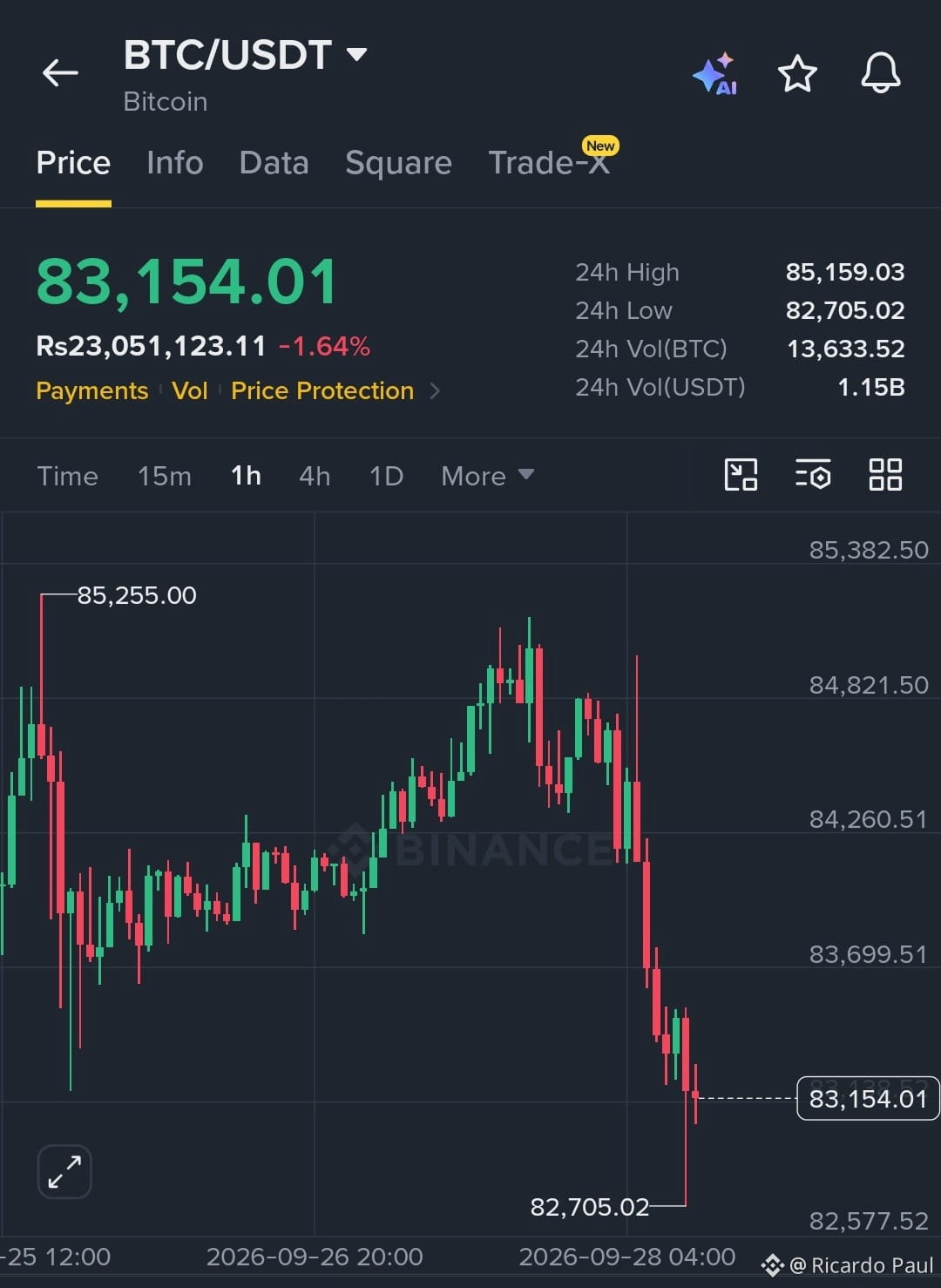
Bitcoin Is Sitting at a Critical Decision Zone
Bitcoin is trading around $83.1K, down roughly 1.6% on the session, after getting rejected from the $85K area. The 1H chart shows the shift clearly: BTC moved from higher highs into a series of lower highs, then lost the $84.26K support and accelerated lower.
The key move was the flush to $82,705.
That wick tells us buyers are still defending the low-$82K region, but the rebound so far isn't strong enough to confirm that sellers are finished.
For me, $82.7K is the immediate line in the sand.
If BTC holds that level and reclaims $83.7K, the sell-off could turn into a liquidity sweep rather than a full trend breakdown. A reclaim of $84.26K would strengthen that case, while $84.8K–$85.2K remains the bigger resistance zone where sellers have already shown up.
But if $82.7K breaks and price starts accepting below it, the picture changes quickly. The next areas I'd watch are roughly $82K and then $81K–$80K.
The interesting part is that price weakness isn't happening in isolation.
Recent U.S. spot Bitcoin ETF flows have shown strong institutional demand, while macro conditions — including elevated yields, a stronger dollar and higher oil prices — are creating pressure on risk assets. That leaves BTC caught between underlying demand and short-term momentum deterioration.
Volume is another thing I'd watch closely.
A bounce without meaningful volume can easily become another lower high. What I want to see is buyers reclaiming lost levels with follow-through, not just a quick green candle after a liquidation flush.
So the map is fairly simple:
$82.7K → immediate support
$83.7K → first recovery level
$84.26K → structure reclaim
$84.8K–$85.2K → major resistance
BTC doesn't need to explode higher from here to improve the chart.
It simply needs to stop making lower highs and start reclaiming the levels it just lost.
Until that happens, I’d treat this as a high-volatility decision zone, not assume that either the breakdown or the next rally is already confirmed.
$BTC
#btc
Bitcoin Is Sitting at a Critical Decision Zone
Bitcoin is trading around $83.1K, down roughly 1.6% on the session, after getting rejected from the $85K area. The 1H chart shows the shift clearly: BTC moved from higher highs into a series of lower highs, then lost the $84.26K support and accelerated lower.
The key move was the flush to $82,705.
That wick tells us buyers are still defending the low-$82K region, but the rebound so far isn't strong enough to confirm that sellers are finished.
For me, $82.7K is the immediate line in the sand.
If BTC holds that level and reclaims $83.7K, the sell-off could turn into a liquidity sweep rather than a full trend breakdown. A reclaim of $84.26K would strengthen that case, while $84.8K–$85.2K remains the bigger resistance zone where sellers have already shown up.
But if $82.7K breaks and price starts accepting below it, the picture changes quickly. The next areas I'd watch are roughly $82K and then $81K–$80K.
The interesting part is that price weakness isn't happening in isolation.
Recent U.S. spot Bitcoin ETF flows have shown strong institutional demand, while macro conditions — including elevated yields, a stronger dollar and higher oil prices — are creating pressure on risk assets. That leaves BTC caught between underlying demand and short-term momentum deterioration.
Volume is another thing I'd watch closely.
A bounce without meaningful volume can easily become another lower high. What I want to see is buyers reclaiming lost levels with follow-through, not just a quick green candle after a liquidation flush.
So the map is fairly simple:
$82.7K → immediate support
$83.7K → first recovery level
$84.26K → structure reclaim
$84.8K–$85.2K → major resistance
BTC doesn't need to explode higher from here to improve the chart.
It simply needs to stop making lower highs and start reclaiming the levels it just lost.
Until that happens, I’d treat this as a high-volatility decision zone, not assume that either the breakdown or the next rally is already confirmed.
$BTC
#btc
Bitcoin is trading around $83.1K, down roughly 1.6% on the session, after getting rejected from the $85K area. The 1H chart shows the shift clearly: BTC moved from higher highs into a series of lower highs, then lost the $84.26K support and accelerated lower.
The key move was the flush to $82,705.
That wick tells us buyers are still defending the low-$82K region, but the rebound so far isn't strong enough to confirm that sellers are finished.
For me, $82.7K is the immediate line in the sand.
If BTC holds that level and reclaims $83.7K, the sell-off could turn into a liquidity sweep rather than a full trend breakdown. A reclaim of $84.26K would strengthen that case, while $84.8K–$85.2K remains the bigger resistance zone where sellers have already shown up.
But if $82.7K breaks and price starts accepting below it, the picture changes quickly. The next areas I'd watch are roughly $82K and then $81K–$80K.
The interesting part is that price weakness isn't happening in isolation.
Recent U.S. spot Bitcoin ETF flows have shown strong institutional demand, while macro conditions — including elevated yields, a stronger dollar and higher oil prices — are creating pressure on risk assets. That leaves BTC caught between underlying demand and short-term momentum deterioration.
Volume is another thing I'd watch closely.
A bounce without meaningful volume can easily become another lower high. What I want to see is buyers reclaiming lost levels with follow-through, not just a quick green candle after a liquidation flush.
So the map is fairly simple:
$82.7K → immediate support
$83.7K → first recovery level
$84.26K → structure reclaim
$84.8K–$85.2K → major resistance
BTC doesn't need to explode higher from here to improve the chart.
It simply needs to stop making lower highs and start reclaiming the levels it just lost.
Until that happens, I’d treat this as a high-volatility decision zone, not assume that either the breakdown or the next rally is already confirmed.
$BTC
#btc
1
123
·
--
Bitcoin is more than a number on a chart.
It is a global monetary network built around transparent rules: a 21 million BTC maximum supply, predictable halvings, Proof-of-Work mining, and decentralized verification.
The 2024 halving reduced new issuance from 6.25 BTC to 3.125 BTC per block, while institutional access has expanded through spot Bitcoin ETFs and traditional financial infrastructure.
But scarcity doesn't guarantee higher prices.
Bitcoin still faces major risks: extreme volatility, regulation, custody failures, leverage, changing liquidity conditions and competition for investor capital.
The bigger question isn't simply “Will BTC go up?”
It is:
Is Bitcoin becoming a more useful, trusted and accessible monetary network?
The protocol keeps producing blocks.
The supply schedule keeps moving toward 21 million.
And the market keeps deciding what each BTC is worth.
That experiment is still running. 🟠
#Bitcoin #BTC #Crypto #Blockchain #DigitalGold $BTC
Bitcoin is more than a number on a chart.
It is a global monetary network built around transparent rules: a 21 million BTC maximum supply, predictable halvings, Proof-of-Work mining, and decentralized verification.
The 2024 halving reduced new issuance from 6.25 BTC to 3.125 BTC per block, while institutional access has expanded through spot Bitcoin ETFs and traditional financial infrastructure.
But scarcity doesn't guarantee higher prices.
Bitcoin still faces major risks: extreme volatility, regulation, custody failures, leverage, changing liquidity conditions and competition for investor capital.
The bigger question isn't simply “Will BTC go up?”
It is:
Is Bitcoin becoming a more useful, trusted and accessible monetary network?
The protocol keeps producing blocks.
The supply schedule keeps moving toward 21 million.
And the market keeps deciding what each BTC is worth.
That experiment is still running. 🟠
#Bitcoin #BTC #Crypto #Blockchain #DigitalGold $BTC
It is a global monetary network built around transparent rules: a 21 million BTC maximum supply, predictable halvings, Proof-of-Work mining, and decentralized verification.
The 2024 halving reduced new issuance from 6.25 BTC to 3.125 BTC per block, while institutional access has expanded through spot Bitcoin ETFs and traditional financial infrastructure.
But scarcity doesn't guarantee higher prices.
Bitcoin still faces major risks: extreme volatility, regulation, custody failures, leverage, changing liquidity conditions and competition for investor capital.
The bigger question isn't simply “Will BTC go up?”
It is:
Is Bitcoin becoming a more useful, trusted and accessible monetary network?
The protocol keeps producing blocks.
The supply schedule keeps moving toward 21 million.
And the market keeps deciding what each BTC is worth.
That experiment is still running. 🟠
#Bitcoin #BTC #Crypto #Blockchain #DigitalGold $BTC

1
146
·
--
What Other Investment Opportunities Remain as AI Stocks Keep Rising?
AI has gone from a market theme to something much bigger.
We’ve watched the major AI names attract huge amounts of capital, while chip demand, data-center spending and computing capacity continue to expand. But here’s the part I find more interesting:
What happens to the companies that make the AI boom possible? #AIStocksWhatNext
Everyone talks about the companies building powerful AI models and chips. Far fewer people talk about the infrastructure underneath them.
Think about it.
More AI means more data centers.
More data centers mean more electricity.
More computing means more networking and cooling.
More digital systems mean stronger cybersecurity.
And companies adopting AI still need software that can actually turn all that technology into revenue.
That creates a much broader AI investment story.
The next opportunity may not necessarily be another headline-grabbing AI stock. It could be a company supplying power, equipment, networking, storage, automation or specialized software to the businesses spending billions on AI.
But I’m also watching the other side of the trade.
AI expectations are already extremely high. Companies can report strong growth and still disappoint the market if investors were expecting something even bigger. At some point, AI spending has to translate into sustainable revenue and profits.
That’s where things could get interesting.
Are we still in the early stages of an AI infrastructure buildout, or are some parts of the market already pricing in years of future growth?
For me, that is the real question behind #AIStocksWhatNext.
The AI story might not end with the biggest chip companies.
It could spread across power, data centers, networking, cybersecurity, automation and enterprise software—the businesses quietly building the foundation underneath the AI economy.
The winners of the next phase may be the companies people aren't talking about loudly yet.
What Other Investment Opportunities Remain as AI Stocks Keep Rising?
AI has gone from a market theme to something much bigger.
We’ve watched the major AI names attract huge amounts of capital, while chip demand, data-center spending and computing capacity continue to expand. But here’s the part I find more interesting:
What happens to the companies that make the AI boom possible? #AIStocksWhatNext
Everyone talks about the companies building powerful AI models and chips. Far fewer people talk about the infrastructure underneath them.
Think about it.
More AI means more data centers.
More data centers mean more electricity.
More computing means more networking and cooling.
More digital systems mean stronger cybersecurity.
And companies adopting AI still need software that can actually turn all that technology into revenue.
That creates a much broader AI investment story.
The next opportunity may not necessarily be another headline-grabbing AI stock. It could be a company supplying power, equipment, networking, storage, automation or specialized software to the businesses spending billions on AI.
But I’m also watching the other side of the trade.
AI expectations are already extremely high. Companies can report strong growth and still disappoint the market if investors were expecting something even bigger. At some point, AI spending has to translate into sustainable revenue and profits.
That’s where things could get interesting.
Are we still in the early stages of an AI infrastructure buildout, or are some parts of the market already pricing in years of future growth?
For me, that is the real question behind #AIStocksWhatNext.
The AI story might not end with the biggest chip companies.
It could spread across power, data centers, networking, cybersecurity, automation and enterprise software—the businesses quietly building the foundation underneath the AI economy.
The winners of the next phase may be the companies people aren't talking about loudly yet.
AI has gone from a market theme to something much bigger.
We’ve watched the major AI names attract huge amounts of capital, while chip demand, data-center spending and computing capacity continue to expand. But here’s the part I find more interesting:
What happens to the companies that make the AI boom possible? #AIStocksWhatNext
Everyone talks about the companies building powerful AI models and chips. Far fewer people talk about the infrastructure underneath them.
Think about it.
More AI means more data centers.
More data centers mean more electricity.
More computing means more networking and cooling.
More digital systems mean stronger cybersecurity.
And companies adopting AI still need software that can actually turn all that technology into revenue.
That creates a much broader AI investment story.
The next opportunity may not necessarily be another headline-grabbing AI stock. It could be a company supplying power, equipment, networking, storage, automation or specialized software to the businesses spending billions on AI.
But I’m also watching the other side of the trade.
AI expectations are already extremely high. Companies can report strong growth and still disappoint the market if investors were expecting something even bigger. At some point, AI spending has to translate into sustainable revenue and profits.
That’s where things could get interesting.
Are we still in the early stages of an AI infrastructure buildout, or are some parts of the market already pricing in years of future growth?
For me, that is the real question behind #AIStocksWhatNext.
The AI story might not end with the biggest chip companies.
It could spread across power, data centers, networking, cybersecurity, automation and enterprise software—the businesses quietly building the foundation underneath the AI economy.
The winners of the next phase may be the companies people aren't talking about loudly yet.

11
15
394
·
--
Bitcoin just keeps making the “Inverse Cramer” meme look interesting. ₿
Back in late July, Jim Cramer said he was going to sell his Bitcoin after IBM CEO Arvind Krishna raised concerns about the potential threat quantum computing could pose to Bitcoin’s cryptography.
BTC was trading around $62.8K at the time.
Fast-forward to today…
Bitcoin has pushed above $85,000, putting it roughly 35–36% higher than the level around Cramer’s infamous sell comment.
And here’s the part worth remembering:
There’s no public wallet or transaction record confirming that Cramer actually sold his entire BTC position. So the “he sold everything” part should be treated as his stated intention, not a verified transaction.
Interestingly, Cramer later told a caller to buy Bitcoin directly, adding another twist to the whole story.
So whether you call it Inverse Cramer, market timing, or simply Bitcoin doing what Bitcoin does…
The chart tells the story:
Cramer: I’m going to sell my Bitcoin.
Bitcoin: Okay… watch this.😂
$BTC
#Bitcoin #BTC #JimCramer #Crypto #BitcoinNews
Bitcoin just keeps making the “Inverse Cramer” meme look interesting. ₿
Back in late July, Jim Cramer said he was going to sell his Bitcoin after IBM CEO Arvind Krishna raised concerns about the potential threat quantum computing could pose to Bitcoin’s cryptography.
BTC was trading around $62.8K at the time.
Fast-forward to today…
Bitcoin has pushed above $85,000, putting it roughly 35–36% higher than the level around Cramer’s infamous sell comment.
And here’s the part worth remembering:
There’s no public wallet or transaction record confirming that Cramer actually sold his entire BTC position. So the “he sold everything” part should be treated as his stated intention, not a verified transaction.
Interestingly, Cramer later told a caller to buy Bitcoin directly, adding another twist to the whole story.
So whether you call it Inverse Cramer, market timing, or simply Bitcoin doing what Bitcoin does…
The chart tells the story:
Cramer: I’m going to sell my Bitcoin.
Bitcoin: Okay… watch this.😂
$BTC
#Bitcoin #BTC #JimCramer #Crypto #BitcoinNews
Back in late July, Jim Cramer said he was going to sell his Bitcoin after IBM CEO Arvind Krishna raised concerns about the potential threat quantum computing could pose to Bitcoin’s cryptography.
BTC was trading around $62.8K at the time.
Fast-forward to today…
Bitcoin has pushed above $85,000, putting it roughly 35–36% higher than the level around Cramer’s infamous sell comment.
And here’s the part worth remembering:
There’s no public wallet or transaction record confirming that Cramer actually sold his entire BTC position. So the “he sold everything” part should be treated as his stated intention, not a verified transaction.
Interestingly, Cramer later told a caller to buy Bitcoin directly, adding another twist to the whole story.
So whether you call it Inverse Cramer, market timing, or simply Bitcoin doing what Bitcoin does…
The chart tells the story:
Cramer: I’m going to sell my Bitcoin.
Bitcoin: Okay… watch this.😂
$BTC
#Bitcoin #BTC #JimCramer #Crypto #BitcoinNews

2
146
·
--
What if owning 1 BTC becomes a generational milestone?
David Marcus, former PayPal president and current Lightspark CEO, recently made a striking point: future generations may wish they had been born early enough to own a full Bitcoin.
It sounds dramatic at first. But look at the supply.
Bitcoin was designed with a hard cap of 21 million BTC. As of September 18, roughly 20.09 million BTC had already been issued, meaning more than 95% of the eventual supply is already out there.
And the remaining coins won't arrive quickly. New issuance is controlled by Bitcoin's halving schedule, gradually reducing the number of new BTC entering circulation.
That's where the conversation gets interesting.
Bitcoin doesn't need every person on Earth to want a whole coin. Even a world where people increasingly hold fractions of BTC can create a very different ownership landscape as adoption grows.
We're already seeing institutional participation remain part of the story. Reuters reported renewed Bitcoin ETF inflows in September, while BTC recently climbed back above $80,000 after trading near $76,000 earlier in the week.
Of course, scarcity alone doesn't guarantee a higher price. Bitcoin remains volatile, and demand can change dramatically with liquidity, regulation, interest rates and investor sentiment.
But Marcus' point raises a much bigger question:
Will owning 1 whole BTC eventually feel less like buying an asset and more like owning a scarce piece of digital history?
Nobody knows where Bitcoin will be decades from now.
What we do know is simple:
21 million is the ceiling.
More than 20 million are already issued.
And the remaining supply is arriving slowly.
That scarcity is not a prediction.
It's built into the code.
$BTC $ETH
#bitcoin #BTC #Crypto #DigitalAssets #Web3
What if owning 1 BTC becomes a generational milestone?
David Marcus, former PayPal president and current Lightspark CEO, recently made a striking point: future generations may wish they had been born early enough to own a full Bitcoin.
It sounds dramatic at first. But look at the supply.
Bitcoin was designed with a hard cap of 21 million BTC. As of September 18, roughly 20.09 million BTC had already been issued, meaning more than 95% of the eventual supply is already out there.
And the remaining coins won't arrive quickly. New issuance is controlled by Bitcoin's halving schedule, gradually reducing the number of new BTC entering circulation.
That's where the conversation gets interesting.
Bitcoin doesn't need every person on Earth to want a whole coin. Even a world where people increasingly hold fractions of BTC can create a very different ownership landscape as adoption grows.
We're already seeing institutional participation remain part of the story. Reuters reported renewed Bitcoin ETF inflows in September, while BTC recently climbed back above $80,000 after trading near $76,000 earlier in the week.
Of course, scarcity alone doesn't guarantee a higher price. Bitcoin remains volatile, and demand can change dramatically with liquidity, regulation, interest rates and investor sentiment.
But Marcus' point raises a much bigger question:
Will owning 1 whole BTC eventually feel less like buying an asset and more like owning a scarce piece of digital history?
Nobody knows where Bitcoin will be decades from now.
What we do know is simple:
21 million is the ceiling.
More than 20 million are already issued.
And the remaining supply is arriving slowly.
That scarcity is not a prediction.
It's built into the code.
$BTC $ETH
#bitcoin #BTC #Crypto #DigitalAssets #Web3
David Marcus, former PayPal president and current Lightspark CEO, recently made a striking point: future generations may wish they had been born early enough to own a full Bitcoin.
It sounds dramatic at first. But look at the supply.
Bitcoin was designed with a hard cap of 21 million BTC. As of September 18, roughly 20.09 million BTC had already been issued, meaning more than 95% of the eventual supply is already out there.
And the remaining coins won't arrive quickly. New issuance is controlled by Bitcoin's halving schedule, gradually reducing the number of new BTC entering circulation.
That's where the conversation gets interesting.
Bitcoin doesn't need every person on Earth to want a whole coin. Even a world where people increasingly hold fractions of BTC can create a very different ownership landscape as adoption grows.
We're already seeing institutional participation remain part of the story. Reuters reported renewed Bitcoin ETF inflows in September, while BTC recently climbed back above $80,000 after trading near $76,000 earlier in the week.
Of course, scarcity alone doesn't guarantee a higher price. Bitcoin remains volatile, and demand can change dramatically with liquidity, regulation, interest rates and investor sentiment.
But Marcus' point raises a much bigger question:
Will owning 1 whole BTC eventually feel less like buying an asset and more like owning a scarce piece of digital history?
Nobody knows where Bitcoin will be decades from now.
What we do know is simple:
21 million is the ceiling.
More than 20 million are already issued.
And the remaining supply is arriving slowly.
That scarcity is not a prediction.
It's built into the code.
$BTC $ETH
#bitcoin #BTC #Crypto #DigitalAssets #Web3

3
189
·
--
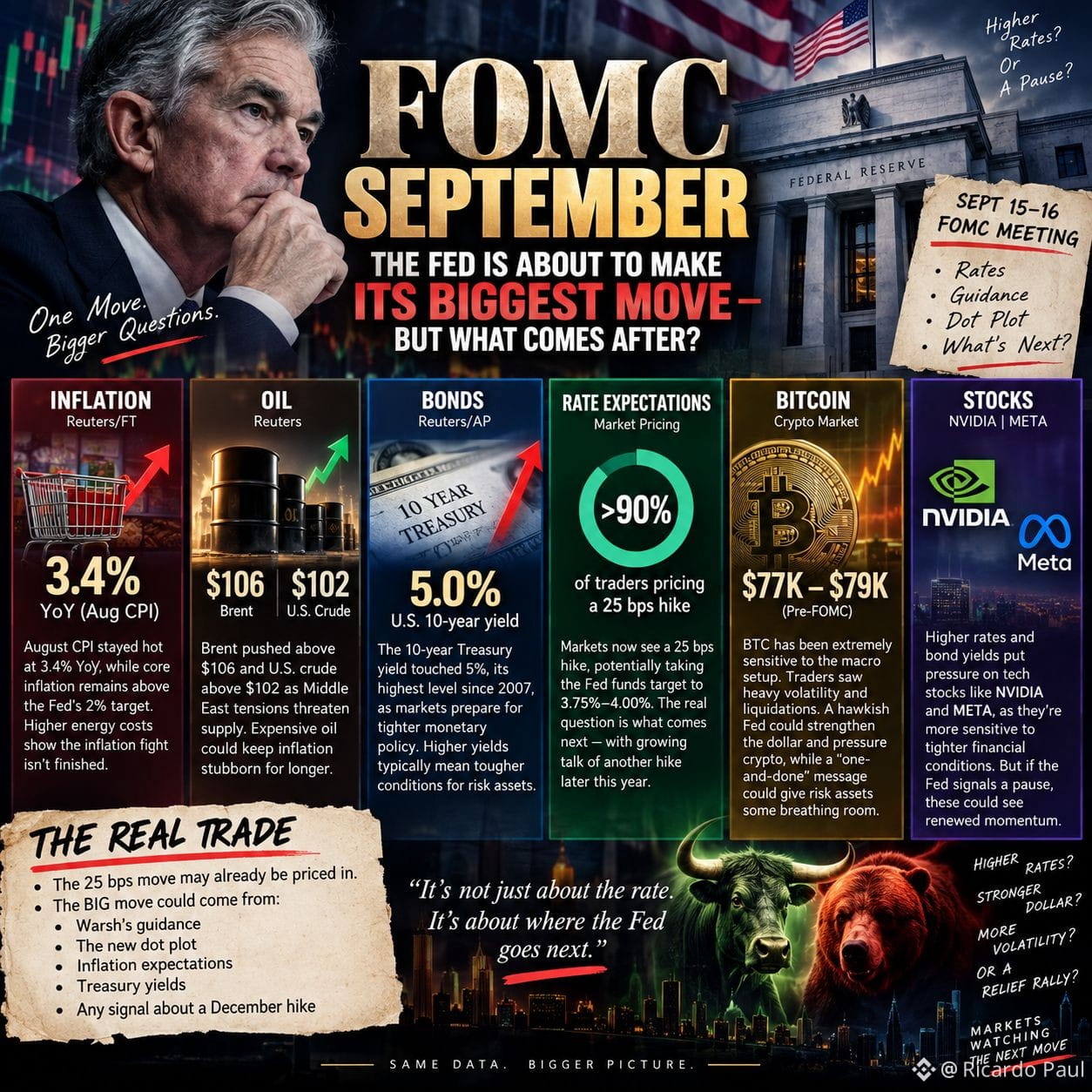
FOMC September: The Fed Is About to Make Its Biggest Move But What Comes After?
The Fed is entering its September 15–16 meeting with markets on edge. A 25 bps hike is now overwhelmingly priced in, but the real question is what Kevin Warsh says AFTER the decision. Is this a one-off move — or the start of another tightening cycle?
August CPI stayed hot at 3.4% YoY, while core inflation remained above the Fed’s 2% target. Add higher energy costs and the inflation fight clearly isn’t finished. That gives the Fed a strong reason to stay hawkish.
The new wildcard is energy. Brent pushed above $106 and U.S. crude above $102 as Middle East tensions threatened supply. If expensive oil feeds into transportation and production costs, inflation could stay stubborn for longer.
The bond market is already sending a warning. The U.S. 10-year Treasury yield touched 5%, its highest level since 2007, while markets prepared for tighter monetary policy. Higher yields usually mean tougher financial conditions for risk assets.
More than 90% of traders are now pricing a 25 bps hike, potentially taking the Fed funds target to 3.75%–4.00%. The interesting part is what comes next: markets are increasingly discussing the possibility of another hike later this year.
BTC has been extremely sensitive to the macro setup. It traded around the $77K–$79K area ahead of FOMC, while traders saw heavy volatility and liquidations. A hawkish Fed could strengthen the dollar and pressure crypto; a “one-and-done” message could give risk assets some breathing room.
The 25 bps move may already be priced in.
The BIG move could come from:
Warsh’s guidance
The new dot plot
Inflation expectations
Treasury yields
Any signal about a December hike
If the Fed hikes but signals one and done,markets could eventually stabilize.
If Warsh opens the door to more hikes, expect higher yields, a stronger dollar and more pressure on liquidity-sensitive assets
September FOMC isn’t just about the rate.
It’s about where the Fed goes next
#FedRateWatch
$BTC
{spot}(BTCUSDT)
FOMC September: The Fed Is About to Make Its Biggest Move But What Comes After?
The Fed is entering its September 15–16 meeting with markets on edge. A 25 bps hike is now overwhelmingly priced in, but the real question is what Kevin Warsh says AFTER the decision. Is this a one-off move — or the start of another tightening cycle?
August CPI stayed hot at 3.4% YoY, while core inflation remained above the Fed’s 2% target. Add higher energy costs and the inflation fight clearly isn’t finished. That gives the Fed a strong reason to stay hawkish.
The new wildcard is energy. Brent pushed above $106 and U.S. crude above $102 as Middle East tensions threatened supply. If expensive oil feeds into transportation and production costs, inflation could stay stubborn for longer.
The bond market is already sending a warning. The U.S. 10-year Treasury yield touched 5%, its highest level since 2007, while markets prepared for tighter monetary policy. Higher yields usually mean tougher financial conditions for risk assets.
More than 90% of traders are now pricing a 25 bps hike, potentially taking the Fed funds target to 3.75%–4.00%. The interesting part is what comes next: markets are increasingly discussing the possibility of another hike later this year.
BTC has been extremely sensitive to the macro setup. It traded around the $77K–$79K area ahead of FOMC, while traders saw heavy volatility and liquidations. A hawkish Fed could strengthen the dollar and pressure crypto; a “one-and-done” message could give risk assets some breathing room.
The 25 bps move may already be priced in.
The BIG move could come from:
Warsh’s guidance
The new dot plot
Inflation expectations
Treasury yields
Any signal about a December hike
If the Fed hikes but signals one and done,markets could eventually stabilize.
If Warsh opens the door to more hikes, expect higher yields, a stronger dollar and more pressure on liquidity-sensitive assets
September FOMC isn’t just about the rate.
It’s about where the Fed goes next
#FedRateWatch
$BTC
The Fed is entering its September 15–16 meeting with markets on edge. A 25 bps hike is now overwhelmingly priced in, but the real question is what Kevin Warsh says AFTER the decision. Is this a one-off move — or the start of another tightening cycle?
August CPI stayed hot at 3.4% YoY, while core inflation remained above the Fed’s 2% target. Add higher energy costs and the inflation fight clearly isn’t finished. That gives the Fed a strong reason to stay hawkish.
The new wildcard is energy. Brent pushed above $106 and U.S. crude above $102 as Middle East tensions threatened supply. If expensive oil feeds into transportation and production costs, inflation could stay stubborn for longer.
The bond market is already sending a warning. The U.S. 10-year Treasury yield touched 5%, its highest level since 2007, while markets prepared for tighter monetary policy. Higher yields usually mean tougher financial conditions for risk assets.
More than 90% of traders are now pricing a 25 bps hike, potentially taking the Fed funds target to 3.75%–4.00%. The interesting part is what comes next: markets are increasingly discussing the possibility of another hike later this year.
BTC has been extremely sensitive to the macro setup. It traded around the $77K–$79K area ahead of FOMC, while traders saw heavy volatility and liquidations. A hawkish Fed could strengthen the dollar and pressure crypto; a “one-and-done” message could give risk assets some breathing room.
The 25 bps move may already be priced in.
The BIG move could come from:
Warsh’s guidance
The new dot plot
Inflation expectations
Treasury yields
Any signal about a December hike
If the Fed hikes but signals one and done,markets could eventually stabilize.
If Warsh opens the door to more hikes, expect higher yields, a stronger dollar and more pressure on liquidity-sensitive assets
September FOMC isn’t just about the rate.
It’s about where the Fed goes next
#FedRateWatch
$BTC
15
22
539
·
--
XAU₮ at $4,328: Gold’s Next Move Could Depend on the Fed
XAU₮ is sitting at an interesting level. The chart shows $4,328.20, down 0.47%, with a 24-hour range of $4,323–$4,354.30 and about $15.26M turnover. Price previously pushed toward $4,399 but failed to hold there. For now, $4,295–$4,323 looks like the key support zone, while $4,347–$4,399 remains the area bulls need to reclaim.
Reuters: Gold slipped to around $4,327/oz on September 14, as rising oil prices revived inflation concerns and lifted expectations for a Fed rate hike. Markets were pricing about an 87% chance of a 25bp hike, up sharply from before the latest inflation data. That keeps pressure on non-yielding gold in the short term.
Oil & macro: Brent jumped above $107, while WTI moved above $102, after fresh Middle East supply and shipping disruptions. The problem for gold is that expensive oil can keep inflation elevated, giving central banks another reason to stay hawkish.
World Gold Council: The longer-term gold story is still strong. Central banks bought 289 tonnes in Q2 2026, five times Q1's revised figure of 57 tonnes. Poland and China remained important buyers, showing that reserve diversification continues even while gold prices remain volatile.
Central-bank update: July brought another 23 tonnes of net official-sector buying. China added 20 tonnes, extending its buying streak to 21 consecutive months, while Poland remained one of the year's largest accumulators.
XAU₮ update: Tether's gold token is also developing beyond simple trading. XAU₮ has been added as collateral for crypto-backed lending, with Arch Lending offering loans against the token at LTVs of up to 75%. That gives tokenized gold another use case: accessing liquidity without directly selling the gold exposure.
Alloy update: Tether is winding down the Alloy/aUSDT route. Existing users have until September 17, 2026 to unwind positions and recover the underlying XAU₮ through the platform. This does not mean XAU₮ itself is being shut down; the change is specific to the Alloy product.
$XAUT
XAU₮ at $4,328: Gold’s Next Move Could Depend on the Fed
XAU₮ is sitting at an interesting level. The chart shows $4,328.20, down 0.47%, with a 24-hour range of $4,323–$4,354.30 and about $15.26M turnover. Price previously pushed toward $4,399 but failed to hold there. For now, $4,295–$4,323 looks like the key support zone, while $4,347–$4,399 remains the area bulls need to reclaim.
Reuters: Gold slipped to around $4,327/oz on September 14, as rising oil prices revived inflation concerns and lifted expectations for a Fed rate hike. Markets were pricing about an 87% chance of a 25bp hike, up sharply from before the latest inflation data. That keeps pressure on non-yielding gold in the short term.
Oil & macro: Brent jumped above $107, while WTI moved above $102, after fresh Middle East supply and shipping disruptions. The problem for gold is that expensive oil can keep inflation elevated, giving central banks another reason to stay hawkish.
World Gold Council: The longer-term gold story is still strong. Central banks bought 289 tonnes in Q2 2026, five times Q1's revised figure of 57 tonnes. Poland and China remained important buyers, showing that reserve diversification continues even while gold prices remain volatile.
Central-bank update: July brought another 23 tonnes of net official-sector buying. China added 20 tonnes, extending its buying streak to 21 consecutive months, while Poland remained one of the year's largest accumulators.
XAU₮ update: Tether's gold token is also developing beyond simple trading. XAU₮ has been added as collateral for crypto-backed lending, with Arch Lending offering loans against the token at LTVs of up to 75%. That gives tokenized gold another use case: accessing liquidity without directly selling the gold exposure.
Alloy update: Tether is winding down the Alloy/aUSDT route. Existing users have until September 17, 2026 to unwind positions and recover the underlying XAU₮ through the platform. This does not mean XAU₮ itself is being shut down; the change is specific to the Alloy product.
$XAUT
XAU₮ is sitting at an interesting level. The chart shows $4,328.20, down 0.47%, with a 24-hour range of $4,323–$4,354.30 and about $15.26M turnover. Price previously pushed toward $4,399 but failed to hold there. For now, $4,295–$4,323 looks like the key support zone, while $4,347–$4,399 remains the area bulls need to reclaim.
Reuters: Gold slipped to around $4,327/oz on September 14, as rising oil prices revived inflation concerns and lifted expectations for a Fed rate hike. Markets were pricing about an 87% chance of a 25bp hike, up sharply from before the latest inflation data. That keeps pressure on non-yielding gold in the short term.
Oil & macro: Brent jumped above $107, while WTI moved above $102, after fresh Middle East supply and shipping disruptions. The problem for gold is that expensive oil can keep inflation elevated, giving central banks another reason to stay hawkish.
World Gold Council: The longer-term gold story is still strong. Central banks bought 289 tonnes in Q2 2026, five times Q1's revised figure of 57 tonnes. Poland and China remained important buyers, showing that reserve diversification continues even while gold prices remain volatile.
Central-bank update: July brought another 23 tonnes of net official-sector buying. China added 20 tonnes, extending its buying streak to 21 consecutive months, while Poland remained one of the year's largest accumulators.
XAU₮ update: Tether's gold token is also developing beyond simple trading. XAU₮ has been added as collateral for crypto-backed lending, with Arch Lending offering loans against the token at LTVs of up to 75%. That gives tokenized gold another use case: accessing liquidity without directly selling the gold exposure.
Alloy update: Tether is winding down the Alloy/aUSDT route. Existing users have until September 17, 2026 to unwind positions and recover the underlying XAU₮ through the platform. This does not mean XAU₮ itself is being shut down; the change is specific to the Alloy product.
$XAUT

60
Connectez-vous pour découvrir plus de contenu
Rejoignez la communauté mondiale des adeptes de cryptomonnaies sur Binance Square
⚡️ Suviez les dernières informations importantes sur les cryptomonnaies.
💬 Jugé digne de confiance par la plus grande plateforme d’échange de cryptomonnaies au monde.
👍 Découvrez les connaissances que partagent les créateurs vérifiés.
Adresse e-mail/Nº de téléphone
Sujets d’actualité
FedMinutesFocusOnOctoberPause
77,751 vues
932 mentions
🚨 HIGH ALERT ‼️ PLEASE DON’T TRADE BLINDLY FOR THE NEXT HOUR 🚨
Guys, we have FOMC Minutes coming in less than 1 hour.
And after the kind of volatility we already saw today, I really don’t want anyone opening random high-leverage positions just before this release.
The biggest reaction I’m watching will be in Gold (XAU), Silver (XAG), BTC and ETH. Then coins like SOL and other highly leveraged mid/low-cap alts can exaggerate whatever move BTC makes.
Gold and Silver are especially sensitive tonight because the market is already reacting to the US dollar + Treasury yields, and both metals have been under heavy pressure ahead of the Fed minutes.
Briefly speaking
📉Hawkish Fed Minutes → Dollar/yields can push higher → pressure on BTC, crypto, Gold & silver
📈Dovish Fed Minutes → Dollar/yields can cool → BTC, Gold, Silver and risk assets can bounce hard.
And please remember the first candle can be a trap. We can get a pump, immediate dump, liquidations on both sides, and then the real direction.
So for now, protect your positions, reduce unnecessary leverage and don’t FOMO into the first move.
Tonight I’m watching $XAU , $XAG and $BTC first. These will tell us very quickly how the market is reading the Fed.
I will Update you guys on time
Follow @Panda Traders and Turn on Your notifications right now
#FedMinutesFocusOnOctoberPause
Panda Traders
·14 mentions J’aime
·2.6k vues
BinanceLaunchesBinanceIntelligence
1M vues
6,201 mentions
EvernorthDelaysNasdaqDebutToOct12
4,220 vues
179 mentions