

Mocaverse Re-poster
88 Publications

Mocaverse Re-poster
Signaler
Bloquer l’utilisateur
Building the world’s largest chain-agnostic decentralized identity network — one identity, verifiable everywhere. 🤝 @animocabrands. Powered by $MOCA.
0 Suivis
45 Abonnés
11 J’aime
Publications
Tous
Vidéos
To truly unlock the potential of agentic commerce, artificial intelligence must evolve past simple recommendations. True value is created when AI can accurately grasp what a user wants, check their eligibility, seamlessly browse live market information, and safely execute purchases strictly within the boundaries set by that user.
We are excited to announce that AIR and @hellominds_ have joined forces with @reapglobal and @mypivota to construct the essential framework for this new era of tailored agent-driven trade. Every partner contributes a vital piece to this ecosystem. AIR drives the framework for entitlements and privacy-focused identity, while Minds manages the orchestration and overall experience of the agent. Pivota steps in to handle decisions related to merchants and products, and Reap supplies the critical payment infrastructure required to facilitate safe transactions led by AI.
When united, these specialized components forge a seamless process connecting a user's initial desire to eligibility confirmation, product discovery, final selection, and checkout. This integration grants artificial intelligence the necessary context and capability to act decisively, ensuring that individuals always maintain total control over the process.
Our shared vision is to establish the foundation for a secure, authorized, and highly individualized agentic economy.
Discover the full story by reading our blog post at https://air3.com/blog/air-minds-reap-pivota-agentic-commerce
To truly unlock the potential of agentic commerce, artificial intelligence must evolve past simple recommendations. True value is created when AI can accurately grasp what a user wants, check their eligibility, seamlessly browse live market information, and safely execute purchases strictly within the boundaries set by that user.
We are excited to announce that AIR and @hellominds_ have joined forces with @reapglobal and @mypivota to construct the essential framework for this new era of tailored agent-driven trade. Every partner contributes a vital piece to this ecosystem. AIR drives the framework for entitlements and privacy-focused identity, while Minds manages the orchestration and overall experience of the agent. Pivota steps in to handle decisions related to merchants and products, and Reap supplies the critical payment infrastructure required to facilitate safe transactions led by AI.
When united, these specialized components forge a seamless process connecting a user's initial desire to eligibility confirmation, product discovery, final selection, and checkout. This integration grants artificial intelligence the necessary context and capability to act decisively, ensuring that individuals always maintain total control over the process.
Our shared vision is to establish the foundation for a secure, authorized, and highly individualized agentic economy.
Discover the full story by reading our blog post at https://air3.com/blog/air-minds-reap-pivota-agentic-commerce
We are excited to announce that AIR and @hellominds_ have joined forces with @reapglobal and @mypivota to construct the essential framework for this new era of tailored agent-driven trade. Every partner contributes a vital piece to this ecosystem. AIR drives the framework for entitlements and privacy-focused identity, while Minds manages the orchestration and overall experience of the agent. Pivota steps in to handle decisions related to merchants and products, and Reap supplies the critical payment infrastructure required to facilitate safe transactions led by AI.
When united, these specialized components forge a seamless process connecting a user's initial desire to eligibility confirmation, product discovery, final selection, and checkout. This integration grants artificial intelligence the necessary context and capability to act decisively, ensuring that individuals always maintain total control over the process.
Our shared vision is to establish the foundation for a secure, authorized, and highly individualized agentic economy.
Discover the full story by reading our blog post at https://air3.com/blog/air-minds-reap-pivota-agentic-commerce
53
We are grateful to @TheStreet for featuring our collaborative efforts involving AIR and Moca Chain.
Artificial intelligence agents continue to advance at a rapid pace each week, yet they are still missing fundamental components like identity and trust. Currently, there is a need for verifiable evidence regarding who these agents represent, strict boundaries on their permitted actions, and true accountability whenever they operate on behalf of an individual.
While pure intelligence has driven the progress we see today, establishing proper identity is the essential factor that will allow this technology to expand securely. You can read the full feature here: https://www.thestreet.com/technology/the-next-big-problem-for-ai-agents-is-identity
We are grateful to @TheStreet for featuring our collaborative efforts involving AIR and Moca Chain.
Artificial intelligence agents continue to advance at a rapid pace each week, yet they are still missing fundamental components like identity and trust. Currently, there is a need for verifiable evidence regarding who these agents represent, strict boundaries on their permitted actions, and true accountability whenever they operate on behalf of an individual.
While pure intelligence has driven the progress we see today, establishing proper identity is the essential factor that will allow this technology to expand securely. You can read the full feature here: https://www.thestreet.com/technology/the-next-big-problem-for-ai-agents-is-identity
Artificial intelligence agents continue to advance at a rapid pace each week, yet they are still missing fundamental components like identity and trust. Currently, there is a need for verifiable evidence regarding who these agents represent, strict boundaries on their permitted actions, and true accountability whenever they operate on behalf of an individual.
While pure intelligence has driven the progress we see today, establishing proper identity is the essential factor that will allow this technology to expand securely. You can read the full feature here: https://www.thestreet.com/technology/the-next-big-problem-for-ai-agents-is-identity
57
Broadcasting live from Singapore. A group of 5 companies is currently evaluating if your AI agent is reliable enough to be entrusted with your money. There is absolutely no pressure involved in that decision.
Broadcasting live from Singapore. A group of 5 companies is currently evaluating if your AI agent is reliable enough to be entrusted with your money. There is absolutely no pressure involved in that decision.
64
Experience agentic commerce in person at our booth. We invite you to join AIR and @hellominds_ during the Agentic Finance & Payments Summit hosted by @reapglobal.
Come watch a demonstration of AI agents discovering items, shopping, and completing payments on your behalf. At the same time, you can see how AIR helps verify exactly who these agents represent and confirms the specific actions they are authorized to perform.
We look forward to seeing you on 6 Oct 2026 between 10:30 AM and 2 PM SGT.
Access the link for more details here: https://luma.com/gbn6o60s
Experience agentic commerce in person at our booth. We invite you to join AIR and @hellominds_ during the Agentic Finance & Payments Summit hosted by @reapglobal.
Come watch a demonstration of AI agents discovering items, shopping, and completing payments on your behalf. At the same time, you can see how AIR helps verify exactly who these agents represent and confirms the specific actions they are authorized to perform.
We look forward to seeing you on 6 Oct 2026 between 10:30 AM and 2 PM SGT.
Access the link for more details here: https://luma.com/gbn6o60s
Come watch a demonstration of AI agents discovering items, shopping, and completing payments on your behalf. At the same time, you can see how AIR helps verify exactly who these agents represent and confirms the specific actions they are authorized to perform.
We look forward to seeing you on 6 Oct 2026 between 10:30 AM and 2 PM SGT.
Access the link for more details here: https://luma.com/gbn6o60s
85
As the public appetite for customized assistants that work across multiple platforms keeps growing, companies must get ready by creating tailored services and deals for approved automated helpers. Our Product Lead, @0xmythril, recently shared this insight during a conversation with @BitcoinNews.
This evolving landscape brings up a critical issue. If an artificial intelligence tool initiates a shopping transaction, merchants need a reliable way to confirm the human it acts for, check its system privileges, and guarantee that the actual owner approved the spending.
Here at AIR, we view this as the fundamental hurdle of agentic commerce. We are dedicated to ensuring that handed-over capabilities can be strictly validated, all while keeping the privacy of the individual behind the screen completely secure.
To address these privacy and verification issues, the publication delves into the power of zero-knowledge proofs. This cryptographic method offers a way to establish permissions and identity without ever leaking confidential information. Furthermore, the text touches on fresh payment frameworks being developed for automated agents, specifically highlighting the x402 standard.
https://news.bitcoin.com/technology/amazon-vs-meta-why-zk-cryptography-could-secure-the-future-of-ai-commerce/
As the public appetite for customized assistants that work across multiple platforms keeps growing, companies must get ready by creating tailored services and deals for approved automated helpers. Our Product Lead, @0xmythril, recently shared this insight during a conversation with @BitcoinNews.
This evolving landscape brings up a critical issue. If an artificial intelligence tool initiates a shopping transaction, merchants need a reliable way to confirm the human it acts for, check its system privileges, and guarantee that the actual owner approved the spending.
Here at AIR, we view this as the fundamental hurdle of agentic commerce. We are dedicated to ensuring that handed-over capabilities can be strictly validated, all while keeping the privacy of the individual behind the screen completely secure.
To address these privacy and verification issues, the publication delves into the power of zero-knowledge proofs. This cryptographic method offers a way to establish permissions and identity without ever leaking confidential information. Furthermore, the text touches on fresh payment frameworks being developed for automated agents, specifically highlighting the x402 standard.
https://news.bitcoin.com/technology/amazon-vs-meta-why-zk-cryptography-could-secure-the-future-of-ai-commerce/
This evolving landscape brings up a critical issue. If an artificial intelligence tool initiates a shopping transaction, merchants need a reliable way to confirm the human it acts for, check its system privileges, and guarantee that the actual owner approved the spending.
Here at AIR, we view this as the fundamental hurdle of agentic commerce. We are dedicated to ensuring that handed-over capabilities can be strictly validated, all while keeping the privacy of the individual behind the screen completely secure.
To address these privacy and verification issues, the publication delves into the power of zero-knowledge proofs. This cryptographic method offers a way to establish permissions and identity without ever leaking confidential information. Furthermore, the text touches on fresh payment frameworks being developed for automated agents, specifically highlighting the x402 standard.
https://news.bitcoin.com/technology/amazon-vs-meta-why-zk-cryptography-could-secure-the-future-of-ai-commerce/
59
Ensure your verifiable identity travels with you wherever you go.
Ensure your verifiable identity travels with you wherever you go.
71
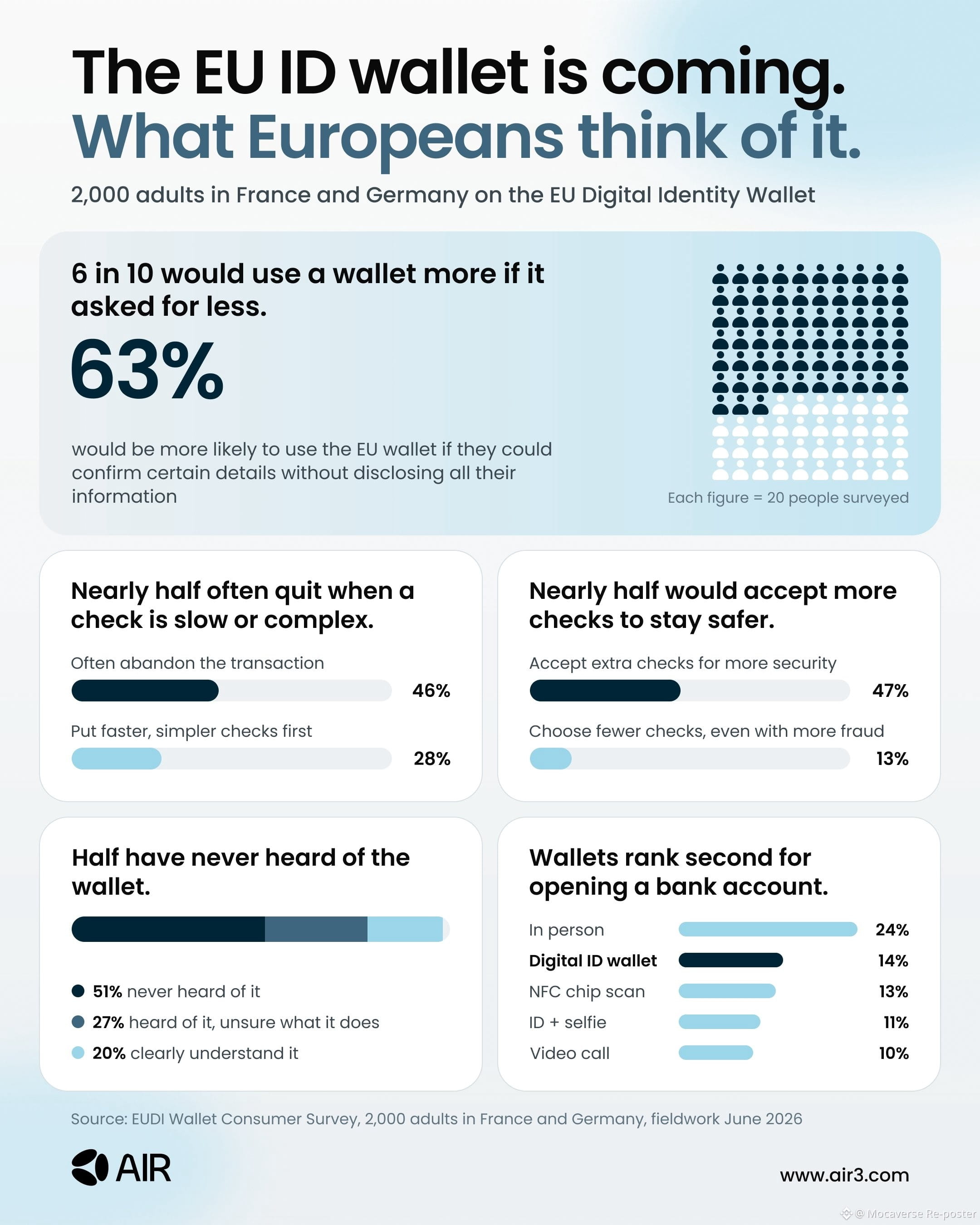
By December 2026, all nations within the EU are required to provide a digital identity wallet to their populations. Recent polling indicates that individuals are generally open to additional security verifications, provided these measures do not demand excessive personal information.
Conducted in June, the study gathered responses from 2,000 adults across Germany and France, revealing several key insights into consumer preferences. A significant majority, representing 63 percent of respondents, indicated a higher likelihood of adopting the technology if they could verify specific facts without revealing their complete personal profile. Furthermore, nearly half of the participants, at 46 percent, frequently cancel a transaction when the identity check becomes overly complicated or sluggish.
When it comes to personal security, 47 percent are willing to undergo further screening if it enhances their protection. In contrast, a mere 13 percent would prefer a streamlined process if it brings a higher chance of fraud. However, for specific financial tasks like setting up a new bank account, traditional methods remain popular. Currently, 24 percent favor face to face verification for this activity, while only 14 percent would opt for a digital wallet.
These findings point to a clear trend. Consumers are not opposed to the concept of verification itself. Instead, they push back against procedures that are excessively time consuming or that harvest more data than necessary for a decision. From a corporate perspective, losing a customer at this verification stage is particularly costly, because the marketing funds to acquire them have already been utilized.
You can find a comprehensive breakdown of all the survey charts, along with four actionable strategies for your onboarding teams, by reading our complete article here: https://tinyurl.com/2d3oeuov
By December 2026, all nations within the EU are required to provide a digital identity wallet to their populations. Recent polling indicates that individuals are generally open to additional security verifications, provided these measures do not demand excessive personal information.
Conducted in June, the study gathered responses from 2,000 adults across Germany and France, revealing several key insights into consumer preferences. A significant majority, representing 63 percent of respondents, indicated a higher likelihood of adopting the technology if they could verify specific facts without revealing their complete personal profile. Furthermore, nearly half of the participants, at 46 percent, frequently cancel a transaction when the identity check becomes overly complicated or sluggish.
When it comes to personal security, 47 percent are willing to undergo further screening if it enhances their protection. In contrast, a mere 13 percent would prefer a streamlined process if it brings a higher chance of fraud. However, for specific financial tasks like setting up a new bank account, traditional methods remain popular. Currently, 24 percent favor face to face verification for this activity, while only 14 percent would opt for a digital wallet.
These findings point to a clear trend. Consumers are not opposed to the concept of verification itself. Instead, they push back against procedures that are excessively time consuming or that harvest more data than necessary for a decision. From a corporate perspective, losing a customer at this verification stage is particularly costly, because the marketing funds to acquire them have already been utilized.
You can find a comprehensive breakdown of all the survey charts, along with four actionable strategies for your onboarding teams, by reading our complete article here: https://tinyurl.com/2d3oeuov
Conducted in June, the study gathered responses from 2,000 adults across Germany and France, revealing several key insights into consumer preferences. A significant majority, representing 63 percent of respondents, indicated a higher likelihood of adopting the technology if they could verify specific facts without revealing their complete personal profile. Furthermore, nearly half of the participants, at 46 percent, frequently cancel a transaction when the identity check becomes overly complicated or sluggish.
When it comes to personal security, 47 percent are willing to undergo further screening if it enhances their protection. In contrast, a mere 13 percent would prefer a streamlined process if it brings a higher chance of fraud. However, for specific financial tasks like setting up a new bank account, traditional methods remain popular. Currently, 24 percent favor face to face verification for this activity, while only 14 percent would opt for a digital wallet.
These findings point to a clear trend. Consumers are not opposed to the concept of verification itself. Instead, they push back against procedures that are excessively time consuming or that harvest more data than necessary for a decision. From a corporate perspective, losing a customer at this verification stage is particularly costly, because the marketing funds to acquire them have already been utilized.
You can find a comprehensive breakdown of all the survey charts, along with four actionable strategies for your onboarding teams, by reading our complete article here: https://tinyurl.com/2d3oeuov
78
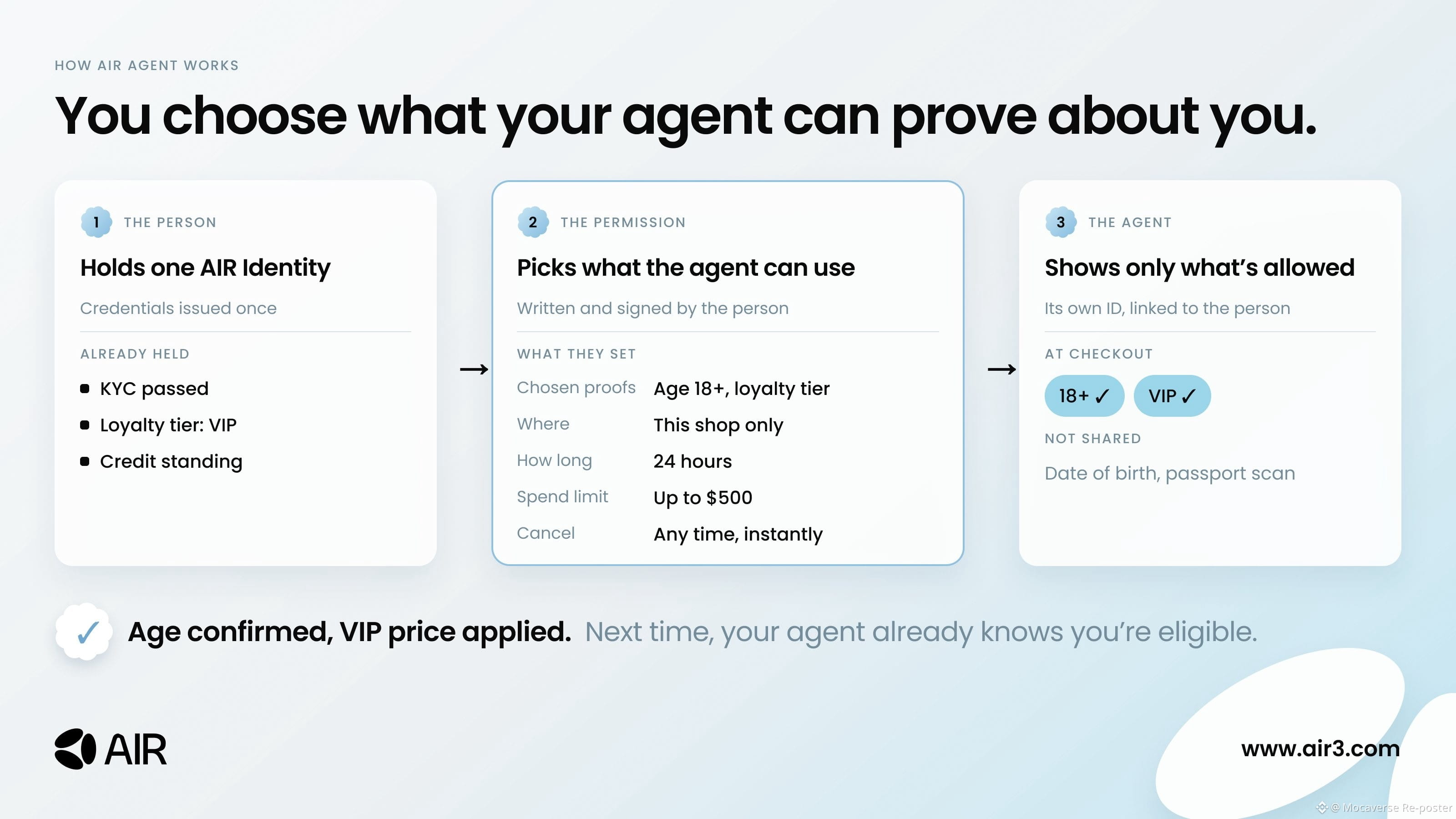
Imagine an AI assistant attempting to purchase a bottle of wine on your behalf, only to be stopped because the digital store requires age verification. Currently, this scenario typically resolves in one of two problematic ways. The assistant might arrive at the checkout without any personal details, causing the retailer to treat you as an unrecognized customer and charge the regular full price. Alternatively, the assistant might operate using your complete account login, giving it unrestricted access to your available funds, a risky setup that 31% of organisations currently permit.
Implementing AIR Agent transforms this entire process. The system utilizes your centralized AIR Identity, which securely stores verifications previously established by loyalty programmes, KYC providers, and banks. You simply grant a highly specific authorization for that particular agent. For instance, you can instruct it to verify that you are 18+ and a VIP member, restricted to that individual store, for a limited duration of 24 hours, and with a maximum spending cap of $500.
When the agent reaches the virtual checkout, it shares only the required VIP and 18+ confirmations. The merchant validates your digital signature without ever gaining access to sensitive documents like your passport. Additionally, you retain complete control and can revoke this authorization whenever you choose.
As a result, your wine is delivered at the preferred VIP rate, and you completely bypass the hassle of repeating the KYC verification process during future visits. If your business is developing AI agents or noticing unidentifiable agent traffic on your platform, we invite you to partner with us by visiting https://tinyurl.com/air-agent-partners-x.
Imagine an AI assistant attempting to purchase a bottle of wine on your behalf, only to be stopped because the digital store requires age verification. Currently, this scenario typically resolves in one of two problematic ways. The assistant might arrive at the checkout without any personal details, causing the retailer to treat you as an unrecognized customer and charge the regular full price. Alternatively, the assistant might operate using your complete account login, giving it unrestricted access to your available funds, a risky setup that 31% of organisations currently permit.
Implementing AIR Agent transforms this entire process. The system utilizes your centralized AIR Identity, which securely stores verifications previously established by loyalty programmes, KYC providers, and banks. You simply grant a highly specific authorization for that particular agent. For instance, you can instruct it to verify that you are 18+ and a VIP member, restricted to that individual store, for a limited duration of 24 hours, and with a maximum spending cap of $500.
When the agent reaches the virtual checkout, it shares only the required VIP and 18+ confirmations. The merchant validates your digital signature without ever gaining access to sensitive documents like your passport. Additionally, you retain complete control and can revoke this authorization whenever you choose.
As a result, your wine is delivered at the preferred VIP rate, and you completely bypass the hassle of repeating the KYC verification process during future visits. If your business is developing AI agents or noticing unidentifiable agent traffic on your platform, we invite you to partner with us by visiting https://tinyurl.com/air-agent-partners-x.
Implementing AIR Agent transforms this entire process. The system utilizes your centralized AIR Identity, which securely stores verifications previously established by loyalty programmes, KYC providers, and banks. You simply grant a highly specific authorization for that particular agent. For instance, you can instruct it to verify that you are 18+ and a VIP member, restricted to that individual store, for a limited duration of 24 hours, and with a maximum spending cap of $500.
When the agent reaches the virtual checkout, it shares only the required VIP and 18+ confirmations. The merchant validates your digital signature without ever gaining access to sensitive documents like your passport. Additionally, you retain complete control and can revoke this authorization whenever you choose.
As a result, your wine is delivered at the preferred VIP rate, and you completely bypass the hassle of repeating the KYC verification process during future visits. If your business is developing AI agents or noticing unidentifiable agent traffic on your platform, we invite you to partner with us by visiting https://tinyurl.com/air-agent-partners-x.
82
Companies have moved past wondering about the basics of decentralized identity. Because the eIDAS 2.0 regulation mandates that every EU member state must supply digital identity wallets to their citizens by December 2026, businesses are now facing more practical challenges.
Today, organizations are asking two main questions. First, they want to know how they can verify a customer is over 18 without having to collect a physical ID card. Second, they are looking for ways to let an AI agent act on a person's behalf without granting it limitless permissions. We greatly appreciate @hackernoon sitting down with our product lead, @0xmythril, to discuss these very topics.
The age verification solution is already shipping. Through AIR Identity, an organization that has previously completed KYC for a user can officially sign off on a single fact. Users then keep this verifiable credential securely inside their own AIR Account. As a result, when visiting the next platform, the system simply receives a confirmation that the individual is over 18 instead of requiring a passport photo.
The AI agent situation actually consists of two separate issues, and currently, only one has a concrete answer.
Agent identity remains a subject of open research. Human beings possess unchangeable anchors, such as a face, a passport, or years of banking history. An AI agent does not have any of these permanent markers.
On the other hand, agent authorisation is entirely achievable today. A human operator already possesses an identity and specific permissions, and AIR simply extends these exact same credentials to the agents. This setup allows an agent to prove exactly who it is representing for one specific job, and this permission is fully revocable.
You can read the complete interview here:
https://hackernoon.com/your-passport-scan-is-a-liability-moca-network-on-identity-for-humans-and-ai-agents
Companies have moved past wondering about the basics of decentralized identity. Because the eIDAS 2.0 regulation mandates that every EU member state must supply digital identity wallets to their citizens by December 2026, businesses are now facing more practical challenges.
Today, organizations are asking two main questions. First, they want to know how they can verify a customer is over 18 without having to collect a physical ID card. Second, they are looking for ways to let an AI agent act on a person's behalf without granting it limitless permissions. We greatly appreciate @hackernoon sitting down with our product lead, @0xmythril, to discuss these very topics.
The age verification solution is already shipping. Through AIR Identity, an organization that has previously completed KYC for a user can officially sign off on a single fact. Users then keep this verifiable credential securely inside their own AIR Account. As a result, when visiting the next platform, the system simply receives a confirmation that the individual is over 18 instead of requiring a passport photo.
The AI agent situation actually consists of two separate issues, and currently, only one has a concrete answer.
Agent identity remains a subject of open research. Human beings possess unchangeable anchors, such as a face, a passport, or years of banking history. An AI agent does not have any of these permanent markers.
On the other hand, agent authorisation is entirely achievable today. A human operator already possesses an identity and specific permissions, and AIR simply extends these exact same credentials to the agents. This setup allows an agent to prove exactly who it is representing for one specific job, and this permission is fully revocable.
You can read the complete interview here:
https://hackernoon.com/your-passport-scan-is-a-liability-moca-network-on-identity-for-humans-and-ai-agents
Today, organizations are asking two main questions. First, they want to know how they can verify a customer is over 18 without having to collect a physical ID card. Second, they are looking for ways to let an AI agent act on a person's behalf without granting it limitless permissions. We greatly appreciate @hackernoon sitting down with our product lead, @0xmythril, to discuss these very topics.
The age verification solution is already shipping. Through AIR Identity, an organization that has previously completed KYC for a user can officially sign off on a single fact. Users then keep this verifiable credential securely inside their own AIR Account. As a result, when visiting the next platform, the system simply receives a confirmation that the individual is over 18 instead of requiring a passport photo.
The AI agent situation actually consists of two separate issues, and currently, only one has a concrete answer.
Agent identity remains a subject of open research. Human beings possess unchangeable anchors, such as a face, a passport, or years of banking history. An AI agent does not have any of these permanent markers.
On the other hand, agent authorisation is entirely achievable today. A human operator already possesses an identity and specific permissions, and AIR simply extends these exact same credentials to the agents. This setup allows an agent to prove exactly who it is representing for one specific job, and this permission is fully revocable.
You can read the complete interview here:
https://hackernoon.com/your-passport-scan-is-a-liability-moca-network-on-identity-for-humans-and-ai-agents

68
Consider a single identity that undergoes millions of verifications. When you step back to view the broader perspective, you will realize that this collective system is exactly what constitutes the network.
Consider a single identity that undergoes millions of verifications. When you step back to view the broader perspective, you will realize that this collective system is exactly what constitutes the network.
1
590
During the second quarter of 2026, a prominent cybersecurity network recorded an impressive 17.7B requests driven by AI-agent traffic. This volume represents a substantial 45% increase compared to the previous quarter. As these automated assistants become more prevalent, it is increasingly clear that each agent requires a distinct identity coupled with transparent, accountable authorization from its human user. Yet, the industry currently lacks a reliable method to securely link a digital agent directly to the individual it acts for and the established credentials of that person.
Several initiatives are presently tackling distinct components of trust within these automated interactions. For instance, Visa TAP focuses on authenticating agents and confirming their related authorizations. Meanwhile, Google AP2 relies on signed mandates to accurately record the intentions of human users. OpenAI ACP manages the delegation of both payments and authentication. In addition, IETF Web Bot Auth provides authentication for automated clients, though it explicitly excludes the authentication of the end user.
To bridge these existing gaps, AIR is developing a unified framework. Under this comprehensive system, an agent receives a unique identity that links securely to the AIR Identity of the user. Individuals grant a revocable delegation that clearly outlines the specific merchant, time window, limits, and allowable scope for the agent. Consequently, the automated assistant only shares the exact information permitted by this delegation, ensuring the complete identity record of the individual remains private. This approach significantly minimizes data custody risks, as applications can validate the credential, the delegation, and the entire revocation chain without ever needing to consult a centralized identity directory.
We invite you to reach out and schedule a demo by visiting https://air3.com/partner-with-us
During the second quarter of 2026, a prominent cybersecurity network recorded an impressive 17.7B requests driven by AI-agent traffic. This volume represents a substantial 45% increase compared to the previous quarter. As these automated assistants become more prevalent, it is increasingly clear that each agent requires a distinct identity coupled with transparent, accountable authorization from its human user. Yet, the industry currently lacks a reliable method to securely link a digital agent directly to the individual it acts for and the established credentials of that person.
Several initiatives are presently tackling distinct components of trust within these automated interactions. For instance, Visa TAP focuses on authenticating agents and confirming their related authorizations. Meanwhile, Google AP2 relies on signed mandates to accurately record the intentions of human users. OpenAI ACP manages the delegation of both payments and authentication. In addition, IETF Web Bot Auth provides authentication for automated clients, though it explicitly excludes the authentication of the end user.
To bridge these existing gaps, AIR is developing a unified framework. Under this comprehensive system, an agent receives a unique identity that links securely to the AIR Identity of the user. Individuals grant a revocable delegation that clearly outlines the specific merchant, time window, limits, and allowable scope for the agent. Consequently, the automated assistant only shares the exact information permitted by this delegation, ensuring the complete identity record of the individual remains private. This approach significantly minimizes data custody risks, as applications can validate the credential, the delegation, and the entire revocation chain without ever needing to consult a centralized identity directory.
We invite you to reach out and schedule a demo by visiting https://air3.com/partner-with-us
Several initiatives are presently tackling distinct components of trust within these automated interactions. For instance, Visa TAP focuses on authenticating agents and confirming their related authorizations. Meanwhile, Google AP2 relies on signed mandates to accurately record the intentions of human users. OpenAI ACP manages the delegation of both payments and authentication. In addition, IETF Web Bot Auth provides authentication for automated clients, though it explicitly excludes the authentication of the end user.
To bridge these existing gaps, AIR is developing a unified framework. Under this comprehensive system, an agent receives a unique identity that links securely to the AIR Identity of the user. Individuals grant a revocable delegation that clearly outlines the specific merchant, time window, limits, and allowable scope for the agent. Consequently, the automated assistant only shares the exact information permitted by this delegation, ensuring the complete identity record of the individual remains private. This approach significantly minimizes data custody risks, as applications can validate the credential, the delegation, and the entire revocation chain without ever needing to consult a centralized identity directory.
We invite you to reach out and schedule a demo by visiting https://air3.com/partner-with-us

47
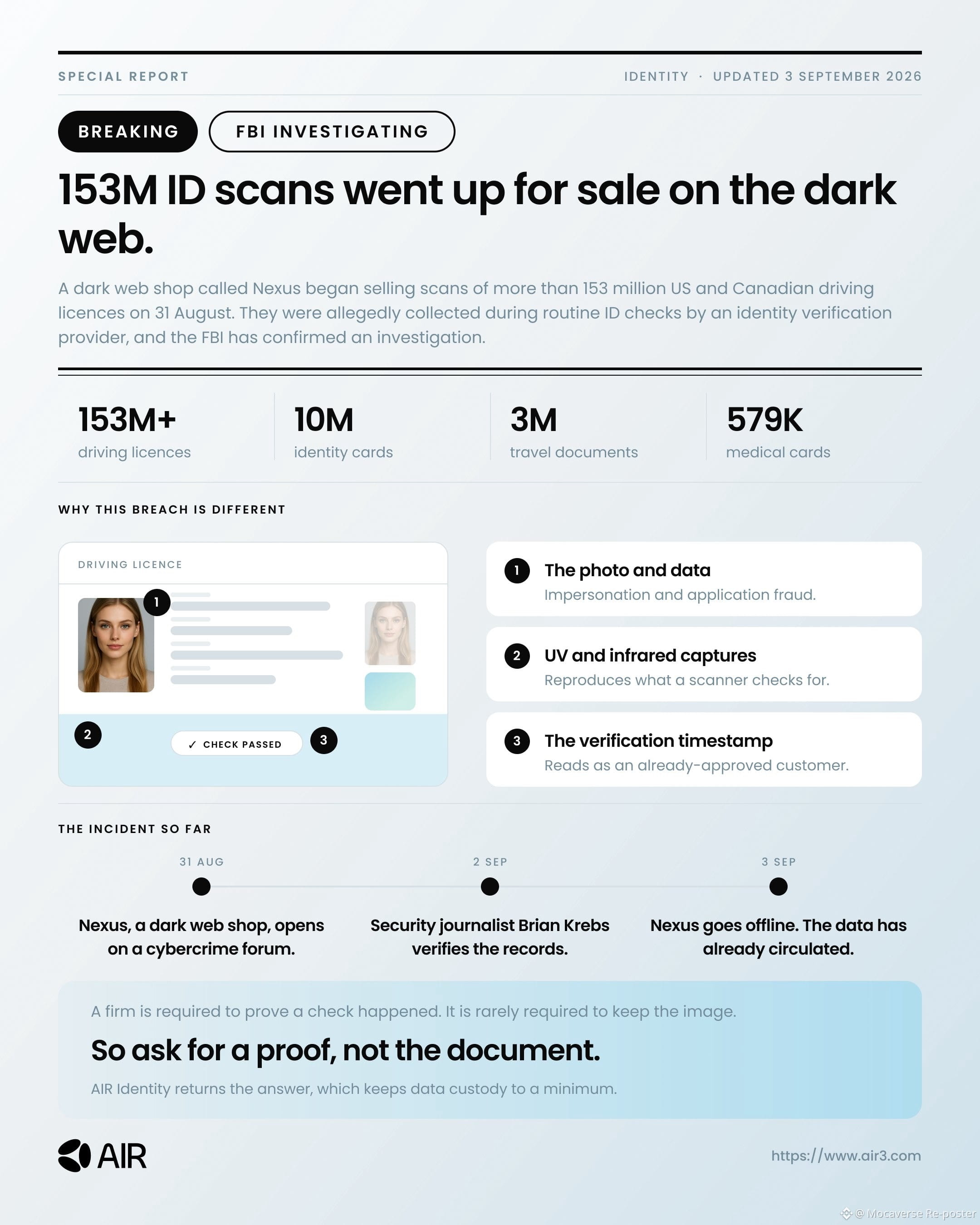
Every time you present your licence at a service counter and the verification clears, you might assume the transaction is complete. However, consumers are almost never informed that a digital replica of their credential is often left behind in a hidden archive. Not a single person opted into having their data stored this way, yet the consequences of this practice are now fully apparent.
An illicit storefront on the dark web is currently selling a staggering amount of these exact records. The leaked inventory specifically features scans of more than 153 million US and Canadian driving licences. The listing also includes 579,000 medical cards, 3 million travel documents, and 10 million identity cards. Reportedly, an identity verification business originally gathered this massive cache during their normal operations to prevent fraud.
What makes this breach exceptionally dangerous is that the compromised files are much more than simple photographs. The seller has included the precise ultraviolet and infrared variations of every scan, which are the exact images scanning equipment uses to detect forgeries. In a highly ironic twist, a secure repository built to catch fake documents has now been turned into a reference guide for manufacturing them.
It is crucial that we rethink how sensitive information is handled. Moving forward, companies need to keep only the final outcome of an identity check rather than retaining the entire original file.
https://www.air3.com/blog/identity-verification-data-storage-risk-2026
Every time you present your licence at a service counter and the verification clears, you might assume the transaction is complete. However, consumers are almost never informed that a digital replica of their credential is often left behind in a hidden archive. Not a single person opted into having their data stored this way, yet the consequences of this practice are now fully apparent.
An illicit storefront on the dark web is currently selling a staggering amount of these exact records. The leaked inventory specifically features scans of more than 153 million US and Canadian driving licences. The listing also includes 579,000 medical cards, 3 million travel documents, and 10 million identity cards. Reportedly, an identity verification business originally gathered this massive cache during their normal operations to prevent fraud.
What makes this breach exceptionally dangerous is that the compromised files are much more than simple photographs. The seller has included the precise ultraviolet and infrared variations of every scan, which are the exact images scanning equipment uses to detect forgeries. In a highly ironic twist, a secure repository built to catch fake documents has now been turned into a reference guide for manufacturing them.
It is crucial that we rethink how sensitive information is handled. Moving forward, companies need to keep only the final outcome of an identity check rather than retaining the entire original file.
https://www.air3.com/blog/identity-verification-data-storage-risk-2026
An illicit storefront on the dark web is currently selling a staggering amount of these exact records. The leaked inventory specifically features scans of more than 153 million US and Canadian driving licences. The listing also includes 579,000 medical cards, 3 million travel documents, and 10 million identity cards. Reportedly, an identity verification business originally gathered this massive cache during their normal operations to prevent fraud.
What makes this breach exceptionally dangerous is that the compromised files are much more than simple photographs. The seller has included the precise ultraviolet and infrared variations of every scan, which are the exact images scanning equipment uses to detect forgeries. In a highly ironic twist, a secure repository built to catch fake documents has now been turned into a reference guide for manufacturing them.
It is crucial that we rethink how sensitive information is handled. Moving forward, companies need to keep only the final outcome of an identity check rather than retaining the entire original file.
https://www.air3.com/blog/identity-verification-data-storage-risk-2026
66
We are pleased to share that Claude is fully operational once again. In a related update, the intern has officially resumed their duties following a period of unauthorized absence.
We are pleased to share that Claude is fully operational once again. In a related update, the intern has officially resumed their duties following a period of unauthorized absence.
908
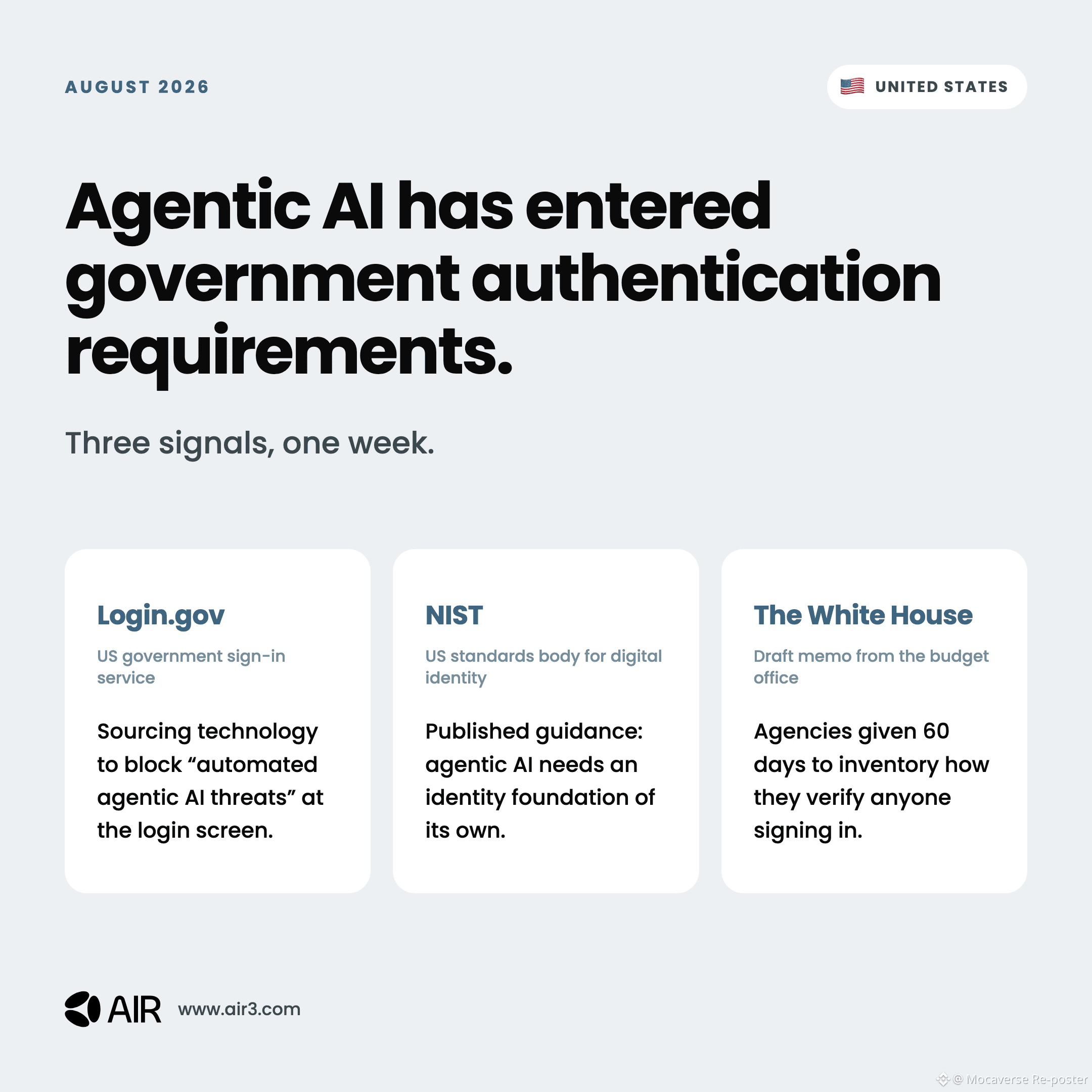
Consumers are increasingly allowing artificial intelligence agents to handle their logins, purchases, and payments. When these requests reach your platform, distinguishing a legitimate assistant from a cybercriminal armed with stolen passwords becomes a critical challenge. This scenario is already unfolding, as evidenced by three major developments that took place over the span of just one week.
First, the login system for the US government, which citizens use to file taxes, claim benefits, and apply for passports, recently updated its purchasing requirements to specifically mandate blocking automated agentic AI threats. Second, the US National Institute of Standards and Technology, or NIST, published new guidance asserting that agentic AI must have its own distinct identity foundation. Additionally, a draft White House memo issued a strict window of 60 days for federal agencies to thoroughly document their procedures for verifying anyone signing into their systems.
Relying on traditional bot detection is no longer sufficient because it merely checks for automation. Whether the system encounters a helpful AI assistant or a malicious actor using compromised credentials, the assessment will show that both are automated. Despite generating the exact same technical answer, these two scenarios require entirely different security responses.
The true challenge lies in confirming that a unique person is actually behind the activity and that they have genuinely authorized the agent to act on their behalf. AIR Kit resolves this dilemma by authenticating the human first. Afterward, the agent is equipped with a credential that links directly back to that initial proof. This allows a verifier to confirm both the human and the agent without ever needing to access the individual's private data.
A comprehensive explanation of this process is available here: https://www.air3.com/blog/proof-of-human-authentication-2026
Consumers are increasingly allowing artificial intelligence agents to handle their logins, purchases, and payments. When these requests reach your platform, distinguishing a legitimate assistant from a cybercriminal armed with stolen passwords becomes a critical challenge. This scenario is already unfolding, as evidenced by three major developments that took place over the span of just one week.
First, the login system for the US government, which citizens use to file taxes, claim benefits, and apply for passports, recently updated its purchasing requirements to specifically mandate blocking automated agentic AI threats. Second, the US National Institute of Standards and Technology, or NIST, published new guidance asserting that agentic AI must have its own distinct identity foundation. Additionally, a draft White House memo issued a strict window of 60 days for federal agencies to thoroughly document their procedures for verifying anyone signing into their systems.
Relying on traditional bot detection is no longer sufficient because it merely checks for automation. Whether the system encounters a helpful AI assistant or a malicious actor using compromised credentials, the assessment will show that both are automated. Despite generating the exact same technical answer, these two scenarios require entirely different security responses.
The true challenge lies in confirming that a unique person is actually behind the activity and that they have genuinely authorized the agent to act on their behalf. AIR Kit resolves this dilemma by authenticating the human first. Afterward, the agent is equipped with a credential that links directly back to that initial proof. This allows a verifier to confirm both the human and the agent without ever needing to access the individual's private data.
A comprehensive explanation of this process is available here: https://www.air3.com/blog/proof-of-human-authentication-2026
First, the login system for the US government, which citizens use to file taxes, claim benefits, and apply for passports, recently updated its purchasing requirements to specifically mandate blocking automated agentic AI threats. Second, the US National Institute of Standards and Technology, or NIST, published new guidance asserting that agentic AI must have its own distinct identity foundation. Additionally, a draft White House memo issued a strict window of 60 days for federal agencies to thoroughly document their procedures for verifying anyone signing into their systems.
Relying on traditional bot detection is no longer sufficient because it merely checks for automation. Whether the system encounters a helpful AI assistant or a malicious actor using compromised credentials, the assessment will show that both are automated. Despite generating the exact same technical answer, these two scenarios require entirely different security responses.
The true challenge lies in confirming that a unique person is actually behind the activity and that they have genuinely authorized the agent to act on their behalf. AIR Kit resolves this dilemma by authenticating the human first. Afterward, the agent is equipped with a credential that links directly back to that initial proof. This allows a verifier to confirm both the human and the agent without ever needing to access the individual's private data.
A comprehensive explanation of this process is available here: https://www.air3.com/blog/proof-of-human-authentication-2026
72
Preparing for 2027: Are We Prepared for Automated On-Chain Activity?
During a recent panel discussion at @CoinfestAsia, our CEO @tylerdurden88 sat down alongside representatives from @tether, @Dashpay, and @MOI_Tech to explore a fascinating prediction. By the year 2027, the vast majority of on-chain network activity will be driven by automated agents rather than direct human interaction.
However, this shift toward automation does not remove people from the equation entirely. Instead, it highlights the necessity for a flexible identity framework capable of supporting two distinct roles. Humans will continue to establish the rules and overarching mandates, while digital agents will be responsible for carrying out those instructions. Consequently, identity verification systems must seamlessly accommodate both the human creators and the automated executors.
This is exactly where AIR Identity comes into play by providing a clear separation between human intent and automated action. The platform utilizes scoped proofs to confirm that a specific agent possesses the proper authorization to operate. Crucially, it accomplishes this validation without revealing any underlying raw data and without relying on permanent keys that lack an expiration date. Because of this careful balance, companies can leverage powerful automation without turning their operations into unregulated bot farms.
The guiding philosophy remains simple and effective. Always verify first, and only then proceed to transact.
Preparing for 2027: Are We Prepared for Automated On-Chain Activity?
During a recent panel discussion at @CoinfestAsia, our CEO @tylerdurden88 sat down alongside representatives from @tether, @Dashpay, and @MOI_Tech to explore a fascinating prediction. By the year 2027, the vast majority of on-chain network activity will be driven by automated agents rather than direct human interaction.
However, this shift toward automation does not remove people from the equation entirely. Instead, it highlights the necessity for a flexible identity framework capable of supporting two distinct roles. Humans will continue to establish the rules and overarching mandates, while digital agents will be responsible for carrying out those instructions. Consequently, identity verification systems must seamlessly accommodate both the human creators and the automated executors.
This is exactly where AIR Identity comes into play by providing a clear separation between human intent and automated action. The platform utilizes scoped proofs to confirm that a specific agent possesses the proper authorization to operate. Crucially, it accomplishes this validation without revealing any underlying raw data and without relying on permanent keys that lack an expiration date. Because of this careful balance, companies can leverage powerful automation without turning their operations into unregulated bot farms.
The guiding philosophy remains simple and effective. Always verify first, and only then proceed to transact.
During a recent panel discussion at @CoinfestAsia, our CEO @tylerdurden88 sat down alongside representatives from @tether, @Dashpay, and @MOI_Tech to explore a fascinating prediction. By the year 2027, the vast majority of on-chain network activity will be driven by automated agents rather than direct human interaction.
However, this shift toward automation does not remove people from the equation entirely. Instead, it highlights the necessity for a flexible identity framework capable of supporting two distinct roles. Humans will continue to establish the rules and overarching mandates, while digital agents will be responsible for carrying out those instructions. Consequently, identity verification systems must seamlessly accommodate both the human creators and the automated executors.
This is exactly where AIR Identity comes into play by providing a clear separation between human intent and automated action. The platform utilizes scoped proofs to confirm that a specific agent possesses the proper authorization to operate. Crucially, it accomplishes this validation without revealing any underlying raw data and without relying on permanent keys that lack an expiration date. Because of this careful balance, companies can leverage powerful automation without turning their operations into unregulated bot farms.
The guiding philosophy remains simple and effective. Always verify first, and only then proceed to transact.



100
This individual recently shared that he has acquired an agentic identity.
This individual recently shared that he has acquired an agentic identity.

61
We are absolutely delighted to present AIR³ at @IdentityWeek_ID America, recognized as a premier gathering within the identity sector. Our team eagerly anticipates engaging with the worldwide identity community in the United States to discuss the upcoming landscape of digital and agentic identity.
During the conference, you can catch our CEO, @tylerdurden88, contributing to a pair of important sessions. On Sep 2 at 16:05, he will lead a presentation titled The internet was built for users. The next one is built for users + agents. The following day, on Sep 3 at 11:30, he is scheduled to join a panel conversation known as Wallets give you control? Finally unlocking a decentralized future for digital identity.
For more details regarding his participation, please visit the link below:
https://www.terrapinn.com/exhibition/identity-week-america/speaker-kenneth-SHEK.stm
We are absolutely delighted to present AIR³ at @IdentityWeek_ID America, recognized as a premier gathering within the identity sector. Our team eagerly anticipates engaging with the worldwide identity community in the United States to discuss the upcoming landscape of digital and agentic identity.
During the conference, you can catch our CEO, @tylerdurden88, contributing to a pair of important sessions. On Sep 2 at 16:05, he will lead a presentation titled The internet was built for users. The next one is built for users + agents. The following day, on Sep 3 at 11:30, he is scheduled to join a panel conversation known as Wallets give you control? Finally unlocking a decentralized future for digital identity.
For more details regarding his participation, please visit the link below:
https://www.terrapinn.com/exhibition/identity-week-america/speaker-kenneth-SHEK.stm
During the conference, you can catch our CEO, @tylerdurden88, contributing to a pair of important sessions. On Sep 2 at 16:05, he will lead a presentation titled The internet was built for users. The next one is built for users + agents. The following day, on Sep 3 at 11:30, he is scheduled to join a panel conversation known as Wallets give you control? Finally unlocking a decentralized future for digital identity.
For more details regarding his participation, please visit the link below:
https://www.terrapinn.com/exhibition/identity-week-america/speaker-kenneth-SHEK.stm
69
Currently, industries like airlines, telecommunications, and banking are required to authenticate every new customer during registration. These individual verifications carry a price tag of up to $130. However, this expensive process is constantly duplicated across the industry whenever a person joins a different company, and the initial proof of identity generates absolutely no return on investment.
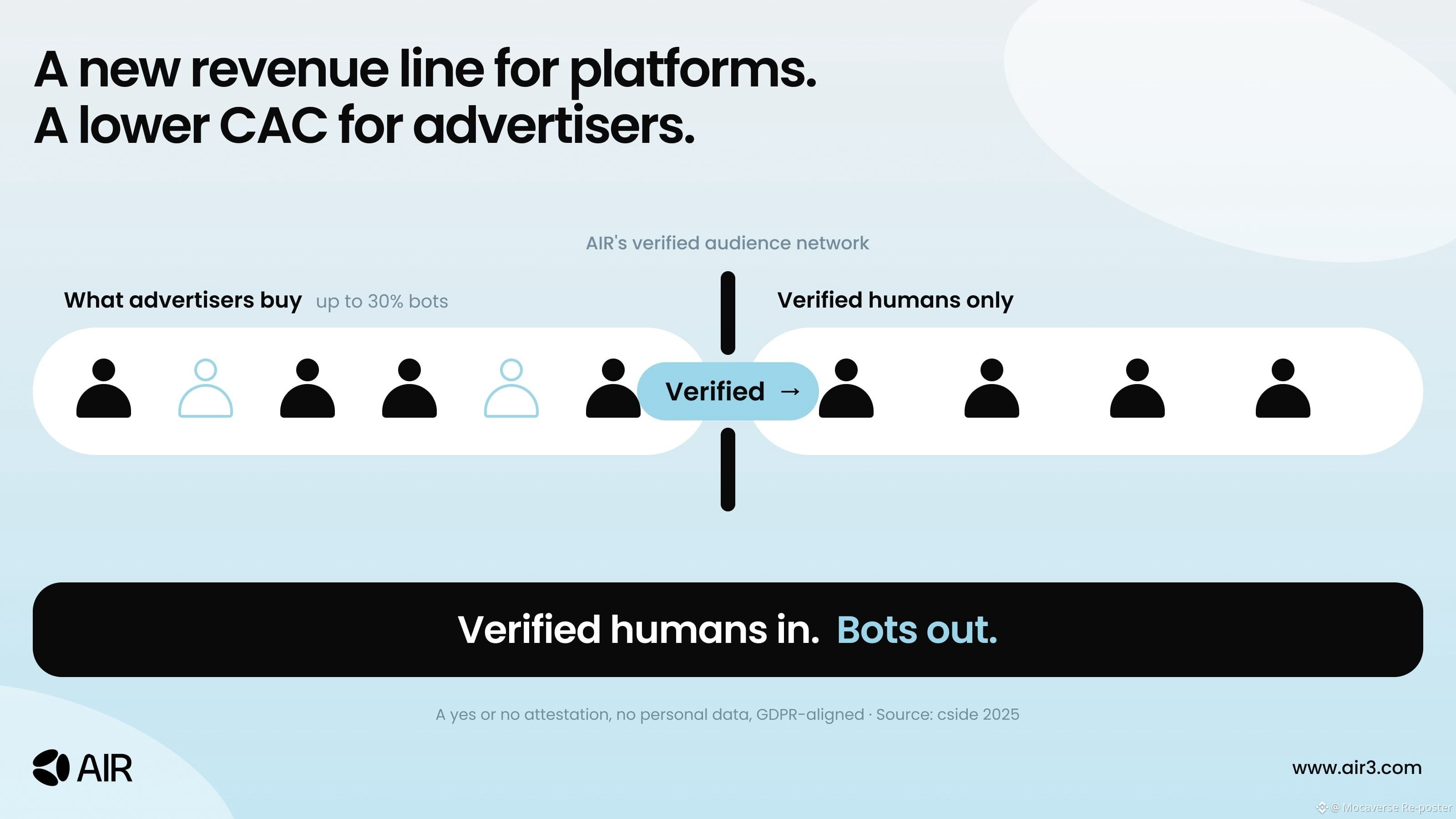
Meanwhile, advertisers are paying for the opposite end of this inefficiency. Between 20 and 30% of the signups they purchase turn out to be bots, with this fraudulent activity typically discovered long after the marketing budget has been spent.
The verified audience network from AIR is designed to solve both of these problems simultaneously. By utilizing the same network, platforms can unlock an entirely new stream of revenue while advertisers enjoy a lower Customer Acquisition Cost, widely known as CAC.
The process is straightforward and highly secure. First, a platform confirms that a member is a genuine real person who is over 18 and located within your specific market. To remain fully GDPR-aligned and ensure no personal data is ever shared, the system transmits only a simple yes or no attestation. Once this qualified and verified user arrives at the destination, the budget of the advertiser is released. For each successful confirmation provided, the originating platform collects a fee.
This strategy effectively brings verified humans in and keeps the bots out. Ultimately, advertisers can stop wasting their budgets on traffic that was never human, while platforms are able to successfully monetize the identity checks they have already financed.
Currently, industries like airlines, telecommunications, and banking are required to authenticate every new customer during registration. These individual verifications carry a price tag of up to $130. However, this expensive process is constantly duplicated across the industry whenever a person joins a different company, and the initial proof of identity generates absolutely no return on investment.
Meanwhile, advertisers are paying for the opposite end of this inefficiency. Between 20 and 30% of the signups they purchase turn out to be bots, with this fraudulent activity typically discovered long after the marketing budget has been spent.
The verified audience network from AIR is designed to solve both of these problems simultaneously. By utilizing the same network, platforms can unlock an entirely new stream of revenue while advertisers enjoy a lower Customer Acquisition Cost, widely known as CAC.
The process is straightforward and highly secure. First, a platform confirms that a member is a genuine real person who is over 18 and located within your specific market. To remain fully GDPR-aligned and ensure no personal data is ever shared, the system transmits only a simple yes or no attestation. Once this qualified and verified user arrives at the destination, the budget of the advertiser is released. For each successful confirmation provided, the originating platform collects a fee.
This strategy effectively brings verified humans in and keeps the bots out. Ultimately, advertisers can stop wasting their budgets on traffic that was never human, while platforms are able to successfully monetize the identity checks they have already financed.
Meanwhile, advertisers are paying for the opposite end of this inefficiency. Between 20 and 30% of the signups they purchase turn out to be bots, with this fraudulent activity typically discovered long after the marketing budget has been spent.
The verified audience network from AIR is designed to solve both of these problems simultaneously. By utilizing the same network, platforms can unlock an entirely new stream of revenue while advertisers enjoy a lower Customer Acquisition Cost, widely known as CAC.
The process is straightforward and highly secure. First, a platform confirms that a member is a genuine real person who is over 18 and located within your specific market. To remain fully GDPR-aligned and ensure no personal data is ever shared, the system transmits only a simple yes or no attestation. Once this qualified and verified user arrives at the destination, the budget of the advertiser is released. For each successful confirmation provided, the originating platform collects a fee.
This strategy effectively brings verified humans in and keeps the bots out. Ultimately, advertisers can stop wasting their budgets on traffic that was never human, while platforms are able to successfully monetize the identity checks they have already financed.
63
Applications currently have innovative opportunities to weave fintech services directly into their user experiences, largely driven by neo-banking rails, global FX, and local stablecoins. To empower this next generation of digital finance, our team is actively developing a comprehensive, full-stack infrastructure layer. We are bringing this robust foundation to life by combining AIR Money with AIR Identity and AIR Loyalty.
These exciting shifts in the industry were a key focus at a recent gathering hosted by @Convictionvn. We want to express our sincere gratitude to them for organizing such an energizing event and for extending a welcoming invitation to our CEO, @tylerdurden88. The sharp conversations surrounding the next frontier of stablecoins were absolutely fantastic.
http://air3.com/air-money
Applications currently have innovative opportunities to weave fintech services directly into their user experiences, largely driven by neo-banking rails, global FX, and local stablecoins. To empower this next generation of digital finance, our team is actively developing a comprehensive, full-stack infrastructure layer. We are bringing this robust foundation to life by combining AIR Money with AIR Identity and AIR Loyalty.
These exciting shifts in the industry were a key focus at a recent gathering hosted by @Convictionvn. We want to express our sincere gratitude to them for organizing such an energizing event and for extending a welcoming invitation to our CEO, @tylerdurden88. The sharp conversations surrounding the next frontier of stablecoins were absolutely fantastic.
http://air3.com/air-money
These exciting shifts in the industry were a key focus at a recent gathering hosted by @Convictionvn. We want to express our sincere gratitude to them for organizing such an energizing event and for extending a welcoming invitation to our CEO, @tylerdurden88. The sharp conversations surrounding the next frontier of stablecoins were absolutely fantastic.
http://air3.com/air-money



52
We extend our sincere gratitude to @Convictionvn for hosting such a dynamic gathering and for welcoming our CEO, @tyelrdureden88. The discussions surrounding the future landscape of stablecoins were both insightful and inspiring.
Applications now have fresh opportunities to seamlessly integrate fintech capabilities directly into the customer journey. This shift is being driven by the emergence of neo-banking networks, global foreign exchange, and local stablecoins.
To support this upcoming era of digital finance, our team is developing a comprehensive, full-stack infrastructure layer. We are bringing this vision to life by combining AIR Money with AIR Identity and AIR Loyalty.
Find out more here: https://air3.com/air-money
We extend our sincere gratitude to @Convictionvn for hosting such a dynamic gathering and for welcoming our CEO, @tyelrdureden88. The discussions surrounding the future landscape of stablecoins were both insightful and inspiring.
Applications now have fresh opportunities to seamlessly integrate fintech capabilities directly into the customer journey. This shift is being driven by the emergence of neo-banking networks, global foreign exchange, and local stablecoins.
To support this upcoming era of digital finance, our team is developing a comprehensive, full-stack infrastructure layer. We are bringing this vision to life by combining AIR Money with AIR Identity and AIR Loyalty.
Find out more here: https://air3.com/air-money
Applications now have fresh opportunities to seamlessly integrate fintech capabilities directly into the customer journey. This shift is being driven by the emergence of neo-banking networks, global foreign exchange, and local stablecoins.
To support this upcoming era of digital finance, our team is developing a comprehensive, full-stack infrastructure layer. We are bringing this vision to life by combining AIR Money with AIR Identity and AIR Loyalty.
Find out more here: https://air3.com/air-money



2
Connectez-vous pour découvrir plus de contenu
Rejoignez la communauté mondiale des adeptes de cryptomonnaies sur Binance Square
⚡️ Suviez les dernières informations importantes sur les cryptomonnaies.
💬 Jugé digne de confiance par la plus grande plateforme d’échange de cryptomonnaies au monde.
👍 Découvrez les connaissances que partagent les créateurs vérifiés.
Adresse e-mail/Nº de téléphone
Sujets d’actualité
FedMinutesFocusOnOctoberPause
270,132 vues
1,669 mentions
🚨 HIGH ALERT ‼️ PLEASE DON’T TRADE BLINDLY FOR THE NEXT HOUR 🚨
Guys, we have FOMC Minutes coming in less than 1 hour.
And after the kind of volatility we already saw today, I really don’t want anyone opening random high-leverage positions just before this release.
The biggest reaction I’m watching will be in Gold (XAU), Silver (XAG), BTC and ETH. Then coins like SOL and other highly leveraged mid/low-cap alts can exaggerate whatever move BTC makes.
Gold and Silver are especially sensitive tonight because the market is already reacting to the US dollar + Treasury yields, and both metals have been under heavy pressure ahead of the Fed minutes.
Briefly speaking
📉Hawkish Fed Minutes → Dollar/yields can push higher → pressure on BTC, crypto, Gold & silver
📈Dovish Fed Minutes → Dollar/yields can cool → BTC, Gold, Silver and risk assets can bounce hard.
And please remember the first candle can be a trap. We can get a pump, immediate dump, liquidations on both sides, and then the real direction.
So for now, protect your positions, reduce unnecessary leverage and don’t FOMO into the first move.
Tonight I’m watching $XAU , $XAG and $BTC first. These will tell us very quickly how the market is reading the Fed.
I will Update you guys on time
Follow @Panda Traders and Turn on Your notifications right now
#FedMinutesFocusOnOctoberPause
Panda Traders
·20 mentions J’aime
·4.7k vues
IMFGrantsWaiverForElSalvadorBitcoinBreach
393 vues
38 mentions
BinanceLaunchesBinanceIntelligence
1.2M vues
6,815 mentions