

Nexiz Crypto
659 Publications
Nexiz Crypto
Signaler
Bloquer l’utilisateur
Ouvert au trading
Trade régulièrement
5.3 an(s)
180 Suivis
135 Abonnés
412 J’aime
Publications
Portefeuille
Tous
Citations
·
--
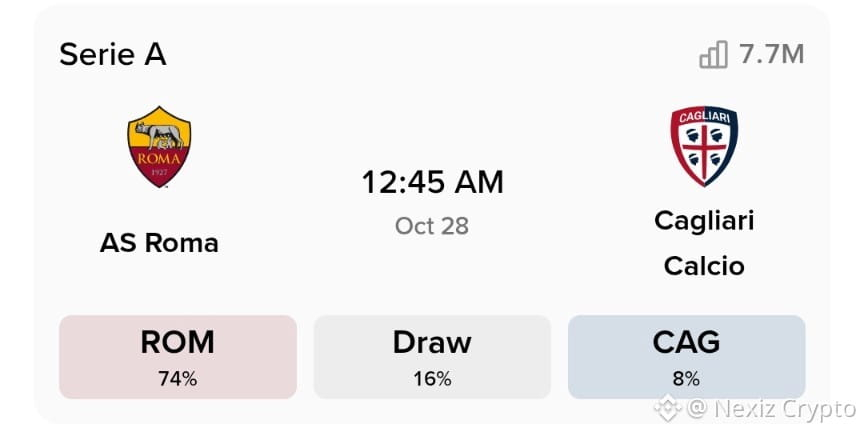
AS Roma vs Cagliari: Roma look like the clear favorites with a 74% win probability, while Cagliari have just 8%. I’m leaning towards a Roma win. #BinancePick
AS Roma vs Cagliari: Roma look like the clear favorites with a 74% win probability, while Cagliari have just 8%. I’m leaning towards a Roma win. #BinancePick
80
·
--
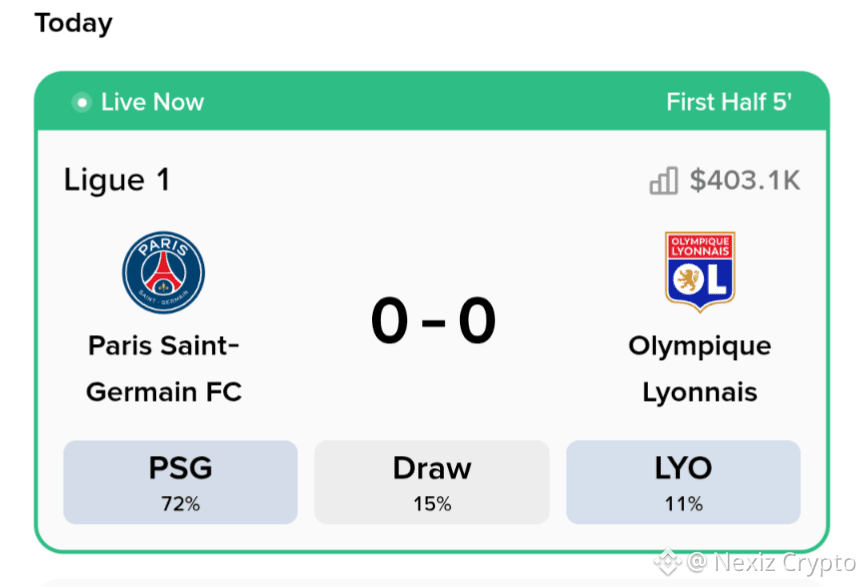
#BinancePick PSG are the favorites against Lyon, with a 72% win probability. Still 0-0 in the 5th minute. Let’s see if PSG can deliver!
#BinancePick PSG are the favorites against Lyon, with a 72% win probability. Still 0-0 in the 5th minute. Let’s see if PSG can deliver!
113
·
--
G2 Esports vs Dplus KIA
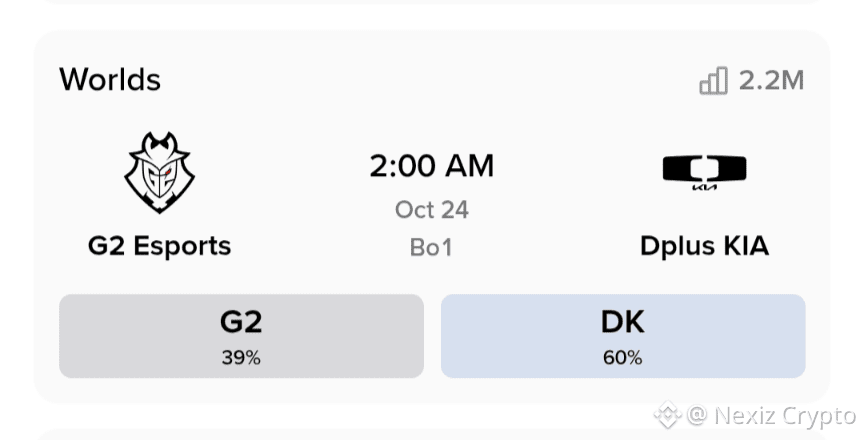
DK looks like the favorite with a 60% win chance, while G2 stands at 39%. Can G2 pull off an upset, or will DK take the win? #BinancePick
G2 Esports vs Dplus KIA
DK looks like the favorite with a 60% win chance, while G2 stands at 39%. Can G2 pull off an upset, or will DK take the win? #BinancePick
DK looks like the favorite with a 60% win chance, while G2 stands at 39%. Can G2 pull off an upset, or will DK take the win? #BinancePick
65
·
--
G2 Esports vs Dplus KIA 🔥
DK looks like the favorite with a 60% win chance, while G2 stands at 39%. Can G2 pull off an upset, or will DK take the win? 👀 #BinancePick
G2 Esports vs Dplus KIA 🔥
DK looks like the favorite with a 60% win chance, while G2 stands at 39%. Can G2 pull off an upset, or will DK take the win? 👀 #BinancePick
DK looks like the favorite with a 60% win chance, while G2 stands at 39%. Can G2 pull off an upset, or will DK take the win? 👀 #BinancePick

65
·
--
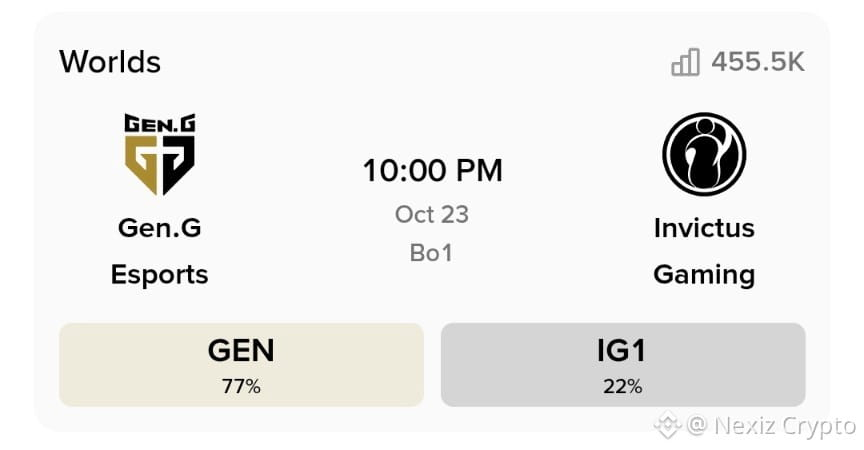
#BinancePick today, Gen.G looks like the stronger side going into this match. IG can still surprise us, but I’m backing GEN to take the win! What’s your prediction?
#BinancePick today, Gen.G looks like the stronger side going into this match. IG can still surprise us, but I’m backing GEN to take the win! What’s your prediction?

74
·
--
I’m going with Gen.G (GEN) for this match! They’ve been looking strong recently, but IG shouldn’t be underestimated. It’s a BO1, so anything can happen!
Who’s your pick? 👀 #BinancePick
I’m going with Gen.G (GEN) for this match! They’ve been looking strong recently, but IG shouldn’t be underestimated. It’s a BO1, so anything can happen!
Who’s your pick? 👀 #BinancePick
Who’s your pick? 👀 #BinancePick
90
·
--
Haussier
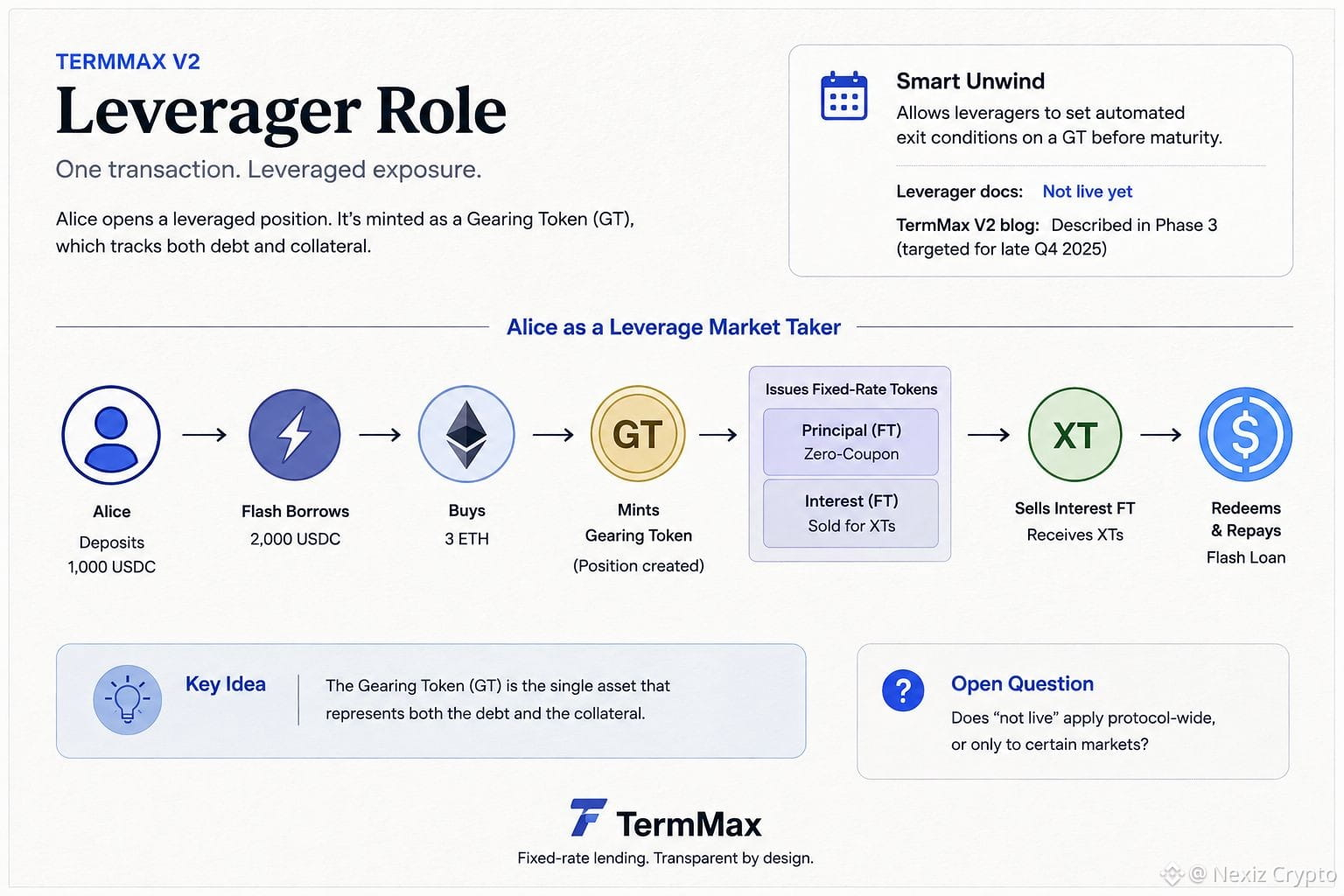
I was reading through TermMax's docs on the Leverager role and one detail caught my attention: the leveraged position isn't tracked as a simple balance, it's minted as its own asset — a Gearing Token.
I assumed this was just a wrapper for collateral, but the mechanism is more self-contained than that. Alice deposits 1,000 USDC, flash-borrows 2,000 more, buys 3 ETH, and locks it into a GT. The GT then issues Fixed-Rate Tokens, which split into principal and interest — the interest part sells for XTs, and those XTs plus the principal redeem enough USDC to repay the flash loan. One transaction, no manual looping.
That's when it clicked why the GT needs to exist at all: it's the single object recording both sides of the position — debt and collateral — at once.
After checking the official TermMax V2 announcement, I noticed something worth flagging. The V2 blog post describes Smart Unwind, which lets leveragers set automated exit conditions on a GT before maturity. But the Leverager docs page still states plainly that this feature is not live yet — even after V2's broader rollout. That's a reasonable trade-off for a phased launch, but it leaves an open question: does "not live" apply protocol-wide, or only to certain markets?
#termmax @termmax
I was reading through TermMax's docs on the Leverager role and one detail caught my attention: the leveraged position isn't tracked as a simple balance, it's minted as its own asset — a Gearing Token.
I assumed this was just a wrapper for collateral, but the mechanism is more self-contained than that. Alice deposits 1,000 USDC, flash-borrows 2,000 more, buys 3 ETH, and locks it into a GT. The GT then issues Fixed-Rate Tokens, which split into principal and interest — the interest part sells for XTs, and those XTs plus the principal redeem enough USDC to repay the flash loan. One transaction, no manual looping.
That's when it clicked why the GT needs to exist at all: it's the single object recording both sides of the position — debt and collateral — at once.
After checking the official TermMax V2 announcement, I noticed something worth flagging. The V2 blog post describes Smart Unwind, which lets leveragers set automated exit conditions on a GT before maturity. But the Leverager docs page still states plainly that this feature is not live yet — even after V2's broader rollout. That's a reasonable trade-off for a phased launch, but it leaves an open question: does "not live" apply protocol-wide, or only to certain markets?
#termmax @TermMax
I assumed this was just a wrapper for collateral, but the mechanism is more self-contained than that. Alice deposits 1,000 USDC, flash-borrows 2,000 more, buys 3 ETH, and locks it into a GT. The GT then issues Fixed-Rate Tokens, which split into principal and interest — the interest part sells for XTs, and those XTs plus the principal redeem enough USDC to repay the flash loan. One transaction, no manual looping.
That's when it clicked why the GT needs to exist at all: it's the single object recording both sides of the position — debt and collateral — at once.
After checking the official TermMax V2 announcement, I noticed something worth flagging. The V2 blog post describes Smart Unwind, which lets leveragers set automated exit conditions on a GT before maturity. But the Leverager docs page still states plainly that this feature is not live yet — even after V2's broader rollout. That's a reasonable trade-off for a phased launch, but it leaves an open question: does "not live" apply protocol-wide, or only to certain markets?
#termmax @TermMax
18
13
175
·
--
Haussier
I was reading through Dusk's announcement on the Chainlink partnership, expecting the usual CCIP integration talk, but one detail stood out before any of the technical language: the partner behind this isn't a crypto-native platform at all, it's NPEX, a fully regulated Dutch stock exchange.
I assumed this was just another bridge-and-data-feed story, so I checked the official page directly. The paragraph that stood out described NPEX's actual track record: NPEX, meanwhile, brings a powerful legacy of regulated market activity. As a Dutch stock exchange supervised by the Netherlands Authority for the Financial Markets (AFM), NPEX has facilitated over €200 million in financing for 100+ SMEs and connects a network of 17,500+ active investors.
That's when it clicked why Chainlink matters here. Dusk isn't just linking chains together, it's linking an already-regulated exchange to on-chain settlement. CCIP becomes the interoperability layer, while Chainlink DataLink and Data Streams are positioned to carry NPEX's official market data on-chain, a different problem than most DeFi oracles are built for.
What surprised me was the framing. Dusk markets itself as privacy-preserving, yet this integration leans heavily on transparency and verified data. That's less a contradiction and more a trade-off: confidentiality at the transaction layer, verifiability at the data layer, so institutions get compliance without giving up privacy entirely.
I'm still working through whether this model scales past one exchange, or whether NPEX is simply the proof case Dusk needs before others follow.
What do you think, fair balance or too early to tell?#dusk $DUSK @Dusk_Foundation
I was reading through Dusk's announcement on the Chainlink partnership, expecting the usual CCIP integration talk, but one detail stood out before any of the technical language: the partner behind this isn't a crypto-native platform at all, it's NPEX, a fully regulated Dutch stock exchange.
I assumed this was just another bridge-and-data-feed story, so I checked the official page directly. The paragraph that stood out described NPEX's actual track record: NPEX, meanwhile, brings a powerful legacy of regulated market activity. As a Dutch stock exchange supervised by the Netherlands Authority for the Financial Markets (AFM), NPEX has facilitated over €200 million in financing for 100+ SMEs and connects a network of 17,500+ active investors.
That's when it clicked why Chainlink matters here. Dusk isn't just linking chains together, it's linking an already-regulated exchange to on-chain settlement. CCIP becomes the interoperability layer, while Chainlink DataLink and Data Streams are positioned to carry NPEX's official market data on-chain, a different problem than most DeFi oracles are built for.
What surprised me was the framing. Dusk markets itself as privacy-preserving, yet this integration leans heavily on transparency and verified data. That's less a contradiction and more a trade-off: confidentiality at the transaction layer, verifiability at the data layer, so institutions get compliance without giving up privacy entirely.
I'm still working through whether this model scales past one exchange, or whether NPEX is simply the proof case Dusk needs before others follow.
What do you think, fair balance or too early to tell?#dusk $DUSK @Dusk
I assumed this was just another bridge-and-data-feed story, so I checked the official page directly. The paragraph that stood out described NPEX's actual track record: NPEX, meanwhile, brings a powerful legacy of regulated market activity. As a Dutch stock exchange supervised by the Netherlands Authority for the Financial Markets (AFM), NPEX has facilitated over €200 million in financing for 100+ SMEs and connects a network of 17,500+ active investors.
That's when it clicked why Chainlink matters here. Dusk isn't just linking chains together, it's linking an already-regulated exchange to on-chain settlement. CCIP becomes the interoperability layer, while Chainlink DataLink and Data Streams are positioned to carry NPEX's official market data on-chain, a different problem than most DeFi oracles are built for.
What surprised me was the framing. Dusk markets itself as privacy-preserving, yet this integration leans heavily on transparency and verified data. That's less a contradiction and more a trade-off: confidentiality at the transaction layer, verifiability at the data layer, so institutions get compliance without giving up privacy entirely.
I'm still working through whether this model scales past one exchange, or whether NPEX is simply the proof case Dusk needs before others follow.
What do you think, fair balance or too early to tell?#dusk $DUSK @Dusk
Fair Balance
100%
Too Early
0%
Need More Data
0%
2 Votes • Vote fermé
5
3
40
·
--
Haussier
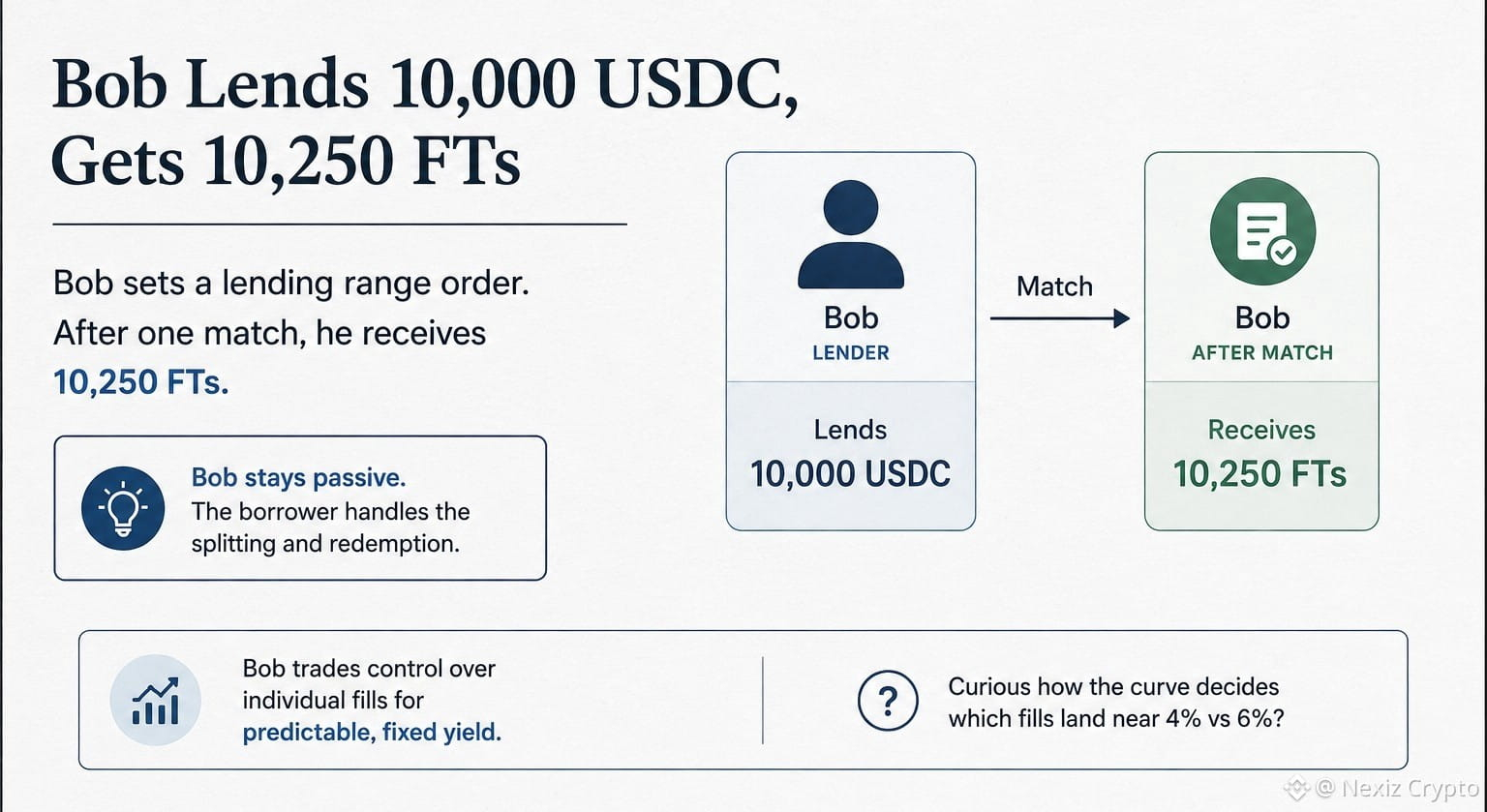
I was reading the section on lending range order setters and one detail caught my attention: in the example, Bob lends 10,000 USDC, and after just one match, he's already holding 10,250 FTs. My first assumption was that the extra 250 were projected yield, not something real yet.
After checking the mechanics again, that's not it. At placement, the system mints principal FTs equal to Bob's full amount, paired with XTs, allocated to the order. What changes at matching is only the interest portion: the borrower splits their issued FTs into principal and interest, sells the interest FTs to Bob's order for XTs, then redeems using those XTs plus their own principal FTs. Bob never touches XT, he just receives the interest FTs.
What surprised me was that the borrower does all the splitting and redemption, not the lender. Bob stays passive once he sets his pricing curve, trading control over individual fill pricing for fixed, predictable yield.
Still curious how the curve decides which fills land near 4% versus 6%.
#termmax @termmax
I was reading the section on lending range order setters and one detail caught my attention: in the example, Bob lends 10,000 USDC, and after just one match, he's already holding 10,250 FTs. My first assumption was that the extra 250 were projected yield, not something real yet.
After checking the mechanics again, that's not it. At placement, the system mints principal FTs equal to Bob's full amount, paired with XTs, allocated to the order. What changes at matching is only the interest portion: the borrower splits their issued FTs into principal and interest, sells the interest FTs to Bob's order for XTs, then redeems using those XTs plus their own principal FTs. Bob never touches XT, he just receives the interest FTs.
What surprised me was that the borrower does all the splitting and redemption, not the lender. Bob stays passive once he sets his pricing curve, trading control over individual fill pricing for fixed, predictable yield.
Still curious how the curve decides which fills land near 4% versus 6%.
#termmax @TermMax
After checking the mechanics again, that's not it. At placement, the system mints principal FTs equal to Bob's full amount, paired with XTs, allocated to the order. What changes at matching is only the interest portion: the borrower splits their issued FTs into principal and interest, sells the interest FTs to Bob's order for XTs, then redeems using those XTs plus their own principal FTs. Bob never touches XT, he just receives the interest FTs.
What surprised me was that the borrower does all the splitting and redemption, not the lender. Bob stays passive once he sets his pricing curve, trading control over individual fill pricing for fixed, predictable yield.
Still curious how the curve decides which fills land near 4% versus 6%.
#termmax @TermMax
18
7
124
·
--
Haussier
Vérifié
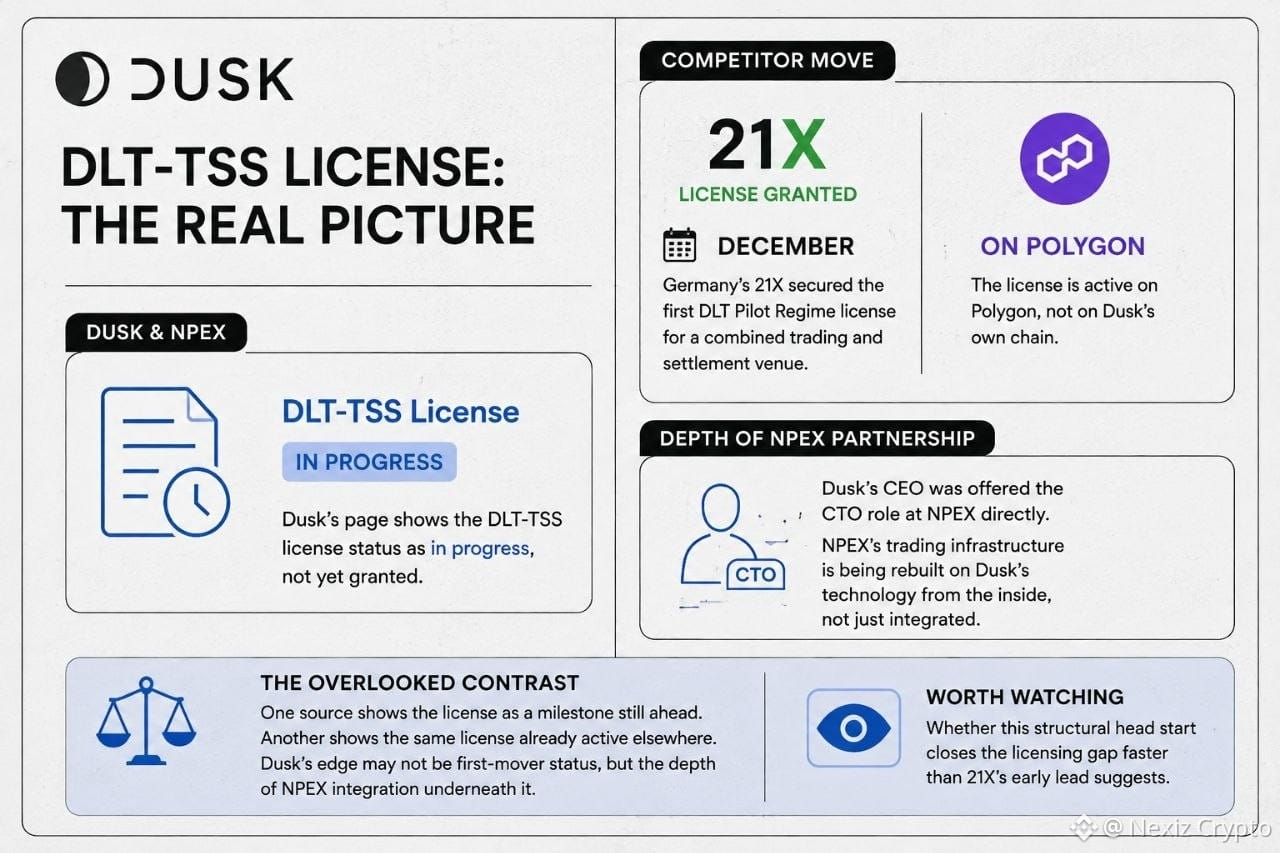
I was reading Dusk's page on the NPEX partnership, and one detail stood out: the DLT-TSS license is still listed as "in progress," not granted. I assumed that was just standard regulatory lag, the usual waiting period for any EU filing. After checking further, the timing turned out to be more specific than I expected. Germany's 21X already secured the first DLT Pilot Regime license for a combined trading and settlement venue back in December, and it did so on Polygon, not on Dusk's own chain. So the exact license Dusk and NPEX are pursuing already exists elsewhere, on infrastructure Dusk doesn't control. What surprised me more was how deep the NPEX relationship actually runs. In past interviews, Dusk's CEO mentioned being offered the CTO role at NPEX directly, meaning NPEX's own trading infrastructure is being rebuilt on Dusk's technology from the inside, not just integrated as a partner. That's the overlooked contrast. One official source frames DLT-TSS as a milestone still ahead. Another shows a competitor already operating under that exact license, on a different chain entirely. Read together, it suggests Dusk's advantage isn't first-mover status on the license itself, it's the depth of the NPEX integration underneath it.
Worth watching whether that structural head start closes the licensing gap faster than 21X's early lead suggests.
#dusk $DUSK @Dusk_Foundation
I was reading Dusk's page on the NPEX partnership, and one detail stood out: the DLT-TSS license is still listed as "in progress," not granted. I assumed that was just standard regulatory lag, the usual waiting period for any EU filing. After checking further, the timing turned out to be more specific than I expected. Germany's 21X already secured the first DLT Pilot Regime license for a combined trading and settlement venue back in December, and it did so on Polygon, not on Dusk's own chain. So the exact license Dusk and NPEX are pursuing already exists elsewhere, on infrastructure Dusk doesn't control. What surprised me more was how deep the NPEX relationship actually runs. In past interviews, Dusk's CEO mentioned being offered the CTO role at NPEX directly, meaning NPEX's own trading infrastructure is being rebuilt on Dusk's technology from the inside, not just integrated as a partner. That's the overlooked contrast. One official source frames DLT-TSS as a milestone still ahead. Another shows a competitor already operating under that exact license, on a different chain entirely. Read together, it suggests Dusk's advantage isn't first-mover status on the license itself, it's the depth of the NPEX integration underneath it.
Worth watching whether that structural head start closes the licensing gap faster than 21X's early lead suggests.
#dusk $DUSK @Dusk
Worth watching whether that structural head start closes the licensing gap faster than 21X's early lead suggests.
#dusk $DUSK @Dusk
7
7
29
·
--
Haussier
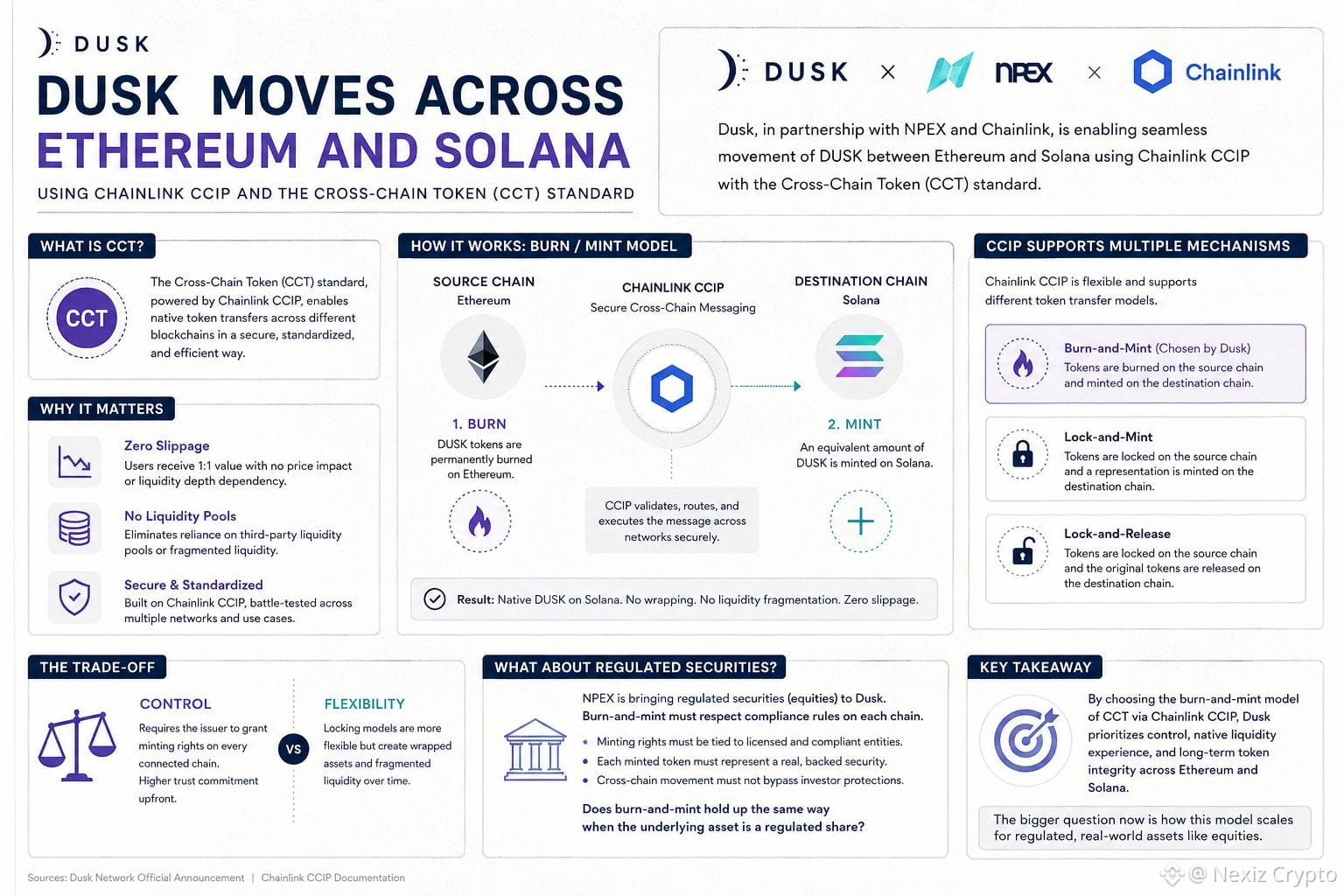
I was reading Dusk's announcement about their partnership with NPEX and Chainlink, and one detail caught my attention immediately: DUSK moving between Ethereum and Solana using something called the Cross-Chain Token standard, or CCT. I assumed this was just another bridge mechanism, the kind that wraps a token and hopes liquidity shows up on the other side.
After checking the official announcement, though, the terminology was more specific than that. Dusk explicitly calls out the "burn/mint model" and describes it as removing dependence on third-party liquidity pools entirely. That's when it clicked why they emphasized zero slippage as a selling point rather than a technical footnote. What surprised me was comparing this against Chainlink's own CCIP documentation, which lists several possible mechanisms: burn-and-mint, lock-and-mint, and lock-and-release. Dusk didn't just adopt CCIP generically; they picked the specific configuration where tokens are destroyed on the source chain and recreated on the destination, rather than locked and represented by a wrapped version.
The trade-off behind that choice seems to be control versus flexibility. Burn-and-mint requires the issuer to grant minting rights on every connected chain, which is a bigger trust commitment upfront, but it avoids the fragmented liquidity problem that wrapped assets create over time.
I'm still working through what this means for NPEX's regulated securities specifically, since equities carry compliance constraints that a generic token might not. Does burn-and-mint hold up the same way when the underlying asset is a regulated share rather than a currency?#dusk $DUSK @Dusk_Foundation
I was reading Dusk's announcement about their partnership with NPEX and Chainlink, and one detail caught my attention immediately: DUSK moving between Ethereum and Solana using something called the Cross-Chain Token standard, or CCT. I assumed this was just another bridge mechanism, the kind that wraps a token and hopes liquidity shows up on the other side.
After checking the official announcement, though, the terminology was more specific than that. Dusk explicitly calls out the "burn/mint model" and describes it as removing dependence on third-party liquidity pools entirely. That's when it clicked why they emphasized zero slippage as a selling point rather than a technical footnote. What surprised me was comparing this against Chainlink's own CCIP documentation, which lists several possible mechanisms: burn-and-mint, lock-and-mint, and lock-and-release. Dusk didn't just adopt CCIP generically; they picked the specific configuration where tokens are destroyed on the source chain and recreated on the destination, rather than locked and represented by a wrapped version.
The trade-off behind that choice seems to be control versus flexibility. Burn-and-mint requires the issuer to grant minting rights on every connected chain, which is a bigger trust commitment upfront, but it avoids the fragmented liquidity problem that wrapped assets create over time.
I'm still working through what this means for NPEX's regulated securities specifically, since equities carry compliance constraints that a generic token might not. Does burn-and-mint hold up the same way when the underlying asset is a regulated share rather than a currency?#dusk $DUSK @Dusk
After checking the official announcement, though, the terminology was more specific than that. Dusk explicitly calls out the "burn/mint model" and describes it as removing dependence on third-party liquidity pools entirely. That's when it clicked why they emphasized zero slippage as a selling point rather than a technical footnote. What surprised me was comparing this against Chainlink's own CCIP documentation, which lists several possible mechanisms: burn-and-mint, lock-and-mint, and lock-and-release. Dusk didn't just adopt CCIP generically; they picked the specific configuration where tokens are destroyed on the source chain and recreated on the destination, rather than locked and represented by a wrapped version.
The trade-off behind that choice seems to be control versus flexibility. Burn-and-mint requires the issuer to grant minting rights on every connected chain, which is a bigger trust commitment upfront, but it avoids the fragmented liquidity problem that wrapped assets create over time.
I'm still working through what this means for NPEX's regulated securities specifically, since equities carry compliance constraints that a generic token might not. Does burn-and-mint hold up the same way when the underlying asset is a regulated share rather than a currency?#dusk $DUSK @Dusk
3
3
106
·
--
Haussier
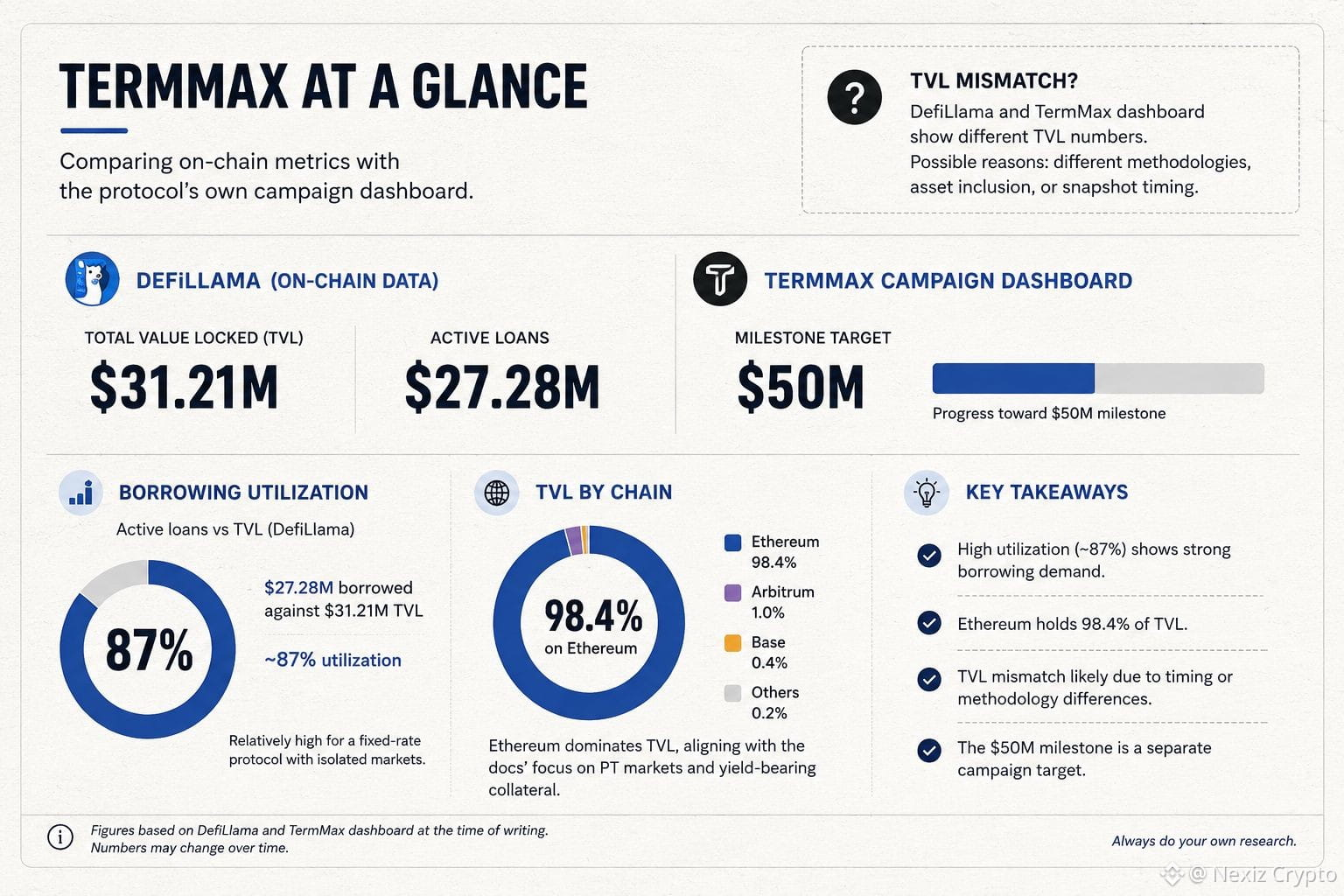
I was checking TermMax's numbers today, and one thing immediately caught my attention.
DefiLlama shows $31.21M in TVL and $27.28M in active loans, while the protocol's campaign dashboard is tracking progress toward a separate $50M milestone.
Two different sources. Two different numbers.
But the more interesting detail was on the borrowing side.
With $27.28M borrowed against $31.21M in TVL, utilization is sitting at roughly 87%. That's pretty high for a fixed-rate protocol built around isolated markets rather than a shared liquidity pool.
Another interesting stat: 98.4% of the protocol's TVL is currently on Ethereum, which seems consistent with the docs' focus on PT markets and yield-bearing collateral.
I'm guessing the TVL difference comes down to timing or methodology, but I'm still curious.
Has anyone found an official explanation for the mismatch?
#termmax @termmax
I was checking TermMax's numbers today, and one thing immediately caught my attention.
DefiLlama shows $31.21M in TVL and $27.28M in active loans, while the protocol's campaign dashboard is tracking progress toward a separate $50M milestone.
Two different sources. Two different numbers.
But the more interesting detail was on the borrowing side.
With $27.28M borrowed against $31.21M in TVL, utilization is sitting at roughly 87%. That's pretty high for a fixed-rate protocol built around isolated markets rather than a shared liquidity pool.
Another interesting stat: 98.4% of the protocol's TVL is currently on Ethereum, which seems consistent with the docs' focus on PT markets and yield-bearing collateral.
I'm guessing the TVL difference comes down to timing or methodology, but I'm still curious.
Has anyone found an official explanation for the mismatch?
#termmax @TermMax
DefiLlama shows $31.21M in TVL and $27.28M in active loans, while the protocol's campaign dashboard is tracking progress toward a separate $50M milestone.
Two different sources. Two different numbers.
But the more interesting detail was on the borrowing side.
With $27.28M borrowed against $31.21M in TVL, utilization is sitting at roughly 87%. That's pretty high for a fixed-rate protocol built around isolated markets rather than a shared liquidity pool.
Another interesting stat: 98.4% of the protocol's TVL is currently on Ethereum, which seems consistent with the docs' focus on PT markets and yield-bearing collateral.
I'm guessing the TVL difference comes down to timing or methodology, but I'm still curious.
Has anyone found an official explanation for the mismatch?
#termmax @TermMax
8
4
90
·
--
Haussier
I was reading through Dusk's node docs late at night, half paying attention. I almost skipped the archive node section entirely.
I assumed it was boring. Just a storage box for old blocks. Nothing exciting.
Then one line stopped me.
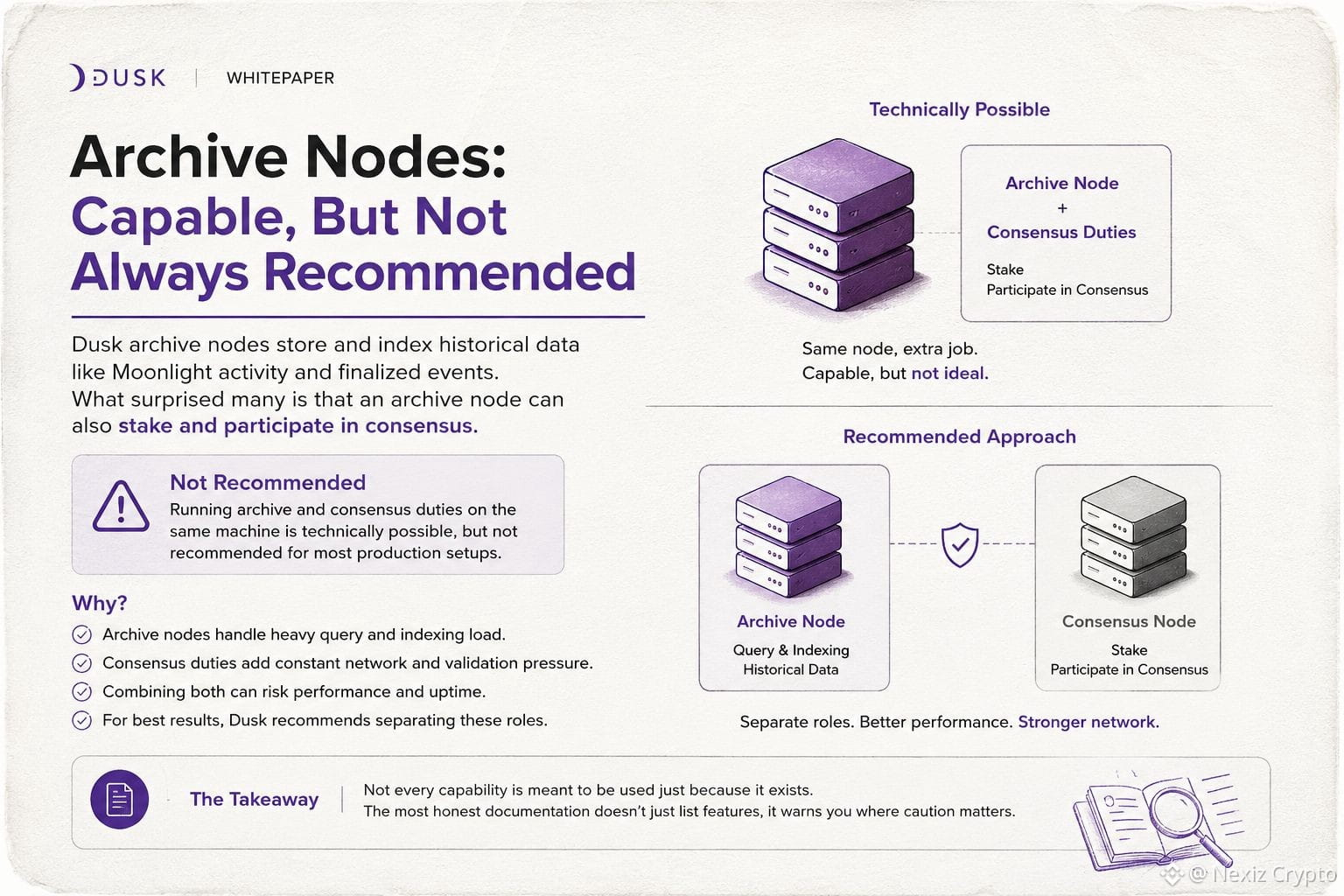
An archive node can also stake and join consensus. Same node, extra job.
Wait, what? I thought archive nodes just sat quietly in the background. I kept reading, expecting more detail. Then I saw the docs also say this isn't really recommended. That confused me for a second. Why mention something you don't actually want people doing?
Then it clicked.
It's not a rule. It's more like a warning label. The node can do both jobs, but doing both at once is asking a lot from one machine. Think of it like a librarian who's also asked to guard the building overnight. Technically possible. Probably exhausting. That small detail changed how I see these nodes. Not every capability is meant to be used just because it exists. Sometimes the most honest thing in documentation isn't the feature. It's the quiet note telling you to be careful with it.
Makes me wonder how many node operators read that line and just... ignored it.
#dusk $DUSK @Dusk_Foundation
{spot}(DUSKUSDT)
I was reading through Dusk's node docs late at night, half paying attention. I almost skipped the archive node section entirely.
I assumed it was boring. Just a storage box for old blocks. Nothing exciting.
Then one line stopped me.
An archive node can also stake and join consensus. Same node, extra job.
Wait, what? I thought archive nodes just sat quietly in the background. I kept reading, expecting more detail. Then I saw the docs also say this isn't really recommended. That confused me for a second. Why mention something you don't actually want people doing?
Then it clicked.
It's not a rule. It's more like a warning label. The node can do both jobs, but doing both at once is asking a lot from one machine. Think of it like a librarian who's also asked to guard the building overnight. Technically possible. Probably exhausting. That small detail changed how I see these nodes. Not every capability is meant to be used just because it exists. Sometimes the most honest thing in documentation isn't the feature. It's the quiet note telling you to be careful with it.
Makes me wonder how many node operators read that line and just... ignored it.
#dusk $DUSK @Dusk
I assumed it was boring. Just a storage box for old blocks. Nothing exciting.
Then one line stopped me.
An archive node can also stake and join consensus. Same node, extra job.
Wait, what? I thought archive nodes just sat quietly in the background. I kept reading, expecting more detail. Then I saw the docs also say this isn't really recommended. That confused me for a second. Why mention something you don't actually want people doing?
Then it clicked.
It's not a rule. It's more like a warning label. The node can do both jobs, but doing both at once is asking a lot from one machine. Think of it like a librarian who's also asked to guard the building overnight. Technically possible. Probably exhausting. That small detail changed how I see these nodes. Not every capability is meant to be used just because it exists. Sometimes the most honest thing in documentation isn't the feature. It's the quiet note telling you to be careful with it.
Makes me wonder how many node operators read that line and just... ignored it.
#dusk $DUSK @Dusk
8
4
87
·
--
Haussier
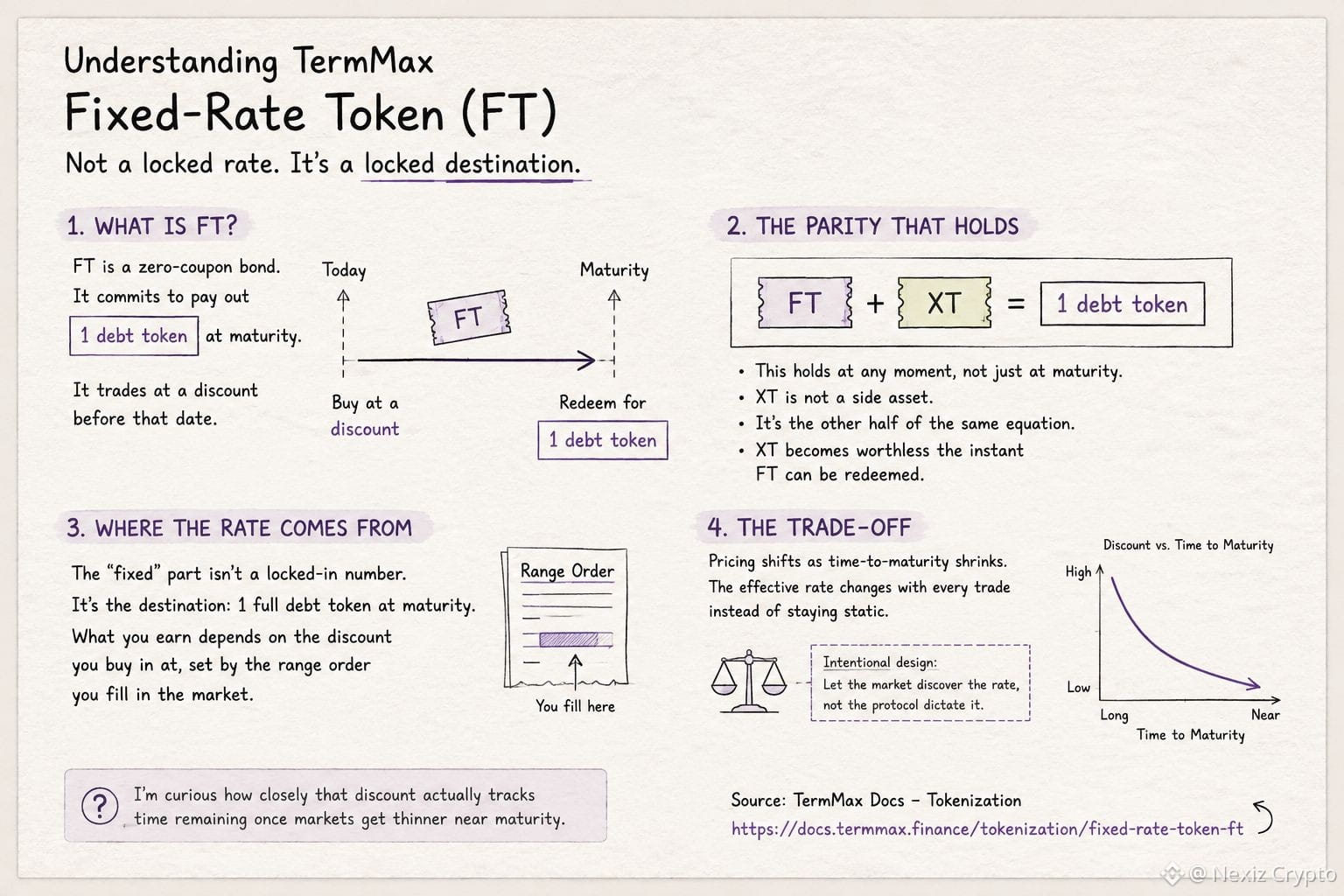
I was reading through TermMax's docs trying to figure out what "Fixed-Rate Token" actually meant, and I assumed the rate itself must be locked by the protocol, set once a market opens. That assumption didn't survive the first page on tokenization.
The docs describe FT as a zero-coupon bond: it commits to pay out 1 debt token at maturity, but it trades at a discount before that date. So the "fixed" part isn't a locked-in number, it's the destination, one full debt token, guaranteed at maturity. What a lender actually earns depends on the discount they buy in at, which is set by whichever range order they end up filling. That's when it clicked. What surprised me was the parity condition running underneath it: 1 FT plus 1 XT equals 1 debt token, holding at any moment, not just at settlement. XT isn't a side asset sitting off to the side, it's the other half of the same equation, and it becomes worthless the instant FT can be redeemed at maturity. The trade-off is that pricing shifts as time-to-maturity shrinks, so the effective rate changes with every trade instead of staying static. That seems intentional, letting the market discover the rate rather than having the protocol dictate it upfront.
I'm curious how closely that discount actually tracks time remaining once markets get thinner near maturity. #termmax @termmax
I was reading through TermMax's docs trying to figure out what "Fixed-Rate Token" actually meant, and I assumed the rate itself must be locked by the protocol, set once a market opens. That assumption didn't survive the first page on tokenization.
The docs describe FT as a zero-coupon bond: it commits to pay out 1 debt token at maturity, but it trades at a discount before that date. So the "fixed" part isn't a locked-in number, it's the destination, one full debt token, guaranteed at maturity. What a lender actually earns depends on the discount they buy in at, which is set by whichever range order they end up filling. That's when it clicked. What surprised me was the parity condition running underneath it: 1 FT plus 1 XT equals 1 debt token, holding at any moment, not just at settlement. XT isn't a side asset sitting off to the side, it's the other half of the same equation, and it becomes worthless the instant FT can be redeemed at maturity. The trade-off is that pricing shifts as time-to-maturity shrinks, so the effective rate changes with every trade instead of staying static. That seems intentional, letting the market discover the rate rather than having the protocol dictate it upfront.
I'm curious how closely that discount actually tracks time remaining once markets get thinner near maturity. #termmax @TermMax
The docs describe FT as a zero-coupon bond: it commits to pay out 1 debt token at maturity, but it trades at a discount before that date. So the "fixed" part isn't a locked-in number, it's the destination, one full debt token, guaranteed at maturity. What a lender actually earns depends on the discount they buy in at, which is set by whichever range order they end up filling. That's when it clicked. What surprised me was the parity condition running underneath it: 1 FT plus 1 XT equals 1 debt token, holding at any moment, not just at settlement. XT isn't a side asset sitting off to the side, it's the other half of the same equation, and it becomes worthless the instant FT can be redeemed at maturity. The trade-off is that pricing shifts as time-to-maturity shrinks, so the effective rate changes with every trade instead of staying static. That seems intentional, letting the market discover the rate rather than having the protocol dictate it upfront.
I'm curious how closely that discount actually tracks time remaining once markets get thinner near maturity. #termmax @TermMax
8
5
109
·
--
Haussier
Partiellement vrai
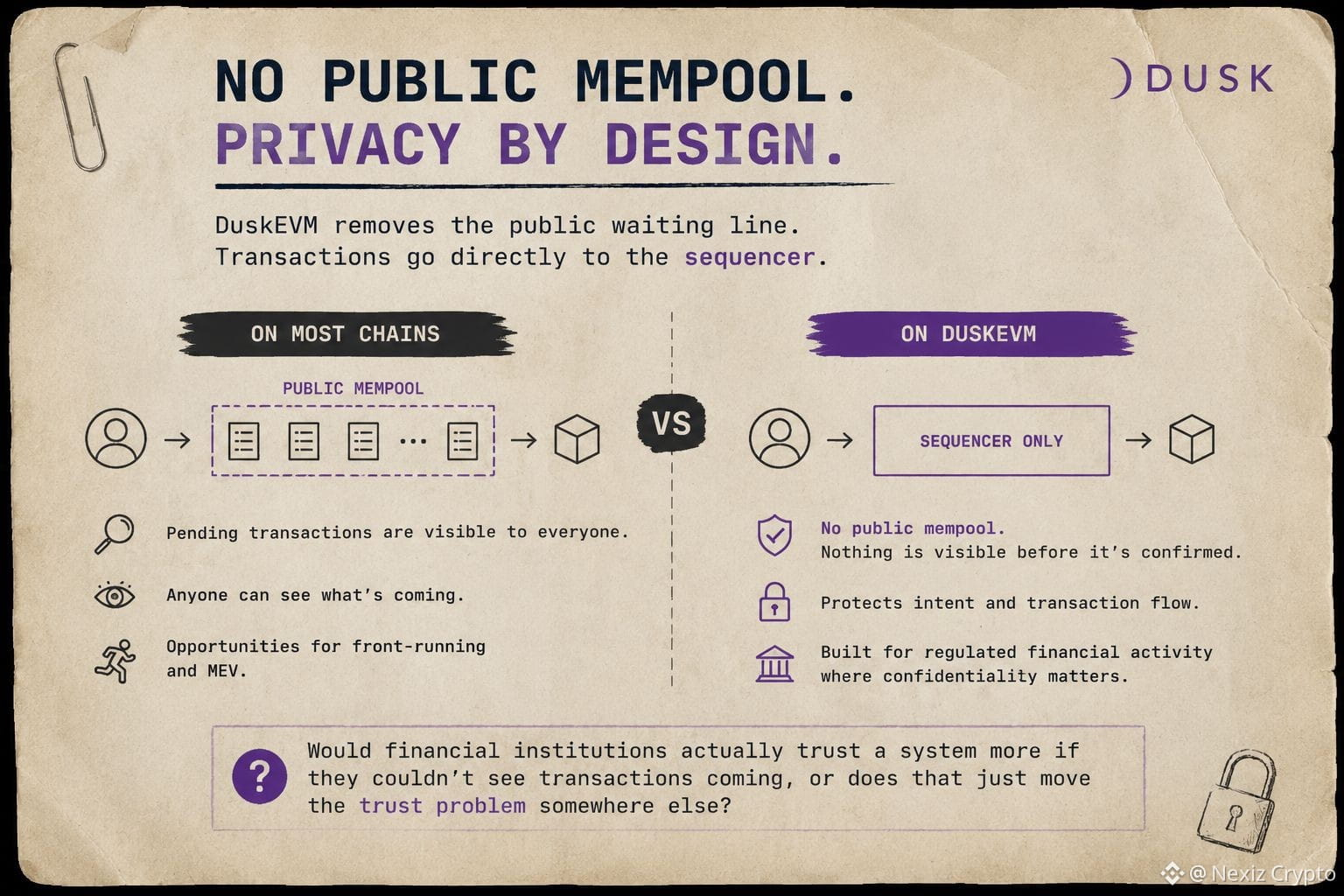
I assumed every blockchain basically worked the same way behind the scenes. Transactions get submitted, they wait in line, everyone can see that line before anything gets confirmed. I never really questioned that. Then I read something in Dusk's documentation that made me stop. DuskEVM doesn't have that visible waiting line at all. Transactions go straight through, with nothing public showing what's about to happen before it happens. That's when it clicked. On most chains, letting everyone see pending transactions is treated as normal, even good, for transparency. But it also means anyone watching closely can see a trade coming and act on it first. For everyday transfers that barely matters. For regulated financial activity, it's a real risk. So this isn't really a technical shortcut. It looks more like a deliberate choice, transparency traded for protection, because financial institutions care less about watching the queue and more about their activity not being exposed before it settles. What I keep coming back to is how this changes what "privacy" even means here. It's not about hiding everything. It's about not broadcasting intent before a transaction is real. Would financial institutions actually trust a system more if they couldn't see transactions coming, or does that just move the trust problem somewhere else? #dusk $DUSK @Dusk_Foundation
{spot}(DUSKUSDT)
I assumed every blockchain basically worked the same way behind the scenes. Transactions get submitted, they wait in line, everyone can see that line before anything gets confirmed. I never really questioned that. Then I read something in Dusk's documentation that made me stop. DuskEVM doesn't have that visible waiting line at all. Transactions go straight through, with nothing public showing what's about to happen before it happens. That's when it clicked. On most chains, letting everyone see pending transactions is treated as normal, even good, for transparency. But it also means anyone watching closely can see a trade coming and act on it first. For everyday transfers that barely matters. For regulated financial activity, it's a real risk. So this isn't really a technical shortcut. It looks more like a deliberate choice, transparency traded for protection, because financial institutions care less about watching the queue and more about their activity not being exposed before it settles. What I keep coming back to is how this changes what "privacy" even means here. It's not about hiding everything. It's about not broadcasting intent before a transaction is real. Would financial institutions actually trust a system more if they couldn't see transactions coming, or does that just move the trust problem somewhere else? #dusk $DUSK @Dusk
5
3
102
·
--
Haussier
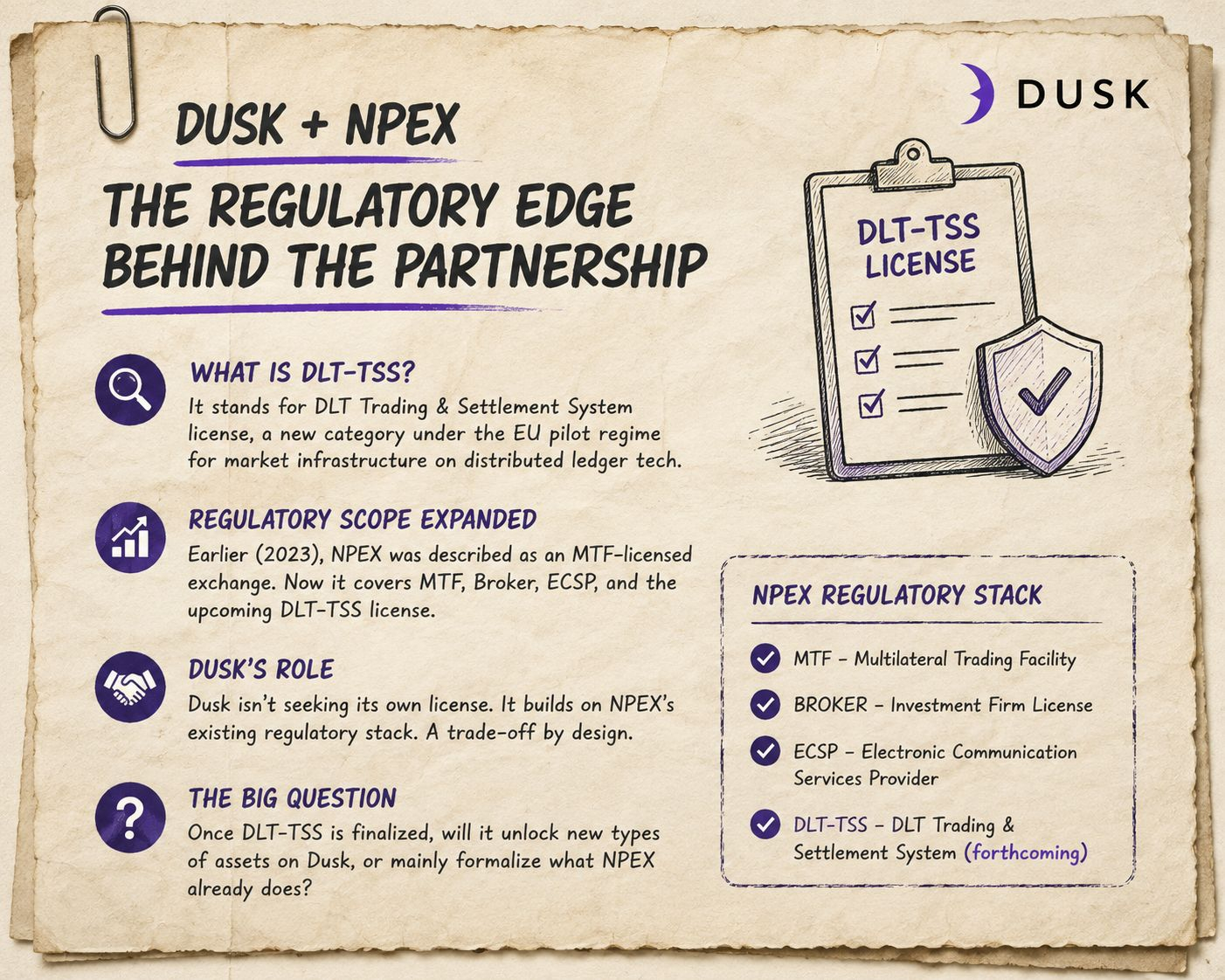
I was reading through Dusk's page on the NPEX partnership, and one detail caught my attention: a mention of a "DLT-TSS" license. I hadn't come across that term in a blockchain context before, so I assumed it was internal Dusk terminology.
After checking the official page, it turned out to be an actual regulatory category, a DLT Trading and Settlement System license, one of the newer designations under EU pilot regime rules for market infrastructure running on distributed ledger tech.
What surprised me was comparing that page against Dusk's earlier NPEX announcement. The original 2023 release described NPEX simply as an MTF-licensed exchange. The more recent "Regulatory Edge" page lists a fuller stack: MTF, Broker, ECSP, and the forthcoming DLT-TSS. That's a noticeable shift in scope between two official materials from the same source, not a contradiction, but a sign the partnership's regulatory coverage expanded over time rather than being fixed from day one.
The cautious read here is that Dusk isn't claiming its own license, it's inheriting NPEX's existing regulatory standing across the stack. That's a trade-off by design: it ties Dusk's compliance story to NPEX's licensing progress instead of a standalone framework.
Which raises a real question: once DLT-TSS is finalized, does that change what kinds of assets can settle on Dusk, or mainly formalize what NPEX already does?
#dusk $DUSK @Dusk_Foundation
I was reading through Dusk's page on the NPEX partnership, and one detail caught my attention: a mention of a "DLT-TSS" license. I hadn't come across that term in a blockchain context before, so I assumed it was internal Dusk terminology.
After checking the official page, it turned out to be an actual regulatory category, a DLT Trading and Settlement System license, one of the newer designations under EU pilot regime rules for market infrastructure running on distributed ledger tech.
What surprised me was comparing that page against Dusk's earlier NPEX announcement. The original 2023 release described NPEX simply as an MTF-licensed exchange. The more recent "Regulatory Edge" page lists a fuller stack: MTF, Broker, ECSP, and the forthcoming DLT-TSS. That's a noticeable shift in scope between two official materials from the same source, not a contradiction, but a sign the partnership's regulatory coverage expanded over time rather than being fixed from day one.
The cautious read here is that Dusk isn't claiming its own license, it's inheriting NPEX's existing regulatory standing across the stack. That's a trade-off by design: it ties Dusk's compliance story to NPEX's licensing progress instead of a standalone framework.
Which raises a real question: once DLT-TSS is finalized, does that change what kinds of assets can settle on Dusk, or mainly formalize what NPEX already does?
#dusk $DUSK @Dusk
After checking the official page, it turned out to be an actual regulatory category, a DLT Trading and Settlement System license, one of the newer designations under EU pilot regime rules for market infrastructure running on distributed ledger tech.
What surprised me was comparing that page against Dusk's earlier NPEX announcement. The original 2023 release described NPEX simply as an MTF-licensed exchange. The more recent "Regulatory Edge" page lists a fuller stack: MTF, Broker, ECSP, and the forthcoming DLT-TSS. That's a noticeable shift in scope between two official materials from the same source, not a contradiction, but a sign the partnership's regulatory coverage expanded over time rather than being fixed from day one.
The cautious read here is that Dusk isn't claiming its own license, it's inheriting NPEX's existing regulatory standing across the stack. That's a trade-off by design: it ties Dusk's compliance story to NPEX's licensing progress instead of a standalone framework.
Which raises a real question: once DLT-TSS is finalized, does that change what kinds of assets can settle on Dusk, or mainly formalize what NPEX already does?
#dusk $DUSK @Dusk
5
2
104
·
--
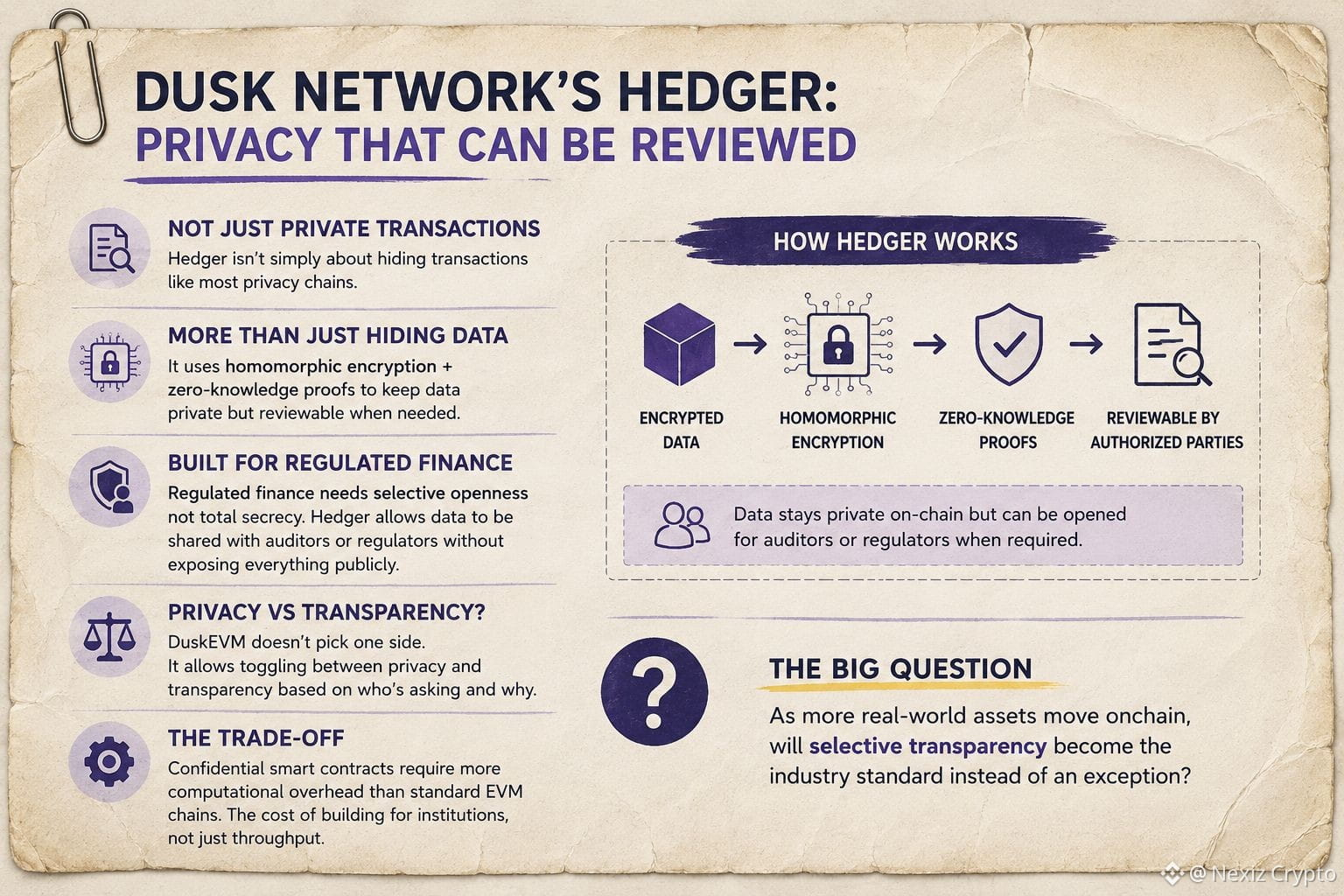
I was reading through some updates on Dusk Network and one detail caught my attention: they're building something called Hedger, described as a privacy module for their upcoming EVM layer.
My first assumption was that this just meant "private transactions," the same pitch most privacy chains make. After checking the official docs, it turned out to be more specific than that. Hedger uses homomorphic encryption alongside zero-knowledge proofs, but the goal isn't just hiding data, it's making that hidden data reviewable when required. That's when it clicked. Regulated finance doesn't actually need total secrecy. It needs privacy that can be selectively opened up for auditors or regulators without exposing everything to the public chain. What surprised me was how this reframes the whole "privacy vs transparency" debate. Instead of picking one, DuskEVM seems built around toggling between them depending on who's asking and why.
There's a trade-off here worth noting. Supporting confidential Solidity-style workflows means more computational overhead than a standard EVM chain, since proofs and encrypted state checks aren't free. That's likely the cost of designing for institutions rather than pure throughput.
Still, it raises a genuine question: as more real-world assets move onchain, will "selective transparency" become the actual industry standard, rather than an edge case?
#dusk $DUSK @Dusk_Foundation
I was reading through some updates on Dusk Network and one detail caught my attention: they're building something called Hedger, described as a privacy module for their upcoming EVM layer.
My first assumption was that this just meant "private transactions," the same pitch most privacy chains make. After checking the official docs, it turned out to be more specific than that. Hedger uses homomorphic encryption alongside zero-knowledge proofs, but the goal isn't just hiding data, it's making that hidden data reviewable when required. That's when it clicked. Regulated finance doesn't actually need total secrecy. It needs privacy that can be selectively opened up for auditors or regulators without exposing everything to the public chain. What surprised me was how this reframes the whole "privacy vs transparency" debate. Instead of picking one, DuskEVM seems built around toggling between them depending on who's asking and why.
There's a trade-off here worth noting. Supporting confidential Solidity-style workflows means more computational overhead than a standard EVM chain, since proofs and encrypted state checks aren't free. That's likely the cost of designing for institutions rather than pure throughput.
Still, it raises a genuine question: as more real-world assets move onchain, will "selective transparency" become the actual industry standard, rather than an edge case?
#dusk $DUSK @Dusk
My first assumption was that this just meant "private transactions," the same pitch most privacy chains make. After checking the official docs, it turned out to be more specific than that. Hedger uses homomorphic encryption alongside zero-knowledge proofs, but the goal isn't just hiding data, it's making that hidden data reviewable when required. That's when it clicked. Regulated finance doesn't actually need total secrecy. It needs privacy that can be selectively opened up for auditors or regulators without exposing everything to the public chain. What surprised me was how this reframes the whole "privacy vs transparency" debate. Instead of picking one, DuskEVM seems built around toggling between them depending on who's asking and why.
There's a trade-off here worth noting. Supporting confidential Solidity-style workflows means more computational overhead than a standard EVM chain, since proofs and encrypted state checks aren't free. That's likely the cost of designing for institutions rather than pure throughput.
Still, it raises a genuine question: as more real-world assets move onchain, will "selective transparency" become the actual industry standard, rather than an edge case?
#dusk $DUSK @Dusk
1
82
·
--
Haussier
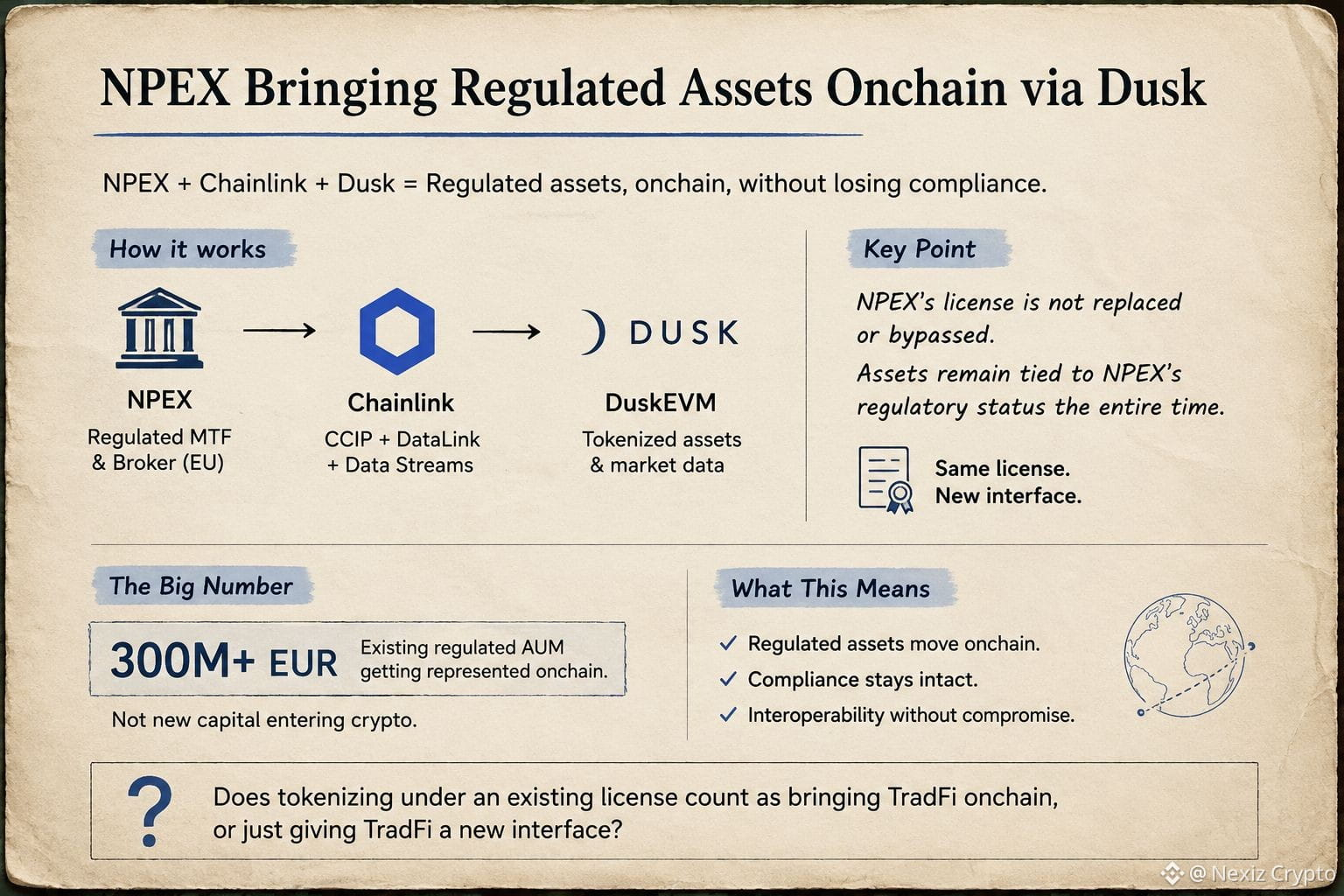
I assumed NPEX was bringing assets onto Dusk through a straightforward token migration.
It isn't that.
NPEX is already a regulated Dutch exchange, licensed as an MTF and broker.
What's actually happening: Chainlink CCIP becomes the interoperability layer for assets NPEX issues on DuskEVM. DataLink brings exchange data onchain. Data Streams handles market feeds.
Nowhere in this does NPEX's license get replaced or bypassed.
The assets stay tied to NPEX's existing regulatory status the entire time. Chainlink's role is just letting that regulated data move across chains without breaking compliance.
One detail stood out. The often-cited 300M+ EUR isn't new capital entering crypto. It's existing regulated AUM getting represented onchain, still governed by the same license it always had.
Does tokenizing under an existing license count as bringing TradFi onchain, or just giving TradFi a new interface? #dusk $DUSK @Dusk_Foundation
I assumed NPEX was bringing assets onto Dusk through a straightforward token migration.
It isn't that.
NPEX is already a regulated Dutch exchange, licensed as an MTF and broker.
What's actually happening: Chainlink CCIP becomes the interoperability layer for assets NPEX issues on DuskEVM. DataLink brings exchange data onchain. Data Streams handles market feeds.
Nowhere in this does NPEX's license get replaced or bypassed.
The assets stay tied to NPEX's existing regulatory status the entire time. Chainlink's role is just letting that regulated data move across chains without breaking compliance.
One detail stood out. The often-cited 300M+ EUR isn't new capital entering crypto. It's existing regulated AUM getting represented onchain, still governed by the same license it always had.
Does tokenizing under an existing license count as bringing TradFi onchain, or just giving TradFi a new interface? #dusk $DUSK @Dusk
It isn't that.
NPEX is already a regulated Dutch exchange, licensed as an MTF and broker.
What's actually happening: Chainlink CCIP becomes the interoperability layer for assets NPEX issues on DuskEVM. DataLink brings exchange data onchain. Data Streams handles market feeds.
Nowhere in this does NPEX's license get replaced or bypassed.
The assets stay tied to NPEX's existing regulatory status the entire time. Chainlink's role is just letting that regulated data move across chains without breaking compliance.
One detail stood out. The often-cited 300M+ EUR isn't new capital entering crypto. It's existing regulated AUM getting represented onchain, still governed by the same license it always had.
Does tokenizing under an existing license count as bringing TradFi onchain, or just giving TradFi a new interface? #dusk $DUSK @Dusk
2
4
95
·
--
Haussier
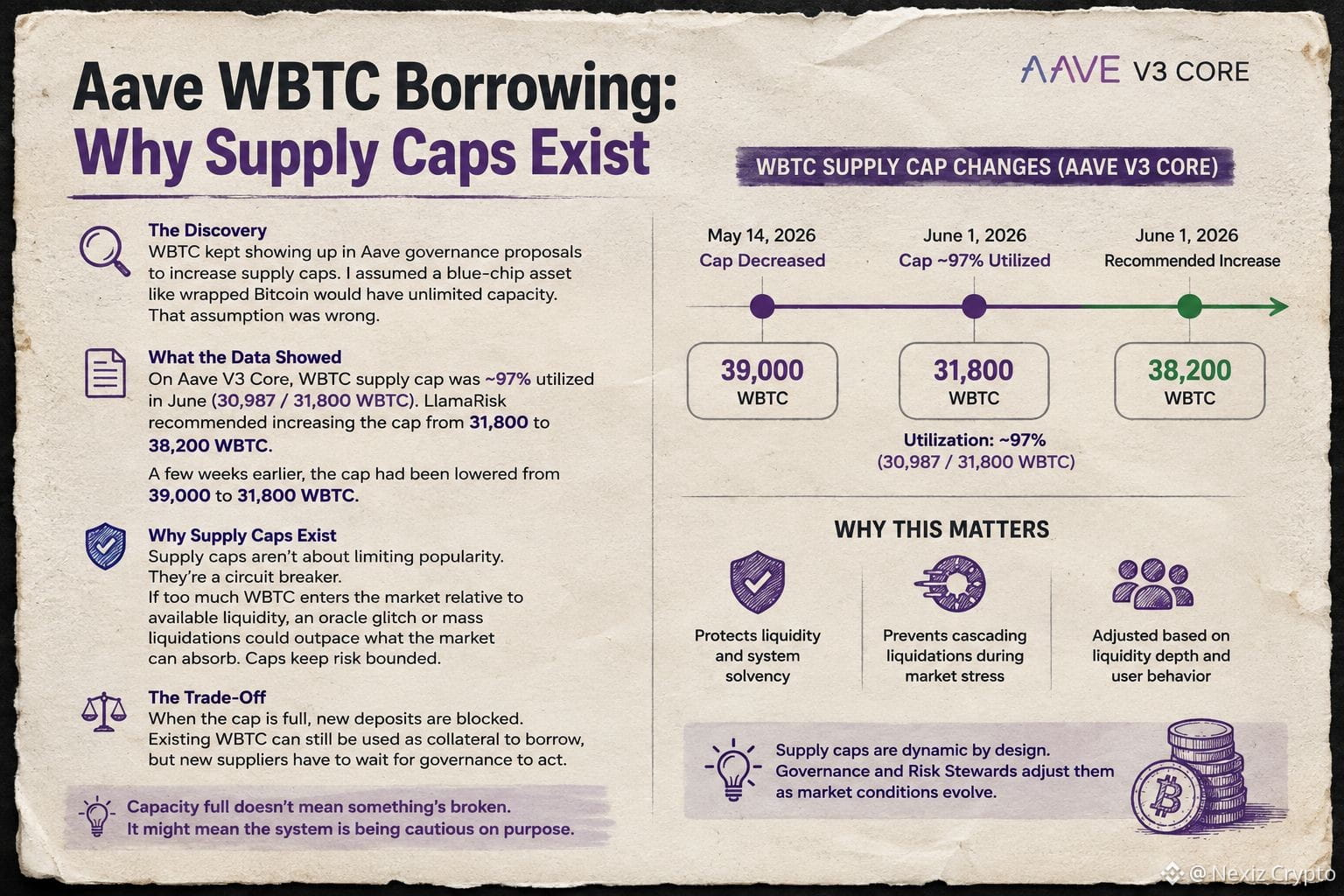
I was reading through Aave's governance forum and noticed something odd: WBTC kept showing up in "supply cap increase" proposals, month after month. I assumed a blue-chip asset like wrapped Bitcoin would just have unlimited room to be deposited and borrowed against.
That assumption didn't hold up.
After checking Aave's actual Risk Steward posts, I found the WBTC supply cap on Aave V3 Core sitting at roughly 97% utilization back in June, prompting LlamaRisk to recommend raising it from 31,800 to 38,200 WBTC. A few weeks earlier, the same cap had been lowered from 39,000 to 31,800.
What surprised me was the back-and-forth. It's not a static number set once and forgotten, it's adjusted almost continuously based on liquidity depth and observed user behavior. That's when it clicked: supply caps aren't there to limit popularity, they're a circuit breaker. If too much WBTC piles up relative to available on-chain liquidity, an oracle glitch or a rush of liquidations could outpace what the market can actually absorb.
Capping supply keeps that risk bounded even when demand is strong. The trade-off is real, though. When the cap fills up, WBTC holders wanting to borrow against their collateral just have to wait for governance to act.
Makes me wonder how many people assume "capacity full" means something's wrong, when it might just mean the system is being cautious on purpose.
#baby $BABY @babylonlabs_io
I was reading through Aave's governance forum and noticed something odd: WBTC kept showing up in "supply cap increase" proposals, month after month. I assumed a blue-chip asset like wrapped Bitcoin would just have unlimited room to be deposited and borrowed against.
That assumption didn't hold up.
After checking Aave's actual Risk Steward posts, I found the WBTC supply cap on Aave V3 Core sitting at roughly 97% utilization back in June, prompting LlamaRisk to recommend raising it from 31,800 to 38,200 WBTC. A few weeks earlier, the same cap had been lowered from 39,000 to 31,800.
What surprised me was the back-and-forth. It's not a static number set once and forgotten, it's adjusted almost continuously based on liquidity depth and observed user behavior. That's when it clicked: supply caps aren't there to limit popularity, they're a circuit breaker. If too much WBTC piles up relative to available on-chain liquidity, an oracle glitch or a rush of liquidations could outpace what the market can actually absorb.
Capping supply keeps that risk bounded even when demand is strong. The trade-off is real, though. When the cap fills up, WBTC holders wanting to borrow against their collateral just have to wait for governance to act.
Makes me wonder how many people assume "capacity full" means something's wrong, when it might just mean the system is being cautious on purpose.
#baby $BABY @BabylonLabs_io
That assumption didn't hold up.
After checking Aave's actual Risk Steward posts, I found the WBTC supply cap on Aave V3 Core sitting at roughly 97% utilization back in June, prompting LlamaRisk to recommend raising it from 31,800 to 38,200 WBTC. A few weeks earlier, the same cap had been lowered from 39,000 to 31,800.
What surprised me was the back-and-forth. It's not a static number set once and forgotten, it's adjusted almost continuously based on liquidity depth and observed user behavior. That's when it clicked: supply caps aren't there to limit popularity, they're a circuit breaker. If too much WBTC piles up relative to available on-chain liquidity, an oracle glitch or a rush of liquidations could outpace what the market can actually absorb.
Capping supply keeps that risk bounded even when demand is strong. The trade-off is real, though. When the cap fills up, WBTC holders wanting to borrow against their collateral just have to wait for governance to act.
Makes me wonder how many people assume "capacity full" means something's wrong, when it might just mean the system is being cautious on purpose.
#baby $BABY @BabylonLabs_io
2
3
110
Connectez-vous pour découvrir plus de contenu
Rejoignez la communauté mondiale des adeptes de cryptomonnaies sur Binance Square
⚡️ Suviez les dernières informations importantes sur les cryptomonnaies.
💬 Jugé digne de confiance par la plus grande plateforme d’échange de cryptomonnaies au monde.
👍 Découvrez les connaissances que partagent les créateurs vérifiés.
Adresse e-mail/Nº de téléphone