

Asif The Trader
441 Publications

Asif The Trader
Signaler
Bloquer l’utilisateur
The Ultimate Trader
Ouvert au trading
Trade fréquemment
1.3 an(s)
538 Suivis
152 Abonnés
449 J’aime
Publications
Portefeuille
Tous
Citations
Vérifié
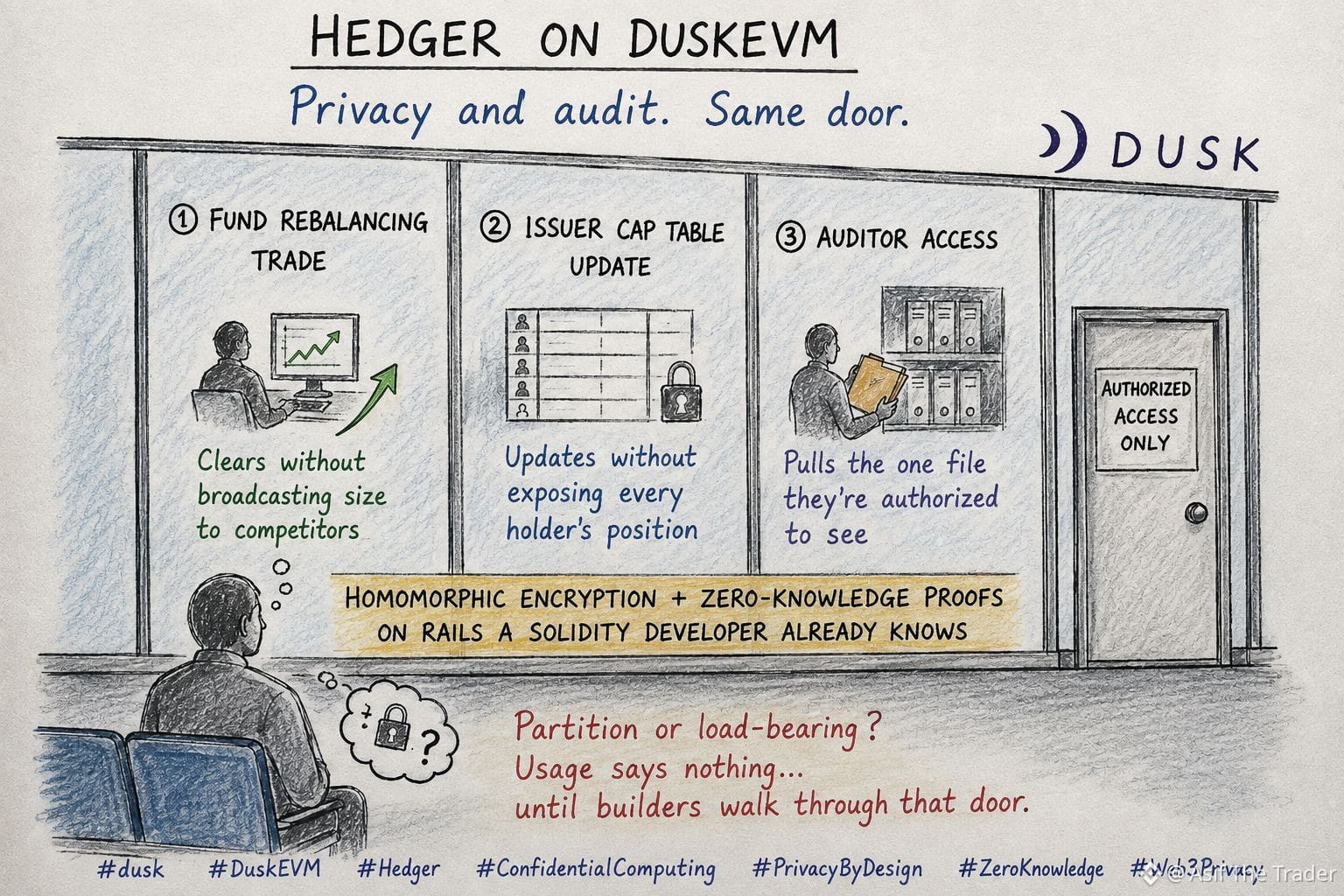
There's a frosted glass partition at my accountant's office. From the waiting room you can see shapes moving, hear murmurs through the wall - but nothing readable. Only the person behind the desk, holding the right file, ever gets to see the actual numbers.
I kept thinking about that partition while reading how Hedger works on @Dusk_Foundation DuskEVM. Most people hear "confidential smart contracts" and picture something sealed shut entirely - a vault nobody gets into, not even the people who'd need to.
That's the part that sat with me longer than I expected. Hedger isn't one wall, it's the partition doing three jobs at once: a fund's rebalancing trade clears without broadcasting its size to competitors, an issuer's cap table updates without exposing every holder's position, an auditor pulls the one file they're authorized to see without touching the rest. Homomorphic encryption plus zero-knowledge proofs, running on rails a Solidity developer already knows. Privacy and audit aren't fighting each other here. They're routed through the same door.
What's easy to skip past is how early this still is. DuskEVM mainnet is arriving, Hedger is the pitch - but a pitch isn't the same as volume. Nobody's published how many contracts are actually live through it yet, or whether any regulated desk has routed real flow through the confidential path versus just testing it in a sandbox. "Reviewable privacy" is a strong claim to make before anyone's reviewed anything.
So is the partition actually load-bearing, or is it just glass hung on a frame, waiting for someone on the other side to show up? $DUSK usage says nothing until builders actually walk through that door. Not yet.
#dusk
{spot}(AAVEUSDT)
{spot}(BTCUSDT)
There's a frosted glass partition at my accountant's office. From the waiting room you can see shapes moving, hear murmurs through the wall - but nothing readable. Only the person behind the desk, holding the right file, ever gets to see the actual numbers.
I kept thinking about that partition while reading how Hedger works on @Dusk DuskEVM. Most people hear "confidential smart contracts" and picture something sealed shut entirely - a vault nobody gets into, not even the people who'd need to.
That's the part that sat with me longer than I expected. Hedger isn't one wall, it's the partition doing three jobs at once: a fund's rebalancing trade clears without broadcasting its size to competitors, an issuer's cap table updates without exposing every holder's position, an auditor pulls the one file they're authorized to see without touching the rest. Homomorphic encryption plus zero-knowledge proofs, running on rails a Solidity developer already knows. Privacy and audit aren't fighting each other here. They're routed through the same door.
What's easy to skip past is how early this still is. DuskEVM mainnet is arriving, Hedger is the pitch - but a pitch isn't the same as volume. Nobody's published how many contracts are actually live through it yet, or whether any regulated desk has routed real flow through the confidential path versus just testing it in a sandbox. "Reviewable privacy" is a strong claim to make before anyone's reviewed anything.
So is the partition actually load-bearing, or is it just glass hung on a frame, waiting for someone on the other side to show up? $DUSK usage says nothing until builders actually walk through that door. Not yet.
#dusk
I kept thinking about that partition while reading how Hedger works on @Dusk DuskEVM. Most people hear "confidential smart contracts" and picture something sealed shut entirely - a vault nobody gets into, not even the people who'd need to.
That's the part that sat with me longer than I expected. Hedger isn't one wall, it's the partition doing three jobs at once: a fund's rebalancing trade clears without broadcasting its size to competitors, an issuer's cap table updates without exposing every holder's position, an auditor pulls the one file they're authorized to see without touching the rest. Homomorphic encryption plus zero-knowledge proofs, running on rails a Solidity developer already knows. Privacy and audit aren't fighting each other here. They're routed through the same door.
What's easy to skip past is how early this still is. DuskEVM mainnet is arriving, Hedger is the pitch - but a pitch isn't the same as volume. Nobody's published how many contracts are actually live through it yet, or whether any regulated desk has routed real flow through the confidential path versus just testing it in a sandbox. "Reviewable privacy" is a strong claim to make before anyone's reviewed anything.
So is the partition actually load-bearing, or is it just glass hung on a frame, waiting for someone on the other side to show up? $DUSK usage says nothing until builders actually walk through that door. Not yet.
#dusk
116
Partiellement vrai
#dusk $DUSK @Dusk_Foundation
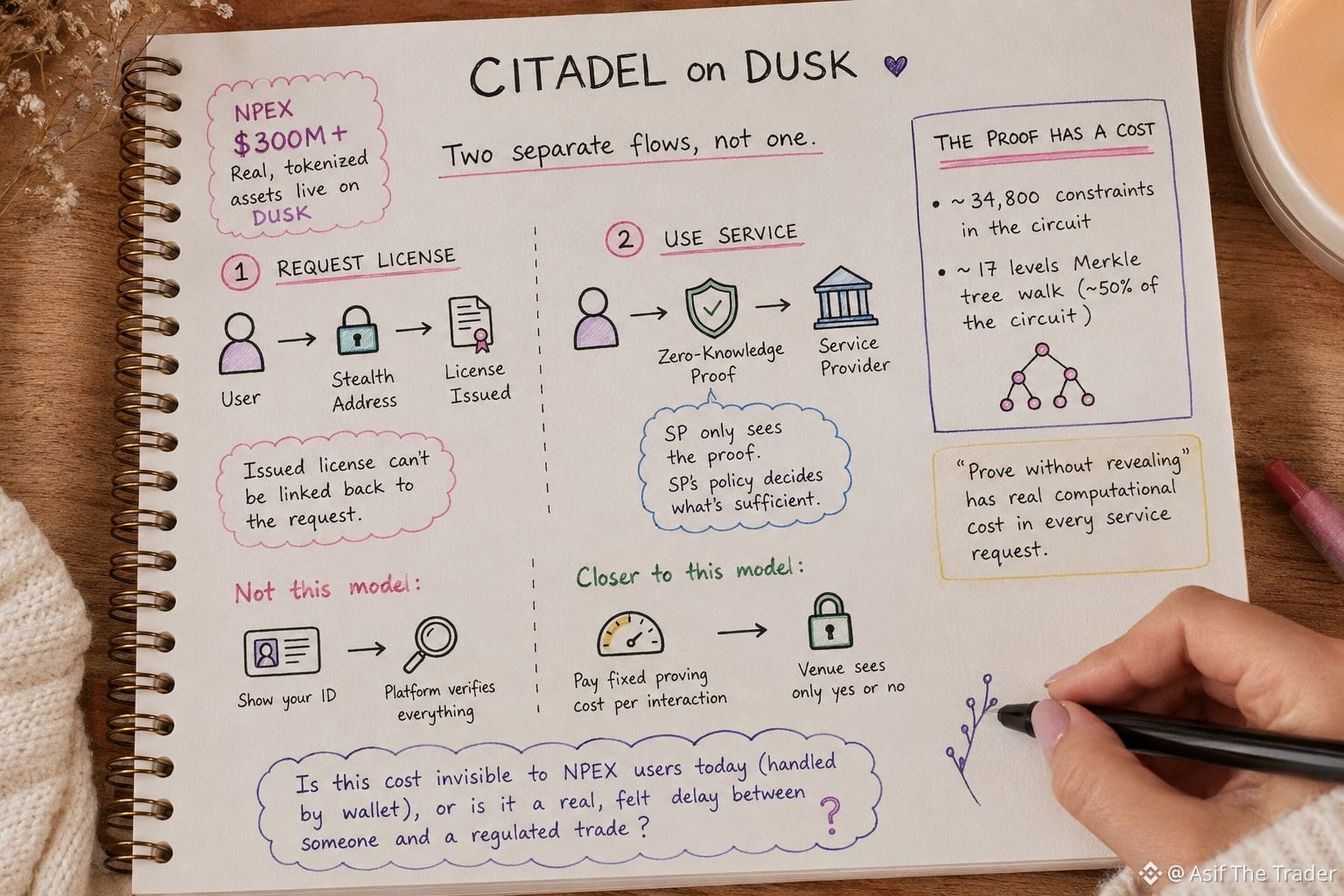
I went back into Citadel's docs after noticing NPEX already has $300M+ of real, tokenized assets live on Dusk. That's not a testnet example anymore, so it made me want to check whether the privacy claim actually holds up under a real regulated venue, not just a whitepaper diagram.
Turns out the protocol is really two separate flows, not one.
First, a user requests a license from a License Provider, using a stealth address, so the issued license can't be linked back to the request.
Second, when the user wants to use a service, they don't resend the license. They send a zero-knowledge proof that they hold a valid one. The Service Provider only ever sees that proof, and it's the SP's own policy that decides what counts as sufficient.
Here's the part that made me pause. That proof isn't free. Citadel's own circuit for proving license ownership runs at roughly 34,800 constraints, and about half of that is just walking a Merkle tree 17 levels deep to confirm the license is actually registered.
So "prove without revealing" has a real computational cost baked into every single service request, not just a design principle on a slide.
That's a different model from "show your ID, let the platform verify everything."
It's closer to: pay a fixed proving cost once per interaction, in exchange for the venue never seeing anything but a yes or no.
What I still can't tell is whether that cost is invisible to an actual NPEX user today, wallet handles it in the background, or whether it's a real, felt delay standing between someone and a regulated trade.
{spot}(MORPHOUSDT)
{spot}(BNBUSDT)
{spot}(AAVEUSDT)
#dusk $DUSK @Dusk
I went back into Citadel's docs after noticing NPEX already has $300M+ of real, tokenized assets live on Dusk. That's not a testnet example anymore, so it made me want to check whether the privacy claim actually holds up under a real regulated venue, not just a whitepaper diagram.
Turns out the protocol is really two separate flows, not one.
First, a user requests a license from a License Provider, using a stealth address, so the issued license can't be linked back to the request.
Second, when the user wants to use a service, they don't resend the license. They send a zero-knowledge proof that they hold a valid one. The Service Provider only ever sees that proof, and it's the SP's own policy that decides what counts as sufficient.
Here's the part that made me pause. That proof isn't free. Citadel's own circuit for proving license ownership runs at roughly 34,800 constraints, and about half of that is just walking a Merkle tree 17 levels deep to confirm the license is actually registered.
So "prove without revealing" has a real computational cost baked into every single service request, not just a design principle on a slide.
That's a different model from "show your ID, let the platform verify everything."
It's closer to: pay a fixed proving cost once per interaction, in exchange for the venue never seeing anything but a yes or no.
What I still can't tell is whether that cost is invisible to an actual NPEX user today, wallet handles it in the background, or whether it's a real, felt delay standing between someone and a regulated trade.
I went back into Citadel's docs after noticing NPEX already has $300M+ of real, tokenized assets live on Dusk. That's not a testnet example anymore, so it made me want to check whether the privacy claim actually holds up under a real regulated venue, not just a whitepaper diagram.
Turns out the protocol is really two separate flows, not one.
First, a user requests a license from a License Provider, using a stealth address, so the issued license can't be linked back to the request.
Second, when the user wants to use a service, they don't resend the license. They send a zero-knowledge proof that they hold a valid one. The Service Provider only ever sees that proof, and it's the SP's own policy that decides what counts as sufficient.
Here's the part that made me pause. That proof isn't free. Citadel's own circuit for proving license ownership runs at roughly 34,800 constraints, and about half of that is just walking a Merkle tree 17 levels deep to confirm the license is actually registered.
So "prove without revealing" has a real computational cost baked into every single service request, not just a design principle on a slide.
That's a different model from "show your ID, let the platform verify everything."
It's closer to: pay a fixed proving cost once per interaction, in exchange for the venue never seeing anything but a yes or no.
What I still can't tell is whether that cost is invisible to an actual NPEX user today, wallet handles it in the background, or whether it's a real, felt delay standing between someone and a regulated trade.
2
2
188
@Dusk_Foundation #dusk $DUSK
The Aug 16 bridge incident made me look at Dusk differently.
Not because of the blocklist.
Because it made me wonder:
After an onchain action is approved, who actually needs to see the data behind it?
For regulated finance, you may need to prove:
eligibility.
ownership.
transfer conditions.
My first assumption was simple:
if something has to be verified, more of the underlying data probably has to be visible.
Then I went back into the Dusk docs and the actual citadel paper.
Citadel's proof of ownership does not put personal data onchain. The user proves inside a circuit that they hold a validly signed credential; the verifier only learns that the statement is true.
The number that stuck with me: verifying that proof takes 0.007 seconds. Generating it takes around 16 seconds on a laptop-grade chip. The expensive part proving happens once, offline, on the user's side. The part a verifier actually does, at the moment someone needs access, is near-instant and reveals nothing beyond "valid."
That split matters for regulated assets.
An institution needs to confirm eligibility. It doesn't need the applicant's full KYC file to do that it needs a proof that resolves to true or false, and Citadel lets the service provider define exactly which attributes that proof has to cover.
So the interesting question isn't " is the blockchain private? "
It's: of everything sitting in a typical KYC payload, how much of it actually needs to touch a verifier once the proof not the data is the thing being checked ?
{spot}(AAVEUSDT)
{spot}(MORPHOUSDT)
For regulated onchain finance, what matters more?
@Dusk #dusk $DUSK
The Aug 16 bridge incident made me look at Dusk differently.
Not because of the blocklist.
Because it made me wonder:
After an onchain action is approved, who actually needs to see the data behind it?
For regulated finance, you may need to prove:
eligibility.
ownership.
transfer conditions.
My first assumption was simple:
if something has to be verified, more of the underlying data probably has to be visible.
Then I went back into the Dusk docs and the actual citadel paper.
Citadel's proof of ownership does not put personal data onchain. The user proves inside a circuit that they hold a validly signed credential; the verifier only learns that the statement is true.
The number that stuck with me: verifying that proof takes 0.007 seconds. Generating it takes around 16 seconds on a laptop-grade chip. The expensive part proving happens once, offline, on the user's side. The part a verifier actually does, at the moment someone needs access, is near-instant and reveals nothing beyond "valid."
That split matters for regulated assets.
An institution needs to confirm eligibility. It doesn't need the applicant's full KYC file to do that it needs a proof that resolves to true or false, and Citadel lets the service provider define exactly which attributes that proof has to cover.
So the interesting question isn't " is the blockchain private? "
It's: of everything sitting in a typical KYC payload, how much of it actually needs to touch a verifier once the proof not the data is the thing being checked ?
For regulated onchain finance, what matters more?
The Aug 16 bridge incident made me look at Dusk differently.
Not because of the blocklist.
Because it made me wonder:
After an onchain action is approved, who actually needs to see the data behind it?
For regulated finance, you may need to prove:
eligibility.
ownership.
transfer conditions.
My first assumption was simple:
if something has to be verified, more of the underlying data probably has to be visible.
Then I went back into the Dusk docs and the actual citadel paper.
Citadel's proof of ownership does not put personal data onchain. The user proves inside a circuit that they hold a validly signed credential; the verifier only learns that the statement is true.
The number that stuck with me: verifying that proof takes 0.007 seconds. Generating it takes around 16 seconds on a laptop-grade chip. The expensive part proving happens once, offline, on the user's side. The part a verifier actually does, at the moment someone needs access, is near-instant and reveals nothing beyond "valid."
That split matters for regulated assets.
An institution needs to confirm eligibility. It doesn't need the applicant's full KYC file to do that it needs a proof that resolves to true or false, and Citadel lets the service provider define exactly which attributes that proof has to cover.
So the interesting question isn't " is the blockchain private? "
It's: of everything sitting in a typical KYC payload, how much of it actually needs to touch a verifier once the proof not the data is the thing being checked ?
For regulated onchain finance, what matters more?
Prove without revealing data
0%
Verify it by seeing the data
100%
1 Votes • Vote fermé
2
1
78
·
--
Baissier
#dusk $DUSK @Dusk_Foundation
I used to think that putting a financial asset onchain automatically meant making the whole financial process better.
Then I tried looking at it from the perspective of a bank or investment fund.
Imagine putting a bond or fund onchain.
It sounds like the problem is solved.
But then I started wondering:
What if the token is onchain, but the financial process around it still isn't?
The institution still has to decide who can own it, how it can be traded, how payments move, and how settlement remains compliant.
That made me rethink what “tokenization” actually means.
Is tokenizing the asset enough, or should the financial lifecycle move with it too?
That question is what drew me toward Dusk.
What interested me about Dusk Trade was seeing the problem approached from the workflow side, not just the token side.
Dusk is working toward bringing assets such as MMFs, ETFs, bonds and other RWAs into an onchain environment.
The way I now think about tokenization is:
ownership → eligibility → trading → payment → settlement
Maybe the real question isn't:
“How many assets can we put onchain?”
Maybe it's:
“How much of the financial process can actually work there?”
Because if only the representation moves onchain, can we really say the market moved with it?
That distinction is what makes Dusk interesting to me.
{spot}(DUSKUSDT)
What matters most when bringing real-world assets onchain?
#dusk $DUSK @Dusk
I used to think that putting a financial asset onchain automatically meant making the whole financial process better.
Then I tried looking at it from the perspective of a bank or investment fund.
Imagine putting a bond or fund onchain.
It sounds like the problem is solved.
But then I started wondering:
What if the token is onchain, but the financial process around it still isn't?
The institution still has to decide who can own it, how it can be traded, how payments move, and how settlement remains compliant.
That made me rethink what “tokenization” actually means.
Is tokenizing the asset enough, or should the financial lifecycle move with it too?
That question is what drew me toward Dusk.
What interested me about Dusk Trade was seeing the problem approached from the workflow side, not just the token side.
Dusk is working toward bringing assets such as MMFs, ETFs, bonds and other RWAs into an onchain environment.
The way I now think about tokenization is:
ownership → eligibility → trading → payment → settlement
Maybe the real question isn't:
“How many assets can we put onchain?”
Maybe it's:
“How much of the financial process can actually work there?”
Because if only the representation moves onchain, can we really say the market moved with it?
That distinction is what makes Dusk interesting to me.
What matters most when bringing real-world assets onchain?
I used to think that putting a financial asset onchain automatically meant making the whole financial process better.
Then I tried looking at it from the perspective of a bank or investment fund.
Imagine putting a bond or fund onchain.
It sounds like the problem is solved.
But then I started wondering:
What if the token is onchain, but the financial process around it still isn't?
The institution still has to decide who can own it, how it can be traded, how payments move, and how settlement remains compliant.
That made me rethink what “tokenization” actually means.
Is tokenizing the asset enough, or should the financial lifecycle move with it too?
That question is what drew me toward Dusk.
What interested me about Dusk Trade was seeing the problem approached from the workflow side, not just the token side.
Dusk is working toward bringing assets such as MMFs, ETFs, bonds and other RWAs into an onchain environment.
The way I now think about tokenization is:
ownership → eligibility → trading → payment → settlement
Maybe the real question isn't:
“How many assets can we put onchain?”
Maybe it's:
“How much of the financial process can actually work there?”
Because if only the representation moves onchain, can we really say the market moved with it?
That distinction is what makes Dusk interesting to me.
What matters most when bringing real-world assets onchain?
Tokenizing the asset
0%
Ownership & eligibility
25%
Trading + settlement
0%
The full financial lifecycle
75%
4 Votes • Vote fermé
9
5
77
·
--
Haussier
Vérifié
300M+ EUR of assets planned to come onchain through Dusk.
That number made me rethink what “tokenization” actually means.
I used to think the interesting part of putting a bond or fund onchain was the token.
Then I realized the token might be the least interesting part.
An onchain token doesn't necessarily mean an onchain financial lifecycle.
The asset can be onchain while eligibility, compliance, transfer restrictions, disclosure, or even settlement still depend on systems elsewhere.
So what did tokenization actually move onchain?
That's why @Dusk_Foundation native issuance direction caught my attention: it looks beyond creating a token and toward the broader lifecycle—issuance, eligibility, transfers, disclosure, and settlement.
And privacy makes that lifecycle harder.
Regulated markets don't need everything public or everything hidden. They need controlled visibility.
Some information stays private.
Some can be proven.
Some can be disclosed when authorized.
So the question becomes:
Can privacy, verification, and disclosure become part of the financial application's rules themselves?
If more of the lifecycle can actually live onchain, maybe the harder bottleneck isn't the blockchain anymore.
Maybe it's the legal and institutional infrastructure surrounding the asset.
That's when native issuance starts looking less like tokenization and more like rebuilding part of the financial lifecycle itself.
@Dusk_Foundation $DUSK #dusk
{spot}(BTCUSDT)
{spot}(BNBUSDT)
{spot}(DUSKUSDT)
What matters most for real-world asset tokenization?
300M+ EUR of assets planned to come onchain through Dusk.
That number made me rethink what “tokenization” actually means.
I used to think the interesting part of putting a bond or fund onchain was the token.
Then I realized the token might be the least interesting part.
An onchain token doesn't necessarily mean an onchain financial lifecycle.
The asset can be onchain while eligibility, compliance, transfer restrictions, disclosure, or even settlement still depend on systems elsewhere.
So what did tokenization actually move onchain?
That's why @Dusk native issuance direction caught my attention: it looks beyond creating a token and toward the broader lifecycle—issuance, eligibility, transfers, disclosure, and settlement.
And privacy makes that lifecycle harder.
Regulated markets don't need everything public or everything hidden. They need controlled visibility.
Some information stays private.
Some can be proven.
Some can be disclosed when authorized.
So the question becomes:
Can privacy, verification, and disclosure become part of the financial application's rules themselves?
If more of the lifecycle can actually live onchain, maybe the harder bottleneck isn't the blockchain anymore.
Maybe it's the legal and institutional infrastructure surrounding the asset.
That's when native issuance starts looking less like tokenization and more like rebuilding part of the financial lifecycle itself.
@Dusk $DUSK #dusk
What matters most for real-world asset tokenization?
That number made me rethink what “tokenization” actually means.
I used to think the interesting part of putting a bond or fund onchain was the token.
Then I realized the token might be the least interesting part.
An onchain token doesn't necessarily mean an onchain financial lifecycle.
The asset can be onchain while eligibility, compliance, transfer restrictions, disclosure, or even settlement still depend on systems elsewhere.
So what did tokenization actually move onchain?
That's why @Dusk native issuance direction caught my attention: it looks beyond creating a token and toward the broader lifecycle—issuance, eligibility, transfers, disclosure, and settlement.
And privacy makes that lifecycle harder.
Regulated markets don't need everything public or everything hidden. They need controlled visibility.
Some information stays private.
Some can be proven.
Some can be disclosed when authorized.
So the question becomes:
Can privacy, verification, and disclosure become part of the financial application's rules themselves?
If more of the lifecycle can actually live onchain, maybe the harder bottleneck isn't the blockchain anymore.
Maybe it's the legal and institutional infrastructure surrounding the asset.
That's when native issuance starts looking less like tokenization and more like rebuilding part of the financial lifecycle itself.
@Dusk $DUSK #dusk
What matters most for real-world asset tokenization?
🔹 Token issuance
29%
🔹 Onchain compliance
43%
🔹 Privacy + verification
14%
🔹 Full lifecycle onchain
14%
7 Votes • Vote fermé
14
8
577
superb
superb

Tasifch786
·
--
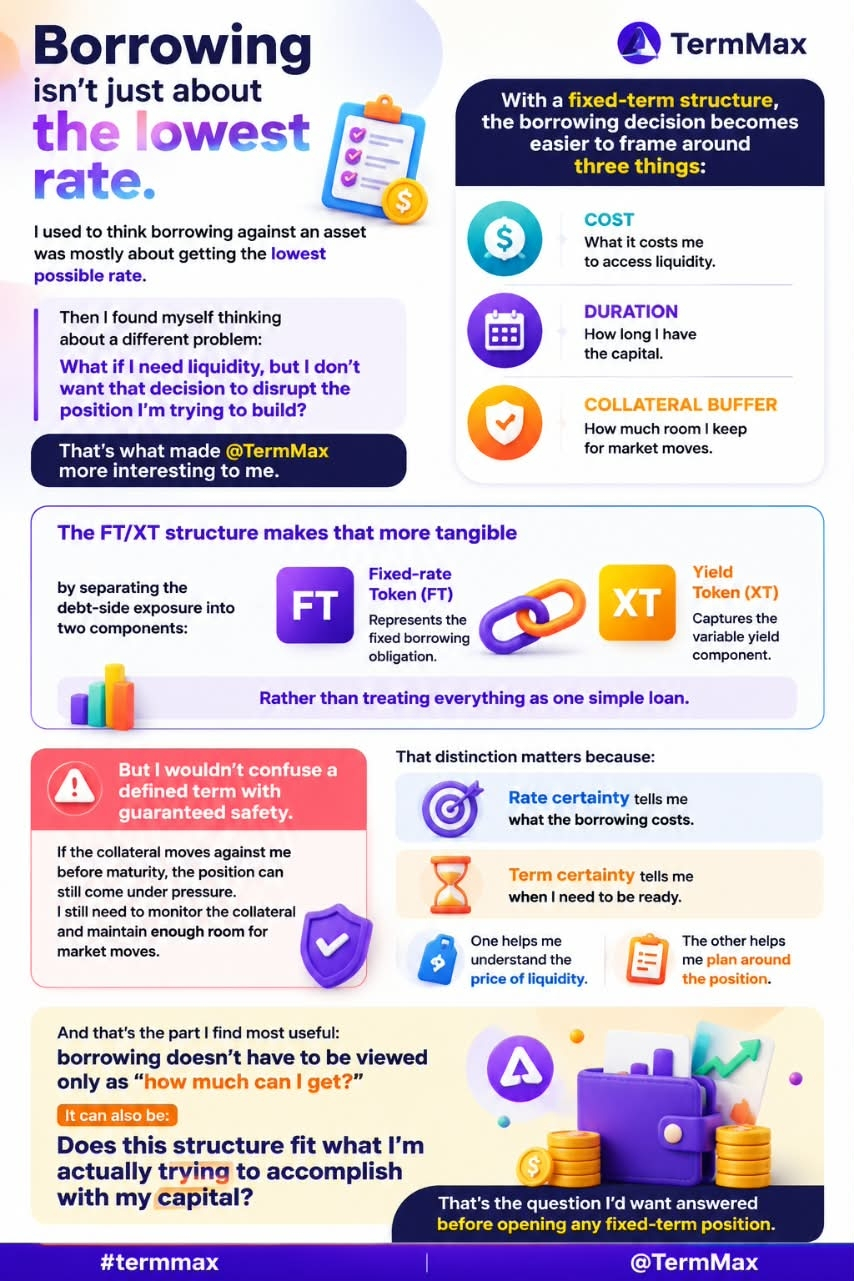
HaussierI used to think borrowing against an asset was mostly about getting the lowest possible rate.
Then I found myself thinking about a different problem:
What if I need liquidity, but I don’t want that decision to disrupt the position I’m trying to build?
That’s what made @TermMax more interesting to me.
With a fixed term structure, the borrowing decision becomes easier to frame around three things:
cost + duration + collateral buffer
The FT/XT structure makes that more tangible by separating the debt-side exposure into a Fixed-rate Token (FT) and a Yield Token (XT) rather than treating everything as one simple loan.
But I wouldn’t confuse a defined term with guaranteed safety.
If the collateral moves against me before maturity, the position can still come under pressure. I still need to monitor the collateral and maintain enough room for market moves.
That distinction matters because:
Rate certainty tells me what the borrowing costs.
Term certainty tells me when I need to be ready.
One helps me understand the price of liquidity.
The other helps me plan around the position.
And that’s the part I find most useful: borrowing doesn't have to be viewed only as “how much can I get?”
It can also be:
Does this structure fit what I’m actually trying to accomplish with my capital?
That’s the question I’d want answered before opening any fixed-term position.
#termmax @TermMax $BTC #defi #Crypto
Then I found myself thinking about a different problem:
What if I need liquidity, but I don’t want that decision to disrupt the position I’m trying to build?
That’s what made @TermMax more interesting to me.
With a fixed term structure, the borrowing decision becomes easier to frame around three things:
cost + duration + collateral buffer
The FT/XT structure makes that more tangible by separating the debt-side exposure into a Fixed-rate Token (FT) and a Yield Token (XT) rather than treating everything as one simple loan.
But I wouldn’t confuse a defined term with guaranteed safety.
If the collateral moves against me before maturity, the position can still come under pressure. I still need to monitor the collateral and maintain enough room for market moves.
That distinction matters because:
Rate certainty tells me what the borrowing costs.
Term certainty tells me when I need to be ready.
One helps me understand the price of liquidity.
The other helps me plan around the position.
And that’s the part I find most useful: borrowing doesn't have to be viewed only as “how much can I get?”
It can also be:
Does this structure fit what I’m actually trying to accomplish with my capital?
That’s the question I’d want answered before opening any fixed-term position.
#termmax @TermMax $BTC #defi #Crypto
2
2
Vérifié
One thing that changed how I look at @termmax is that the important part isn't only getting a fixed rate.
It's being able to decide what the financing should look like before the position starts.
That sounds subtle, but it changes the role financing can play in the trade itself.
In a typical variable rate market, you decide how much you want to borrow and then accept whatever financing conditions the market gives you.
With TermMax, those terms can become part of the trade itself.
A borrower can specify the maximum rate they're willing to pay and the maturity they want, while lenders can set the minimum rate they're willing to accept.
So the question changes from:
“ What rate can I get right now? ”
to:
“What terms make this position worth taking?”
That's a meaningful shift.
You're no longer just choosing how much liquidity to use. You're locking in the cost and duration of the capital before committing to the position.
And that matters beyond traders.
A treasury can budget around a defined term and borrowing cost.
An allocator can compare opportunities without assuming today's financing rate will still be there tomorrow.
The part I think is easy to miss is this:
predictable financing doesn't just reduce uncertainty. It makes capital easier to manage.
That's why I see TermMax as more than another fixed-rate lending protocol.
It's moving borrowing closer to something you can structure upfront, rather than something you constantly react to after the position is open.
And as more serious capital moves onchain, that difference could become much harder to ignore.
@termmax #TermMax #BTC #crypto
{spot}(BTCUSDT)
{spot}(BNBUSDT)
What matters most when choosing onchain financing?
One thing that changed how I look at @TermMax is that the important part isn't only getting a fixed rate.
It's being able to decide what the financing should look like before the position starts.
That sounds subtle, but it changes the role financing can play in the trade itself.
In a typical variable rate market, you decide how much you want to borrow and then accept whatever financing conditions the market gives you.
With TermMax, those terms can become part of the trade itself.
A borrower can specify the maximum rate they're willing to pay and the maturity they want, while lenders can set the minimum rate they're willing to accept.
So the question changes from:
“ What rate can I get right now? ”
to:
“What terms make this position worth taking?”
That's a meaningful shift.
You're no longer just choosing how much liquidity to use. You're locking in the cost and duration of the capital before committing to the position.
And that matters beyond traders.
A treasury can budget around a defined term and borrowing cost.
An allocator can compare opportunities without assuming today's financing rate will still be there tomorrow.
The part I think is easy to miss is this:
predictable financing doesn't just reduce uncertainty. It makes capital easier to manage.
That's why I see TermMax as more than another fixed-rate lending protocol.
It's moving borrowing closer to something you can structure upfront, rather than something you constantly react to after the position is open.
And as more serious capital moves onchain, that difference could become much harder to ignore.
@TermMax #TermMax #BTC #crypto
What matters most when choosing onchain financing?
It's being able to decide what the financing should look like before the position starts.
That sounds subtle, but it changes the role financing can play in the trade itself.
In a typical variable rate market, you decide how much you want to borrow and then accept whatever financing conditions the market gives you.
With TermMax, those terms can become part of the trade itself.
A borrower can specify the maximum rate they're willing to pay and the maturity they want, while lenders can set the minimum rate they're willing to accept.
So the question changes from:
“ What rate can I get right now? ”
to:
“What terms make this position worth taking?”
That's a meaningful shift.
You're no longer just choosing how much liquidity to use. You're locking in the cost and duration of the capital before committing to the position.
And that matters beyond traders.
A treasury can budget around a defined term and borrowing cost.
An allocator can compare opportunities without assuming today's financing rate will still be there tomorrow.
The part I think is easy to miss is this:
predictable financing doesn't just reduce uncertainty. It makes capital easier to manage.
That's why I see TermMax as more than another fixed-rate lending protocol.
It's moving borrowing closer to something you can structure upfront, rather than something you constantly react to after the position is open.
And as more serious capital moves onchain, that difference could become much harder to ignore.
@TermMax #TermMax #BTC #crypto
What matters most when choosing onchain financing?
Fixed borrowing cost
43%
Defined maturity
14%
Variable rates
43%
Flexible liquidity
0%
7 Votes • Vote fermé
7
6
563
·
--
Haussier
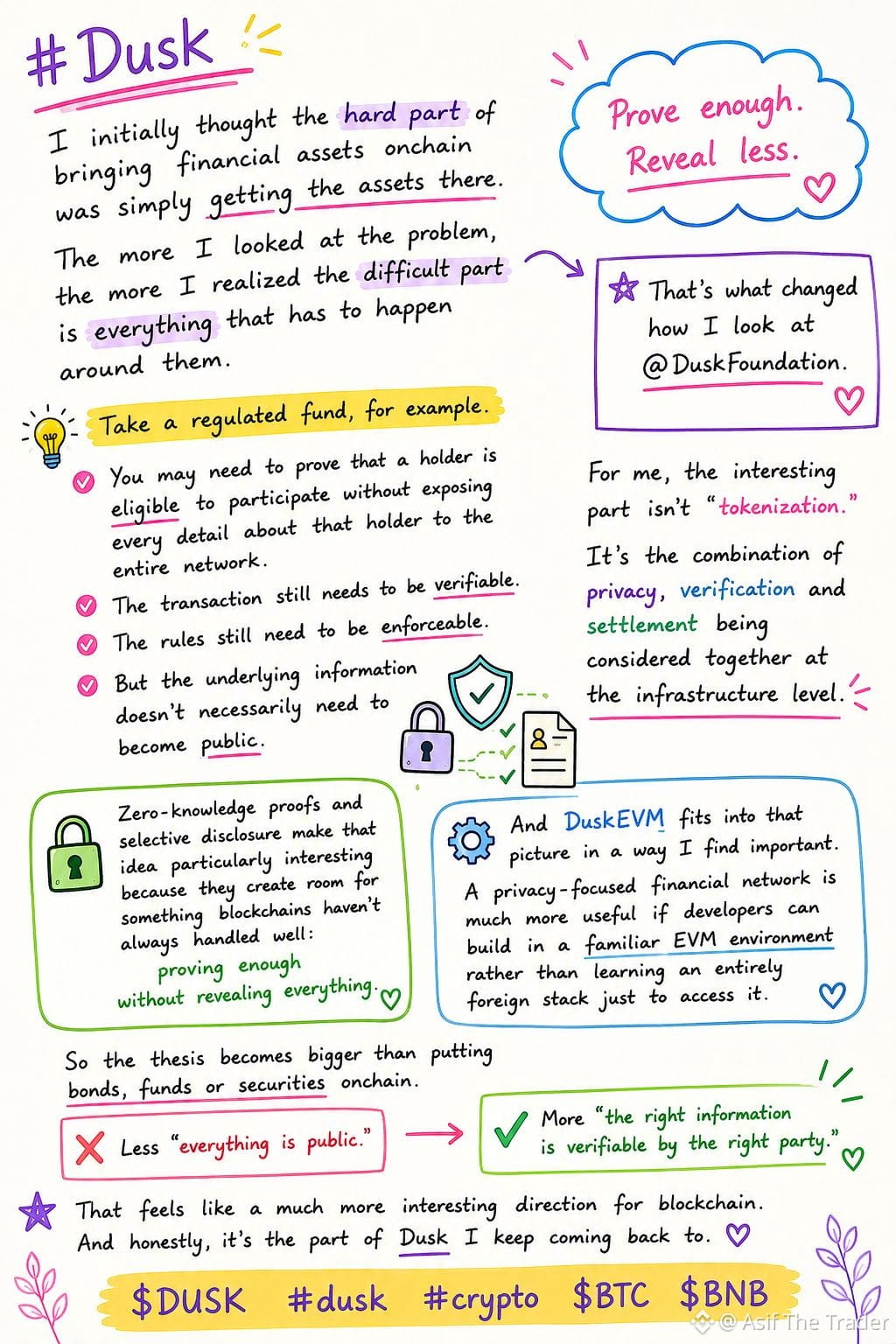
#Dusk
I initially thought the hard part of bringing financial assets onchain was simply getting the assets there.
The more I looked at the problem, the more I realized the difficult part is everything that has to happen around them.
Take a regulated fund, for example.
You may need to prove that a holder is eligible to participate without exposing every detail about that holder to the entire network.
The transaction still needs to be verifiable.
The rules still need to be enforceable.
But the underlying information doesn't necessarily need to become public.
That shift in perspective is what made
@Dusk_Foundation more interesting to me.
For me, the real opportunity isn't simply “ tokenization.”
It's bringing privacy, verification and settlement together at the infrastructure layer.
Zero-knowledge proofs and selective disclosure are especially interesting here because they point toward a model where you can prove what matters without revealing everything behind the proof.
Prove enough. Reveal less.
And DuskEVM makes that thesis even more practical.
If developers can work in a familiar EVM environment while building for privacy-focused financial infrastructure, the barrier to experimenting with these ideas becomes much lower.
So I don't think the bigger story is simply putting bonds, funds or securities onchain.
It's what happens when the underlying financial infrastructure is designed around a more selective idea of transparency from the start.
Not:
“ Make everything public.”
But:
“ Make the right information verifiable by the right party.”
That distinction might end up mattering a lot more than the tokenization narrative itself.
$DUSK #dusk #crypto $BTC $BNB
{spot}(BTCUSDT)
{spot}(DUSKUSDT)
#Dusk
I initially thought the hard part of bringing financial assets onchain was simply getting the assets there.
The more I looked at the problem, the more I realized the difficult part is everything that has to happen around them.
Take a regulated fund, for example.
You may need to prove that a holder is eligible to participate without exposing every detail about that holder to the entire network.
The transaction still needs to be verifiable.
The rules still need to be enforceable.
But the underlying information doesn't necessarily need to become public.
That shift in perspective is what made
@Dusk more interesting to me.
For me, the real opportunity isn't simply “ tokenization.”
It's bringing privacy, verification and settlement together at the infrastructure layer.
Zero-knowledge proofs and selective disclosure are especially interesting here because they point toward a model where you can prove what matters without revealing everything behind the proof.
Prove enough. Reveal less.
And DuskEVM makes that thesis even more practical.
If developers can work in a familiar EVM environment while building for privacy-focused financial infrastructure, the barrier to experimenting with these ideas becomes much lower.
So I don't think the bigger story is simply putting bonds, funds or securities onchain.
It's what happens when the underlying financial infrastructure is designed around a more selective idea of transparency from the start.
Not:
“ Make everything public.”
But:
“ Make the right information verifiable by the right party.”
That distinction might end up mattering a lot more than the tokenization narrative itself.
$DUSK #dusk #crypto $BTC $BNB
I initially thought the hard part of bringing financial assets onchain was simply getting the assets there.
The more I looked at the problem, the more I realized the difficult part is everything that has to happen around them.
Take a regulated fund, for example.
You may need to prove that a holder is eligible to participate without exposing every detail about that holder to the entire network.
The transaction still needs to be verifiable.
The rules still need to be enforceable.
But the underlying information doesn't necessarily need to become public.
That shift in perspective is what made
@Dusk more interesting to me.
For me, the real opportunity isn't simply “ tokenization.”
It's bringing privacy, verification and settlement together at the infrastructure layer.
Zero-knowledge proofs and selective disclosure are especially interesting here because they point toward a model where you can prove what matters without revealing everything behind the proof.
Prove enough. Reveal less.
And DuskEVM makes that thesis even more practical.
If developers can work in a familiar EVM environment while building for privacy-focused financial infrastructure, the barrier to experimenting with these ideas becomes much lower.
So I don't think the bigger story is simply putting bonds, funds or securities onchain.
It's what happens when the underlying financial infrastructure is designed around a more selective idea of transparency from the start.
Not:
“ Make everything public.”
But:
“ Make the right information verifiable by the right party.”
That distinction might end up mattering a lot more than the tokenization narrative itself.
$DUSK #dusk #crypto $BTC $BNB
16
9
908
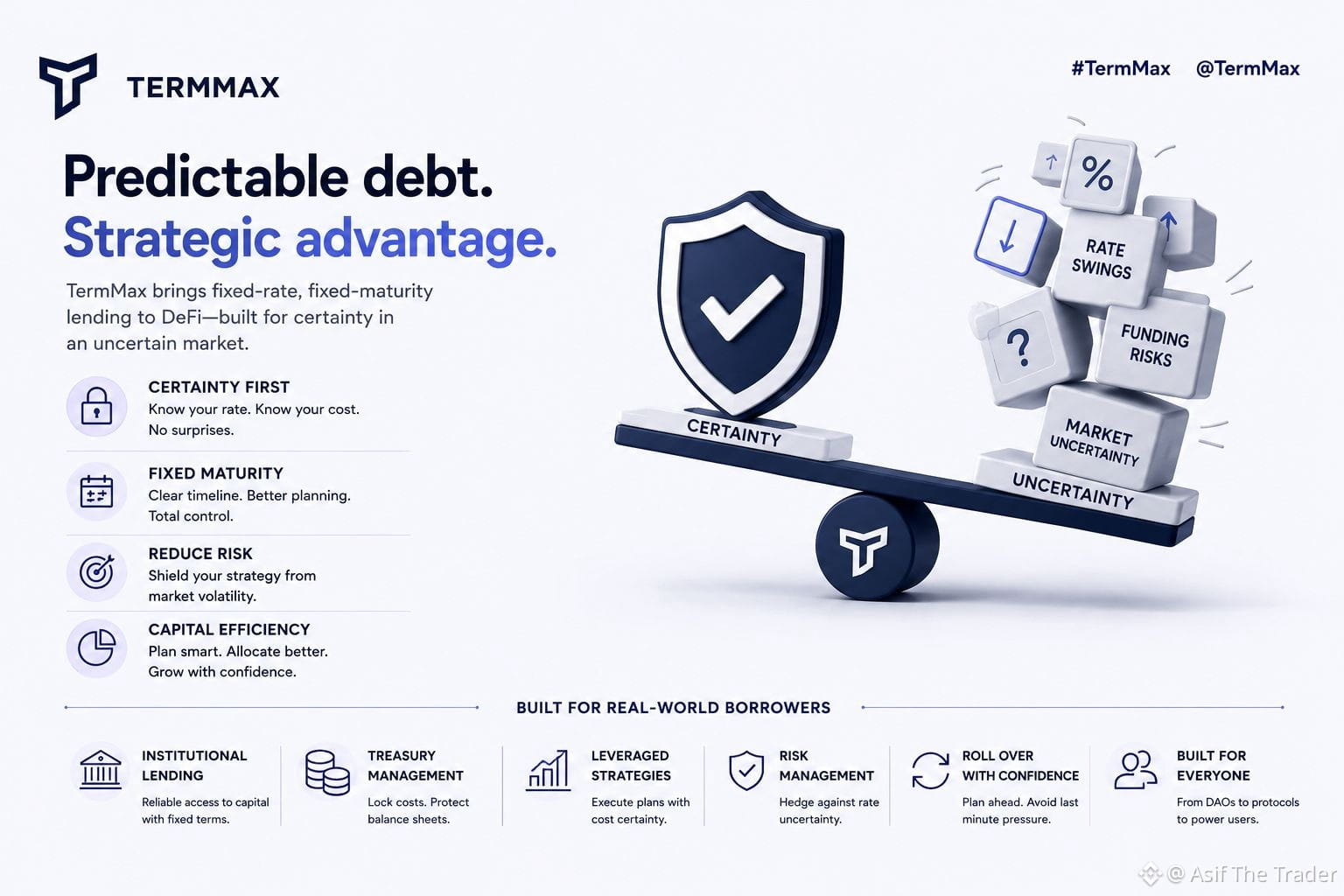
@termmax got me thinking about a different part of lending markets: the value of certainty.
A fixed borrowing structure can look restrictive at first, especially when market conditions change quickly.
But flexibility has a cost too.
With variable debt, borrowers are constantly exposed to changing rates and funding conditions. A fixed maturity position trades some of that flexibility for a clearer picture of what the financing will look like over its lifetime.
That makes TermMax interesting to me. The question isn’t simply whether fixed-rate borrowing is cheaper or more flexible. It’s whether knowing your financing terms upfront is valuable enough to justify giving up some optionality.
During calm markets, flexibility may be the priority. When rates become harder to predict, certainty can become much more valuable.
That’s the part I find most interesting about TermMax: certainty isn’t just a pricing feature. It can be the product itself—the ability to know what your debt looks like before the market decides for you.
#TermMax
{spot}(BTCUSDT)
{spot}(BNBUSDT)
@TermMax got me thinking about a different part of lending markets: the value of certainty.
A fixed borrowing structure can look restrictive at first, especially when market conditions change quickly.
But flexibility has a cost too.
With variable debt, borrowers are constantly exposed to changing rates and funding conditions. A fixed maturity position trades some of that flexibility for a clearer picture of what the financing will look like over its lifetime.
That makes TermMax interesting to me. The question isn’t simply whether fixed-rate borrowing is cheaper or more flexible. It’s whether knowing your financing terms upfront is valuable enough to justify giving up some optionality.
During calm markets, flexibility may be the priority. When rates become harder to predict, certainty can become much more valuable.
That’s the part I find most interesting about TermMax: certainty isn’t just a pricing feature. It can be the product itself—the ability to know what your debt looks like before the market decides for you.
#TermMax
A fixed borrowing structure can look restrictive at first, especially when market conditions change quickly.
But flexibility has a cost too.
With variable debt, borrowers are constantly exposed to changing rates and funding conditions. A fixed maturity position trades some of that flexibility for a clearer picture of what the financing will look like over its lifetime.
That makes TermMax interesting to me. The question isn’t simply whether fixed-rate borrowing is cheaper or more flexible. It’s whether knowing your financing terms upfront is valuable enough to justify giving up some optionality.
During calm markets, flexibility may be the priority. When rates become harder to predict, certainty can become much more valuable.
That’s the part I find most interesting about TermMax: certainty isn’t just a pricing feature. It can be the product itself—the ability to know what your debt looks like before the market decides for you.
#TermMax
10
5
83
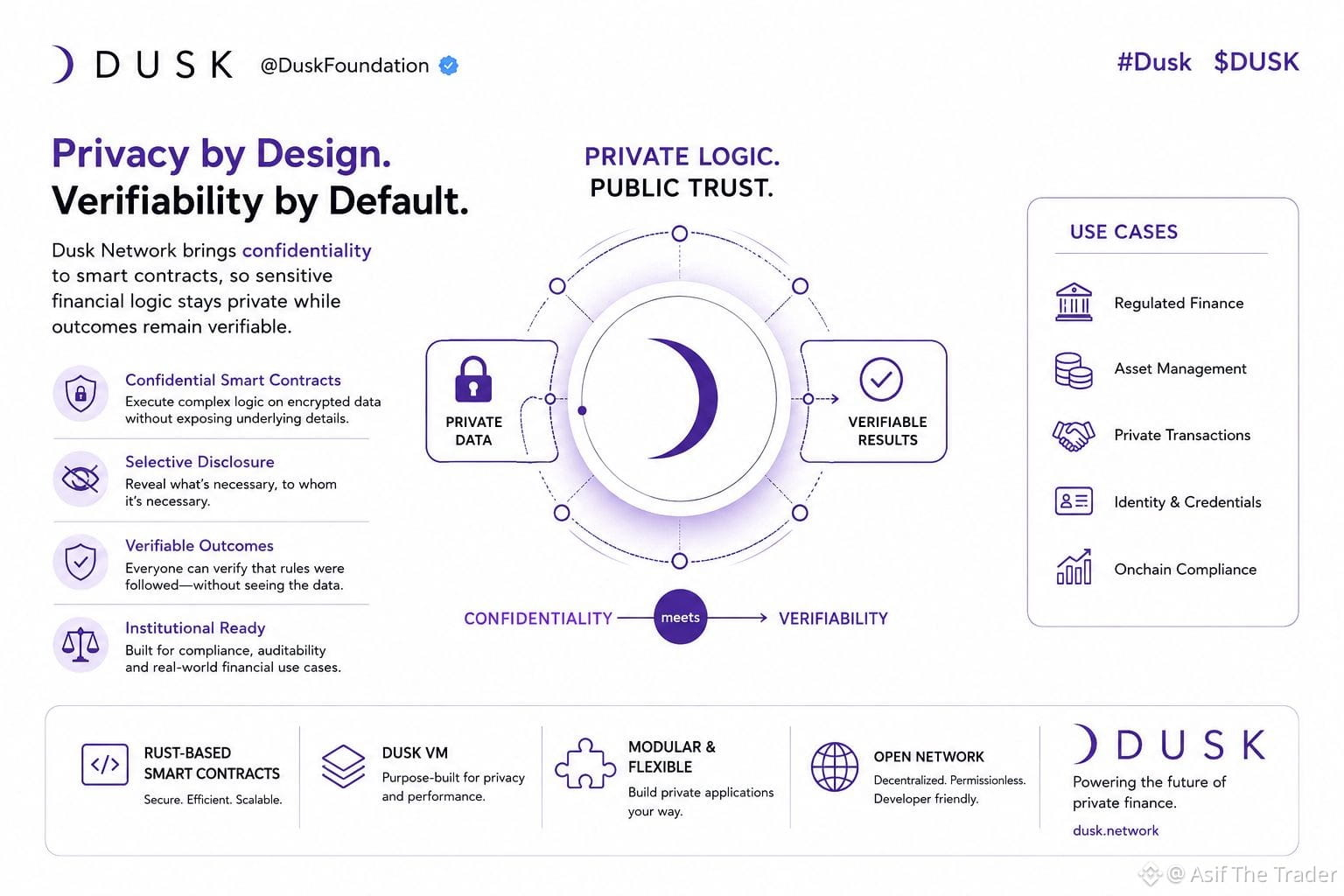
Privacy on a blockchain shouldn’t mean sacrificing the ability to verify what happened.
That tension is what makes Dusk interesting to me.
Traditional public ledgers are great at making activity auditable, but financial applications often deal with information that simply shouldn’t be exposed to everyone.
@Dusk_Foundation takes a different route by bringing confidentiality into the smart
contract layer itself.
That opens up a more practical possibility: applications where sensitive financial operations can stay protected while the network can still enforce the rules and validate the outcome.
That’s a much bigger idea than hiding wallet balances.
It’s about building financial infrastructure where privacy and verifiability don’t have to be opposites.
That’s the part of Dusk I’m watching most closely.
@Dusk_Foundation $DUSK #dusk
{spot}(DUSKUSDT)
{spot}(BTCUSDT)
Privacy on a blockchain shouldn’t mean sacrificing the ability to verify what happened.
That tension is what makes Dusk interesting to me.
Traditional public ledgers are great at making activity auditable, but financial applications often deal with information that simply shouldn’t be exposed to everyone.
@Dusk takes a different route by bringing confidentiality into the smart
contract layer itself.
That opens up a more practical possibility: applications where sensitive financial operations can stay protected while the network can still enforce the rules and validate the outcome.
That’s a much bigger idea than hiding wallet balances.
It’s about building financial infrastructure where privacy and verifiability don’t have to be opposites.
That’s the part of Dusk I’m watching most closely.
@Dusk $DUSK #dusk
That tension is what makes Dusk interesting to me.
Traditional public ledgers are great at making activity auditable, but financial applications often deal with information that simply shouldn’t be exposed to everyone.
@Dusk takes a different route by bringing confidentiality into the smart
contract layer itself.
That opens up a more practical possibility: applications where sensitive financial operations can stay protected while the network can still enforce the rules and validate the outcome.
That’s a much bigger idea than hiding wallet balances.
It’s about building financial infrastructure where privacy and verifiability don’t have to be opposites.
That’s the part of Dusk I’m watching most closely.
@Dusk $DUSK #dusk
17
6
1.8k
#termmax @termmax
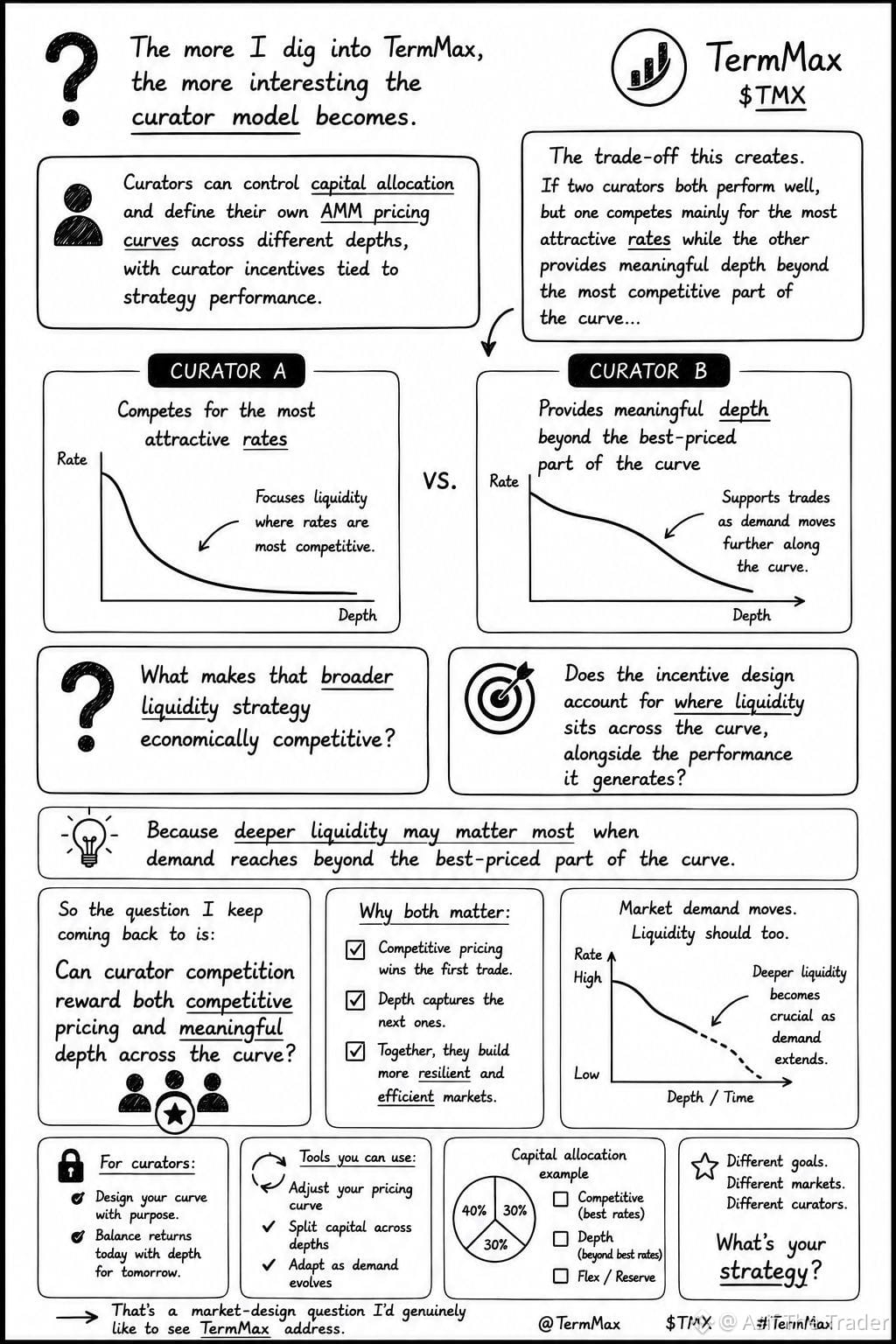
The more I dig into TermMax, the more interesting the curator model becomes.
Curators can control capital allocation and define their own AMM pricing curves across different depths, with curator incentives tied to strategy performance.
What stands out to me is the trade-off this creates.
If two curators both perform well, but one competes mainly for the most attractive rates while the other provides meaningful depth beyond the most competitive part of the curve, what makes that broader liquidity strategy economically competitive?
And more importantly, does the incentive design account for where liquidity sits across the curve, alongside the performance it generates?
Because deeper liquidity may matter most when demand reaches beyond the best priced part of the curve.
So the question I keep coming back to is:
Can curator competition reward both competitive pricing and meaningful depth across the curve ?
That’s a market design question I’d genuinely like to see TermMax address.
#termmax @TermMax
The more I dig into TermMax, the more interesting the curator model becomes.
Curators can control capital allocation and define their own AMM pricing curves across different depths, with curator incentives tied to strategy performance.
What stands out to me is the trade-off this creates.
If two curators both perform well, but one competes mainly for the most attractive rates while the other provides meaningful depth beyond the most competitive part of the curve, what makes that broader liquidity strategy economically competitive?
And more importantly, does the incentive design account for where liquidity sits across the curve, alongside the performance it generates?
Because deeper liquidity may matter most when demand reaches beyond the best priced part of the curve.
So the question I keep coming back to is:
Can curator competition reward both competitive pricing and meaningful depth across the curve ?
That’s a market design question I’d genuinely like to see TermMax address.
The more I dig into TermMax, the more interesting the curator model becomes.
Curators can control capital allocation and define their own AMM pricing curves across different depths, with curator incentives tied to strategy performance.
What stands out to me is the trade-off this creates.
If two curators both perform well, but one competes mainly for the most attractive rates while the other provides meaningful depth beyond the most competitive part of the curve, what makes that broader liquidity strategy economically competitive?
And more importantly, does the incentive design account for where liquidity sits across the curve, alongside the performance it generates?
Because deeper liquidity may matter most when demand reaches beyond the best priced part of the curve.
So the question I keep coming back to is:
Can curator competition reward both competitive pricing and meaningful depth across the curve ?
That’s a market design question I’d genuinely like to see TermMax address.
7
5
83
·
--
Baissier
#dusk $DUSK
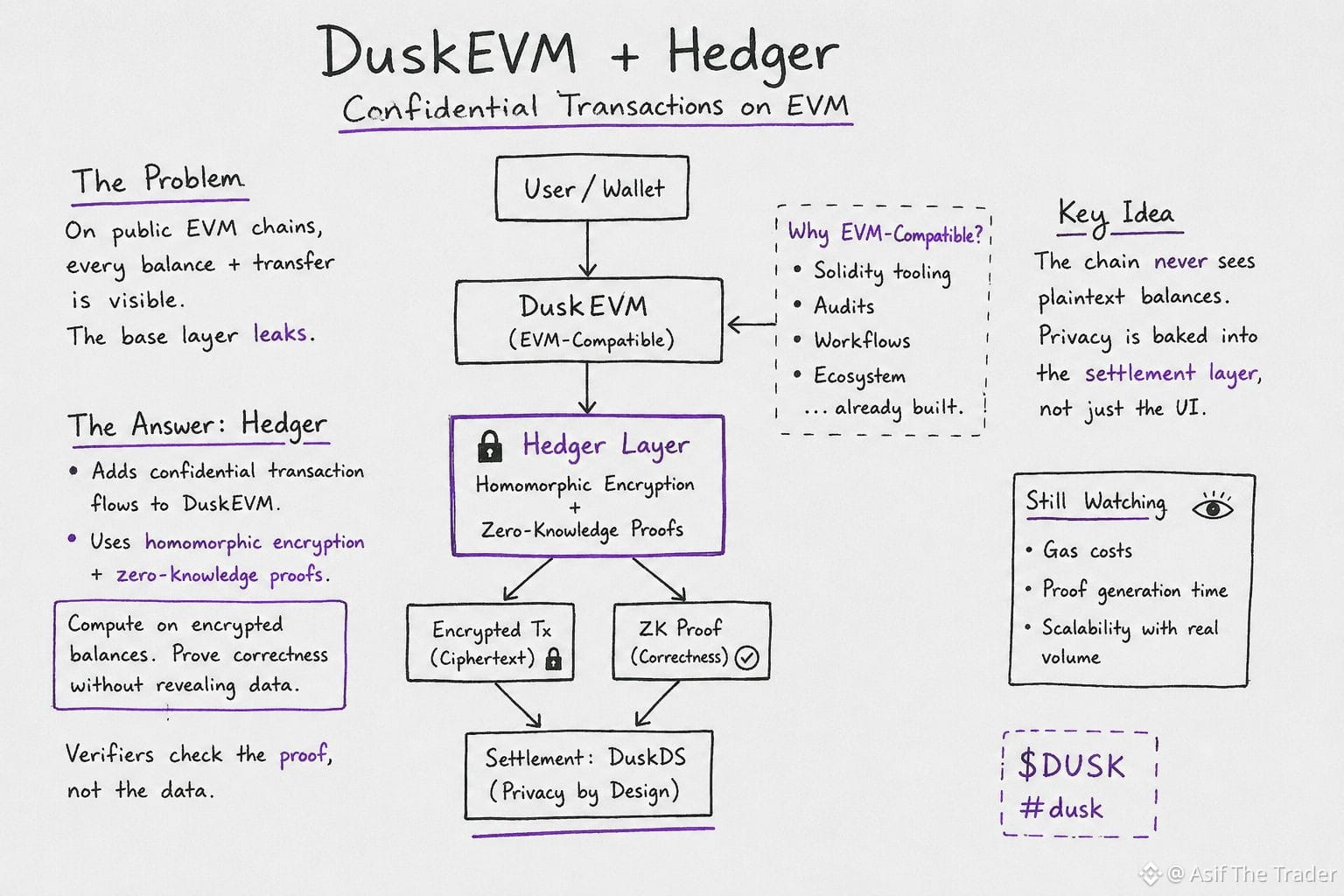
Spent some time this week trying to understand why @Dusk_Foundation didn't just ship privacy as a bolt-on to a normal EVM chain, and it comes down to a problem most people skip past: on a public EVM, every balance and transfer is visible to anyone who looks, even if you wrap it in a "private" app on top. The base layer leaks.
Dusk's answer is Hedger — it adds confidential transaction flows directly to DuskEVM using homomorphic encryption combined with zero-knowledge proofs. The idea is that a contract can compute over encrypted balances and still produce a proof that the computation was done correctly, without ever decrypting the underlying numbers. Verifiers check the proof, not the data. That's a very different guarantee than "the frontend hides your balance" it means the chain itself never has the plaintext to leak in the first place.
Why put that on an EVM-compatible layer instead of a totally custom VM? Because institutions already have Solidity tooling, audits, and workflows built up over a decade. DuskEVM (OP Stack, settling back to DuskDS) lets that tooling stay, while Hedger changes what the base layer is allowed to see. Privacy becomes a property of settlement, not a UI trick.
Still watching how gas costs and proof generation scale once real transaction volume hits it, but the architecture itself is the more interesting story than the price chart right now.
$DUSK #dusk
{spot}(DUSKUSDT)
#dusk $DUSK
Spent some time this week trying to understand why @Dusk didn't just ship privacy as a bolt-on to a normal EVM chain, and it comes down to a problem most people skip past: on a public EVM, every balance and transfer is visible to anyone who looks, even if you wrap it in a "private" app on top. The base layer leaks.
Dusk's answer is Hedger — it adds confidential transaction flows directly to DuskEVM using homomorphic encryption combined with zero-knowledge proofs. The idea is that a contract can compute over encrypted balances and still produce a proof that the computation was done correctly, without ever decrypting the underlying numbers. Verifiers check the proof, not the data. That's a very different guarantee than "the frontend hides your balance" it means the chain itself never has the plaintext to leak in the first place.
Why put that on an EVM-compatible layer instead of a totally custom VM? Because institutions already have Solidity tooling, audits, and workflows built up over a decade. DuskEVM (OP Stack, settling back to DuskDS) lets that tooling stay, while Hedger changes what the base layer is allowed to see. Privacy becomes a property of settlement, not a UI trick.
Still watching how gas costs and proof generation scale once real transaction volume hits it, but the architecture itself is the more interesting story than the price chart right now.
$DUSK #dusk
Spent some time this week trying to understand why @Dusk didn't just ship privacy as a bolt-on to a normal EVM chain, and it comes down to a problem most people skip past: on a public EVM, every balance and transfer is visible to anyone who looks, even if you wrap it in a "private" app on top. The base layer leaks.
Dusk's answer is Hedger — it adds confidential transaction flows directly to DuskEVM using homomorphic encryption combined with zero-knowledge proofs. The idea is that a contract can compute over encrypted balances and still produce a proof that the computation was done correctly, without ever decrypting the underlying numbers. Verifiers check the proof, not the data. That's a very different guarantee than "the frontend hides your balance" it means the chain itself never has the plaintext to leak in the first place.
Why put that on an EVM-compatible layer instead of a totally custom VM? Because institutions already have Solidity tooling, audits, and workflows built up over a decade. DuskEVM (OP Stack, settling back to DuskDS) lets that tooling stay, while Hedger changes what the base layer is allowed to see. Privacy becomes a property of settlement, not a UI trick.
Still watching how gas costs and proof generation scale once real transaction volume hits it, but the architecture itself is the more interesting story than the price chart right now.
$DUSK #dusk
9
5
60
·
--
Haussier
#termmax @termmax
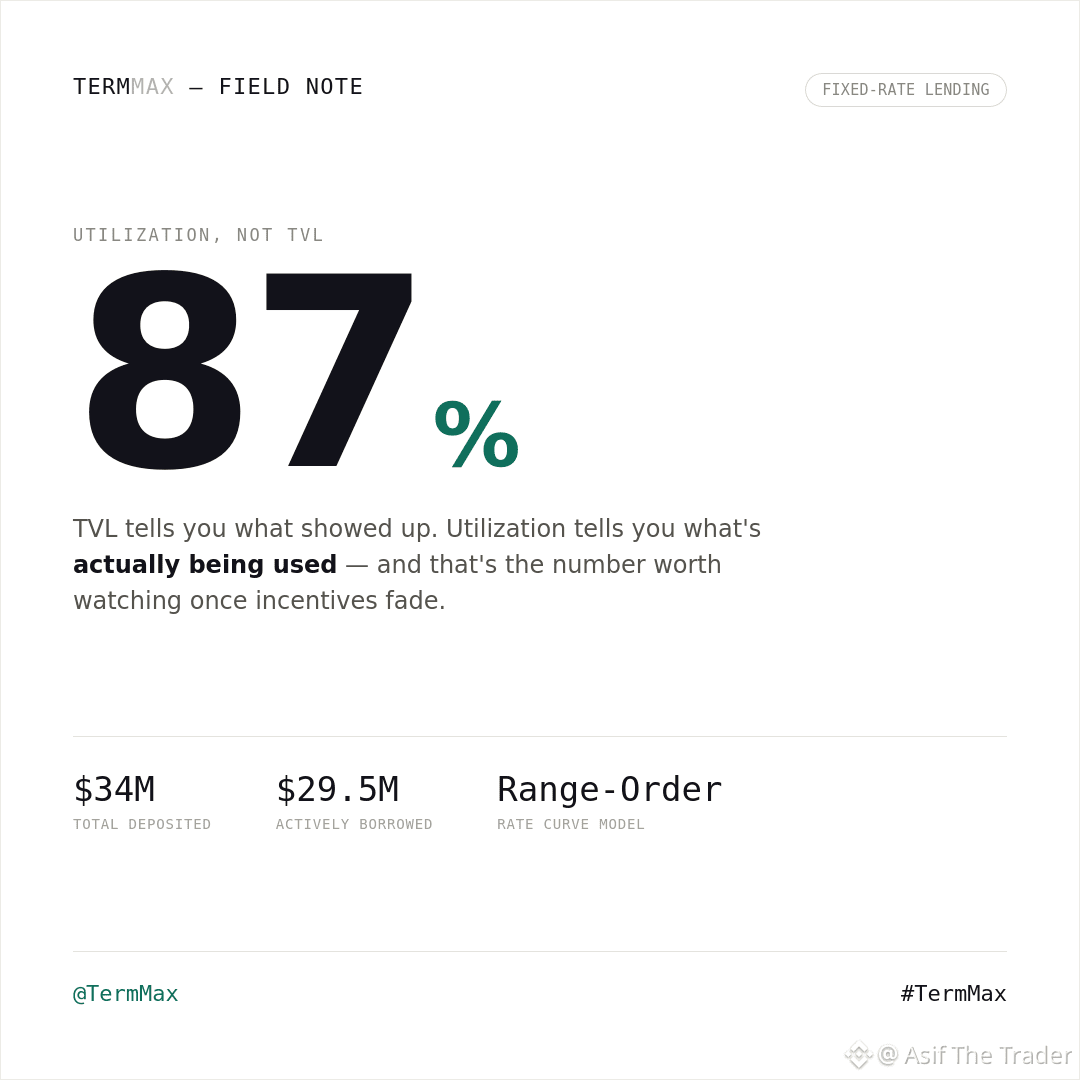
TVL tells you what showed up. Utilization tells you what's actually being used — and today TermMax's numbers make that gap worth noticing.
$34M deposited, ~$29.5M borrowed, sitting near 87% utilization. That's an actively used pool, not just parked liquidity.
What stands out is the structure underneath it. Instead of one shared pool rate, lenders choose their own rate curve through range orders. So that 87% isn't one uniform number — it's an aggregate built from many individual curve choices.
Early days still, one day's data isn't a trend. What I'm watching next is whether this utilization holds once incentive programs start winding down.
#TermMax @termmax
#termmax @TermMax
TVL tells you what showed up. Utilization tells you what's actually being used — and today TermMax's numbers make that gap worth noticing.
$34M deposited, ~$29.5M borrowed, sitting near 87% utilization. That's an actively used pool, not just parked liquidity.
What stands out is the structure underneath it. Instead of one shared pool rate, lenders choose their own rate curve through range orders. So that 87% isn't one uniform number — it's an aggregate built from many individual curve choices.
Early days still, one day's data isn't a trend. What I'm watching next is whether this utilization holds once incentive programs start winding down.
#TermMax @TermMax
TVL tells you what showed up. Utilization tells you what's actually being used — and today TermMax's numbers make that gap worth noticing.
$34M deposited, ~$29.5M borrowed, sitting near 87% utilization. That's an actively used pool, not just parked liquidity.
What stands out is the structure underneath it. Instead of one shared pool rate, lenders choose their own rate curve through range orders. So that 87% isn't one uniform number — it's an aggregate built from many individual curve choices.
Early days still, one day's data isn't a trend. What I'm watching next is whether this utilization holds once incentive programs start winding down.
#TermMax @TermMax
9
5
88
@termmax #TermMax
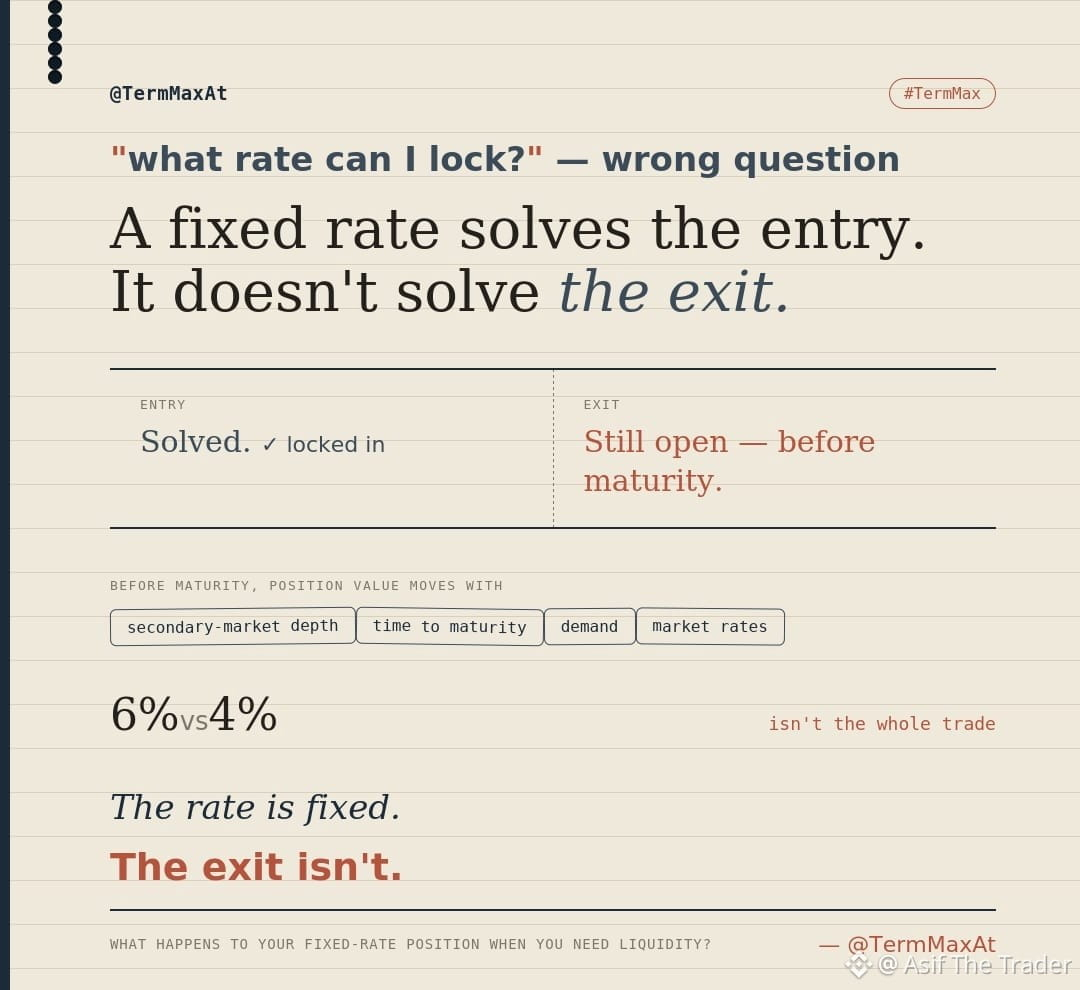
Everyone asks, “what rate can I lock on TermMax?”
But I started thinking about what comes after the trade:
what happens when I want out?
A fixed rate solves the entry problem.
It doesn’t automatically solve the exit.
Before maturity, the position’s value can change with secondary-market depth, time to maturity, demand, and market rates.
So 6% vs 4% isn’t the whole trade.
The more interesting question is:
what happens to that fixed-rate position when you need liquidity?
The rate may be fixed.
The exit isn’t.
@TermMax #TermMax
Everyone asks, “what rate can I lock on TermMax?”
But I started thinking about what comes after the trade:
what happens when I want out?
A fixed rate solves the entry problem.
It doesn’t automatically solve the exit.
Before maturity, the position’s value can change with secondary-market depth, time to maturity, demand, and market rates.
So 6% vs 4% isn’t the whole trade.
The more interesting question is:
what happens to that fixed-rate position when you need liquidity?
The rate may be fixed.
The exit isn’t.
Everyone asks, “what rate can I lock on TermMax?”
But I started thinking about what comes after the trade:
what happens when I want out?
A fixed rate solves the entry problem.
It doesn’t automatically solve the exit.
Before maturity, the position’s value can change with secondary-market depth, time to maturity, demand, and market rates.
So 6% vs 4% isn’t the whole trade.
The more interesting question is:
what happens to that fixed-rate position when you need liquidity?
The rate may be fixed.
The exit isn’t.
5
5
57
Vérifié
@Dusk_Foundation $DUSK #dusk
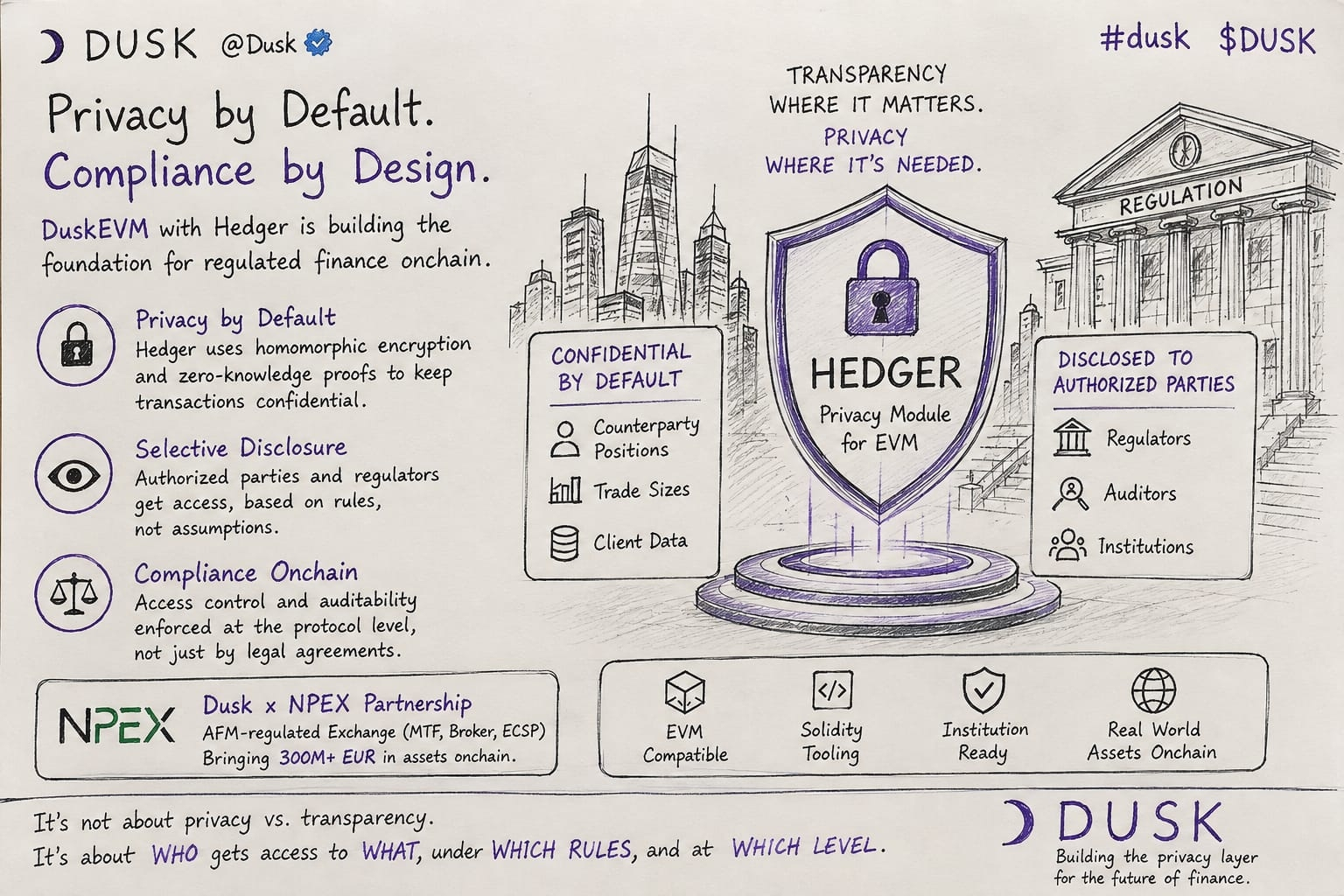
I used to think making a blockchain institution-ready was mostly about EVM compatibility.
Give developers Solidity tooling, keep the UX familiar, and adoption would follow.
The more I look at DuskEVM, the more I think the harder problem is actually privacy.
Regulated finance needs a middle ground. You can’t put every trade size, position, or piece of client data on a fully transparent ledger. But you also can’t make everything invisible. Regulators, auditors, and authorized participants still need the right information at the right time.
That’s where Hedger gets interesting.
Dusk presents Hedger as a privacy module for EVM designed to keep transactions confidential while enabling selective disclosure when access is required.
And that changes how I think about privacy:
Privacy doesn’t mean hiding everything.
It means controlling who can see what, when they can see it, and why.
That last part matters for regulated markets.
The NPEX connection makes the idea even more interesting. Combined with the push toward putting real-world assets onchain, it points to a use case that goes beyond the typical crypto-native audience.
Still, I wouldn’t call the problem solved.
The real test is whether this architecture can handle institutional-scale activity while satisfying serious disclosure, audit, and compliance requirements.
That’s what I’ll be watching.
Because maybe the real question isn’t:
Privacy or transparency?
Maybe it’s:
Who gets access to what, under which rules, and at what level?
@Dusk_Foundation $DUSK #dusk
@Dusk $DUSK #dusk
I used to think making a blockchain institution-ready was mostly about EVM compatibility.
Give developers Solidity tooling, keep the UX familiar, and adoption would follow.
The more I look at DuskEVM, the more I think the harder problem is actually privacy.
Regulated finance needs a middle ground. You can’t put every trade size, position, or piece of client data on a fully transparent ledger. But you also can’t make everything invisible. Regulators, auditors, and authorized participants still need the right information at the right time.
That’s where Hedger gets interesting.
Dusk presents Hedger as a privacy module for EVM designed to keep transactions confidential while enabling selective disclosure when access is required.
And that changes how I think about privacy:
Privacy doesn’t mean hiding everything.
It means controlling who can see what, when they can see it, and why.
That last part matters for regulated markets.
The NPEX connection makes the idea even more interesting. Combined with the push toward putting real-world assets onchain, it points to a use case that goes beyond the typical crypto-native audience.
Still, I wouldn’t call the problem solved.
The real test is whether this architecture can handle institutional-scale activity while satisfying serious disclosure, audit, and compliance requirements.
That’s what I’ll be watching.
Because maybe the real question isn’t:
Privacy or transparency?
Maybe it’s:
Who gets access to what, under which rules, and at what level?
@Dusk $DUSK #dusk
I used to think making a blockchain institution-ready was mostly about EVM compatibility.
Give developers Solidity tooling, keep the UX familiar, and adoption would follow.
The more I look at DuskEVM, the more I think the harder problem is actually privacy.
Regulated finance needs a middle ground. You can’t put every trade size, position, or piece of client data on a fully transparent ledger. But you also can’t make everything invisible. Regulators, auditors, and authorized participants still need the right information at the right time.
That’s where Hedger gets interesting.
Dusk presents Hedger as a privacy module for EVM designed to keep transactions confidential while enabling selective disclosure when access is required.
And that changes how I think about privacy:
Privacy doesn’t mean hiding everything.
It means controlling who can see what, when they can see it, and why.
That last part matters for regulated markets.
The NPEX connection makes the idea even more interesting. Combined with the push toward putting real-world assets onchain, it points to a use case that goes beyond the typical crypto-native audience.
Still, I wouldn’t call the problem solved.
The real test is whether this architecture can handle institutional-scale activity while satisfying serious disclosure, audit, and compliance requirements.
That’s what I’ll be watching.
Because maybe the real question isn’t:
Privacy or transparency?
Maybe it’s:
Who gets access to what, under which rules, and at what level?
@Dusk $DUSK #dusk
8
5
89
@Dusk_Foundation #dusk $DUSK
I often thought the hardest part of putting financial assets onchain was simply getting the asset there.
The more I look at Dusk, the harder question seems to come after issuance:
Who should be able to see what, and who should be able to prove what?
Take a regulated bond. A transfer may need to be verified, but that doesn’t mean everyone should see the holder’s balance, position or counterparties.
That’s the tension:
privacy without losing proof.
Dusk approaches it with shielded transactions, zero-knowledge proofs and selective disclosure, while DuskEVM and Hedger bring confidential workflows to Solidity-based applications.
But there’s another assumption worth questioning: putting an asset onchain doesn’t automatically put its lifecycle there.
Issuance, ownership, transfers, settlement and servicing can still sit across disconnected systems.
That’s why Dusk’s native-issuance approach interests me: not just creating a token, but keeping more of the asset’s lifecycle connected onchain.
The real test is whether regulated markets can make that lifecycle private where it should be, provable where it must be, and connected from issuance through settlement and servicing.
If that balance works at scale, does the real value of tokenization shift from the token itself to the infrastructure that coordinates everything around it?
What matters most for onchain finance?
@Dusk #dusk $DUSK
I often thought the hardest part of putting financial assets onchain was simply getting the asset there.
The more I look at Dusk, the harder question seems to come after issuance:
Who should be able to see what, and who should be able to prove what?
Take a regulated bond. A transfer may need to be verified, but that doesn’t mean everyone should see the holder’s balance, position or counterparties.
That’s the tension:
privacy without losing proof.
Dusk approaches it with shielded transactions, zero-knowledge proofs and selective disclosure, while DuskEVM and Hedger bring confidential workflows to Solidity-based applications.
But there’s another assumption worth questioning: putting an asset onchain doesn’t automatically put its lifecycle there.
Issuance, ownership, transfers, settlement and servicing can still sit across disconnected systems.
That’s why Dusk’s native-issuance approach interests me: not just creating a token, but keeping more of the asset’s lifecycle connected onchain.
The real test is whether regulated markets can make that lifecycle private where it should be, provable where it must be, and connected from issuance through settlement and servicing.
If that balance works at scale, does the real value of tokenization shift from the token itself to the infrastructure that coordinates everything around it?
What matters most for onchain finance?
I often thought the hardest part of putting financial assets onchain was simply getting the asset there.
The more I look at Dusk, the harder question seems to come after issuance:
Who should be able to see what, and who should be able to prove what?
Take a regulated bond. A transfer may need to be verified, but that doesn’t mean everyone should see the holder’s balance, position or counterparties.
That’s the tension:
privacy without losing proof.
Dusk approaches it with shielded transactions, zero-knowledge proofs and selective disclosure, while DuskEVM and Hedger bring confidential workflows to Solidity-based applications.
But there’s another assumption worth questioning: putting an asset onchain doesn’t automatically put its lifecycle there.
Issuance, ownership, transfers, settlement and servicing can still sit across disconnected systems.
That’s why Dusk’s native-issuance approach interests me: not just creating a token, but keeping more of the asset’s lifecycle connected onchain.
The real test is whether regulated markets can make that lifecycle private where it should be, provable where it must be, and connected from issuance through settlement and servicing.
If that balance works at scale, does the real value of tokenization shift from the token itself to the infrastructure that coordinates everything around it?
What matters most for onchain finance?
🔘 Privacy + proof
83%
🔘 Asset lifecycle
17%
🔘 Transparency
0%
🔘 Settlement
0%
6 Votes • Vote fermé
7
5
86
Vérifié
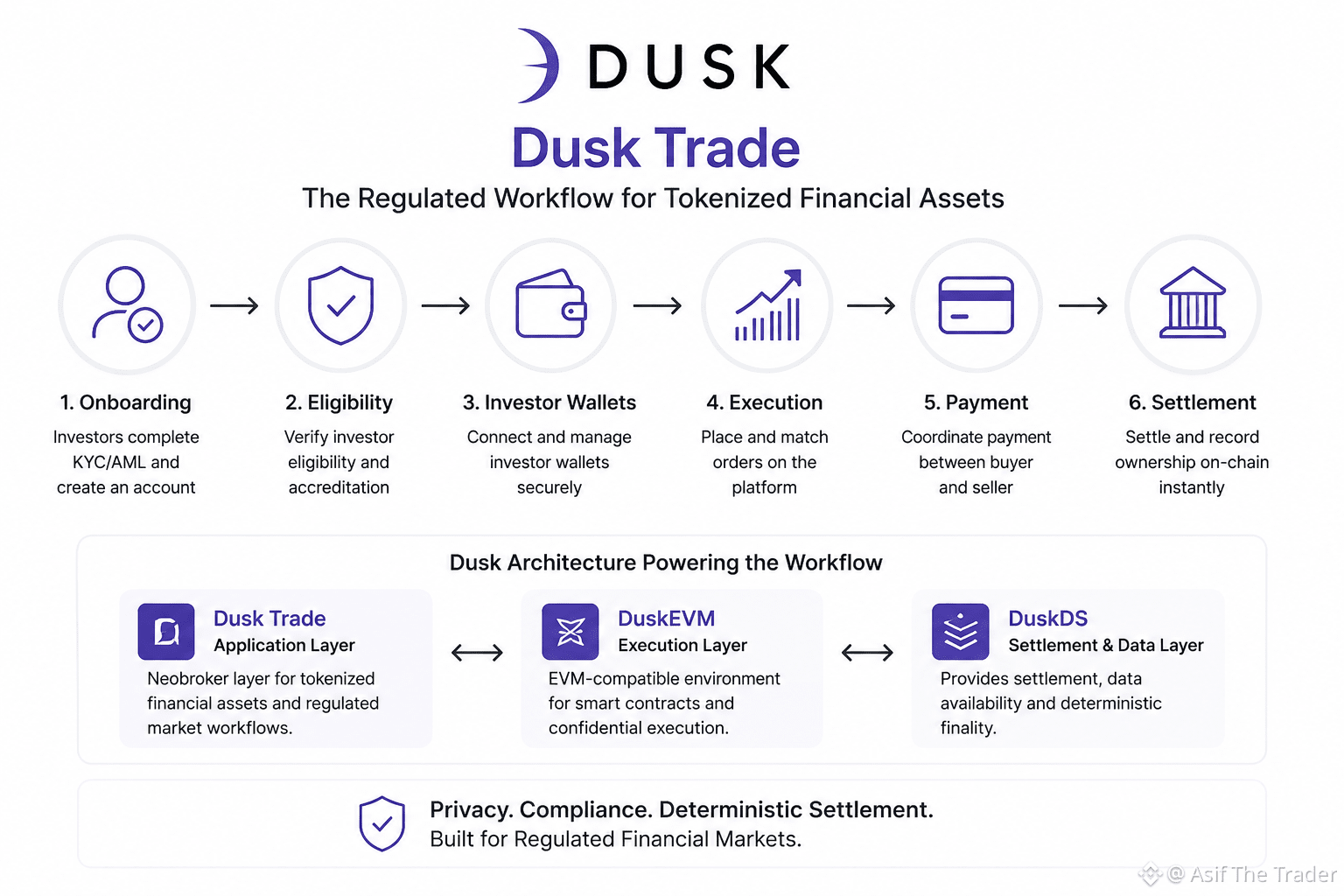
I have noticed something about Dusk Trade that made me rethink what tokenization is actually trying to solve.
At first, a neobroker for tokenized assets sounded like another interface for buying and selling digital securities. But the deeper I looked, the more I realized the asset itself may not be the hardest part. In regulated markets, the difficult part is everything around it — onboarding investors, checking eligibility, connecting investor wallets, executing trades, coordinating payment, and ultimately settling ownership.
That creates an interesting tension.
Putting a bond, ETF or other financial asset on-chain can make it programmable. But programmability alone does not answer who is allowed to access it, what information should remain private, how authorized parties can verify activity, or how an executed trade ultimately becomes settled ownership.
This is where Dusk Trade becomes more interesting to me. It is positioned as the application layer for tokenized financial assets, while DuskEVM provides EVM-compatible execution and DuskDS supports settlement and data availability. The real question is not whether these components exist, but whether they can operate together across the same financial workflow.
And that is the part I’m still watching.
Because tokenizing the asset may only be the beginning. The harder test is whether the infrastructure around it can actually make regulated markets more efficient — rather than simply recreating familiar complexity in a different form.
Can Dusk Trade genuinely simplify the regulated financial workflow by bringing more of it on-chain or will the same complexity simply take a different form?
@Dusk_Foundation $DUSK #dusk
I have noticed something about Dusk Trade that made me rethink what tokenization is actually trying to solve.
At first, a neobroker for tokenized assets sounded like another interface for buying and selling digital securities. But the deeper I looked, the more I realized the asset itself may not be the hardest part. In regulated markets, the difficult part is everything around it — onboarding investors, checking eligibility, connecting investor wallets, executing trades, coordinating payment, and ultimately settling ownership.
That creates an interesting tension.
Putting a bond, ETF or other financial asset on-chain can make it programmable. But programmability alone does not answer who is allowed to access it, what information should remain private, how authorized parties can verify activity, or how an executed trade ultimately becomes settled ownership.
This is where Dusk Trade becomes more interesting to me. It is positioned as the application layer for tokenized financial assets, while DuskEVM provides EVM-compatible execution and DuskDS supports settlement and data availability. The real question is not whether these components exist, but whether they can operate together across the same financial workflow.
And that is the part I’m still watching.
Because tokenizing the asset may only be the beginning. The harder test is whether the infrastructure around it can actually make regulated markets more efficient — rather than simply recreating familiar complexity in a different form.
Can Dusk Trade genuinely simplify the regulated financial workflow by bringing more of it on-chain or will the same complexity simply take a different form?
@Dusk $DUSK #dusk
At first, a neobroker for tokenized assets sounded like another interface for buying and selling digital securities. But the deeper I looked, the more I realized the asset itself may not be the hardest part. In regulated markets, the difficult part is everything around it — onboarding investors, checking eligibility, connecting investor wallets, executing trades, coordinating payment, and ultimately settling ownership.
That creates an interesting tension.
Putting a bond, ETF or other financial asset on-chain can make it programmable. But programmability alone does not answer who is allowed to access it, what information should remain private, how authorized parties can verify activity, or how an executed trade ultimately becomes settled ownership.
This is where Dusk Trade becomes more interesting to me. It is positioned as the application layer for tokenized financial assets, while DuskEVM provides EVM-compatible execution and DuskDS supports settlement and data availability. The real question is not whether these components exist, but whether they can operate together across the same financial workflow.
And that is the part I’m still watching.
Because tokenizing the asset may only be the beginning. The harder test is whether the infrastructure around it can actually make regulated markets more efficient — rather than simply recreating familiar complexity in a different form.
Can Dusk Trade genuinely simplify the regulated financial workflow by bringing more of it on-chain or will the same complexity simply take a different form?
@Dusk $DUSK #dusk
14
7
71
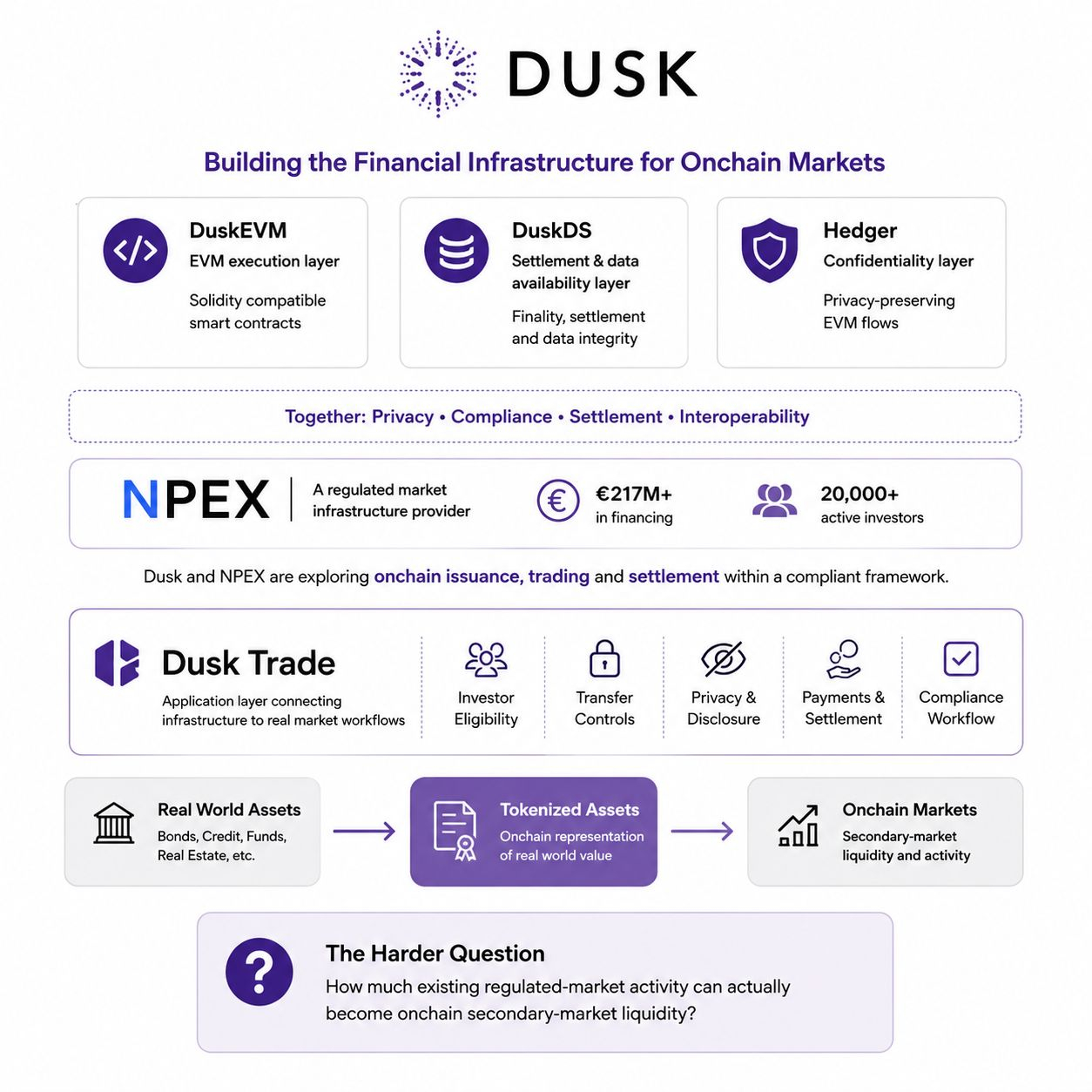
I still think DuskEVM is solving the easy part of the problem.
Making Solidity developers comfortable on a new chain is one thing. Making regulated financial markets actually work around it is much harder.
What caught my attention wasn’t the EVM compatibility. It was what sits underneath it: DuskEVM handles EVM execution, DuskDS provides settlement and data availability, while Hedger offers a route toward confidential EVM flows.
Then I looked at NPEX.
NPEX currently reports €217M+ in financing and 20,000+ active investors. Its partnership with Dusk is where an existing regulated market meets infrastructure being built for onchain financial workflows.
But that creates the harder question:
How much of that existing activity can actually become onchain secondary-market liquidity?
Because tokenizing an asset isn’t the hard part.
The real test is everything around it: who can access it, who can hold or transfer it, what stays private, what must be disclosed, how payments and settlement are coordinated, and whether the entire process works as one compliant workflow.
That’s why Dusk Trade interests me. It is trying to connect those market processes rather than treating the token itself as the finished product.
So I’m less interested in whether Dusk can put another asset onchain.
I’m more interested in whether its regulated-market relationships can translate into real trading and settlement activity onchain.
The architecture is one thing. Proving the liquidity is another.
Can Dusk bridge that gap?
@Dusk_Foundation $DUSK #dusk
I still think DuskEVM is solving the easy part of the problem.
Making Solidity developers comfortable on a new chain is one thing. Making regulated financial markets actually work around it is much harder.
What caught my attention wasn’t the EVM compatibility. It was what sits underneath it: DuskEVM handles EVM execution, DuskDS provides settlement and data availability, while Hedger offers a route toward confidential EVM flows.
Then I looked at NPEX.
NPEX currently reports €217M+ in financing and 20,000+ active investors. Its partnership with Dusk is where an existing regulated market meets infrastructure being built for onchain financial workflows.
But that creates the harder question:
How much of that existing activity can actually become onchain secondary-market liquidity?
Because tokenizing an asset isn’t the hard part.
The real test is everything around it: who can access it, who can hold or transfer it, what stays private, what must be disclosed, how payments and settlement are coordinated, and whether the entire process works as one compliant workflow.
That’s why Dusk Trade interests me. It is trying to connect those market processes rather than treating the token itself as the finished product.
So I’m less interested in whether Dusk can put another asset onchain.
I’m more interested in whether its regulated-market relationships can translate into real trading and settlement activity onchain.
The architecture is one thing. Proving the liquidity is another.
Can Dusk bridge that gap?
@Dusk $DUSK #dusk
Making Solidity developers comfortable on a new chain is one thing. Making regulated financial markets actually work around it is much harder.
What caught my attention wasn’t the EVM compatibility. It was what sits underneath it: DuskEVM handles EVM execution, DuskDS provides settlement and data availability, while Hedger offers a route toward confidential EVM flows.
Then I looked at NPEX.
NPEX currently reports €217M+ in financing and 20,000+ active investors. Its partnership with Dusk is where an existing regulated market meets infrastructure being built for onchain financial workflows.
But that creates the harder question:
How much of that existing activity can actually become onchain secondary-market liquidity?
Because tokenizing an asset isn’t the hard part.
The real test is everything around it: who can access it, who can hold or transfer it, what stays private, what must be disclosed, how payments and settlement are coordinated, and whether the entire process works as one compliant workflow.
That’s why Dusk Trade interests me. It is trying to connect those market processes rather than treating the token itself as the finished product.
So I’m less interested in whether Dusk can put another asset onchain.
I’m more interested in whether its regulated-market relationships can translate into real trading and settlement activity onchain.
The architecture is one thing. Proving the liquidity is another.
Can Dusk bridge that gap?
@Dusk $DUSK #dusk
9
8
104
I still think DuskEVM solves the easy part of the problem. The harder question is why I would stay.
I noticed the developer entry point is familiar: Solidity works with Hardhat and Foundry, while DuskEVM uses Chain ID 744 on mainnet and 745 on testnet.
But EVM compatibility alone isn’t enough.
The more interesting layer is Hedger, which brings confidential EVM workflows using homomorphic encryption and zero-knowledge proofs. That could matter when financial applications need privacy without losing the ability to meet regulatory requirements.
Then there’s Dusk Trade, focusing on things like investor onboarding, controlled asset transfers, payment coordination and settlement for tokenized financial assets.
That creates the real tension for me:
EVM compatibility can get developers through the door. But privacy, compliance and financial infrastructure have to give them a reason to stay.
Can Dusk turn its familiar EVM environment into a real advantage for regulated finance, rather than simply becoming another EVM chain?
@Dusk_Foundation $DUSK #dusk
What will make DuskEVM stand out in regulated finance?
I still think DuskEVM solves the easy part of the problem. The harder question is why I would stay.
I noticed the developer entry point is familiar: Solidity works with Hardhat and Foundry, while DuskEVM uses Chain ID 744 on mainnet and 745 on testnet.
But EVM compatibility alone isn’t enough.
The more interesting layer is Hedger, which brings confidential EVM workflows using homomorphic encryption and zero-knowledge proofs. That could matter when financial applications need privacy without losing the ability to meet regulatory requirements.
Then there’s Dusk Trade, focusing on things like investor onboarding, controlled asset transfers, payment coordination and settlement for tokenized financial assets.
That creates the real tension for me:
EVM compatibility can get developers through the door. But privacy, compliance and financial infrastructure have to give them a reason to stay.
Can Dusk turn its familiar EVM environment into a real advantage for regulated finance, rather than simply becoming another EVM chain?
@Dusk $DUSK #dusk
What will make DuskEVM stand out in regulated finance?
I noticed the developer entry point is familiar: Solidity works with Hardhat and Foundry, while DuskEVM uses Chain ID 744 on mainnet and 745 on testnet.
But EVM compatibility alone isn’t enough.
The more interesting layer is Hedger, which brings confidential EVM workflows using homomorphic encryption and zero-knowledge proofs. That could matter when financial applications need privacy without losing the ability to meet regulatory requirements.
Then there’s Dusk Trade, focusing on things like investor onboarding, controlled asset transfers, payment coordination and settlement for tokenized financial assets.
That creates the real tension for me:
EVM compatibility can get developers through the door. But privacy, compliance and financial infrastructure have to give them a reason to stay.
Can Dusk turn its familiar EVM environment into a real advantage for regulated finance, rather than simply becoming another EVM chain?
@Dusk $DUSK #dusk
What will make DuskEVM stand out in regulated finance?
EVM compatibility
40%
Privacy + compliance
60%
5 Votes • Vote fermé
4
5
79
Connectez-vous pour découvrir plus de contenu
Rejoignez la communauté mondiale des adeptes de cryptomonnaies sur Binance Square
⚡️ Suviez les dernières informations importantes sur les cryptomonnaies.
💬 Jugé digne de confiance par la plus grande plateforme d’échange de cryptomonnaies au monde.
👍 Découvrez les connaissances que partagent les créateurs vérifiés.
Adresse e-mail/Nº de téléphone