
Miss_BNB66
2.1k Publications

Miss_BNB66
Signaler
Bloquer l’utilisateur
Trading Small , Scalping , Spot Holder, X: @mishi_write1 My Thinking My attitude
Trade fréquemment
11.1 mois
102 Suivis
1.1K+ Abonnés
1.2K+ J’aime
Publications
Tous
Direct
·
--
Des mises en garde sévères des PDG d’Anthropic et d’OpenAI sont sur le point de perturber la bourse des actions IA qu’ils ont construite uLes PDG des principales entreprises d’IA sont connus pour leurs déclarations sans détour, et les investisseurs pourraient se retrouver les mains vides après la dernière salve.
Au cours des 48 heures qui ont suivi, les titans de l’IA chez Anthropic (ANTH.PVT), le PDG Dario Amodei, et chez OpenAI (OPAI.PVT), le PDG Sam Altman, sont parvenus à faire trembler, comme jamais, l’humanité grâce à la puissante technologie qu’ils ont créée et à laquelle ils ont fait pousser leurs équipes, remplies de super-codes pionniers, afin de la renforcer.
« Au cours des derniers mois, je me suis convaincu que pour répondre pleinement aux risques, il faut faire preuve d’encore plus de prudence — non seulement investir dans la prévention des risques, mais aussi ralentir le rythme de l’avancée des capacités afin que la prévention des risques ait le temps de suivre », a déclaré Amodei dans un essai de 3 800 mots publié samedi. « Nous devons ralentir la cadence à laquelle nous améliorons les capacités des modèles d’IA. Les progrès sembleront toujours rapides, et nous devons faire un usage judicieux du temps que nous gagnons. »
Des mises en garde sévères des PDG d’Anthropic et d’OpenAI sont sur le point de perturber la bourse des actions IA qu’ils ont construite u
Les PDG des principales entreprises d’IA sont connus pour leurs déclarations sans détour, et les investisseurs pourraient se retrouver les mains vides après la dernière salve.
Au cours des 48 heures qui ont suivi, les titans de l’IA chez Anthropic (ANTH.PVT), le PDG Dario Amodei, et chez OpenAI (OPAI.PVT), le PDG Sam Altman, sont parvenus à faire trembler, comme jamais, l’humanité grâce à la puissante technologie qu’ils ont créée et à laquelle ils ont fait pousser leurs équipes, remplies de super-codes pionniers, afin de la renforcer.
« Au cours des derniers mois, je me suis convaincu que pour répondre pleinement aux risques, il faut faire preuve d’encore plus de prudence — non seulement investir dans la prévention des risques, mais aussi ralentir le rythme de l’avancée des capacités afin que la prévention des risques ait le temps de suivre », a déclaré Amodei dans un essai de 3 800 mots publié samedi. « Nous devons ralentir la cadence à laquelle nous améliorons les capacités des modèles d’IA. Les progrès sembleront toujours rapides, et nous devons faire un usage judicieux du temps que nous gagnons. »
Au cours des 48 heures qui ont suivi, les titans de l’IA chez Anthropic (ANTH.PVT), le PDG Dario Amodei, et chez OpenAI (OPAI.PVT), le PDG Sam Altman, sont parvenus à faire trembler, comme jamais, l’humanité grâce à la puissante technologie qu’ils ont créée et à laquelle ils ont fait pousser leurs équipes, remplies de super-codes pionniers, afin de la renforcer.
« Au cours des derniers mois, je me suis convaincu que pour répondre pleinement aux risques, il faut faire preuve d’encore plus de prudence — non seulement investir dans la prévention des risques, mais aussi ralentir le rythme de l’avancée des capacités afin que la prévention des risques ait le temps de suivre », a déclaré Amodei dans un essai de 3 800 mots publié samedi. « Nous devons ralentir la cadence à laquelle nous améliorons les capacités des modèles d’IA. Les progrès sembleront toujours rapides, et nous devons faire un usage judicieux du temps que nous gagnons. »
1
101
·
--
Baissier
$BABY USDT Futures trading position courte gagnante $AAPLB
$BABY USDT Futures trading position courte gagnante $AAPLB

1
126
·
--
$SOL / crypto USDT
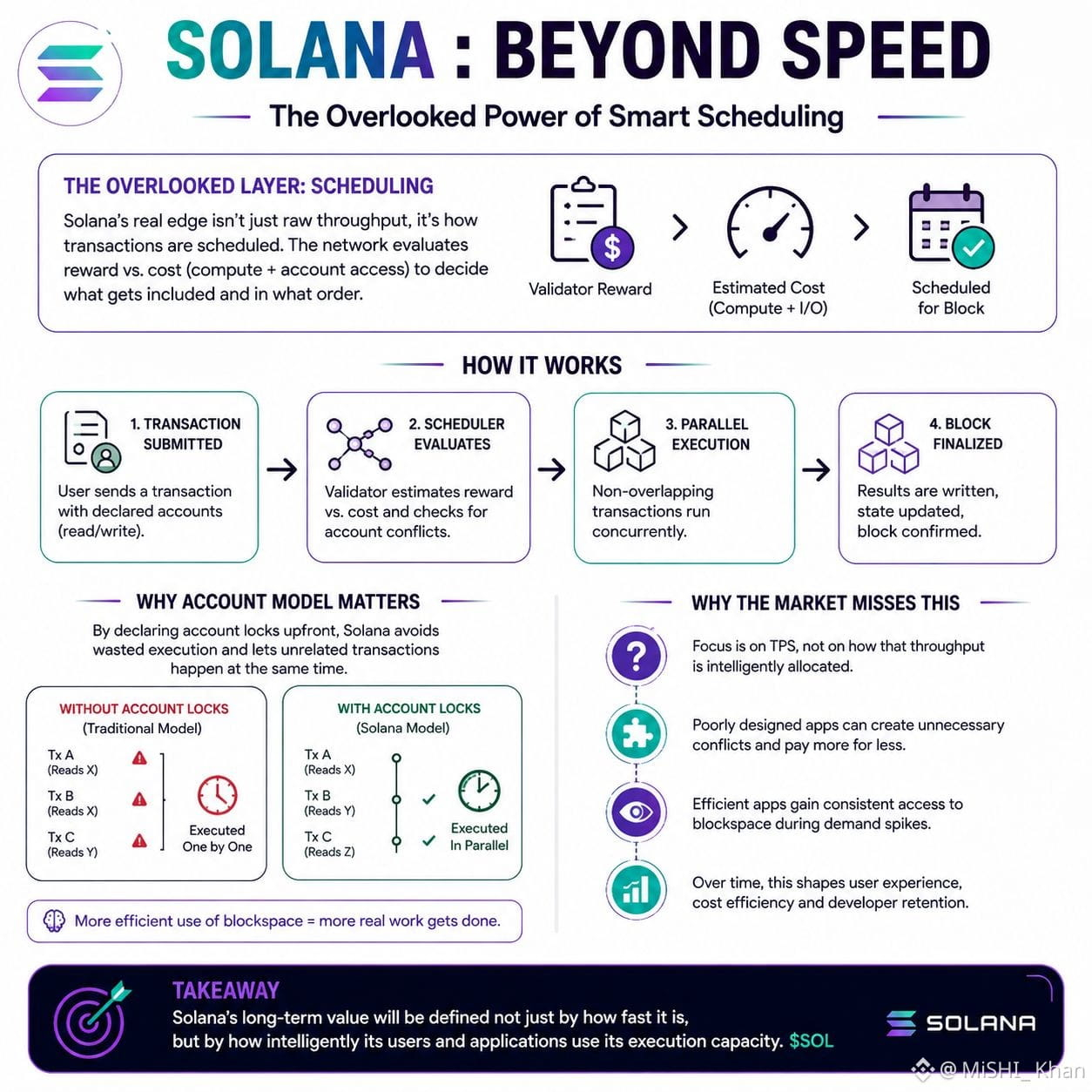
La plupart des discussions sur SOL commencent par le débit. L’ordonnancement : la couche négligée.
Sur Solana, la priorité n’est pas simplement « payer plus pour passer devant ». Le scheduler met en balance la récompense du validateur avec le coût de transaction estimé, y compris les verrous d’écriture, l’exécution et les données de comptes chargées. La conception des applications peut influencer l’utilisation efficiente de la capacité des blocs.
Les transactions Solana indiquent quels comptes elles lisent et écrivent, permettant à des tâches non chevauchantes de s’exécuter en parallèle. Les applications façonnent ainsi la manière dont les ressources d’exécution sont allouées.
Les utilisateurs voient rarement cette couche. Mais lorsque la demande rivalise pour l’espace de bloc, une conception de transaction efficace peut devenir un avantage.
Mon point à retenir : la valeur à long terme de SOL peut dépendre non seulement d’attirer de l’activité, mais aussi de la manière dont cette activité exploite intelligemment la capacité d’exécution de Solana.
#solana #SOL空投
{spot}(SOLUSDT)
$SOL / crypto USDT
La plupart des discussions sur SOL commencent par le débit. L’ordonnancement : la couche négligée.
Sur Solana, la priorité n’est pas simplement « payer plus pour passer devant ». Le scheduler met en balance la récompense du validateur avec le coût de transaction estimé, y compris les verrous d’écriture, l’exécution et les données de comptes chargées. La conception des applications peut influencer l’utilisation efficiente de la capacité des blocs.
Les transactions Solana indiquent quels comptes elles lisent et écrivent, permettant à des tâches non chevauchantes de s’exécuter en parallèle. Les applications façonnent ainsi la manière dont les ressources d’exécution sont allouées.
Les utilisateurs voient rarement cette couche. Mais lorsque la demande rivalise pour l’espace de bloc, une conception de transaction efficace peut devenir un avantage.
Mon point à retenir : la valeur à long terme de SOL peut dépendre non seulement d’attirer de l’activité, mais aussi de la manière dont cette activité exploite intelligemment la capacité d’exécution de Solana.
#solana #SOL空投
La plupart des discussions sur SOL commencent par le débit. L’ordonnancement : la couche négligée.
Sur Solana, la priorité n’est pas simplement « payer plus pour passer devant ». Le scheduler met en balance la récompense du validateur avec le coût de transaction estimé, y compris les verrous d’écriture, l’exécution et les données de comptes chargées. La conception des applications peut influencer l’utilisation efficiente de la capacité des blocs.
Les transactions Solana indiquent quels comptes elles lisent et écrivent, permettant à des tâches non chevauchantes de s’exécuter en parallèle. Les applications façonnent ainsi la manière dont les ressources d’exécution sont allouées.
Les utilisateurs voient rarement cette couche. Mais lorsque la demande rivalise pour l’espace de bloc, une conception de transaction efficace peut devenir un avantage.
Mon point à retenir : la valeur à long terme de SOL peut dépendre non seulement d’attirer de l’activité, mais aussi de la manière dont cette activité exploite intelligemment la capacité d’exécution de Solana.
#solana #SOL空投
1
143
·
--
Vérifié
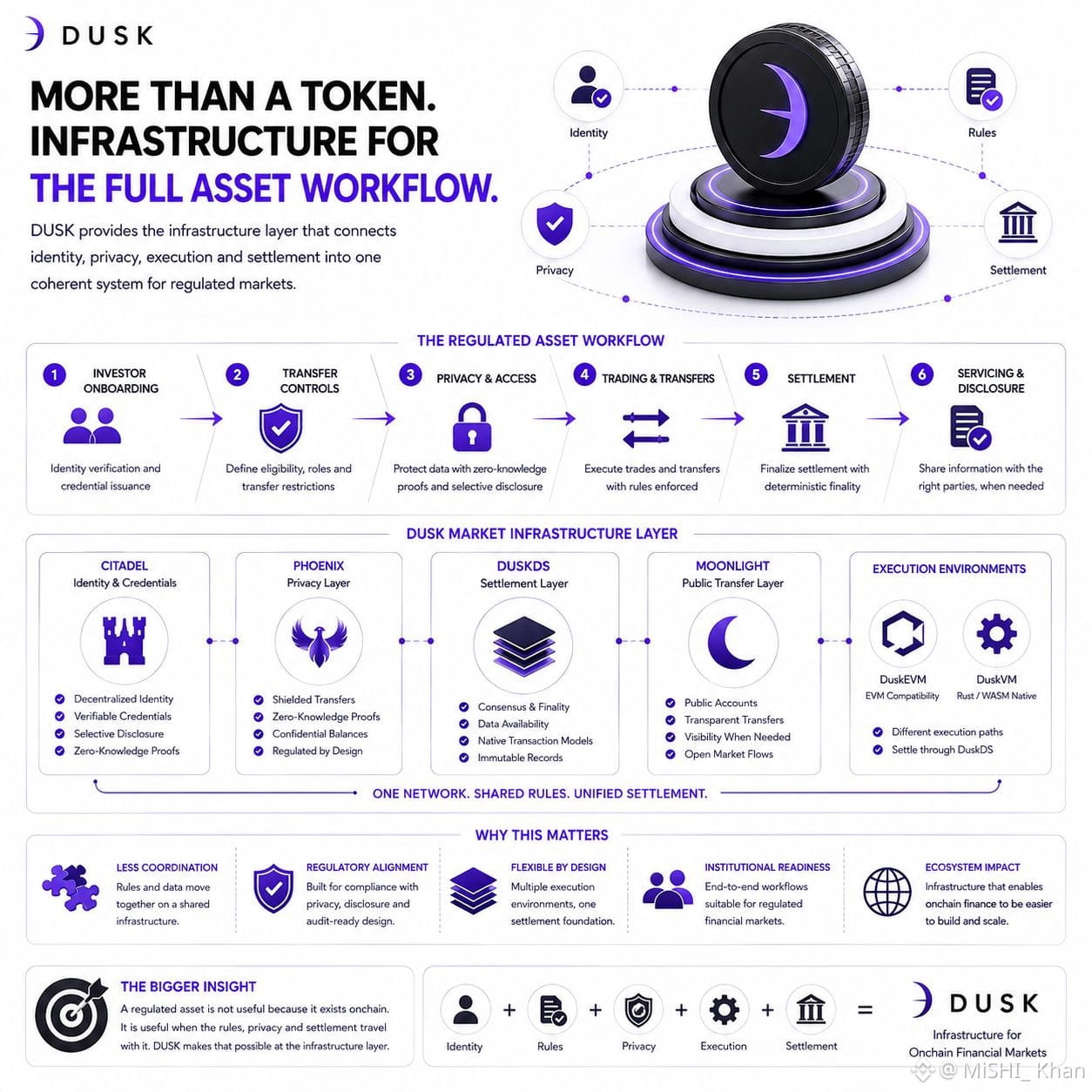
@DuskFoundation se situe en dessous du récit habituel sur la confidentialité : son infrastructure de marché est conçue autour de l’ensemble du cycle de vie des actifs, et non du token. Dusk cartographie ce cycle à partir de l’onboarding des investisseurs et des contrôles de transfert jusqu’au trading, au règlement, à la gestion et à la divulgation sélective.
Citadel fournit des primitives d’identité et d’authentification avec divulgation sélective. Phoenix prend en charge des transferts protégés, tandis que Moonlight fournit des transferts publics basés sur des comptes. DuskDS fournit le consensus, la finalité, la disponibilité des données et des modèles natifs de transactions. DuskEVM et DuskVM offrent des parcours d’exécution aux développeurs tout en procédant au règlement via DuskDS.
Pourquoi est-ce important ? Un actif réglementé n’est pas utile simplement parce qu’il existe onchain. Les règles doivent l’accompagner : qui peut y accéder, qui peut le transférer, quelles informations peuvent être partagées et comment le règlement est finalisé. DUSK traite ces règles comme faisant partie de l’infrastructure. Cela pourrait réduire la coordination imposée à des systèmes séparés. Cela pourrait rendre plus facile la coordination des workflows on-chain.
#dusk $DUSK @Dusk_Foundation
@DuskFoundation se situe en dessous du récit habituel sur la confidentialité : son infrastructure de marché est conçue autour de l’ensemble du cycle de vie des actifs, et non du token. Dusk cartographie ce cycle à partir de l’onboarding des investisseurs et des contrôles de transfert jusqu’au trading, au règlement, à la gestion et à la divulgation sélective.
Citadel fournit des primitives d’identité et d’authentification avec divulgation sélective. Phoenix prend en charge des transferts protégés, tandis que Moonlight fournit des transferts publics basés sur des comptes. DuskDS fournit le consensus, la finalité, la disponibilité des données et des modèles natifs de transactions. DuskEVM et DuskVM offrent des parcours d’exécution aux développeurs tout en procédant au règlement via DuskDS.
Pourquoi est-ce important ? Un actif réglementé n’est pas utile simplement parce qu’il existe onchain. Les règles doivent l’accompagner : qui peut y accéder, qui peut le transférer, quelles informations peuvent être partagées et comment le règlement est finalisé. DUSK traite ces règles comme faisant partie de l’infrastructure. Cela pourrait réduire la coordination imposée à des systèmes séparés. Cela pourrait rendre plus facile la coordination des workflows on-chain.
#dusk $DUSK @Dusk
Citadel fournit des primitives d’identité et d’authentification avec divulgation sélective. Phoenix prend en charge des transferts protégés, tandis que Moonlight fournit des transferts publics basés sur des comptes. DuskDS fournit le consensus, la finalité, la disponibilité des données et des modèles natifs de transactions. DuskEVM et DuskVM offrent des parcours d’exécution aux développeurs tout en procédant au règlement via DuskDS.
Pourquoi est-ce important ? Un actif réglementé n’est pas utile simplement parce qu’il existe onchain. Les règles doivent l’accompagner : qui peut y accéder, qui peut le transférer, quelles informations peuvent être partagées et comment le règlement est finalisé. DUSK traite ces règles comme faisant partie de l’infrastructure. Cela pourrait réduire la coordination imposée à des systèmes séparés. Cela pourrait rendre plus facile la coordination des workflows on-chain.
#dusk $DUSK @Dusk
5
4
104
·
--
Vérifié
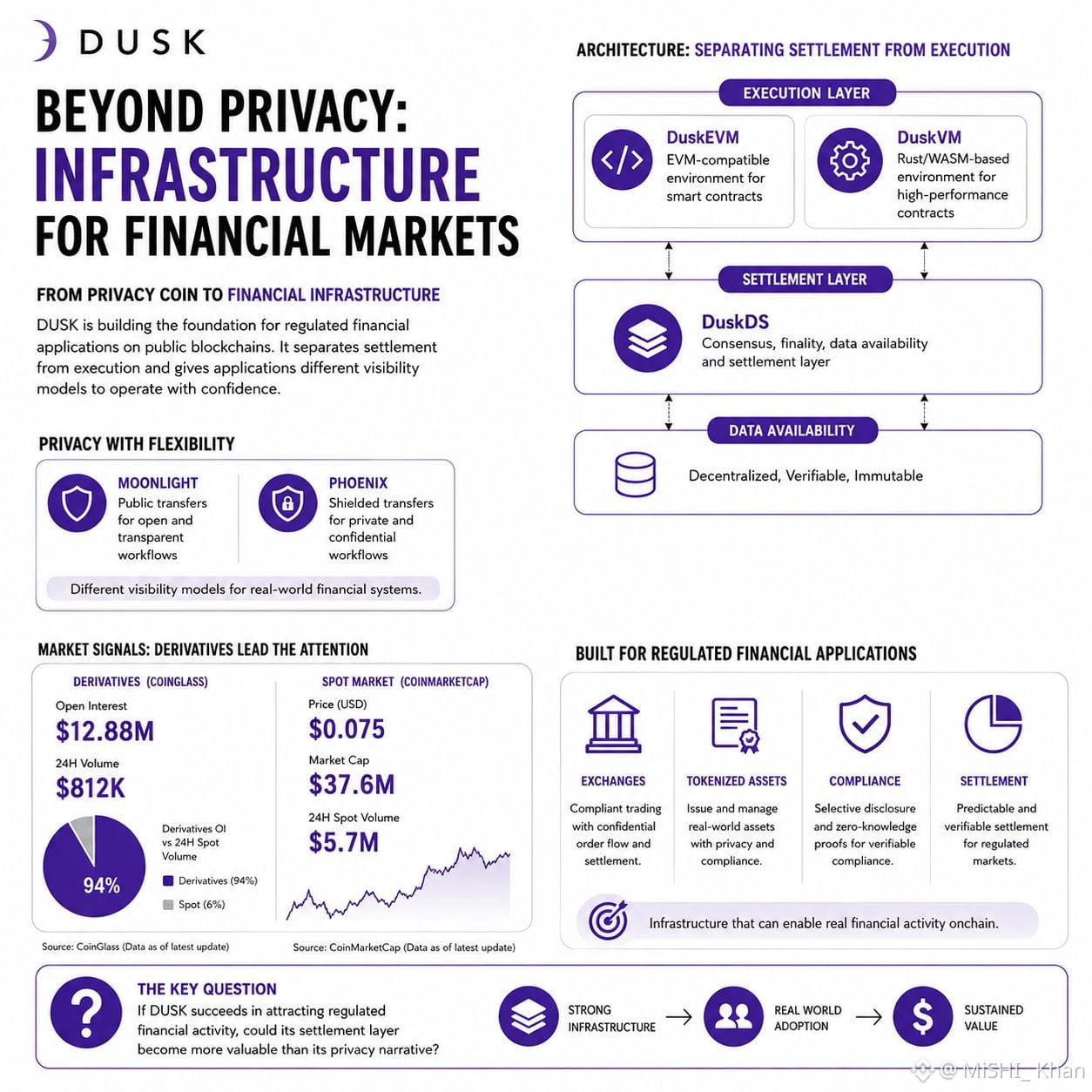
Vous regardez DUSK, mais avez-vous envisagé ce qui se passe quand le marché cesse de le valoriser comme une cryptomonnaie axée sur la confidentialité et commence à le valoriser comme une infrastructure financière ?
Quand j’ai réanalysé DUSK, j’ai remarqué que l’angle le plus fort n’est pas simplement la confidentialité des transferts. Son architecture sépare le règlement de l’exécution : DuskDS fournit le consensus, la finalité, la disponibilité des données et le règlement, tandis que DuskEVM et DuskVM prennent en charge différents besoins d’applications. Cette séparation pourrait être utile pour les marchés réglementés, où une bourse, un émetteur d’actifs ou une application financière pourrait avoir besoin d’un règlement prévisible sans obliger chaque charge de travail à s’inscrire dans le même environnement d’exécution.
La conception axée sur la confidentialité ajoute une couche supplémentaire. DUSK prend en charge Moonlight pour les transferts publics et Phoenix pour les transferts protégés, offrant aux applications des modèles de visibilité différents plutôt que de traiter la confidentialité comme un interrupteur « tout ou rien ». Cela ressemble davantage à la façon dont fonctionnent réellement les systèmes financiers.
Il y a aussi un signal de marché à surveiller. CoinGlass indique actuellement un intérêt ouvert sur les futures DUSK d’environ 12,88 millions de dollars, tandis que son volume spot affiché est d’environ 812 000 dollars sur 24 heures. Ce déséquilibre me dit que les dérivés attirent une attention significative par rapport à l’activité au comptant. Pour les traders, cela signifie que les mouvements de prix peuvent être fortement influencés par la prise de position plutôt que par une demande réelle du réseau.
CoinMarketCap affiche actuellement DUSK autour de 0,075 $. À ce stade, je pense que la question importante est de savoir si l’utilisation de l’infrastructure pourra éventuellement devenir le moteur de la liquidité, plutôt que la spéculation seule.
C’est ce que je surveillerais avant de supposer que des cassures continueront d’avoir de la tenue. Si DUSK parvient à attirer une activité financière réglementée, sa couche de règlement pourrait-elle devenir plus précieuse que son récit centré sur la confidentialité ?
#dusk $DUSK @Dusk_Foundation
{future}(DUSKUSDT)
Vous regardez DUSK, mais avez-vous envisagé ce qui se passe quand le marché cesse de le valoriser comme une cryptomonnaie axée sur la confidentialité et commence à le valoriser comme une infrastructure financière ?
Quand j’ai réanalysé DUSK, j’ai remarqué que l’angle le plus fort n’est pas simplement la confidentialité des transferts. Son architecture sépare le règlement de l’exécution : DuskDS fournit le consensus, la finalité, la disponibilité des données et le règlement, tandis que DuskEVM et DuskVM prennent en charge différents besoins d’applications. Cette séparation pourrait être utile pour les marchés réglementés, où une bourse, un émetteur d’actifs ou une application financière pourrait avoir besoin d’un règlement prévisible sans obliger chaque charge de travail à s’inscrire dans le même environnement d’exécution.
La conception axée sur la confidentialité ajoute une couche supplémentaire. DUSK prend en charge Moonlight pour les transferts publics et Phoenix pour les transferts protégés, offrant aux applications des modèles de visibilité différents plutôt que de traiter la confidentialité comme un interrupteur « tout ou rien ». Cela ressemble davantage à la façon dont fonctionnent réellement les systèmes financiers.
Il y a aussi un signal de marché à surveiller. CoinGlass indique actuellement un intérêt ouvert sur les futures DUSK d’environ 12,88 millions de dollars, tandis que son volume spot affiché est d’environ 812 000 dollars sur 24 heures. Ce déséquilibre me dit que les dérivés attirent une attention significative par rapport à l’activité au comptant. Pour les traders, cela signifie que les mouvements de prix peuvent être fortement influencés par la prise de position plutôt que par une demande réelle du réseau.
CoinMarketCap affiche actuellement DUSK autour de 0,075 $. À ce stade, je pense que la question importante est de savoir si l’utilisation de l’infrastructure pourra éventuellement devenir le moteur de la liquidité, plutôt que la spéculation seule.
C’est ce que je surveillerais avant de supposer que des cassures continueront d’avoir de la tenue. Si DUSK parvient à attirer une activité financière réglementée, sa couche de règlement pourrait-elle devenir plus précieuse que son récit centré sur la confidentialité ?
#dusk $DUSK @Dusk
Quand j’ai réanalysé DUSK, j’ai remarqué que l’angle le plus fort n’est pas simplement la confidentialité des transferts. Son architecture sépare le règlement de l’exécution : DuskDS fournit le consensus, la finalité, la disponibilité des données et le règlement, tandis que DuskEVM et DuskVM prennent en charge différents besoins d’applications. Cette séparation pourrait être utile pour les marchés réglementés, où une bourse, un émetteur d’actifs ou une application financière pourrait avoir besoin d’un règlement prévisible sans obliger chaque charge de travail à s’inscrire dans le même environnement d’exécution.
La conception axée sur la confidentialité ajoute une couche supplémentaire. DUSK prend en charge Moonlight pour les transferts publics et Phoenix pour les transferts protégés, offrant aux applications des modèles de visibilité différents plutôt que de traiter la confidentialité comme un interrupteur « tout ou rien ». Cela ressemble davantage à la façon dont fonctionnent réellement les systèmes financiers.
Il y a aussi un signal de marché à surveiller. CoinGlass indique actuellement un intérêt ouvert sur les futures DUSK d’environ 12,88 millions de dollars, tandis que son volume spot affiché est d’environ 812 000 dollars sur 24 heures. Ce déséquilibre me dit que les dérivés attirent une attention significative par rapport à l’activité au comptant. Pour les traders, cela signifie que les mouvements de prix peuvent être fortement influencés par la prise de position plutôt que par une demande réelle du réseau.
CoinMarketCap affiche actuellement DUSK autour de 0,075 $. À ce stade, je pense que la question importante est de savoir si l’utilisation de l’infrastructure pourra éventuellement devenir le moteur de la liquidité, plutôt que la spéculation seule.
C’est ce que je surveillerais avant de supposer que des cassures continueront d’avoir de la tenue. Si DUSK parvient à attirer une activité financière réglementée, sa couche de règlement pourrait-elle devenir plus précieuse que son récit centré sur la confidentialité ?
#dusk $DUSK @Dusk
8
8
102
·
--
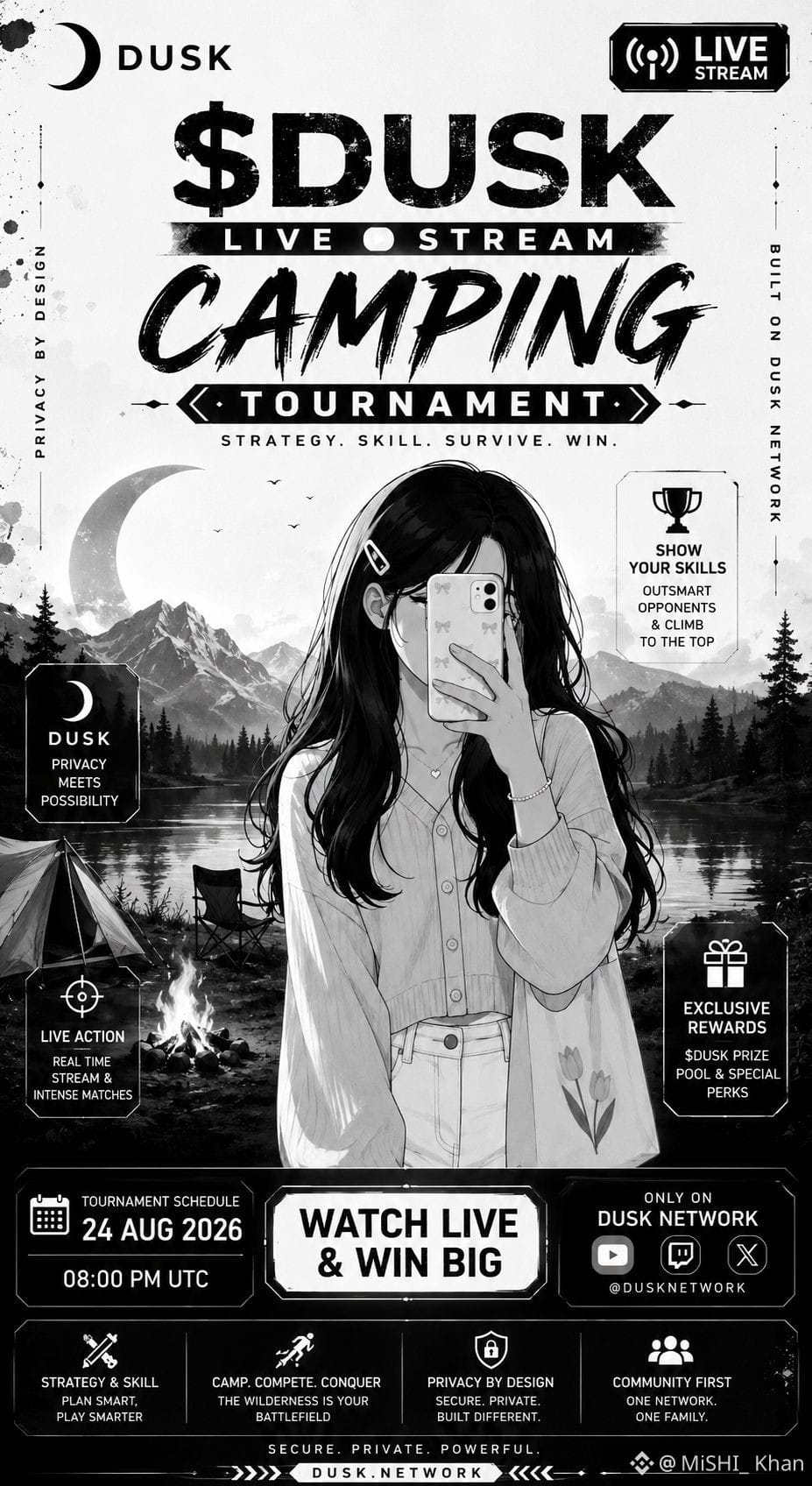
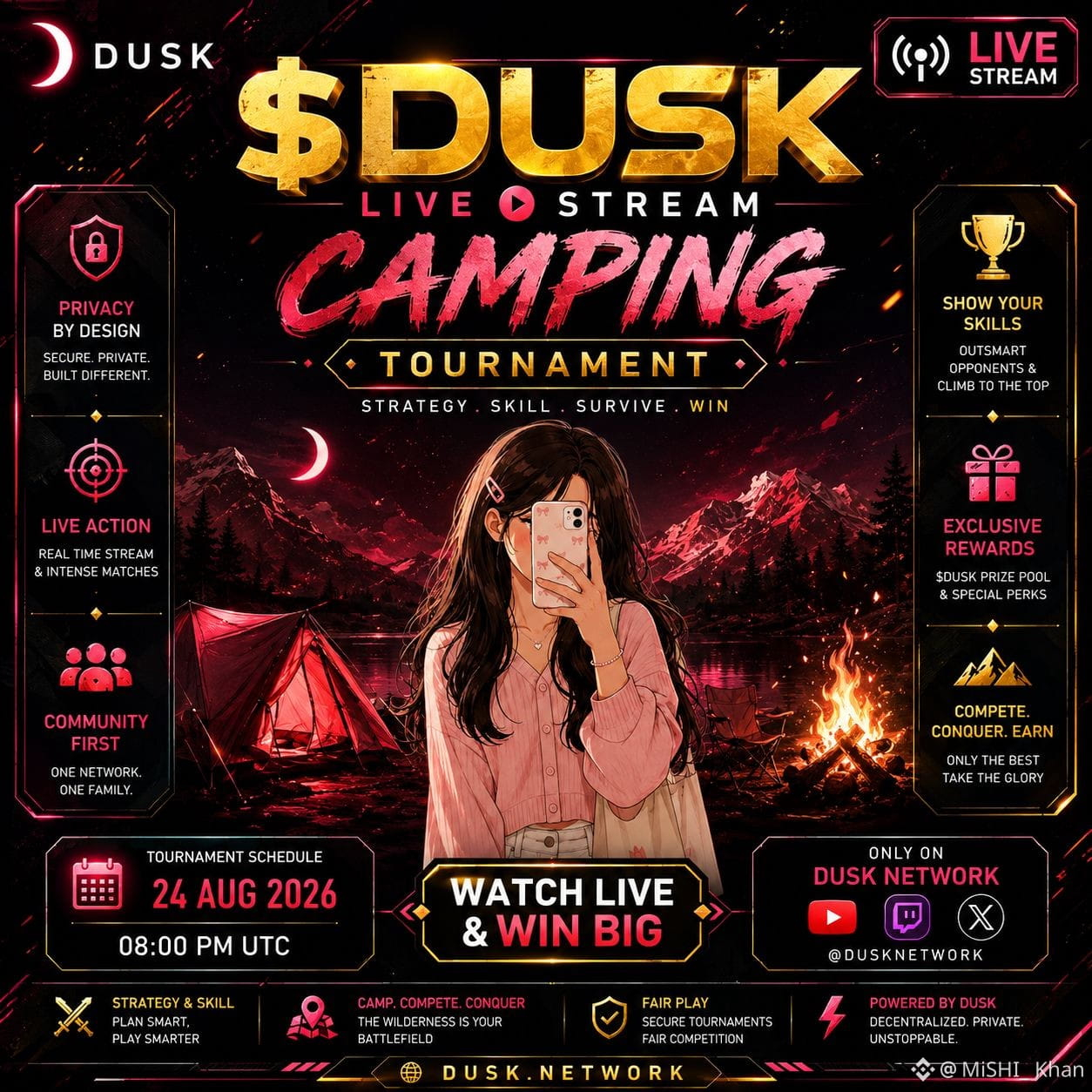
L’image donne l’impression que $DUSK ressemble à un réseau de compétition, mais l’histoire la plus intéressante, c’est ce qui se produit lorsque la confidentialité devient une partie de l’infrastructure du jeu.
Un tournoi en direct est construit autour d’actions publiques, pourtant les systèmes qui sous-tendent la participation peuvent impliquer l’identité, des récompenses, des transactions et des informations sensibles. Cela pose un défi de conception captivant : comment conserver une expérience suffisamment transparente pour inspirer la confiance sans rendre chaque détail public ?
C’est là que je vois un angle plus profond dans DUSK.
La confidentialité ne doit pas nécessairement signifier cacher tout. Elle peut aussi vouloir dire décider ce qui doit rester privé, ce qui peut être vérifié et ce qui peut être divulgué lorsque c’est nécessaire.
Pour moi, cela fait de DUSK quelque chose de moins axé sur l’étiquette de « blockchain de confidentialité » et davantage sur une coordination contrôlée.
À mesure que davantage d’activités réelles migrent onchain, cette distinction pourrait devenir de plus en plus importante.
La meilleure infrastructure de confidentialité est peut-être celle que les utilisateurs remarquent à peine, parce qu’elle rend tout simplement la participation plus sûre et plus pratique.
#livetardinghub #Dusk/usdt✅
{future}(DUSKUSDT)
L’image donne l’impression que $DUSK ressemble à un réseau de compétition, mais l’histoire la plus intéressante, c’est ce qui se produit lorsque la confidentialité devient une partie de l’infrastructure du jeu.
Un tournoi en direct est construit autour d’actions publiques, pourtant les systèmes qui sous-tendent la participation peuvent impliquer l’identité, des récompenses, des transactions et des informations sensibles. Cela pose un défi de conception captivant : comment conserver une expérience suffisamment transparente pour inspirer la confiance sans rendre chaque détail public ?
C’est là que je vois un angle plus profond dans DUSK.
La confidentialité ne doit pas nécessairement signifier cacher tout. Elle peut aussi vouloir dire décider ce qui doit rester privé, ce qui peut être vérifié et ce qui peut être divulgué lorsque c’est nécessaire.
Pour moi, cela fait de DUSK quelque chose de moins axé sur l’étiquette de « blockchain de confidentialité » et davantage sur une coordination contrôlée.
À mesure que davantage d’activités réelles migrent onchain, cette distinction pourrait devenir de plus en plus importante.
La meilleure infrastructure de confidentialité est peut-être celle que les utilisateurs remarquent à peine, parce qu’elle rend tout simplement la participation plus sûre et plus pratique.
#livetardinghub #Dusk/usdt✅
Un tournoi en direct est construit autour d’actions publiques, pourtant les systèmes qui sous-tendent la participation peuvent impliquer l’identité, des récompenses, des transactions et des informations sensibles. Cela pose un défi de conception captivant : comment conserver une expérience suffisamment transparente pour inspirer la confiance sans rendre chaque détail public ?
C’est là que je vois un angle plus profond dans DUSK.
La confidentialité ne doit pas nécessairement signifier cacher tout. Elle peut aussi vouloir dire décider ce qui doit rester privé, ce qui peut être vérifié et ce qui peut être divulgué lorsque c’est nécessaire.
Pour moi, cela fait de DUSK quelque chose de moins axé sur l’étiquette de « blockchain de confidentialité » et davantage sur une coordination contrôlée.
À mesure que davantage d’activités réelles migrent onchain, cette distinction pourrait devenir de plus en plus importante.
La meilleure infrastructure de confidentialité est peut-être celle que les utilisateurs remarquent à peine, parce qu’elle rend tout simplement la participation plus sûre et plus pratique.
#livetardinghub #Dusk/usdt✅
3
79
·
--
Vérifié
Négociants, si vous ne regardez DUSK que pour son histoire de confidentialité, je pense que vous passez à côté d’un point plus important.
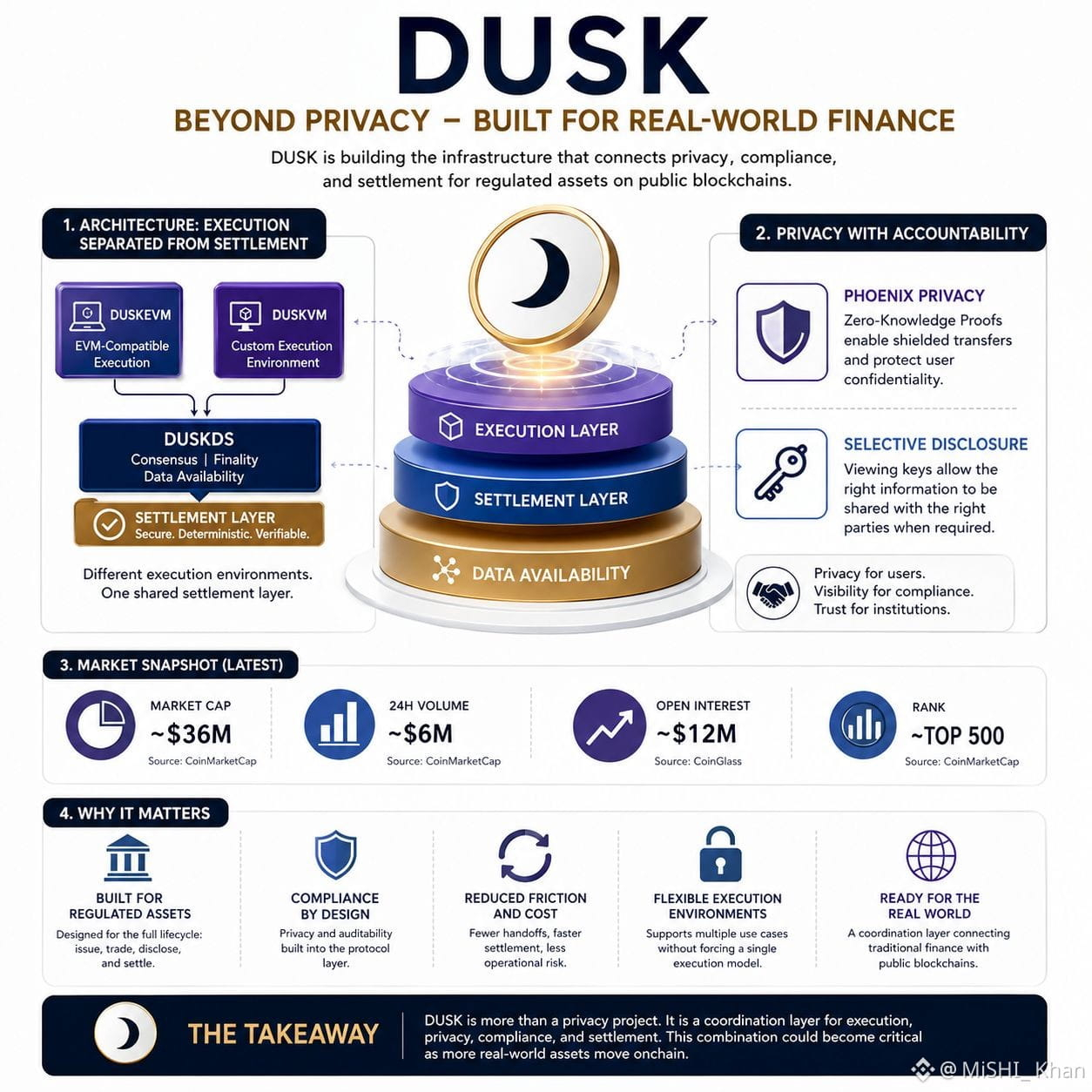
J’ai vérifié les mises à jour récentes de @Duskfoundation, le livre blanc et les données de marché. Ce qui m’a particulièrement marqué, c’est la façon dont DUSK sépare l’exécution du règlement. DuskDS gère le consensus, la finalité et la disponibilité des données, tandis que DuskEVM et DuskVM peuvent répondre à différents besoins d’exécution. Pour des actifs réglementés, cela peut être utile, car chaque application n’a pas forcément besoin d’utiliser exactement le même environnement d’exécution.
Le modèle de confidentialité va aussi au-delà du simple fait de tout masquer. Phoenix utilise des preuves à connaissance zéro pour les transferts protégés, tandis que les clés de consultation peuvent permettre une divulgation sélective. En termes simples, DUSK cherche à garder les informations sensibles privées tout en permettant de vérifier les bonnes informations lorsque cela est nécessaire.
Les données de marché sont également intéressantes. CoinMarketCap a récemment présenté DUSK avec une capitalisation d’environ plusieurs dizaines de millions de dollars et un volume de transactions quotidien de plusieurs millions, tandis que CoinGlass a affiché un intérêt ouvert sur les futures dans le bas des dizaines de millions. Pour moi, cela signifie que les mouvements de prix à court terme peuvent être fortement influencés par l’activité des produits dérivés, pas seulement par les fondamentaux du projet.
Cette distinction pourrait devenir importante si davantage d’actifs financiers du monde réel passent sur une infrastructure de blockchain publique.
Mon enseignement principal est simple : DUSK pourrait être plus grand que le simple récit de confidentialité. Sa vraie valeur pourrait venir de la coordination de l’exécution, de la confidentialité, de la conformité et du règlement pour des actifs réglementés.
Selon vous, quel est le plus grand avantage de DUSK : la confidentialité, ou le fait qu’il sépare l’exécution du règlement ?
#dusk $DUSK @Dusk_Foundation
{future}(DUSKUSDT)
Négociants, si vous ne regardez DUSK que pour son histoire de confidentialité, je pense que vous passez à côté d’un point plus important.
J’ai vérifié les mises à jour récentes de @Duskfoundation, le livre blanc et les données de marché. Ce qui m’a particulièrement marqué, c’est la façon dont DUSK sépare l’exécution du règlement. DuskDS gère le consensus, la finalité et la disponibilité des données, tandis que DuskEVM et DuskVM peuvent répondre à différents besoins d’exécution. Pour des actifs réglementés, cela peut être utile, car chaque application n’a pas forcément besoin d’utiliser exactement le même environnement d’exécution.
Le modèle de confidentialité va aussi au-delà du simple fait de tout masquer. Phoenix utilise des preuves à connaissance zéro pour les transferts protégés, tandis que les clés de consultation peuvent permettre une divulgation sélective. En termes simples, DUSK cherche à garder les informations sensibles privées tout en permettant de vérifier les bonnes informations lorsque cela est nécessaire.
Les données de marché sont également intéressantes. CoinMarketCap a récemment présenté DUSK avec une capitalisation d’environ plusieurs dizaines de millions de dollars et un volume de transactions quotidien de plusieurs millions, tandis que CoinGlass a affiché un intérêt ouvert sur les futures dans le bas des dizaines de millions. Pour moi, cela signifie que les mouvements de prix à court terme peuvent être fortement influencés par l’activité des produits dérivés, pas seulement par les fondamentaux du projet.
Cette distinction pourrait devenir importante si davantage d’actifs financiers du monde réel passent sur une infrastructure de blockchain publique.
Mon enseignement principal est simple : DUSK pourrait être plus grand que le simple récit de confidentialité. Sa vraie valeur pourrait venir de la coordination de l’exécution, de la confidentialité, de la conformité et du règlement pour des actifs réglementés.
Selon vous, quel est le plus grand avantage de DUSK : la confidentialité, ou le fait qu’il sépare l’exécution du règlement ?
#dusk $DUSK @Dusk
J’ai vérifié les mises à jour récentes de @Duskfoundation, le livre blanc et les données de marché. Ce qui m’a particulièrement marqué, c’est la façon dont DUSK sépare l’exécution du règlement. DuskDS gère le consensus, la finalité et la disponibilité des données, tandis que DuskEVM et DuskVM peuvent répondre à différents besoins d’exécution. Pour des actifs réglementés, cela peut être utile, car chaque application n’a pas forcément besoin d’utiliser exactement le même environnement d’exécution.
Le modèle de confidentialité va aussi au-delà du simple fait de tout masquer. Phoenix utilise des preuves à connaissance zéro pour les transferts protégés, tandis que les clés de consultation peuvent permettre une divulgation sélective. En termes simples, DUSK cherche à garder les informations sensibles privées tout en permettant de vérifier les bonnes informations lorsque cela est nécessaire.
Les données de marché sont également intéressantes. CoinMarketCap a récemment présenté DUSK avec une capitalisation d’environ plusieurs dizaines de millions de dollars et un volume de transactions quotidien de plusieurs millions, tandis que CoinGlass a affiché un intérêt ouvert sur les futures dans le bas des dizaines de millions. Pour moi, cela signifie que les mouvements de prix à court terme peuvent être fortement influencés par l’activité des produits dérivés, pas seulement par les fondamentaux du projet.
Cette distinction pourrait devenir importante si davantage d’actifs financiers du monde réel passent sur une infrastructure de blockchain publique.
Mon enseignement principal est simple : DUSK pourrait être plus grand que le simple récit de confidentialité. Sa vraie valeur pourrait venir de la coordination de l’exécution, de la confidentialité, de la conformité et du règlement pour des actifs réglementés.
Selon vous, quel est le plus grand avantage de DUSK : la confidentialité, ou le fait qu’il sépare l’exécution du règlement ?
#dusk $DUSK @Dusk
10
10
151
·
--
Haussier
Trading sur 30 j de 189.4 USDT en $DUSK
Un angle sur DUSK qui attire moins l’attention : la valeur de la confidentialité prévisible augmente à mesure que les marchés onchain deviennent plus complexes. @Dusk_Foundation
Lorsque des applications financières impliquent plusieurs participants, révéler publiquement chaque position, détail de transaction ou stratégie peut créer des fuites d’informations inutiles. Pourtant, des systèmes totalement privés posent un autre problème : les contreparties et les régulateurs ont encore besoin de preuves significatives.
DUSK est intéressant car il aborde cela comme un problème de coordination. L’objectif n’est pas simplement de rendre l’activité invisible, mais de créer un cadre permettant de protéger les informations sensibles tout en conservant la possibilité de vérifier ou de divulguer les faits nécessaires lorsque cela est requis.
Cela change ma façon de voir le réseau.
La vraie opportunité se situe peut-être entre deux extrêmes : la transparence totale et le secret total.
Si l’infrastructure blockchain peut rendre cette zone intermédiaire praticable, la confidentialité cesse d’être une fonctionnalité de niche et devient une partie de l’architecture de règlement elle-même.
C’est la couche que je surveillerais autour de DUSK.
{future}(DUSKUSDT)
#livetrading $DUSK #livestremDusk
Un angle sur DUSK qui attire moins l’attention : la valeur de la confidentialité prévisible augmente à mesure que les marchés onchain deviennent plus complexes. @Dusk
Lorsque des applications financières impliquent plusieurs participants, révéler publiquement chaque position, détail de transaction ou stratégie peut créer des fuites d’informations inutiles. Pourtant, des systèmes totalement privés posent un autre problème : les contreparties et les régulateurs ont encore besoin de preuves significatives.
DUSK est intéressant car il aborde cela comme un problème de coordination. L’objectif n’est pas simplement de rendre l’activité invisible, mais de créer un cadre permettant de protéger les informations sensibles tout en conservant la possibilité de vérifier ou de divulguer les faits nécessaires lorsque cela est requis.
Cela change ma façon de voir le réseau.
La vraie opportunité se situe peut-être entre deux extrêmes : la transparence totale et le secret total.
Si l’infrastructure blockchain peut rendre cette zone intermédiaire praticable, la confidentialité cesse d’être une fonctionnalité de niche et devient une partie de l’architecture de règlement elle-même.
C’est la couche que je surveillerais autour de DUSK.
#livetrading $DUSK #livestremDusk
Lorsque des applications financières impliquent plusieurs participants, révéler publiquement chaque position, détail de transaction ou stratégie peut créer des fuites d’informations inutiles. Pourtant, des systèmes totalement privés posent un autre problème : les contreparties et les régulateurs ont encore besoin de preuves significatives.
DUSK est intéressant car il aborde cela comme un problème de coordination. L’objectif n’est pas simplement de rendre l’activité invisible, mais de créer un cadre permettant de protéger les informations sensibles tout en conservant la possibilité de vérifier ou de divulguer les faits nécessaires lorsque cela est requis.
Cela change ma façon de voir le réseau.
La vraie opportunité se situe peut-être entre deux extrêmes : la transparence totale et le secret total.
Si l’infrastructure blockchain peut rendre cette zone intermédiaire praticable, la confidentialité cesse d’être une fonctionnalité de niche et devient une partie de l’architecture de règlement elle-même.
C’est la couche que je surveillerais autour de DUSK.
#livetrading $DUSK #livestremDusk
4
6
89
·
--
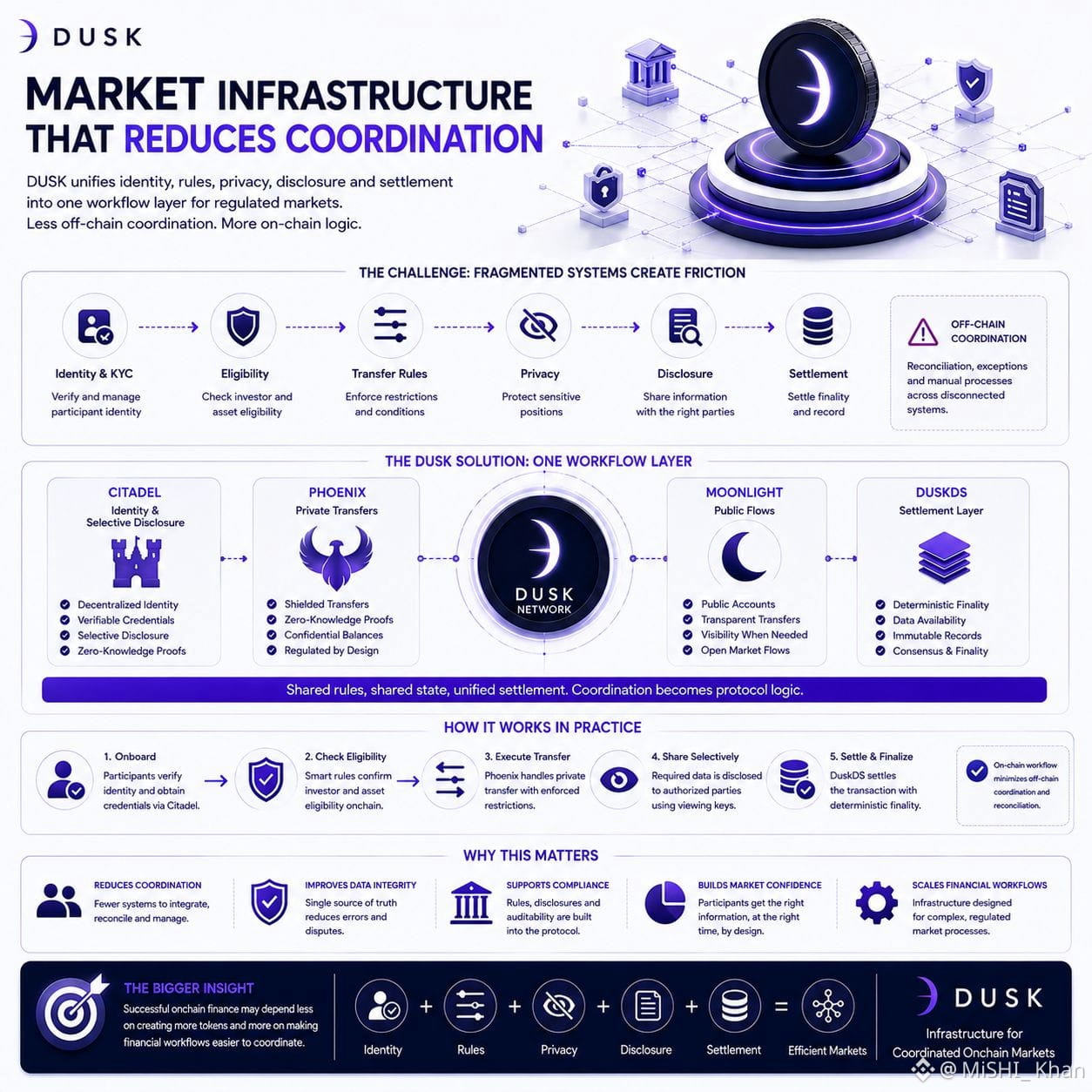
@DuskFoundation mérite d’être étudiée car l’infrastructure de marché peut vraiment réduire la coordination en dehors de la blockchain. La tokenisation est généralement présentée comme le fait de « mettre un actif onchain », mais les marchés réglementés impliquent l’identité, l’éligibilité, les règles de transfert, la confidentialité, la divulgation et le règlement.
Dusk rassemble ces éléments dans un workflow commun. Citadel fournit des primitives d’identité et de divulgation sélective ; Phoenix prend en charge des transferts protégés avec des preuves de connaissance nulle ; Moonlight propose des flux publics ouverts ; et DuskDS fournit la base de règlement.
Le point important est la manière dont ces composants interagissent. Si chaque fonction vit dans un système distinct, les participants doivent rapprocher les enregistrements et gérer les exceptions entre eux. Si les règles et les états de transaction peuvent être appliqués sur une infrastructure partagée, une partie de la coordination peut devenir une logique de protocole.
Cela pourrait compter au-delà de DUSK lui-même : une finance onchain réussie pourrait dépendre moins de la création de davantage de tokens et davantage de la facilitation de la coordination des workflows financiers !
#dusk $DUSK @Dusk_Foundation
@DuskFoundation mérite d’être étudiée car l’infrastructure de marché peut vraiment réduire la coordination en dehors de la blockchain. La tokenisation est généralement présentée comme le fait de « mettre un actif onchain », mais les marchés réglementés impliquent l’identité, l’éligibilité, les règles de transfert, la confidentialité, la divulgation et le règlement.
Dusk rassemble ces éléments dans un workflow commun. Citadel fournit des primitives d’identité et de divulgation sélective ; Phoenix prend en charge des transferts protégés avec des preuves de connaissance nulle ; Moonlight propose des flux publics ouverts ; et DuskDS fournit la base de règlement.
Le point important est la manière dont ces composants interagissent. Si chaque fonction vit dans un système distinct, les participants doivent rapprocher les enregistrements et gérer les exceptions entre eux. Si les règles et les états de transaction peuvent être appliqués sur une infrastructure partagée, une partie de la coordination peut devenir une logique de protocole.
Cela pourrait compter au-delà de DUSK lui-même : une finance onchain réussie pourrait dépendre moins de la création de davantage de tokens et davantage de la facilitation de la coordination des workflows financiers !
#dusk $DUSK @Dusk
Dusk rassemble ces éléments dans un workflow commun. Citadel fournit des primitives d’identité et de divulgation sélective ; Phoenix prend en charge des transferts protégés avec des preuves de connaissance nulle ; Moonlight propose des flux publics ouverts ; et DuskDS fournit la base de règlement.
Le point important est la manière dont ces composants interagissent. Si chaque fonction vit dans un système distinct, les participants doivent rapprocher les enregistrements et gérer les exceptions entre eux. Si les règles et les états de transaction peuvent être appliqués sur une infrastructure partagée, une partie de la coordination peut devenir une logique de protocole.
Cela pourrait compter au-delà de DUSK lui-même : une finance onchain réussie pourrait dépendre moins de la création de davantage de tokens et davantage de la facilitation de la coordination des workflows financiers !
#dusk $DUSK @Dusk
6
3
93
·
--
Haussier
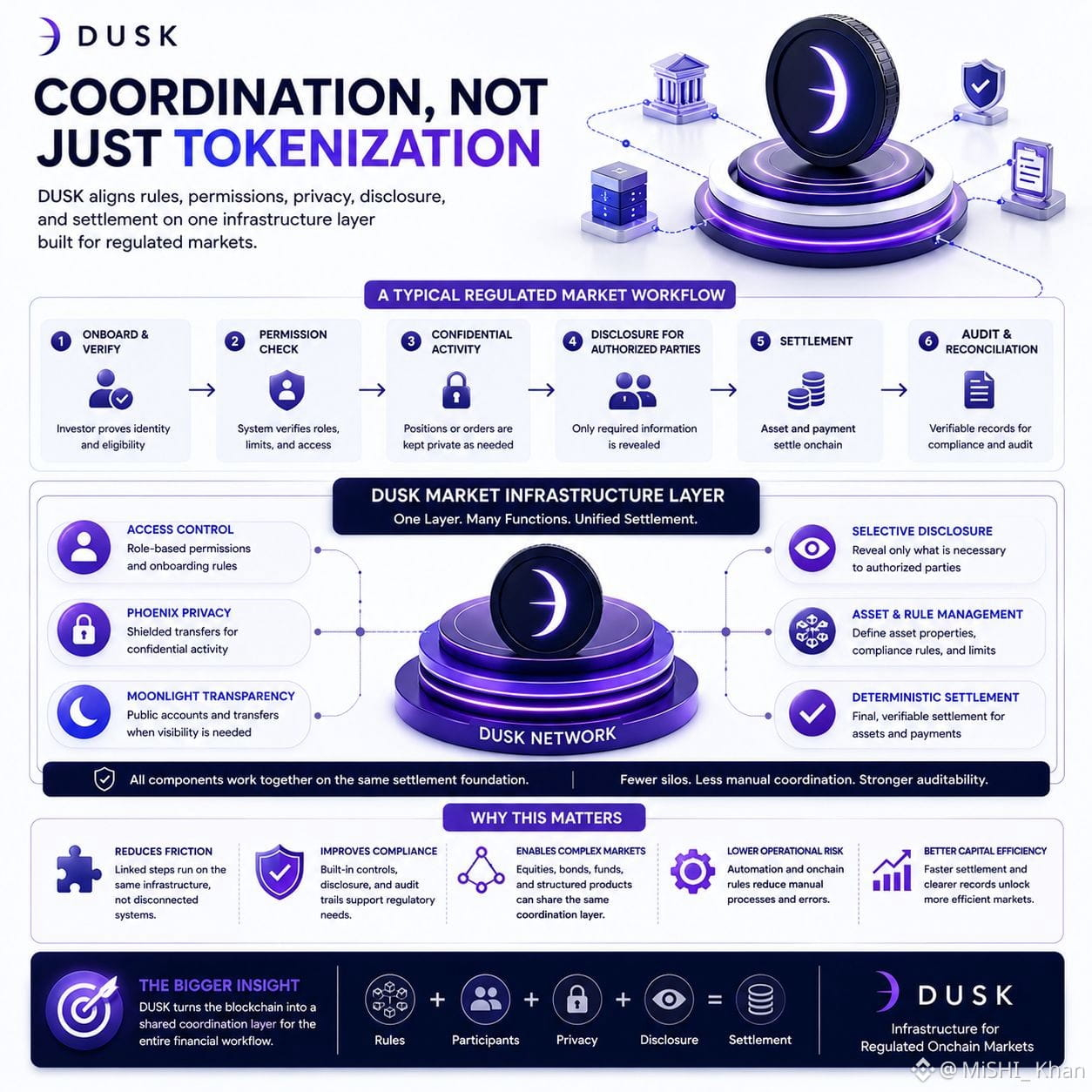
Une idée DUSK négligée consiste à dire que les marchés réglementés ont besoin de coordination, pas seulement de tokenisation. La conception de l’infrastructure de marché de Dusk place les règles d’actifs, les autorisations des participants, la confidentialité, la divulgation et le règlement autour de la même couche de base.
La raison est simple : les workflows comportent des étapes liées. Un investisseur peut avoir besoin de prouver son éligibilité, un émetteur peut avoir besoin de visibilité, et une opération de paiement doit pouvoir se régler avec un actif. Si chaque fonction se trouve dans un système distinct, la conciliation et la coordination hors chaîne font partie du processus.
DUSK fournit le contrôle d’accès, des transferts à l’abri de Phoenix, des flux publics Moonlight, une divulgation sélective et un règlement déterministe. L’enseignement le plus profond est que la blockchain devient une couche de coordination partagée pour le workflow, et pas seulement un registre pour le transfert final.
{future}(DUSKUSDT)
#dusk $DUSK @Dusk_Foundation
Une idée DUSK négligée consiste à dire que les marchés réglementés ont besoin de coordination, pas seulement de tokenisation. La conception de l’infrastructure de marché de Dusk place les règles d’actifs, les autorisations des participants, la confidentialité, la divulgation et le règlement autour de la même couche de base.
La raison est simple : les workflows comportent des étapes liées. Un investisseur peut avoir besoin de prouver son éligibilité, un émetteur peut avoir besoin de visibilité, et une opération de paiement doit pouvoir se régler avec un actif. Si chaque fonction se trouve dans un système distinct, la conciliation et la coordination hors chaîne font partie du processus.
DUSK fournit le contrôle d’accès, des transferts à l’abri de Phoenix, des flux publics Moonlight, une divulgation sélective et un règlement déterministe. L’enseignement le plus profond est que la blockchain devient une couche de coordination partagée pour le workflow, et pas seulement un registre pour le transfert final.
#dusk $DUSK @Dusk
La raison est simple : les workflows comportent des étapes liées. Un investisseur peut avoir besoin de prouver son éligibilité, un émetteur peut avoir besoin de visibilité, et une opération de paiement doit pouvoir se régler avec un actif. Si chaque fonction se trouve dans un système distinct, la conciliation et la coordination hors chaîne font partie du processus.
DUSK fournit le contrôle d’accès, des transferts à l’abri de Phoenix, des flux publics Moonlight, une divulgation sélective et un règlement déterministe. L’enseignement le plus profond est que la blockchain devient une couche de coordination partagée pour le workflow, et pas seulement un registre pour le transfert final.
#dusk $DUSK @Dusk
13
15
210
·
--
Vérifié
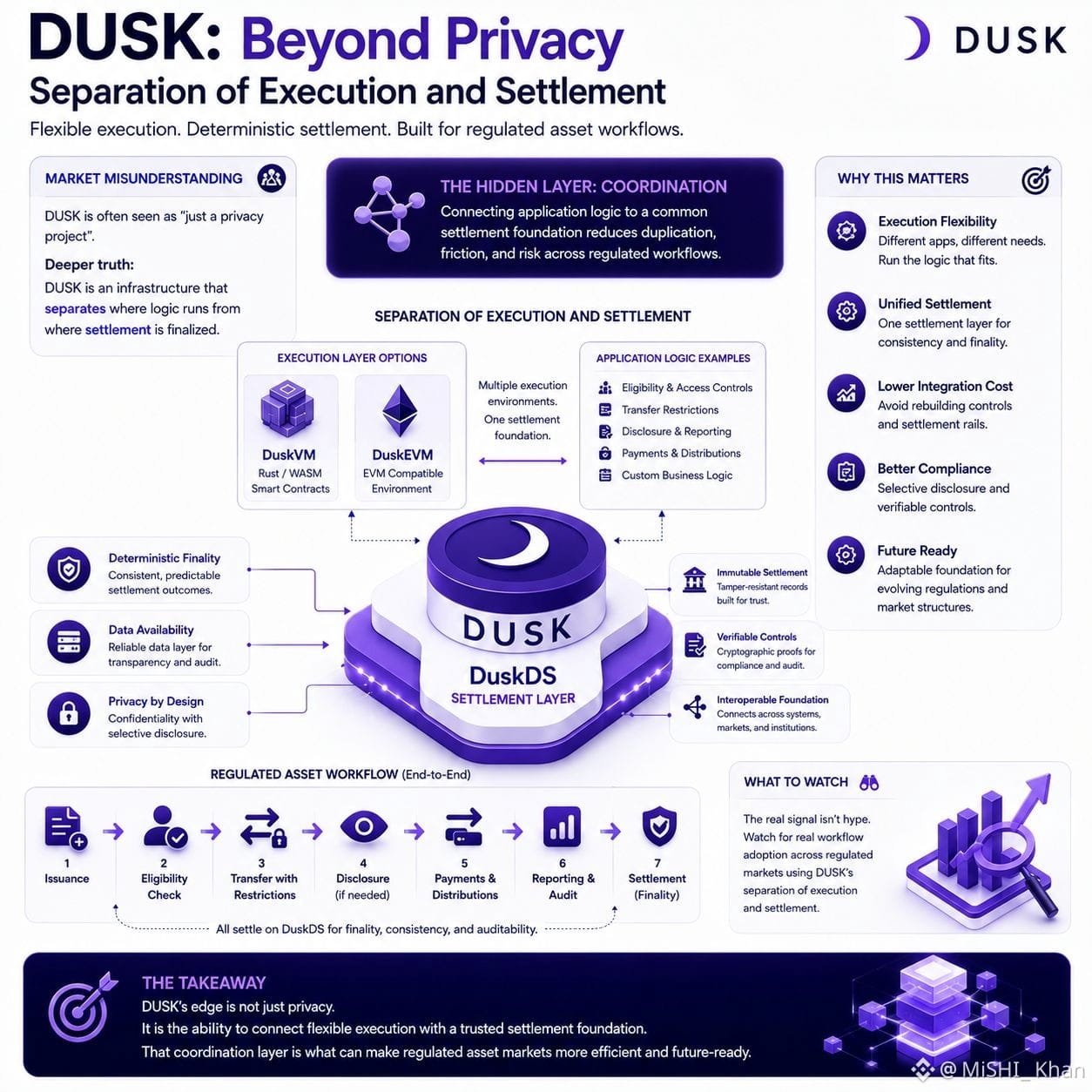
@DUSK est souvent considéré comme un projet axé sur la confidentialité, mais cela passe à côté du choix de conception : séparer l’exécution du règlement. DuskDS fournit le règlement, la disponibilité des données et une finalité déterministe, tandis que DuskVM prend en charge des contrats Rust/WASM et que DuskEVM propose un chemin compatible avec l’EVM. Cette flexibilité est importante, car la finance réglementée ne suit que rarement un seul workflow. Un actif peut avoir besoin d’éligibilité, de restrictions de transfert, de divulgation, de reporting et de règlement. L’influence de DUSK pourrait être la coordination : relier la logique d’application à une base de règlement plutôt que de reconstruire des contrôles entre plusieurs systèmes. Le marché peut se concentrer sur la confidentialité, tandis que le problème plus difficile consiste à faire s’emboîter des workflows réglementés. Je surveillerais l’adoption des workflows dès maintenant. L’infrastructure gagne quand elle devient invisible.
#dusk $DUSK @Dusk_Foundation
{future}(DUSKUSDT)
@DUSK est souvent considéré comme un projet axé sur la confidentialité, mais cela passe à côté du choix de conception : séparer l’exécution du règlement. DuskDS fournit le règlement, la disponibilité des données et une finalité déterministe, tandis que DuskVM prend en charge des contrats Rust/WASM et que DuskEVM propose un chemin compatible avec l’EVM. Cette flexibilité est importante, car la finance réglementée ne suit que rarement un seul workflow. Un actif peut avoir besoin d’éligibilité, de restrictions de transfert, de divulgation, de reporting et de règlement. L’influence de DUSK pourrait être la coordination : relier la logique d’application à une base de règlement plutôt que de reconstruire des contrôles entre plusieurs systèmes. Le marché peut se concentrer sur la confidentialité, tandis que le problème plus difficile consiste à faire s’emboîter des workflows réglementés. Je surveillerais l’adoption des workflows dès maintenant. L’infrastructure gagne quand elle devient invisible.
#dusk $DUSK @Dusk
#dusk $DUSK @Dusk
8
9
103
·
--
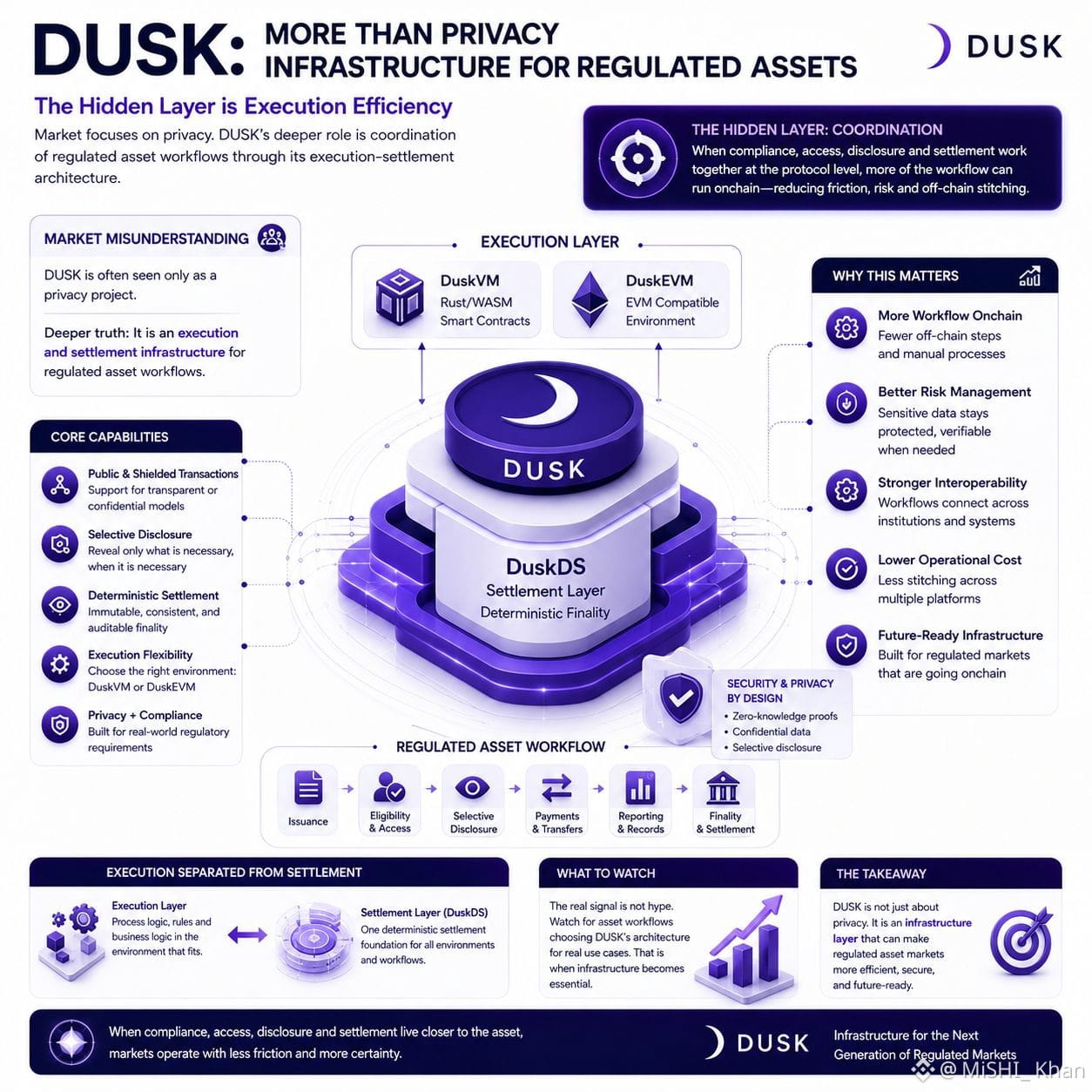
Le marché peut manquer DUSK lorsqu’on le réduit à un récit axé sur la confidentialité. La couche plus profonde correspond à l’efficacité d’exécution pour les actifs réglementés. Dusk sépare l’exécution du règlement : DuskVM gère les contrats Rust/WASM, tandis que DuskEVM propose un chemin compatible EVM qui règle via DuskDS. Les marchés réglementés ont besoin de plus que de simples transferts. L’éligibilité, l’accès, la divulgation, l’émission, les paiements, le reporting et la finalité doivent s’emboîter. Dusk prend en charge des modèles de transactions publiques et protégées, avec une divulgation sélective lorsque des preuves sont nécessaires. L’effet caché, c’est la coordination : davantage de workflow peut vivre au niveau du protocole au lieu d’être assemblé entre des systèmes. Je surveillerais si les workflows d’actifs utilisent cette architecture. Le signal le plus fort, c’est que l’infrastructure devient essentielle dès maintenant, pas du sensationnalisme.
#dusk $DUSK @Dusk_Foundation
{future}(DUSKUSDT)
Le marché peut manquer DUSK lorsqu’on le réduit à un récit axé sur la confidentialité. La couche plus profonde correspond à l’efficacité d’exécution pour les actifs réglementés. Dusk sépare l’exécution du règlement : DuskVM gère les contrats Rust/WASM, tandis que DuskEVM propose un chemin compatible EVM qui règle via DuskDS. Les marchés réglementés ont besoin de plus que de simples transferts. L’éligibilité, l’accès, la divulgation, l’émission, les paiements, le reporting et la finalité doivent s’emboîter. Dusk prend en charge des modèles de transactions publiques et protégées, avec une divulgation sélective lorsque des preuves sont nécessaires. L’effet caché, c’est la coordination : davantage de workflow peut vivre au niveau du protocole au lieu d’être assemblé entre des systèmes. Je surveillerais si les workflows d’actifs utilisent cette architecture. Le signal le plus fort, c’est que l’infrastructure devient essentielle dès maintenant, pas du sensationnalisme.
#dusk $DUSK @Dusk
#dusk $DUSK @Dusk
10
5
102
·
--
Haussier
Vérifié
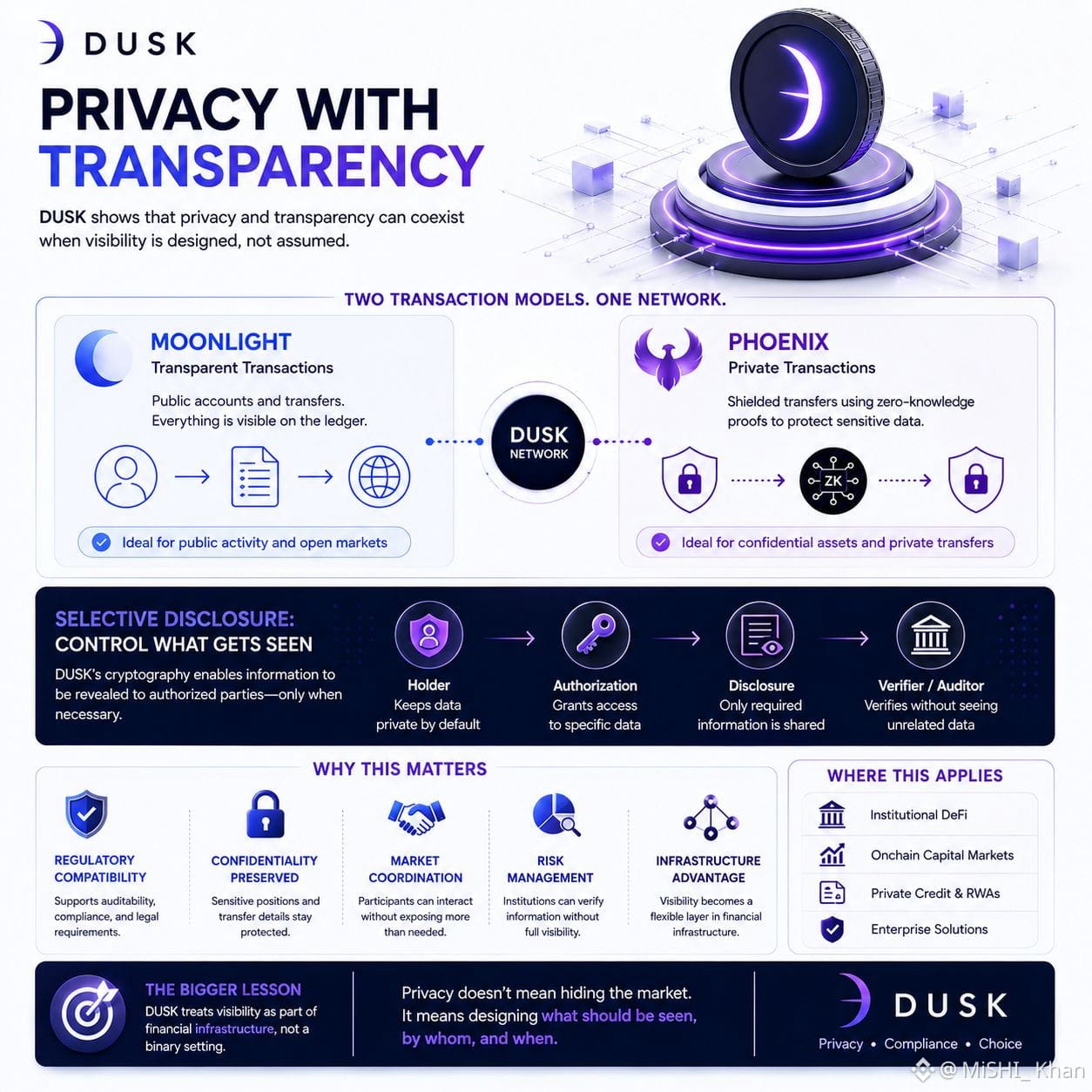
Une partie de DUSK qui mérite l’attention est la façon dont son modèle de confidentialité peut coexister avec la transparence. Dusk prend en charge Moonlight pour les comptes publics et Phoenix pour les transferts protégés, tandis que sa pile cryptographique permet la divulgation sélective.
Cela implique un choix de conception : la confidentialité n’a pas à signifier le fait de cacher le marché. Une application peut conserver les soldes ou les détails des transferts confidentiels tout en permettant de révéler l’information lorsque cela est nécessaire.
Pourquoi est-ce important ? Les marchés réglementés ont besoin d’auditabilité et d’un accès contrôlé. Si chaque détail est public, les positions peuvent être exposées. Si tout est privé, la vérification devient plus difficile.
La leçon la plus profonde est que DUSK considère la visibilité comme faisant partie de l’infrastructure financière, et non comme un réglage binaire. Cela pourrait faciliter la coordination des marchés onchain à grande échelle.
#dusk $DUSK @Dusk_Foundation
Une partie de DUSK qui mérite l’attention est la façon dont son modèle de confidentialité peut coexister avec la transparence. Dusk prend en charge Moonlight pour les comptes publics et Phoenix pour les transferts protégés, tandis que sa pile cryptographique permet la divulgation sélective.
Cela implique un choix de conception : la confidentialité n’a pas à signifier le fait de cacher le marché. Une application peut conserver les soldes ou les détails des transferts confidentiels tout en permettant de révéler l’information lorsque cela est nécessaire.
Pourquoi est-ce important ? Les marchés réglementés ont besoin d’auditabilité et d’un accès contrôlé. Si chaque détail est public, les positions peuvent être exposées. Si tout est privé, la vérification devient plus difficile.
La leçon la plus profonde est que DUSK considère la visibilité comme faisant partie de l’infrastructure financière, et non comme un réglage binaire. Cela pourrait faciliter la coordination des marchés onchain à grande échelle.
#dusk $DUSK @Dusk
Cela implique un choix de conception : la confidentialité n’a pas à signifier le fait de cacher le marché. Une application peut conserver les soldes ou les détails des transferts confidentiels tout en permettant de révéler l’information lorsque cela est nécessaire.
Pourquoi est-ce important ? Les marchés réglementés ont besoin d’auditabilité et d’un accès contrôlé. Si chaque détail est public, les positions peuvent être exposées. Si tout est privé, la vérification devient plus difficile.
La leçon la plus profonde est que DUSK considère la visibilité comme faisant partie de l’infrastructure financière, et non comme un réglage binaire. Cela pourrait faciliter la coordination des marchés onchain à grande échelle.
#dusk $DUSK @Dusk
11
6
126
·
--
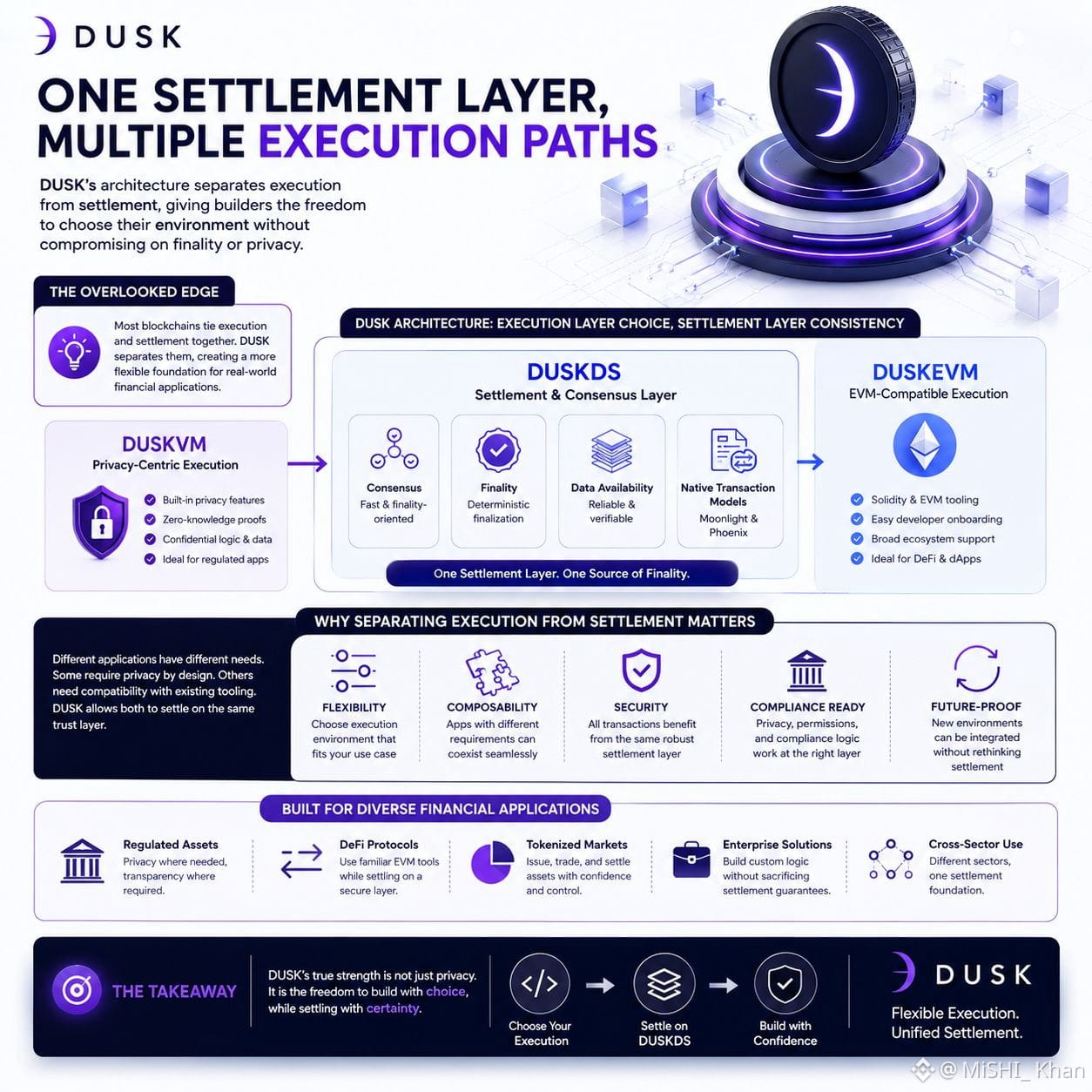
Une partie négligée de DUSK est la manière dont son architecture sépare l’exécution du règlement. DuskDS gère le consensus, la finalité, la disponibilité des données et les modèles de transactions natives, tandis que DuskVM et DuskEVM fournissent des environnements différents pour la logique d’application.
Pourquoi est-ce important ? Les applications financières ont des besoins différents. L’une peut avoir besoin de fonctionnalités de confidentialité, tandis qu’une autre préférera Solidity et des outils EVM familiers. DUSK permet aux deux approches de se régler via la même couche, au lieu de forcer les applications à s’inscrire dans un seul modèle d’exécution.
L’implication plus profonde est la flexibilité de l’infrastructure. Les concepteurs peuvent choisir l’environnement d’exécution sans abandonner DuskDS comme fondation de règlement. C’est particulièrement important pour les applications réglementées, où la confidentialité, la logique de conformité et un règlement prévisible doivent fonctionner ensemble.
#dusk $DUSK @Dusk_Foundation
{future}(DUSKUSDT)
Une partie négligée de DUSK est la manière dont son architecture sépare l’exécution du règlement. DuskDS gère le consensus, la finalité, la disponibilité des données et les modèles de transactions natives, tandis que DuskVM et DuskEVM fournissent des environnements différents pour la logique d’application.
Pourquoi est-ce important ? Les applications financières ont des besoins différents. L’une peut avoir besoin de fonctionnalités de confidentialité, tandis qu’une autre préférera Solidity et des outils EVM familiers. DUSK permet aux deux approches de se régler via la même couche, au lieu de forcer les applications à s’inscrire dans un seul modèle d’exécution.
L’implication plus profonde est la flexibilité de l’infrastructure. Les concepteurs peuvent choisir l’environnement d’exécution sans abandonner DuskDS comme fondation de règlement. C’est particulièrement important pour les applications réglementées, où la confidentialité, la logique de conformité et un règlement prévisible doivent fonctionner ensemble.
#dusk $DUSK @Dusk
Pourquoi est-ce important ? Les applications financières ont des besoins différents. L’une peut avoir besoin de fonctionnalités de confidentialité, tandis qu’une autre préférera Solidity et des outils EVM familiers. DUSK permet aux deux approches de se régler via la même couche, au lieu de forcer les applications à s’inscrire dans un seul modèle d’exécution.
L’implication plus profonde est la flexibilité de l’infrastructure. Les concepteurs peuvent choisir l’environnement d’exécution sans abandonner DuskDS comme fondation de règlement. C’est particulièrement important pour les applications réglementées, où la confidentialité, la logique de conformité et un règlement prévisible doivent fonctionner ensemble.
#dusk $DUSK @Dusk
13
8
113
·
--
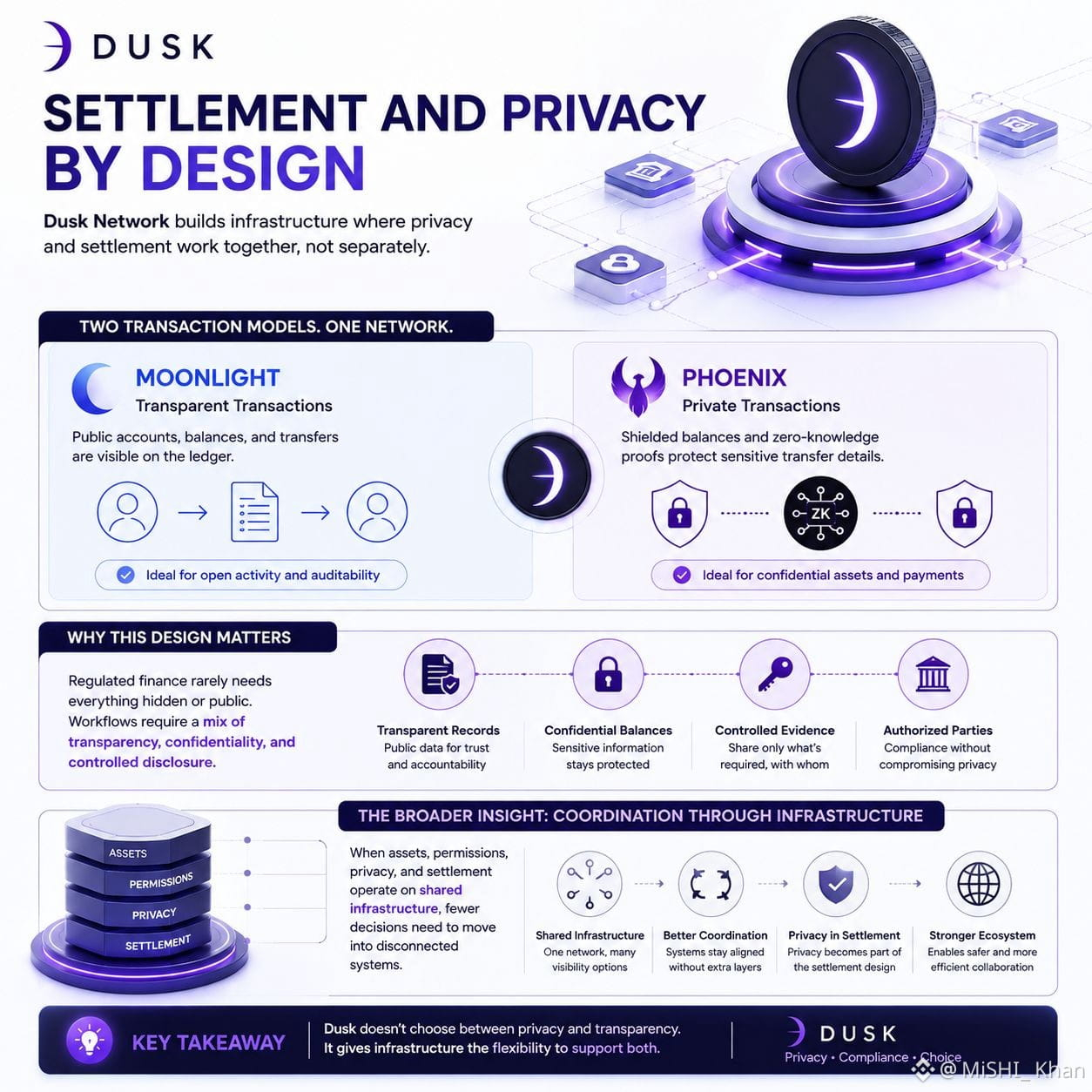
@DuskFoundation est intéressant car il traite le règlement et la confidentialité comme des problèmes de conception. DuskDS prend en charge deux modèles de transaction : Moonlight expose l’activité publique des comptes, tandis que Phoenix utilise des transferts protégés avec des preuves à connaissance nulle.
Cela compte car la finance réglementée n’a que rarement besoin de tout cacher ou de tout rendre public. Un flux de travail peut nécessiter des relevés transparents, des soldes confidentiels et des preuves contrôlées pour des parties autorisées. Dusk permet à ces choix de visibilité de coexister au lieu d’imposer un seul réglage de confidentialité à l’ensemble du système.
L’enseignment plus large, c’est la coordination. Si les actifs, les autorisations, la confidentialité et le règlement fonctionnent autour d’une infrastructure partagée, moins de décisions doivent être déplacées vers des systèmes déconnectés. La confidentialité devient un élément de la conception du règlement plutôt qu’une simple préférence utilisateur.
@Dusk_Foundation #dusk $DUSK
{future}(DUSKUSDT)
@DuskFoundation est intéressant car il traite le règlement et la confidentialité comme des problèmes de conception. DuskDS prend en charge deux modèles de transaction : Moonlight expose l’activité publique des comptes, tandis que Phoenix utilise des transferts protégés avec des preuves à connaissance nulle.
Cela compte car la finance réglementée n’a que rarement besoin de tout cacher ou de tout rendre public. Un flux de travail peut nécessiter des relevés transparents, des soldes confidentiels et des preuves contrôlées pour des parties autorisées. Dusk permet à ces choix de visibilité de coexister au lieu d’imposer un seul réglage de confidentialité à l’ensemble du système.
L’enseignment plus large, c’est la coordination. Si les actifs, les autorisations, la confidentialité et le règlement fonctionnent autour d’une infrastructure partagée, moins de décisions doivent être déplacées vers des systèmes déconnectés. La confidentialité devient un élément de la conception du règlement plutôt qu’une simple préférence utilisateur.
@Dusk #dusk $DUSK
Cela compte car la finance réglementée n’a que rarement besoin de tout cacher ou de tout rendre public. Un flux de travail peut nécessiter des relevés transparents, des soldes confidentiels et des preuves contrôlées pour des parties autorisées. Dusk permet à ces choix de visibilité de coexister au lieu d’imposer un seul réglage de confidentialité à l’ensemble du système.
L’enseignment plus large, c’est la coordination. Si les actifs, les autorisations, la confidentialité et le règlement fonctionnent autour d’une infrastructure partagée, moins de décisions doivent être déplacées vers des systèmes déconnectés. La confidentialité devient un élément de la conception du règlement plutôt qu’une simple préférence utilisateur.
@Dusk #dusk $DUSK
30
18
269
·
--
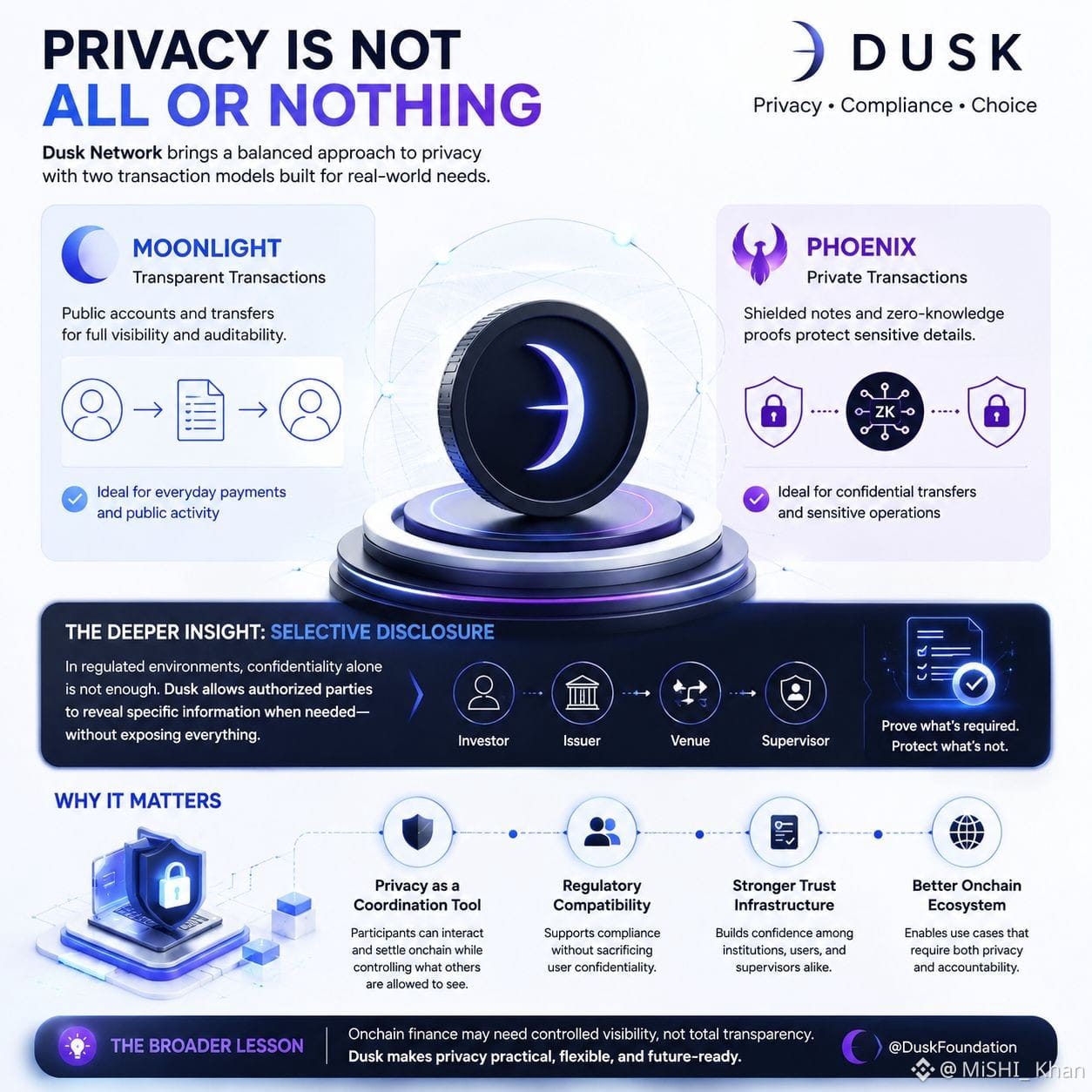
Un détail que le marché peut manquer au sujet de @DuskFoundation, c’est que la confidentialité n’est pas traitée comme un tout ou rien. Dusk utilise deux modèles de transaction : Moonlight conserve les comptes et transfère des données publiques, tandis que Phoenix utilise des notes masquées et des preuves à divulgation nulle pour dissimuler les détails sensibles des transferts.
Le point plus profond, c’est la divulgation sélective. Sur des marchés réglementés, la seule confidentialité ne suffit pas. Un investisseur, un émetteur, un lieu de négociation ou un superviseur peut avoir besoin d’une preuve d’éligibilité ou de propriété sans voir des données sans rapport. Dusk permet aux parties autorisées de révéler certaines informations lorsque c’est nécessaire.
Ainsi, la confidentialité est un outil de coordination, pas seulement un bouclier. Les participants peuvent travailler sur une couche de règlement tout en contrôlant ce que les autres peuvent voir. Le message général : la finance onchain peut nécessiter une visibilité contrôlée, pas une transparence totale.
@Dusk_Foundation #dusk $DUSK
{future}(DUSKUSDT)
Un détail que le marché peut manquer au sujet de @DuskFoundation, c’est que la confidentialité n’est pas traitée comme un tout ou rien. Dusk utilise deux modèles de transaction : Moonlight conserve les comptes et transfère des données publiques, tandis que Phoenix utilise des notes masquées et des preuves à divulgation nulle pour dissimuler les détails sensibles des transferts.
Le point plus profond, c’est la divulgation sélective. Sur des marchés réglementés, la seule confidentialité ne suffit pas. Un investisseur, un émetteur, un lieu de négociation ou un superviseur peut avoir besoin d’une preuve d’éligibilité ou de propriété sans voir des données sans rapport. Dusk permet aux parties autorisées de révéler certaines informations lorsque c’est nécessaire.
Ainsi, la confidentialité est un outil de coordination, pas seulement un bouclier. Les participants peuvent travailler sur une couche de règlement tout en contrôlant ce que les autres peuvent voir. Le message général : la finance onchain peut nécessiter une visibilité contrôlée, pas une transparence totale.
@Dusk #dusk $DUSK
Le point plus profond, c’est la divulgation sélective. Sur des marchés réglementés, la seule confidentialité ne suffit pas. Un investisseur, un émetteur, un lieu de négociation ou un superviseur peut avoir besoin d’une preuve d’éligibilité ou de propriété sans voir des données sans rapport. Dusk permet aux parties autorisées de révéler certaines informations lorsque c’est nécessaire.
Ainsi, la confidentialité est un outil de coordination, pas seulement un bouclier. Les participants peuvent travailler sur une couche de règlement tout en contrôlant ce que les autres peuvent voir. Le message général : la finance onchain peut nécessiter une visibilité contrôlée, pas une transparence totale.
@Dusk #dusk $DUSK
30
17
303
·
--
Haussier
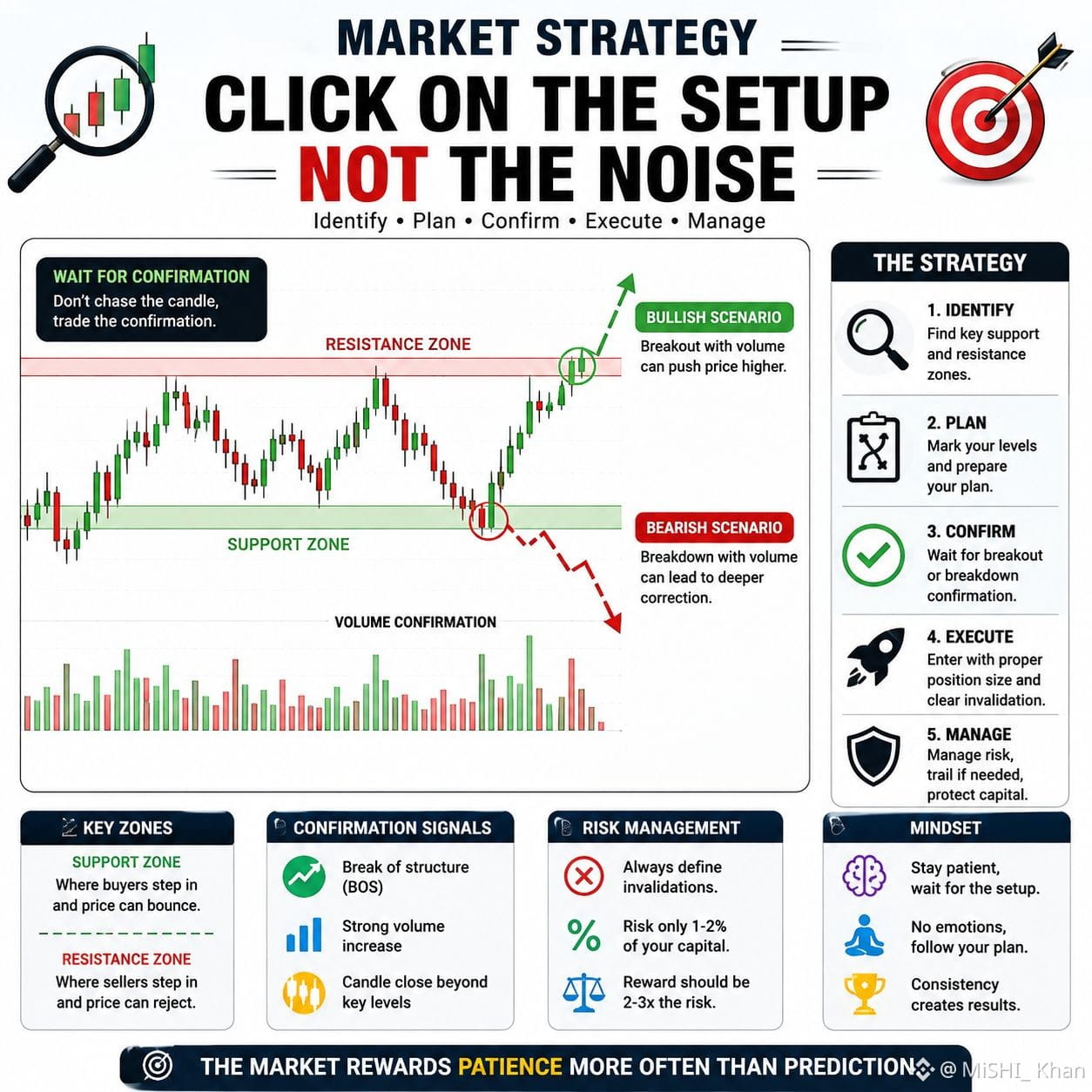
Stratégie de marché : cliquez sur la configuration, pas sur le bruit
Les marchés n’évoluent que rarement en ligne droite. La démarche la plus intelligente consiste à identifier où le prix se consolide, à marquer les zones clés de support et de résistance, puis à attendre une confirmation avant d’entrer.
Si le support tient et que le volume augmente, le momentum peut s’orienter à la hausse. Si le support se casse avec une forte pression vendeuse, le prochain mouvement pourrait être une correction plus profonde.
La stratégie clé est simple : ne poursuis pas la bougie — négocie la confirmation.
La gestion du risque compte davantage que la prédiction du sommet ou du creux exact. Garde une invalidation clairement définie, une taille de position maîtrisée, et évite les entrées émotionnelles.
Le marché récompense plus souvent la patience que la prédiction.
#MarketSentimentToday
Stratégie de marché : cliquez sur la configuration, pas sur le bruit
Les marchés n’évoluent que rarement en ligne droite. La démarche la plus intelligente consiste à identifier où le prix se consolide, à marquer les zones clés de support et de résistance, puis à attendre une confirmation avant d’entrer.
Si le support tient et que le volume augmente, le momentum peut s’orienter à la hausse. Si le support se casse avec une forte pression vendeuse, le prochain mouvement pourrait être une correction plus profonde.
La stratégie clé est simple : ne poursuis pas la bougie — négocie la confirmation.
La gestion du risque compte davantage que la prédiction du sommet ou du creux exact. Garde une invalidation clairement définie, une taille de position maîtrisée, et évite les entrées émotionnelles.
Le marché récompense plus souvent la patience que la prédiction.
#MarketSentimentToday
Les marchés n’évoluent que rarement en ligne droite. La démarche la plus intelligente consiste à identifier où le prix se consolide, à marquer les zones clés de support et de résistance, puis à attendre une confirmation avant d’entrer.
Si le support tient et que le volume augmente, le momentum peut s’orienter à la hausse. Si le support se casse avec une forte pression vendeuse, le prochain mouvement pourrait être une correction plus profonde.
La stratégie clé est simple : ne poursuis pas la bougie — négocie la confirmation.
La gestion du risque compte davantage que la prédiction du sommet ou du creux exact. Garde une invalidation clairement définie, une taille de position maîtrisée, et évite les entrées émotionnelles.
Le marché récompense plus souvent la patience que la prédiction.
#MarketSentimentToday
88
·
--
Le marché n’attend pas votre entrée. 👀
En ce moment, poursuivre chaque bougie verte est le moyen le plus simple de devenir du liquidity pour les sorties.
La meilleure stratégie est simple : observez le prix + le volume + la liquidité ensemble.
Si le prix casse une résistance mais que le volume reste faible → ne poursuivez pas.
Si le prix reteste un support et que les acheteurs le défendent avec un volume plus fort → la configuration devient plus intéressante.
Si le BTC perd un niveau de support clé → réduisez le risque sur l’ensemble des altcoins à bêta élevé.
La plus grande opportunité n’est souvent pas la première bougie. C’est la confirmation lorsque le marché montre sa direction.
Tradez la réaction, pas l’émotion.
Votre avantage, c’est la patience. 🎯
#SheinToStartHKIPOBookbuildingAsSoonAsNextWeek
Le marché n’attend pas votre entrée. 👀
En ce moment, poursuivre chaque bougie verte est le moyen le plus simple de devenir du liquidity pour les sorties.
La meilleure stratégie est simple : observez le prix + le volume + la liquidité ensemble.
Si le prix casse une résistance mais que le volume reste faible → ne poursuivez pas.
Si le prix reteste un support et que les acheteurs le défendent avec un volume plus fort → la configuration devient plus intéressante.
Si le BTC perd un niveau de support clé → réduisez le risque sur l’ensemble des altcoins à bêta élevé.
La plus grande opportunité n’est souvent pas la première bougie. C’est la confirmation lorsque le marché montre sa direction.
Tradez la réaction, pas l’émotion.
Votre avantage, c’est la patience. 🎯
#SheinToStartHKIPOBookbuildingAsSoonAsNextWeek
En ce moment, poursuivre chaque bougie verte est le moyen le plus simple de devenir du liquidity pour les sorties.
La meilleure stratégie est simple : observez le prix + le volume + la liquidité ensemble.
Si le prix casse une résistance mais que le volume reste faible → ne poursuivez pas.
Si le prix reteste un support et que les acheteurs le défendent avec un volume plus fort → la configuration devient plus intéressante.
Si le BTC perd un niveau de support clé → réduisez le risque sur l’ensemble des altcoins à bêta élevé.
La plus grande opportunité n’est souvent pas la première bougie. C’est la confirmation lorsque le marché montre sa direction.
Tradez la réaction, pas l’émotion.
Votre avantage, c’est la patience. 🎯
#SheinToStartHKIPOBookbuildingAsSoonAsNextWeek

1
1
156
·
--
Article
Mise à jour du marché spot BNB — 11 août 2026BNB de Binance se situe actuellement autour de 599–604 $, tandis que le marché se trouve directement dans une zone de décision clé. Les données en direct de Binance indiquent environ 599,75 $, un plus haut sur 24 h proche de 609,70 $ et un plus bas sur 24 h autour de 597,35 $.
Tendance : Neutre → prudemment haussière
Pivot : 600–603 $
Résistance : 610–617 $
Zone de cassure : 617+
Prochain objectif à la hausse : 640–650 $
Support : 586–583 $
Support majeur : ~544 $
🎯 Prochain mouvement
Scénario haussier : Une clôture claire en 4H/journalier au-dessus de 617 $ avec un volume en expansion pourrait faire basculer l’élan vers 640–650 $.
Scénario baissier : Rejet autour de 610–617 $ suivi d’une cassure sous 583 $ affaiblirait la structure et ouvrirait de la place vers 560–544 $.
Mise à jour du marché spot BNB — 11 août 2026
BNB de Binance se situe actuellement autour de 599–604 $, tandis que le marché se trouve directement dans une zone de décision clé. Les données en direct de Binance indiquent environ 599,75 $, un plus haut sur 24 h proche de 609,70 $ et un plus bas sur 24 h autour de 597,35 $.
Tendance : Neutre → prudemment haussière
Pivot : 600–603 $
Résistance : 610–617 $
Zone de cassure : 617+
Prochain objectif à la hausse : 640–650 $
Support : 586–583 $
Support majeur : ~544 $
🎯 Prochain mouvement
Scénario haussier : Une clôture claire en 4H/journalier au-dessus de 617 $ avec un volume en expansion pourrait faire basculer l’élan vers 640–650 $.
Scénario baissier : Rejet autour de 610–617 $ suivi d’une cassure sous 583 $ affaiblirait la structure et ouvrirait de la place vers 560–544 $.
Tendance : Neutre → prudemment haussière
Pivot : 600–603 $
Résistance : 610–617 $
Zone de cassure : 617+
Prochain objectif à la hausse : 640–650 $
Support : 586–583 $
Support majeur : ~544 $
🎯 Prochain mouvement
Scénario haussier : Une clôture claire en 4H/journalier au-dessus de 617 $ avec un volume en expansion pourrait faire basculer l’élan vers 640–650 $.
Scénario baissier : Rejet autour de 610–617 $ suivi d’une cassure sous 583 $ affaiblirait la structure et ouvrirait de la place vers 560–544 $.
1
36
·
--
$BNB Spot Market Update — 9 Aug 2026Le BNB se situe actuellement autour de 600 $, et la structure à court terme montre une tendance prudemment haussière. La page de prix la plus récente de Binance affiche environ 600,39 $, tandis qu’une analyse technique récente place 583 $ comme support important et 602–603 $ comme zone de décision immédiate.
Niveaux clés :
🟢 Support : $583 → $572
⚡ Zone de décision : $600–$603
🔥 Cassure : $618 → $635
🚀 Prochain objectif haussier : $648, puis potentiellement $657+
🔴 Invalidation baissière : perte soutenue de $572
Mon scénario de prochaine action
Au-dessus de 603 $ : l’élan peut se renforcer vers 618–635. Une clôture quotidienne nette au-dessus de 635 rendrait la continuation haussière beaucoup plus convaincante.
$BNB Spot Market Update — 9 Aug 2026
Le BNB se situe actuellement autour de 600 $, et la structure à court terme montre une tendance prudemment haussière. La page de prix la plus récente de Binance affiche environ 600,39 $, tandis qu’une analyse technique récente place 583 $ comme support important et 602–603 $ comme zone de décision immédiate.
Niveaux clés :
🟢 Support : $583 → $572
⚡ Zone de décision : $600–$603
🔥 Cassure : $618 → $635
🚀 Prochain objectif haussier : $648, puis potentiellement $657+
🔴 Invalidation baissière : perte soutenue de $572
Mon scénario de prochaine action
Au-dessus de 603 $ : l’élan peut se renforcer vers 618–635. Une clôture quotidienne nette au-dessus de 635 rendrait la continuation haussière beaucoup plus convaincante.
Niveaux clés :
🟢 Support : $583 → $572
⚡ Zone de décision : $600–$603
🔥 Cassure : $618 → $635
🚀 Prochain objectif haussier : $648, puis potentiellement $657+
🔴 Invalidation baissière : perte soutenue de $572
Mon scénario de prochaine action
Au-dessus de 603 $ : l’élan peut se renforcer vers 618–635. Une clôture quotidienne nette au-dessus de 635 rendrait la continuation haussière beaucoup plus convaincante.
2
98
Connectez-vous pour découvrir plus de contenu
Rejoignez la communauté mondiale des adeptes de cryptomonnaies sur Binance Square
⚡️ Suviez les dernières informations importantes sur les cryptomonnaies.
💬 Jugé digne de confiance par la plus grande plateforme d’échange de cryptomonnaies au monde.
👍 Découvrez les connaissances que partagent les créateurs vérifiés.
Adresse e-mail/Nº de téléphone
Sujets d’actualité
BTCBreaks80K
66,381 vues
1,436 mentions
$BTC
À quel prix le BTC va-t-il atteindre en 2026 ?
Le spot est à 80 748 $ : il reste 104 jours
↑ 90 k$ - 58%
↑ 100 k$ - 24%
↓ creux à 70 k$ d’abord - 48%
Le scénario haussier évoqué au niveau du plancher :
> Août a connu une vraie envolée : de 62 275 $ à 81 479 $ — +31% du bas au sommet
> La loi CLARITY a échoué lors du vote de clôture au Sénat, 49 contre 50 le 15 septembre. Le BTC glissait déjà bien avant le vote : il a touché 74 968 $ durant cette heure, puis a tout repris en trois jours
> La Fed a relevé ses taux le 16 septembre — pour la première fois depuis juillet 2023. Le spot se situe actuellement à 7,4 % au-dessus du plus bas du jour
> Les altcoins surperforment nettement. Vue sur 30 jours : SOL +38 %, XRP +35 %, ETH +32 % contre BTC +23 %
> Le calendrier reste chargé de raisons pour lesquelles cela devrait se casser — et c’est précisément le mur d’inquiétude que les marchés haussiers ont tendance à escalader
> Les élections de mi-mandat ont lieu le 3 novembre, en plein milieu de cette fenêtre de marché
Alors, vous mettriez quoi comme pari à +24% en 104 jours ?
$ETH
$SOL
#BTCBreaks80K #solonapumping #ETH🔥🔥🔥🔥🔥🔥 #BullMarket📈
Wealthy bloke
·4 mentions J’aime
·4.8k vues
BuffettBecomesBerkshireChairmanEmeritus
15,904 vues
497 mentions
ZcashSpotETFTops$230MMonthlyInflow
4,507 vues
76 mentions