

Zara ETH
6.3k Publications

Zara ETH
Signaler
Bloquer l’utilisateur
Crypto Girls...
8 Suivis
17.6K+ Abonnés
10.7K+ J’aime
Publications
Tous
Direct
·
--
Haussier
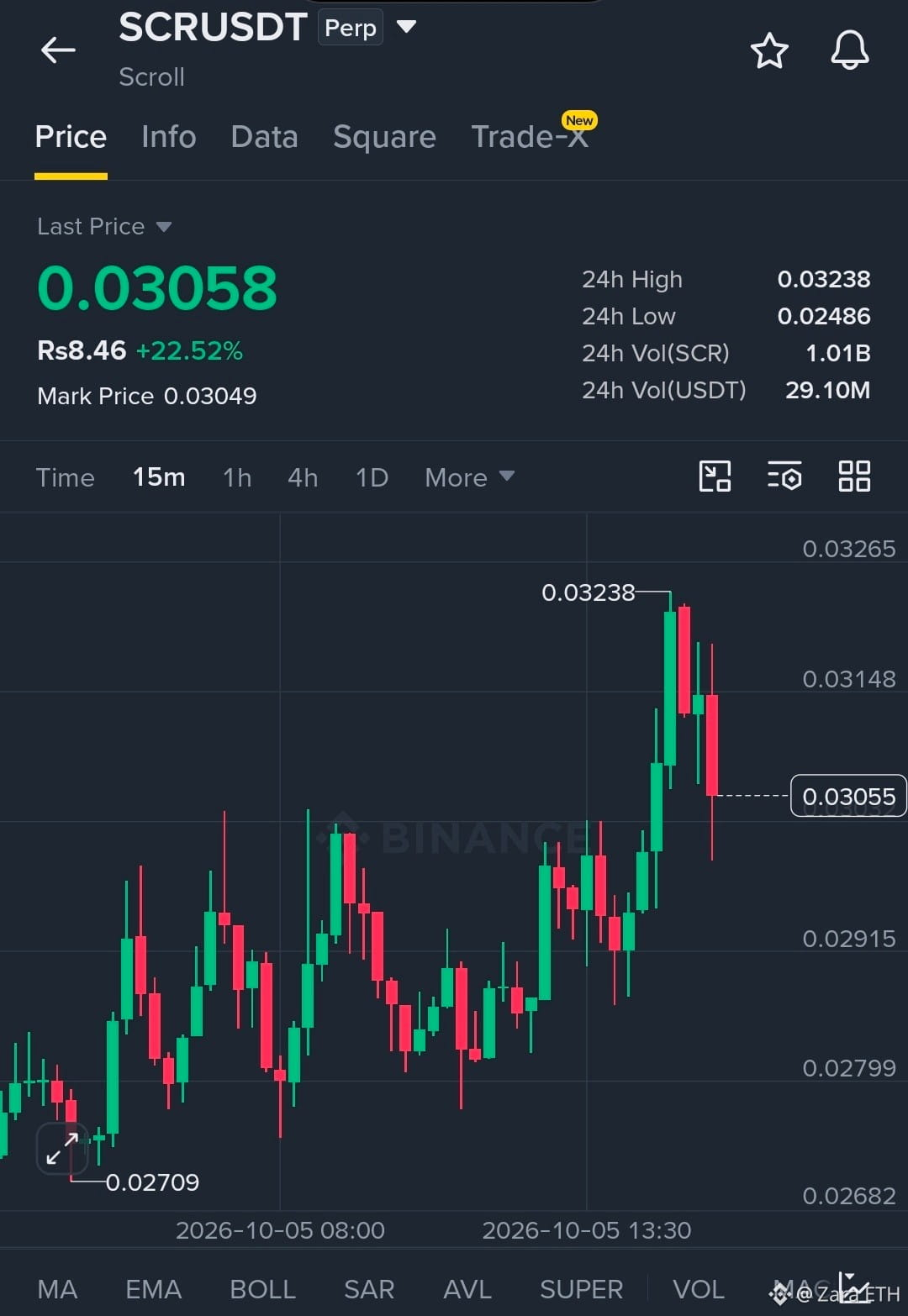
$SCR USDT Perpetual is making a strong move.
Price: 0.03058
24H Change: +22.52%
24H High: 0.03238
24H Low: 0.02486
24H Volume: 29.10M USDT
SCR Volume: 1.01B
Mark Price: 0.03049
Timeframe: 15M
After breaking sharply higher, SCR hit 0.03238 before pulling back toward 0.03055. Bulls are still in control, but 0.03238 is the key resistance to watch. A clean breakout could bring another explosive leg, while losing 0.0300 may trigger a deeper pullback.
#Nikkei225Jumps2.5%ToThreeMonthHigh #GreekPoliceBustCryptoScamRingArrest17
{spot}(SCRUSDT)
$SCR USDT Perpetual is making a strong move.
Price: 0.03058
24H Change: +22.52%
24H High: 0.03238
24H Low: 0.02486
24H Volume: 29.10M USDT
SCR Volume: 1.01B
Mark Price: 0.03049
Timeframe: 15M
After breaking sharply higher, SCR hit 0.03238 before pulling back toward 0.03055. Bulls are still in control, but 0.03238 is the key resistance to watch. A clean breakout could bring another explosive leg, while losing 0.0300 may trigger a deeper pullback.
#Nikkei225Jumps2.5%ToThreeMonthHigh #GreekPoliceBustCryptoScamRingArrest17
Price: 0.03058
24H Change: +22.52%
24H High: 0.03238
24H Low: 0.02486
24H Volume: 29.10M USDT
SCR Volume: 1.01B
Mark Price: 0.03049
Timeframe: 15M
After breaking sharply higher, SCR hit 0.03238 before pulling back toward 0.03055. Bulls are still in control, but 0.03238 is the key resistance to watch. A clean breakout could bring another explosive leg, while losing 0.0300 may trigger a deeper pullback.
#Nikkei225Jumps2.5%ToThreeMonthHigh #GreekPoliceBustCryptoScamRingArrest17
1
101
·
--
Haussier
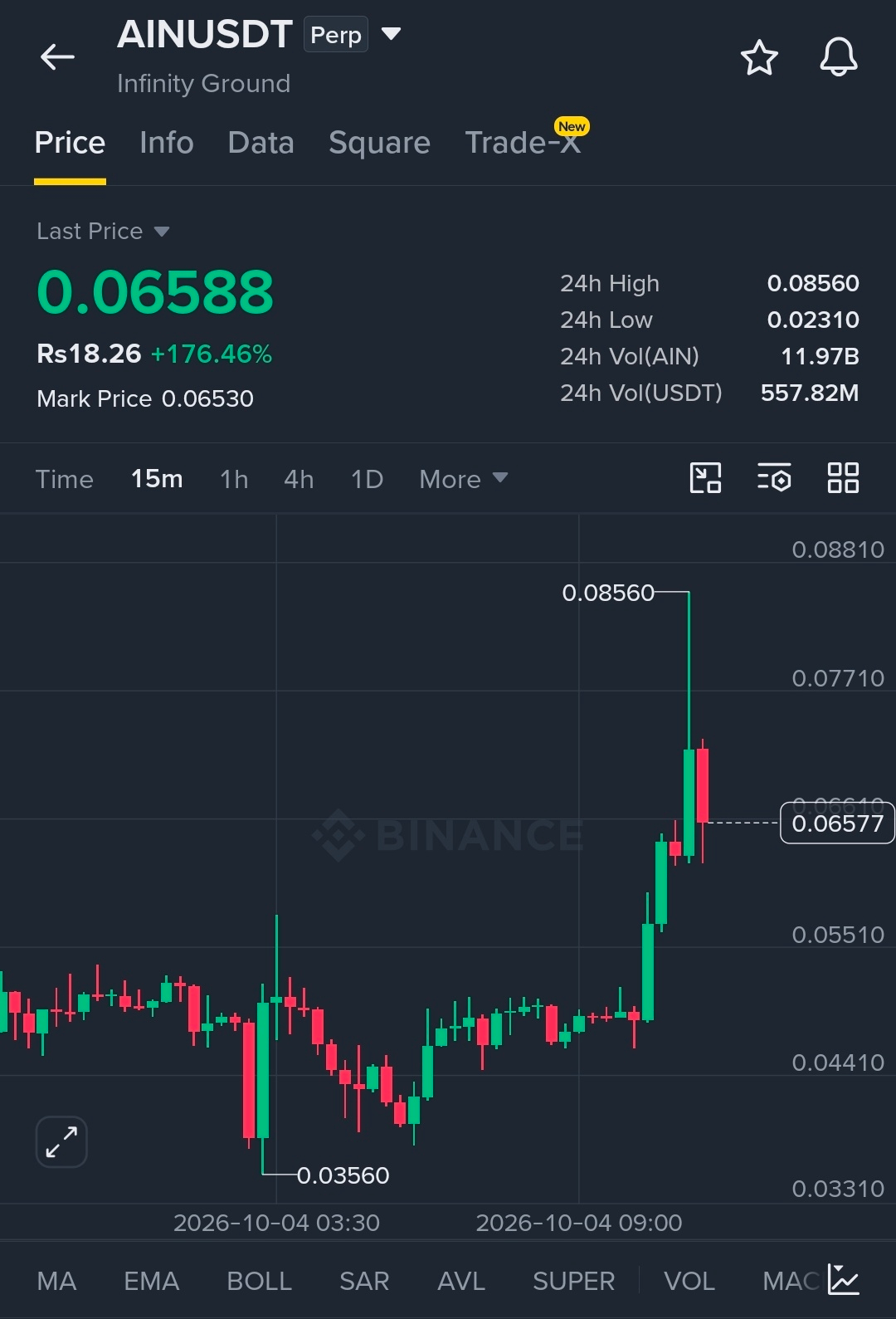
$AIN USDT EXPLODES +176.46% — MASSIVE PRICE SURGE!
AINUSDT Perpetual is making a powerful move in the crypto market.
* Last Price: 0.06588 USDT
* PKR Price: Rs 18.26
* 24H Change: +176.46%
* 24H High: 0.08560 USDT
* 24H Low: 0.02310 USDT
* 24H Volume: 557.82M USDT
* AIN Volume: 11.97B
* Mark Price: 0.06530 USDT
* Timeframe: 15 Minutes
From 0.02310 to a high of 0.08560 — an explosive rally that has caught the market's attention.
Will AIN break its previous high and surge further, or is a major correction on the horizon?
The next move could be crucial. Stay alert!
#SECHaltsCryptoETFReviewsAmidFundingLapse #CerebrasSinksNearly20%OnReportNvidiaToPowerOpenAI
{alpha}(560x9558a9254890b2a8b057a789f413631b9084f4a3)
$AIN USDT EXPLODES +176.46% — MASSIVE PRICE SURGE!
AINUSDT Perpetual is making a powerful move in the crypto market.
* Last Price: 0.06588 USDT
* PKR Price: Rs 18.26
* 24H Change: +176.46%
* 24H High: 0.08560 USDT
* 24H Low: 0.02310 USDT
* 24H Volume: 557.82M USDT
* AIN Volume: 11.97B
* Mark Price: 0.06530 USDT
* Timeframe: 15 Minutes
From 0.02310 to a high of 0.08560 — an explosive rally that has caught the market's attention.
Will AIN break its previous high and surge further, or is a major correction on the horizon?
The next move could be crucial. Stay alert!
#SECHaltsCryptoETFReviewsAmidFundingLapse #CerebrasSinksNearly20%OnReportNvidiaToPowerOpenAI
AINUSDT Perpetual is making a powerful move in the crypto market.
* Last Price: 0.06588 USDT
* PKR Price: Rs 18.26
* 24H Change: +176.46%
* 24H High: 0.08560 USDT
* 24H Low: 0.02310 USDT
* 24H Volume: 557.82M USDT
* AIN Volume: 11.97B
* Mark Price: 0.06530 USDT
* Timeframe: 15 Minutes
From 0.02310 to a high of 0.08560 — an explosive rally that has caught the market's attention.
Will AIN break its previous high and surge further, or is a major correction on the horizon?
The next move could be crucial. Stay alert!
#SECHaltsCryptoETFReviewsAmidFundingLapse #CerebrasSinksNearly20%OnReportNvidiaToPowerOpenAI
1
264
·
--
Haussier
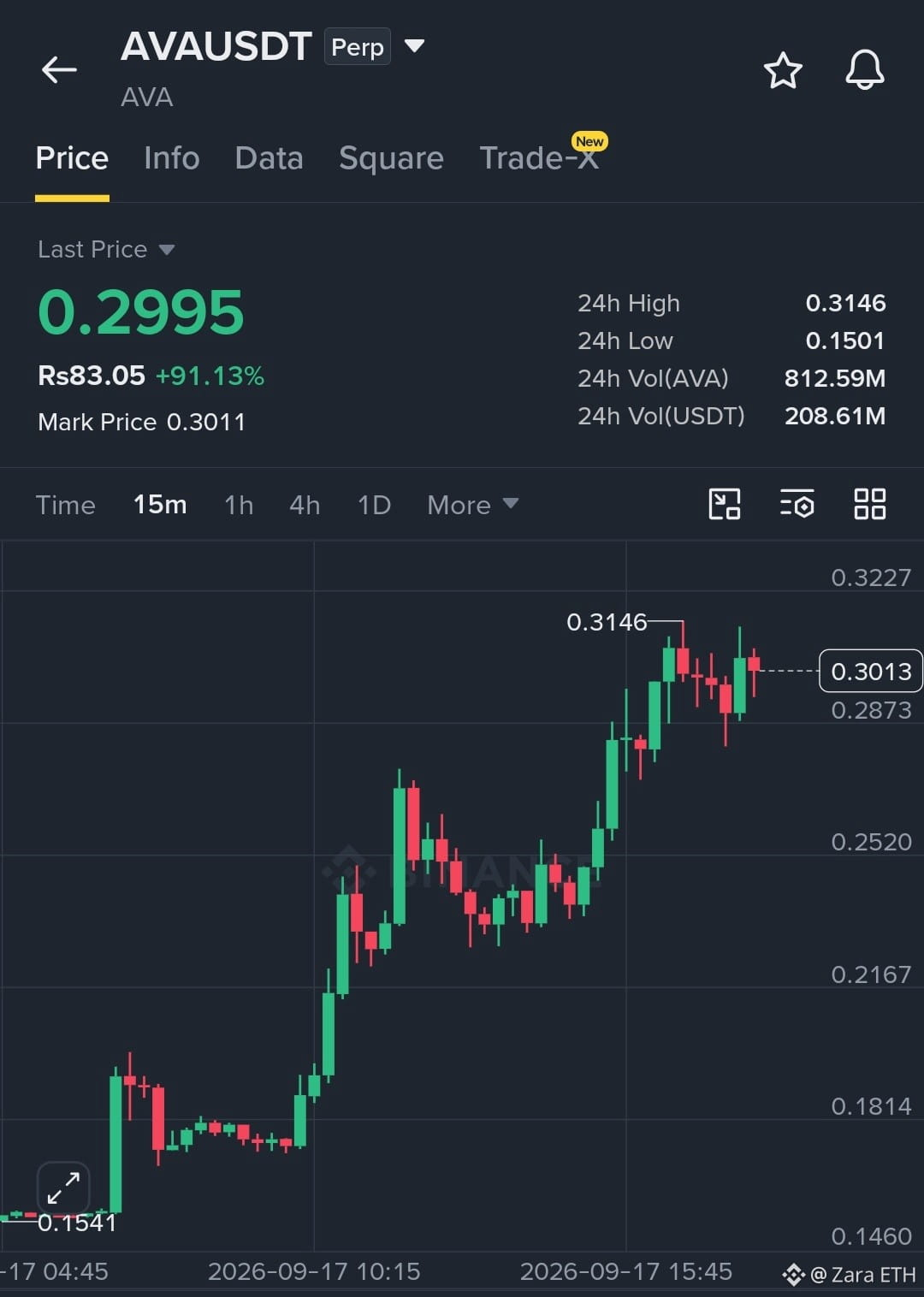
$AVA is heating up fast.
Price: 0.2995
24H: +91.13%
24H High: 0.3146
Volume: 812.59M AVA
15M chart shows strong bullish momentum after breaking key resistance.
EP: 0.298–0.302
TP1: 0.3146
TP2: 0.3227
SL: 0.2873
Hold above 0.2873 and the next breakout could come quickly.
#MemeLaunchpads82%OfArcDayOneVolume #AmazonGetsWarrantsToBuyGeneracStock
{spot}(AVAUSDT)
$AVA is heating up fast.
Price: 0.2995
24H: +91.13%
24H High: 0.3146
Volume: 812.59M AVA
15M chart shows strong bullish momentum after breaking key resistance.
EP: 0.298–0.302
TP1: 0.3146
TP2: 0.3227
SL: 0.2873
Hold above 0.2873 and the next breakout could come quickly.
#MemeLaunchpads82%OfArcDayOneVolume #AmazonGetsWarrantsToBuyGeneracStock
Price: 0.2995
24H: +91.13%
24H High: 0.3146
Volume: 812.59M AVA
15M chart shows strong bullish momentum after breaking key resistance.
EP: 0.298–0.302
TP1: 0.3146
TP2: 0.3227
SL: 0.2873
Hold above 0.2873 and the next breakout could come quickly.
#MemeLaunchpads82%OfArcDayOneVolume #AmazonGetsWarrantsToBuyGeneracStock
1
149
·
--
Haussier
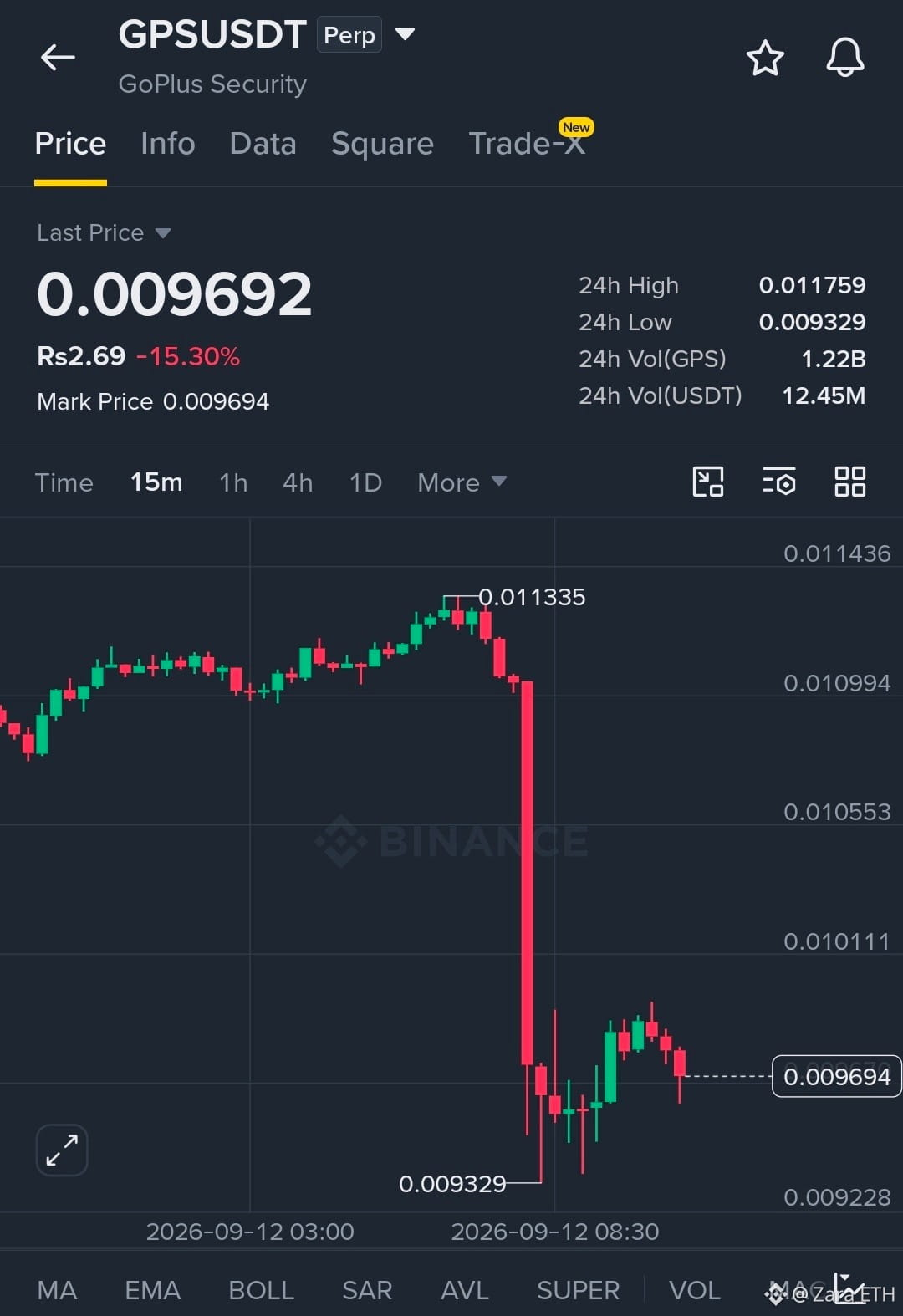
$GPS is under heavy pressure, trading at $0.009692, down 15.30% in 24H.
24H High: $0.011759
24H Low: $0.009329
Mark Price: $0.009694
24H Volume: 1.22B GPS | 12.45M USDT
On the 15M chart, GPS crashed sharply from $0.011335 to the $0.009329 low before a weak rebound.
Key zone now: $0.009329–$0.009700.
A break below the low could trigger another leg down, while reclaiming $0.0101+ could bring buyers back .
#EtherRalliesAsBearishBetsLiquidate #OpenAILaunchesAgentsAPIPublicBeta
{spot}(GPSUSDT)
$GPS is under heavy pressure, trading at $0.009692, down 15.30% in 24H.
24H High: $0.011759
24H Low: $0.009329
Mark Price: $0.009694
24H Volume: 1.22B GPS | 12.45M USDT
On the 15M chart, GPS crashed sharply from $0.011335 to the $0.009329 low before a weak rebound.
Key zone now: $0.009329–$0.009700.
A break below the low could trigger another leg down, while reclaiming $0.0101+ could bring buyers back .
#EtherRalliesAsBearishBetsLiquidate #OpenAILaunchesAgentsAPIPublicBeta
24H High: $0.011759
24H Low: $0.009329
Mark Price: $0.009694
24H Volume: 1.22B GPS | 12.45M USDT
On the 15M chart, GPS crashed sharply from $0.011335 to the $0.009329 low before a weak rebound.
Key zone now: $0.009329–$0.009700.
A break below the low could trigger another leg down, while reclaiming $0.0101+ could bring buyers back .
#EtherRalliesAsBearishBetsLiquidate #OpenAILaunchesAgentsAPIPublicBeta
333
·
--
Haussier
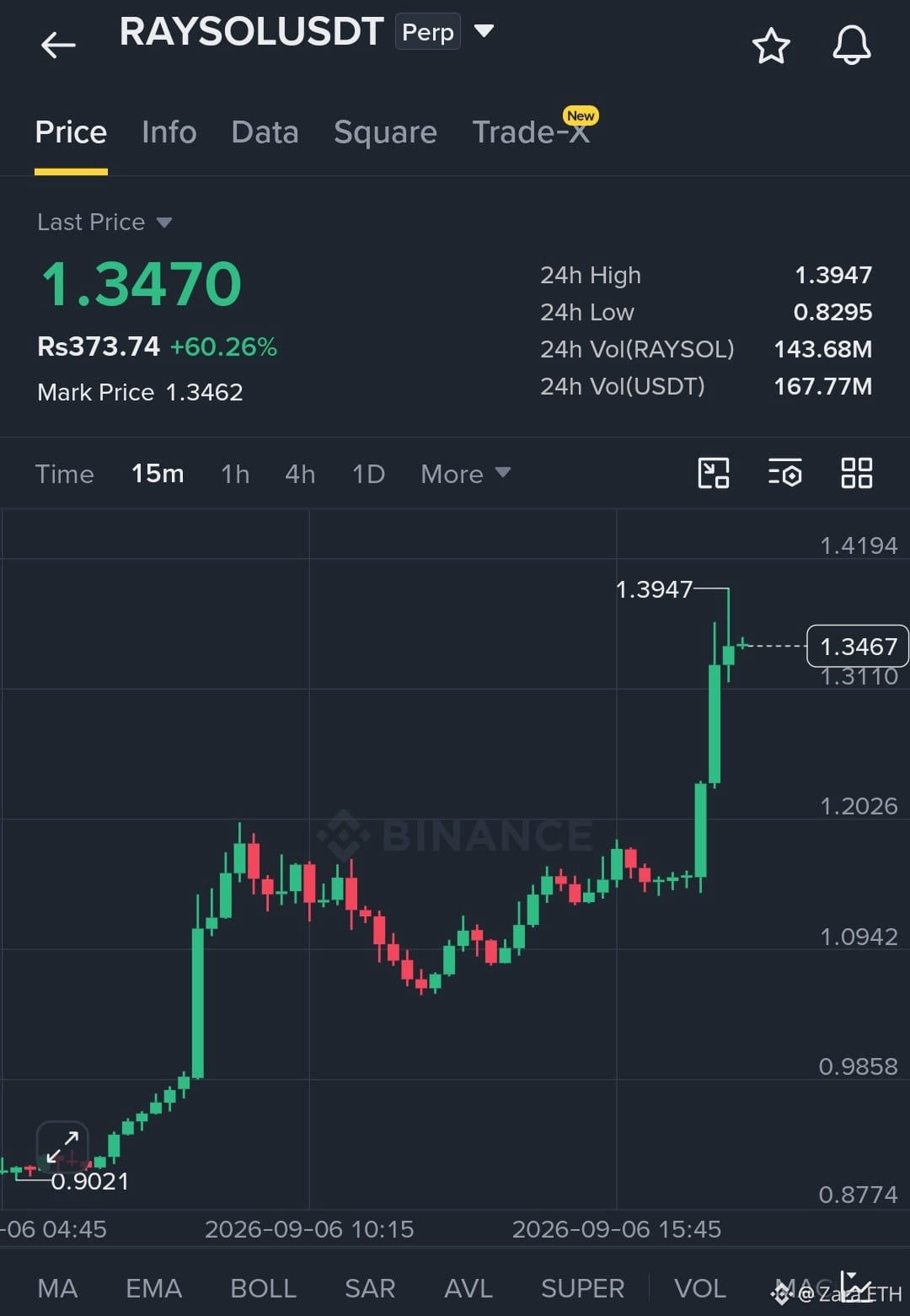
$RAYSOL is heating up fast.
Price: $1.3470, up 60.26% in 24H
24H High: $1.3947
24H Low: $0.8295
24H Volume: 143.68M RAYSOL / $167.77M USDT
The 15M chart shows a powerful breakout from the $1.20 zone, with buyers pushing straight toward $1.40.
Watch $1.31–$1.20 as key support. A clean break above $1.3947 could open the door to fresh highs.
#RussiaUkraine72-hourCeasefire #USAugustNonfarmPayrollsDueToday
{future}(RAYSOLUSDT)
$RAYSOL is heating up fast.
Price: $1.3470, up 60.26% in 24H
24H High: $1.3947
24H Low: $0.8295
24H Volume: 143.68M RAYSOL / $167.77M USDT
The 15M chart shows a powerful breakout from the $1.20 zone, with buyers pushing straight toward $1.40.
Watch $1.31–$1.20 as key support. A clean break above $1.3947 could open the door to fresh highs.
#RussiaUkraine72-hourCeasefire #USAugustNonfarmPayrollsDueToday
Price: $1.3470, up 60.26% in 24H
24H High: $1.3947
24H Low: $0.8295
24H Volume: 143.68M RAYSOL / $167.77M USDT
The 15M chart shows a powerful breakout from the $1.20 zone, with buyers pushing straight toward $1.40.
Watch $1.31–$1.20 as key support. A clean break above $1.3947 could open the door to fresh highs.
#RussiaUkraine72-hourCeasefire #USAugustNonfarmPayrollsDueToday
194
·
--
Haussier
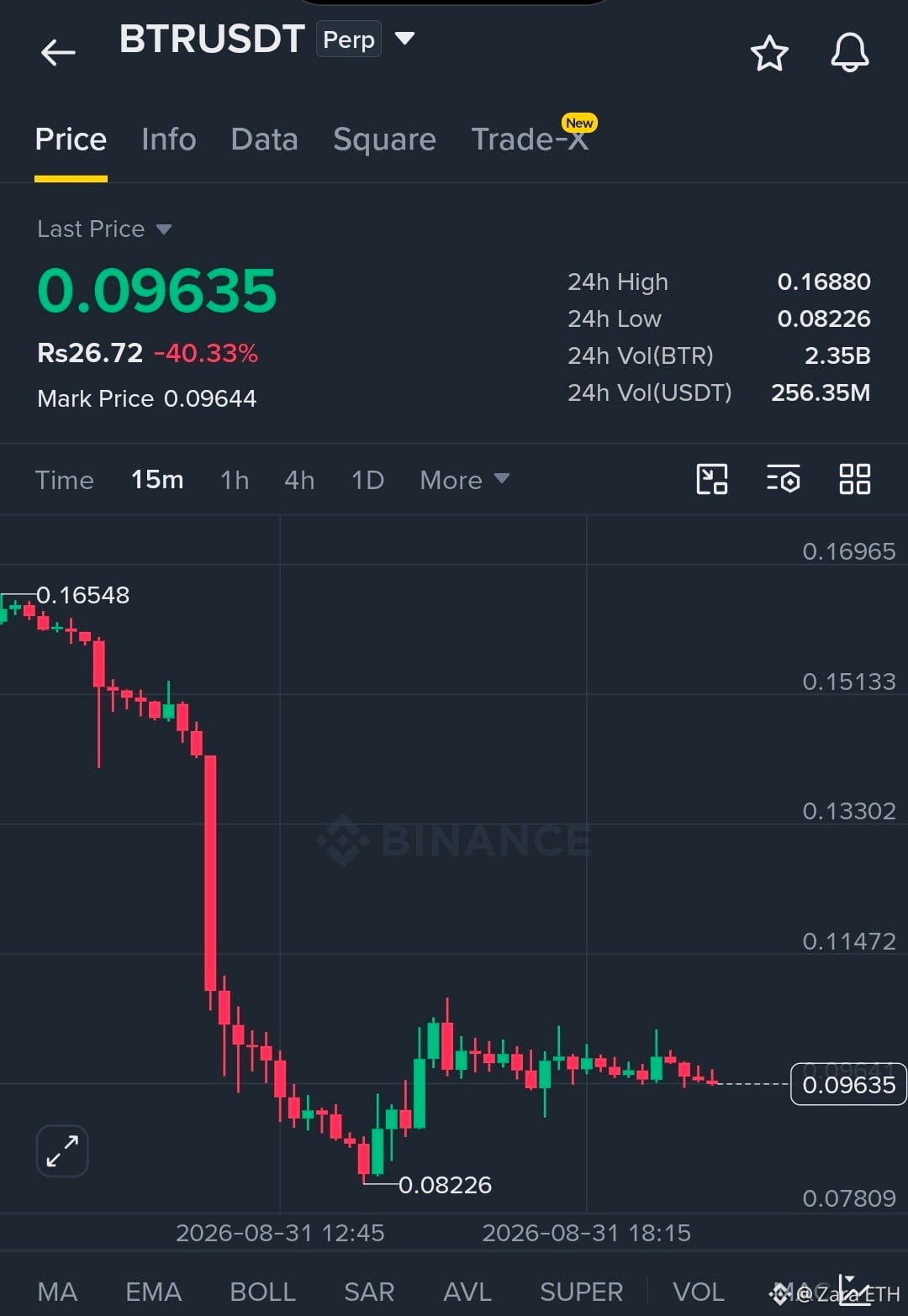
$BTR USDT Perp — Extreme Volatility
BTR is trading at 0.09635 USDT, down a massive 40.33% in 24H.
24H High: 0.16880
24H Low: 0.08226
Mark Price: 0.09644
24H Volume: 2.35B BTR / 256.35M USDT
Chart: 15M
After the brutal sell-off to 0.08226, price bounced and is now consolidating around 0.09635.
Key zone: 0.09635
Support: 0.08226
Resistance: 0.10–0.11
BTR is sitting on a knife-edge — the next breakout could get explosive.
#BitcoinUp23%InAugustOutperformingGoldAndStocks #ChinaPropertyStocksJumpOnNewMortgageRules
{future}(BTRUSDT)
$BTR USDT Perp — Extreme Volatility
BTR is trading at 0.09635 USDT, down a massive 40.33% in 24H.
24H High: 0.16880
24H Low: 0.08226
Mark Price: 0.09644
24H Volume: 2.35B BTR / 256.35M USDT
Chart: 15M
After the brutal sell-off to 0.08226, price bounced and is now consolidating around 0.09635.
Key zone: 0.09635
Support: 0.08226
Resistance: 0.10–0.11
BTR is sitting on a knife-edge — the next breakout could get explosive.
#BitcoinUp23%InAugustOutperformingGoldAndStocks #ChinaPropertyStocksJumpOnNewMortgageRules
BTR is trading at 0.09635 USDT, down a massive 40.33% in 24H.
24H High: 0.16880
24H Low: 0.08226
Mark Price: 0.09644
24H Volume: 2.35B BTR / 256.35M USDT
Chart: 15M
After the brutal sell-off to 0.08226, price bounced and is now consolidating around 0.09635.
Key zone: 0.09635
Support: 0.08226
Resistance: 0.10–0.11
BTR is sitting on a knife-edge — the next breakout could get explosive.
#BitcoinUp23%InAugustOutperformingGoldAndStocks #ChinaPropertyStocksJumpOnNewMortgageRules
185
·
--
Haussier
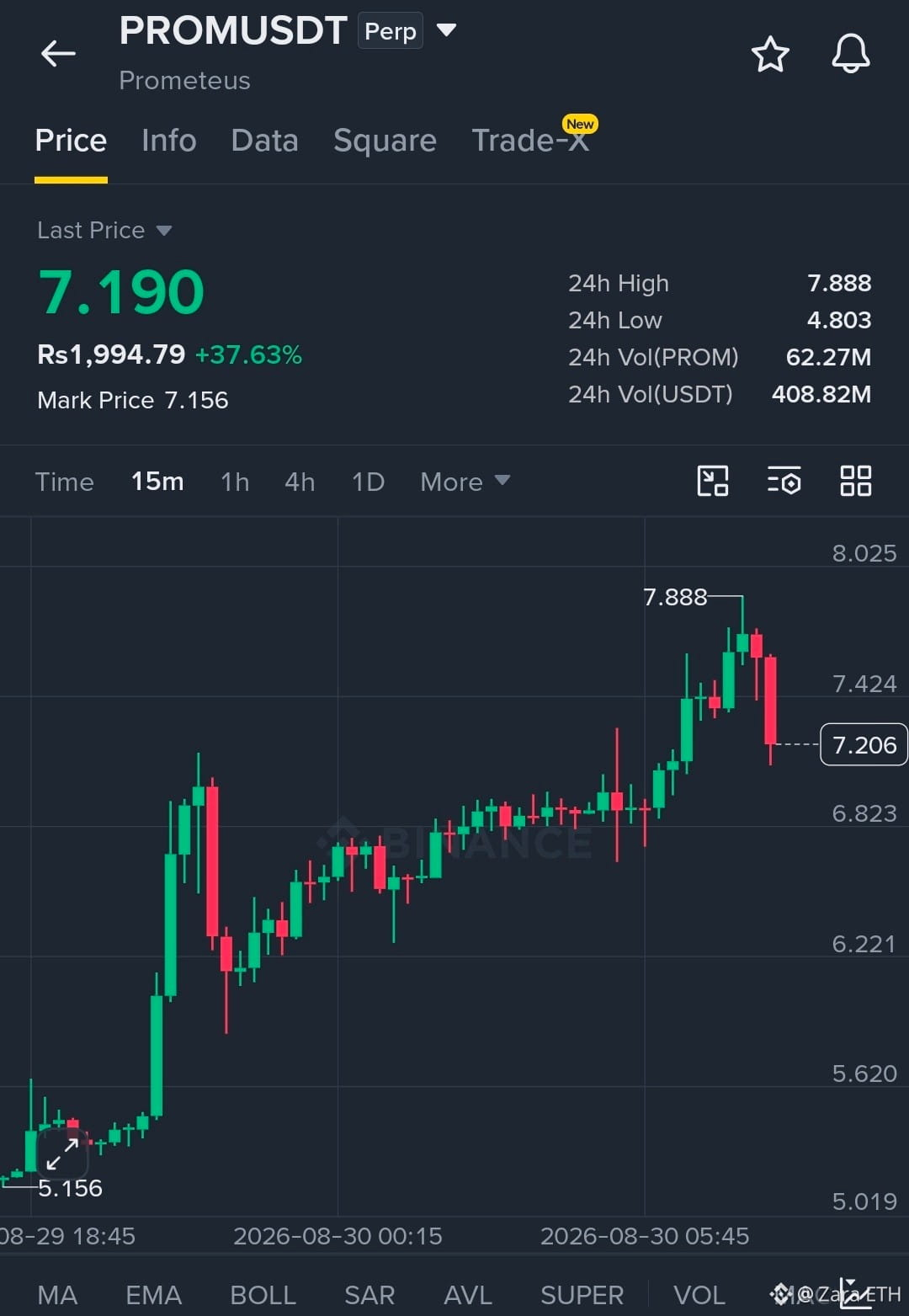
$PROM is moving hard.
PROMUSDT is trading around 7.190, up 37.63% in 24H, after printing a high of 7.888 from a low of 4.803.
24H Volume: 408.82M USDT
Current chart: 15M
Key level: 7.424
Resistance: 7.888
Momentum remains intense, but the sharp rejection from the high makes the next move critical.
PROM is officially in breakout territory.
#AfghanistanTalibanReportedlyBansCryptoNationwide #BitcoinSpotETFEnds9DayInflowStreak
{spot}(PROMUSDT)
$PROM is moving hard.
PROMUSDT is trading around 7.190, up 37.63% in 24H, after printing a high of 7.888 from a low of 4.803.
24H Volume: 408.82M USDT
Current chart: 15M
Key level: 7.424
Resistance: 7.888
Momentum remains intense, but the sharp rejection from the high makes the next move critical.
PROM is officially in breakout territory.
#AfghanistanTalibanReportedlyBansCryptoNationwide #BitcoinSpotETFEnds9DayInflowStreak
PROMUSDT is trading around 7.190, up 37.63% in 24H, after printing a high of 7.888 from a low of 4.803.
24H Volume: 408.82M USDT
Current chart: 15M
Key level: 7.424
Resistance: 7.888
Momentum remains intense, but the sharp rejection from the high makes the next move critical.
PROM is officially in breakout territory.
#AfghanistanTalibanReportedlyBansCryptoNationwide #BitcoinSpotETFEnds9DayInflowStreak
1
232
·
--
Haussier
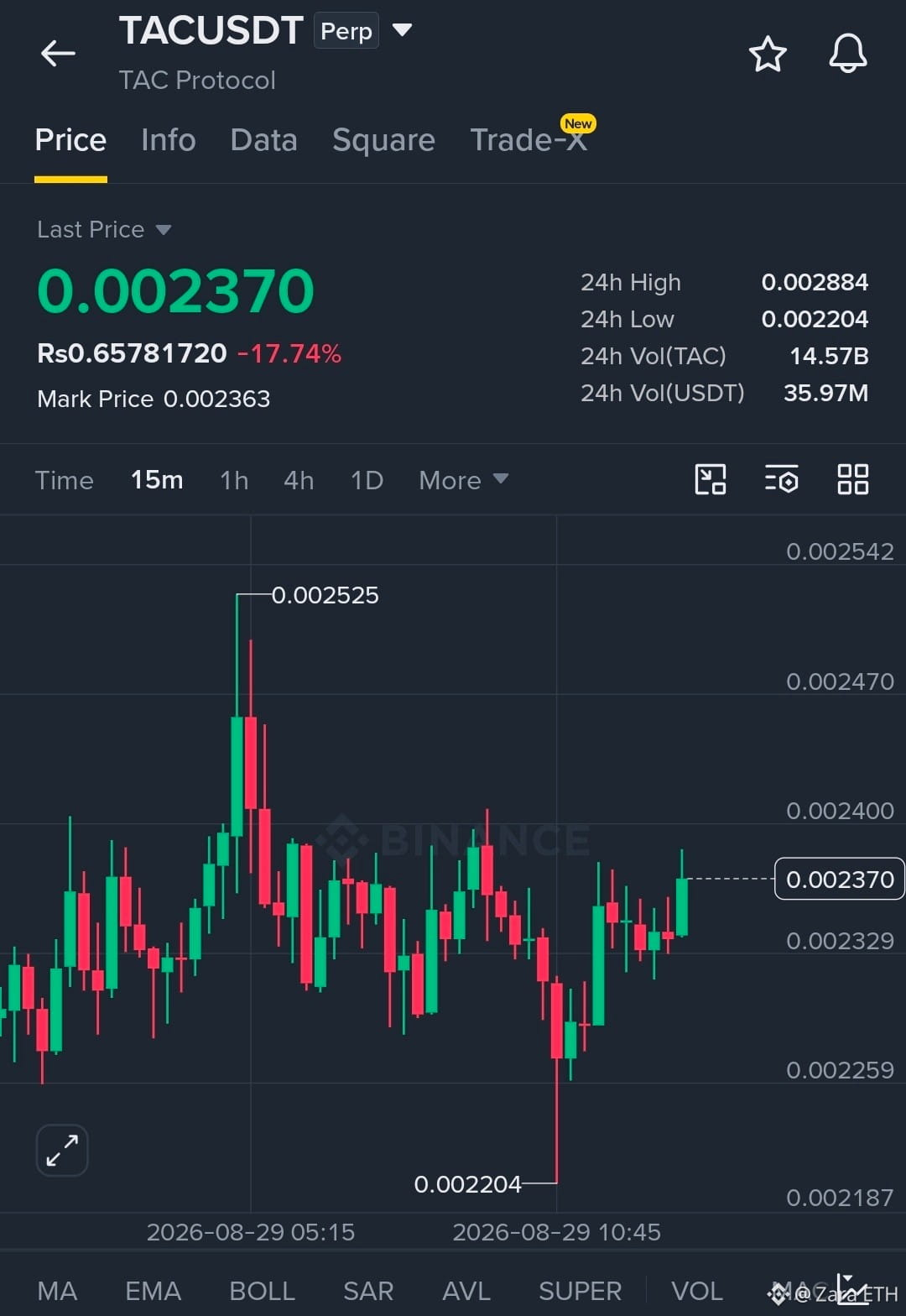
$TAC Protocol (TACUSDT) is showing a high-volatility setup.
Price: 0.002370
24H Change: -17.74%
24H High: 0.002884
24H Low: 0.002204
24H Volume: 14.57B TAC / $35.97M USDT
Mark Price: 0.002363
On the 15M chart, TAC bounced sharply from 0.002204 and is now pushing toward 0.002400 resistance. A breakout could accelerate the recovery, while rejection may send price back toward 0.002329 and 0.002259.
Volatility is heating up. Watch 0.002400 closely.
#WarshSaysInflationIsFedTopFocus #SOLJumps20%OnTheWeek
{future}(TACUSDT)
$TAC Protocol (TACUSDT) is showing a high-volatility setup.
Price: 0.002370
24H Change: -17.74%
24H High: 0.002884
24H Low: 0.002204
24H Volume: 14.57B TAC / $35.97M USDT
Mark Price: 0.002363
On the 15M chart, TAC bounced sharply from 0.002204 and is now pushing toward 0.002400 resistance. A breakout could accelerate the recovery, while rejection may send price back toward 0.002329 and 0.002259.
Volatility is heating up. Watch 0.002400 closely.
#WarshSaysInflationIsFedTopFocus #SOLJumps20%OnTheWeek
Price: 0.002370
24H Change: -17.74%
24H High: 0.002884
24H Low: 0.002204
24H Volume: 14.57B TAC / $35.97M USDT
Mark Price: 0.002363
On the 15M chart, TAC bounced sharply from 0.002204 and is now pushing toward 0.002400 resistance. A breakout could accelerate the recovery, while rejection may send price back toward 0.002329 and 0.002259.
Volatility is heating up. Watch 0.002400 closely.
#WarshSaysInflationIsFedTopFocus #SOLJumps20%OnTheWeek
163
·
--
Haussier
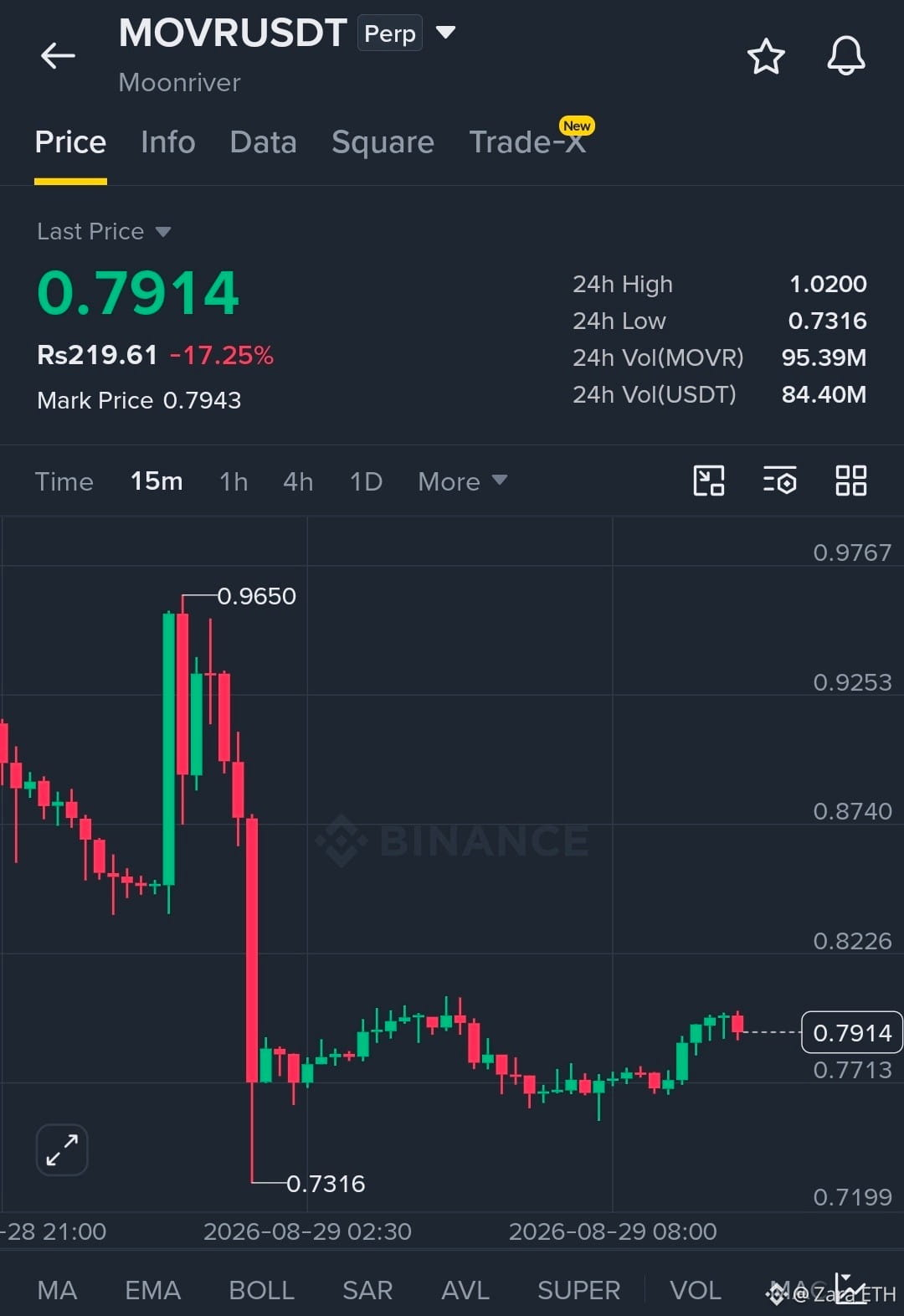
$MOVR USDT is in a wild fight right now.
Moonriver is trading at $0.7914, down 17.25% in 24H after a brutal rejection from $1.0200.
24H Low: $0.7316
24H Volume: 95.39M MOVR / 84.40M USDT
On the 15M chart, MOVR dumped hard, found support near $0.7316, and is now recovering toward $0.80.
$0.80 is the immediate battle zone. A breakout could accelerate the rebound, while losing $0.7713 could put the $0.7316 low back in play.
High volatility. High stakes. MOVR is moving.
#USShortTermTreasuryYieldsJump #CaliforniaBillWouldBarOfficialMemeCoins
{spot}(MOVRUSDT)
$MOVR USDT is in a wild fight right now.
Moonriver is trading at $0.7914, down 17.25% in 24H after a brutal rejection from $1.0200.
24H Low: $0.7316
24H Volume: 95.39M MOVR / 84.40M USDT
On the 15M chart, MOVR dumped hard, found support near $0.7316, and is now recovering toward $0.80.
$0.80 is the immediate battle zone. A breakout could accelerate the rebound, while losing $0.7713 could put the $0.7316 low back in play.
High volatility. High stakes. MOVR is moving.
#USShortTermTreasuryYieldsJump #CaliforniaBillWouldBarOfficialMemeCoins
Moonriver is trading at $0.7914, down 17.25% in 24H after a brutal rejection from $1.0200.
24H Low: $0.7316
24H Volume: 95.39M MOVR / 84.40M USDT
On the 15M chart, MOVR dumped hard, found support near $0.7316, and is now recovering toward $0.80.
$0.80 is the immediate battle zone. A breakout could accelerate the rebound, while losing $0.7713 could put the $0.7316 low back in play.
High volatility. High stakes. MOVR is moving.
#USShortTermTreasuryYieldsJump #CaliforniaBillWouldBarOfficialMemeCoins
2
214
·
--
Haussier
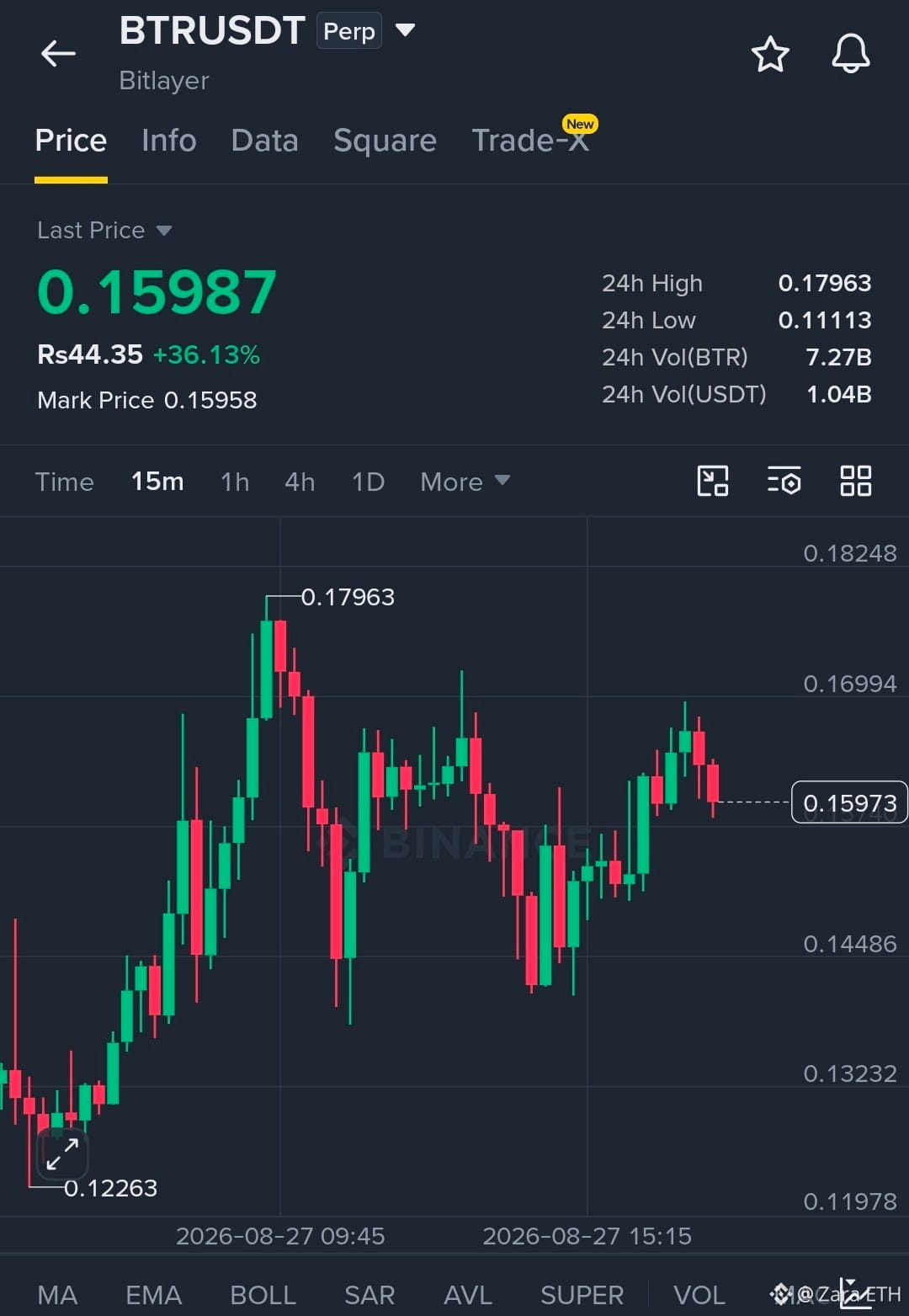
$BTR /USDT PERP — 15M
BTR is moving hard after a massive +36.13% surge.
Price: 0.15987
24H High: 0.17963
24H Low: 0.11113
24H Vol: 7.27B BTR / 1.04B USDT
Price is now sitting near 0.160, with 0.16994 as the key resistance. A clean breakout could send BTR back toward 0.17963.
If buyers lose 0.159, watch 0.14486 as the next major support.
Volatility is extreme. This setup is at a critical decision zone.
#BestBuyQ2RevenueTopsEstimatesLiftsOutlook #DollarPostsBiggestGainInNearlyFourWeeks
{future}(BTRUSDT)
$BTR /USDT PERP — 15M
BTR is moving hard after a massive +36.13% surge.
Price: 0.15987
24H High: 0.17963
24H Low: 0.11113
24H Vol: 7.27B BTR / 1.04B USDT
Price is now sitting near 0.160, with 0.16994 as the key resistance. A clean breakout could send BTR back toward 0.17963.
If buyers lose 0.159, watch 0.14486 as the next major support.
Volatility is extreme. This setup is at a critical decision zone.
#BestBuyQ2RevenueTopsEstimatesLiftsOutlook #DollarPostsBiggestGainInNearlyFourWeeks
BTR is moving hard after a massive +36.13% surge.
Price: 0.15987
24H High: 0.17963
24H Low: 0.11113
24H Vol: 7.27B BTR / 1.04B USDT
Price is now sitting near 0.160, with 0.16994 as the key resistance. A clean breakout could send BTR back toward 0.17963.
If buyers lose 0.159, watch 0.14486 as the next major support.
Volatility is extreme. This setup is at a critical decision zone.
#BestBuyQ2RevenueTopsEstimatesLiftsOutlook #DollarPostsBiggestGainInNearlyFourWeeks
247
·
--
Partiellement vrai
Reading through Dusk's treasury breakdown and literally stopped mid-bite.
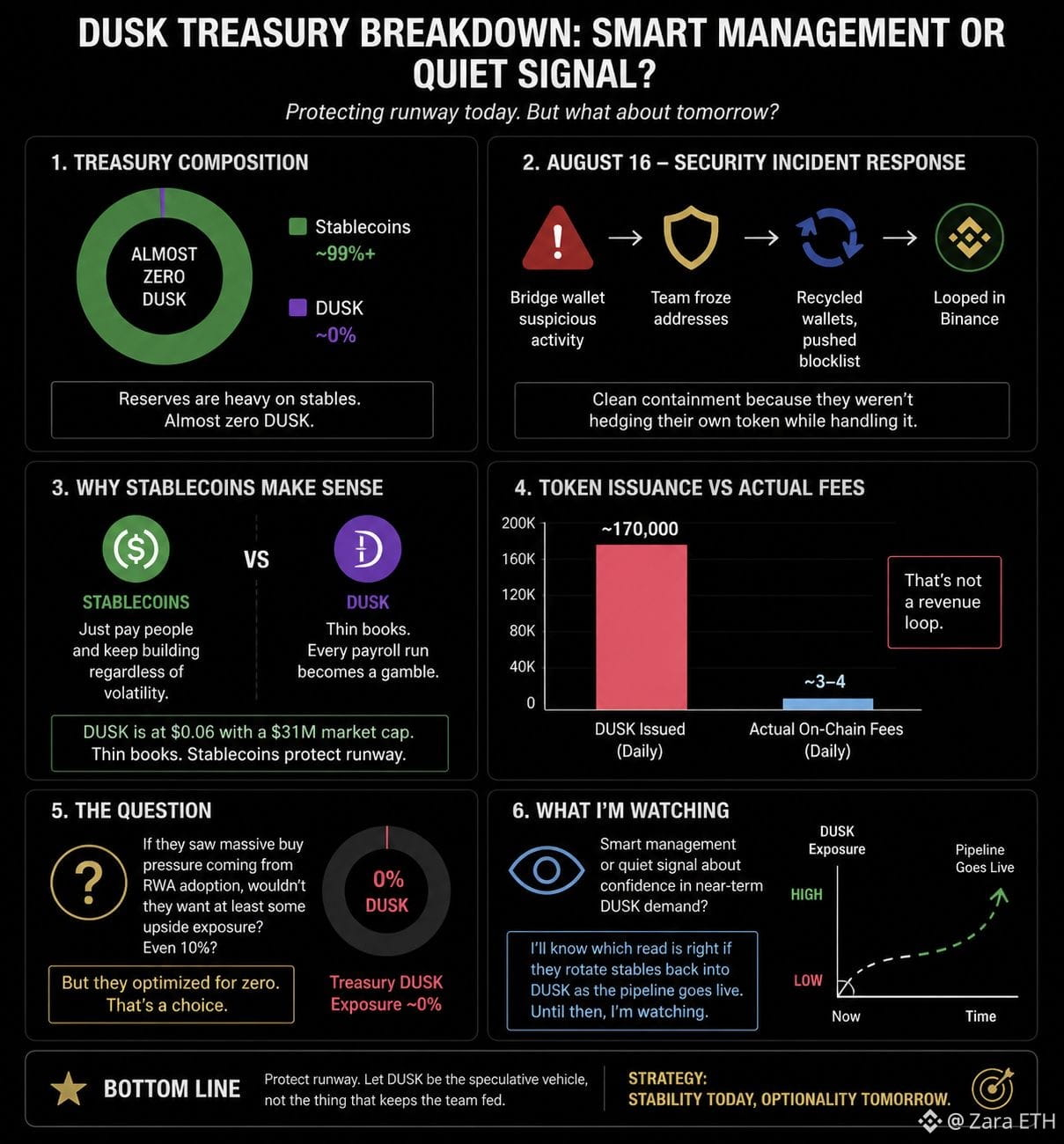
They're out here pitching "MiCA-compliant, TradFi on-ramp"—all the institutional buzzwords. So naturally you'd expect the foundation to be holding a fat bag of their own token. Alignment, right?
Nope. Reserves are heavy on stables. Almost zero DUSK.
Then I remembered August 16. Bridge wallet caught suspicious activity. Team moved fast—froze addresses, recycled wallets, pushed a blocklist, looped in Binance. Clean containment.
What made that possible? They weren't scrambling to hedge their own token while handling it.
DUSK is at $0.06 with a $31M market cap. Thin books. If treasury was in DUSK, every payroll run becomes a gamble. Stablecoins let them just pay people and keep building regardless of volatility.
Honestly? That's just smart. Protect runway. Let DUSK be the speculative vehicle, not the thing that keeps the team fed.
But here's what's bugging me.
They're issuing ~170k DUSK daily. Actual on-chain fees? Maybe 3–4 DUSK a day. That's not a revenue loop. If they saw massive buy pressure coming from RWA adoption, wouldn't they want at least some upside exposure? Even 10%? But they optimized for zero. That's a choice.
I keep flipping. Smart management or quiet signal about confidence in near-term DUSK demand?
I'll know which read is right if I ever see them rotate stables back into DUSK as the pipeline goes live. Until then, I'm watching.
@Dusk_Foundation #dusk $DUSK
{spot}(DUSKUSDT)
Reading through Dusk's treasury breakdown and literally stopped mid-bite.
They're out here pitching "MiCA-compliant, TradFi on-ramp"—all the institutional buzzwords. So naturally you'd expect the foundation to be holding a fat bag of their own token. Alignment, right?
Nope. Reserves are heavy on stables. Almost zero DUSK.
Then I remembered August 16. Bridge wallet caught suspicious activity. Team moved fast—froze addresses, recycled wallets, pushed a blocklist, looped in Binance. Clean containment.
What made that possible? They weren't scrambling to hedge their own token while handling it.
DUSK is at $0.06 with a $31M market cap. Thin books. If treasury was in DUSK, every payroll run becomes a gamble. Stablecoins let them just pay people and keep building regardless of volatility.
Honestly? That's just smart. Protect runway. Let DUSK be the speculative vehicle, not the thing that keeps the team fed.
But here's what's bugging me.
They're issuing ~170k DUSK daily. Actual on-chain fees? Maybe 3–4 DUSK a day. That's not a revenue loop. If they saw massive buy pressure coming from RWA adoption, wouldn't they want at least some upside exposure? Even 10%? But they optimized for zero. That's a choice.
I keep flipping. Smart management or quiet signal about confidence in near-term DUSK demand?
I'll know which read is right if I ever see them rotate stables back into DUSK as the pipeline goes live. Until then, I'm watching.
@Dusk #dusk $DUSK
They're out here pitching "MiCA-compliant, TradFi on-ramp"—all the institutional buzzwords. So naturally you'd expect the foundation to be holding a fat bag of their own token. Alignment, right?
Nope. Reserves are heavy on stables. Almost zero DUSK.
Then I remembered August 16. Bridge wallet caught suspicious activity. Team moved fast—froze addresses, recycled wallets, pushed a blocklist, looped in Binance. Clean containment.
What made that possible? They weren't scrambling to hedge their own token while handling it.
DUSK is at $0.06 with a $31M market cap. Thin books. If treasury was in DUSK, every payroll run becomes a gamble. Stablecoins let them just pay people and keep building regardless of volatility.
Honestly? That's just smart. Protect runway. Let DUSK be the speculative vehicle, not the thing that keeps the team fed.
But here's what's bugging me.
They're issuing ~170k DUSK daily. Actual on-chain fees? Maybe 3–4 DUSK a day. That's not a revenue loop. If they saw massive buy pressure coming from RWA adoption, wouldn't they want at least some upside exposure? Even 10%? But they optimized for zero. That's a choice.
I keep flipping. Smart management or quiet signal about confidence in near-term DUSK demand?
I'll know which read is right if I ever see them rotate stables back into DUSK as the pipeline goes live. Until then, I'm watching.
@Dusk #dusk $DUSK
1
4
1k
·
--
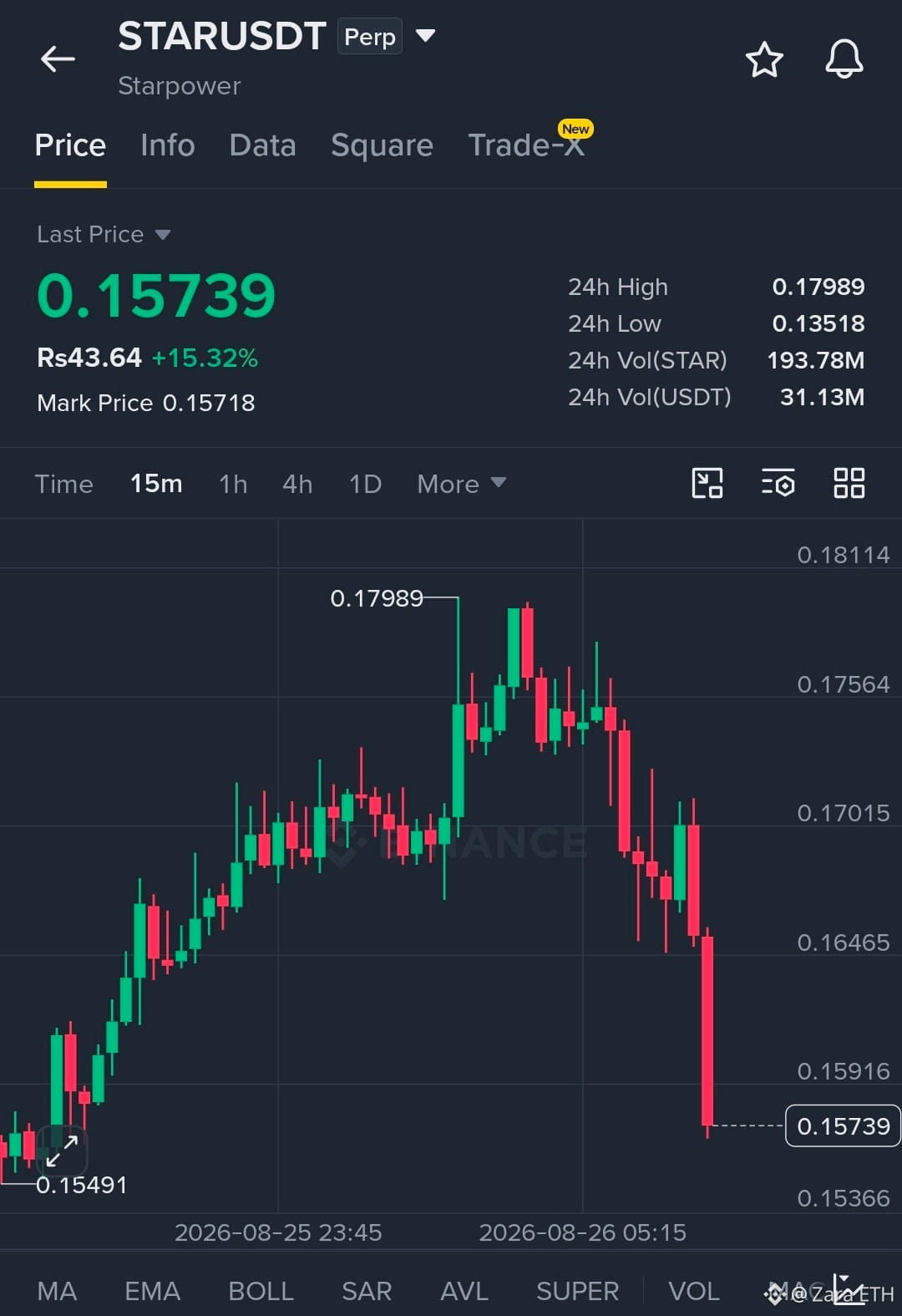
$STAR USDT is making a strong move.
Price: 0.15739 | +15.32%
24H High: 0.17989
24H Low: 0.13518
24H Volume: $31.13M
After a sharp rally from the 0.13518 low, STAR is now pulling back near 0.157.
Watch 0.159–0.164 closely. Reclaiming this zone could open the way toward 0.170 and 0.180.
#USCryptoEquityIndexRises5.04% #SolanaRWAHoldersTop300000
{future}(STARUSDT)
$STAR USDT is making a strong move.
Price: 0.15739 | +15.32%
24H High: 0.17989
24H Low: 0.13518
24H Volume: $31.13M
After a sharp rally from the 0.13518 low, STAR is now pulling back near 0.157.
Watch 0.159–0.164 closely. Reclaiming this zone could open the way toward 0.170 and 0.180.
#USCryptoEquityIndexRises5.04% #SolanaRWAHoldersTop300000
Price: 0.15739 | +15.32%
24H High: 0.17989
24H Low: 0.13518
24H Volume: $31.13M
After a sharp rally from the 0.13518 low, STAR is now pulling back near 0.157.
Watch 0.159–0.164 closely. Reclaiming this zone could open the way toward 0.170 and 0.180.
#USCryptoEquityIndexRises5.04% #SolanaRWAHoldersTop300000
2
1.2k
·
--
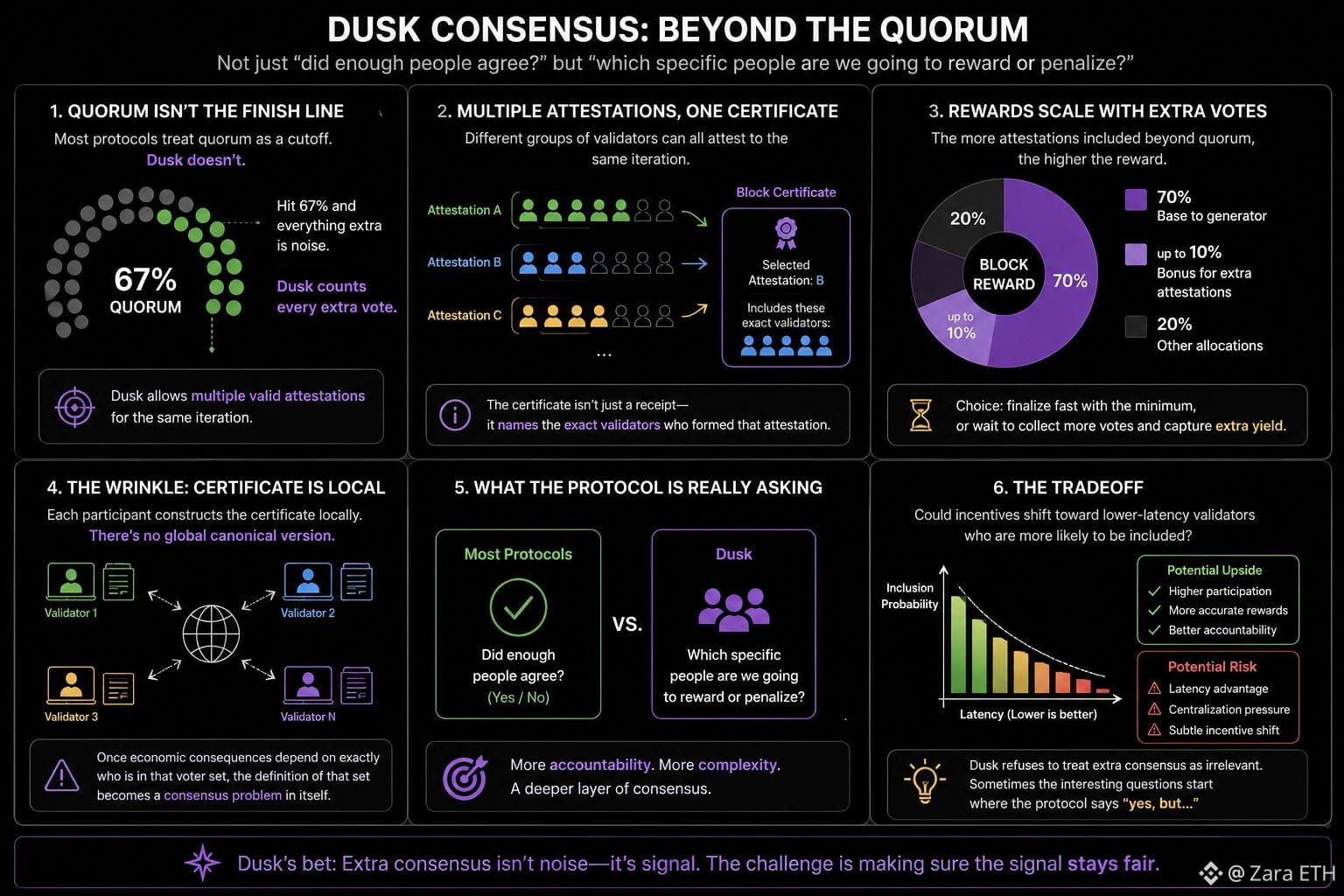
Most consensus protocols treat quorum as a cutoff—hit 67% and everything extra is noise. Dusk doesn't.
It allows multiple valid attestations for the same iteration, which means you can have different groups of validators all claiming agreement. The block certificate picks one. But that certificate isn't just a receipt—it names the exact validators who formed that attestation.
Why does that matter? Because rewards scale with votes beyond the quorum. The generator gets 70% of the block reward, plus a bonus up to 10% depending on how many extra attestations they pack in. So now there's a choice: finalize fast with the minimum, or wait a bit longer to scoop up more votes and capture that extra yield.
But here's the wrinkle: the certificate is constructed locally by each participant. There's no global canonical version. And once economic consequences depend on exactly who is in that voter set, the definition of that set becomes a consensus problem in itself.
So the protocol isn't just asking "did enough people agree?" It's asking "which specific people are we going to reward or penalize?" That adds accountability, sure. But it also adds a layer of complexity that could subtly shift incentives toward lower-latency validators who are more likely to be included.
I'm not convinced that tradeoff is clean. But I do think Dusk is onto something by refusing to treat extra consensus as irrelevant. Sometimes the interesting questions start where the protocol says "yes, but..."
@Dusk_Foundation #dusk $DUSK
{spot}(DUSKUSDT)
Most consensus protocols treat quorum as a cutoff—hit 67% and everything extra is noise. Dusk doesn't.
It allows multiple valid attestations for the same iteration, which means you can have different groups of validators all claiming agreement. The block certificate picks one. But that certificate isn't just a receipt—it names the exact validators who formed that attestation.
Why does that matter? Because rewards scale with votes beyond the quorum. The generator gets 70% of the block reward, plus a bonus up to 10% depending on how many extra attestations they pack in. So now there's a choice: finalize fast with the minimum, or wait a bit longer to scoop up more votes and capture that extra yield.
But here's the wrinkle: the certificate is constructed locally by each participant. There's no global canonical version. And once economic consequences depend on exactly who is in that voter set, the definition of that set becomes a consensus problem in itself.
So the protocol isn't just asking "did enough people agree?" It's asking "which specific people are we going to reward or penalize?" That adds accountability, sure. But it also adds a layer of complexity that could subtly shift incentives toward lower-latency validators who are more likely to be included.
I'm not convinced that tradeoff is clean. But I do think Dusk is onto something by refusing to treat extra consensus as irrelevant. Sometimes the interesting questions start where the protocol says "yes, but..."
@Dusk #dusk $DUSK
It allows multiple valid attestations for the same iteration, which means you can have different groups of validators all claiming agreement. The block certificate picks one. But that certificate isn't just a receipt—it names the exact validators who formed that attestation.
Why does that matter? Because rewards scale with votes beyond the quorum. The generator gets 70% of the block reward, plus a bonus up to 10% depending on how many extra attestations they pack in. So now there's a choice: finalize fast with the minimum, or wait a bit longer to scoop up more votes and capture that extra yield.
But here's the wrinkle: the certificate is constructed locally by each participant. There's no global canonical version. And once economic consequences depend on exactly who is in that voter set, the definition of that set becomes a consensus problem in itself.
So the protocol isn't just asking "did enough people agree?" It's asking "which specific people are we going to reward or penalize?" That adds accountability, sure. But it also adds a layer of complexity that could subtly shift incentives toward lower-latency validators who are more likely to be included.
I'm not convinced that tradeoff is clean. But I do think Dusk is onto something by refusing to treat extra consensus as irrelevant. Sometimes the interesting questions start where the protocol says "yes, but..."
@Dusk #dusk $DUSK
3
460
·
--
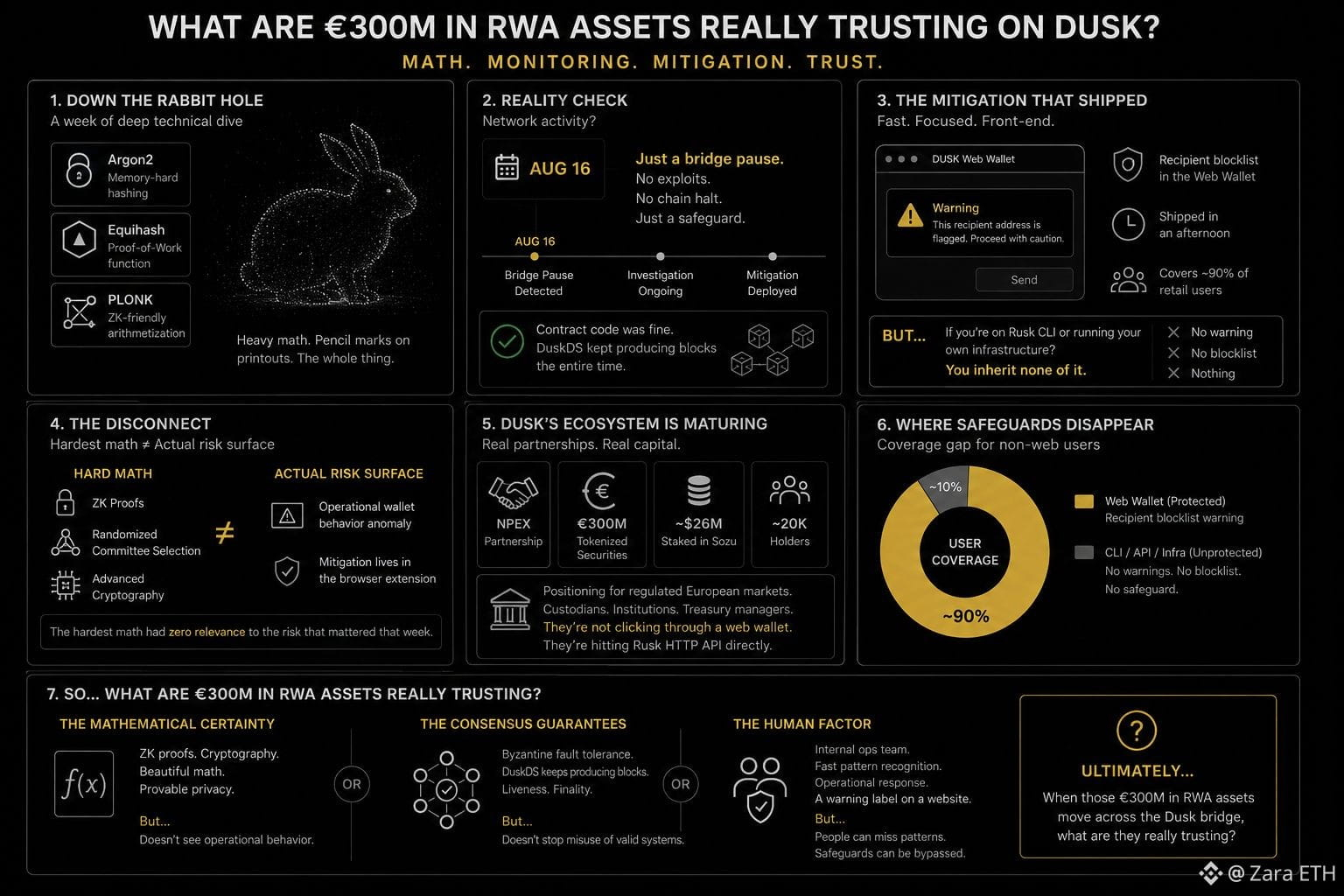
Spent the better part of a week down a Khovratovich rabbit hole on Dusk—Argon2, Equihash, the PLONK arithmetization. Heavy math. Pencil marks on printouts, the whole thing. Then I tabbed over to check actual network activity... and it was just a bridge pause from August 16.
A team-managed operational wallet got flagged for behavior inconsistent with normal bridge ops. Contract code was fine. DuskDS kept producing blocks the entire time. The "fix" they shipped? A recipient blocklist in the Web Wallet that throws a warning before you can send to a flagged address.
That's where my brain short-circuited.
The hardest math in Dusk's stack—the ZK proofs, the randomized committee selection—had zero relevance to the actual risk surface that week. The mitigation landed where the default user lives: the browser extension. But if you're on Rusk CLI or running your own infrastructure? You inherit none of it. No warning. No blocklist. Nothing.
I keep flipping on whether that's pragmatic or unsettling. Half of me says cover 90% of retail users in an afternoon, argue about elegance later. The other half remembers Dusk is positioning for regulated European markets—NPEX partnership, €300M in tokenized securities, ~$26M staked in Sozu with roughly 20k holders. When custodians and treasury managers eventually show up, they aren't clicking through a web wallet. They're hitting Rusk HTTP API directly. And that safeguard just silently disappears for them.
So I'm sitting here wondering: when those €300M in RWA assets actually move across the Dusk bridge, what are they really trusting? The mathematical certainty of the ZK proofs? The Byzantine fault tolerance of the consensus? Or just the fact that the internal ops team caught a weird pattern fast enough to push a warning label to a website?
@Dusk_Foundation #dusk $DUSK
{future}(DUSKUSDT)
Spent the better part of a week down a Khovratovich rabbit hole on Dusk—Argon2, Equihash, the PLONK arithmetization. Heavy math. Pencil marks on printouts, the whole thing. Then I tabbed over to check actual network activity... and it was just a bridge pause from August 16.
A team-managed operational wallet got flagged for behavior inconsistent with normal bridge ops. Contract code was fine. DuskDS kept producing blocks the entire time. The "fix" they shipped? A recipient blocklist in the Web Wallet that throws a warning before you can send to a flagged address.
That's where my brain short-circuited.
The hardest math in Dusk's stack—the ZK proofs, the randomized committee selection—had zero relevance to the actual risk surface that week. The mitigation landed where the default user lives: the browser extension. But if you're on Rusk CLI or running your own infrastructure? You inherit none of it. No warning. No blocklist. Nothing.
I keep flipping on whether that's pragmatic or unsettling. Half of me says cover 90% of retail users in an afternoon, argue about elegance later. The other half remembers Dusk is positioning for regulated European markets—NPEX partnership, €300M in tokenized securities, ~$26M staked in Sozu with roughly 20k holders. When custodians and treasury managers eventually show up, they aren't clicking through a web wallet. They're hitting Rusk HTTP API directly. And that safeguard just silently disappears for them.
So I'm sitting here wondering: when those €300M in RWA assets actually move across the Dusk bridge, what are they really trusting? The mathematical certainty of the ZK proofs? The Byzantine fault tolerance of the consensus? Or just the fact that the internal ops team caught a weird pattern fast enough to push a warning label to a website?
@Dusk #dusk $DUSK
A team-managed operational wallet got flagged for behavior inconsistent with normal bridge ops. Contract code was fine. DuskDS kept producing blocks the entire time. The "fix" they shipped? A recipient blocklist in the Web Wallet that throws a warning before you can send to a flagged address.
That's where my brain short-circuited.
The hardest math in Dusk's stack—the ZK proofs, the randomized committee selection—had zero relevance to the actual risk surface that week. The mitigation landed where the default user lives: the browser extension. But if you're on Rusk CLI or running your own infrastructure? You inherit none of it. No warning. No blocklist. Nothing.
I keep flipping on whether that's pragmatic or unsettling. Half of me says cover 90% of retail users in an afternoon, argue about elegance later. The other half remembers Dusk is positioning for regulated European markets—NPEX partnership, €300M in tokenized securities, ~$26M staked in Sozu with roughly 20k holders. When custodians and treasury managers eventually show up, they aren't clicking through a web wallet. They're hitting Rusk HTTP API directly. And that safeguard just silently disappears for them.
So I'm sitting here wondering: when those €300M in RWA assets actually move across the Dusk bridge, what are they really trusting? The mathematical certainty of the ZK proofs? The Byzantine fault tolerance of the consensus? Or just the fact that the internal ops team caught a weird pattern fast enough to push a warning label to a website?
@Dusk #dusk $DUSK
3
4
510
·
--
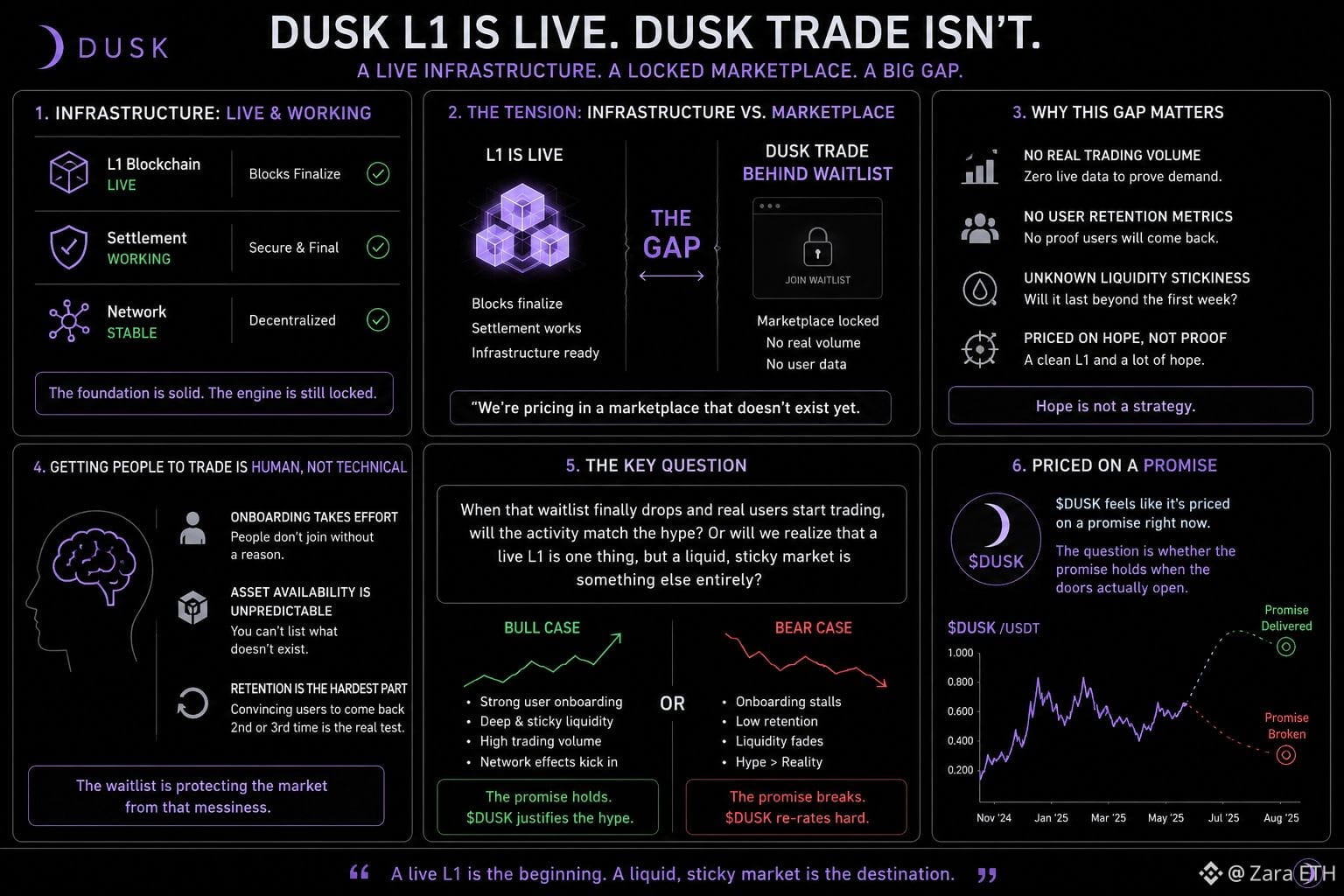
There's a quiet tension in watching Dusk's L1 go live while Dusk Trade sits behind a waitlist.
The infrastructure is there. Blocks finalize. Settlement works. But the economic engine—the actual marketplace—is still locked behind a sign-up form. That gap matters more than most people realize.
Right now, we're pricing in a thriving marketplace that doesn't actually exist yet. No real trading volume. No user retention metrics. No proof that liquidity will stick around after the first week. Just a really clean L1 and a lot of hope.
Getting people to trade isn't a technical problem—it's a human one. Onboarding takes effort. Asset availability is unpredictable. And convincing someone to come back a second or third time? That's the hardest part. The waitlist is protecting the market from that messiness.
I keep circling back to the same question. When that waitlist finally drops and real users start trading, will the activity match the hype? Or will we realize that a live L1 is one thing, but a liquid, sticky market is something else entirely?
$DUSK feels like it's priced on a promise right now. The question is whether the promise holds when the doors actually open.
@Dusk_Foundation #dusk $DUSK
{future}(DUSKUSDT)
There's a quiet tension in watching Dusk's L1 go live while Dusk Trade sits behind a waitlist.
The infrastructure is there. Blocks finalize. Settlement works. But the economic engine—the actual marketplace—is still locked behind a sign-up form. That gap matters more than most people realize.
Right now, we're pricing in a thriving marketplace that doesn't actually exist yet. No real trading volume. No user retention metrics. No proof that liquidity will stick around after the first week. Just a really clean L1 and a lot of hope.
Getting people to trade isn't a technical problem—it's a human one. Onboarding takes effort. Asset availability is unpredictable. And convincing someone to come back a second or third time? That's the hardest part. The waitlist is protecting the market from that messiness.
I keep circling back to the same question. When that waitlist finally drops and real users start trading, will the activity match the hype? Or will we realize that a live L1 is one thing, but a liquid, sticky market is something else entirely?
$DUSK feels like it's priced on a promise right now. The question is whether the promise holds when the doors actually open.
@Dusk #dusk $DUSK
The infrastructure is there. Blocks finalize. Settlement works. But the economic engine—the actual marketplace—is still locked behind a sign-up form. That gap matters more than most people realize.
Right now, we're pricing in a thriving marketplace that doesn't actually exist yet. No real trading volume. No user retention metrics. No proof that liquidity will stick around after the first week. Just a really clean L1 and a lot of hope.
Getting people to trade isn't a technical problem—it's a human one. Onboarding takes effort. Asset availability is unpredictable. And convincing someone to come back a second or third time? That's the hardest part. The waitlist is protecting the market from that messiness.
I keep circling back to the same question. When that waitlist finally drops and real users start trading, will the activity match the hype? Or will we realize that a live L1 is one thing, but a liquid, sticky market is something else entirely?
$DUSK feels like it's priced on a promise right now. The question is whether the promise holds when the doors actually open.
@Dusk #dusk $DUSK
1
2
238
·
--
I was scrolling through Dusk's block explorer last night, just curious. What I found made me pause.
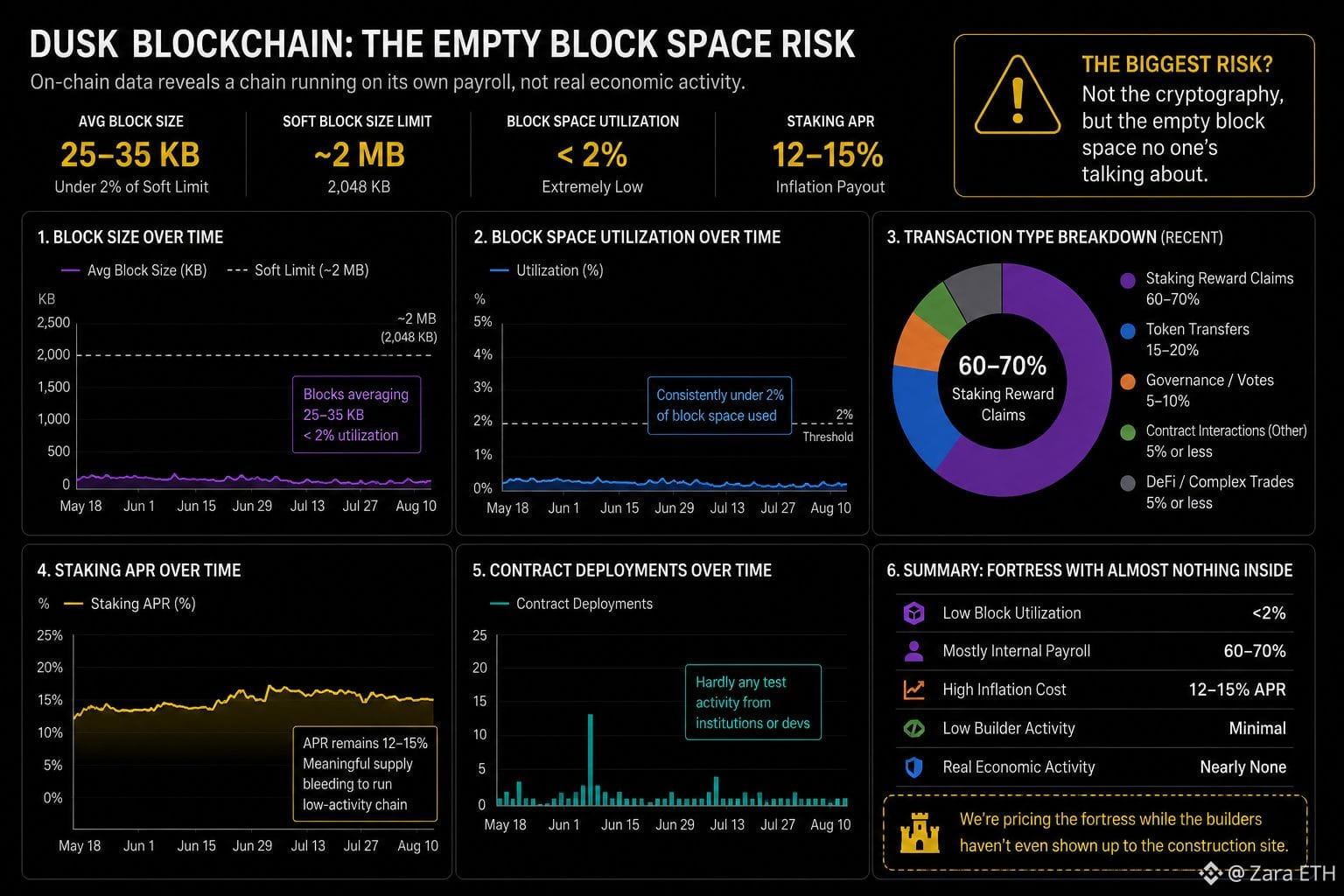
Blocks are averaging 25–35 KB when the soft limit is around 2 MB. That's under 2% utilization. For a Layer-1 built for heavy zero-knowledge private contracts, I expected some noise. Instead, barely a whisper.
Then I clicked inside. Roughly 60-70% of recent transactions aren't complex DeFi trades or confidential securities. They're just staking reward claims—validators collecting inflation payouts, over and over.
The network's primary job right now is basically processing its own payroll.
Meanwhile, the staking APR is still around 12-15% to incentivize validators. That's a meaningful chunk of supply bleeding out to run a chain that, by its own on-chain data, isn't handling any real external economic value yet.
I checked contract deployments. Hardly any test activity from institutions, or even devs messing around. The tech is solid, the thesis makes sense. But on-chain data shows a fortified vault with almost nothing inside.
We're pricing the fortress while the builders haven't even shown up to the construction site.
What if the biggest risk isn't the cryptography, but the empty block space no one's talking about?
@Dusk_Foundation #dusk $DUSK
{future}(DUSKUSDT)
I was scrolling through Dusk's block explorer last night, just curious. What I found made me pause.
Blocks are averaging 25–35 KB when the soft limit is around 2 MB. That's under 2% utilization. For a Layer-1 built for heavy zero-knowledge private contracts, I expected some noise. Instead, barely a whisper.
Then I clicked inside. Roughly 60-70% of recent transactions aren't complex DeFi trades or confidential securities. They're just staking reward claims—validators collecting inflation payouts, over and over.
The network's primary job right now is basically processing its own payroll.
Meanwhile, the staking APR is still around 12-15% to incentivize validators. That's a meaningful chunk of supply bleeding out to run a chain that, by its own on-chain data, isn't handling any real external economic value yet.
I checked contract deployments. Hardly any test activity from institutions, or even devs messing around. The tech is solid, the thesis makes sense. But on-chain data shows a fortified vault with almost nothing inside.
We're pricing the fortress while the builders haven't even shown up to the construction site.
What if the biggest risk isn't the cryptography, but the empty block space no one's talking about?
@Dusk #dusk $DUSK
Blocks are averaging 25–35 KB when the soft limit is around 2 MB. That's under 2% utilization. For a Layer-1 built for heavy zero-knowledge private contracts, I expected some noise. Instead, barely a whisper.
Then I clicked inside. Roughly 60-70% of recent transactions aren't complex DeFi trades or confidential securities. They're just staking reward claims—validators collecting inflation payouts, over and over.
The network's primary job right now is basically processing its own payroll.
Meanwhile, the staking APR is still around 12-15% to incentivize validators. That's a meaningful chunk of supply bleeding out to run a chain that, by its own on-chain data, isn't handling any real external economic value yet.
I checked contract deployments. Hardly any test activity from institutions, or even devs messing around. The tech is solid, the thesis makes sense. But on-chain data shows a fortified vault with almost nothing inside.
We're pricing the fortress while the builders haven't even shown up to the construction site.
What if the biggest risk isn't the cryptography, but the empty block space no one's talking about?
@Dusk #dusk $DUSK
1
5
391
·
--
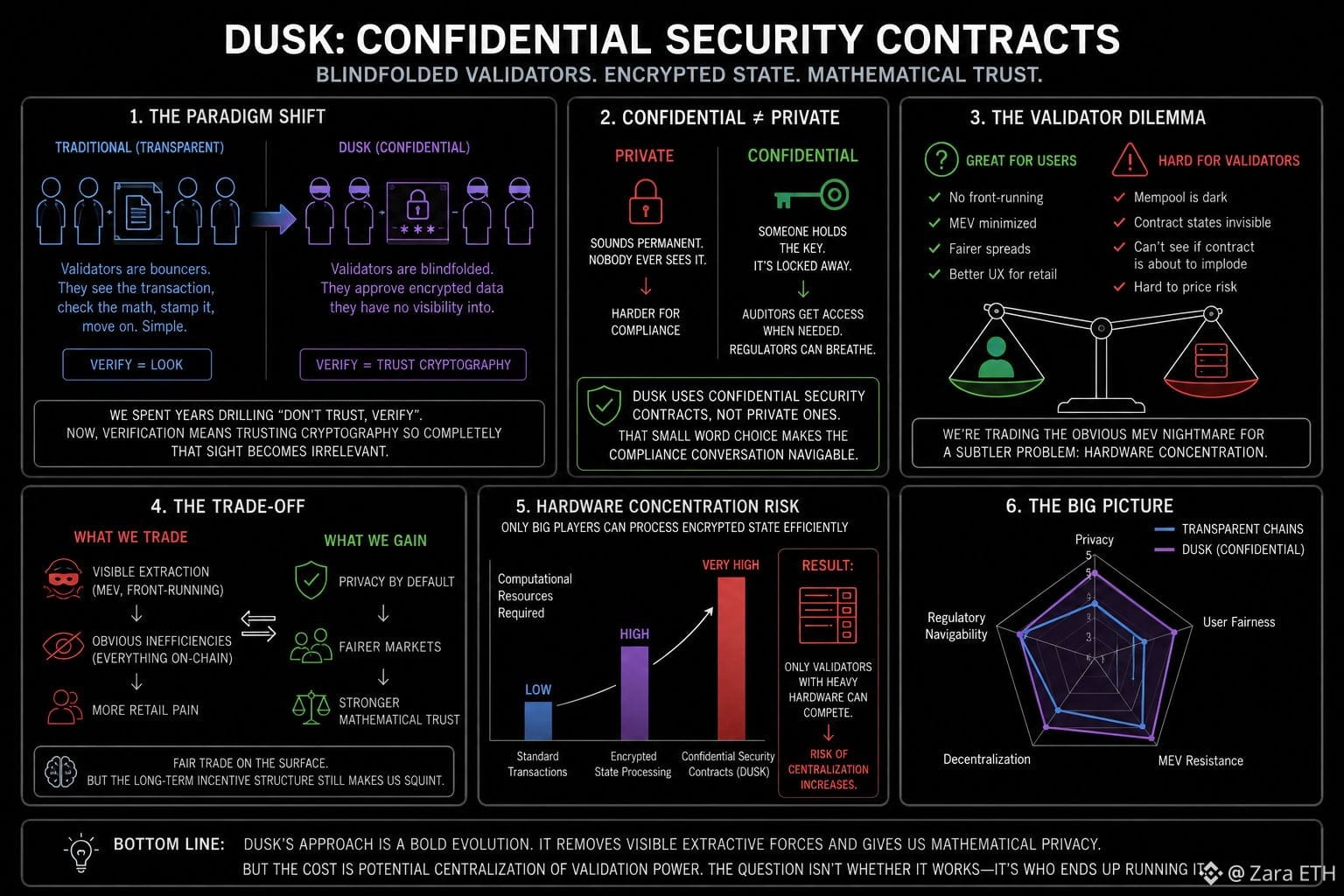
I keep getting stuck on the validators.
Normally, they're just bouncers. They see the transaction, check the math, stamp it, move on. Simple.
But on Dusk, we're asking them to agree on state changes they literally cannot read. They're blindfolded, approving encrypted data they have no visibility into.
We spent years drilling "don't trust, verify" into the ecosystem. Verify means look. But here, verification means trusting the cryptography so completely that sight becomes irrelevant. That's a wild shift. The transparency we fetishized is gone, yet somehow the trustlessness feels more mathematical, more absolute.
The branding actually nails this distinction. They use Confidential Security Contracts, not Private ones. Private sounds permanent—nobody ever sees it. Confidential implies someone holds the key, it's just locked away. That small word choice makes the compliance conversation actually navigable. Auditors get access when needed. Regulators can breathe.
But I keep circling back to the validators. If the mempool is dark and contract states are invisible, how do they price the risk of validating? You can't front-run, which is great for users. But you also can't see if a contract is about to implode.
We're trading the obvious MEV nightmare for a subtler problem: hardware concentration. Only the big players with heavy rigs can process these encrypted state transitions efficiently.
So sure, spreads tighten for retail because bots can't snipe us. But are we just swapping visible extraction for invisible centralization?
Fair trade on the surface. But the long-term incentive structure still makes me squint.
@Dusk_Foundation #dusk $DUSK
{future}(DUSKUSDT)
I keep getting stuck on the validators.
Normally, they're just bouncers. They see the transaction, check the math, stamp it, move on. Simple.
But on Dusk, we're asking them to agree on state changes they literally cannot read. They're blindfolded, approving encrypted data they have no visibility into.
We spent years drilling "don't trust, verify" into the ecosystem. Verify means look. But here, verification means trusting the cryptography so completely that sight becomes irrelevant. That's a wild shift. The transparency we fetishized is gone, yet somehow the trustlessness feels more mathematical, more absolute.
The branding actually nails this distinction. They use Confidential Security Contracts, not Private ones. Private sounds permanent—nobody ever sees it. Confidential implies someone holds the key, it's just locked away. That small word choice makes the compliance conversation actually navigable. Auditors get access when needed. Regulators can breathe.
But I keep circling back to the validators. If the mempool is dark and contract states are invisible, how do they price the risk of validating? You can't front-run, which is great for users. But you also can't see if a contract is about to implode.
We're trading the obvious MEV nightmare for a subtler problem: hardware concentration. Only the big players with heavy rigs can process these encrypted state transitions efficiently.
So sure, spreads tighten for retail because bots can't snipe us. But are we just swapping visible extraction for invisible centralization?
Fair trade on the surface. But the long-term incentive structure still makes me squint.
@Dusk #dusk $DUSK
Normally, they're just bouncers. They see the transaction, check the math, stamp it, move on. Simple.
But on Dusk, we're asking them to agree on state changes they literally cannot read. They're blindfolded, approving encrypted data they have no visibility into.
We spent years drilling "don't trust, verify" into the ecosystem. Verify means look. But here, verification means trusting the cryptography so completely that sight becomes irrelevant. That's a wild shift. The transparency we fetishized is gone, yet somehow the trustlessness feels more mathematical, more absolute.
The branding actually nails this distinction. They use Confidential Security Contracts, not Private ones. Private sounds permanent—nobody ever sees it. Confidential implies someone holds the key, it's just locked away. That small word choice makes the compliance conversation actually navigable. Auditors get access when needed. Regulators can breathe.
But I keep circling back to the validators. If the mempool is dark and contract states are invisible, how do they price the risk of validating? You can't front-run, which is great for users. But you also can't see if a contract is about to implode.
We're trading the obvious MEV nightmare for a subtler problem: hardware concentration. Only the big players with heavy rigs can process these encrypted state transitions efficiently.
So sure, spreads tighten for retail because bots can't snipe us. But are we just swapping visible extraction for invisible centralization?
Fair trade on the surface. But the long-term incentive structure still makes me squint.
@Dusk #dusk $DUSK
5
362
·
--
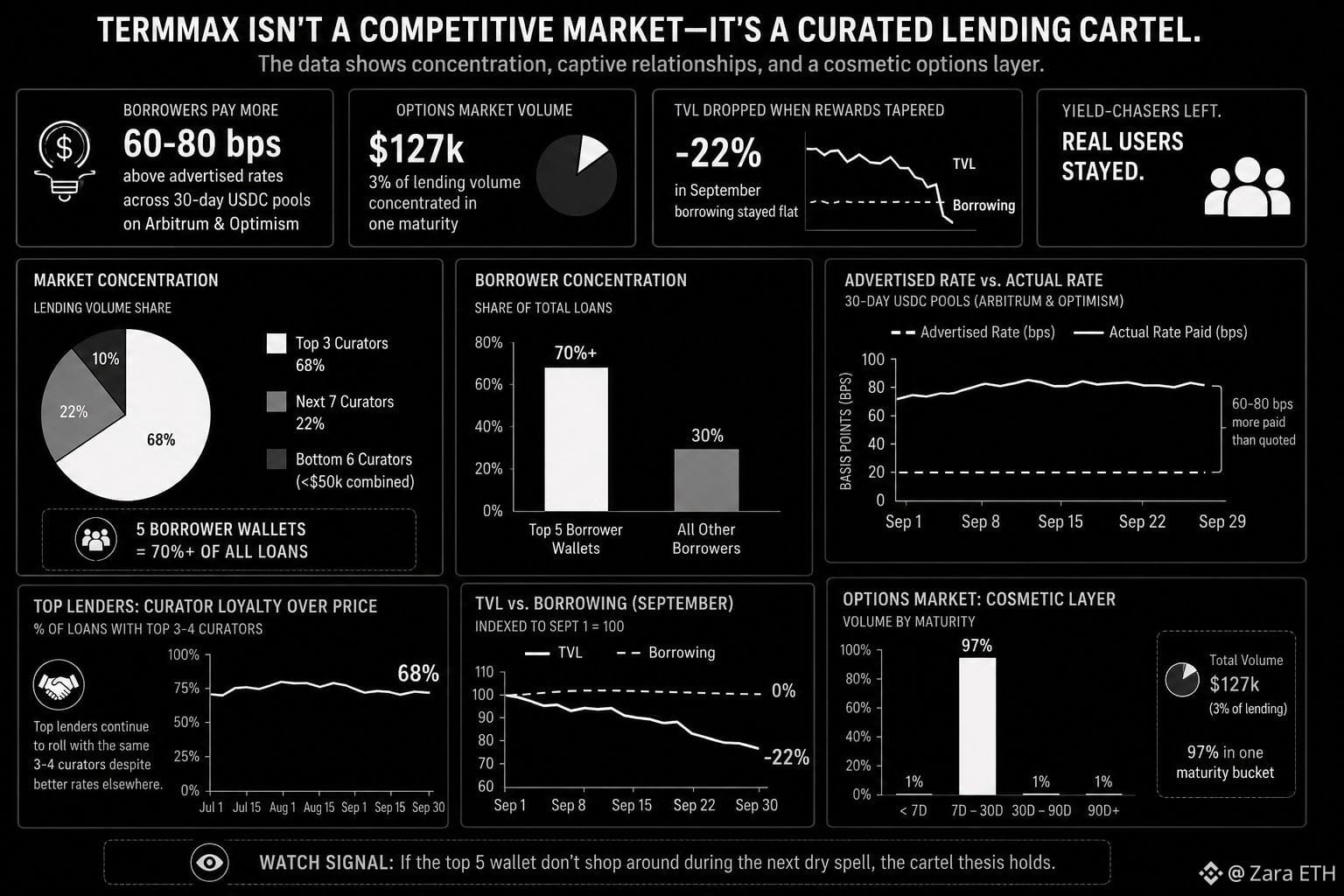
TermMax isn't a competitive market—it's a curated lending cartel.
Advertised rates are bait. Borrowers pay 60-80 bps more than quoted across 30-day USDC pools on Arbitrum and Optimism.
Market concentration:
· Top 3 curators control 68% of lending volume
· Bottom 6 curators have <$50k combined
· 5 borrower wallets = 70%+ of all loans
Options market is silent: $127k volume (3% of lending) concentrated in one maturity.
The real story:
· Top lenders roll with same 3-4 curators despite better rates elsewhere
· When rewards tapered in Sept, TVL dropped 22%—borrowing stayed flat
· Yield-chasers left. Real users stayed.
This is structured financing, not DeFi.
Top borrowers value reliability over basis points. Curators have captive relationships. The options layer is cosmetic.
Watch signal: If the top 5 wallets don't shop around during the next dry spell, the cartel thesis holds.
@termmax #TermMax
TermMax isn't a competitive market—it's a curated lending cartel.
Advertised rates are bait. Borrowers pay 60-80 bps more than quoted across 30-day USDC pools on Arbitrum and Optimism.
Market concentration:
· Top 3 curators control 68% of lending volume
· Bottom 6 curators have <$50k combined
· 5 borrower wallets = 70%+ of all loans
Options market is silent: $127k volume (3% of lending) concentrated in one maturity.
The real story:
· Top lenders roll with same 3-4 curators despite better rates elsewhere
· When rewards tapered in Sept, TVL dropped 22%—borrowing stayed flat
· Yield-chasers left. Real users stayed.
This is structured financing, not DeFi.
Top borrowers value reliability over basis points. Curators have captive relationships. The options layer is cosmetic.
Watch signal: If the top 5 wallets don't shop around during the next dry spell, the cartel thesis holds.
@TermMax #TermMax
Advertised rates are bait. Borrowers pay 60-80 bps more than quoted across 30-day USDC pools on Arbitrum and Optimism.
Market concentration:
· Top 3 curators control 68% of lending volume
· Bottom 6 curators have <$50k combined
· 5 borrower wallets = 70%+ of all loans
Options market is silent: $127k volume (3% of lending) concentrated in one maturity.
The real story:
· Top lenders roll with same 3-4 curators despite better rates elsewhere
· When rewards tapered in Sept, TVL dropped 22%—borrowing stayed flat
· Yield-chasers left. Real users stayed.
This is structured financing, not DeFi.
Top borrowers value reliability over basis points. Curators have captive relationships. The options layer is cosmetic.
Watch signal: If the top 5 wallets don't shop around during the next dry spell, the cartel thesis holds.
@TermMax #TermMax
5
604
·
--
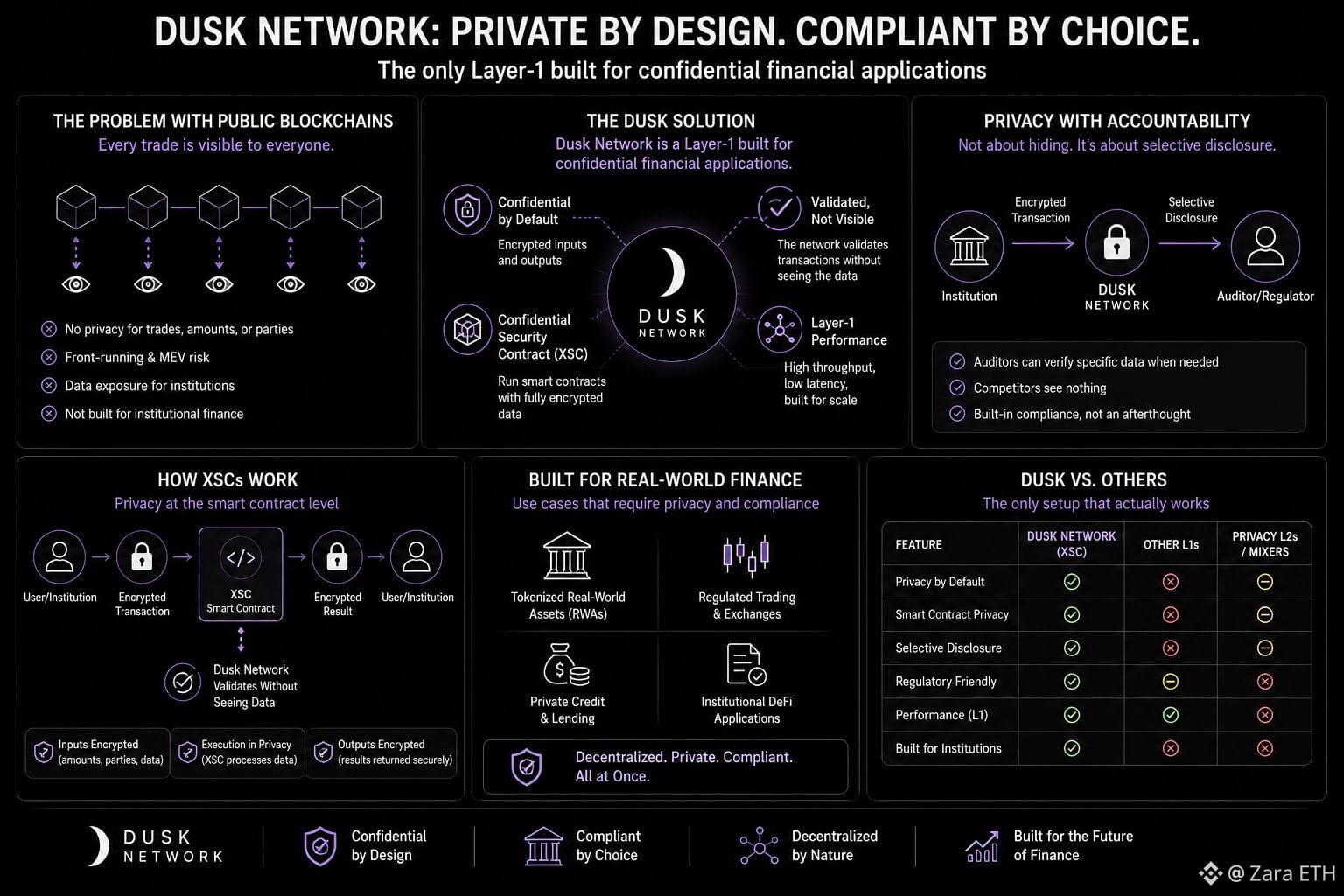
Public blockchains are terrible for institutional finance. Why? Because every trade is visible to everyone.
Dusk Network fixes that. It's a Layer-1 built for confidential financial applications, powered by the Confidential Security Contract (XSC) standard. XSCs let you run smart contracts with fully encrypted inputs and outputs — the network validates the transaction without ever seeing the amounts or parties involved.
That's privacy by design, not an add-on. But here's the key: it's not about hiding from regulators. Dusk supports selective disclosure — auditors can verify specific data when needed, while competitors see nothing.
For tokenized real-world assets and regulated trading, this might be the only setup that actually works: decentralized, private, and compliant all at once.
@Dusk_Foundation #dusk $DUSK
{future}(DUSKUSDT)
Public blockchains are terrible for institutional finance. Why? Because every trade is visible to everyone.
Dusk Network fixes that. It's a Layer-1 built for confidential financial applications, powered by the Confidential Security Contract (XSC) standard. XSCs let you run smart contracts with fully encrypted inputs and outputs — the network validates the transaction without ever seeing the amounts or parties involved.
That's privacy by design, not an add-on. But here's the key: it's not about hiding from regulators. Dusk supports selective disclosure — auditors can verify specific data when needed, while competitors see nothing.
For tokenized real-world assets and regulated trading, this might be the only setup that actually works: decentralized, private, and compliant all at once.
@Dusk #dusk $DUSK
Dusk Network fixes that. It's a Layer-1 built for confidential financial applications, powered by the Confidential Security Contract (XSC) standard. XSCs let you run smart contracts with fully encrypted inputs and outputs — the network validates the transaction without ever seeing the amounts or parties involved.
That's privacy by design, not an add-on. But here's the key: it's not about hiding from regulators. Dusk supports selective disclosure — auditors can verify specific data when needed, while competitors see nothing.
For tokenized real-world assets and regulated trading, this might be the only setup that actually works: decentralized, private, and compliant all at once.
@Dusk #dusk $DUSK
3
3
211
·
--
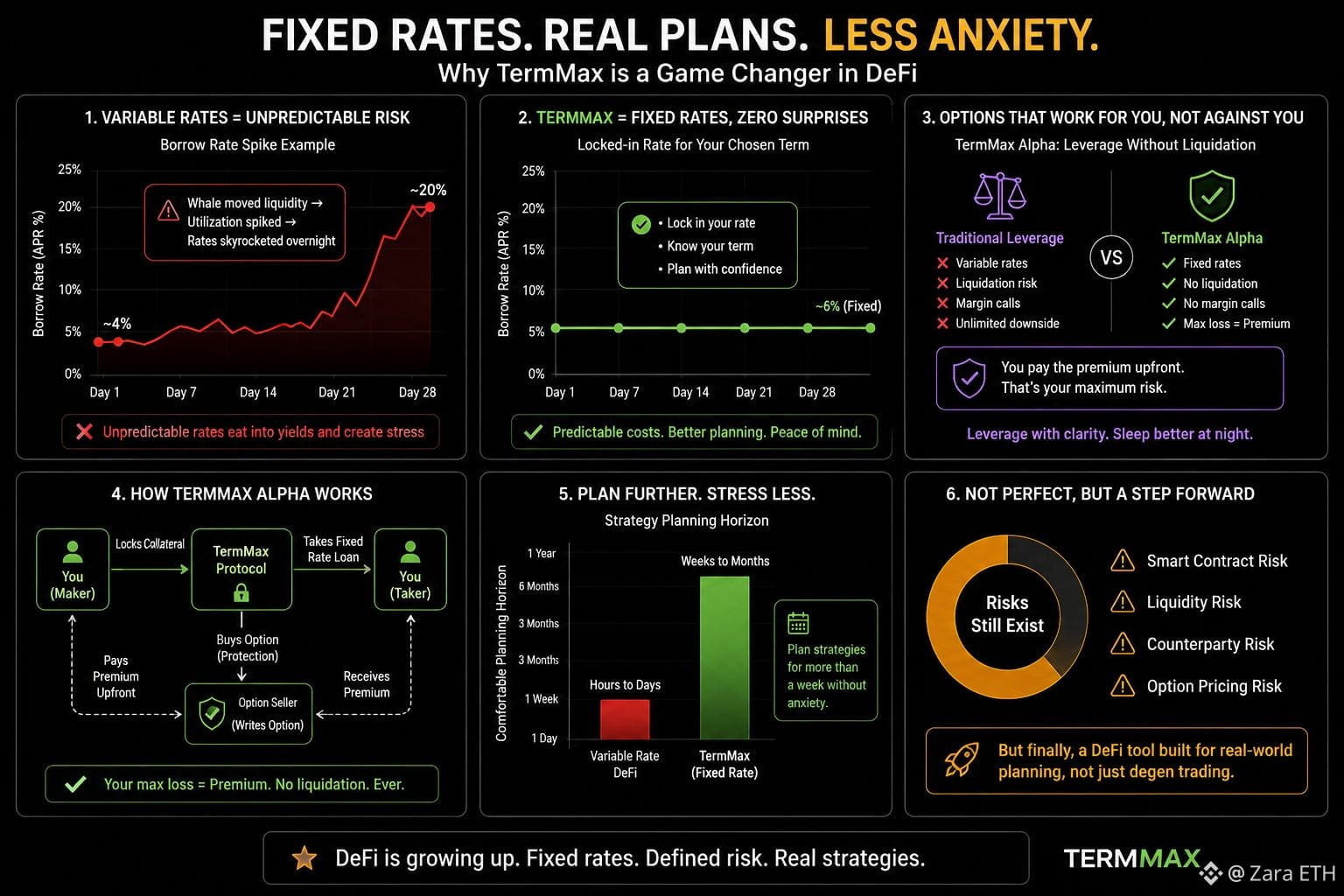
Honestly, the variable rate thing in DeFi is starting to drive me nuts.
I had a position last month where my borrow rate went from like 4% to nearly 20% overnight. Same protocol. Same collateral. Just some whale moved liquidity and suddenly my "safe" yield was getting eaten alive.
That's why TermMax actually made sense when I stumbled across it. It's doing fixed rates, which sounds boring, but boring is exactly what I need when I'm planning more than a few days ahead.
You lock in your rate, you know your term, and that's it. No more refreshing the dashboard constantly to see if you need to unwind a position because utilization spiked at 3 AM.
What caught me off guard is how they combined it with options. I thought options meant more risk, but the way they set it up, you can actually use them as protection. That Alpha product where you get leverage without liquidation? You just pay the premium upfront and that's your max loss. No margin calls, no panic.
I'm not saying it's perfect or anything. Still dealing with smart contract risks, and liquidity could always be an issue. But someone finally built a tool where I can actually plan a strategy for more than a week without anxiety.
Just feels like DeFi is growing up a little. Not everything needs to be volatile all the time.
@termmax #TermMax
Honestly, the variable rate thing in DeFi is starting to drive me nuts.
I had a position last month where my borrow rate went from like 4% to nearly 20% overnight. Same protocol. Same collateral. Just some whale moved liquidity and suddenly my "safe" yield was getting eaten alive.
That's why TermMax actually made sense when I stumbled across it. It's doing fixed rates, which sounds boring, but boring is exactly what I need when I'm planning more than a few days ahead.
You lock in your rate, you know your term, and that's it. No more refreshing the dashboard constantly to see if you need to unwind a position because utilization spiked at 3 AM.
What caught me off guard is how they combined it with options. I thought options meant more risk, but the way they set it up, you can actually use them as protection. That Alpha product where you get leverage without liquidation? You just pay the premium upfront and that's your max loss. No margin calls, no panic.
I'm not saying it's perfect or anything. Still dealing with smart contract risks, and liquidity could always be an issue. But someone finally built a tool where I can actually plan a strategy for more than a week without anxiety.
Just feels like DeFi is growing up a little. Not everything needs to be volatile all the time.
@TermMax #TermMax
I had a position last month where my borrow rate went from like 4% to nearly 20% overnight. Same protocol. Same collateral. Just some whale moved liquidity and suddenly my "safe" yield was getting eaten alive.
That's why TermMax actually made sense when I stumbled across it. It's doing fixed rates, which sounds boring, but boring is exactly what I need when I'm planning more than a few days ahead.
You lock in your rate, you know your term, and that's it. No more refreshing the dashboard constantly to see if you need to unwind a position because utilization spiked at 3 AM.
What caught me off guard is how they combined it with options. I thought options meant more risk, but the way they set it up, you can actually use them as protection. That Alpha product where you get leverage without liquidation? You just pay the premium upfront and that's your max loss. No margin calls, no panic.
I'm not saying it's perfect or anything. Still dealing with smart contract risks, and liquidity could always be an issue. But someone finally built a tool where I can actually plan a strategy for more than a week without anxiety.
Just feels like DeFi is growing up a little. Not everything needs to be volatile all the time.
@TermMax #TermMax
2
4
1.8k
Connectez-vous pour découvrir plus de contenu
Rejoignez la communauté mondiale des adeptes de cryptomonnaies sur Binance Square
⚡️ Suviez les dernières informations importantes sur les cryptomonnaies.
💬 Jugé digne de confiance par la plus grande plateforme d’échange de cryptomonnaies au monde.
👍 Découvrez les connaissances que partagent les créateurs vérifiés.
Adresse e-mail/Nº de téléphone
Sujets d’actualité
BinanceLaunchesBinanceIntelligence
400,604 vues
3,087 mentions
#BinanceLaunchesBinanceIntelligence
⚡ AI Meets Crypto Trading: Binance Intelligence is Live! ⚡
Trading just got a massive upgrade with Binance's new AI suite:
1️⃣ Binance AI: Personalized market dashboards & 4-hour macro market audio briefings.
2️⃣ Binance AI Pro: Build and run automated strategies using simple natural language prompts.
3️⃣ Binance Agent OS: Developer framework for autonomous financial AI agents.
Describe your strategy ➔ Paper test ➔ Execute 24/7.
Are you building your next trading strategy with AI? Drop your thoughts below! 👇
#BinanceLaunchesBinanceIntelligence #BinanceSquare #CryptoAI #Trading $EDEN
Hazi BNB
·1 mentions J’aime
·884 vues
BitcoinTargets2026OpenAt$87570
2,400 vues
75 mentions
BitcoinRejectedAt$87KThirdTime
2,403 vues
62 mentions