
Ruoxi BNB
10.3k Publications

Ruoxi BNB
Signaler
Bloquer l’utilisateur
Ouvert au trading
Trade régulièrement
10.9 mois
1.4K+ Suivis
21.3K+ Abonnés
6.5K+ J’aime
Publications
Portefeuille
Tous
Citations
Direct
PINNED
·
--
Haussier
@Dusk_Foundation
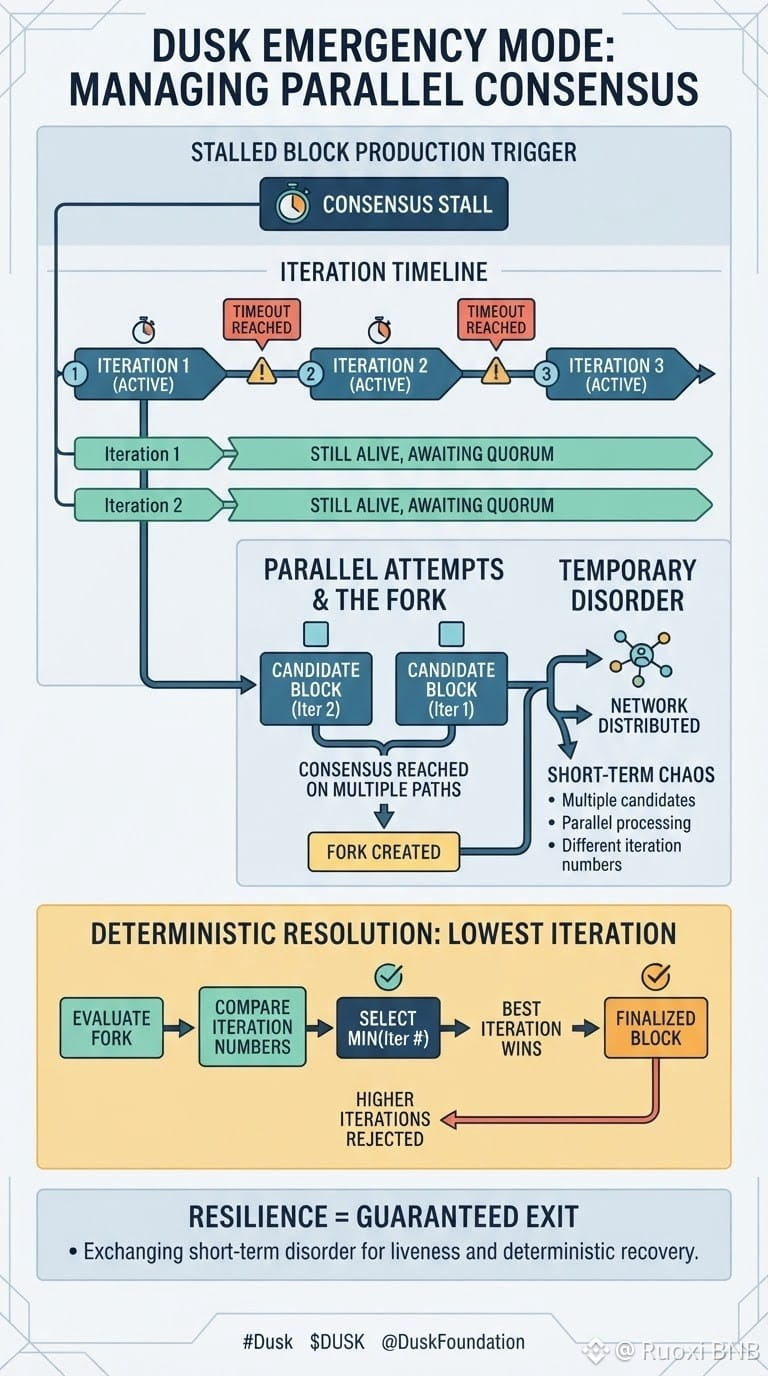
Au début, j’ai supposé que le mode d’urgence de Dusk était principalement une solution de secours en cas de blocage de la production de blocs. Mais plus je regardais, plus un petit détail sautait aux yeux : les itérations ouvertes peuvent continuer en même temps. Une nouvelle itération démarre après le délai maximal de temporisation de l’étape, tandis que les itérations précédentes restent en vie jusqu’à ce qu’elles atteignent réellement le quorum. Cela signifie que le protocole accepte des tentatives parallèles temporaires au lieu d’obliger le réseau à attendre un chemin bloqué. Le coût évident, c’est que plusieurs candidats peuvent éventuellement parvenir à un consensus, ce qui crée une fourche (fork) qui doit ensuite être résolue en choisissant l’itération la plus basse. Je trouve cet arbitrage plus intéressant que l’étiquette « urgence » elle-même. En pratique, Dusk échange un certain désordre à court terme contre une meilleure chance qu’au moins un chemin avance quand des provisionneurs manquent ou sont isolés. Peut-être que c’est un mode de défaillance raisonnable, mais cela déplace la complexité du fait d’attendre vers la résolution des forks.
Cela me fait me demander si la résilience tient parfois moins à éviter des états compliqués qu’à s’assurer que le chaos a une issue déterministe ?
@Dusk_Foundation #dusk $DUSK
{spot}(DUSKUSDT)
@Dusk
Au début, j’ai supposé que le mode d’urgence de Dusk était principalement une solution de secours en cas de blocage de la production de blocs. Mais plus je regardais, plus un petit détail sautait aux yeux : les itérations ouvertes peuvent continuer en même temps. Une nouvelle itération démarre après le délai maximal de temporisation de l’étape, tandis que les itérations précédentes restent en vie jusqu’à ce qu’elles atteignent réellement le quorum. Cela signifie que le protocole accepte des tentatives parallèles temporaires au lieu d’obliger le réseau à attendre un chemin bloqué. Le coût évident, c’est que plusieurs candidats peuvent éventuellement parvenir à un consensus, ce qui crée une fourche (fork) qui doit ensuite être résolue en choisissant l’itération la plus basse. Je trouve cet arbitrage plus intéressant que l’étiquette « urgence » elle-même. En pratique, Dusk échange un certain désordre à court terme contre une meilleure chance qu’au moins un chemin avance quand des provisionneurs manquent ou sont isolés. Peut-être que c’est un mode de défaillance raisonnable, mais cela déplace la complexité du fait d’attendre vers la résolution des forks.
Cela me fait me demander si la résilience tient parfois moins à éviter des états compliqués qu’à s’assurer que le chaos a une issue déterministe ?
@Dusk #dusk $DUSK
Au début, j’ai supposé que le mode d’urgence de Dusk était principalement une solution de secours en cas de blocage de la production de blocs. Mais plus je regardais, plus un petit détail sautait aux yeux : les itérations ouvertes peuvent continuer en même temps. Une nouvelle itération démarre après le délai maximal de temporisation de l’étape, tandis que les itérations précédentes restent en vie jusqu’à ce qu’elles atteignent réellement le quorum. Cela signifie que le protocole accepte des tentatives parallèles temporaires au lieu d’obliger le réseau à attendre un chemin bloqué. Le coût évident, c’est que plusieurs candidats peuvent éventuellement parvenir à un consensus, ce qui crée une fourche (fork) qui doit ensuite être résolue en choisissant l’itération la plus basse. Je trouve cet arbitrage plus intéressant que l’étiquette « urgence » elle-même. En pratique, Dusk échange un certain désordre à court terme contre une meilleure chance qu’au moins un chemin avance quand des provisionneurs manquent ou sont isolés. Peut-être que c’est un mode de défaillance raisonnable, mais cela déplace la complexité du fait d’attendre vers la résolution des forks.
Cela me fait me demander si la résilience tient parfois moins à éviter des états compliqués qu’à s’assurer que le chaos a une issue déterministe ?
@Dusk #dusk $DUSK
3
4
145
PINNED
·
--
Haussier
@Dusk_Foundation
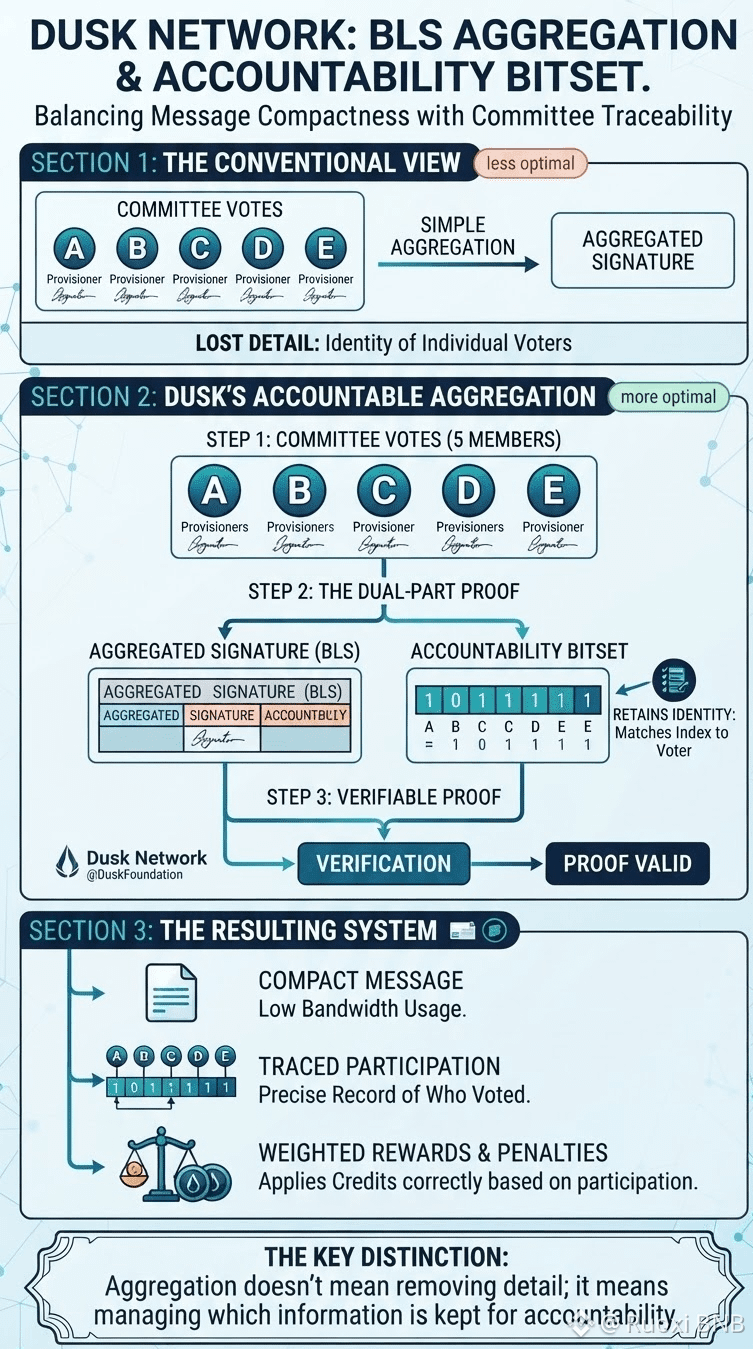
Au début, je supposais que l’agrégation BLS de Dusk était surtout une astuce de bande passante. Mais en regardant de plus près, le bitset attaché à la signature agrégée me semblait plus important que la compression elle-même. Chaque membre du comité possède un index, et le bitset enregistre exactement quels membres ont contribué avec leurs signatures. Cela signifie que le réseau peut transporter une seule signature compacte tout en préservant l’identité des électeurs qui la sous-tendent. J’ai trouvé cette nuance intéressante, car l’agrégation me fait généralement penser à supprimer des détails. Ici, certains détails sont retirés du format du message, mais le protocole conserve assez de structure pour reconstruire qui a réellement participé. C’est important, car les votes du comité sont pondérés par des crédits, et les récompenses ainsi que les pénalités ultérieures dépendent de l’identification des électeurs concernés. Donc, la preuve compacte doit quand même s’accompagner d’un enregistrement précis de l’adhésion. Peut-être que la partie utile de l’agrégation n’est pas simplement de rendre les messages de consensus plus petits, mais de décider quelles informations peuvent être comprimées sans risque et lesquelles ne le peuvent pas.
Cela me fait me demander jusqu’à quel point un « caractère succinct » d’une preuve de consensus peut aller avant que la responsabilité ne commence à se perdre ?
@Dusk_Foundation #dusk $DUSK
{spot}(DUSKUSDT)
@Dusk
Au début, je supposais que l’agrégation BLS de Dusk était surtout une astuce de bande passante. Mais en regardant de plus près, le bitset attaché à la signature agrégée me semblait plus important que la compression elle-même. Chaque membre du comité possède un index, et le bitset enregistre exactement quels membres ont contribué avec leurs signatures. Cela signifie que le réseau peut transporter une seule signature compacte tout en préservant l’identité des électeurs qui la sous-tendent. J’ai trouvé cette nuance intéressante, car l’agrégation me fait généralement penser à supprimer des détails. Ici, certains détails sont retirés du format du message, mais le protocole conserve assez de structure pour reconstruire qui a réellement participé. C’est important, car les votes du comité sont pondérés par des crédits, et les récompenses ainsi que les pénalités ultérieures dépendent de l’identification des électeurs concernés. Donc, la preuve compacte doit quand même s’accompagner d’un enregistrement précis de l’adhésion. Peut-être que la partie utile de l’agrégation n’est pas simplement de rendre les messages de consensus plus petits, mais de décider quelles informations peuvent être comprimées sans risque et lesquelles ne le peuvent pas.
Cela me fait me demander jusqu’à quel point un « caractère succinct » d’une preuve de consensus peut aller avant que la responsabilité ne commence à se perdre ?
@Dusk #dusk $DUSK
Au début, je supposais que l’agrégation BLS de Dusk était surtout une astuce de bande passante. Mais en regardant de plus près, le bitset attaché à la signature agrégée me semblait plus important que la compression elle-même. Chaque membre du comité possède un index, et le bitset enregistre exactement quels membres ont contribué avec leurs signatures. Cela signifie que le réseau peut transporter une seule signature compacte tout en préservant l’identité des électeurs qui la sous-tendent. J’ai trouvé cette nuance intéressante, car l’agrégation me fait généralement penser à supprimer des détails. Ici, certains détails sont retirés du format du message, mais le protocole conserve assez de structure pour reconstruire qui a réellement participé. C’est important, car les votes du comité sont pondérés par des crédits, et les récompenses ainsi que les pénalités ultérieures dépendent de l’identification des électeurs concernés. Donc, la preuve compacte doit quand même s’accompagner d’un enregistrement précis de l’adhésion. Peut-être que la partie utile de l’agrégation n’est pas simplement de rendre les messages de consensus plus petits, mais de décider quelles informations peuvent être comprimées sans risque et lesquelles ne le peuvent pas.
Cela me fait me demander jusqu’à quel point un « caractère succinct » d’une preuve de consensus peut aller avant que la responsabilité ne commence à se perdre ?
@Dusk #dusk $DUSK
20
11
207
·
--
bonjour les gars
bonjour les gars
Ruoxi BNB
·
--
[Terminé] 🎙️ Bienvenue 🤗 🎙️les gars 💕🌱
264 auditeurs
99
·
--
Haussier
@Dusk_Foundation
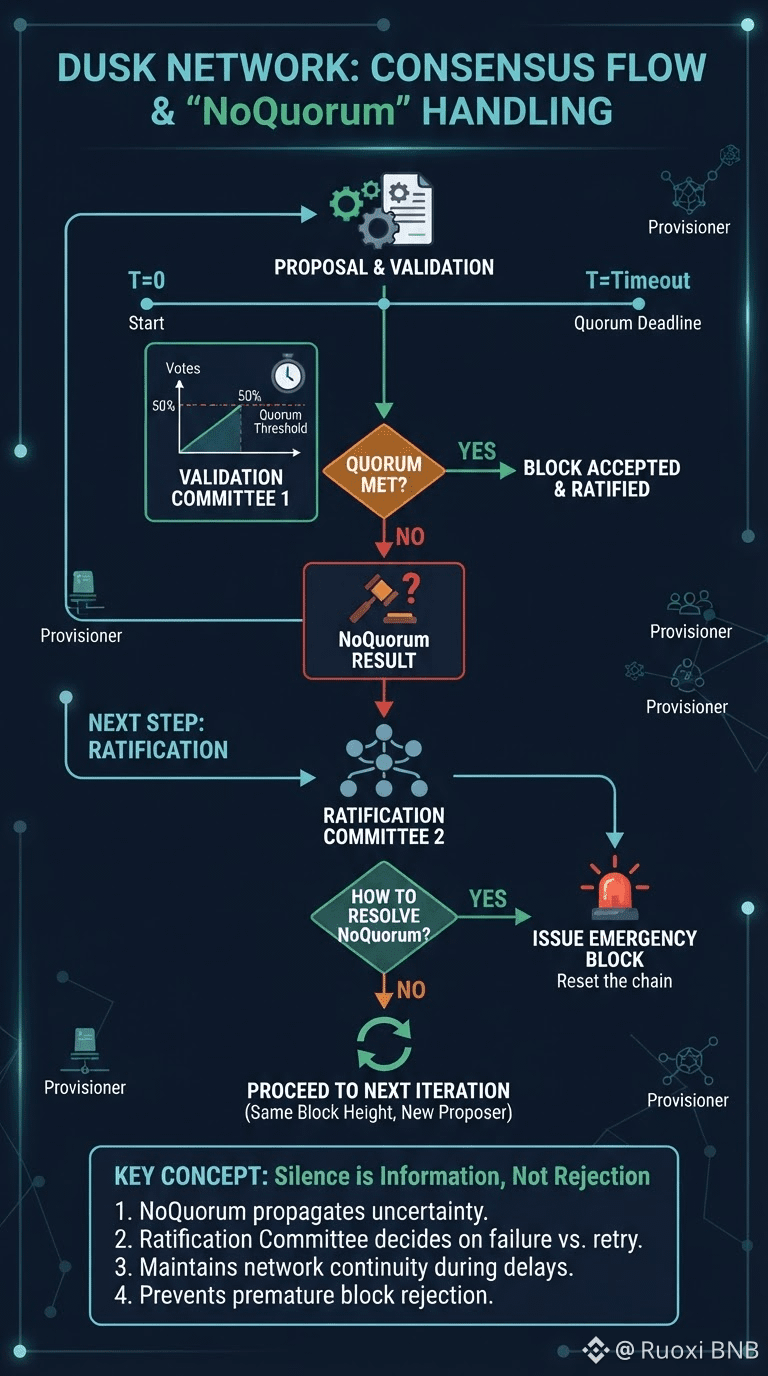
Au début, j’ai supposé que le processus de vote de Dusk consistait surtout à atteindre un quorum avant un délai d’attente. Mais plus j’y regardais, plus le traitement d’un quorum manquant a attiré mon attention. Si l’étape de validation ne peut pas rassembler suffisamment de votes à temps, elle ne se contente pas de déclarer le bloc invalide. Elle produit un résultat « NoQuorum », puis ce résultat est repris lors de la ratification. Le prochain comité a alors à voter sur ce résultat plutôt que de redémarrer tout le processus immédiatement. Cela crée une légère distinction entre « le bloc a échoué » et « le réseau n’a pas pu décider ». Ce sont des situations très différentes, surtout lorsque des provisioners peuvent être hors ligne ou que les messages sont retardés. Le protocole conserve cette incertitude visible pendant une étape supplémentaire avant de décider si l’itération doit échouer. Je trouve cela plus intéressant que le simple délai d’attente lui-même. Cela suggère que le silence est traité comme une information, mais pas nécessairement comme un rejet.
Donc peut-être que la question plus discrète est de savoir quelle quantité d’incertitude un système de consensus devrait préserver avant de transformer, en dernier ressort, l’absence d’accord en échec ?
@Dusk_Foundation #dusk $DUSK
{spot}(DUSKUSDT)
@Dusk
Au début, j’ai supposé que le processus de vote de Dusk consistait surtout à atteindre un quorum avant un délai d’attente. Mais plus j’y regardais, plus le traitement d’un quorum manquant a attiré mon attention. Si l’étape de validation ne peut pas rassembler suffisamment de votes à temps, elle ne se contente pas de déclarer le bloc invalide. Elle produit un résultat « NoQuorum », puis ce résultat est repris lors de la ratification. Le prochain comité a alors à voter sur ce résultat plutôt que de redémarrer tout le processus immédiatement. Cela crée une légère distinction entre « le bloc a échoué » et « le réseau n’a pas pu décider ». Ce sont des situations très différentes, surtout lorsque des provisioners peuvent être hors ligne ou que les messages sont retardés. Le protocole conserve cette incertitude visible pendant une étape supplémentaire avant de décider si l’itération doit échouer. Je trouve cela plus intéressant que le simple délai d’attente lui-même. Cela suggère que le silence est traité comme une information, mais pas nécessairement comme un rejet.
Donc peut-être que la question plus discrète est de savoir quelle quantité d’incertitude un système de consensus devrait préserver avant de transformer, en dernier ressort, l’absence d’accord en échec ?
@Dusk #dusk $DUSK
Au début, j’ai supposé que le processus de vote de Dusk consistait surtout à atteindre un quorum avant un délai d’attente. Mais plus j’y regardais, plus le traitement d’un quorum manquant a attiré mon attention. Si l’étape de validation ne peut pas rassembler suffisamment de votes à temps, elle ne se contente pas de déclarer le bloc invalide. Elle produit un résultat « NoQuorum », puis ce résultat est repris lors de la ratification. Le prochain comité a alors à voter sur ce résultat plutôt que de redémarrer tout le processus immédiatement. Cela crée une légère distinction entre « le bloc a échoué » et « le réseau n’a pas pu décider ». Ce sont des situations très différentes, surtout lorsque des provisioners peuvent être hors ligne ou que les messages sont retardés. Le protocole conserve cette incertitude visible pendant une étape supplémentaire avant de décider si l’itération doit échouer. Je trouve cela plus intéressant que le simple délai d’attente lui-même. Cela suggère que le silence est traité comme une information, mais pas nécessairement comme un rejet.
Donc peut-être que la question plus discrète est de savoir quelle quantité d’incertitude un système de consensus devrait préserver avant de transformer, en dernier ressort, l’absence d’accord en échec ?
@Dusk #dusk $DUSK
20
13
152
·
--
Haussier
@Dusk_Foundation
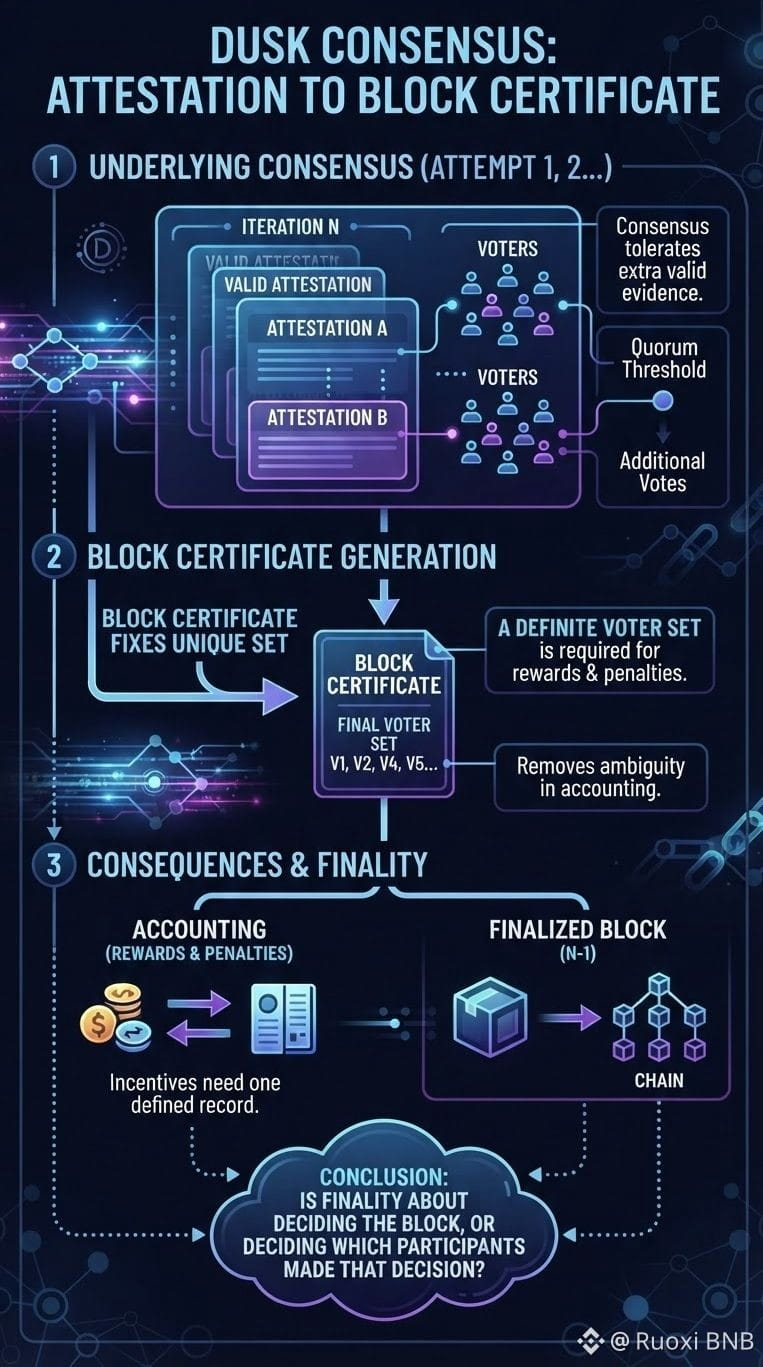
Au début, j’ai supposé que les attestations de Dusk étaient principalement une manière compacte de prouver qu’assez de pourvoyeurs étaient d’accord. Mais en regardant de plus près, un détail m’a sauté aux yeux : plus d’une attestation valide peut exister pour la même itération si des votes au-delà du quorum sont reçus. Dusk ajoute donc un certificat de bloc qui fixe un ensemble unique d’électeurs à partir de l’attestation du bloc précédent. Cela ressemble moins à un détail de compression et davantage à une façon d’empêcher que la comptabilité ultérieure ne devienne ambiguë. Les récompenses et les pénalités nécessitent un ensemble d’électeurs bien défini, même si l’étape de consensus sous-jacente a pu produire plusieurs preuves de quorum possibles. Le protocole sépare « assez de votes ont eu lieu » de « quels votes comptent pour les conséquences ultérieures ». Cette distinction est facile à manquer lorsqu’on lit le flux du consensus, mais elle trace une petite frontière de confiance autour de ce qui suit l’accord. Le consensus peut tolérer des preuves valides supplémentaires, tandis que les incitations ont encore besoin d’un enregistrement défini.
Cela me fait me demander si la finalité consiste uniquement à décider le bloc, ou aussi à décider quels participants le système se souvient d’avoir pris cette décision ?
@Dusk_Foundation #dusk $DUSK
{spot}(DUSKUSDT)
@Dusk
Au début, j’ai supposé que les attestations de Dusk étaient principalement une manière compacte de prouver qu’assez de pourvoyeurs étaient d’accord. Mais en regardant de plus près, un détail m’a sauté aux yeux : plus d’une attestation valide peut exister pour la même itération si des votes au-delà du quorum sont reçus. Dusk ajoute donc un certificat de bloc qui fixe un ensemble unique d’électeurs à partir de l’attestation du bloc précédent. Cela ressemble moins à un détail de compression et davantage à une façon d’empêcher que la comptabilité ultérieure ne devienne ambiguë. Les récompenses et les pénalités nécessitent un ensemble d’électeurs bien défini, même si l’étape de consensus sous-jacente a pu produire plusieurs preuves de quorum possibles. Le protocole sépare « assez de votes ont eu lieu » de « quels votes comptent pour les conséquences ultérieures ». Cette distinction est facile à manquer lorsqu’on lit le flux du consensus, mais elle trace une petite frontière de confiance autour de ce qui suit l’accord. Le consensus peut tolérer des preuves valides supplémentaires, tandis que les incitations ont encore besoin d’un enregistrement défini.
Cela me fait me demander si la finalité consiste uniquement à décider le bloc, ou aussi à décider quels participants le système se souvient d’avoir pris cette décision ?
@Dusk #dusk $DUSK
Au début, j’ai supposé que les attestations de Dusk étaient principalement une manière compacte de prouver qu’assez de pourvoyeurs étaient d’accord. Mais en regardant de plus près, un détail m’a sauté aux yeux : plus d’une attestation valide peut exister pour la même itération si des votes au-delà du quorum sont reçus. Dusk ajoute donc un certificat de bloc qui fixe un ensemble unique d’électeurs à partir de l’attestation du bloc précédent. Cela ressemble moins à un détail de compression et davantage à une façon d’empêcher que la comptabilité ultérieure ne devienne ambiguë. Les récompenses et les pénalités nécessitent un ensemble d’électeurs bien défini, même si l’étape de consensus sous-jacente a pu produire plusieurs preuves de quorum possibles. Le protocole sépare « assez de votes ont eu lieu » de « quels votes comptent pour les conséquences ultérieures ». Cette distinction est facile à manquer lorsqu’on lit le flux du consensus, mais elle trace une petite frontière de confiance autour de ce qui suit l’accord. Le consensus peut tolérer des preuves valides supplémentaires, tandis que les incitations ont encore besoin d’un enregistrement défini.
Cela me fait me demander si la finalité consiste uniquement à décider le bloc, ou aussi à décider quels participants le système se souvient d’avoir pris cette décision ?
@Dusk #dusk $DUSK
35
18
224
·
--
Haussier
@Dusk_Foundation
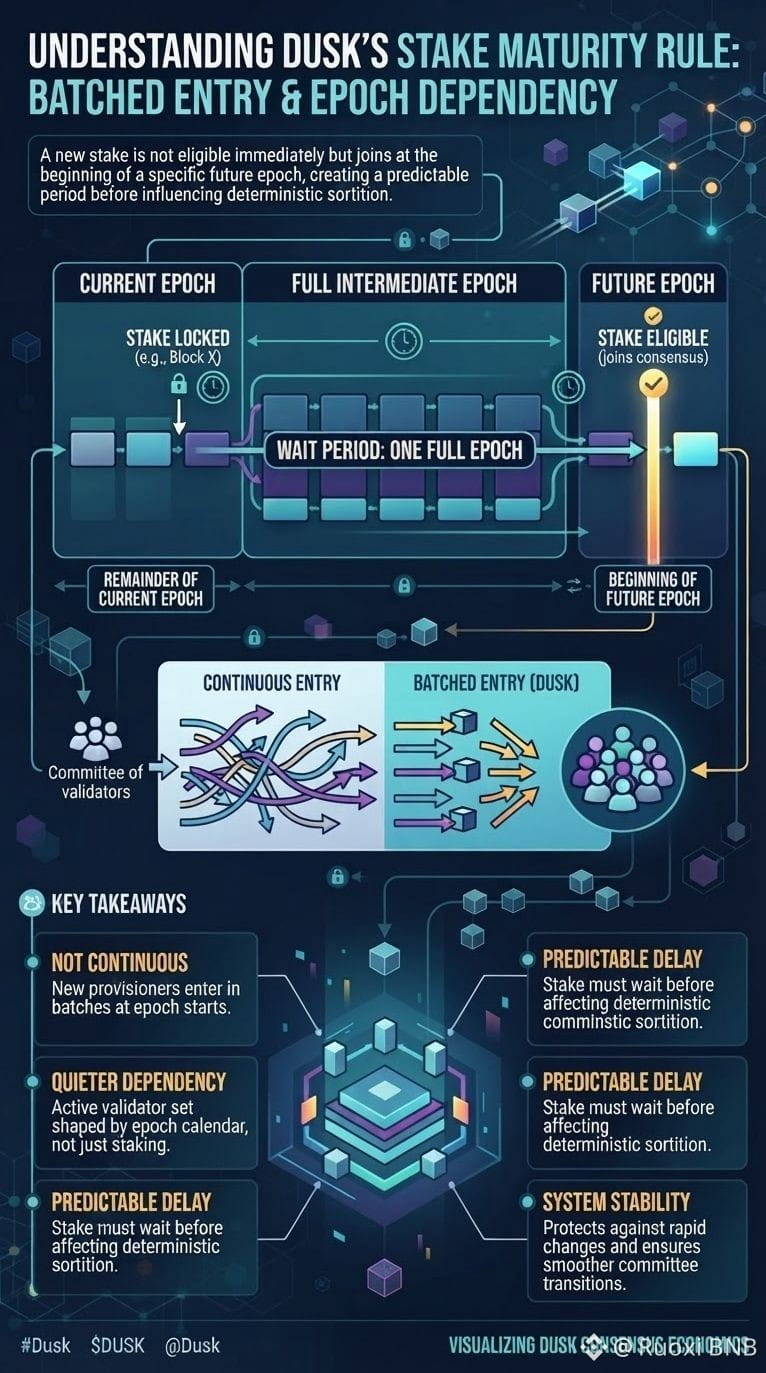
Au début, je me suis dit que la règle de maturité de la mise de Dusk était surtout une période d’attente pour empêcher quelqu’un de rejoindre le consensus trop rapidement. Mais plus j’y regardais, plus je voyais que le timing semblait au contraire plus délibéré. Une nouvelle mise n’est pas éligible immédiatement, et elle ne le devient pas non plus à un bloc arbitraire. Le livre blanc place l’éligibilité au début d’une époque, après que le reste de l’époque en cours plus une autre époque complète se soit écoulé. Ce qui a retenu mon attention, c’est que cette règle fait en pratique entrer de nouveaux validateurs dans le consensus par lots plutôt qu’en continu. Cela crée une dépendance plus silencieuse : l’ensemble actif des validateurs est en partie façonné par le calendrier des époques, et pas seulement par la personne qui a misé. Cela signifie aussi qu’une mise nouvellement verrouillée doit attendre une période prévisible avant de pouvoir affecter la sélection déterministe. Peut-être que cela rend les changements de comité plus faciles à raisonner, mais cela retarde aussi la manière dont de nouveaux participants peuvent influencer le système.
Donc peut-être que la question n’est pas pourquoi la mise a un délai, mais plutôt ce que ce délai protège vraiment ?
@Dusk_Foundation #dusk $DUSK
{spot}(DUSKUSDT)
@Dusk
Au début, je me suis dit que la règle de maturité de la mise de Dusk était surtout une période d’attente pour empêcher quelqu’un de rejoindre le consensus trop rapidement. Mais plus j’y regardais, plus je voyais que le timing semblait au contraire plus délibéré. Une nouvelle mise n’est pas éligible immédiatement, et elle ne le devient pas non plus à un bloc arbitraire. Le livre blanc place l’éligibilité au début d’une époque, après que le reste de l’époque en cours plus une autre époque complète se soit écoulé. Ce qui a retenu mon attention, c’est que cette règle fait en pratique entrer de nouveaux validateurs dans le consensus par lots plutôt qu’en continu. Cela crée une dépendance plus silencieuse : l’ensemble actif des validateurs est en partie façonné par le calendrier des époques, et pas seulement par la personne qui a misé. Cela signifie aussi qu’une mise nouvellement verrouillée doit attendre une période prévisible avant de pouvoir affecter la sélection déterministe. Peut-être que cela rend les changements de comité plus faciles à raisonner, mais cela retarde aussi la manière dont de nouveaux participants peuvent influencer le système.
Donc peut-être que la question n’est pas pourquoi la mise a un délai, mais plutôt ce que ce délai protège vraiment ?
@Dusk #dusk $DUSK
Au début, je me suis dit que la règle de maturité de la mise de Dusk était surtout une période d’attente pour empêcher quelqu’un de rejoindre le consensus trop rapidement. Mais plus j’y regardais, plus je voyais que le timing semblait au contraire plus délibéré. Une nouvelle mise n’est pas éligible immédiatement, et elle ne le devient pas non plus à un bloc arbitraire. Le livre blanc place l’éligibilité au début d’une époque, après que le reste de l’époque en cours plus une autre époque complète se soit écoulé. Ce qui a retenu mon attention, c’est que cette règle fait en pratique entrer de nouveaux validateurs dans le consensus par lots plutôt qu’en continu. Cela crée une dépendance plus silencieuse : l’ensemble actif des validateurs est en partie façonné par le calendrier des époques, et pas seulement par la personne qui a misé. Cela signifie aussi qu’une mise nouvellement verrouillée doit attendre une période prévisible avant de pouvoir affecter la sélection déterministe. Peut-être que cela rend les changements de comité plus faciles à raisonner, mais cela retarde aussi la manière dont de nouveaux participants peuvent influencer le système.
Donc peut-être que la question n’est pas pourquoi la mise a un délai, mais plutôt ce que ce délai protège vraiment ?
@Dusk #dusk $DUSK
22
10
169
·
--
Mon ami s'il te plaît, suis-moi
Mon ami s'il te plaît, suis-moi
Ruoxi BNB
·
--
[Terminé] 🎙️ bonjour 🎙️ 🥰🥰🥰🌞
8 auditeurs
2
65
·
--
Haussier
@Dusk_Foundation
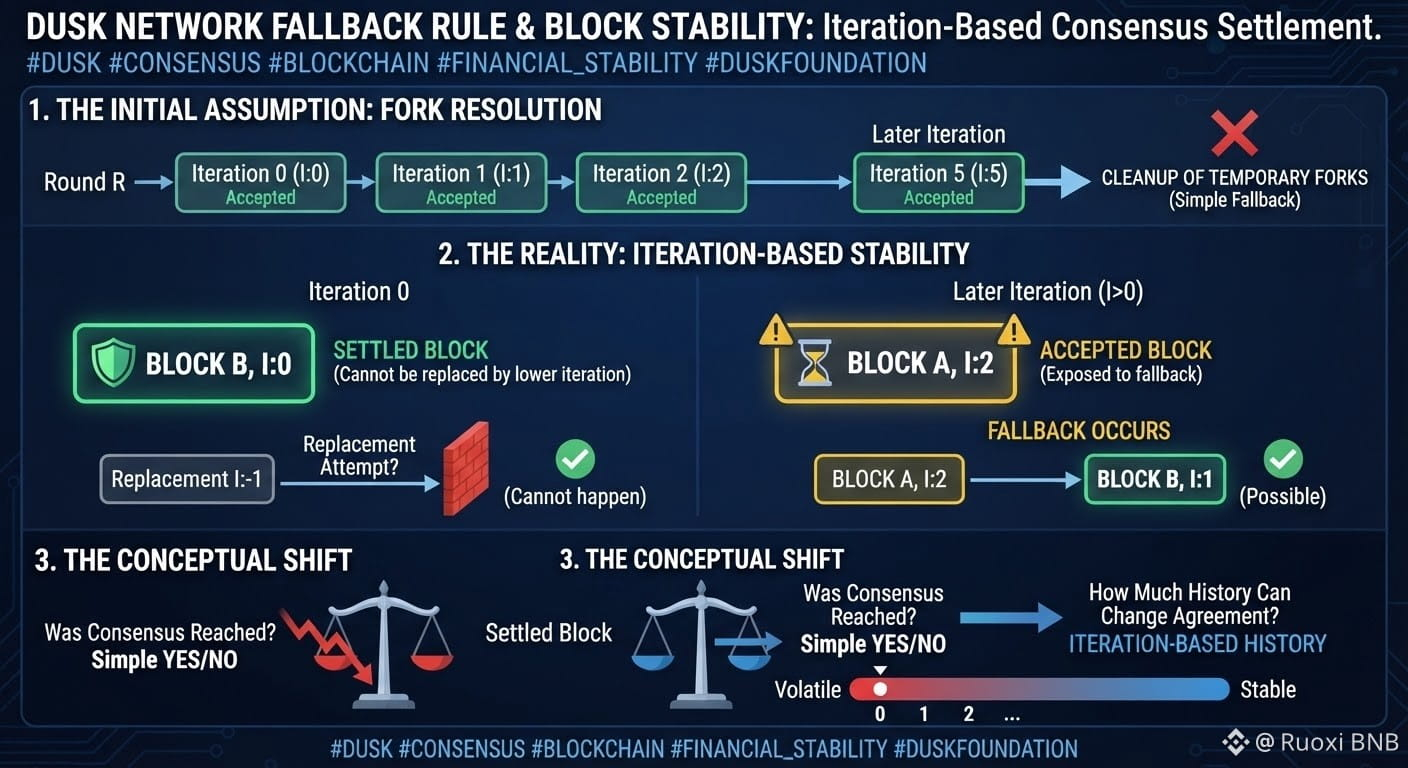
Au début, j’ai supposé que la règle de repli de Dusk était principalement là pour nettoyer les forks causés par des retards réseau. Mais plus j’y regardais, plus la règle me semblait étrange. Si deux blocs parviennent à un consensus au cours de la même ronde, Dusk peut remplacer un bloc provenant d’une itération supérieure par un bloc provenant d’une itération inférieure, même après que le bloc de l’itération supérieure a déjà été accepté localement. Ainsi, un bloc accepté n’est pas nécessairement un bloc stabilisé. Le point intéressant est que le protocole ne traite pas chaque résultat de consensus réussi comme étant d’une force équivalente. Le numéro d’itération conserve une signification une fois le vote terminé. Un bloc de l’itération zéro ne peut pas être remplacé par un autre bloc provenant d’une itération inférieure, tandis que les itérations ultérieures restent exposées au repli. Cela signifie que l’historique de la manière dont le consensus a été atteint fait partie de la stabilité du bloc. C’est un détail mineur, mais cela change ma façon de penser « l’accord » dans ce design. Donc peut-être que la question n’est pas de savoir si le consensus a eu lieu. Il s’agit plutôt de savoir combien d’historique reste capable de modifier ce que cet accord signifie ?
@Dusk_Foundation #dusk $DUSK
{spot}(DUSKUSDT)
@Dusk
Au début, j’ai supposé que la règle de repli de Dusk était principalement là pour nettoyer les forks causés par des retards réseau. Mais plus j’y regardais, plus la règle me semblait étrange. Si deux blocs parviennent à un consensus au cours de la même ronde, Dusk peut remplacer un bloc provenant d’une itération supérieure par un bloc provenant d’une itération inférieure, même après que le bloc de l’itération supérieure a déjà été accepté localement. Ainsi, un bloc accepté n’est pas nécessairement un bloc stabilisé. Le point intéressant est que le protocole ne traite pas chaque résultat de consensus réussi comme étant d’une force équivalente. Le numéro d’itération conserve une signification une fois le vote terminé. Un bloc de l’itération zéro ne peut pas être remplacé par un autre bloc provenant d’une itération inférieure, tandis que les itérations ultérieures restent exposées au repli. Cela signifie que l’historique de la manière dont le consensus a été atteint fait partie de la stabilité du bloc. C’est un détail mineur, mais cela change ma façon de penser « l’accord » dans ce design. Donc peut-être que la question n’est pas de savoir si le consensus a eu lieu. Il s’agit plutôt de savoir combien d’historique reste capable de modifier ce que cet accord signifie ?
@Dusk #dusk $DUSK
Au début, j’ai supposé que la règle de repli de Dusk était principalement là pour nettoyer les forks causés par des retards réseau. Mais plus j’y regardais, plus la règle me semblait étrange. Si deux blocs parviennent à un consensus au cours de la même ronde, Dusk peut remplacer un bloc provenant d’une itération supérieure par un bloc provenant d’une itération inférieure, même après que le bloc de l’itération supérieure a déjà été accepté localement. Ainsi, un bloc accepté n’est pas nécessairement un bloc stabilisé. Le point intéressant est que le protocole ne traite pas chaque résultat de consensus réussi comme étant d’une force équivalente. Le numéro d’itération conserve une signification une fois le vote terminé. Un bloc de l’itération zéro ne peut pas être remplacé par un autre bloc provenant d’une itération inférieure, tandis que les itérations ultérieures restent exposées au repli. Cela signifie que l’historique de la manière dont le consensus a été atteint fait partie de la stabilité du bloc. C’est un détail mineur, mais cela change ma façon de penser « l’accord » dans ce design. Donc peut-être que la question n’est pas de savoir si le consensus a eu lieu. Il s’agit plutôt de savoir combien d’historique reste capable de modifier ce que cet accord signifie ?
@Dusk #dusk $DUSK
25
11
164
·
--
Haussier
@Dusk_Foundation
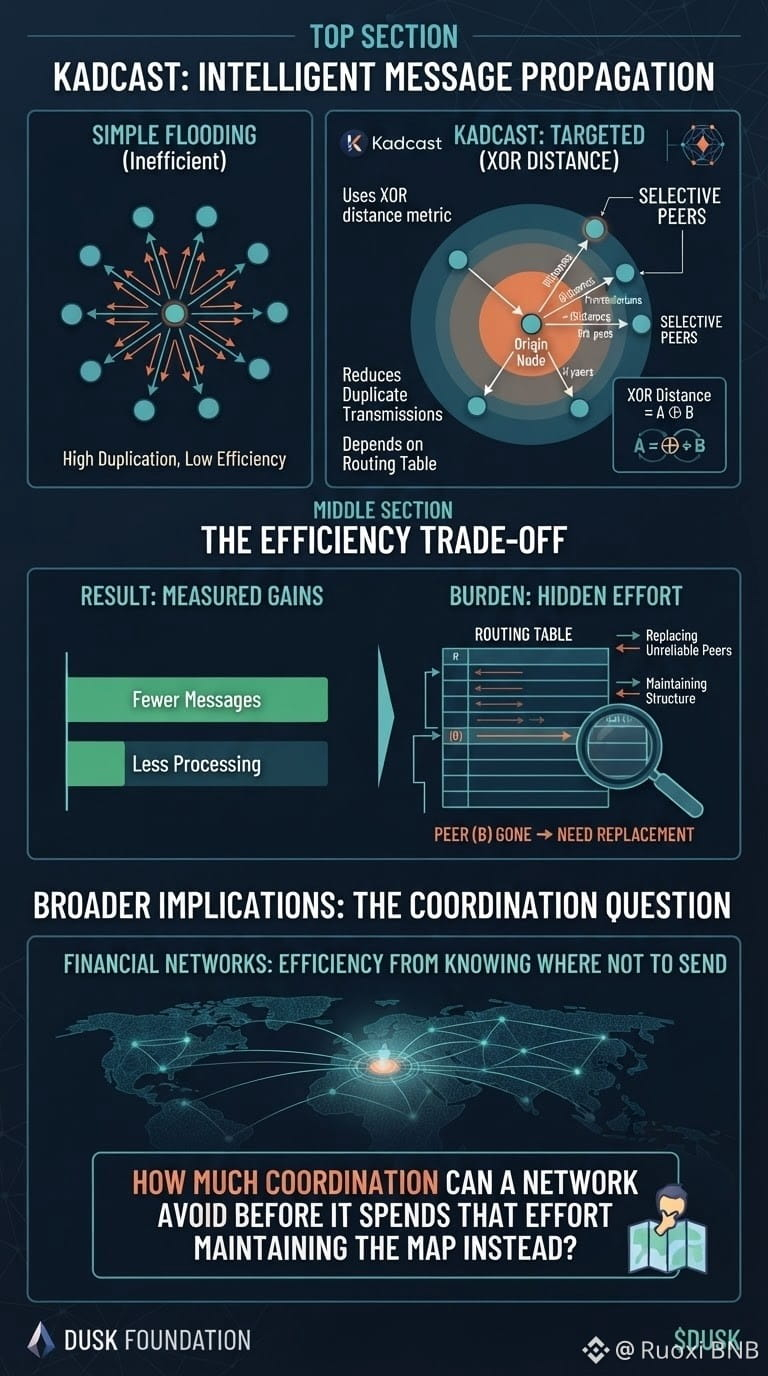
Au début, j’ai supposé que l’efficacité du réseau de Dusk venait surtout de la réduction de la quantité de données que les nœuds doivent traiter. Mais en examinant davantage Kadcast, le petit détail qui m’est resté a été l’utilisation de la distance XOR pour décider par où les messages doivent transiter. Un nœud ne fait pas simplement suivre un bloc à chaque pair proche. Il l’envoie vers des pairs sélectionnés à des distances croissantes dans la structure de routage. Cela réduit les transmissions en double, mais cela signifie aussi que la propagation dépend du fait que les tables de routage soient utiles et suffisamment à jour. Si des pairs disparaissent ou deviennent peu fiables, le réseau doit les remplacer avant que ces chemins structurés restent efficaces. J’ai trouvé ce compromis facile à négliger parce que le résultat se mesure par moins de messages, tandis que la charge a en partie été déplacée vers le maintien de la structure qui décide où vont les messages. Cela m’a amené à réfléchir plus largement aux réseaux financiers. L’efficacité vient souvent du fait de savoir où ne pas envoyer quelque chose. Ce qui laisse la question plus discrète : dans quelle mesure un réseau peut-il éviter cette coordination avant de devoir dépenser cet effort pour maintenir la carte en place ?
@Dusk_Foundation #dusk $DUSK
{spot}(DUSKUSDT)
@Dusk
Au début, j’ai supposé que l’efficacité du réseau de Dusk venait surtout de la réduction de la quantité de données que les nœuds doivent traiter. Mais en examinant davantage Kadcast, le petit détail qui m’est resté a été l’utilisation de la distance XOR pour décider par où les messages doivent transiter. Un nœud ne fait pas simplement suivre un bloc à chaque pair proche. Il l’envoie vers des pairs sélectionnés à des distances croissantes dans la structure de routage. Cela réduit les transmissions en double, mais cela signifie aussi que la propagation dépend du fait que les tables de routage soient utiles et suffisamment à jour. Si des pairs disparaissent ou deviennent peu fiables, le réseau doit les remplacer avant que ces chemins structurés restent efficaces. J’ai trouvé ce compromis facile à négliger parce que le résultat se mesure par moins de messages, tandis que la charge a en partie été déplacée vers le maintien de la structure qui décide où vont les messages. Cela m’a amené à réfléchir plus largement aux réseaux financiers. L’efficacité vient souvent du fait de savoir où ne pas envoyer quelque chose. Ce qui laisse la question plus discrète : dans quelle mesure un réseau peut-il éviter cette coordination avant de devoir dépenser cet effort pour maintenir la carte en place ?
@Dusk #dusk $DUSK
Au début, j’ai supposé que l’efficacité du réseau de Dusk venait surtout de la réduction de la quantité de données que les nœuds doivent traiter. Mais en examinant davantage Kadcast, le petit détail qui m’est resté a été l’utilisation de la distance XOR pour décider par où les messages doivent transiter. Un nœud ne fait pas simplement suivre un bloc à chaque pair proche. Il l’envoie vers des pairs sélectionnés à des distances croissantes dans la structure de routage. Cela réduit les transmissions en double, mais cela signifie aussi que la propagation dépend du fait que les tables de routage soient utiles et suffisamment à jour. Si des pairs disparaissent ou deviennent peu fiables, le réseau doit les remplacer avant que ces chemins structurés restent efficaces. J’ai trouvé ce compromis facile à négliger parce que le résultat se mesure par moins de messages, tandis que la charge a en partie été déplacée vers le maintien de la structure qui décide où vont les messages. Cela m’a amené à réfléchir plus largement aux réseaux financiers. L’efficacité vient souvent du fait de savoir où ne pas envoyer quelque chose. Ce qui laisse la question plus discrète : dans quelle mesure un réseau peut-il éviter cette coordination avant de devoir dépenser cet effort pour maintenir la carte en place ?
@Dusk #dusk $DUSK
43
19
168
·
--
Haussier
Vérifié
@Dusk_Foundation
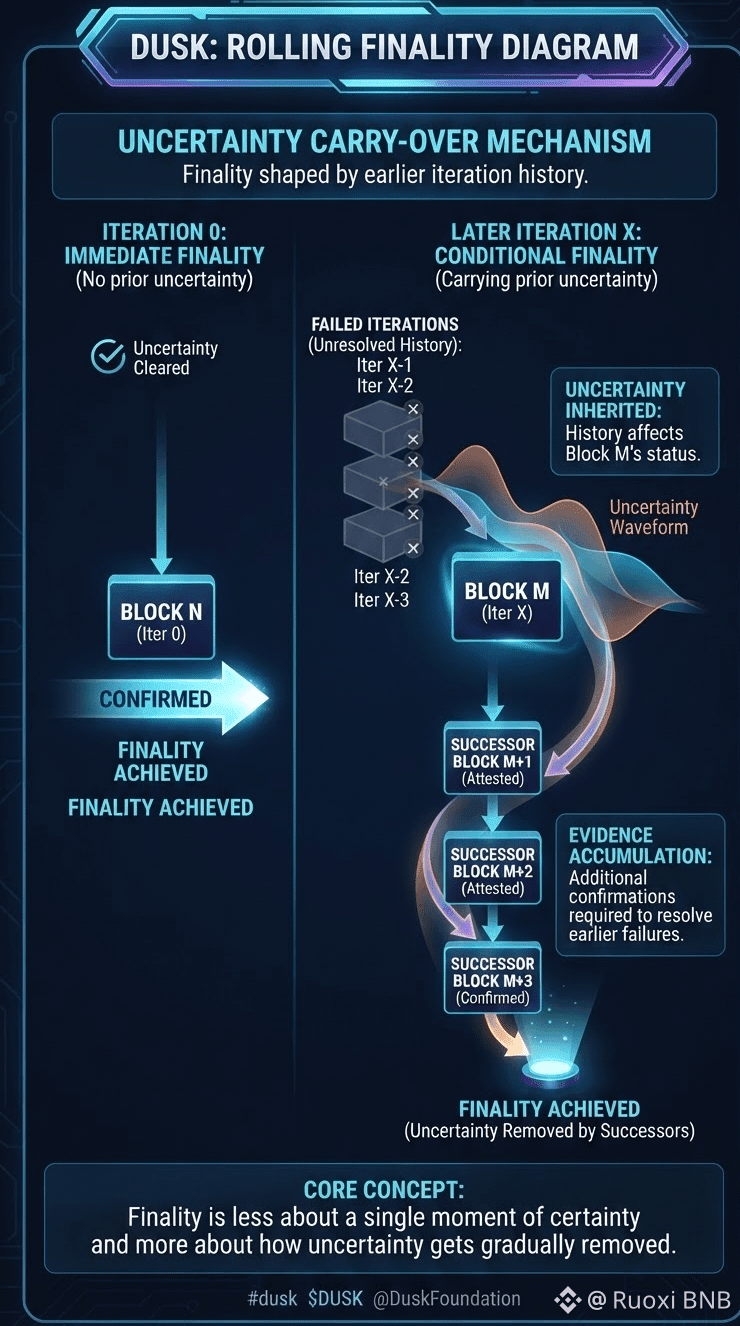
Au début, je pensais que la finalité plus rapide venait surtout du fait de rendre le consensus plus efficace. Mais en observant plus en détail les règles de finalité en “rolling” de Dusk, le point intéressant était que le statut d’un bloc peut dépendre du nombre d’itérations antérieures ayant échoué à parvenir à un résultat définitif. Un bloc accepté à une itération ultérieure n’est pas traité de la même manière qu’un bloc issu de l’itération zéro. S’il existe des tentatives antérieures non résolues, le protocole attend des successeurs attestés ou confirmés supplémentaires avant de considérer ce bloc comme confirmé.
Ce qui a attiré mon attention, c’est la manière dont l’incertitude devient quelque chose que la chaîne transporte avec elle. Elle ne se contente pas de dire : « ce bloc est passé, on passe à autre chose ». L’historique de l’incertitude précédente influence encore la quantité de preuves nécessaires ensuite. Cela ressemble à un compromis raisonnable, mais cela signifie aussi que la finalité est en partie façonnée par ce qui s’est produit avant le bloc lui-même.
Dans les systèmes financiers, la confiance fonctionne souvent de la même manière : un résultat peut être accepté tout en portant encore un certain contexte non résolu.
Cela me fait me demander si la finalité tient moins à un instant unique de certitude qu’à la façon dont l’incertitude est progressivement supprimée.
@Dusk_Foundation #dusk $DUSK
{spot}(DUSKUSDT)
@Dusk
Au début, je pensais que la finalité plus rapide venait surtout du fait de rendre le consensus plus efficace. Mais en observant plus en détail les règles de finalité en “rolling” de Dusk, le point intéressant était que le statut d’un bloc peut dépendre du nombre d’itérations antérieures ayant échoué à parvenir à un résultat définitif. Un bloc accepté à une itération ultérieure n’est pas traité de la même manière qu’un bloc issu de l’itération zéro. S’il existe des tentatives antérieures non résolues, le protocole attend des successeurs attestés ou confirmés supplémentaires avant de considérer ce bloc comme confirmé.
Ce qui a attiré mon attention, c’est la manière dont l’incertitude devient quelque chose que la chaîne transporte avec elle. Elle ne se contente pas de dire : « ce bloc est passé, on passe à autre chose ». L’historique de l’incertitude précédente influence encore la quantité de preuves nécessaires ensuite. Cela ressemble à un compromis raisonnable, mais cela signifie aussi que la finalité est en partie façonnée par ce qui s’est produit avant le bloc lui-même.
Dans les systèmes financiers, la confiance fonctionne souvent de la même manière : un résultat peut être accepté tout en portant encore un certain contexte non résolu.
Cela me fait me demander si la finalité tient moins à un instant unique de certitude qu’à la façon dont l’incertitude est progressivement supprimée.
@Dusk #dusk $DUSK
Au début, je pensais que la finalité plus rapide venait surtout du fait de rendre le consensus plus efficace. Mais en observant plus en détail les règles de finalité en “rolling” de Dusk, le point intéressant était que le statut d’un bloc peut dépendre du nombre d’itérations antérieures ayant échoué à parvenir à un résultat définitif. Un bloc accepté à une itération ultérieure n’est pas traité de la même manière qu’un bloc issu de l’itération zéro. S’il existe des tentatives antérieures non résolues, le protocole attend des successeurs attestés ou confirmés supplémentaires avant de considérer ce bloc comme confirmé.
Ce qui a attiré mon attention, c’est la manière dont l’incertitude devient quelque chose que la chaîne transporte avec elle. Elle ne se contente pas de dire : « ce bloc est passé, on passe à autre chose ». L’historique de l’incertitude précédente influence encore la quantité de preuves nécessaires ensuite. Cela ressemble à un compromis raisonnable, mais cela signifie aussi que la finalité est en partie façonnée par ce qui s’est produit avant le bloc lui-même.
Dans les systèmes financiers, la confiance fonctionne souvent de la même manière : un résultat peut être accepté tout en portant encore un certain contexte non résolu.
Cela me fait me demander si la finalité tient moins à un instant unique de certitude qu’à la façon dont l’incertitude est progressivement supprimée.
@Dusk #dusk $DUSK
70
20
371
·
--
Haussier
@Dusk_Foundation
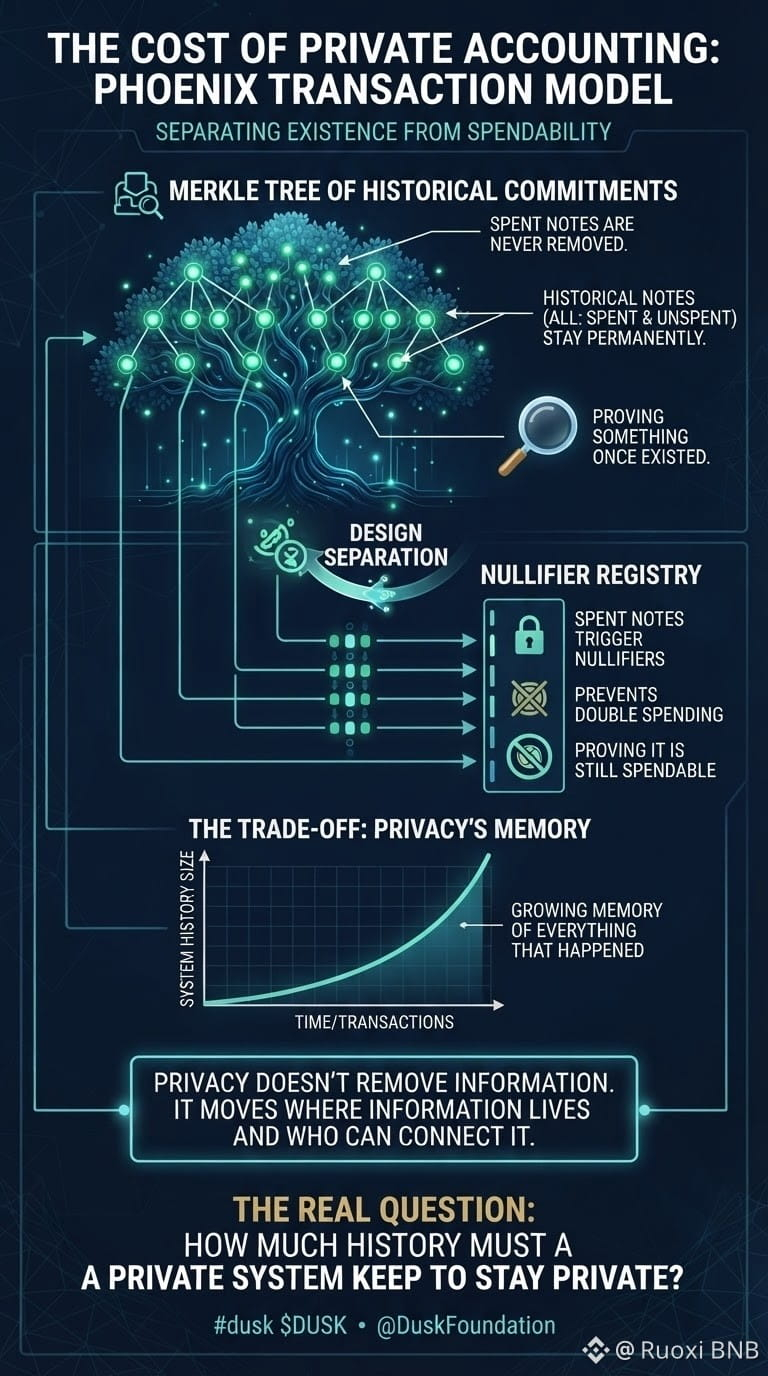
Au début, je pensais que les systèmes de confidentialité cherchent surtout à effacer les traces d’une activité passée.
Mais plus j’observais Phoenix, plus je remarquais que les notes épuisées ne sont jamais supprimées de l’arbre de Merkle. Elles y restent de façon permanente, même après que leur valeur a déjà été utilisée ailleurs. La double dépense est évitée grâce à des nullifiants, et non en supprimant les anciens enregistrements.
Ce qui a attiré mon attention, c’est que cette conception sépare deux idées habituellement liées : prouver qu’une chose a déjà existé, et prouver si elle est encore dépensable. Le réseau conserve la première partie indéfiniment et suit la seconde quelque part d’autre.
Peut-être que c’est simplement le coût de la comptabilité privée. Un système qui cache les relations entre les transactions peut tout de même avoir besoin d’une mémoire qui grandit pour conserver tout ce qui s’est déjà produit, même si une grande partie n’est plus, sur le plan économique, active.
Cela m’a fait penser que la confidentialité ne supprime souvent pas l’information. Elle la déplace : elle modifie simplement où l’information réside et qui peut la relier.
Alors peut-être que la question n’est pas la quantité de données qu’un système privé révèle. C’est plutôt la quantité d’historique qu’il doit conserver pour rester privé.
@Dusk_Foundation #dusk $DUSK
{spot}(DUSKUSDT)
@Dusk
Au début, je pensais que les systèmes de confidentialité cherchent surtout à effacer les traces d’une activité passée.
Mais plus j’observais Phoenix, plus je remarquais que les notes épuisées ne sont jamais supprimées de l’arbre de Merkle. Elles y restent de façon permanente, même après que leur valeur a déjà été utilisée ailleurs. La double dépense est évitée grâce à des nullifiants, et non en supprimant les anciens enregistrements.
Ce qui a attiré mon attention, c’est que cette conception sépare deux idées habituellement liées : prouver qu’une chose a déjà existé, et prouver si elle est encore dépensable. Le réseau conserve la première partie indéfiniment et suit la seconde quelque part d’autre.
Peut-être que c’est simplement le coût de la comptabilité privée. Un système qui cache les relations entre les transactions peut tout de même avoir besoin d’une mémoire qui grandit pour conserver tout ce qui s’est déjà produit, même si une grande partie n’est plus, sur le plan économique, active.
Cela m’a fait penser que la confidentialité ne supprime souvent pas l’information. Elle la déplace : elle modifie simplement où l’information réside et qui peut la relier.
Alors peut-être que la question n’est pas la quantité de données qu’un système privé révèle. C’est plutôt la quantité d’historique qu’il doit conserver pour rester privé.
@Dusk #dusk $DUSK
Au début, je pensais que les systèmes de confidentialité cherchent surtout à effacer les traces d’une activité passée.
Mais plus j’observais Phoenix, plus je remarquais que les notes épuisées ne sont jamais supprimées de l’arbre de Merkle. Elles y restent de façon permanente, même après que leur valeur a déjà été utilisée ailleurs. La double dépense est évitée grâce à des nullifiants, et non en supprimant les anciens enregistrements.
Ce qui a attiré mon attention, c’est que cette conception sépare deux idées habituellement liées : prouver qu’une chose a déjà existé, et prouver si elle est encore dépensable. Le réseau conserve la première partie indéfiniment et suit la seconde quelque part d’autre.
Peut-être que c’est simplement le coût de la comptabilité privée. Un système qui cache les relations entre les transactions peut tout de même avoir besoin d’une mémoire qui grandit pour conserver tout ce qui s’est déjà produit, même si une grande partie n’est plus, sur le plan économique, active.
Cela m’a fait penser que la confidentialité ne supprime souvent pas l’information. Elle la déplace : elle modifie simplement où l’information réside et qui peut la relier.
Alors peut-être que la question n’est pas la quantité de données qu’un système privé révèle. C’est plutôt la quantité d’historique qu’il doit conserver pour rester privé.
@Dusk #dusk $DUSK
43
23
174
·
--
Haussier
@Dusk_Foundation
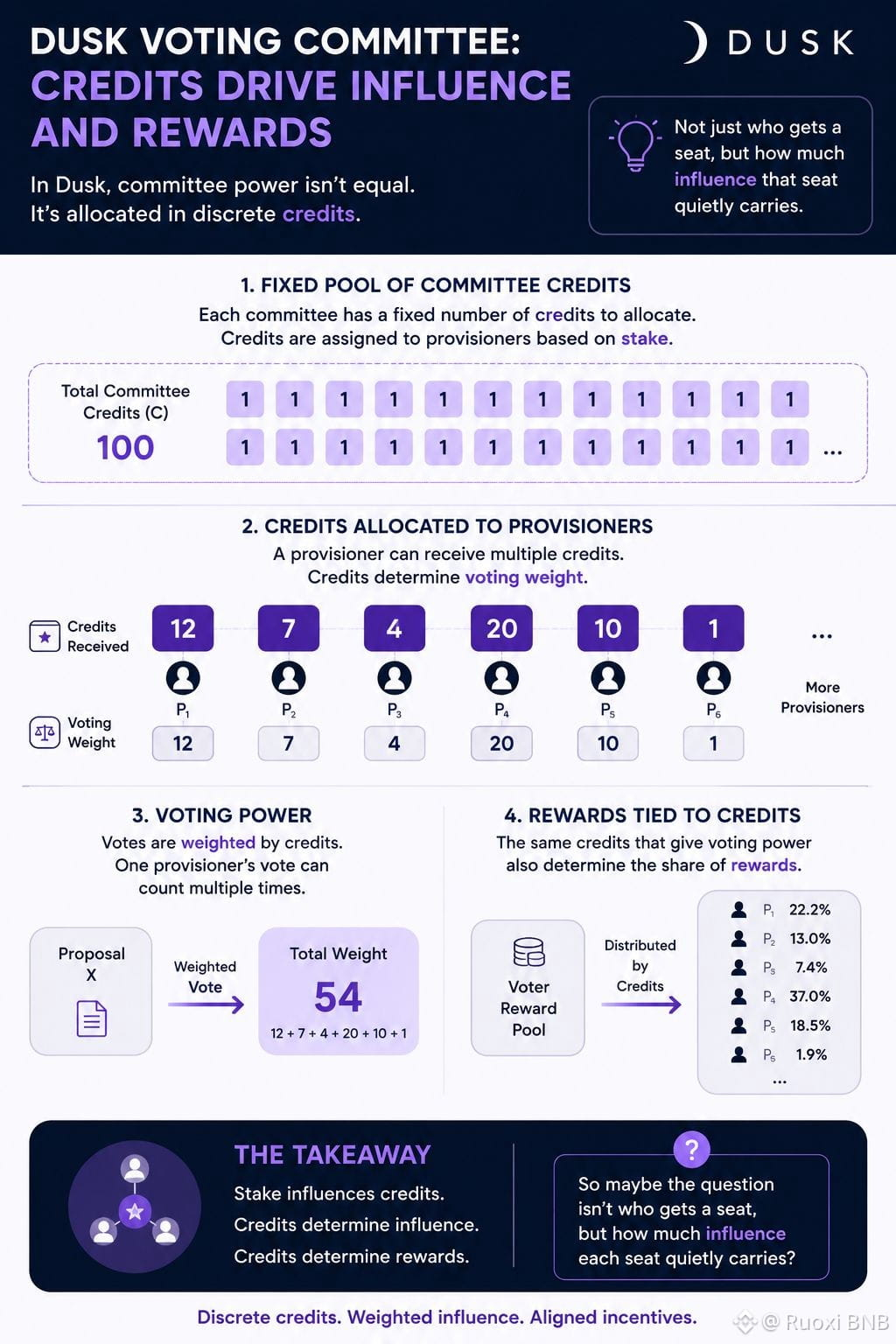
Au début, je pensais qu’un comité de vote tournait surtout autour de la personne qui est sélectionnée. Ce qui a retenu mon attention dans la conception de Dusk, c’est ce qui se passe après la sélection. Chaque comité dispose d’un pool fixe de crédits, et un provisioner peut en recevoir plus d’un. Ces crédits deviennent un poids de vote, si bien que le vote d’un provisioner peut être compté plusieurs fois en pratique. Mais la même attribution de crédits alimente aussi les récompenses : l’influence du comité et la rémunération sont donc liées à la même petite unité. Cela crée une dépendance intéressante. Une mise plus importante peut conduire à davantage de crédits, plus de poids de vote et une plus grande part de la récompense destinée aux votants. Pourtant, le système ne fait pas simplement que reproduire la répartition initiale des mises, car la sélection s’effectue elle-même au moyen de ces crédits discrets. J’ai trouvé ce détail plus intéressant que l’idée principale de comités pondérés par la mise. Cela rend le comité moins semblable à une liste de votants égaux et davantage comme une allocation temporaire d’influence. Alors peut-être que la vraie question n’est pas de savoir qui obtient un siège, mais plutôt la quantité d’influence que chaque siège porte discrètement ?
@Dusk_Foundation #dusk $DUSK
{spot}(DUSKUSDT)
@Dusk
Au début, je pensais qu’un comité de vote tournait surtout autour de la personne qui est sélectionnée. Ce qui a retenu mon attention dans la conception de Dusk, c’est ce qui se passe après la sélection. Chaque comité dispose d’un pool fixe de crédits, et un provisioner peut en recevoir plus d’un. Ces crédits deviennent un poids de vote, si bien que le vote d’un provisioner peut être compté plusieurs fois en pratique. Mais la même attribution de crédits alimente aussi les récompenses : l’influence du comité et la rémunération sont donc liées à la même petite unité. Cela crée une dépendance intéressante. Une mise plus importante peut conduire à davantage de crédits, plus de poids de vote et une plus grande part de la récompense destinée aux votants. Pourtant, le système ne fait pas simplement que reproduire la répartition initiale des mises, car la sélection s’effectue elle-même au moyen de ces crédits discrets. J’ai trouvé ce détail plus intéressant que l’idée principale de comités pondérés par la mise. Cela rend le comité moins semblable à une liste de votants égaux et davantage comme une allocation temporaire d’influence. Alors peut-être que la vraie question n’est pas de savoir qui obtient un siège, mais plutôt la quantité d’influence que chaque siège porte discrètement ?
@Dusk #dusk $DUSK
Au début, je pensais qu’un comité de vote tournait surtout autour de la personne qui est sélectionnée. Ce qui a retenu mon attention dans la conception de Dusk, c’est ce qui se passe après la sélection. Chaque comité dispose d’un pool fixe de crédits, et un provisioner peut en recevoir plus d’un. Ces crédits deviennent un poids de vote, si bien que le vote d’un provisioner peut être compté plusieurs fois en pratique. Mais la même attribution de crédits alimente aussi les récompenses : l’influence du comité et la rémunération sont donc liées à la même petite unité. Cela crée une dépendance intéressante. Une mise plus importante peut conduire à davantage de crédits, plus de poids de vote et une plus grande part de la récompense destinée aux votants. Pourtant, le système ne fait pas simplement que reproduire la répartition initiale des mises, car la sélection s’effectue elle-même au moyen de ces crédits discrets. J’ai trouvé ce détail plus intéressant que l’idée principale de comités pondérés par la mise. Cela rend le comité moins semblable à une liste de votants égaux et davantage comme une allocation temporaire d’influence. Alors peut-être que la vraie question n’est pas de savoir qui obtient un siège, mais plutôt la quantité d’influence que chaque siège porte discrètement ?
@Dusk #dusk $DUSK
60
20
168
·
--
Haussier
@Dusk_Foundation
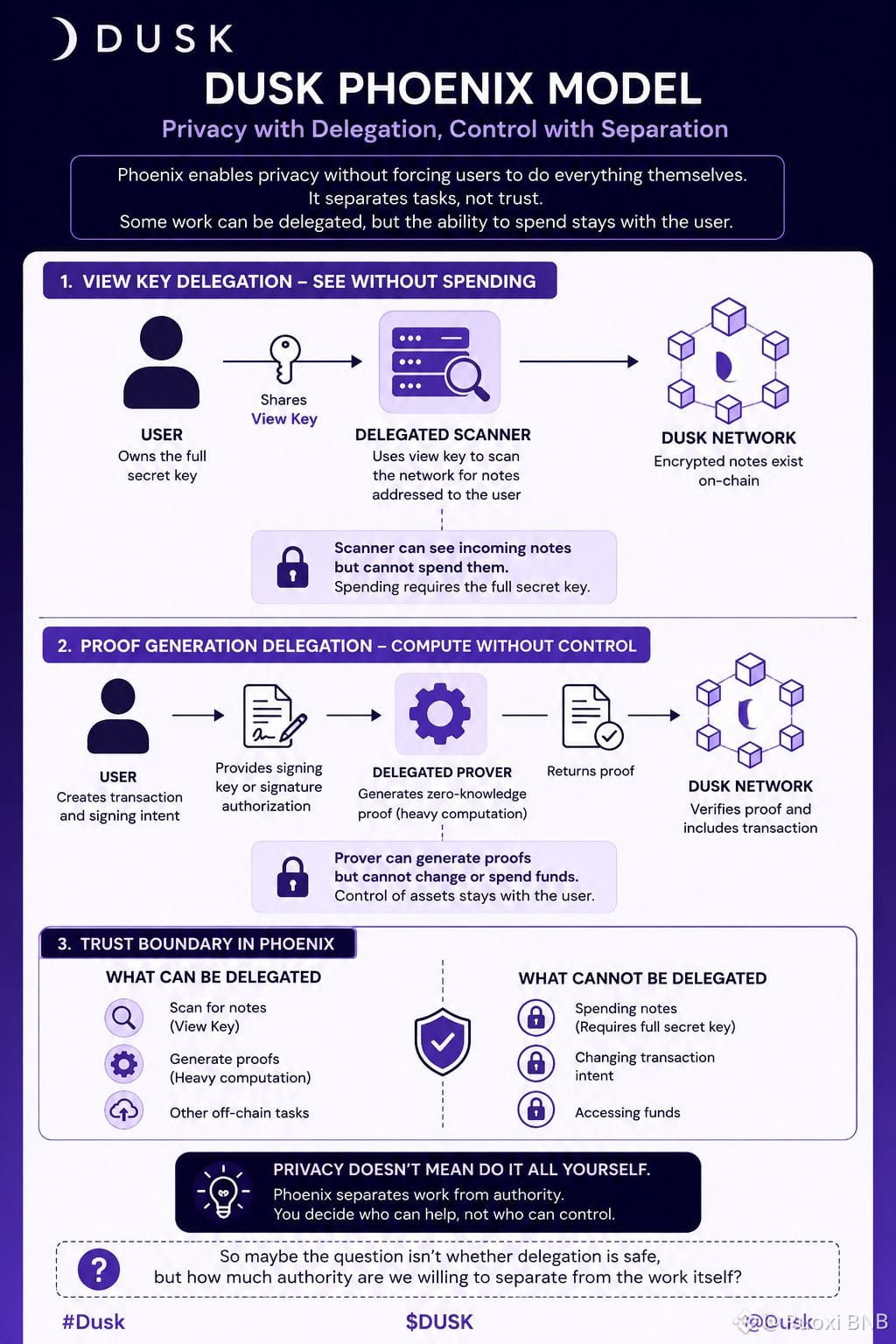
Au début, je pensais que le modèle Phoenix de Dusk conservait surtout les détails des transactions cachés. Mais plus je l’examinais, plus le modèle de délégation devenait intéressant. Un utilisateur peut donner à un tiers une clé de consultation pour parcourir le réseau et y trouver des notes qui lui sont adressées, tandis que ce tiers ne peut toujours pas dépenser ces notes, car il ne dispose pas de la clé secrète complète. La même séparation se retrouve dans la génération de preuves : des signatures peuvent permettre à quelqu’un d’autre de prendre en charge le calcul ZK lourd, sans pour autant lui donner d’autorité sur la transaction elle-même. Ce qui a attiré mon attention, c’est la limite de confiance que cela crée. La confidentialité ne signifie pas que chaque tâche doive rester forcément entre les mains de l’utilisateur. Une partie du travail peut être externalisée, mais la capacité à dépenser reste séparée. Cela ressemble à un compromis pratique entre des systèmes privés et la réalité selon laquelle le calcul est souvent délégué. Cela soulève aussi une question plus discrète : dans quelle mesure les utilisateurs sont à l’aise pour placer une confiance partielle. Alors peut-être que la question n’est pas de savoir si la délégation est sûre, mais plutôt quelle autorité les gens sont prêts à dissocier du travail lui-même ?
@Dusk_Foundation #dusk $DUSK
{spot}(DUSKUSDT)
@Dusk
Au début, je pensais que le modèle Phoenix de Dusk conservait surtout les détails des transactions cachés. Mais plus je l’examinais, plus le modèle de délégation devenait intéressant. Un utilisateur peut donner à un tiers une clé de consultation pour parcourir le réseau et y trouver des notes qui lui sont adressées, tandis que ce tiers ne peut toujours pas dépenser ces notes, car il ne dispose pas de la clé secrète complète. La même séparation se retrouve dans la génération de preuves : des signatures peuvent permettre à quelqu’un d’autre de prendre en charge le calcul ZK lourd, sans pour autant lui donner d’autorité sur la transaction elle-même. Ce qui a attiré mon attention, c’est la limite de confiance que cela crée. La confidentialité ne signifie pas que chaque tâche doive rester forcément entre les mains de l’utilisateur. Une partie du travail peut être externalisée, mais la capacité à dépenser reste séparée. Cela ressemble à un compromis pratique entre des systèmes privés et la réalité selon laquelle le calcul est souvent délégué. Cela soulève aussi une question plus discrète : dans quelle mesure les utilisateurs sont à l’aise pour placer une confiance partielle. Alors peut-être que la question n’est pas de savoir si la délégation est sûre, mais plutôt quelle autorité les gens sont prêts à dissocier du travail lui-même ?
@Dusk #dusk $DUSK
Au début, je pensais que le modèle Phoenix de Dusk conservait surtout les détails des transactions cachés. Mais plus je l’examinais, plus le modèle de délégation devenait intéressant. Un utilisateur peut donner à un tiers une clé de consultation pour parcourir le réseau et y trouver des notes qui lui sont adressées, tandis que ce tiers ne peut toujours pas dépenser ces notes, car il ne dispose pas de la clé secrète complète. La même séparation se retrouve dans la génération de preuves : des signatures peuvent permettre à quelqu’un d’autre de prendre en charge le calcul ZK lourd, sans pour autant lui donner d’autorité sur la transaction elle-même. Ce qui a attiré mon attention, c’est la limite de confiance que cela crée. La confidentialité ne signifie pas que chaque tâche doive rester forcément entre les mains de l’utilisateur. Une partie du travail peut être externalisée, mais la capacité à dépenser reste séparée. Cela ressemble à un compromis pratique entre des systèmes privés et la réalité selon laquelle le calcul est souvent délégué. Cela soulève aussi une question plus discrète : dans quelle mesure les utilisateurs sont à l’aise pour placer une confiance partielle. Alors peut-être que la question n’est pas de savoir si la délégation est sûre, mais plutôt quelle autorité les gens sont prêts à dissocier du travail lui-même ?
@Dusk #dusk $DUSK
85
28
382
·
--
Haussier
Partiellement vrai
@Dusk_Foundation
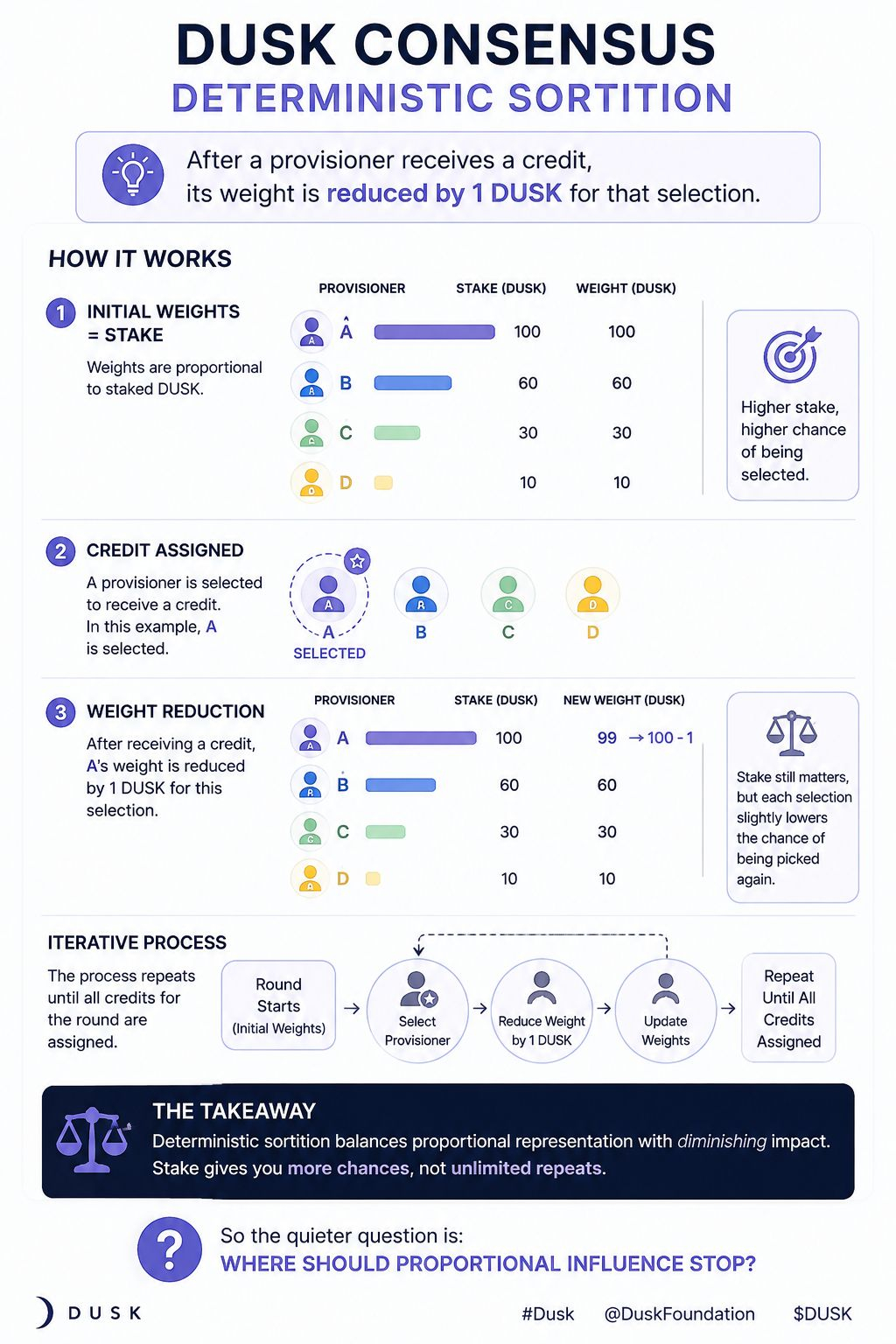
Au départ, j’ai supposé que la sélection déterministe de Dusk était principalement destinée à rendre la sélection des comités proportionnelle aux mises. Mais en regardant de plus près, le détail le plus marquant n’était pas là : ce qui se passe après qu’un provisionneur reçoit un crédit. Son poids est alors réduit de 1 DUSK pour cette sélection. L’idée est simple, mais cela signifie que le processus de sélection n’est pas seulement une manière répétée d’effectuer des tirages à partir de la même distribution de mise. Un provisionneur disposant de plus de mise obtient toujours plus de chances, tandis que chaque sélection réussie réduit légèrement sa probabilité de recevoir un autre crédit. Cela ressemble à un compromis pratique entre une influence pondérée par la mise et le fait de favoriser encore et encore les mêmes participants au sein d’un comité. Cela implique aussi que la mise remplit ici deux rôles : déterminer d’abord l’éligibilité initiale à la sélection, puis perdre progressivement du poids lorsque des crédits sont attribués. J’ai trouvé cela plus intéressant que l’affirmation de base selon laquelle la sélection est proportionnelle. Peut-être que c’est moins une question d’équité prise isolément, et davantage une question de savoir combien d’influence répétée une position de mise donnée devrait obtenir. La question plus discrète est donc : où doit s’arrêter l’influence proportionnelle ?
@Dusk_Foundation #dusk $DUSK
{spot}(DUSKUSDT)
@Dusk
Au départ, j’ai supposé que la sélection déterministe de Dusk était principalement destinée à rendre la sélection des comités proportionnelle aux mises. Mais en regardant de plus près, le détail le plus marquant n’était pas là : ce qui se passe après qu’un provisionneur reçoit un crédit. Son poids est alors réduit de 1 DUSK pour cette sélection. L’idée est simple, mais cela signifie que le processus de sélection n’est pas seulement une manière répétée d’effectuer des tirages à partir de la même distribution de mise. Un provisionneur disposant de plus de mise obtient toujours plus de chances, tandis que chaque sélection réussie réduit légèrement sa probabilité de recevoir un autre crédit. Cela ressemble à un compromis pratique entre une influence pondérée par la mise et le fait de favoriser encore et encore les mêmes participants au sein d’un comité. Cela implique aussi que la mise remplit ici deux rôles : déterminer d’abord l’éligibilité initiale à la sélection, puis perdre progressivement du poids lorsque des crédits sont attribués. J’ai trouvé cela plus intéressant que l’affirmation de base selon laquelle la sélection est proportionnelle. Peut-être que c’est moins une question d’équité prise isolément, et davantage une question de savoir combien d’influence répétée une position de mise donnée devrait obtenir. La question plus discrète est donc : où doit s’arrêter l’influence proportionnelle ?
@Dusk #dusk $DUSK
Au départ, j’ai supposé que la sélection déterministe de Dusk était principalement destinée à rendre la sélection des comités proportionnelle aux mises. Mais en regardant de plus près, le détail le plus marquant n’était pas là : ce qui se passe après qu’un provisionneur reçoit un crédit. Son poids est alors réduit de 1 DUSK pour cette sélection. L’idée est simple, mais cela signifie que le processus de sélection n’est pas seulement une manière répétée d’effectuer des tirages à partir de la même distribution de mise. Un provisionneur disposant de plus de mise obtient toujours plus de chances, tandis que chaque sélection réussie réduit légèrement sa probabilité de recevoir un autre crédit. Cela ressemble à un compromis pratique entre une influence pondérée par la mise et le fait de favoriser encore et encore les mêmes participants au sein d’un comité. Cela implique aussi que la mise remplit ici deux rôles : déterminer d’abord l’éligibilité initiale à la sélection, puis perdre progressivement du poids lorsque des crédits sont attribués. J’ai trouvé cela plus intéressant que l’affirmation de base selon laquelle la sélection est proportionnelle. Peut-être que c’est moins une question d’équité prise isolément, et davantage une question de savoir combien d’influence répétée une position de mise donnée devrait obtenir. La question plus discrète est donc : où doit s’arrêter l’influence proportionnelle ?
@Dusk #dusk $DUSK
51
13
353
·
--
@Dusk_Foundation
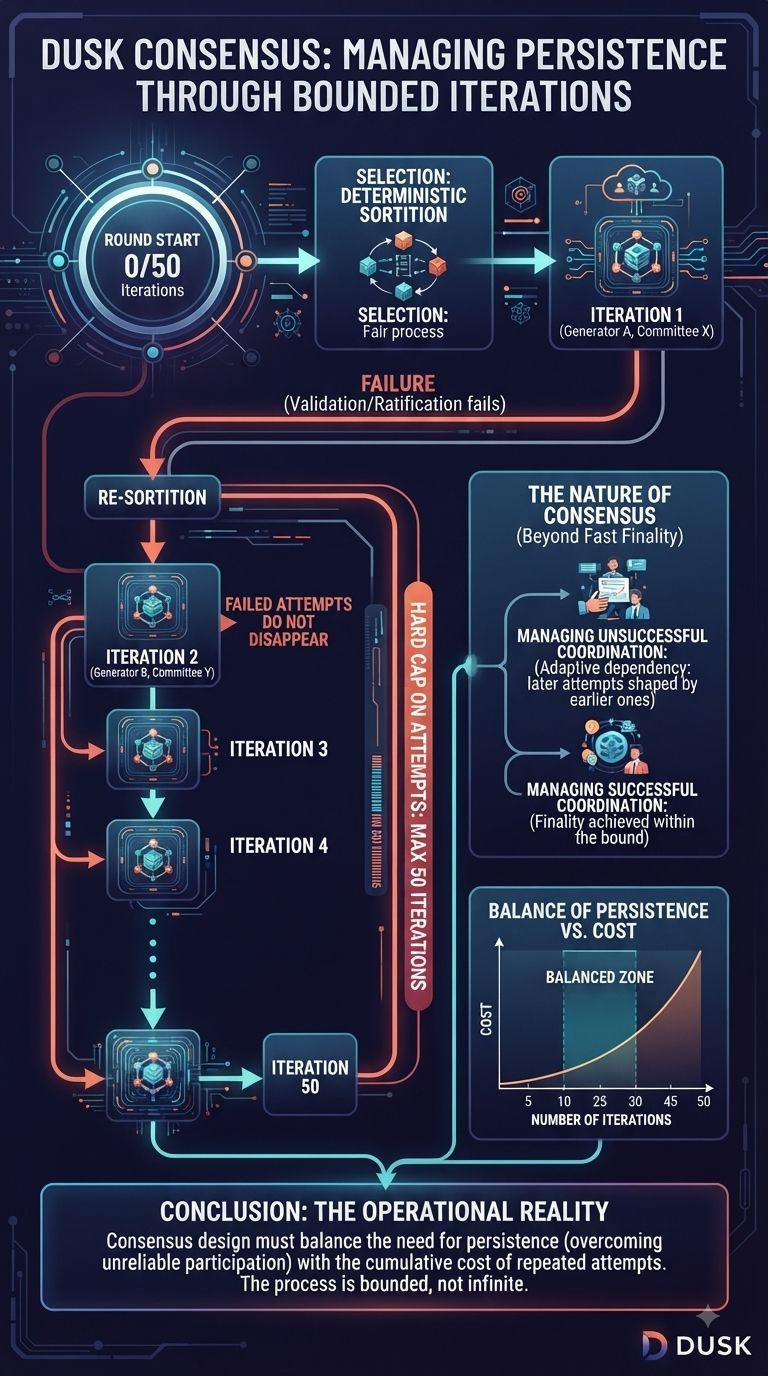
Au début, j’ai supposé que les tours de consensus de Dusk étaient surtout une question d’attendre suffisamment de votes. Mais en regardant davantage la structure d’itération, ce qui est resté avec moi, c’est qu’une tentative échouée ne disparaît pas simplement. Si la validation ou la ratification échoue, le protocole passe à une autre itération, avec un nouveau générateur et des comités sélectionnés via une sélection déterministe. Cela crée une petite mais intéressante dépendance : une tentative ultérieure est en partie façonnée par ce qui s’est passé lors des tentatives précédentes. Le livre blanc limite même un tour à 50 itérations, ce qui suggère que l’échec n’est pas traité comme un cas exceptionnel que l’on peut ignorer. Il doit s’inscrire dans un processus borné. Je trouve cela plus intéressant que la description habituelle de « finalité rapide ». Ici, le consensus semble consister autant à gérer une coordination infructueuse qu’à gérer une coordination réussie. Il est peut-être inévitable que ce soit le cas lorsque la participation au réseau n’est pas parfaitement fiable. Ce qui laisse la question plus discrète : comment un système de consensus doit-il équilibrer la persistance avec le coût de tentatives répétées pour parvenir à un accord ? #dusk $DUSK @Dusk_Foundation $DUSK
{spot}(DUSKUSDT)
@Dusk
Au début, j’ai supposé que les tours de consensus de Dusk étaient surtout une question d’attendre suffisamment de votes. Mais en regardant davantage la structure d’itération, ce qui est resté avec moi, c’est qu’une tentative échouée ne disparaît pas simplement. Si la validation ou la ratification échoue, le protocole passe à une autre itération, avec un nouveau générateur et des comités sélectionnés via une sélection déterministe. Cela crée une petite mais intéressante dépendance : une tentative ultérieure est en partie façonnée par ce qui s’est passé lors des tentatives précédentes. Le livre blanc limite même un tour à 50 itérations, ce qui suggère que l’échec n’est pas traité comme un cas exceptionnel que l’on peut ignorer. Il doit s’inscrire dans un processus borné. Je trouve cela plus intéressant que la description habituelle de « finalité rapide ». Ici, le consensus semble consister autant à gérer une coordination infructueuse qu’à gérer une coordination réussie. Il est peut-être inévitable que ce soit le cas lorsque la participation au réseau n’est pas parfaitement fiable. Ce qui laisse la question plus discrète : comment un système de consensus doit-il équilibrer la persistance avec le coût de tentatives répétées pour parvenir à un accord ? #dusk $DUSK @Dusk $DUSK
Au début, j’ai supposé que les tours de consensus de Dusk étaient surtout une question d’attendre suffisamment de votes. Mais en regardant davantage la structure d’itération, ce qui est resté avec moi, c’est qu’une tentative échouée ne disparaît pas simplement. Si la validation ou la ratification échoue, le protocole passe à une autre itération, avec un nouveau générateur et des comités sélectionnés via une sélection déterministe. Cela crée une petite mais intéressante dépendance : une tentative ultérieure est en partie façonnée par ce qui s’est passé lors des tentatives précédentes. Le livre blanc limite même un tour à 50 itérations, ce qui suggère que l’échec n’est pas traité comme un cas exceptionnel que l’on peut ignorer. Il doit s’inscrire dans un processus borné. Je trouve cela plus intéressant que la description habituelle de « finalité rapide ». Ici, le consensus semble consister autant à gérer une coordination infructueuse qu’à gérer une coordination réussie. Il est peut-être inévitable que ce soit le cas lorsque la participation au réseau n’est pas parfaitement fiable. Ce qui laisse la question plus discrète : comment un système de consensus doit-il équilibrer la persistance avec le coût de tentatives répétées pour parvenir à un accord ? #dusk $DUSK @Dusk $DUSK
41
16
168
·
--
Haussier
Vérifié
@Dusk_Foundation
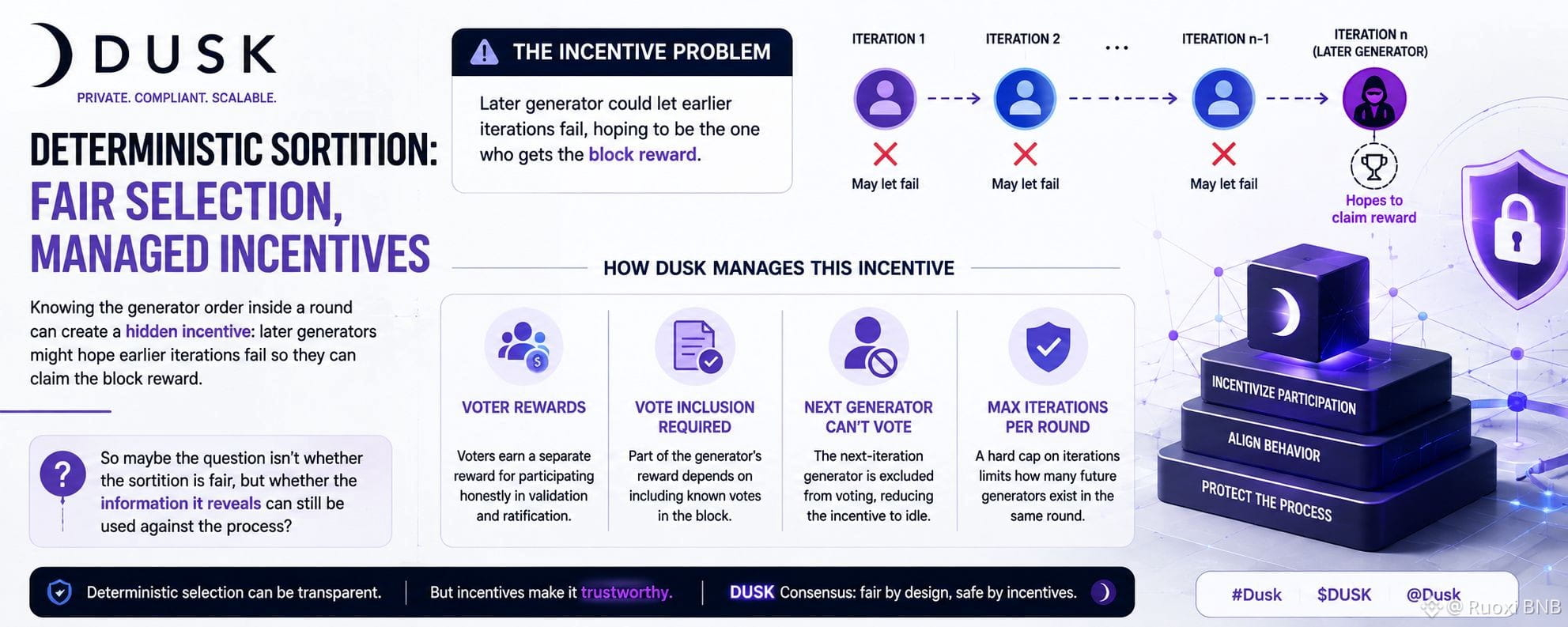
Au début, j’ai supposé que la sélection déterministe de Dusk visait principalement à rendre la sélection des comités équitable. Mais plus je regardais, ce qui a attiré mon attention, c’est le problème créé par le fait de connaître l’ordre du générateur au sein d’un tour. Un générateur ultérieur pourrait avoir une raison de laisser les itérations précédentes échouer, dans l’espoir de collecter la récompense de bloc. Le livre blanc traite cela comme un problème d’incitation, plutôt que comme une hypothèse de participation honnête. Les votants reçoivent une récompense distincte, une partie de la récompense du générateur dépend de l’inclusion de votes connus, et le générateur de l’itération suivante est exclu du vote. Il existe aussi un plafond strict sur le nombre d’itérations, ce qui limite le nombre de générateurs futurs pouvant exister dans le même tour. Ce que j’ai trouvé intéressant, c’est à quel point tout le design du consensus vise à empêcher quelqu’un de tirer avantage d’une information que le protocole lui-même lui fournit. La sélection peut être déterministe, mais le comportement autour de cette sélection doit encore être maîtrisé. Donc peut-être que la question n’est pas de savoir si la sélection est équitable, mais plutôt si l’information qu’elle révèle peut encore être utilisée contre le processus ?
@Dusk_Foundation #dusk $DUSK
{spot}(DUSKUSDT)
@Dusk
Au début, j’ai supposé que la sélection déterministe de Dusk visait principalement à rendre la sélection des comités équitable. Mais plus je regardais, ce qui a attiré mon attention, c’est le problème créé par le fait de connaître l’ordre du générateur au sein d’un tour. Un générateur ultérieur pourrait avoir une raison de laisser les itérations précédentes échouer, dans l’espoir de collecter la récompense de bloc. Le livre blanc traite cela comme un problème d’incitation, plutôt que comme une hypothèse de participation honnête. Les votants reçoivent une récompense distincte, une partie de la récompense du générateur dépend de l’inclusion de votes connus, et le générateur de l’itération suivante est exclu du vote. Il existe aussi un plafond strict sur le nombre d’itérations, ce qui limite le nombre de générateurs futurs pouvant exister dans le même tour. Ce que j’ai trouvé intéressant, c’est à quel point tout le design du consensus vise à empêcher quelqu’un de tirer avantage d’une information que le protocole lui-même lui fournit. La sélection peut être déterministe, mais le comportement autour de cette sélection doit encore être maîtrisé. Donc peut-être que la question n’est pas de savoir si la sélection est équitable, mais plutôt si l’information qu’elle révèle peut encore être utilisée contre le processus ?
@Dusk #dusk $DUSK
Au début, j’ai supposé que la sélection déterministe de Dusk visait principalement à rendre la sélection des comités équitable. Mais plus je regardais, ce qui a attiré mon attention, c’est le problème créé par le fait de connaître l’ordre du générateur au sein d’un tour. Un générateur ultérieur pourrait avoir une raison de laisser les itérations précédentes échouer, dans l’espoir de collecter la récompense de bloc. Le livre blanc traite cela comme un problème d’incitation, plutôt que comme une hypothèse de participation honnête. Les votants reçoivent une récompense distincte, une partie de la récompense du générateur dépend de l’inclusion de votes connus, et le générateur de l’itération suivante est exclu du vote. Il existe aussi un plafond strict sur le nombre d’itérations, ce qui limite le nombre de générateurs futurs pouvant exister dans le même tour. Ce que j’ai trouvé intéressant, c’est à quel point tout le design du consensus vise à empêcher quelqu’un de tirer avantage d’une information que le protocole lui-même lui fournit. La sélection peut être déterministe, mais le comportement autour de cette sélection doit encore être maîtrisé. Donc peut-être que la question n’est pas de savoir si la sélection est équitable, mais plutôt si l’information qu’elle révèle peut encore être utilisée contre le processus ?
@Dusk #dusk $DUSK
44
14
315
·
--
Haussier
$EDGE
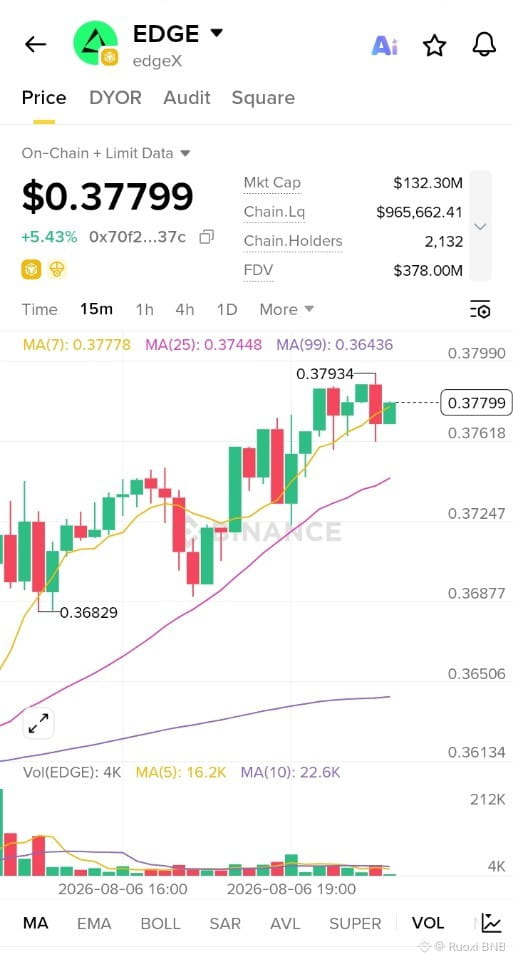
les transactions s'évaluent à 0,37799 $, en restant au-dessus des moyennes mobiles à court terme et en signalant un élan haussier régulier. Le prix s'approche d'une résistance à proximité, tandis que des moyennes plus élevées continuent de soutenir la tendance plus large. Un volume maintenu pourrait renforcer la confiance, bien que des rejets restent possibles près des récents plus hauts. Surveillez une confirmation au-dessus de la résistance avant de vous engager. #EDGE #DeFi #Crypto #Trading $EDGE
{alpha}(560x70f2eadf1ca1969ff42b0c78e9da519e8937cbaf)
$EDGE
les transactions s'évaluent à 0,37799 $, en restant au-dessus des moyennes mobiles à court terme et en signalant un élan haussier régulier. Le prix s'approche d'une résistance à proximité, tandis que des moyennes plus élevées continuent de soutenir la tendance plus large. Un volume maintenu pourrait renforcer la confiance, bien que des rejets restent possibles près des récents plus hauts. Surveillez une confirmation au-dessus de la résistance avant de vous engager. #EDGE #DeFi #Crypto #Trading $EDGE
les transactions s'évaluent à 0,37799 $, en restant au-dessus des moyennes mobiles à court terme et en signalant un élan haussier régulier. Le prix s'approche d'une résistance à proximité, tandis que des moyennes plus élevées continuent de soutenir la tendance plus large. Un volume maintenu pourrait renforcer la confiance, bien que des rejets restent possibles près des récents plus hauts. Surveillez une confirmation au-dessus de la résistance avant de vous engager. #EDGE #DeFi #Crypto #Trading $EDGE
2
138
·
--
Haussier
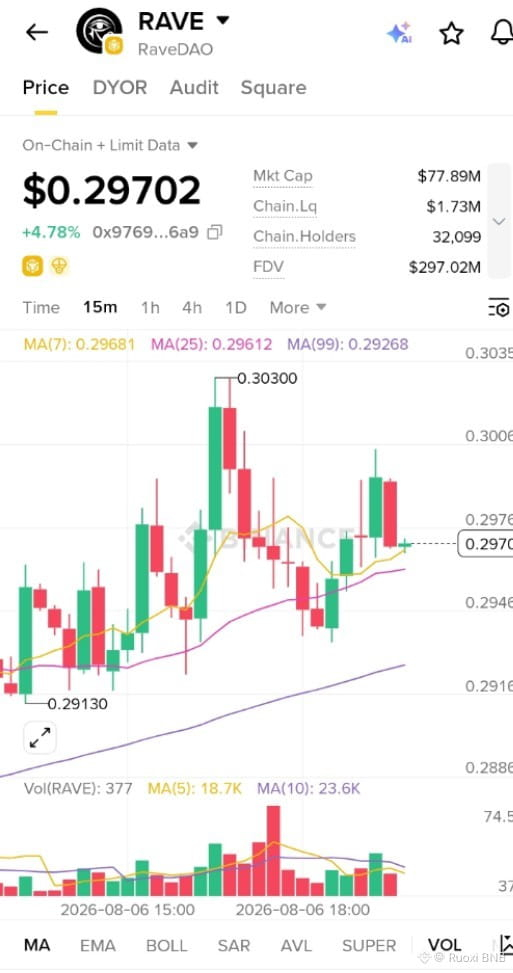
$RAVE trades à 0,29702 $, planant au-dessus des moyennes mobiles clés et reflétant une solidité sous-jacente régulière. Le momentum reste constructif, bien que la résistance proche des récents sommets puisse limiter les avancées immédiates. Le maintien du support actuel peut préserver la structure haussière, tandis que le volume mérite une surveillance attentive pour une confirmation plus solide. #RAVE #RaveDAO #Crypto #DeFi $RAVE
{alpha}(560x97693439ea2f0ecdeb9135881e49f354656a911c)
$RAVE trades à 0,29702 $, planant au-dessus des moyennes mobiles clés et reflétant une solidité sous-jacente régulière. Le momentum reste constructif, bien que la résistance proche des récents sommets puisse limiter les avancées immédiates. Le maintien du support actuel peut préserver la structure haussière, tandis que le volume mérite une surveillance attentive pour une confirmation plus solide. #RAVE #RaveDAO #Crypto #DeFi $RAVE
3
218
·
--
Haussier
$AKE effectue des transactions à 0,0042275 $, reste au-dessus des moyennes mobiles clés et signale une dynamique haussière à court terme résiliente. Les acheteurs continuent de défendre le support, tandis qu’une résistance proche pourrait déterminer la prochaine direction du mouvement. Une participation croissante pourrait renforcer la confiance, mais une gestion disciplinée des risques reste essentielle dans un contexte de marché changeant. #AKE #Crypto #Altcoins #DeFi $AKE
{future}(AKEUSDT)
$AKE effectue des transactions à 0,0042275 $, reste au-dessus des moyennes mobiles clés et signale une dynamique haussière à court terme résiliente. Les acheteurs continuent de défendre le support, tandis qu’une résistance proche pourrait déterminer la prochaine direction du mouvement. Une participation croissante pourrait renforcer la confiance, mais une gestion disciplinée des risques reste essentielle dans un contexte de marché changeant. #AKE #Crypto #Altcoins #DeFi $AKE
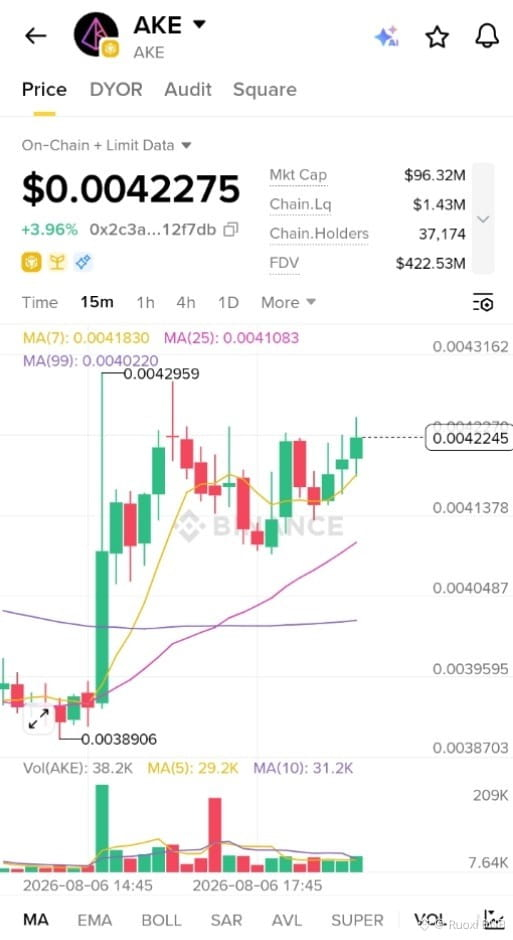
1
278
·
--
Haussier
$BTW échanges à 0,18063 $, au-dessus des moyennes mobiles clés avec un élan haussier régulier. Les acheteurs continuent de défendre le support, tandis que la résistance proche pourrait freiner davantage la hausse. Surveillez le volume pour confirmation avant d’anticiper une continuation durable. Restez discipliné, gérez le risque et surveillez attentivement l’évolution des prix au fil des conditions de marché qui changent chaque jour. #BTW #Bitway #Crypto #Altcoins $BTW
{future}(BTWUSDT)
$BTW échanges à 0,18063 $, au-dessus des moyennes mobiles clés avec un élan haussier régulier. Les acheteurs continuent de défendre le support, tandis que la résistance proche pourrait freiner davantage la hausse. Surveillez le volume pour confirmation avant d’anticiper une continuation durable. Restez discipliné, gérez le risque et surveillez attentivement l’évolution des prix au fil des conditions de marché qui changent chaque jour. #BTW #Bitway #Crypto #Altcoins $BTW
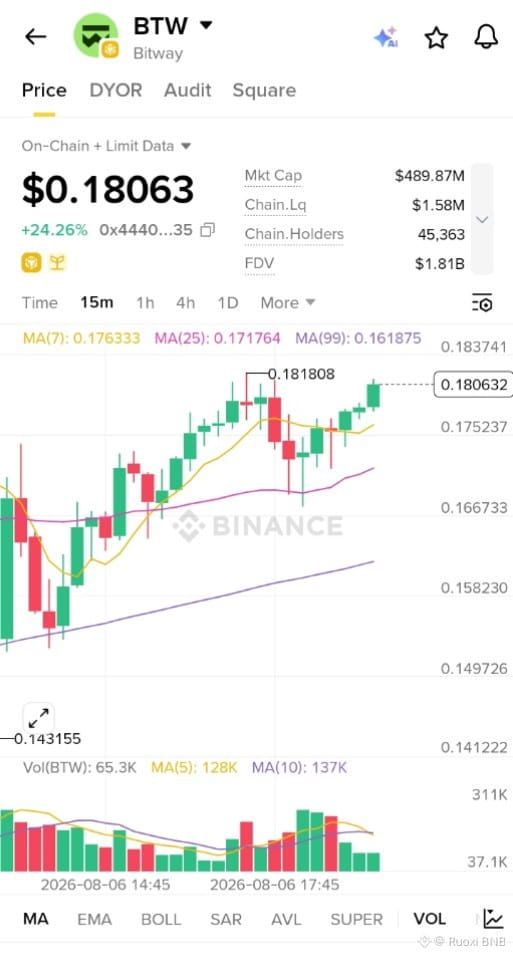
1
307
Connectez-vous pour découvrir plus de contenu
Rejoignez la communauté mondiale des adeptes de cryptomonnaies sur Binance Square
⚡️ Suviez les dernières informations importantes sur les cryptomonnaies.
💬 Jugé digne de confiance par la plus grande plateforme d’échange de cryptomonnaies au monde.
👍 Découvrez les connaissances que partagent les créateurs vérifiés.
Adresse e-mail/Nº de téléphone
Sujets d’actualité
FedRateWatch
604,186 vues
2,816 mentions
Partagez et gagnez une récompense de trafic dans notre campagne de hashtag tendance
✨Sujet : FOMC de septembre — Quelle sera la prochaine décision de la Fed ?
👉Comment participer :
Publiez une courte publication ou un article avec le hashtag #FedRateWatch
Créez du contenu à partir des angles ci-dessous :
- L’inflation cœur de l’IPC d’août a augmenté de 0,3% d’un mois sur l’autre, et les chances d’une hausse de 25 points de base cette semaine sont désormais proches de 90%. Anticipez-vous une hausse des taux cette semaine ? Est-ce un cas isolé, ou le début d’un cycle de hausses plus long ?
- Si la hausse a lieu, comment cela se répercute-t-il sur le BTC, les valeurs technologiques et l’or ? Plutôt haussier ou baissier ?
- Comment comptez-vous trader ensuite ? Partagez votre trading/positions BTC, actions ou or avec notre widget de partage de trades.
⏰Période de la campagne :
- 2026-09-15 11:00 - 2026-09-17 3:00 UTC
🎁Récompense :
- Les publications éligibles qui respectent les consignes ci-dessus et contiennent plus de 100 mots seront examinées et pourraient recevoir un boost aléatoire de trafic de 500 à 3 000 vues. Vous recevrez une notification de votre secrétaire de flux si votre publication est sélectionnée.
- Ayez une chance de faire apparaître votre article sur Binance Square Official
Vous manque-t-il des idées pour votre publication ? Visitez la page du sujet #FedRateWatch ou le Square Guide on How to Post for Better Reach.
Binance Square Official
·396 mentions J’aime
·882.4k vues
BitcoinSlidesTo$76000
23,964 vues
121 mentions
BitcoinReboundsTo$79K
62,804 vues
403 mentions